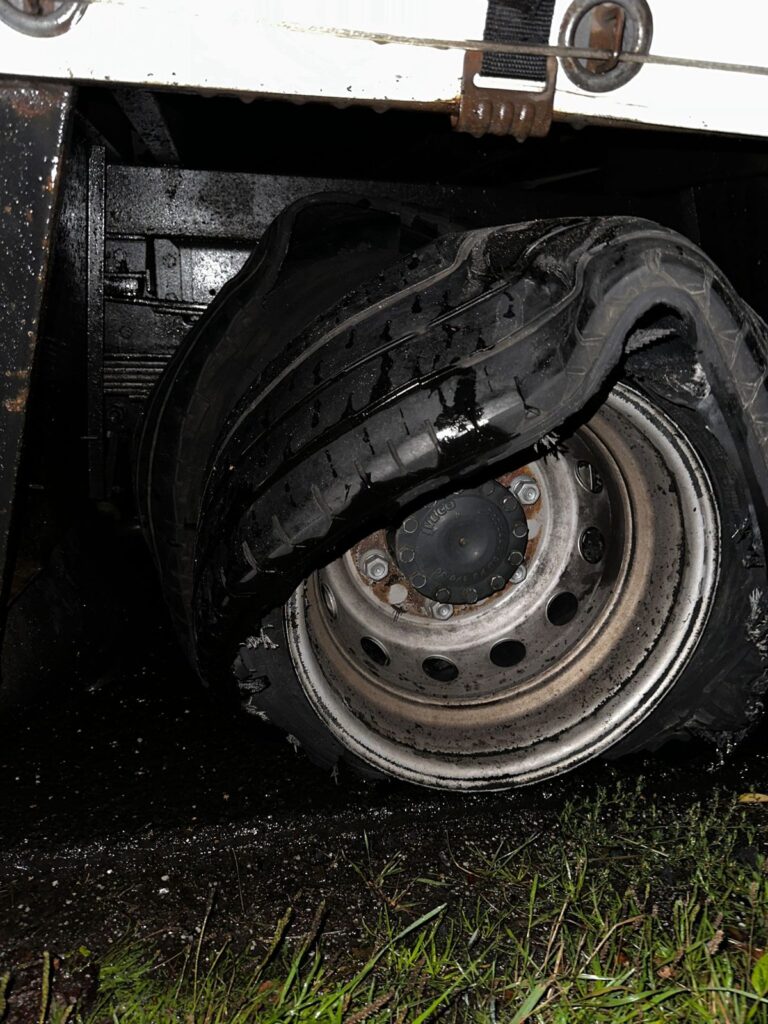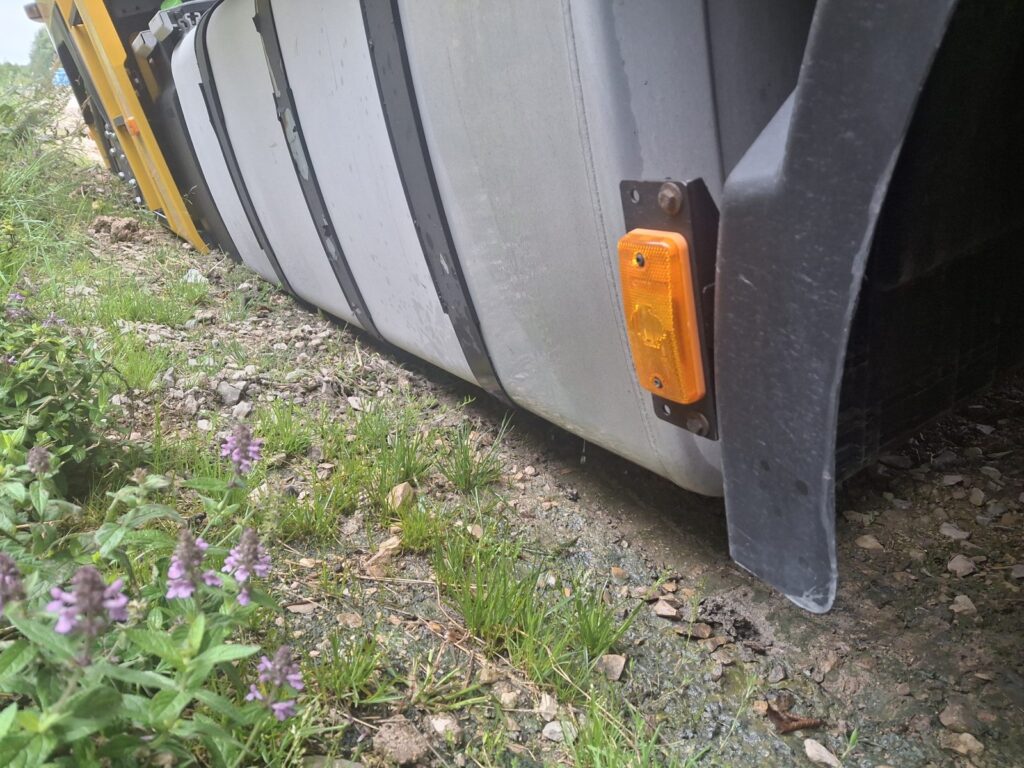
In short: a curtain-sider trailer lost air in a 445/45 R19.5 tyre on the A7 near Fulda, heading towards Kassel. The driver pulled onto the soft verge beside a rest area exit, and the unit tilted towards the embankment. Our dispatch desk took the call at 08:10, the crew arrived at 09:05, and the trailer was rolling again at 10:15. Total time from call to departure: 125 minutes. Total bill: 960 EUR net, with no secondary damage to the rim or the neighbouring tyre.
A flat trailer tyre looks like a small problem until you stand next to it. At 130 PSI of working pressure and with a loaded axle above it, a 19.5-inch tyre that has collapsed onto its rim can cook the sidewall, bend the rim flange and, in the worst case, take the neighbouring tyre with it. Add soft ground under a leaning rig and the job stops being a routine wheel change. It becomes a small recovery operation in miniature.
This report walks through the call hour by hour, shows what the crew actually did on the verge, and lists every line of the invoice. If you run a fleet, drive yourself or dispatch from an office in Poland, Lithuania or the Netherlands, you will find the numbers you need to judge what a proper truck tyre service on a German motorway should cost and how long it should take.
The emergency: a flat trailer tyre on the A7 near Fulda
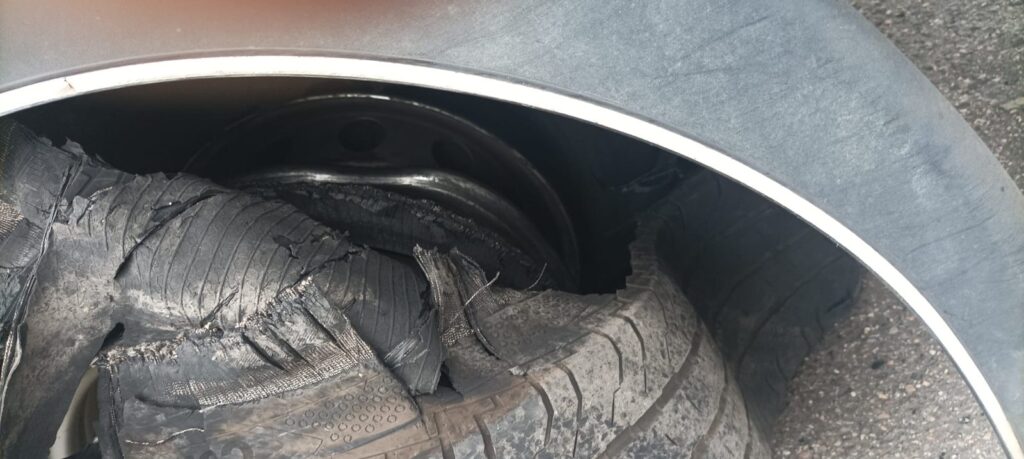
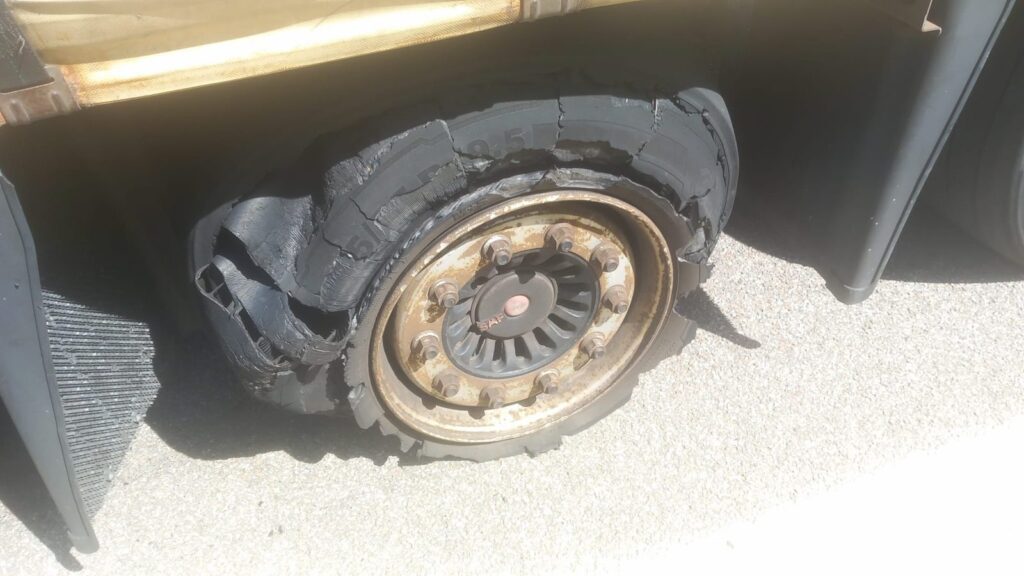
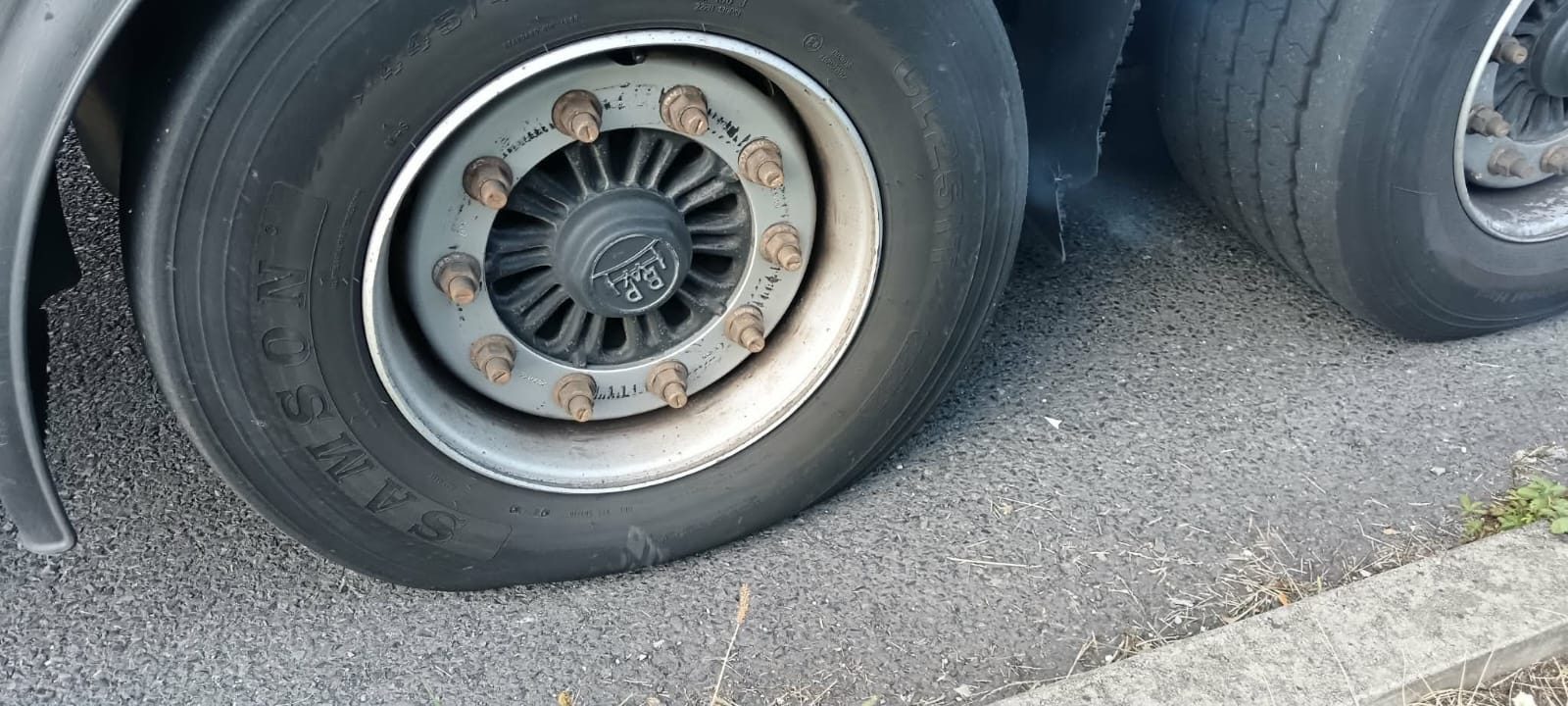
A trailer tyre of size 445/45 R19.5 went flat on a dry, hazy Monday morning on the A7, just before the rest area exit near Fulda in the direction of Kassel. The driver noticed the pressure loss, slowed down and steered onto the verge beside the exit lane. It was a sensible decision, because driving on a collapsed tyre destroys the rim within a few kilometres.
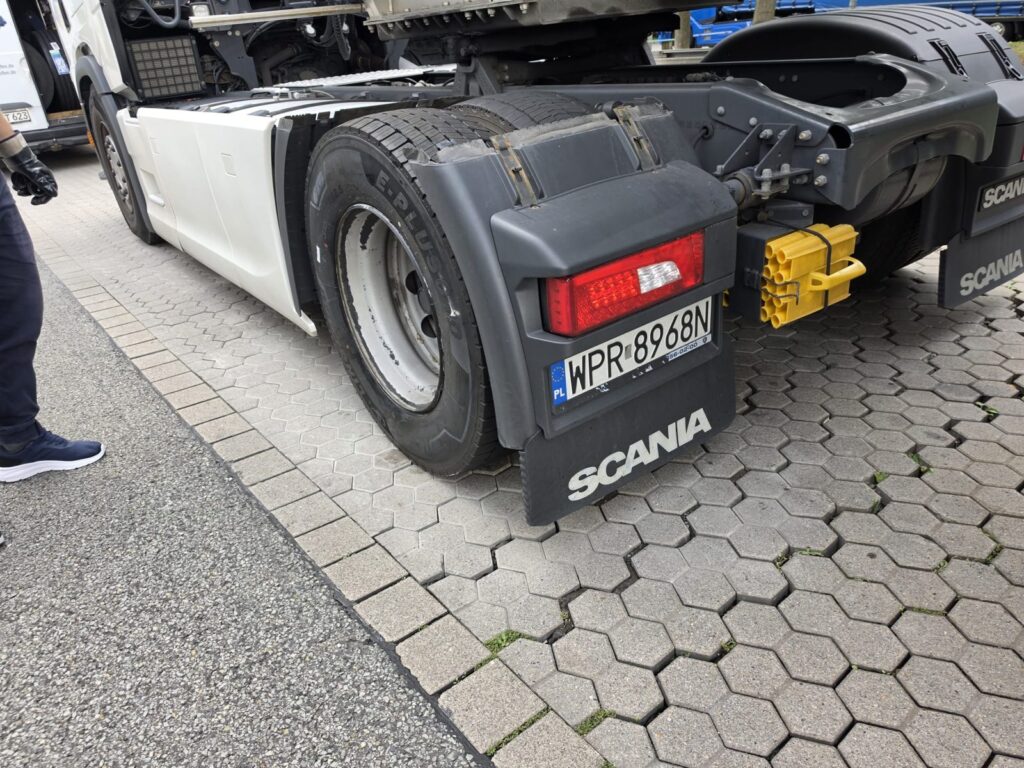
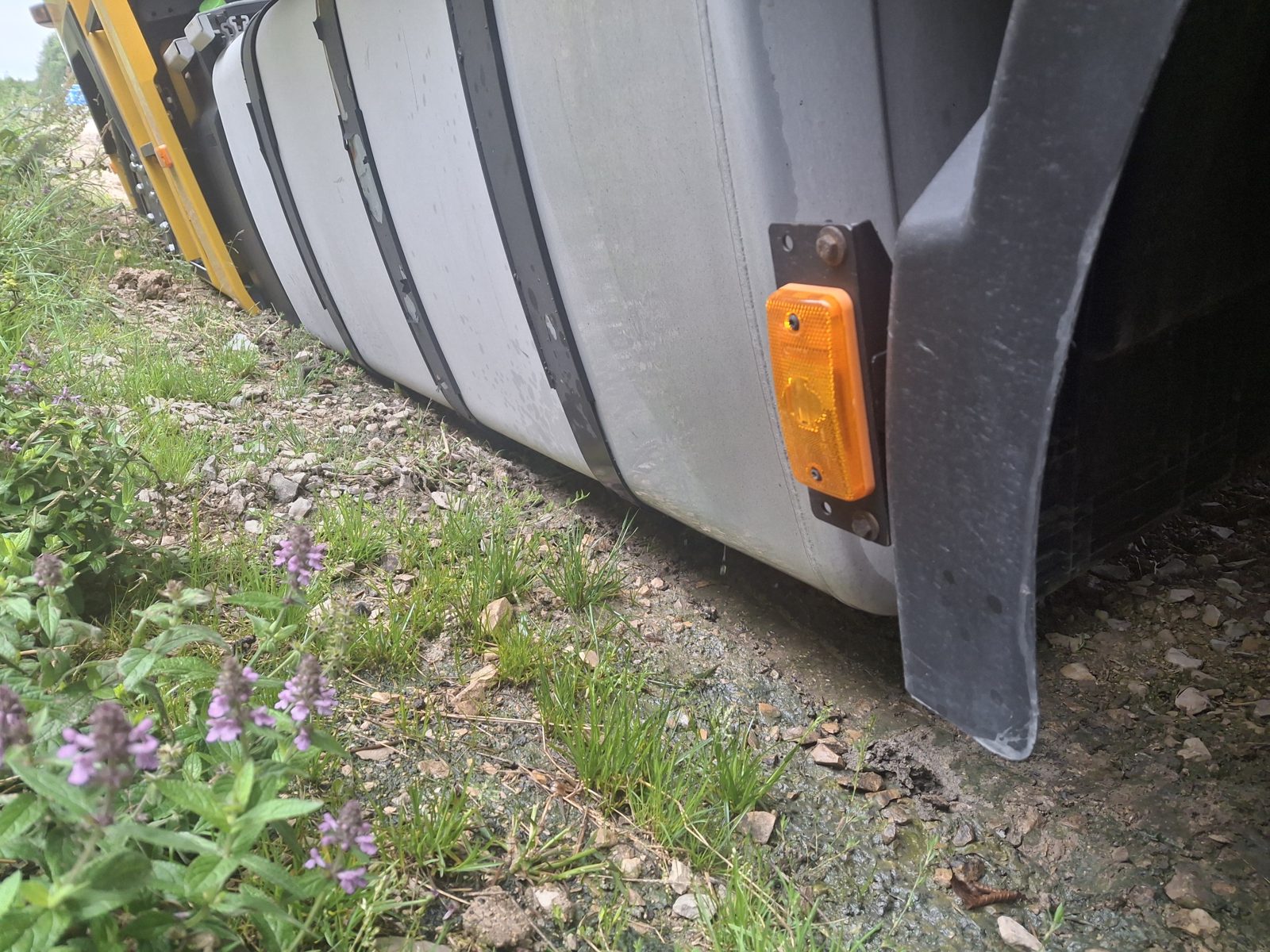
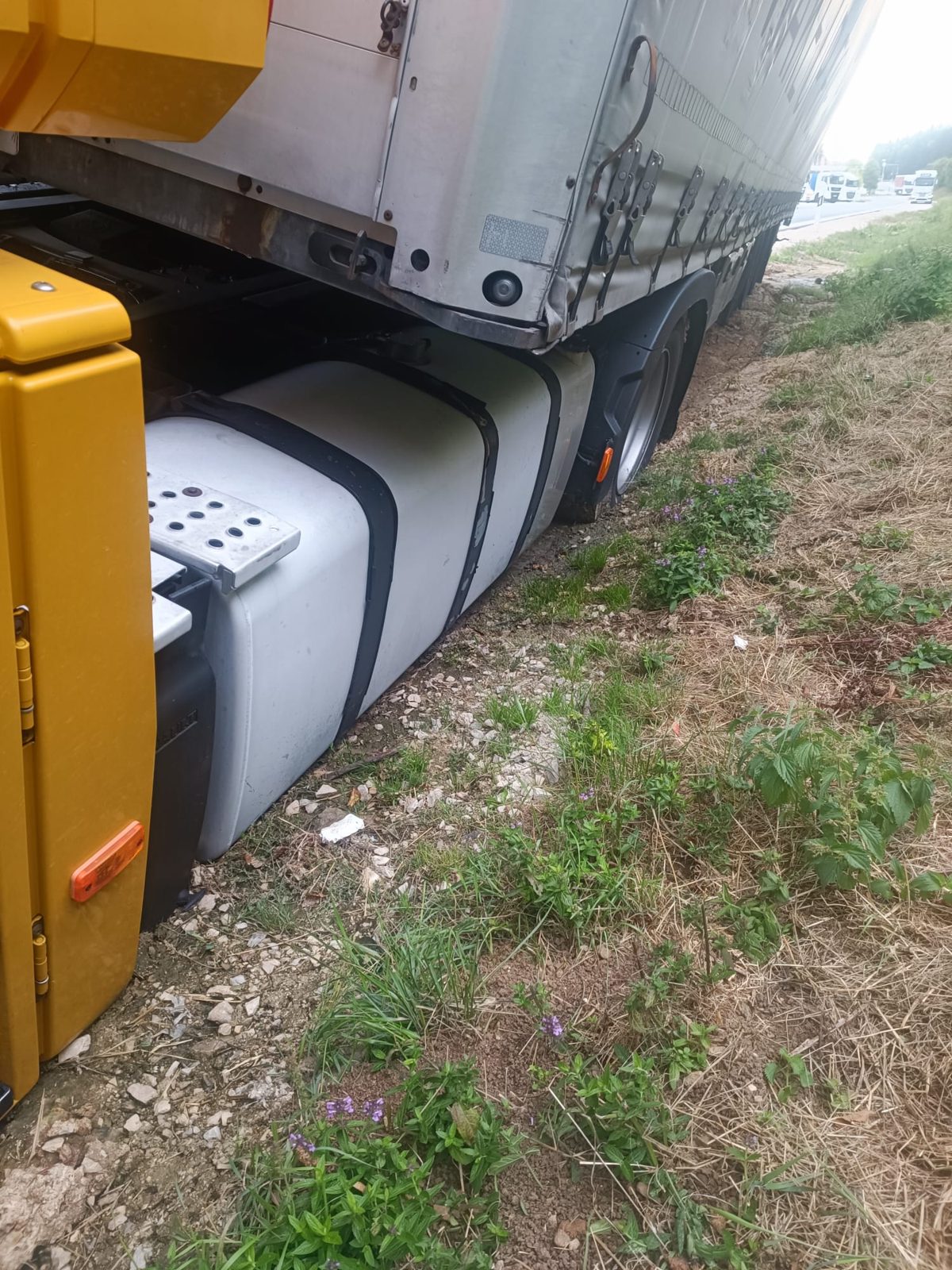
The problem was the ground. The verge at this spot is not a paved hard shoulder but a strip of gravel and grass, and after a damp night it was soft. Under the weight of the loaded rig, the tractor unit and the trailer axle sank slowly into the soil. By the time the driver phoned us, the whole combination leaned visibly towards the embankment. The fuel tank and the orange side marker lamp sat much closer to the ground than they should.
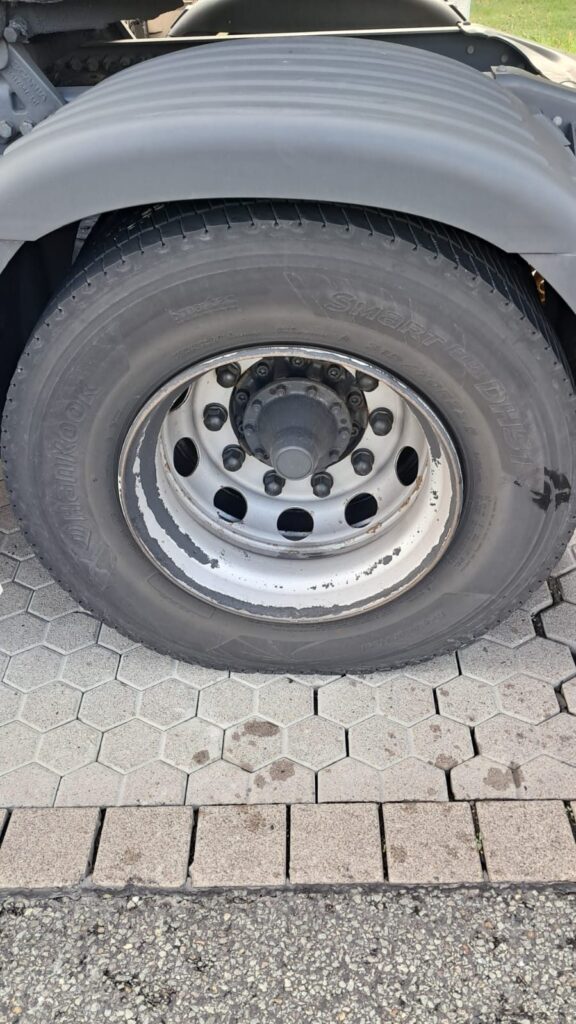
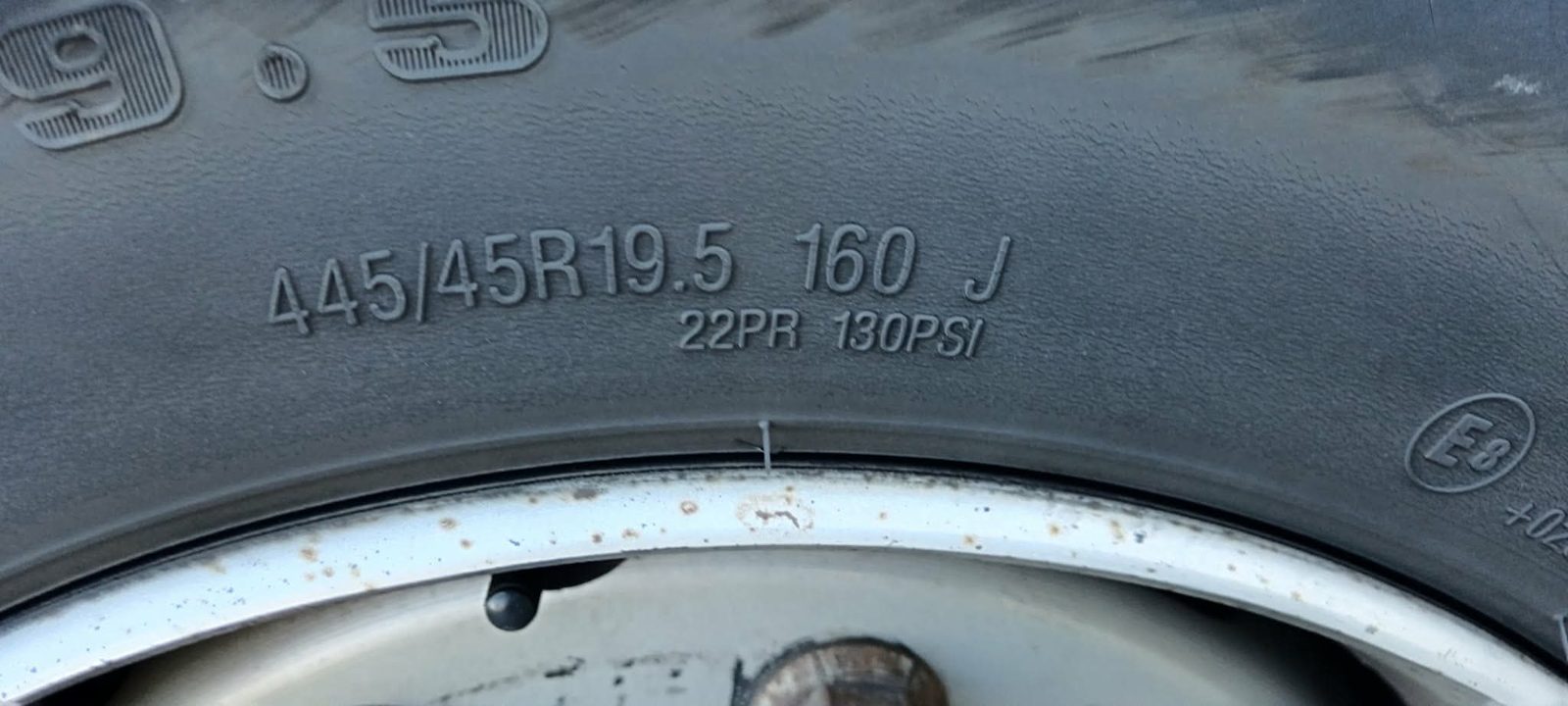
The tyre itself was a Megatrailer size. Its sidewall read 445/45 R19.5 160 J, 22PR, 130 PSI, which means a load index of 160 (a high load capacity for a single wheel), a speed symbol J (100 km/h) and a maximum cold pressure of 130 PSI, roughly 9 bar. The tyre lay completely flat on the rim. Beside it, on the same bogie, the second tyre was still holding air but carried more load than usual, so it needed checking too.
Three details defined the job:
- Size: 445/45 R19.5 is a low-profile trailer tyre used on mega-trailers and curtain-siders. It is not stocked by every roadside dealer.
- Position: the wheel was on a trailer axle, not a drive axle, so no tractor unit parts were involved.
- Ground: soft verge, leaning rig, and a lorry park with moving traffic only a few metres away.
How we organised the help: dispatch, partner crew, tyre
Our dispatch desk answers every call around the clock, and the first minutes decide how long the driver waits. In this case the call came in at 08:10. The driver described a flat tyre, the lean of the rig, and the nearest landmark. The dispatcher took the GPS position, confirmed that the driver was safe behind the barrier and that the warning triangle was set up, and wrote down the tyre size from the sidewall.
Between 08:10 and 08:25 the desk did the following:
- Located the nearest mobile tyre crew in our partner network that carries heavy-duty equipment.
- Checked that a new trailer tyre in 445/45 R19.5 was available on the van or could be collected on the way.
- Agreed the price in principle with the driver’s dispatcher, so that nobody had to argue at the roadside.
- Told the crew about the soft ground so that they loaded support plates, planks and wheel chocks.
- Sent the driver an honest arrival estimate: 40 minutes of driving, so arrival shortly after 09:00.
The crew left at 08:25 and drove for 40 minutes. In the meantime the dispatcher stayed in touch with the driver, reminded him to stay behind the guard rail and to keep the hazard lights on. That is the unglamorous part of truck tyre breakdown service: most of the work happens before the van arrives.
Our mobile truck service covers the whole country, but the same logic applies everywhere: the nearest equipped crew, not the nearest random garage. If you want to know more about how callouts are structured, the tyre service page explains the process in short form.
What is the safest way to work on a leaning rig?
The safest way is to stop the lean first, then lift. Nobody places a jack under an axle that stands on soft soil, because the jack will sink faster than it lifts, and the load can shift sideways. This is the reason the case needed extra preparation, and the reason the labour line on the invoice includes work on the ground.
A truck tyre that has run flat also carries hidden risks. The sidewall may be cut or overheated from the inside, the bead can be damaged, and the rim flange may be bent. A trailer tyre on a loaded axle can be under several tonnes of load, so a mistake with the jack or the chocks is not an inconvenience. It is a hazard for the crew and for passing traffic.
German rules are clear on the basics. The tread depth and general tyre condition requirements are set out in section 36 of the StVZO, and any tyre that is cut, deformed or run flat for a distance has to be treated as unfit for further use. In practice, the crew will almost never repair a heavy-duty trailer tyre that has run on its rim. It gets replaced.
Step-by-step: how the truck tyre replacement was done
The crew arrived at 09:05, which was 55 minutes after the call. Here is the full procedure, in the order it happened.
Step 1: Inspection (09:05-09:15)
The technician walked around the rig first. He looked at the ground, the angle of the lean, the flat tyre, the neighbouring tyre on the same axle, the second axle of the bogie and the rim. He measured the pressure of the other tyres and photographed the damage. This takes only ten minutes, but it prevents mistakes: if the ground had been softer than it looked, the plan would have changed.
Step 2: Securing the site (09:15-09:35)
Warning triangle, hazard lights and high-visibility clothing came first. Then came the part that cost extra time: laying heavy support plates and wooden planks under the jack point and under the axle, so that the load would spread over a larger area of the soft soil. Wheel chocks went under the tractor wheels and the remaining trailer wheels. Only after that did anyone put a jack under the trailer.
This phase is what separates a professional mobile truck tyre service from a quick fix. Twenty minutes of preparation is not wasted time, because it is the cheapest insurance against a rig slipping off a jack.
Step 3: Removing the wheel (09:35-10:05)
The crew lifted the axle, undid the ten wheel nuts on the flat wheel and took it off the hub. The hub cap, which carries the axle maker’s logo, was checked for leaks and play. Then the old tyre was taken off the rim, and the technician inspected the bead seat, the rim flange and the valve hole. The rim was straight and undamaged, which was good news: a bent rim would have added a replacement part and at least 30 minutes.
Step 4: Fitting the new tyre (10:05-10:15)
A new trailer tyre in 445/45 R19.5 went onto the cleaned rim. The tyre was inflated to the specified pressure, and the wheel was refitted to the hub. The nuts were tightened in a star pattern in several rounds, then with a torque wrench to the value specified by the axle manufacturer. For a ten-stud wheel on a trailer axle this is typically in the region of 600-650 Nm, but always check the figure for the axle in question. Wheel nut torque is not a place for guessing; our guide on wheel nut torque for trucks has the details.
Step 5: Final check
After 10 minutes of fitting time the crew checked the pressure of the new tyre and of its neighbour, removed the planks and plates, and took down the warning triangle. The driver signed the job sheet. The rig left the verge at 10:15.
One practical tip from the crew: after the first 50 to 100 kilometres, a driver should re-check the wheel nut torque, because the nuts can settle slightly. It is a habit worth building into every long run.
Full timeline: from call to departure
The table below shows the real times of the callout. The total from call to departure was 125 minutes (2 hours 5 minutes), and the crew arrived 55 minutes after the call.
| Time | Phase | Action |
|---|---|---|
| 08:10 | Call | Driver reports flat tyre and a leaning tractor unit; dispatcher takes data and GPS position |
| 08:10-08:25 | Dispatch | Nearest mobile crew in the partner network selected; tyre 445/45 R19.5 confirmed |
| 08:25-09:05 | Drive | Crew on the road, 40 minutes |
| 09:05-09:15 | Inspection | Ground, rim, second tyre and pressure checked; photos taken |
| 09:15-09:35 | Securing the site | Warning triangle, support plates and planks under the jack, wheel chocks |
| 09:35-10:05 | Wheel removal | Axle lifted, wheel removed, tyre taken off the rim, bead and rim inspected |
| 10:05-10:15 | Fitting and check | New tyre, inflation, wheel refitted, nuts tightened in a star pattern, pressure checked; ready 10:15 |
Total: 08:10 to 10:15 = 125 minutes. On a dry morning with light traffic that is a realistic figure for a motorway callout. In heavy rain, at night or on a Friday afternoon with congestion on the A7, expect a longer arrival time.
What does a truck tyre callout cost on the autobahn?
For this job the final invoice came to 960 EUR net (zzgl. MwSt.). Here is the full breakdown.
| Item | Price (EUR) |
|---|---|
| Callout / Anfahrt | 240.00 |
| Labour, 2 h at 120 EUR/h (including ground preparation on soft verge) | 240.00 |
| Tyre 445/45 R19.5 (new, trailer type) | 460.00 |
| Disposal of the old tyre | 20.00 |
| TOTAL | 960.00 |
All amounts are net, before VAT. There are no hidden extras for night work or weekend rates, because the call came on a weekday morning.
Why the price looks the way it does
Four things drive the cost of any truck tyre replacement at the roadside:
- Distance: the callout fee covers the crew’s drive and the van. A callout from 40 minutes away costs more than one from 10 minutes away.
- Tyre size and brand: 445/45 R19.5 is a specialist trailer size, so the price sits in the upper part of the range for trailer tyres.
- Ground and traffic: soft verge, a steep slope or a narrow shoulder adds labour. In this case the support plates and planks took about 20 minutes.
- Time of day: night, weekend and public holiday callouts carry a surcharge of 25 to 50 percent.
What a day of standstill costs
Compare 960 EUR with the alternative. A rig that stands for a day because nobody could fit the tyre costs a haulier roughly 800 to 1,200 EUR in lost revenue, driver wages, missed slots and possible penalties on the consignment. A job done in two hours on the spot costs about the same as one day of standstill, but it saves the delivery. If the load is time-sensitive, such as fresh goods or just-in-time parts, the saving is much larger.
That is why many Spedition owners now pay for a 24-hour truck tyre roadside assistance contact as a fixed part of their fleet planning. For a closer look at typical figures, the ranges quoted above reflect what we see across Germany.
Why you should not change a trailer tyre yourself
A driver can change a car wheel on a hard shoulder, but a loaded 19.5-inch trailer wheel is a different task. Doing it alone carries real risks:
- Weight: a mounted 445/45 R19.5 wheel weighs well over 60 kg, and the lifting equipment in a cab is not made for a loaded axle.
- Soft ground: a standard jack sinks into a verge like this one, and the rig can move.
- Pressure: a tyre of 130 PSI stores serious energy. A damaged bead or a faulty rim can fail violently during inflation.
- Torque: ten nuts tightened by feel can end up uneven, which risks a wheel coming loose at motorway speed.
- Traffic: working next to the lane on a bend with trucks passing at 80 km/h is dangerous without proper lighting and signs.
- Time limits: the driver has driving-hour limits (Lenkzeit) and may not have the hours to wait or improvise.
German motorway rules also matter here. According to the operator of the German motorway network, Autobahn GmbH, the hard shoulder and verges are some of the most dangerous work locations on the network. A trained crew with a van, lights and the right tools reduces the risk considerably.
What we also do: typical callouts across Germany
The Fulda job is one of many. Our network handles the following situations every week:
- Flat or blown trailer tyres on motorways and at lorry parks, from Hamburg to Munich.
- Drive-axle blowouts on tractor units, often with damaged wheel arches or air lines.
- Tyre damage from stones or screws, where the question is whether a repair or a replacement is the right call.
- Lost wheels or loose wheel nuts after a recent wheel change by a third party.
- Rim damage and bent flanges after a kerb contact or a run on a flat tyre.
- Valve failures and slow leaks, typically found during morning checks.
- Seasonal wheel changes for whole fleets, on the customer’s yard.
- Tyre checks before long-haul runs, with pressure, tread depth and sidewall inspection.
When a tyre problem comes with other damage, for example a ripped-off mudguard or a damaged brake line, we can also arrange recovery. Our towing service works alongside the tyre crews for exactly these cases.
Prevention: how to avoid a flat on the A7
Most trailer tyre failures give warning signs. A short routine saves a lot of money and time.
- Check pressure weekly, cold, with a calibrated gauge. A tyre that is 15 percent below its target pressure runs hotter and wears faster, and it is the most common root cause of blowouts.
- Walk around the rig every morning. Look for bulges, cuts, embedded stones and screws, uneven wear and missing valve caps.
- Measure tread depth. The legal minimum is 1.6 mm, but most fleets replace trailer tyres earlier.
- Match twin tyres. Dual wheels with different diameters or pressures overload one tyre.
- Use the load index and speed symbol correctly. The 160 J marking on this tyre is a fixed limit, not a suggestion.
- Park on hard ground. Wherever possible, use a proper bay and avoid soft verges, especially after rain.
- Re-torque wheel nuts after any wheel change, usually after 50 to 100 km.
- Keep a basic kit. Warning triangle, high-visibility vest, wheel chocks and a torch are required or sensible. Support boards for soft ground cost little and could have saved time in this case.
Fleet managers should also keep a record of tyre age, retreading history and previous repairs. A tyre with a visible production date older than six years deserves a closer look, even when the tread looks good.
Tyres, sizes and fleet care: the wider picture
Trailer tyres in 19.5 and 22.5 inch sizes are the backbone of European road freight. The 445/45 R19.5 size is typical on low-loader and mega-trailer axles where loading height matters. Other common sizes include 385/65 R22.5 for standard trailers and 315/80 R22.5 for steer and drive axles. For size standards and load tables, the European Tyre and Rim Technical Organisation (ETRTO) publishes the reference data used by manufacturers across Europe.
Major manufacturers, including Michelin, Continental, Goodyear and Bridgestone, supply heavy-duty tyres designed for different jobs: regional distribution, long-haul or mixed on-road and off-road use. Continental and its competitors publish tyre pressure and load guidance for each range, and it is worth reading before you choose a tyre for a specific axle.
Fleet operators often ask whether to buy premium tyres or cheaper brands. The honest answer depends on kilometres, load and the cost of downtime. A cheaper tyre that fails on a motorway can cost much more than the saving at purchase, but a premium tyre on a short-haul trailer that sits idle half of the week may never repay the difference. What matters is a consistent policy: the same brand and size on each axle, regular inspection and a plan for retreading.
Retreaded casings can cut tyre costs per kilometre, as long as the casing has been properly inspected. After a run-flat event, however, the casing is usually finished. Internal heat damage cannot be seen from outside, which is why we recommend replacement rather than repair after a tyre has run on its rim.
For general technical inspections and roadworthiness standards, the testing organisation DEKRA publishes useful guidance for fleet operators. We would add one habit of our own: photograph the tyres at each service, so you have evidence of wear patterns if you need to claim under warranty.
Why drivers and fleets choose lkwhelp24
Several things matter when you are stuck on a verge and the clock is running:
- 24/7 availability: the dispatch desk answers day and night, on weekends and on public holidays.
- A checked partner network: crews are equipped for heavy-duty tyres up to 22.5 inches, with the right jacks, torque wrenches and compressors.
- Transparent pricing: callout, labour, tyre and disposal appear as separate lines on the quote, before work starts. All prices are net.
- Multilingual dispatch: we speak German, English, Polish and Russian, which removes the guesswork when a Lithuanian or Polish driver needs to describe an unfamiliar road.
- Nationwide coverage: from the Danish border to the Alps, from Aachen to Görlitz.
- Documentation: photos, a job sheet and a correct invoice for your accounts department.
If you have never needed us, it is worth saving the number in your phone and in your fleet manual. Our contact page lists everything in one place.
Frequently asked questions
How long does a truck tyre change take on the motorway?
A typical callout takes between 1 hour 30 minutes and 3 hours from the call to departure. In this case it took 125 minutes: 15 minutes for dispatch, 40 minutes of driving, and 65 minutes of work on site. Rain, night and heavy traffic extend the time.
What does a truck tyre service callout cost in Germany?
A typical heavy-duty tyre job on a motorway costs between 750 and 1,400 EUR net, depending on tyre size and distance. In this case, the total was 960 EUR net, including callout, labour, a new 445/45 R19.5 tyre and disposal of the old one.
Can a flat truck tyre be repaired instead of replaced?
Sometimes, if the damage is a small puncture in the tread and the tyre has not run on the rim. A tyre that has been driven flat should be replaced, because heat damages the casing from the inside. The crew inspects the tyre and makes the call on site.
Who pays for the callout?
The vehicle operator or the haulier usually pays, sometimes through a fleet contract, a fuel card service or an insurer. We issue a proper invoice with VAT shown separately, so you can pass it on. We always agree the price before work begins.
What should I do first when a trailer tyre goes flat?
Move carefully to the safest place available, switch on the hazard lights, put on a high-visibility vest, set up the warning triangle and stand behind the guard rail. Then call us with your location, tyre size and a description of the ground. Do not start jacking up the rig alone.
Do you work on trailers as well as tractor units?
Yes. We handle trailer axles, steer axles and drive axles, in sizes such as 445/45 R19.5, 385/65 R22.5, 315/80 R22.5 and 245/70 R19.5. Details of the tyre being fitted are confirmed during the call, so the correct size is on the van when the crew arrives.
Summary
| Parameter | Value |
|---|---|
| Tyre | 445/45 R19.5 160 J, 22PR, 130 PSI (trailer) |
| Location | A7 near Fulda, rest area exit, direction Kassel |
| Condition | Tyre fully flat on the rim, rig leaning on soft verge |
| Reaction time | 55 minutes from call to arrival |
| Total time | 125 minutes (2 h 05 min), 08:10 to 10:15 |
| Cost | 960 EUR net (zzgl. MwSt.) |
| Secondary damage | None: rim straight, neighbouring tyre sound |
The lesson from this callout is simple: a flat tyre on soft ground needs preparation first and rubber second. A crew with plates, planks and a proper torque wrench turned a leaning, risky situation into a clean two-hour job.
Need a truck tyre service right now?
Call the dispatch desk at +49 160 5753826, day or night. Give us your position, the tyre size and what you see, and we will send the nearest equipped crew. More information is at www.lkwhelp24.com. Open around the clock, all over Germany.
Keywords: truck tyre service | mobile truck tyre service | truck tyre replacement | truck tyre change | truck tyre callout | truck tyre roadside assistance | truck tyre repair | trailer tyre service | trailer tyre replacement | trailer flat tyre | truck tyre burst | truck tyre blowout | truck tyre breakdown service | truck tyre emergency | truck tyre germany | truck wheel change | truck tyre fitting | 445/45 R19.5
Related articles
- Tire Blowout on the Autobahn: The Immediate Action Checklist for Truck Drivers
- Emergency Tire Service for Trucks: Fast Help Around the Clock
- Tyre Blowout on a Mega-Trailer on the A8 near Rosenheim: Why the Hard Shoulder Is the Most Dangerous Place to Work
- Trailer Tyre Damage from Gravel at a Rest Area on the A31 near Gronau
- Truck Tyre Service Repairs a Tipper Truck’s Screw Puncture Near Regensburg in 100 Minutes