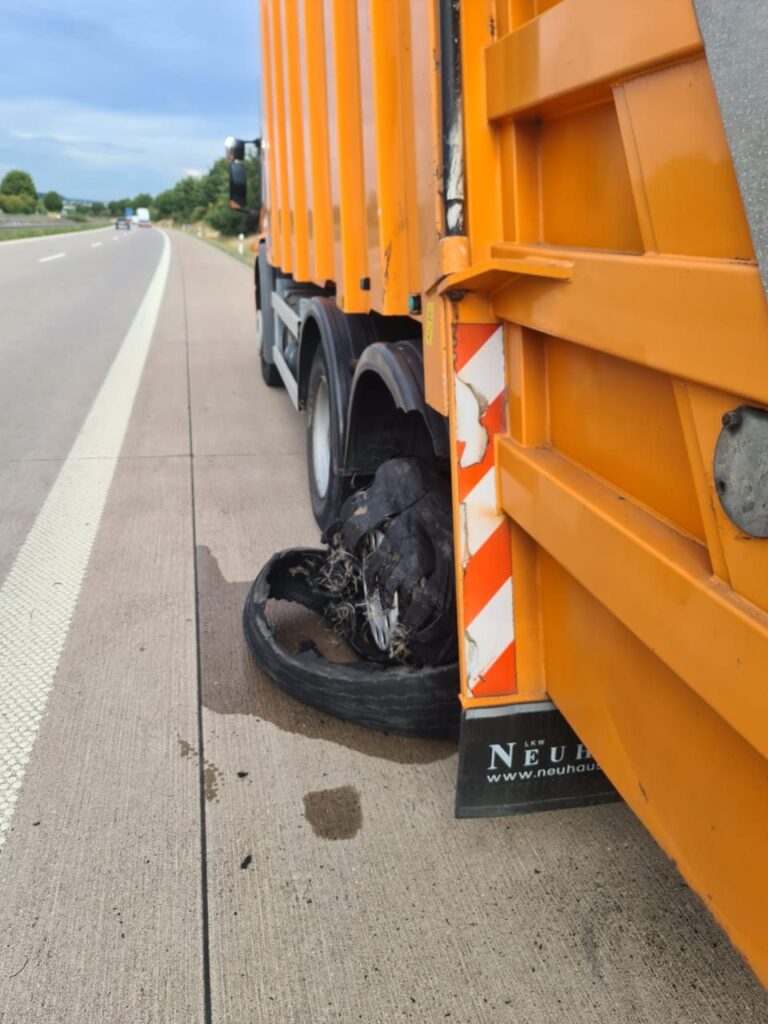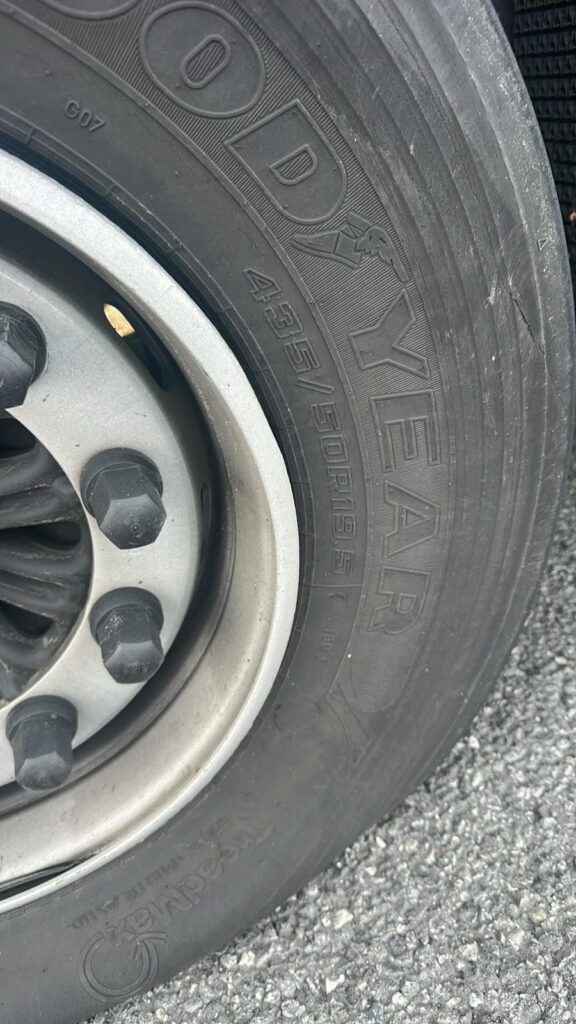
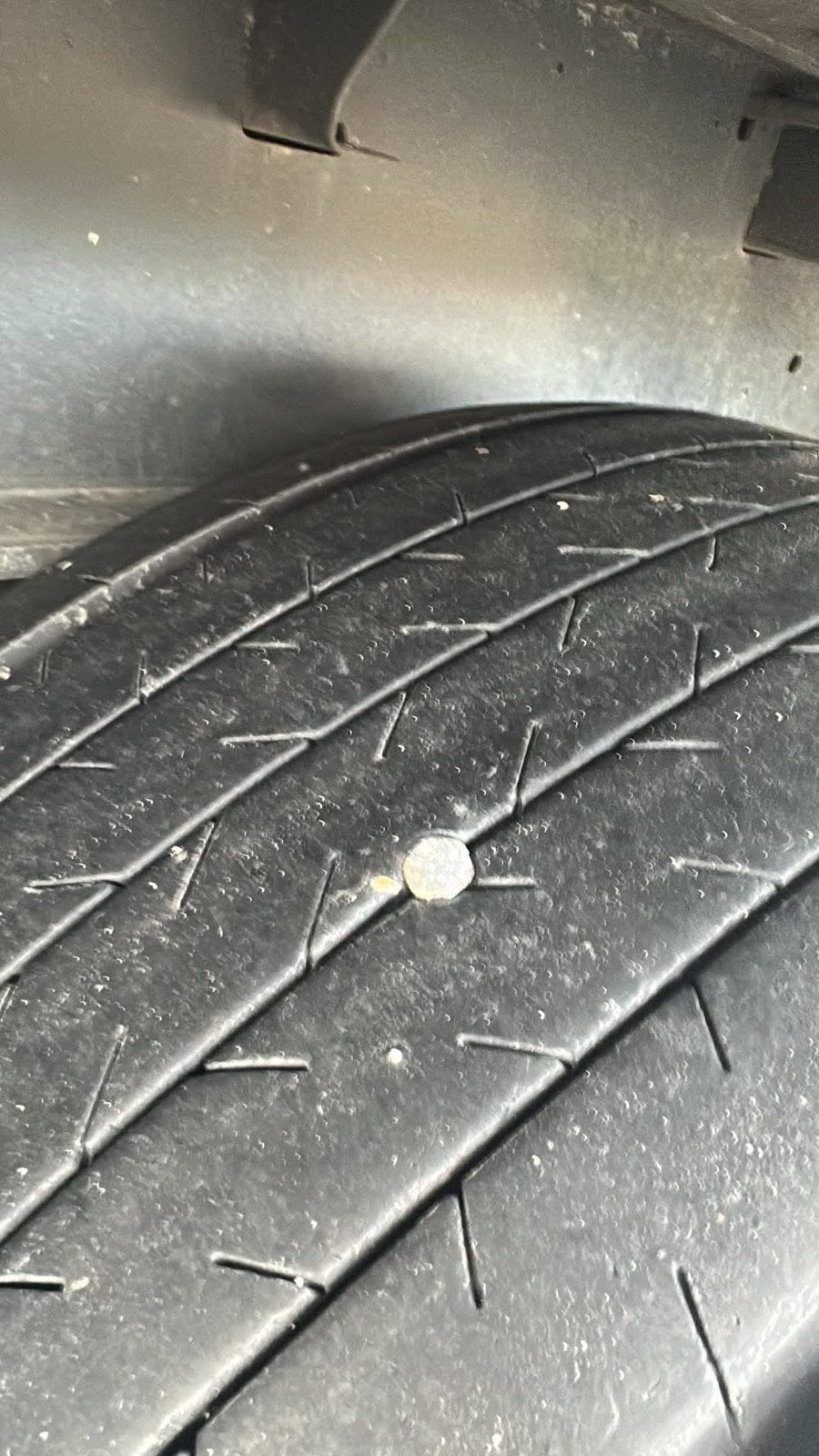
In short: on a Friday morning a driver noticed a slow pressure loss on a motorway car park beside the A7 near Bad Hersfeld. A nail sat in the tread of a Goodyear 435/50 R19.5 trailer tyre, and the sidewall had already creased from the miles driven flat. Our mobile truck tyre service replaced the tyre on the spot. From the first call at 08:42 to a trailer ready for the road at 10:27 took 105 minutes. The invoice came to 875 EUR net.
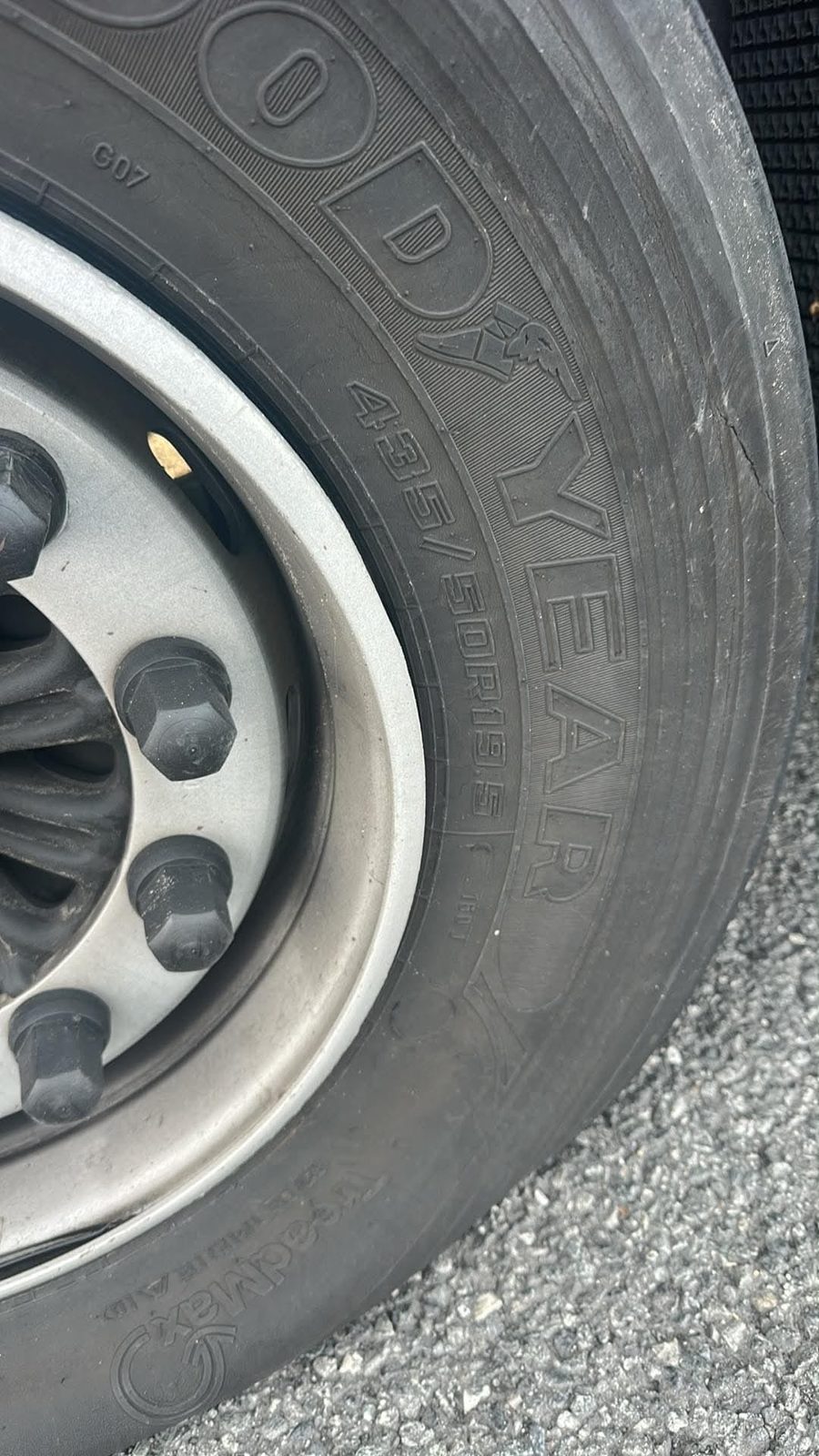
If you run lorries in Germany, you will meet this situation sooner or later. A nail, a screw or a stone picks up a trailer tyre, the air leaks out quietly, and the driver finds out only when the trailer starts to feel odd. What happens in the next ten minutes decides whether you pay for one tyre or for a tyre, a rim and a day of lost time. This article walks through the whole job, hour by hour and euro by euro, so you can judge what a proper truck tyre service looks like in practice.
The emergency: a flat trailer tyre beside the A7
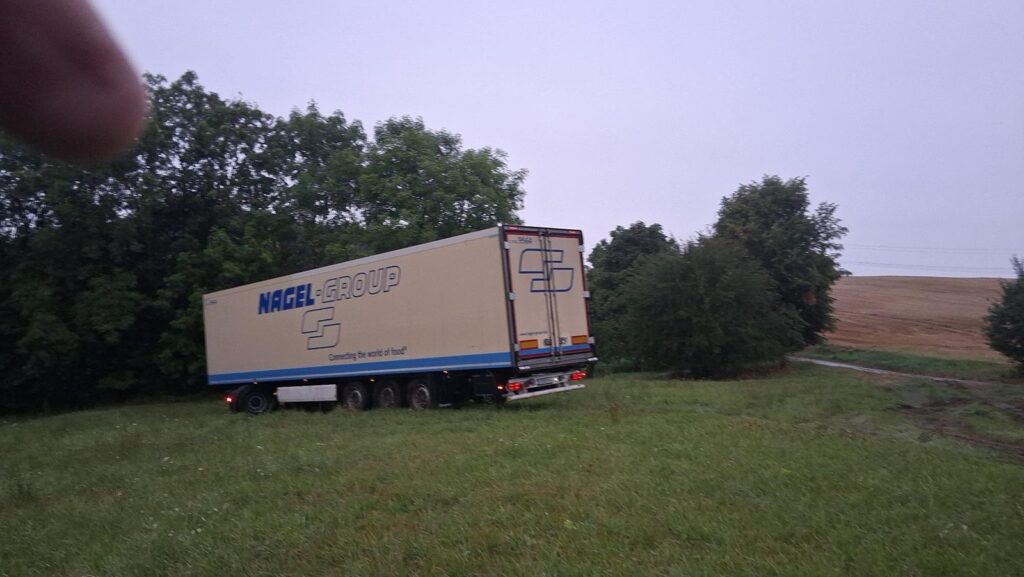
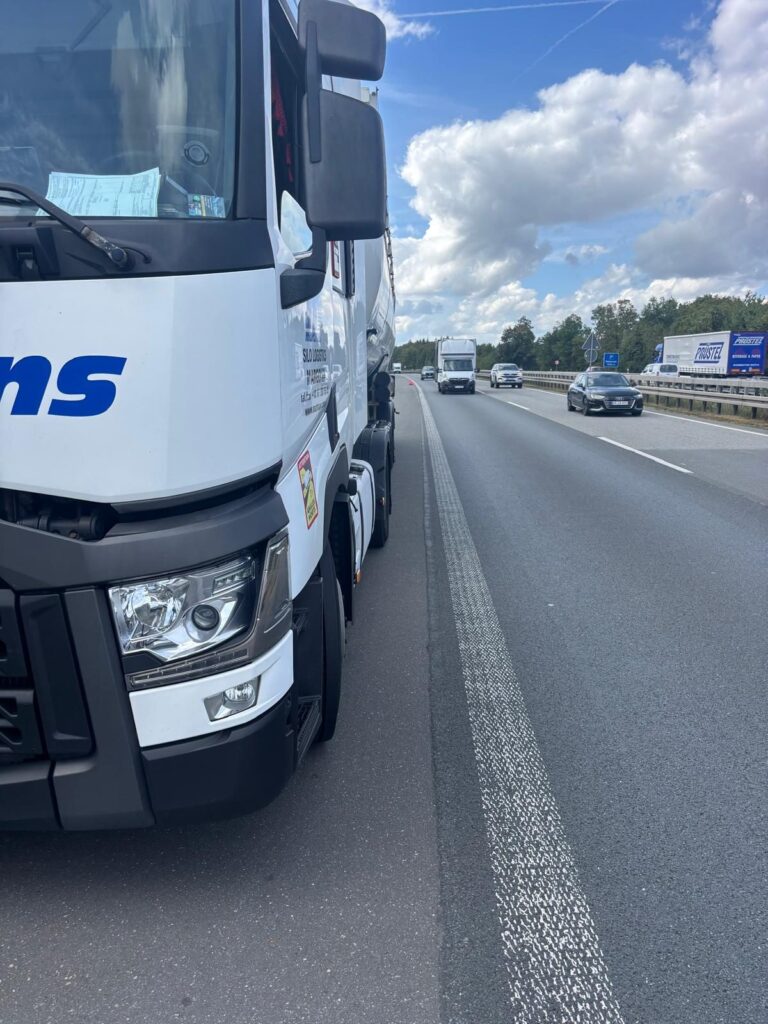
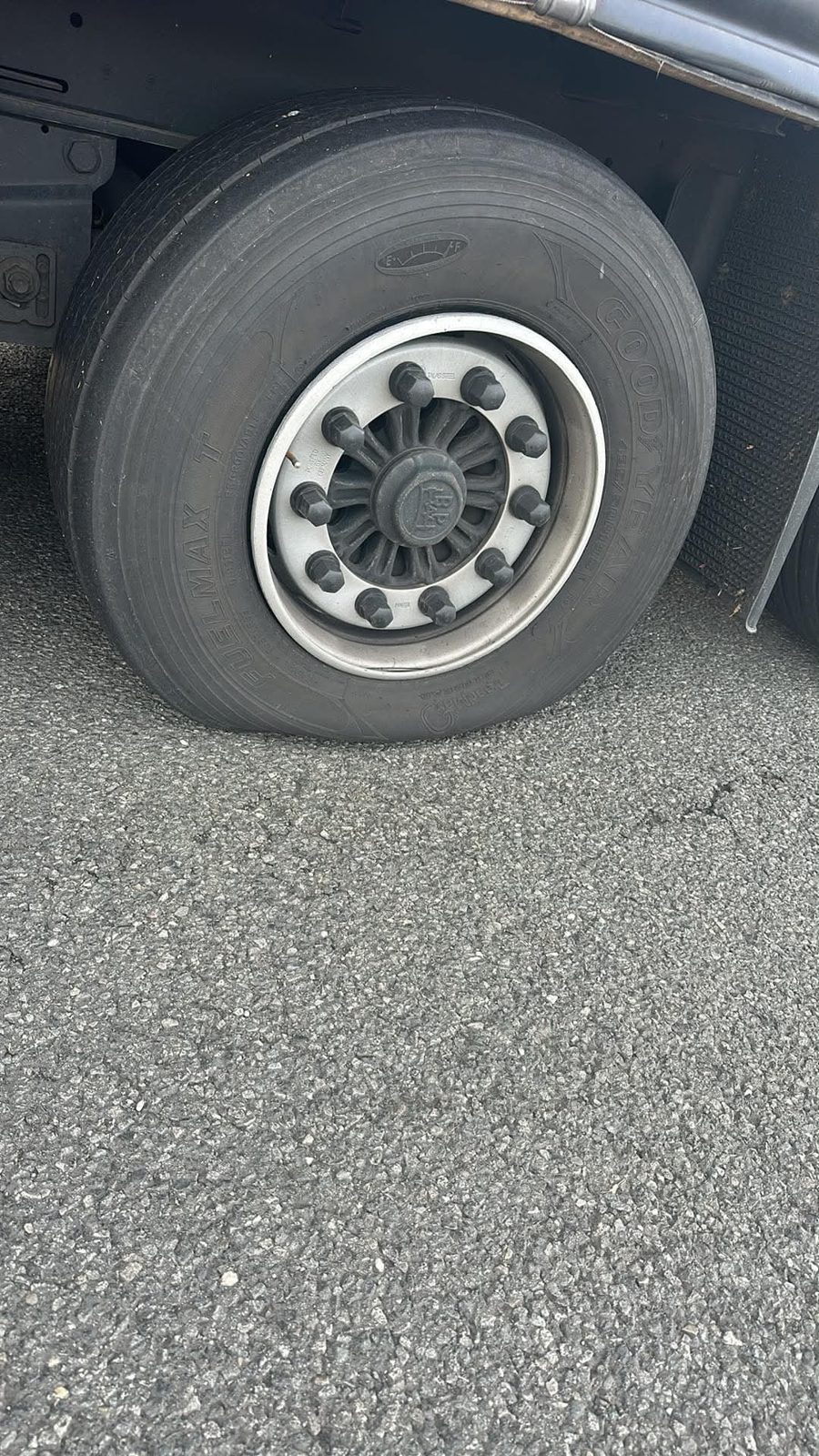
The trailer in this case was a semi-trailer from a European haulier, running on a 435/50 R19.5 Goodyear FUELMAX T, a low-profile tyre made for trailer axles. The driver had pulled onto a motorway car park near Bad Hersfeld for a short break. When he walked round the unit before setting off again, he saw that one tyre on the trailer axle sat noticeably lower than its neighbour.
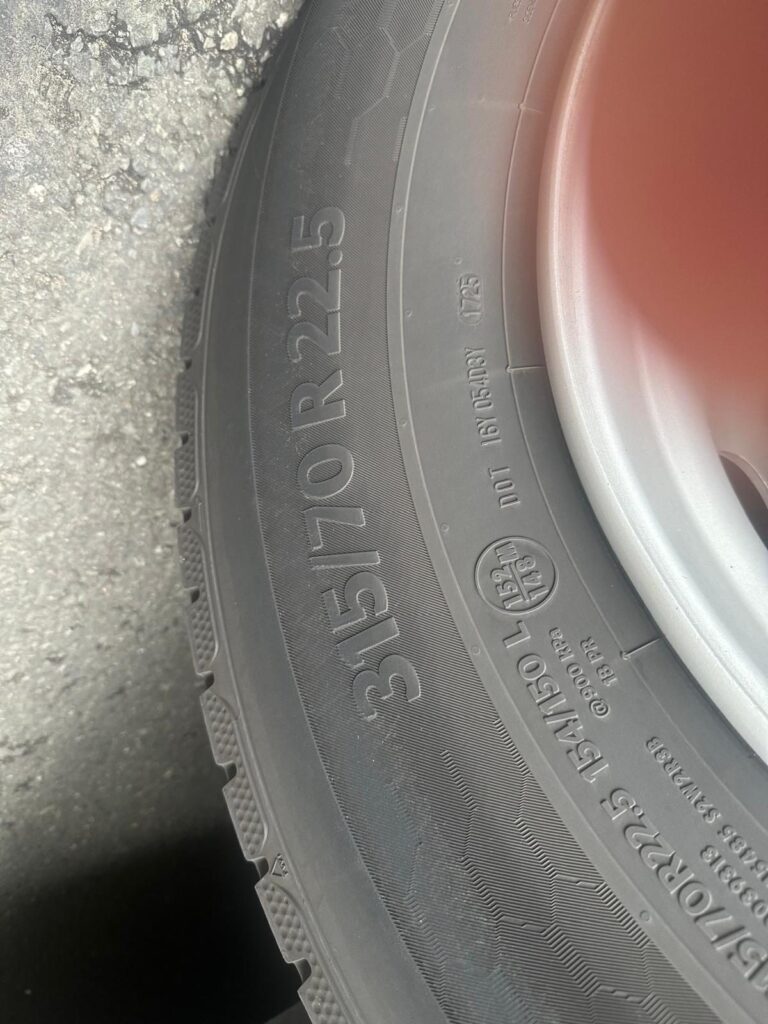
He did the right thing. He did not drive on, he put out the warning triangle and called our dispatch line on +49 160 5753826 at 08:42. He gave the tyre size, which he could read straight off the sidewall, and his position. That one detail saved several minutes: a dispatcher who knows the exact dimension can match the right replacement before the crew even leaves the depot.
The morning was dry and bright, the tarmac clean. It was a good day for roadside work, which is worth saying because in rain or snow the same job takes longer.
How the help was organised
The truck tyre service started on the phone, not at the wheel. Our dispatch desk works around the clock and speaks several languages, so the driver did not have to explain a technical problem in a language he does not use daily. The 13 minutes between the call and the dispatch of a crew went on the questions that matter:
- Which axle is affected, and is it a single tyre or a twin pair?
- Is the rim still round, or has the tyre been running flat for a while?
- Is there a spare wheel on the trailer, and is it the same size?
- Is the vehicle parked safely, away from live traffic?
- Does the load or the delivery slot allow a wait of an hour or more?
From the answers, the dispatcher picked the nearest mobile crew in our partner network, one that could bring a 435/50 R19.5 trailer tyre on board rather than only a repair kit. That is the difference between a generic call-out and a real mobile truck service: the van arrives with the part, not with a promise.
By 08:55 the crew was on the road. The driver was told the arrival window and asked to stay with the vehicle.
On site: why a flat trailer tyre cannot be ignored
A trailer tyre that has lost its air is not a minor inconvenience. A loaded semi-trailer weighs many tonnes, and when one tyre goes soft, the neighbouring tyres on the axle carry its share. Heat builds up in the sidewall of a flat tyre very quickly, because the rubber flexes far more than it was designed to. That flexing is exactly what produced the crease we found on the shoulder of this tyre.
Normal inflation pressure for a truck or trailer tyre of this class sits in the region of 8 to 9 bar, depending on load and the figures printed in the tyre data. At that pressure a tyre behaves like a rigid, springy structure. At zero pressure it collapses onto the rim, and the bead can slip off its seat. Continued driving can also bruise the rim flange, which turns a tyre job into a wheel job.
Karkasse (casing) – the internal layer of steel cords and rubber that carries the load; once it has been creased by running flat, it cannot be repaired safely.
The driver in this case had noticed early, so the damage stopped at the tyre. A few kilometres more and we would probably have been talking about a bent rim, a damaged hub seal or even a brake issue from the heat.
Step by step: how the tyre was replaced
The crew arrived at 09:35, after 40 minutes on the road. The work followed a fixed order, the same one we use on every roadside truck tyre replacement.
Step 1: inspection (10 minutes)
The technician checked the tyre before touching a tool. He found a metal nail sitting between two tread grooves, the clear cause of the leak. He also found a crease along the shoulder of the sidewall, a typical sign of a tyre that has run on low pressure.
That second finding decided the job. A nail hole in the tread can sometimes be repaired with a plug or a patch, but only if the casing is undamaged. A creased sidewall rules out any repair. The tyre had to go, and the crew had brought the right replacement.
Step 2: securing the work area
The vehicle stood on level ground, handbrake on, the trailer supply to the tractor unit sorted so the trailer could not roll. Wheel chocks went under the opposite wheels. The driver had already placed the warning triangle, and the crew added their own beacon.
Step 3: removing the wheel
The technician lifted the axle with a hydraulic jack rated for trailer loads. He loosened and removed the ten wheel nuts in a crossing pattern, then pulled the wheel off the hub. He checked the hub face and the studs for damage while the wheel was off. Nothing was bent, nothing was rusted through, and the rim showed no deformation.
Step 4: dismounting and fitting the new tyre
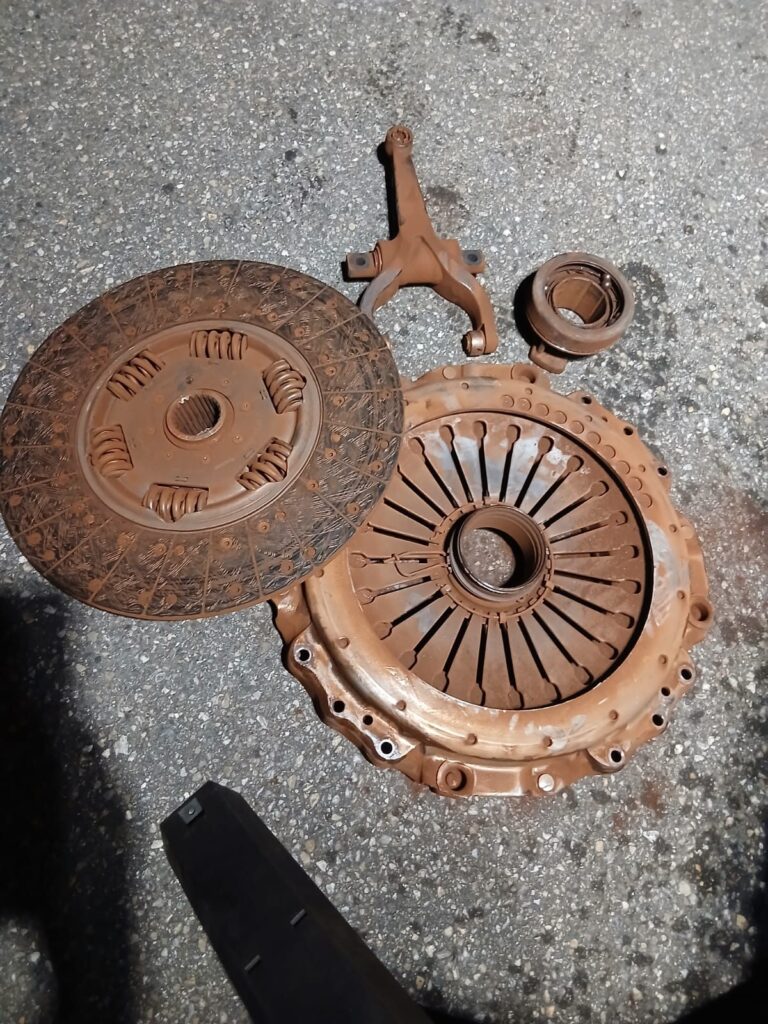
The old tyre came off the rim and the rim was cleaned and inspected, including the bead seat and the valve. The new Goodyear 435/50 R19.5 went on with fresh bead lubricant. Balancing was not needed for this trailer wheel, which is normal on non-steered trailer axles at motorway speeds. The tyre was seated and inflated to the figure given in the tyre data.
Step 5: refitting, torque and final check
The wheel went back on the hub, and the ten nuts were tightened in a star pattern with a calibrated torque wrench, to the value the axle manufacturer specifies. For heavy truck and trailer axles that value is high, often in the range of 600 to 650 Nm, which is why a hand-tightened wheel never counts. We explain the procedure in more detail in our guide to wheel nut torque for trucks.
After a short settling period the nuts were re-tightened, the pressure was read once more, and the old tyre was loaded for disposal.
Full timeline: 105 minutes from call to ready
The numbers below come straight from our job log.
| Time | Phase | Action |
|---|---|---|
| 08:42 | Call | Driver spots the pressure loss at the car park, phones +49 160 5753826, gives size 435/50R19.5 and location |
| 08:42 – 08:55 | Dispatch | Dispatcher asks about axle, rim condition and spare wheel; finds the nearest partner crew (13 min) |
| 08:55 – 09:35 | Journey | Crew drives out with a suitable tyre on board (40 min); driver sets up the warning triangle |
| 09:35 – 09:45 | Assessment | Nail in the tread, crease in the sidewall from running flat; plug repair not permitted, replacement needed (10 min) |
| 09:45 – 10:20 | Tyre change | Axle lifted with hydraulic jack, wheel removed, tyre changed, wheel refitted, nuts torqued with a calibrated wrench (35 min) |
| 10:20 – 10:27 | Handover | Pressure check, nuts re-tightened, old tyre disposed of, paperwork (7 min) |
| 10:27 | Done | Trailer ready for the next run |
The split is worth a second look: 13 minutes of dispatch, 40 minutes of driving and 52 minutes of actual work on site. The longest block is the drive, and that is the part no company can compress on a motorway, because the crew has to get through ordinary traffic like everybody else. What a good truck tyre service can control is the 13 minutes of dispatch and the quality of the preparation, so the crew leaves with the right tyre.
What did the truck tyre service cost?
The total was 875 EUR net (plus VAT). Here is the full breakdown.
| Item | Price (EUR) |
|---|---|
| Call-out and callout flat rate | 240 |
| New tyre 435/50 R19.5 (premium trailer tyre) | 480 |
| Labour, 1 h 15 min at 110 EUR per hour | 135 |
| Disposal of the old tyre | 20 |
| TOTAL | 875 |
All amounts are net, excluding German VAT (zzgl. MwSt.).
Three factors move this figure up or down on other jobs:
- Time and day. Night work and weekends add a surcharge, typically between a quarter and a half on the call-out. This job ran at normal morning rates.
- Tyre type and brand. A premium trailer tyre costs more than a budget one. Fitting the same make as the other tyres on the axle is good practice, because mixed brands wear differently.
- Distance. The longer the crew has to drive, the higher the call-out flat rate.
Compared with the alternative
A standing semi-trailer costs a haulier about 800 to 1,200 EUR per day in lost earnings, wages, and missed slots. An idle day would have eaten almost the whole repair bill. Waiting until the next morning, or trying to limp to a workshop on a damaged tyre, is nearly always the more expensive choice. If you want to compare prices for other situations, our overview of truck tyre change costs lists typical figures.
Why you should leave this to professionals
A roadside truck tyre replacement looks simple on video. In real life, it is a job where things go wrong in ways that hurt people. A driver who tries to do it alone risks the following:
- A standard car jack or a bottle jack not rated for a loaded trailer axle can slip. Axle weights run into several tonnes.
- Over-inflating or under-seating a bead can make a tyre burst. Truck tyre explosions are among the most dangerous workshop accidents.
- Wheel nuts tightened by feel will either be too loose, risking a lost wheel at 80 km/h, or too tight, stretching the studs.
- A creased sidewall that nobody spots can fail again a few hundred kilometres later.
- Working on a motorway car park or hard shoulder without a proper beacon and protective gear puts the driver in the path of passing traffic.
- Insurance and fleet policies often require the work to be done by a qualified technician with a documented job.
Beyond safety, there is a practical point. Driver hours are limited by tachograph rules. An hour spent fighting a wheel with the wrong tools is an hour that does not come back.
Typical situations where we are called out
The A7 job is one of many. Across Germany we regularly deal with the following:
- Nail, screw or stone punctures in trailer and tractor tyres, as in this case
- Tyre blowouts on drive axles at motorway speed, with debris on the carriageway
- Sidewall damage from kerbs at loading ramps and service stations
- Slow pressure loss, often from a faulty valve or a corroded rim
- Twin-tyre pairs where one tyre has failed and the other has been overloaded
- Seasonal wheel changes on a fleet, done at the yard rather than at a workshop
- Tyre checks after long standstills, before a long-haul run
If your problem is more than a tyre, for example if the unit cannot move at all, our towing service can take over, and the crew can tell you early whether a tow is needed or not.
Prevention for drivers and fleets
Most flats are not bad luck. They come from small things nobody checked. These are the habits that cost nothing and save the most:
- Walk round the vehicle before every trip. Look at each tyre, not just the front ones. A tyre that sits lower than its neighbour is a warning.
- Check pressure with a gauge, cold. Visual checks miss a loss of 1 bar. Do it weekly at least, and always before long runs.
- Look into the tread for foreign objects. Nails, screws and stones are easy to spot while the tyre is still pressurised, and a tyre that is pulled early often survives.
- Watch the tread depth. The legal minimum under § 36 StVZO is 1.6 mm for most truck tyres, but fleets that care about wet grip change earlier.
- Keep a record. A simple tyre log per axle shows patterns: one trailer that loses air every month points to a rim or valve problem, not to chance.
- Know your tyre size. Writing the dimension on the dash or on the driver’s card saves a phone call’s worth of questions. For the meaning of the markings, ETRTO publishes the standards behind tyre and rim sizes.
- Do not drive on a flat tyre to the next exit. Even a few kilometres at reduced speed can destroy a casing that could otherwise have been repaired.
- Rotate and inspect twin pairs. An uneven pair puts extra load on the larger tyre and shortens its life.
Fleet managers can add a monthly check at the yard. An inspection takes minutes per vehicle and costs far less than a single breakdown. We also run scheduled fleet checks on customer premises when requested.
More on trailer tyres and fleet tyre care
Trailer tyres have a harder life than people think. They carry heavy loads, they are rarely checked as carefully as tractor tyres, and they sit in car parks for days. Low-profile sizes such as 435/50 R19.5 are common on mega-trailers and curtain-siders, because the lower sidewall gives more cargo height. The price for that design is less tolerance for under-inflation: the sidewall is short, so the flex when pressure drops is severe, and a crease appears fast.
The main manufacturers cover this segment with dedicated trailer lines. Goodyear sells the FUELMAX T for long-distance trailers, Michelin has the X Multi Trailer range, Continental has the Hybrid and Conti Hybrid HT series, and Bridgestone offers the R-Trailer range. All of them are built for high load indices and low rolling resistance, and all need the correct pressure to deliver it. Under-inflation of just 10 percent raises fuel use slightly and shortens tread life noticeably.
Retreading is another point. The tread of a good casing can be renewed with a process such as Treadmax, which Goodyear markets, and the casing runs a second life at much lower cost. This only works if the casing is intact, which is one more reason never to run a tyre flat. A creased sidewall like the one in this case ends that option for good.
For fleets, the sensible approach is to match tyre brand and model per axle, record fitting dates, and plan replacement before the tread reaches the limit. When a tyre does fail on the road, a mobile truck tyre service saves the fleet the cost of a tow and the loss of a day. Independent bodies such as DEKRA publish regular guidance on tyre condition and vehicle safety, and their tips fit well with a fleet maintenance plan.
Other terms you will hear in this context include Lenkachse (steering axle), Antriebsachse (drive axle), Radnabe (hub), Radbolzen (wheel stud), Profiltiefe (tread depth) and Reifendruck (tyre pressure). A good partner explains them in plain words, not in jargon.
Frequently asked questions
How much does a truck tyre change on the autobahn cost?
A roadside tyre change on the autobahn for a trailer tyre typically costs between 750 and 1,400 EUR net, including the call-out, a new tyre, labour and disposal. In this case the total was 875 EUR net. Night work, weekends and long distances add surcharges.
How long does a truck tyre service take to arrive?
Arrival usually takes between 35 and 70 minutes on a motorway, after 10 to 20 minutes of dispatch. In this case the crew needed 40 minutes. Rain, snow, heavy traffic and night shifts can stretch the time.
Can a tyre with a nail in the tread be repaired?
Sometimes. If the nail only penetrated the tread and the casing is undamaged, a professional repair is possible. If the tyre ran flat and the sidewall is creased, replacement is mandatory. Our technician checks this before deciding.
Should I keep driving to the next workshop?
No. Driving on a tyre with low pressure heats the sidewall and can ruin the casing, the rim and sometimes the brakes. Stop at the next safe place, switch on the hazards, set up the warning triangle and call for help.
What do I need to tell the dispatcher?
Give your location, the tyre dimension (printed on the sidewall, here 435/50 R19.5), the axle position, and whether the vehicle is parked safely. Photos help, but are not required.
Does the service cover foreign-registered vehicles?
Yes. We assist trucks and trailers from all European countries, and our dispatch desk works in several languages. The procedure is the same everywhere in Germany.
Why hauliers choose Lkwhelp24
- 24/7 availability. Phone, day or night, weekend or public holiday, anywhere in Germany.
- A proven partner network. We send the nearest qualified crew with the right tyre on board.
- Transparent pricing. The quote reflects a clear structure: call-out, tyre, labour, disposal. No hidden extras, all amounts net.
- Multilingual dispatch. Drivers can explain the problem in the language they are most comfortable with.
- Documented work. You receive a clear job record for your fleet file or insurer.
You can see our full range on the tyre service page, and our contact page lists every way to reach us.
Summary
| Fact | Value |
|---|---|
| Vehicle | Semi-trailer of a European haulier |
| Tyre | Goodyear FUELMAX T, 435/50 R19.5 |
| Location | Motorway car park, A7 near Bad Hersfeld |
| Cause | Nail in the tread, crease in the sidewall |
| Response | 13 min dispatch, 40 min journey |
| On-site work | 52 min |
| Total time | 105 min (call 08:42, ready 10:27) |
| Cost | 875 EUR net (zzgl. MwSt.) |
| Secondary damage | None: rim, hub and studs intact |
The lesson is simple. Notice early, stop immediately, and call a crew that brings the right tyre. The driver here did all three, and that is why a nail cost 875 EUR instead of a lost day and a ruined wheel.
Need a truck tyre service right now?
Call us any time on +49 160 5753826, or visit www.lkwhelp24.com. Round the clock across Germany.
Keywords: truck tyre service | mobile truck tyre service | truck tyre replacement | truck tyre roadside assistance | trailer tyre service | truck tyre change | truck tyre repair | trailer flat tyre | truck tyre breakdown service | mobile Reifenservice | A7 Bad Hersfeld | Goodyear 435/50 R19.5