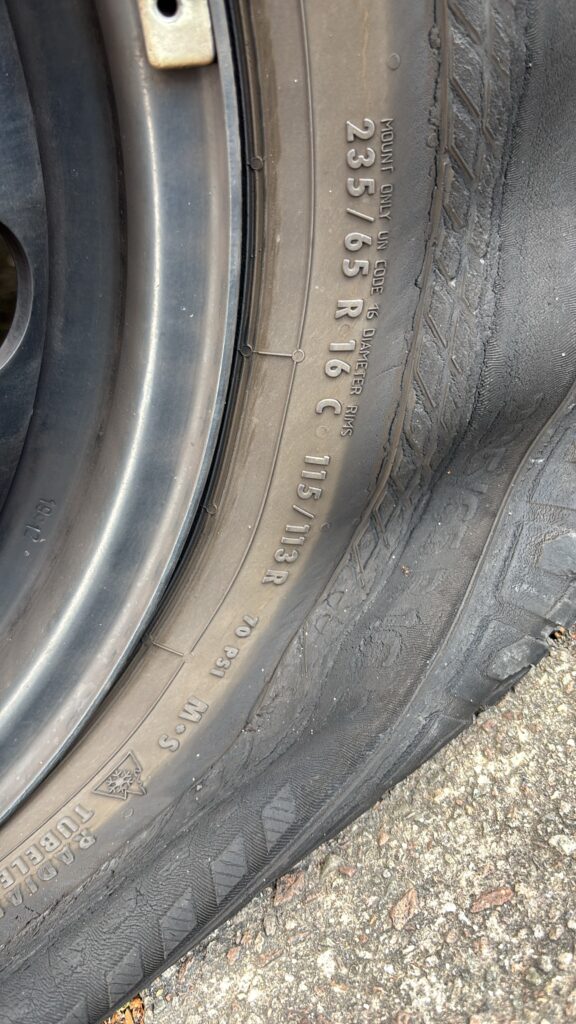
An oversize low-loader parked on the A7 with a dead tyre at 03:05 was rolling again at 05:05 after a night callout, and the whole job cost €861.50 net. A nail had gone through the tread of a 245/70 R17.5 tyre, the pressure was gone, and the crew from our partner network arrived 55 minutes after the call. This article walks through the night in detail: what the driver reported, how we dispatched, what happened at the roadside, and what the bill looked like.
We run a 24/7 truck tyre service across Germany, and a night puncture on an abnormal load is one of the less common but most expensive situations a haulier can face. The trailer cannot simply be towed away, the permit clock keeps ticking, and every hour on the hard standing costs money. If you drive or manage oversize transport, the details below are worth reading before it happens to you.
The emergency: a night puncture on an oversize low-loader
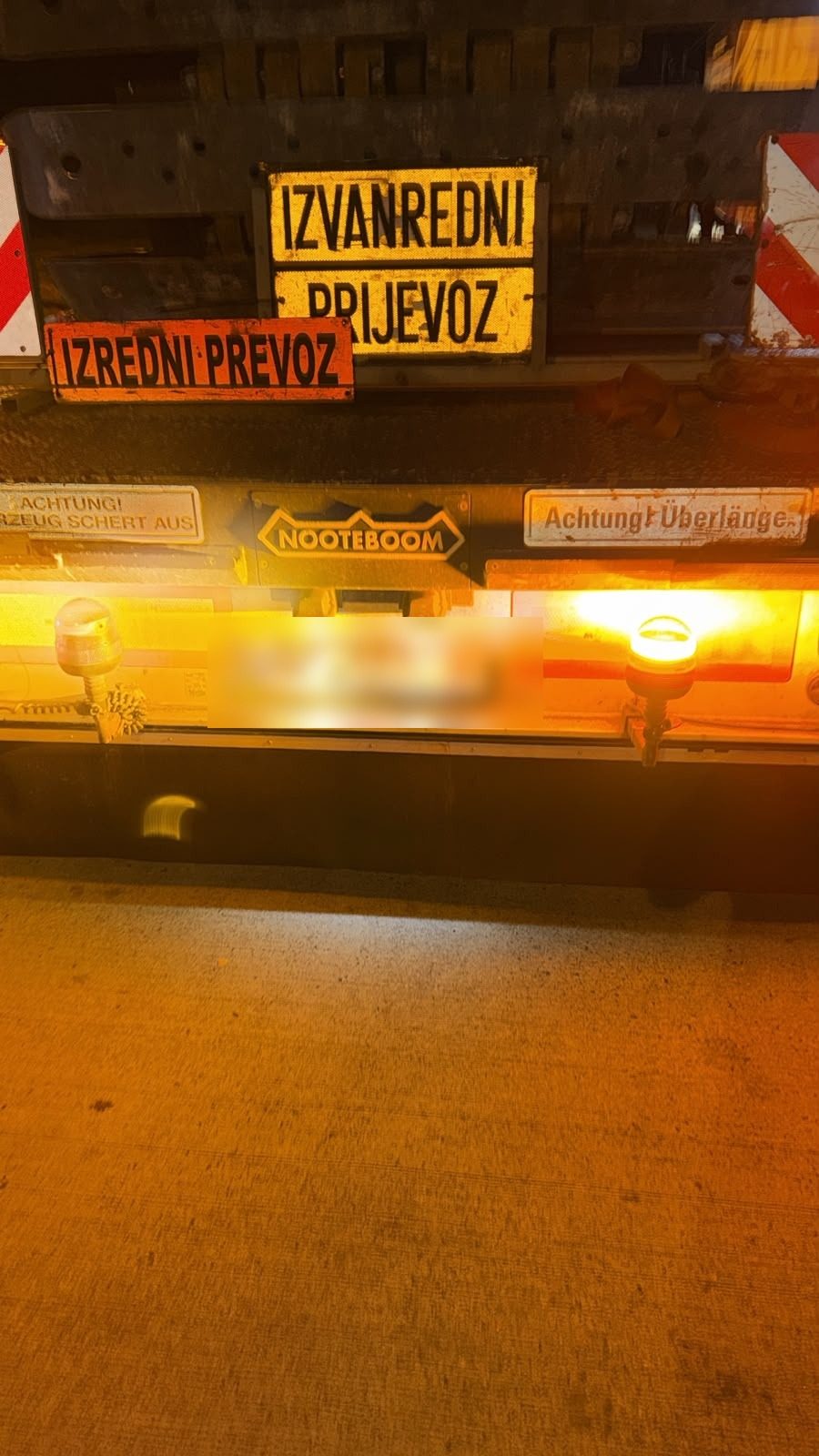
A Croatian haulier’s multi-axle low-loader, carrying an abnormal load with flashing beacons and “oversize” panels, lost tyre pressure on the A7 near Bad Hersfeld on the night of 19 August 2026. The driver noticed the problem on the Hattenbacher Dreieck stretch, heading towards Fulda and Würzburg in Hesse, and managed to bring the combination onto a wide concrete parking area before the tyre went completely flat.
That decision mattered. Hessen’s section of the A7 is busy at night with long-distance freight, and a flat tyre on a wide, slow, heavily marked trailer is a hazard for everyone behind it. Because the driver stopped early and switched on all warning lights and the oversize beacons, the situation stayed under control.
The call reached our dispatch desk at 03:05. The driver spoke calmly and gave the essentials straight away: location, trailer type, one axle with no pressure, load on board, permit still valid. In a case like this the first minute of information decides how fast the right wheel, the right crew and the right tools arrive.
What the spec looked like
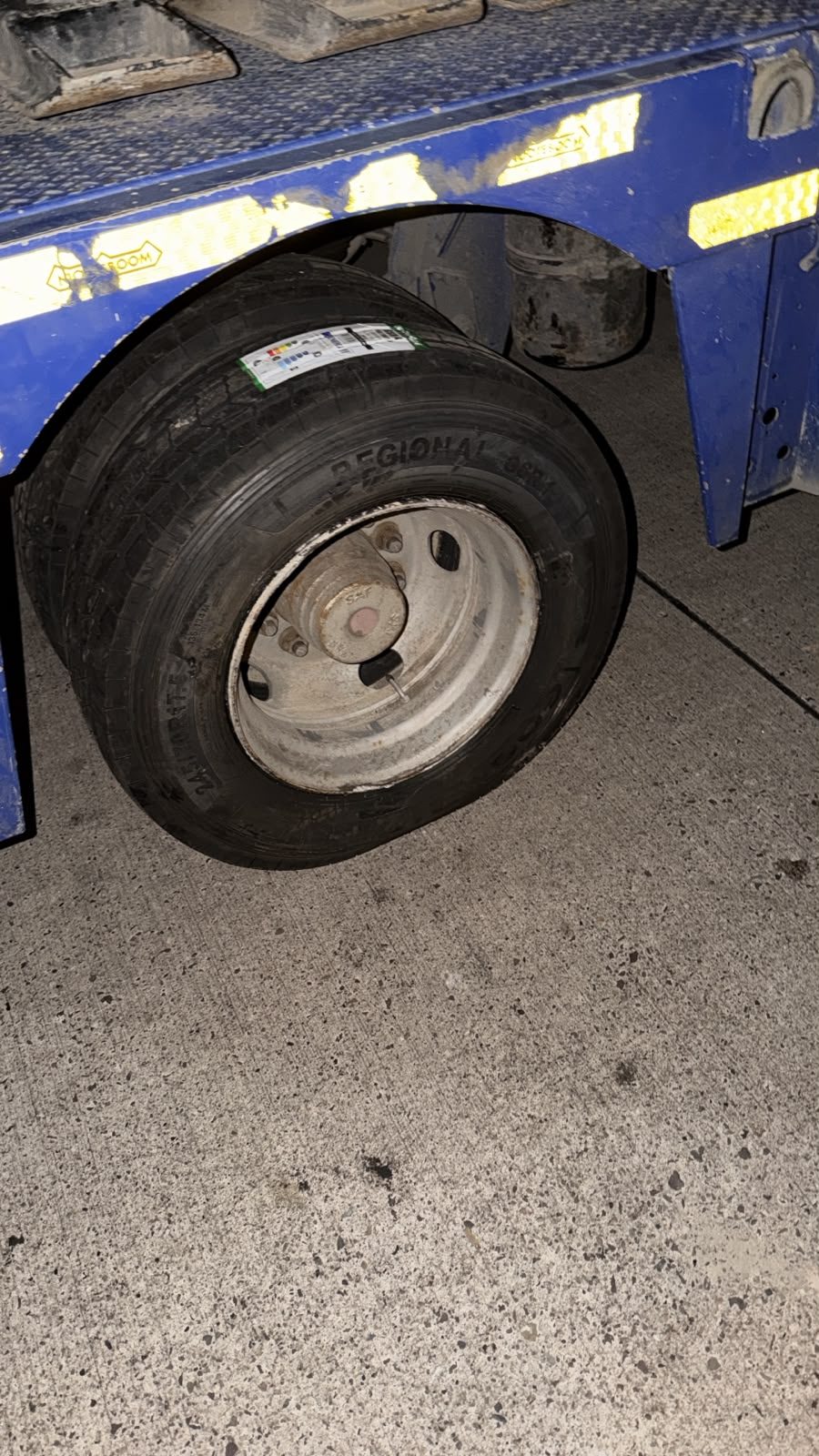
The tyre in question was a 245/70 R17.5 from a regional-pattern series, fitted as a single wheel on a low-loader axle. This size is typical for modular low-loaders and heavy-haul trailers because the small rim diameter keeps the deck low. It also means there is very little sidewall to absorb a nail, and very little margin once the pressure drops.
- Vehicle: multi-axle low-loader semi-trailer (Nooteboom type), night, dry road
- Fault: nail in the tread, tyre completely flat, vehicle had rolled some distance on the deflated tyre
- Tyre size: 245/70 R17.5, regional pattern
- Operating pressure: 8.5 to 9.0 bar after fitting
- Location: A7, Bad Hersfeld area, direction Fulda and Würzburg, concrete hard standing
How we organised help: dispatch step by step
Dispatch took 15 minutes, from 03:05 to 03:20, and ended with a mobile crew of our partner network in the region confirmed and on the road. That is the part drivers never see, so it is worth spelling out. We do not simply send “a tyre man”. We match the job to a crew that carries the right stock and has handled heavy-haul trailers before.
- Confirm the position. We asked for the motorway, direction, nearest junction and a landmark, and sent the driver a short checklist for staying safe while waiting.
- Identify the tyre and axle. Size, load index if readable, which axle, single or dual fitting, and whether the wheel was still on the rim bead.
- Check the load and the permit. An abnormal load changes everything: the trailer cannot be lifted by just any jack, and the permit conditions limit where and when the vehicle may stand or move.
- Select the crew. We called the nearest suitable team in our partner network in the region, confirmed that a new 245/70 R17.5 was on the van, and fixed the callout price with the driver by phone.
- Keep the driver informed. From 03:20 the crew was en route, and the driver had a direct number to the dispatcher throughout the 40-minute drive.
The 40-minute approach is realistic for a night callout in rural Hessen. During the day, with traffic, it can be longer. In heavy rain or fog it can also stretch, and we say so honestly when we quote an arrival time. If you want to see what this process looks like for other breakdowns, our mobile truck service page lists the typical callouts we handle.
The situation at the roadside: why a flat tyre cannot be ignored
A flat tyre on a low-loader axle is not something to “limp to the next workshop” with. Truck tyres run at 8.5 to 9.5 bar, many times the pressure in a car tyre, and the structure only works while it is inflated. Once pressure is gone, the sidewalls flex beyond what the casing is built for, heat builds up quickly, and the internal cords can be destroyed within a few hundred metres.
In this case, the driver reported that the trailer had rolled slowly on the soft tyre before stopping. That is exactly the kind of detail the crew needs, because it tells them to expect sidewall damage and to inspect the rim flange for deformation. A tyre that has been driven flat is almost never repairable, however small the original puncture.
The extra problem with oversize loads
An abnormal load makes the axle loads high and unevenly distributed. A deflated tyre pushes the neighbouring tyres on the same axle line to carry more weight, which can overload them. If a second tyre on the same side fails, you are no longer dealing with a puncture but with a structural problem and possibly a recovery job.
The permit is the other pressure point. Transport permits for abnormal loads are tied to a route and a time window, and many hauliers also run escort vehicles on tight schedules. Once the window passes, the operator may have to apply again. This is why a standstill of an oversize combination is usually costlier than a standstill of a standard artic.
For general rules on tyre condition and tread depth, the official text of § 36 StVZO is the reference, and for the legal side of abnormal loads on the motorway network the Federal Office for Logistics and Mobility (BAG) publishes background information for operators.
Step-by-step repair: how the tyre was changed at 4 am
The repair itself took 45 minutes for the wheel change plus 15 minutes for the arrival checks and 5 minutes for the final torque and pressure. Here is the sequence in the order the crew worked through it.
Step 1: Inspection and securing the site (04:00 to 04:15)
The crew arrived at 04:00, 55 minutes after the call. Before touching the wheel they placed warning triangles and switched on their own beacons, and kept the trailer’s oversize lights running. The first 15 minutes were all about the site and the diagnosis.
- Beacons and cones set out behind the trailer, in line with the parked combination
- Wheel chocks placed, parking brake and spring brakes confirmed
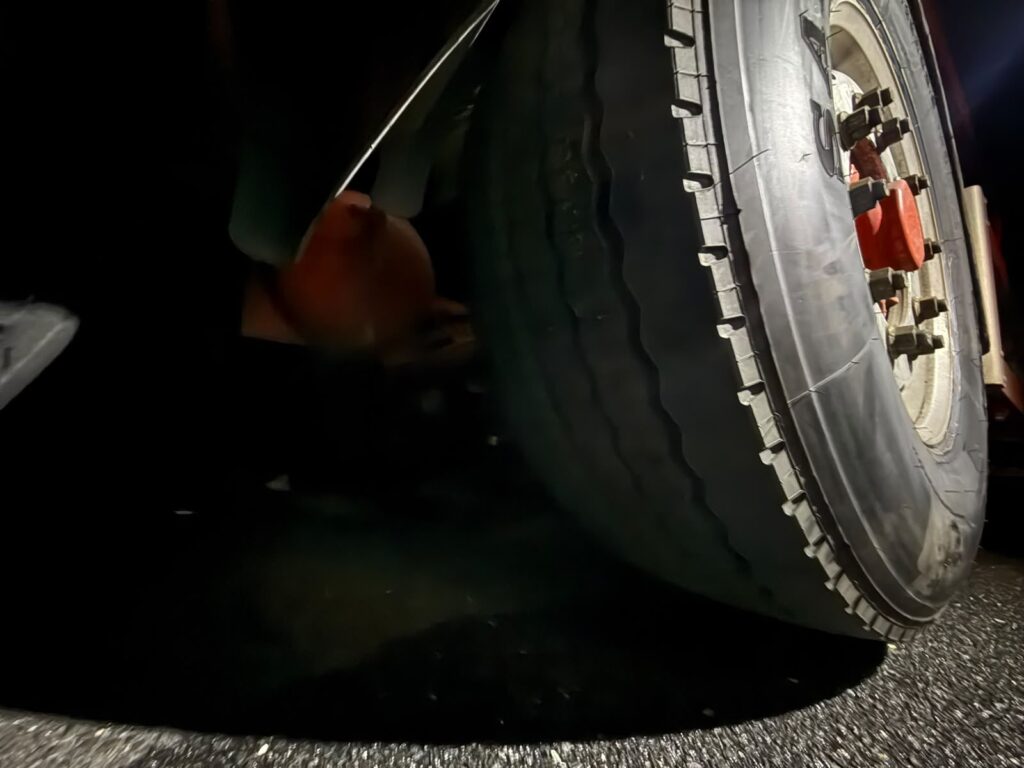
- Tyre inspected: nail found in the tread, no pressure, casing damaged from running flat
- Rim, hub and wheel nuts checked for deformation or damage
- Neighbouring tyres checked for pressure and heat
Step 2: Lifting the axle and removing the wheel (04:15 to 04:30)
For a low-loader the crew uses a hydraulic bottle jack rated well above the axle load, with a stable base on the concrete surface. The wheel nuts are loosened before lifting, the axle is raised, and the wheel is taken off. On a small 17.5-inch rim the wheel is lighter than a standard 22.5-inch truck wheel, but it is still heavy enough to need two hands and a trolley.
Step 3: Tyre swap and balancing (04:30 to 04:50)
The old tyre was dismounted from the rim and the rim inspected for cracks and flange damage. It was undamaged, which spared the owner a much larger bill. A new 245/70 R17.5 tyre was mounted, a new valve inserted, and the assembly was balanced on a mobile unit. The valve is a small item that often gets forgotten and causes slow leaks months later.
Step 4: Refitting and lowering (04:50 to 05:00)
The wheel was placed back on the hub, the nuts hand-tightened in a star pattern, and the axle lowered until the wheel took the weight of the trailer. At this point no one tightens the nuts fully: the final torque is only applied with the tyre on the ground.
Step 5: Final torque and pressure check (05:00 to 05:05)
The nuts were tightened in a star pattern with a torque wrench to the manufacturer’s value, then the tyre was inflated to 8.5 to 9.0 bar. The crew checked every nut a second time, looked at the tyre for any sign of seating problems, and signed off. At 05:05 the driver confirmed the work and carried on with the journey. If you want the exact figures for the wheel nuts on your axle type, our guide to truck wheel nut torque lists the typical values and the correct procedure.
Full timeline: 125 minutes from call to departure
From the first phone call at 03:05 to the driver leaving at 05:05 took 125 minutes (2 hrs 5 min). Reaction time until the crew was on site was 55 minutes. Here is the night as it happened.
| Time | Phase | Action |
|---|---|---|
| 03:05 | Call | Driver reports pressure loss on the low-loader on the A7; the oversize combination is parked on the hard standing |
| 03:05 to 03:20 | Dispatch | Tyre size, axle and load confirmed; crew of our partner network in the region selected (15 min) |
| 03:20 to 04:00 | Approach | Crew drives through the night, driver stays in contact (40 min) |
| 04:00 to 04:15 | Inspection and securing | Arrival, beacons set, tyre inspected, nail found in the tread, tyre flat and run on deflated (15 min) |
| 04:15 to 05:00 | Removal and fitting | Axle lifted, wheel removed, 245/70 R17.5 replaced, balanced (45 min) |
| 05:00 to 05:05 | Finish | Nuts torqued in star pattern, pressure set to 8.5 to 9.0 bar (5 min) |
| 05:05 | Done | Final check, driver continues the journey |
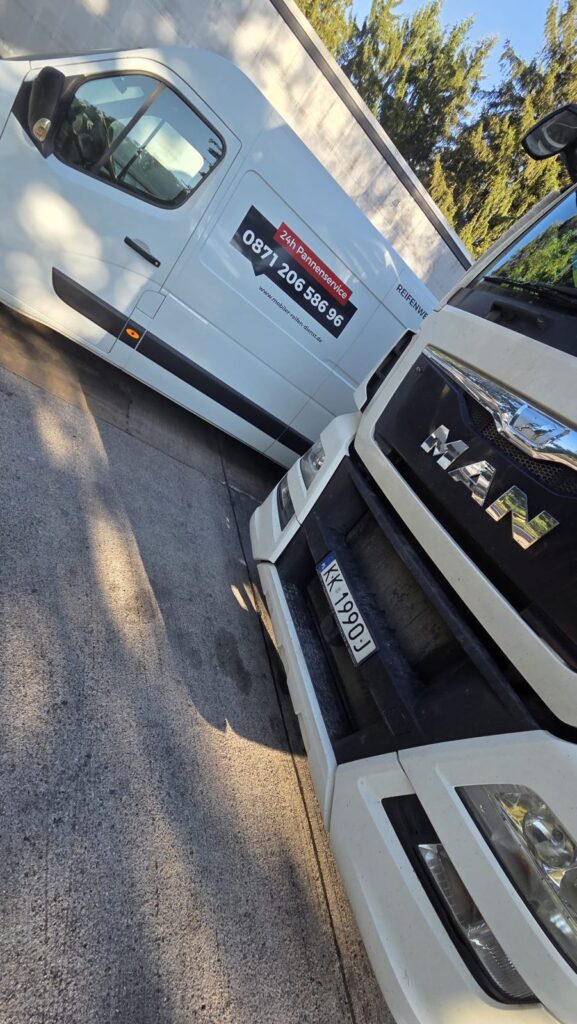
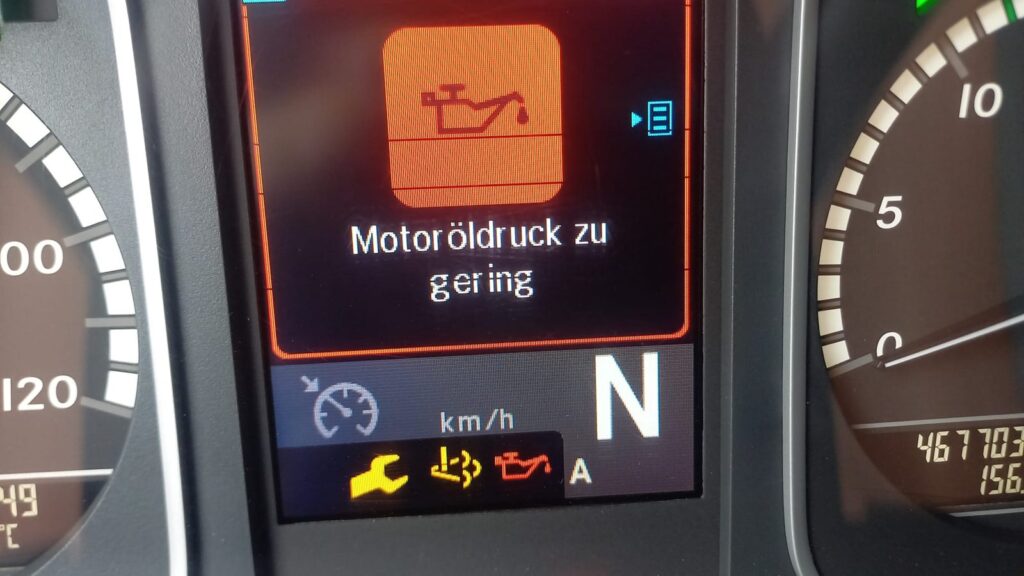
Total: 125 minutes from call to departure. The photos in this article were taken on site between 04:04 and 04:05, during the inspection.
What it cost: the full net price breakdown
The job cost €861.50 net (plus VAT). Everything below is in euros and excludes value-added tax, as is standard for commercial customers.
| Item | Price (EUR) |
|---|---|
| Callout / Anfahrt | 240.00 |
| Night surcharge (+35 % on callout) | 84.00 |
| New truck tyre 245/70 R17.5 | 380.00 |
| Labour: 1.25 h x €110 (removal, fitting, balancing) | 137.50 |
| Disposal of old tyre | 20.00 |
| TOTAL | 861.50 |
All amounts are net; VAT is added on the invoice.
What drives the price
Three things move the number up or down: time of day, distance and the tyre itself. The callout fee of €240 reflects a 40-minute drive for a crew carrying a stocked van. Night work adds 35 % to the callout, which is how we price work between late evening and early morning. The tyre is the single biggest item, and a regional-pattern 17.5-inch tyre is cheaper than a 315/80 R22.5 steer tyre but not cheap.
Labour at €110 per hour was charged for 1.25 hours. That is realistic for a wheel change that includes lifting, removing, dismounting, mounting, balancing and torquing. Disposal of the old casing is a separate legal obligation, so it appears as its own line. If you want to see what other jobs cost, our article on truck tyre change cost breaks down typical prices by size.
Compared with the alternative
The alternative to a roadside callout is a long wait or a recovery. A stationary oversize combination typically costs €800 to €1,200 per day in lost revenue, plus the permit, which is tied to a time window and may expire. Recovery to a workshop would have meant a heavy-duty tow, a second approach and a daytime workshop slot, easily doubling the total. Against that, €861.50 and two hours is a modest price.
There was also no secondary damage: the rim was intact and the tyre was replaced before it could harm the axle or the neighbouring wheels. That is the main benefit of acting early.
Why you should not change a truck tyre yourself
Changing a truck wheel at the roadside by yourself is risky, and on a low-loader with an abnormal load it is hazardous. Even where a driver has the tools, the conditions at night on a motorway shoulder are not safe for the work. Here are the main risks, in the order we see them most often.
- Wrong jack or wrong lifting point. A trailer axle on a heavy-haul unit carries many tonnes. An undersized jack can slip, and the consequences are severe.
- Incorrect wheel nut torque. Too loose and the wheel can work loose within a few hours; too tight and studs can stretch or break. A calibrated torque wrench is not optional.
- Damaged bead or rim. Mounting a tyre without checking the rim flange can leave the new tyre with a slow leak or a poor seat.
- Inflation hazard. Truck tyres are inflated to 8.5 to 9.5 bar. An improperly seated bead can burst during inflation, which is dangerous at close range.
- Traffic. Working near live lanes at night on a hard standing or hard shoulder is one of the most dangerous situations in road transport.
- Driving hours and permit. A driver who spends two hours on a wheel change may exhaust his driving hours or break a rest period, which creates a different set of problems.
For a deeper look at the right sequence and what to do first after a blowout, see our tyre blowout checklist for drivers.
Typical situations we attend across Germany
This night callout in Hessen is one of many. Our network covers the whole motorway system, and the situations repeat in a recognisable pattern.
- Nail or screw in the tread on a steer, drive or trailer axle, often found at a motorway services after a long run
- Blowout on a drive axle with a damaged mudguard or air line
- Sidewall damage from a kerb strike at a depot or roundabout
- Valve failures and slow leaks on dual wheels
- Cracked or bent rims after hitting a pothole at speed
- Seasonal wheel changes on distribution trucks at a private yard
- Flat tyres on specialist trailers, including low-loaders, tankers and car transporters
- Night and weekend callouts where the usual workshop is closed
We handle all of these as part of our 24/7 roadside work. If the tyre is only part of the problem, our team can also bring a mechanic from the tyre service side of the network, or arrange a towing service if the vehicle cannot be repaired on site.
Prevention: how drivers and fleets avoid night breakdowns
Most punctures cannot be avoided, but the damage they cause often can. The difference between a €300 repair and an €860 callout with downtime usually comes down to the driver noticing the problem within the first few kilometres. A few habits make the difference.
- Check tyre pressure at the start of every shift. A tyre that has lost 1 bar overnight is probably leaking slowly. Use a calibrated gauge, not a tap with a boot.
- Walk round the vehicle at every stop. Look for nails, screws, cuts and bulges in the tread and sidewall. Pay attention to the inside of dual wheels, where problems hide.
- Keep a record of tread depth and age. A tyre that is nearing its limit is more vulnerable to punctures and should be replaced on your terms, not at 3 am.
- Do not drive on a deflated tyre. Even a short distance can destroy the casing. If the pressure warning comes on, find a safe place and stop.
- Carry a high-visibility vest, warning triangle and torch. They are required, and at night they are the difference between a safe stop and a dangerous one.
- Save a roadside number before you need it. Keep our number, +49 160 5753826, in the phone and in the cab, with the vehicle details ready.
For fleets, a scheduled inspection programme pays for itself. We have written about this in detail, for example in our article on a pre-trip inspection near Hamm where a driver spotted a nail before it became a breakdown. For pressure values by tyre type, see our page on truck tyre pressure.
Truck tyres and fleet maintenance: brands, sizes and what to know
A well-run fleet treats tyres as a managed asset rather than a consumable. The right tyre for the right axle, at the right pressure, with a documented replacement point, reduces both breakdowns and fuel cost. Here are the points we raise most often with fleet managers.
Sizes and axle positions
The tyre size on the sidewall describes width, aspect ratio and rim diameter. A 245/70 R17.5 is common on low-loaders and light distribution trucks, 315/80 R22.5 on steer and drive axles of tractor units, 385/65 R22.5 on trailers and 245/70 R19.5 on rigid distribution vehicles. A van uses something like 235/65 R16C. The rule is simple: replace like with like, and never mix different sizes on the same axle. The European Tyre and Rim Technical Organisation (ETRTO) publishes the standards behind these designations.
Brands and patterns
The main premium truck tyre manufacturers include Michelin, Continental, Goodyear and Bridgestone, and each offers different patterns for steer, drive, trailer and regional or long-haul use. A regional pattern, like the one on this low-loader, is designed for mixed roads and moderate speeds. It is not a bad choice for a heavy-haul trailer, but it suits a lower annual mileage than a long-haul pattern.
When choosing between new, premium tyres and retreads, think about the axle. Retreaded casings are often used on drive and trailer positions, but steer axles are usually fitted with new tyres. Whichever you choose, keep a record of the casing age and the repair history.
Valves, nuts and the details that get missed
Many callouts that look like “just a tyre” turn out to involve a valve, a bent rim or a loose wheel nut. When a wheel is removed, the crew should check the studs, the nuts, the hub face and the rim seat. On axles from established makers such as BPW, the maintenance schedule includes wheel nut re-torquing after the first kilometres, which is easy to forget after an emergency change.
Dual wheels and pairing
On twin fitting, the two tyres should have similar diameters, because a worn tyre next to a new one carries different loads and heats up faster. After a change on one side, the fleet should check the other tyre of the pair. Our article on twin-tyre checks explains how to do this efficiently.
Frequently asked questions
How much does an emergency truck tyre change on the motorway cost?
A typical roadside truck tyre change costs between €750 and €1,400 net, depending on tyre size, time of day and distance. In this case the total was €861.50 net for a 245/70 R17.5 at night: callout €240, night surcharge €84, tyre €380, labour €137.50 and disposal €20.
How long does a mobile truck tyre service take to arrive?
On motorways in our network the crew usually arrives within 35 to 70 minutes of dispatch. On this job, the call came at 03:05, dispatch took 15 minutes, and the crew was on site at 04:00, 55 minutes after the call. Weather, traffic and time of day all affect this.
Can a truck tyre be repaired after a nail puncture?
Sometimes, but not after driving on a flat. A small puncture in the central tread, found immediately, can be repaired with a vulcanised patch. If the tyre ran without pressure, the casing is damaged and replacement is the safe option. You can read more in our guide to truck tyre repair.
Do you service oversize and heavy-haul trailers at night?
Yes. We take the load and permit details at the first call and send a crew with a suitable jack and a stocked van. The work happens on the hard standing or parking area where the vehicle is stopped, as long as the position is safe.
What pressure should a truck tyre have after fitting?
Most truck tyres run at 8.5 to 9.5 bar, depending on the load and tyre rating. On this 245/70 R17.5 low-loader tyre, the crew set 8.5 to 9.0 bar. The correct value is on the tyre manufacturer’s load and pressure table and should match the axle load.
Who pays for a roadside tyre change?
The vehicle owner or haulier pays, and the cost is normally invoiced net with VAT added. Some fleets have a service contract or a fleet card that covers part of the cost. We provide a clear invoice with every line item so it can be passed to your accounts department or insurer.
Why hauliers choose Lkwhelp24
We are an operation built for drivers who are stuck at the wrong time of night, and the way we work follows from that. A few points that matter in practice:
- Open 24 hours, 365 days. Calls at 03:05 are as normal as calls at noon.
- A tested partner network. Crews are matched to the job and carry the right stock for the tyre sizes we know are common in the region.
- A price you agree before the crew leaves. The callout price is confirmed on the phone, and the invoice lists every item.
- A multilingual dispatch desk. Drivers from Croatia, Poland, Lithuania, the Netherlands and further afield get help in a language they are comfortable with.
- Coverage across Germany. From the A7 in Hessen to the A8 near Rosenheim and the A2 near Hanover, the same standard applies.
If you want to see how this looks in other situations, read our case of a mobile truck tyre service on the A19 near Malchin, or our overview of emergency tyre service for trucks.
Summary: key figures of the callout
| Parameter | Value |
|---|---|
| Vehicle | Multi-axle low-loader semi-trailer, abnormal load, Croatian haulier |
| Location | A7 near Bad Hersfeld (Hattenbacher Dreieck), direction Fulda and Würzburg |
| Tyre | 245/70 R17.5, regional pattern, new tyre fitted |
| Fault | Nail in the tread, pressure lost, tyre ran flat |
| Time of call | 03:05, 19 August 2026 |
| Reaction time (call to arrival) | 55 minutes |
| Total time (call to departure) | 125 minutes (2 hrs 5 min) |
| Final tyre pressure | 8.5 to 9.0 bar |
| Total cost | €861.50 net plus VAT |
| Secondary damage | None, rim intact |
Call us when it matters
If your truck, trailer or low-loader has a flat tyre anywhere in Germany, call the dispatch desk and we will tell you straight away what the crew can do and what it costs. Have the location, tyre size and vehicle type ready, and stay in a safe position.
Phone: +49 160 5753826
Website: www.lkwhelp24.com
Round the clock, anywhere in Germany.
Keywords: truck tyre service | mobile tyre service | truck tyre change | truck tyre callout | truck tyre roadside assistance | truck tyre replacement | truck tyre repair | trailer tyre service | truck tyre breakdown | truck tyre emergency | low-loader tyre puncture | oversize load breakdown | A7 Bad Hersfeld | truck tyre Germany
Related articles
- Emergency Tire Service for Trucks: Fast Help Around the Clock
- Mobile Truck Tyre Service on the A19 near Malchin: Scania Artic Back on the Road in 2 Hours 16 Minutes After a Blowout
- Pre-Trip Inspection Near Hamm: How a Driver Spotted a Nail in the Tread
- Truck Tyre Repair 2026: When It Works and When Only Replacement Will Do
- Truck Wheel Nut Torque: Table and Correct Mounting Procedure