Skip to content
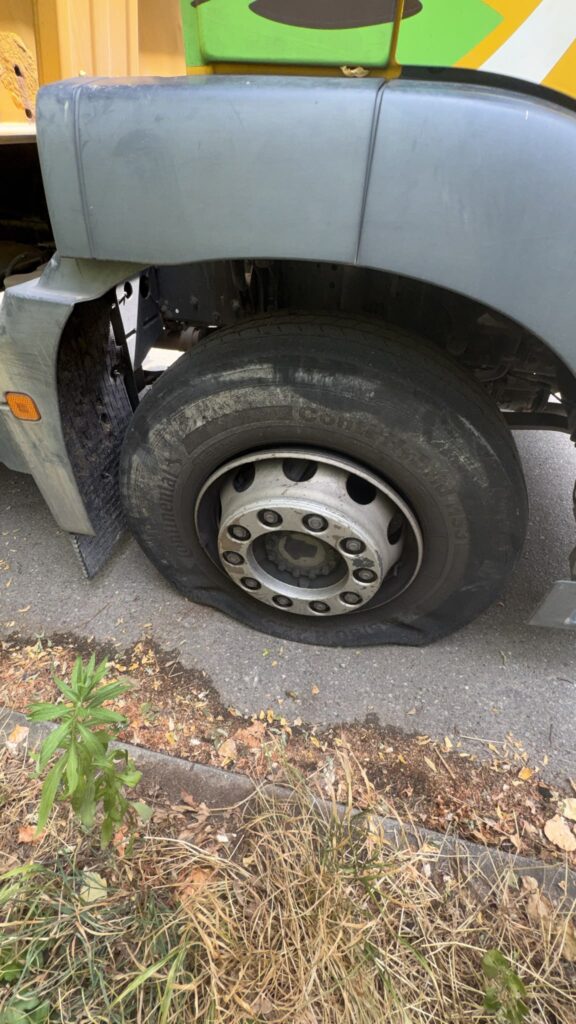
A Mercedes-Benz Actros tipper truck comes to a stop in the middle of a construction site near Regensburg after a construction-site screw punctures the right rear tyre, size 315/80 R22.5. LKWHelp24’s mobile truck tyre service arrives, locates the puncture in the centre of the tread, carries out a proper mushroom-plug repair from the inside, and gets the tipper back to full operating pressure in 1 hour 40 minutes from the call. Cost: 320 euros net plus VAT. The alternative, a new truck tyre after sidewall damage, would have cost significantly more and without the years of service life a proper repair provides.
The case follows a pattern that repeats daily on German construction sites: heavy vehicles drive over gravel, rubble and stray fasteners, and a tyre quietly picks up a foreign object. Fleet managers and site supervisors dealing with this situation will find the full timeline here, the technical background on repairing truck tyres, and the prevention steps that avoid the next standstill.
16 July was an ordinary working day on the site until the tipper started slowly losing air while manoeuvring on the yard. What follows is the reconstruction of a job that shows why, on construction sites, speed and expertise matter equally for heavy commercial vehicles.
The emergency on the construction site
A loaded Mercedes-Benz Actros tipper noticed a growing loss of pressure in its right rear tyre during the afternoon of 16 July. The truck was loaded with excavated soil, as is typical for tipper work, and stood in the middle of the active work zone of the construction site near Regensburg.
Foreign-object puncture – a condition in which a sharp object such as a screw, a nail or a piece of reinforcement bar penetrates the tread and lets air escape, often gradually rather than suddenly. That is exactly what happened here: a construction-site screw had lodged in the tread and initially partly sealed its own puncture channel, so the pressure loss was not immediately obvious.
For the site, this meant far more than a flat tyre. A tipper hauling excavated soil and bulk material is the backbone of the day’s workflow. Without it, several paid workers are idle, material cannot be moved, and the construction schedule stalls. Calling professional help immediately, rather than topping up the tyre and carrying on, was the only sensible decision in this situation.
How the assistance was organised
The call to LKWHelp24 came in at 13:10, and within 15 minutes a service partner in the region was alerted. Dispatch for construction-site jobs follows a fixed pattern designed exactly for situations like this.
Remote diagnosis by phone – gathering tyre size, vehicle type, load status and the exact position of the damage to set the course for the right response before the technician even leaves. The dispatcher asked for the tyre size, 315/80 R22.5, the vehicle type, a tipper truck, and the exact location of the site, in order to assign a partner immediately with the right equipment for heavy commercial tyres.
Within the first 15 minutes it was clear: no full wheel replacement needed, most likely an on-site repair, pending inspection of the tyre itself. LKWHelp24’s 24/7 dispatch system covers partners nationwide who specialise in mobile breakdown assistance for trucks and heavy commercial vehicles, from articulated lorries to construction-site tippers. For this job, a service partner was activated who could drive straight to the site without routing through a central workshop. The 40-minute arrival time fell within the usual 30 to 60 minutes LKWHelp24 aims for nationwide.
On site: technical details of the damage
The service technician arrived on site at 14:05, 40 minutes after being alerted. The first visual inspection gave a clear diagnosis: the screw was lodged in the centre of the tread, with a puncture channel under 6 millimetres in diameter.
Centre-tread damage – a puncture within the tread area, outside the sidewall zones, is generally considered repairable under the relevant tyre industry standards, provided the size and location meet the requirements. That was exactly the case here.
The tyre’s carcass showed no visible structural damage, the sidewall was intact, and tread depth was well above the legal minimum. Under German road traffic regulations, tread depth on trucks must be at least 1.6 millimetres, a value this comparatively new truck tyre exceeded by a wide margin. Tyre pressure before the repair was already noticeably below the manufacturer’s target value for the loaded condition, a typical sign of a slowly leaking puncture channel.
Truck tyre, size 315/80 R22.5 – the standard size for heavy commercial vehicles such as tippers, articulated lorries and construction-site trucks, engineered for high axle loads and continuous duty. This reinforcement is not a comfort feature on a tipper loaded with excavated soil, it carries real payload, which is why damage to this type of tyre must be assessed with particular care.
Step by step: how the repair went
The actual on-site work took 45 minutes and followed a structured process that is standard for professional tyre repairs on heavy commercial vehicles.
- Visual inspection and location. The technician identified the screw visually and by touch, determined its exact position in the tread and measured the puncture diameter to confirm the tyre was repairable.
- Wheel removal. The wheel was released from the hub, the wheel bolts removed with the correct torque tool, and the complete tyre taken off the vehicle to gain access to the inside.
- Separating tyre and rim. Only with the tyre fully removed from the rim can the repair site be properly treated from the inside, a step that plug-and-seal sprays skip entirely, which is exactly why they remain a lower-quality fix.
- Mushroom-plug repair from the inside. The damaged channel was cleaned, roughened, treated with vulcanising fluid and sealed from the inside with a tyre mushroom plug, a combination of a rubber stem in the channel and a patch on the inner wall that seals the tyre permanently and to standard.
- Fitting, balancing and pressure check. The repaired tyre was refitted to the rim, the wheel mounted on the hub, bolted down to the correct torque, and the tyre pressure set precisely to the target value for the loaded condition.
By 14:50 the tipper was ready to drive, a total of 1 hour and 40 minutes after the first call.
Timeline of the job
| Time | Phase | Action |
|---|---|---|
| 13:10 | Call | Breakdown reported from the site |
| 13:10–13:25 (15 min) | Dispatch | Remote diagnosis, tyre size/location gathered, regional partner alerted |
| 13:25–14:05 (40 min) | Travel | Service vehicle en route to the site |
| 14:05–14:50 (45 min) | On-site work | Visual inspection, screw located (centre tread, puncture under 6 mm), wheel removal, mushroom-plug repair from the inside, refitting, pressure check |
| 14:50 | Done | Total time from call: 1 hour 40 minutes |
Cost of the tyre repair: breakdown and comparison
Total cost for this job was 320 euros net plus VAT, split across three transparent line items. LKWHelp24 prices daytime jobs from 290 euros net plus VAT, and jobs at night or on Sundays and public holidays from 549 euros net plus VAT, always with a fixed price agreed before the job starts.
| Item | Price (EUR), net plus VAT |
|---|---|
| Call-out fee | 120 |
| On-site labour | 90 |
| Tyre repair (mushroom plug from the inside, truck tyre 315/80 R22.5) | 110 |
| TOTAL | 320 |
Three main factors set the price: distance to the site, since the call-out fee reflects the distance to the nearest available service partner; the actual time spent on site, which is naturally higher for a demount-and-repair job on heavy truck tyres than a simple tyre swap; and the type of repair itself, since a proper internal mushroom-plug repair needs more material and care than an external sealant plug.
For comparison: had the puncture been in the sidewall, a repair would not have been legally or technically permitted, and a new truck tyre in size 315/80 R22.5 would have cost between 320 and 420 euros net plus fitting depending on brand, not counting the extra downtime for sourcing it. The real cost driver of a construction-site standstill, however, is rarely the tyre price itself. When the tipper stands still and the whole site with it, paid waiting time for several workers adds up to a delayed project schedule, and these follow-on costs usually far exceed the repair bill.
Why a professional is needed, not a can of sealant
A professional is needed for tyre breakdowns on heavy commercial vehicles because assessing repairability, correctly demounting the wheel and applying the right torque to the wheel bolts all have a direct effect on driving safety. DIY fixes carry risks that weigh particularly heavily on a loaded tipper.
Why topping up air and driving on is not a solution: a tyre running at a pressure noticeably below its target value generates excessive flexing in the carcass. The sidewall heats up more than intended, and on a truck tyre already working near the top of its load rating under a load of excavated soil, the risk of a sudden blowout rises sharply. Briefly topping up air to reach the nearest workshop can be acceptable in exceptional cases, but it never replaces a proper repair or replacement.
Puncture spray and canned sealant: when they help and when they harm. A sealant spray can help in a genuine emergency to keep a vehicle mobile just long enough to get clear of traffic or off the site. On truck tyres of this size, though, its effect is very limited, and it is never a substitute for a permanent repair. It often clogs the TPMS sensor inside the tyre, which can cause tyre-pressure monitoring faults, and it makes a proper later repair at a workshop significantly harder, since the sticky residue has to be removed before any internal work can begin. In this case, sealant was deliberately avoided in favour of the permanent solution with demounting and a mushroom plug, an approach that is cheaper in the long run than a later re-repair.
Spare wheels on tippers: the underrated weak point. Many construction-site tippers either carry no spare wheel at all, or one that has sat unused for years without anyone checking its pressure. A spare wheel with too little air is no real help in an emergency. Practical tip for fleet managers: check the spare wheel’s pressure and condition every quarter so it is genuinely ready to use when needed.
Typical tyre damage on construction sites
Construction sites are among the most common causes of tyre damage for heavy commercial vehicles, for several well-documented reasons.
Screws and nails are scattered on almost every active site, often from loose packaging, broken fixings or transport pallets. They are small, usually dark, and frequently lie exactly in the wheel tracks that vehicles repeatedly drive over while manoeuvring.
Reinforcement bar offcuts from concrete work, short pieces of wire or cut steel ends, often remain in loose ground and can stand up at the worst possible angle when driven over.
Nails from pallets are one of the underrated hazards, since wooden pallets break apart regularly and their nails disappear into grit or gravel, invisible until the moment they are run over.
Broken brick and glass occur equally in demolition work and new-build sites, with sharp edges that can damage the tread and, at an unfavourable angle, the sidewall too.
Add to that the constant manoeuvring in loading and unloading zones. Tippers and construction-site trucks repeatedly drive the same short stretches there, often at walking pace with full steering lock, which increases the chance that a foreign object gets pressed straight into the tread rather than just grazed.
A screw in the tyre is considered by tyre professionals to be the trickiest single case. Unlike a large cut or a blowout, the puncture channel around a lodged screw often initially seals itself. The tyre loses air only slowly, sometimes over hours or even days, and the driver frequently only notices the problem on the road, when steering feel changes or the tyre-pressure warning triggers. This exact slow-leak pattern was also present on the tipper near Regensburg.
Downtime for construction trucks: a major economic lever
Downtime for a tipper carries significant weight financially, because with it the entire site logistics come to a halt. Without soil haulage, excavators, wheel loaders and several construction workers often cannot continue working meaningfully.
During this time, the company pays full wages for staff who cannot be productive, while the contractually agreed project schedule stalls at the same time. On larger sites with completion deadlines, a delay of just a few hours can grow into noticeable contractual penalties or follow-on costs by the end of the project. That is why response time for a construction-site job is not a comfort factor but a direct economic lever: every quarter-hour saved reduces the number of worker-hours lost.
Prevention for construction yard and tipper fleets
Anyone regularly driving to construction sites can systematically reduce the risk of tyre breakdowns without complicating daily operations.
Tyre check after every site visit. A quick visual check of the tread after every drive over an active site catches lodged foreign objects before they work deeper in or reach the carcass. This check takes a few minutes and fits into the daily vehicle handover.
Keeping loading zones clear. Site supervisors who consistently have loose screws, nails and packaging debris removed from the area where vehicles manoeuvre reduce the risk for their own fleet and for every other vehicle on site.
A magnetic sweeper on site. A magnetic sweeper, run regularly over access roads and manoeuvring areas, systematically collects metal debris such as screws and nails and is one of the most effective and cheapest prevention measures on larger sites.
Choosing tyres with a reinforced carcass. When buying new tippers for permanent construction-site duty, it pays to choose truck tyres with a particularly robust carcass and higher puncture resistance, a premium that pays for itself over the tyre’s service life through fewer breakdowns.
Mobile truck tyre service for heavy commercial fleets: what fleet managers should know
Mobile truck tyre service covers articulated lorries just as much as tippers, construction-site trucks and other heavy commercial vehicles in permanent use in the construction and earthworks trade. Fleet managers coordinating several vehicles will benefit from understanding the technical basics that make a tyre repair possible, or not.
Tyre pressure – the internal pressure of the tyre, given in bar, must be matched exactly to load and vehicle type, since too little pressure overloads the carcass and too much reduces grip and the contact patch. On loaded tippers, the target value is often noticeably higher than when unloaded, a detail that often gets overlooked when topping up.
Tread depth – the depth of the grooves in the tread, set by law at a minimum of 1.6 millimetres, largely determines water drainage and therefore aquaplaning safety. Tyre manufacturers such as Continental, Michelin, Goodyear and Bridgestone offer dedicated truck tyre lines for commercial vehicles, optimised for high mileage under full load as well as puncture resistance, a criterion particularly relevant for fleets working on construction sites.
Carcass – the load-bearing structure of steel and textile cord layers beneath the tread that holds the tyre’s shape and carries the load. A damaged carcass, for example from a puncture in the sidewall, generally makes a repair impossible, since structural integrity can no longer be reliably restored.
Balancing – matching the mass distribution on the wheel after fitting or repair, so that imbalance does not cause steering-wheel vibration or uneven tyre wear at higher speeds. Balancing is part of a proper finish after every demount-and-repair job.
Torque – the specified tightening force for the wheel bolts when refitting the wheel to the hub, defined by the manufacturer and applied precisely with a torque wrench, since bolts that are too loose can work free and bolts that are over-tightened can damage the hub. On heavy commercial vehicles with high axle loads, this step is safety-critical and must never be done by feel alone.
Fleet operators who regularly face situations like this should also look at seasonal requirements. Anyone working on construction sites in winter should know the rules on winter tyres for commercial vehicles, as well as the meaning of load index for commercial tyres, which states the maximum load a single tyre can carry, and should never be undercut on a loaded tipper.
Why LKWHelp24
LKWHelp24 organises mobile breakdown assistance around the clock, nationwide, for trucks, articulated lorries and heavy commercial vehicles, including tippers on construction and earthworks sites. The number +49 160 575 3826 is reachable 24 hours a day, 7 days a week, including on WhatsApp, in German, English, Polish and Russian, and dispatch works with a nationwide partner network to keep arrival times short even away from motorways, typically 30 to 60 minutes.
The job near Regensburg shows the principle in practice: call, remote diagnosis, partner dispatch, travel, professional repair, all within 1 hour and 40 minutes, with a transparent fixed price agreed before the job starts. For construction yard and tipper fleets, that means predictable costs and minimised downtime, two factors that can directly decide the economics of a job on time-bound construction projects.
Frequently asked questions (FAQ)
Can a truck tyre with a screw in the tread always be repaired?
No, not always. A truck tyre with a screw in the tread is repairable if the puncture lies within the tread area, not in the sidewall, and the diameter of the damage does not exceed a certain limit, usually around 6 millimetres. A specialist checks this after demounting from the inside and only then gives a binding decision.
How long does a mobile tyre repair take on a tipper truck?
A mobile tyre repair on a tipper truck usually takes between 1 and 2 hours from the call, depending on the damage and travel distance. In the documented case near Regensburg, total time was 1 hour 40 minutes, of which 45 minutes was pure on-site work for demounting, repair and refitting.
What does a mobile tyre repair on a construction site cost?
A daytime job with LKWHelp24 starts from 290 euros net plus VAT, a job at night or on Sundays and public holidays from 549 euros net plus VAT, and tyres from size R17.5 from 315 euros. In the case described, the call-out fee, labour and the mushroom-plug repair on the truck tyre 315/80 R22.5 added up to 320 euros net, agreed as a fixed price before the job began.
Is sealant spray a sensible alternative to a professional repair?
Sealant spray is only a short-term fix to get a vehicle out of a danger zone, not a permanent repair, particularly on large-volume truck tyres. It can clog the TPMS sensor and make a later proper repair at a workshop harder, which is why a direct mushroom-plug repair is preferable whenever there is time to arrange it.
Why are construction sites especially damaging to tyres on heavy commercial vehicles?
Construction sites are especially damaging to tyres because screws, nails, reinforcement offcuts and rubble frequently lie loose in the driving area, and vehicles such as tippers repeatedly drive the same stretches while manoeuvring in loading zones. This combination of sharp-edged material and intensive contact significantly raises the chance of a puncture compared with normal roads.
What vehicles does LKWHelp24’s mobile tyre service cover?
LKWHelp24 organises mobile breakdown assistance for trucks and heavy commercial vehicles, including articulated lorries, tippers and construction-site trucks, nationwide and around the clock.
Summary
A construction-site screw in the tread of a tipper truck near Regensburg caused a tyre puncture on 16 July that brought an entire site to a standstill. LKWHelp24 organised assistance within 15 minutes of the call, the service partner arrived after a 40-minute drive, and the professional mushroom-plug repair from the inside was completed after a further 45 minutes. Total time: 1 hour 40 minutes, total cost: 320 euros net plus VAT. The case underlines why a fast, professional mobile repair is clearly the better economic option for construction-site jobs compared with DIY fixes or an unnecessary tyre replacement.
Get help now
Tyre puncture on a construction site or on the road with a tipper, an articulated lorry or another heavy truck? LKWHelp24 is reachable 24 hours a day, 7 days a week at +49 160 575 3826, also on WhatsApp, or via www.lkwhelp24.com. Fast dispatch, an experienced partner network nationwide, transparent fixed pricing agreed before the job starts.
Keywords: mobile truck tyre service, tipper truck tyre puncture, tyre repair construction site, truck breakdown assistance, truck tyre repair, 315/80 R22.5, tyre service Regensburg, mushroom plug tyre repair, fleet tyre maintenance
Related articles
- Tyre service overview by LKWHelp24
- Truck tyre repair: when it works and when it doesn’t
- Emergency truck tyre service near you: mobile tyre service 24/7
- Truck tyre service Germany: 24/7 emergency assistance
- Mobile truck tyre service Hamburg motorway
- Tyre puncture A43 Dortmund: truck tyre service on the job
- Tyre emergency service nearby: fast help with tyre punctures
- Tyre puncture in a field: recovering a 40-tonne truck near Landsberg am Lech
- Tyre service by LKWHelp24
Further reading: https://lkwhelp24.com/en/towing-service/.