Skip to content
A tire failure at 80 km/h on the German autobahn is one of the most dangerous moments a truck driver will face. In an articulated truck with a gross weight of 40 tonnes, the first three or four seconds decide whether the situation ends under control or turns into a collision with injuries. At LKWHelp24 we respond to exactly this kind of call on German motorways, and we keep seeing the same mistakes: braking too hard, steering the wrong way, and setting up the warning triangle far too close to the vehicle. This article is a practical action plan for the moment the blowout happens, not a guide to finding a workshop afterward. That is intentional, because the priorities in the first minute are different from the priorities ten minutes later.
Warning signs that often come before a blowout

A full blowout rarely happens completely without warning. In most cases there are signals minutes or even kilometers earlier that an attentive driver can catch.
Steering wheel vibration is the most common early sign. When a steer axle tire loses air or an imbalance develops from early carcass damage, it transmits directly into the steering. A slight pull to one side that keeps needing correction often points to uneven pressure between the left and right tire.
An unusual noise, a rhythmic thumping or flapping in time with wheel rotation, is another warning. It often sounds like a loose panel, but is actually a tire deforming or a tread starting to separate from the casing.
Modern tractor units and many trailers carry TPMS (Tire Pressure Monitoring System). A warning on the dashboard showing pressure loss on a specific axle is the clearest of all signals and should never be ignored, even if the driver is on a stretch without a hard shoulder and has to find a safe spot first.
A smell of hot rubber coming through the ventilation can appear during longer driving with noticeably low pressure. The tire overheats from the extra flexing of the sidewall, and this overheating is the most common technical cause of a truck tire blowout, as also described in Continental’s technical guidance on tires and wheels.
The first second: what the body instinctively gets wrong
The human reflex to a sudden loud bang or a jolt in the steering wheel is to brake hard and yank the wheel toward the direction the vehicle seems to be pulling away from. In a car that might just about work. In a truck with high axle loads, that exact movement is what turns a blowout into a crash.
First: hold the steering wheel firmly with both hands, without overcorrecting. A blown tire changes rolling resistance abruptly on one side of the vehicle. The truck pulls in that direction. The driver needs to counter it, but gradually and gently, never with a jerk. A full-force countersteer almost always overcorrects and sets the combination swaying, which with a loaded trailer can quickly turn into jackknifing.
Second: do not hit the brake. This is the part most drivers find hardest, because it feels wrong not to brake when something goes wrong. But hard braking while trying to steer straight destabilizes the axle load distribution even further, especially if the failed tire is on the drive axle or the trailer. Instead, ease off the accelerator and let the vehicle slow through natural rolling resistance and the extra drag from the damaged tire itself.
Third: only once speed has dropped noticeably, typically below 60 km/h, should light and gentle braking be added to help slow down further. Until then, steering control and easing off the gas are the only two actions that matter.
Merging safely onto the hard shoulder
Once the truck is stable in its lane again and speed is dropping, the second critical phase begins: changing lanes toward the hard shoulder. In heavy traffic this is often the moment with the highest collision risk, because other vehicles do not expect the truck’s behavior.
Turn on the hazard lights immediately, before the lane change starts, not after. That gives following vehicles an early visual signal that something is wrong before any visible swerving happens. Checking mirrors is essential, but with a tire failure the truck is often already drifting slightly, so a single glance is rarely enough. Several quick checks are needed.
The lane change itself should happen at as shallow an angle as possible, never an abrupt cut across. Depending on the starting lane, that can mean drifting gradually toward the right over several hundred meters instead of moving to the shoulder in one motion. This is a point our dispatchers at LKWHelp24 repeatedly have to explain on emergency calls, when a panicking driver reports being stuck in the middle of the left lane.
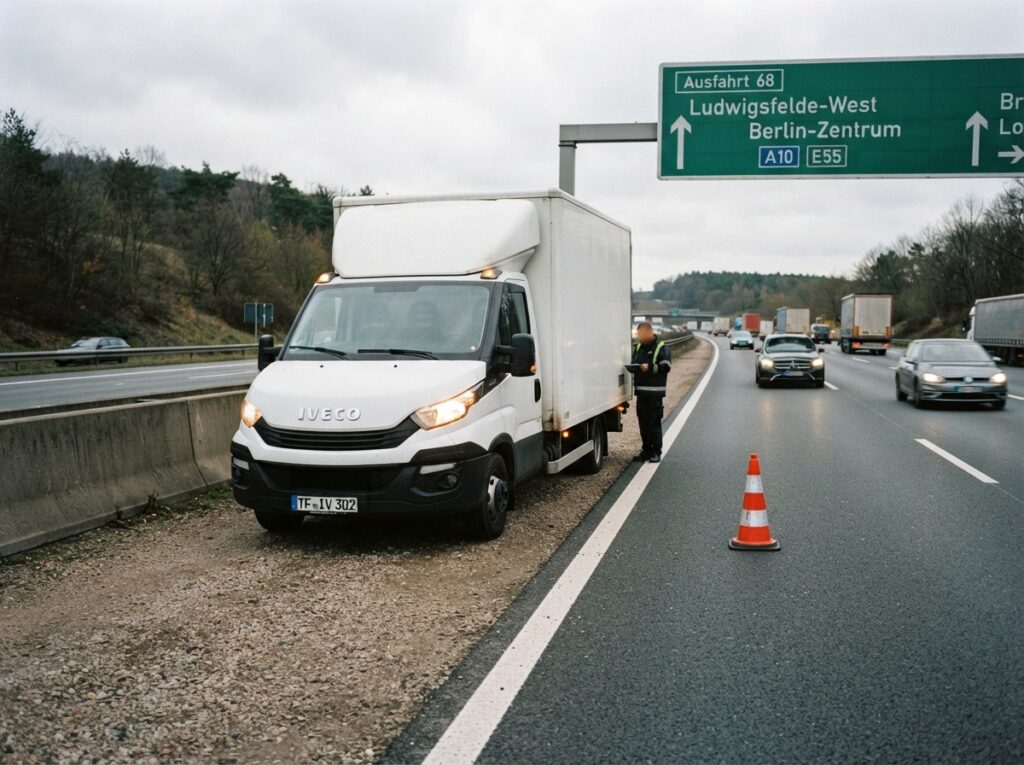
Once on the hard shoulder, the truck should be pulled as far right as possible, ideally with the right wheels slightly onto the verge or embankment where that is possible without compromising stability. Every extra centimeter of distance from the running lane reduces the risk of a rear collision from vehicles clipping the shoulder.
After stopping: the correct order of actions
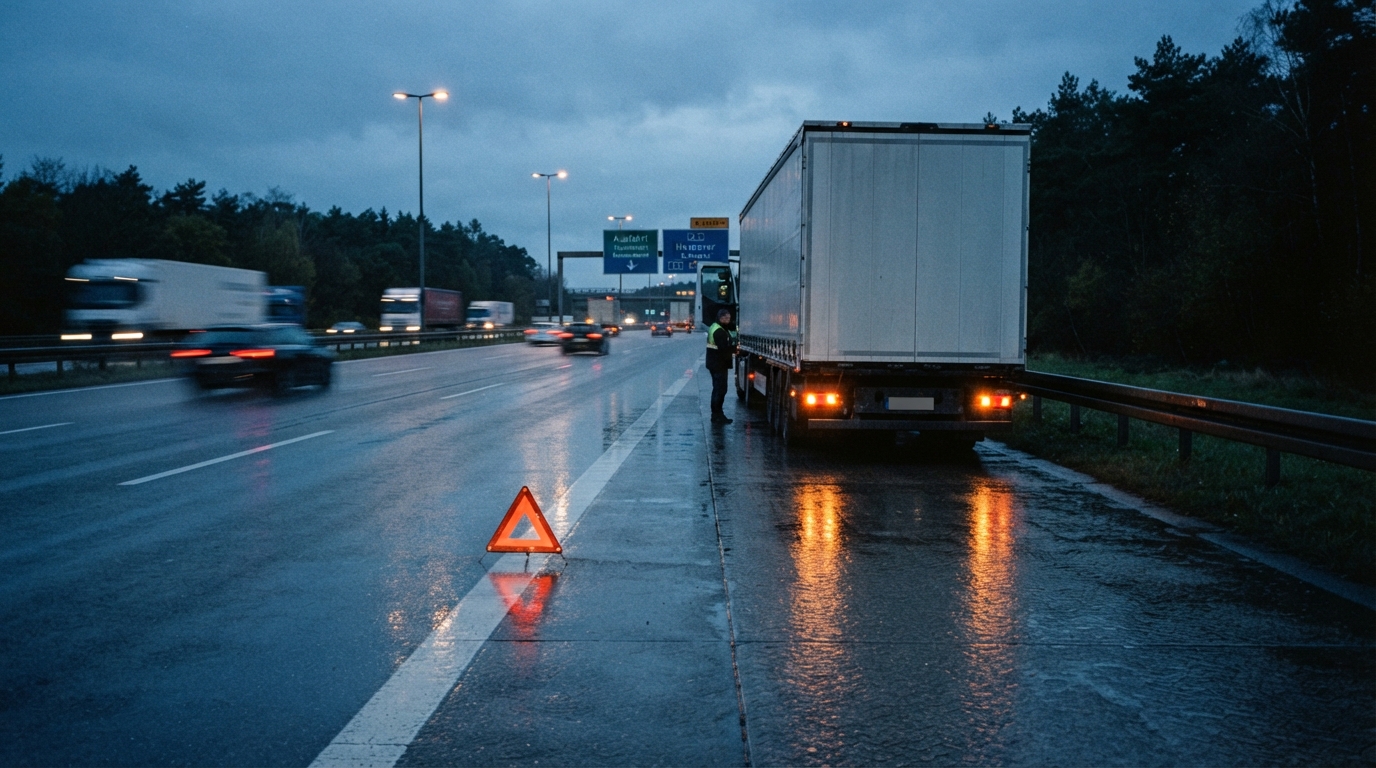
Once the vehicle has come to a stop, a sequence of actions follows, and the order is where things frequently go wrong in practice, sometimes with fatal consequences.
First, hazard lights stay on, the engine can stay running or be switched off depending on the situation, but above all: do not get out immediately. A tire that has just blown or was overheating can stay dangerously hot for two to three minutes, sometimes over 100 degrees Celsius on the tread, and a damaged wheel can theoretically retain residual pressure in adjacent systems. Waiting two to three minutes before approaching the affected wheel is not excessive caution, it is standard recommended practice in long-haul driving.
While still sitting in the cab: put on the hi-vis vest. This is the point most drivers get wrong. The vest goes on inside the cab, before opening the door, not outside next to the truck. Under German traffic law, wearing a hi-vis vest outside the vehicle for a broken-down vehicle on the autobahn is a legal requirement, see the relevant rules on behavior during accidents and breakdowns in the German road traffic regulations (StVO). A driver who looks for and puts on the vest only after leaving the cab stands unprotected in moving traffic during that time, often with their back to the road.
Next comes placing the warning triangle. The autobahn requires a much greater distance than country roads, in practice we recommend at least 150 to 200 meters from the vehicle, more on bends, hilltops, or in poor visibility. The triangle goes on the right side of the road or on the hard shoulder itself, clearly visible to approaching traffic, and the driver always walks with their back toward the crash barrier, never with their back to traffic.
The single most important and most frequently ignored point: after placing the triangle, the driver and any passengers move behind the crash barrier, not beside the vehicle and not in front of it. The hard shoulder of an autobahn is not a safe zone. According to accident statistics from the German Federal Statistical Office on road traffic accidents, several hundred accidents happen every year involving collisions with vehicles and people standing on the hard shoulder, a significant share of them fatal. Distraction, microsleep, and delayed reaction at high speed are the main causes. The only genuinely safe position is behind the barrier, with a view of your own vehicle but physically separated from the roadway.
What must never be done
There are three behaviors that repeatedly cause serious or fatal accidents after a tire blowout on the autobahn, and that we at LKWHelp24 explicitly address on emergency calls when a driver suggests them.
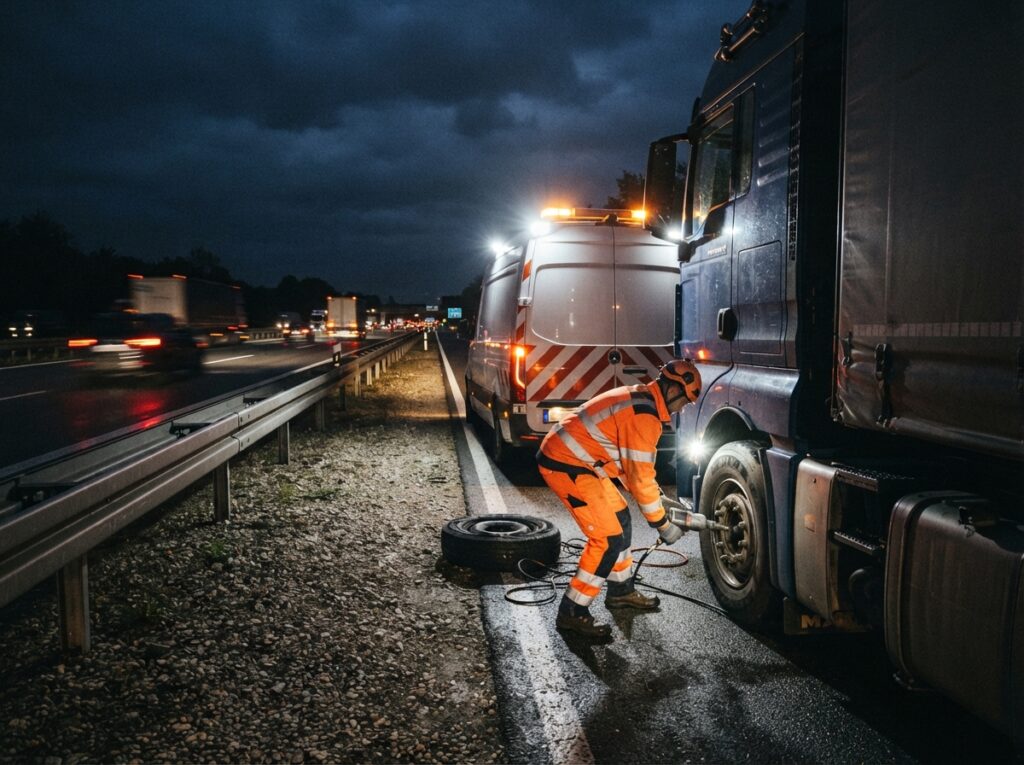
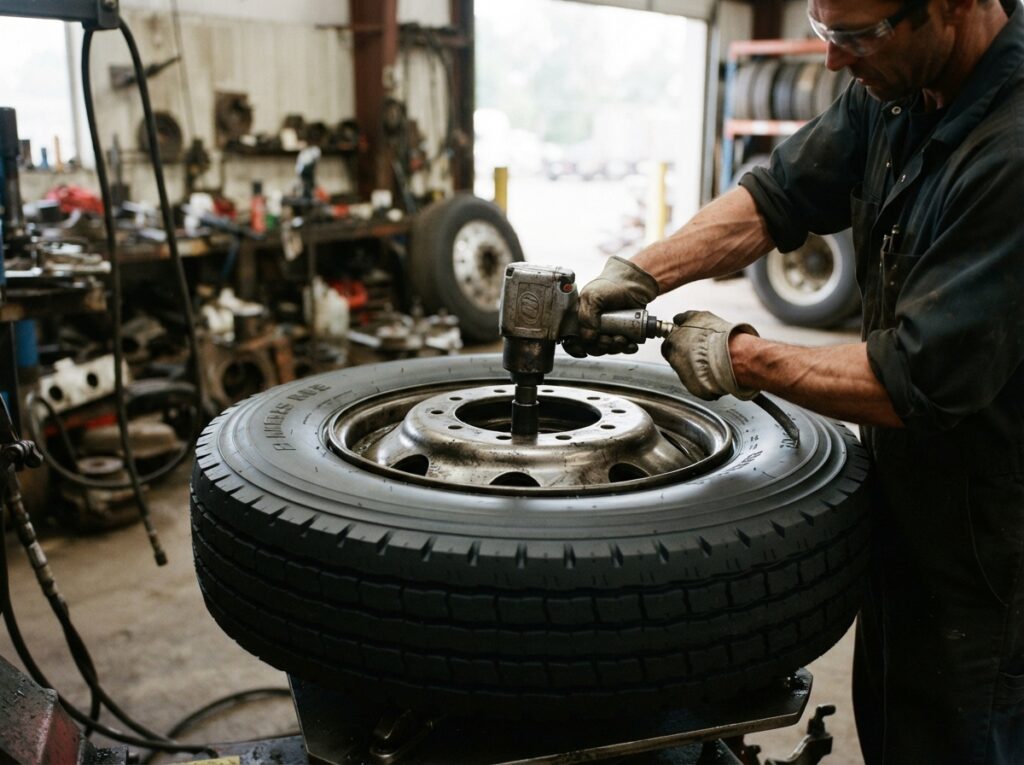
Changing the wheel yourself on the hard shoulder of the autobahn is one of the most dangerous things a driver can do. A truck wheel weighs between 80 and 150 kilograms depending on size and configuration, the jack has to sit securely on uneven or sloped ground, and for the entire time the driver is right next to moving traffic, often kneeling or bent over with limited visibility. Even trained workshop staff only carry out such changes with additional protection, warning beacons, a second person, radio contact with traffic control on particularly critical stretches. This is exactly why mobile tire service exists as its own line of work, see also our overview of emergency tire service near you and the step-by-step guide to emergency wheel change on a truck.
Continuing to drive on a blown or badly damaged tire to reach the next exit or rest stop is the second dangerous practice, and unfortunately a common one, because drivers want to save time or avoid stopping in a more dangerous spot. A tire without sufficient pressure deforms more with every additional rotation, the carcass overheats further, and in the worst case the tread separates completely from the carcass, which can cause an uncontrolled skid. Driving on the rim or on a destroyed tire also frequently damages brake lines, air suspension bellows, or fenders, turning a simple tire failure into a far more expensive repair.
The third mistake is leaving the safe position behind the barrier to fetch something from the truck, take photos, or call the insurance company while standing next to the vehicle. Every second spent next to the truck on the hard shoulder is unnecessary risk. Phone calls, documentation photos, and waiting for roadside assistance should, whenever possible, happen from the safe position behind the barrier.
What to do / what not to do: quick reference
| Situation | Right | Wrong |
|---|---|---|
| First jolt in the wheel | Hold the wheel firmly, ease off the gas | Brake hard, oversteer |
| Vehicle pulling sideways | Gentle countersteer, controlled slowdown | Sudden, forceful countersteer |
| Lane change in heavy traffic | Shallow angle, hazards on beforehand | Abrupt cut across |
| After stopping | Wait 2-3 minutes, let the tire cool | Handle the hot wheel immediately |
| Hi-vis vest | Put on inside the cab, before exiting | Put on outside next to the truck |
| Warning triangle | 150-200 m on the autobahn | Placed too close to the vehicle |
| Personal safety | Wait behind the crash barrier | Standing beside or in front of the truck |
| Wheel change | Call a professional mobile tire service | Change it yourself on the shoulder |
The dual-wheel complication
One detail many drivers underestimate concerns dual-wheel setups on drive or trailer axles. When one of the two tires in a dual configuration loses air or blows out completely, the second tire in the pair often keeps carrying the load, and from the outside it is sometimes impossible to tell at a glance that one tire has already failed. The truck appears to keep driving normally, but the remaining tire is now significantly overloaded and overheats itself within a short time, which can cause a second, usually much more violent failure.
A reduced but noticeable vibration pattern, a slight sideways drift, or an unusual noise from the tandem axle area are the warning signs that need to be taken seriously despite seemingly normal driving. Anyone who suspects a tire is damaged in a dual configuration should stop at the next safe opportunity and check both tires in the pair from the outside and, if possible, shine a flashlight between them. Details on correctly reading tire markings and load capacity can be found in our article on reading truck tire sidewall markings.
Weather as a risk multiplier
Rain, fog, and ice change the entire dynamic of a tire failure considerably. On wet roads, the braking effect from the remaining resistance is lower, the truck becomes more prone to aquaplaning on the remaining intact tires, and visibility for following vehicles drops sharply. A warning triangle clearly visible from 200 meters in clear weather might only become visible from 50 meters in heavy rain or fog, which cuts the reaction time of following vehicles almost to zero.
In fog or heavy rain, we recommend increasing rather than reducing the triangle distance, and using a portable warning beacon in addition if one is available. In icy winter conditions, another danger appears: the walk from the truck to the barrier itself can be slippery, which makes solid footwear and careful, small steps on the shoulder more important than it might seem in summer. Tire condition itself also plays a role here, correct pressure is especially critical in winter, more on that in our article on winter tires for trucks in Germany and correct truck tire pressure.
A real case
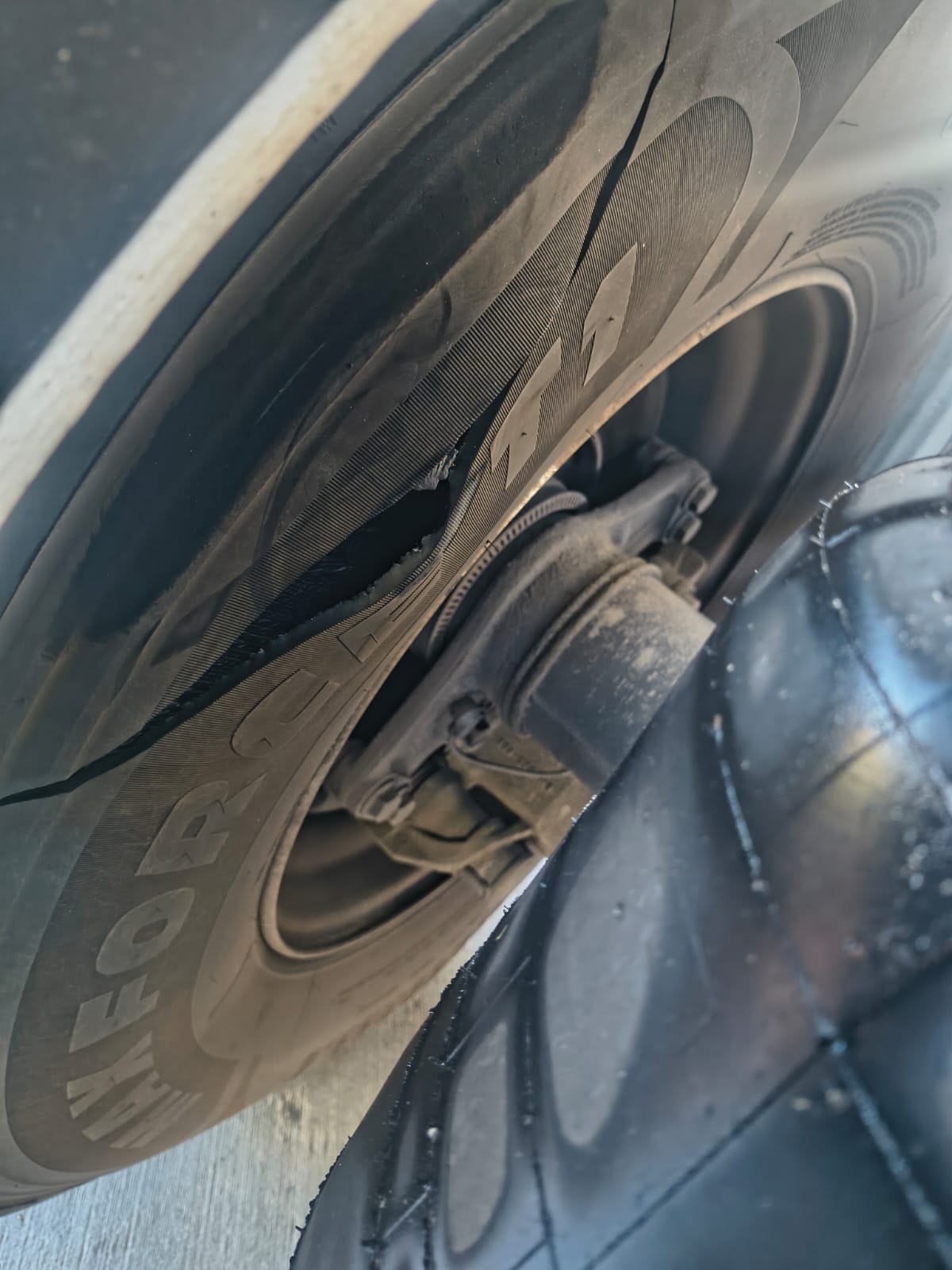
In September 2026, a Scania articulated truck was driving on the A19 near Malchin when the right tire of a dual-wheel pair on the drive axle blew out. The driver first noticed only a dull thumping noise, kept the wheel steady, eased off the accelerator, and moved onto the hard shoulder in a controlled way over roughly 300 meters. After stopping, he waited inside the cab, put on the hi-vis vest, placed the triangle at a sufficient distance, and waited behind the barrier for the mobile tire team dispatched by LKWHelp24. The team arrived within about 40 minutes, and the full wheel change, including a check of the second dual tire, took just over two hours. The driver was back on the road the same day, with no follow-on damage to the vehicle and no dangerous situation in traffic. This calm, correctly sequenced response is exactly what we hope for every driver in a real emergency.
When help needs to be called
Once you are safely behind the barrier, the next step is calling a mobile tire service. LKWHelp24 is available around the clock, in German, English, Polish, and Russian, via WhatsApp at +49 160 5753826. Typical response time is 30 to 60 minutes, depending on the exact location on the autobahn and current traffic conditions. Giving an exact location speeds up help significantly, ideally the kilometer marker from the nearest autobahn sign or GPS coordinates from a navigation device. What to expect afterward in terms of costs and process is covered separately, for example in our article on truck towing costs, for cases where the vehicle cannot be repaired on site, or in the overview of our mobile truck tire service. LKWHelp24 works exclusively with commercial vehicles from 7.5 tonnes upward, meaning articulated trucks, solo trucks, and heavy vans in that weight class, see also our overview of truck models in Germany and breakdown assistance from 7.5 tonnes.
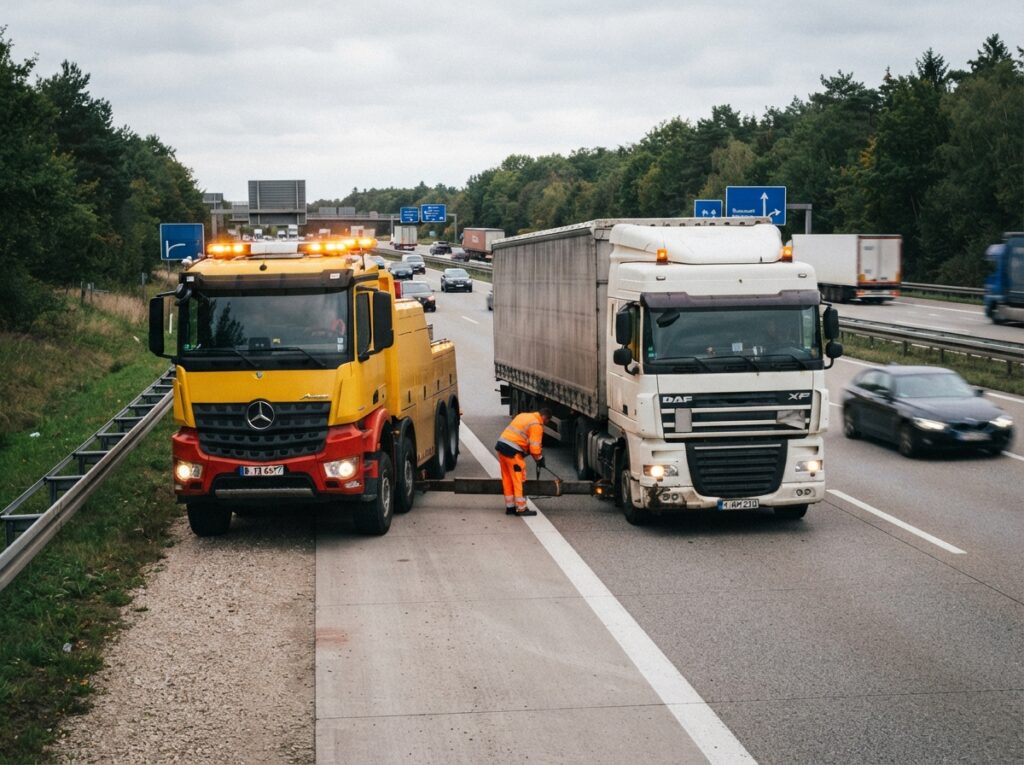
If the truck actually has to be towed, for example after rim damage or when no suitable replacement tire can be fitted on site, its own set of safety rules applies for the towing process itself, which we describe in our article on what to keep in mind when towing. For the wider question of when and how to use hazard lights, beyond the immediate breakdown situation, our article on hazard lights: meaning, StVO rules and behavior for truck drivers gives a good overview.
Preventive checks before departure
Much of what matters in an emergency can be defused with a short check before setting off. Looking at the pressure of every tire, not just the visibly mounted ones but also the inner tires in dual setups, takes a few minutes but can save hours on the hard shoulder later. Just as important is a visual check for foreign objects, cuts in the sidewall, or uneven wear that might point to a wheel alignment problem. Drivers who regularly operate the same tractor unit develop a feel over time for how the vehicle normally handles, and that feel makes it far easier to tell an early tire failure apart from a harmless bump in the road. For a general overview of truck models operating in Germany and what breakdown coverage looks like above 7.5 tonnes, our related article is a useful starting point, as is the general comparison of towing situations noted above.
Frequently asked questions
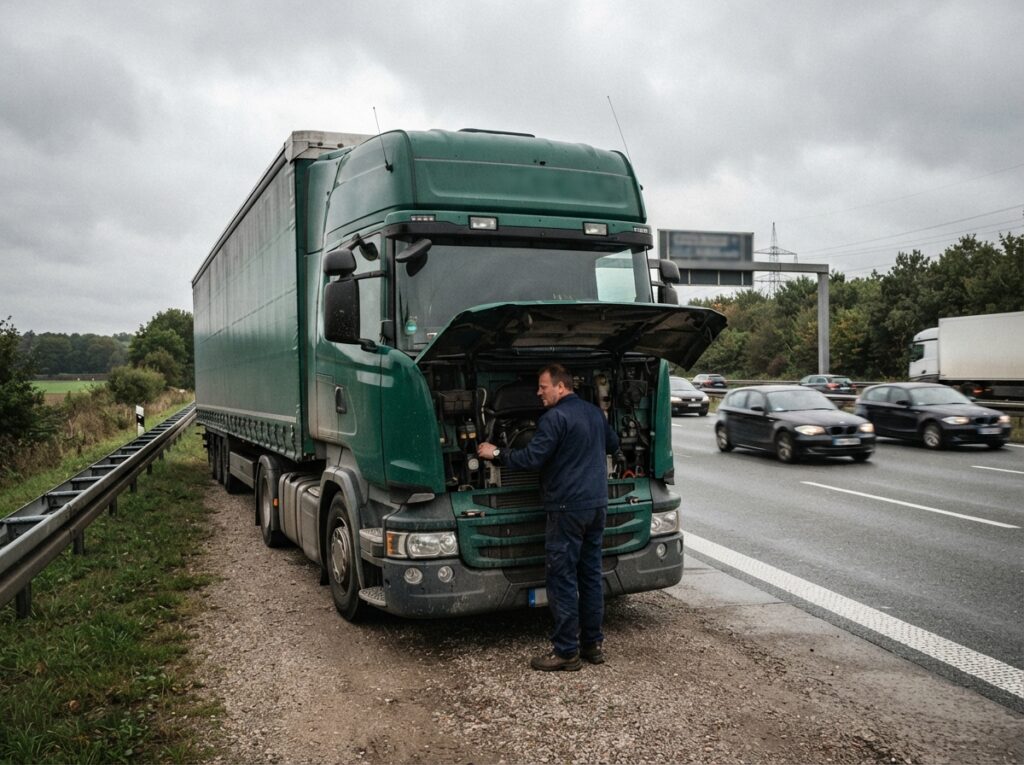
**How far can I drive on a flat tire to reach the next exit?** Practically not at all. Even a few hundred meters on a tire with no pressure or a blown tire can further damage the rim, brake lines, and suspension. As soon as there is a safe opportunity to stop, it should be used, even if the shoulder is not in an ideal spot.
**Do I need to call the police for every tire blowout?** Not necessarily, as long as no one is injured and no other vehicle was involved. But for a breakdown in moving traffic on the autobahn, especially if the truck is not fully on the shoulder or a lane is blocked, calling the police or the motorway maintenance authority makes sense so that traffic warnings can be triggered if needed.
**What if there is no hard shoulder available?** On some stretches, for example through roadworks or on multi-lane approach roads, there is no shoulder. In that case, move as far right as physically possible, hazards on, and if the lane width allows it, head for the next designated lay-by or parking area, even if that means a short additional distance. If that is not possible, the only option is to stay seated with the seatbelt on and call for emergency help immediately rather than stepping out into moving traffic.
**How do I know if a tire on the dual-wheel axle is affected if I cannot see anything?** Watch for slightly changed handling, minimal pulling to one side, a new, steady noise from the tandem axle area. Any time there is a suspicion, a quick visual check at the next safe opportunity is worthwhile, using a flashlight between the two tires if it is dark.
**Is one warning triangle enough, or do I need extra protection?** A warning triangle is the legal minimum. In darkness, fog, or on heavily trafficked stretches, an additional warning beacon or flashing light, if carried in the vehicle, is a useful addition, but it does not replace the triangle.
**How does the cost of mobile tire service compare to waiting for a tow truck?** Mobile tire service usually repairs or replaces the tire directly on site, saving time and therefore also demurrage or extra costs from cargo under deadline pressure. Towing only becomes necessary once the damage goes beyond the tire itself, for example a damaged rim or axle. Detailed figures and examples are available in our overview of truck towing costs.
A tire blowout on the autobahn cannot always be prevented, even with the best maintenance and correct tire pressure. What can be controlled is the reaction in the first seconds and minutes afterward. Staying calm, holding the wheel firmly, merging onto the shoulder in a controlled way, putting on the vest before exiting, keeping enough distance for the triangle, and spending the waiting time behind the barrier are the points that decide safety in a real emergency. LKWHelp24 is reachable around the clock via WhatsApp at +49 160 5753826 whenever help is needed on site.