Skip to content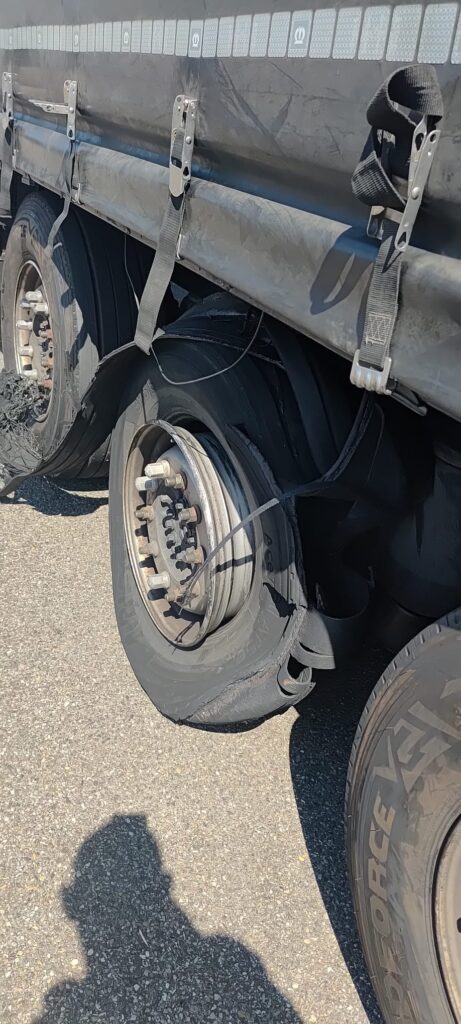
TL;DR: On 12 August, a sharp piece of gravel wedged in the tread groove of a semi-trailer tyre (385/65 R22.5) punched through the carcass while the driver was manoeuvring at a rest area on the A31 near Gronau. From the first call to departure it took 1 hour 40 minutes, at a total cost of €830 net.
A tyre failure on the motorway usually has an obvious cause: a sharp object on the carriageway, a kerb strike, an overloaded axle. The case described here is quieter and, for that reason, more dangerous. The tyre wasn’t damaged while the artic was moving on the road — it was damaged while parked, and the damage built up over hours rather than in a single second.
Loose gravel and construction debris on poorly maintained truck parking areas is an underrated risk for hauliers. A single stone pressed into a tread groove during a manoeuvre looks harmless. With every further rotation it gets driven deeper, until it works through the rubber down to the steel belt. That is exactly what happened on 12 August at a rest area on the A31, close to the Dutch border, near Gronau.
The Situation: A Semi-Trailer with Tyre Damage Near the Dutch Border
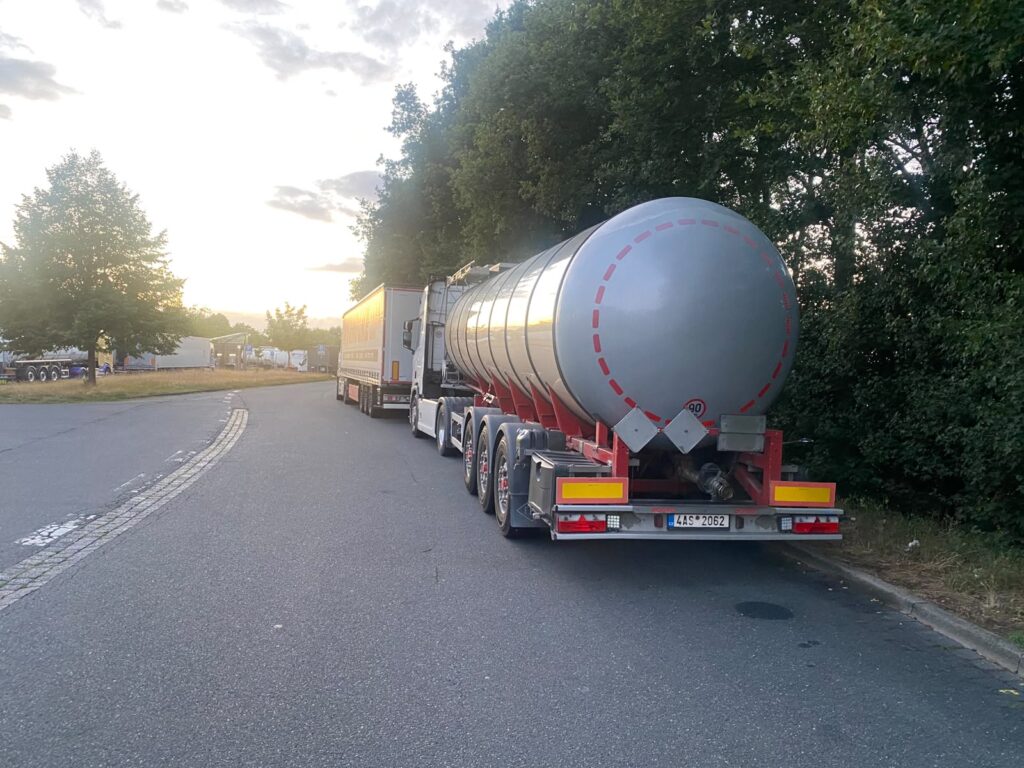
The driver of an articulated lorry had stopped overnight at a rest area on the A31 near Gronau. The surface there is asphalt, but patched with coarse gravel and loose stone chips in places — typical of parking areas that haven’t seen resurfacing in years. While manoeuvring out of the bay in the morning, the driver noticed an unusual noise from the trailer’s right-hand axle.
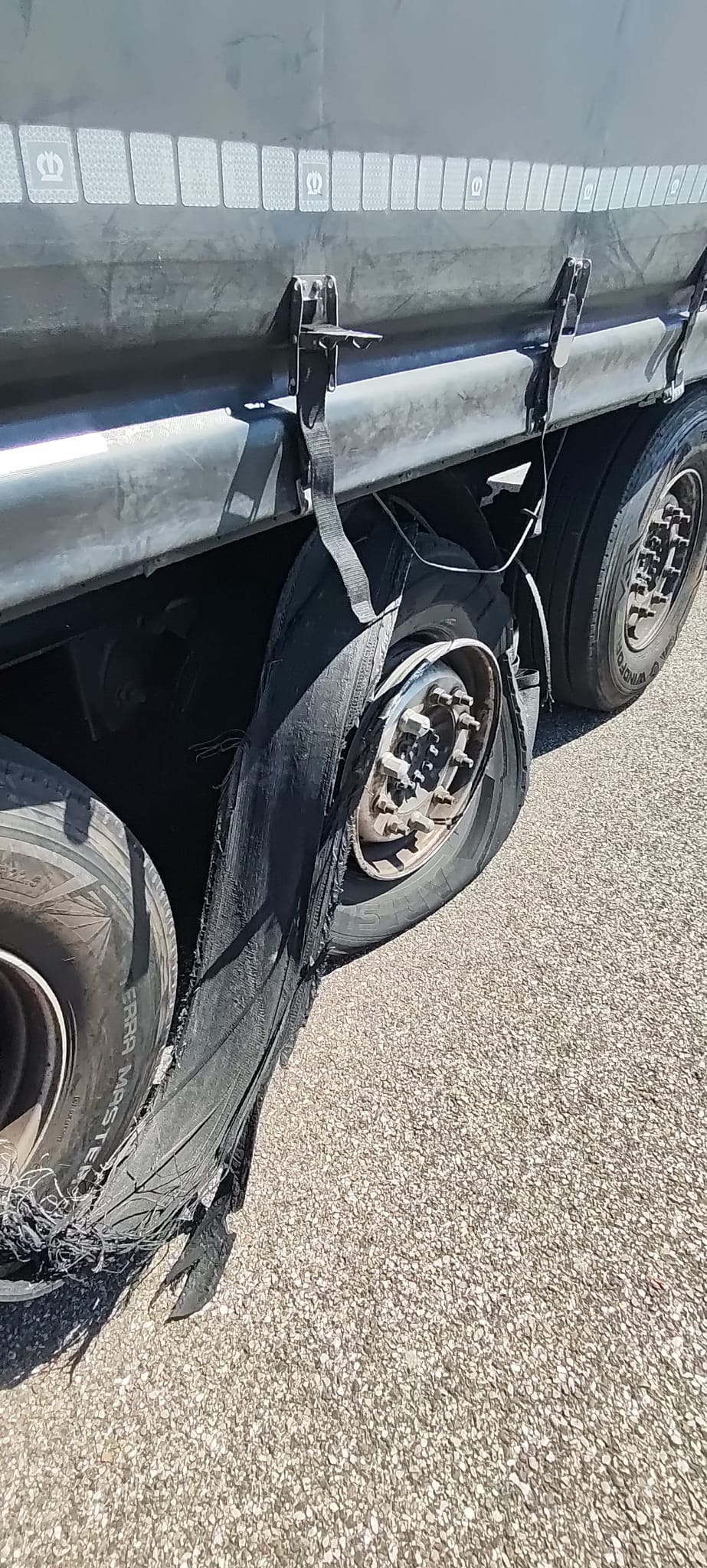
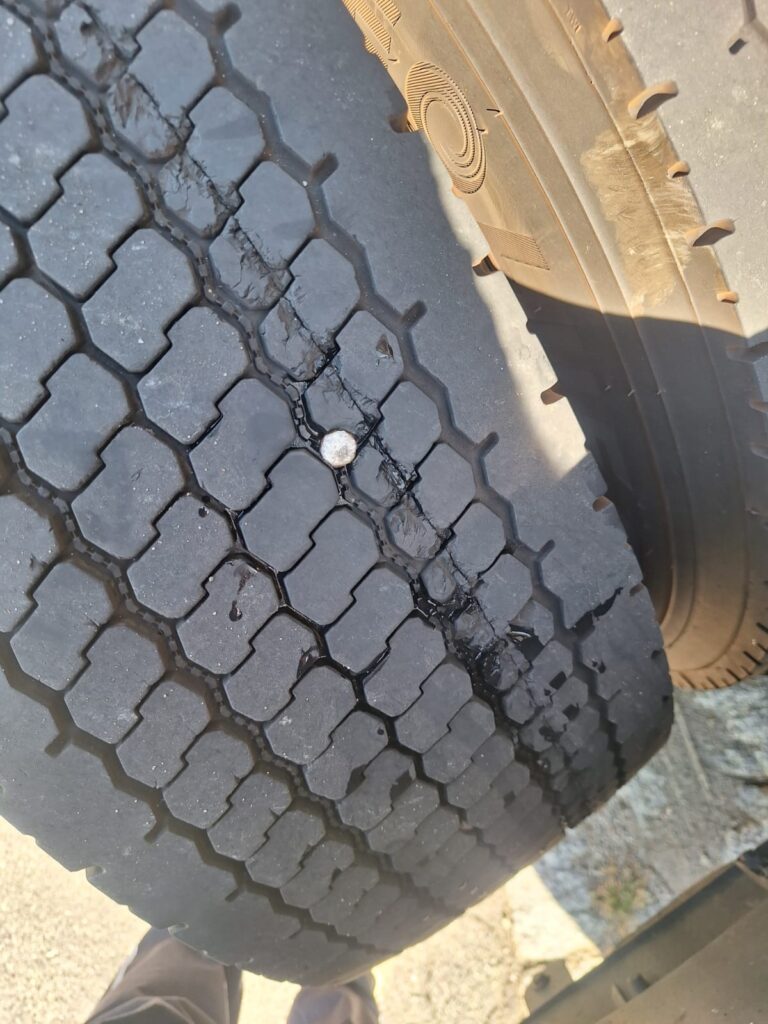
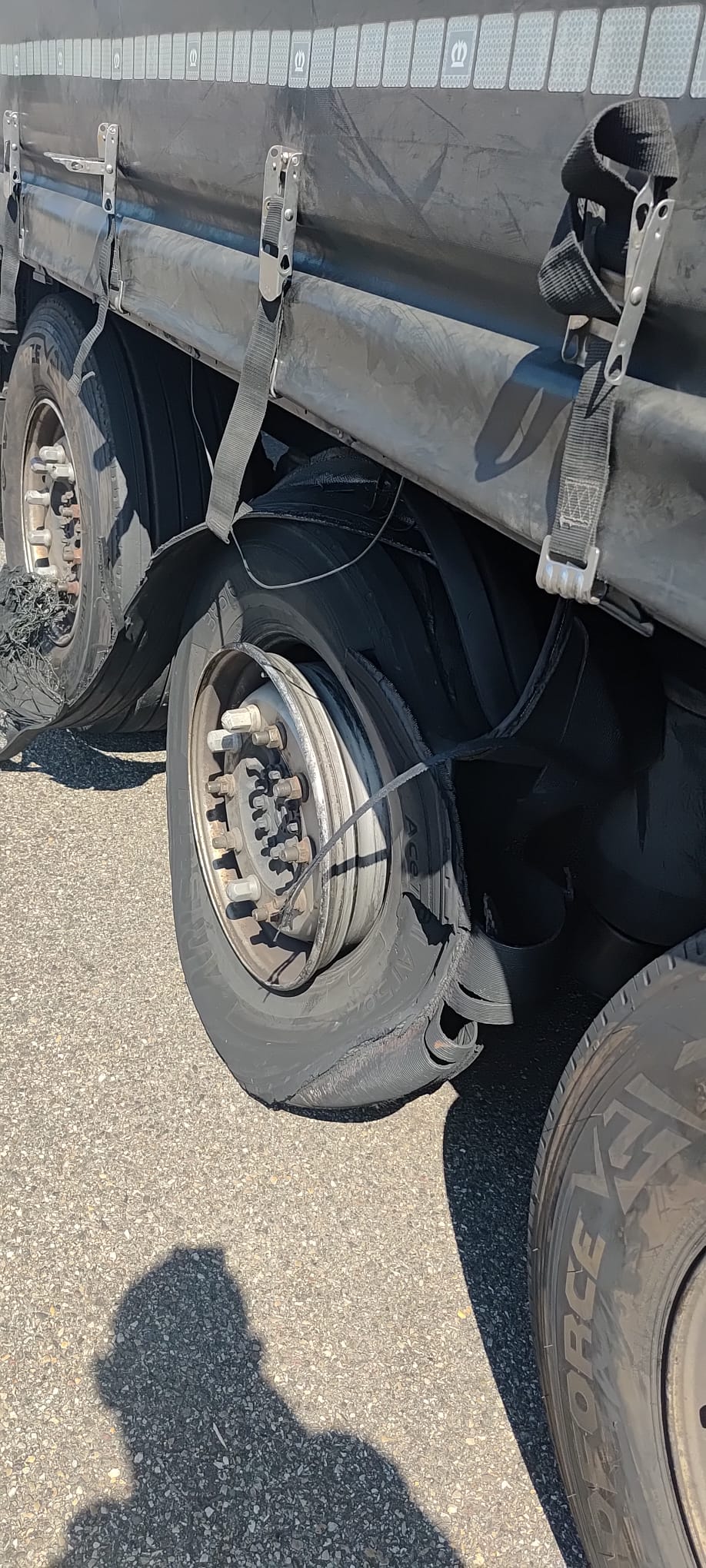
A visual check revealed a hole in the tread of a tyre sized 385/65 R22.5 — the standard dimension for semi-trailers across Europe. A chunk of gravel was lodged deep in the tread groove, and the carcass beneath it had been punctured, air audibly escaping. Continuing the journey was out of the question: on a trailer running twin wheels, a failure on one tyre instantly shifts the load onto its twin, overloading it in turn and risking a second failure soon after.
The driver called our emergency line at around 13:10. The situation was clear-cut: no accident, no recovery needed, but a vehicle that was technically unroadworthy in broad daylight at a rest area near the border. Cases like this fall squarely under our mobile truck service, dispatched straight to the vehicle rather than routing it through a workshop.
How We Organised the Response
Our dispatch operates 24/7 and covers the whole of Germany, including border regions like the Münsterland. The sequence for this job:
- Take the call — location, tyre size and damage pattern are established up front, no guessing once the technician is on site.
- Activate a partner workshop from the regional network — for the Gronau/Münsterland area, a tyre fitter with a matching 385/65 R22.5 tyre in stock was available.
- Confirm the route and tyre availability before the technician sets off — a second trip wastes time and money.
- Brief the driver on how to secure the vehicle and what to do while waiting (warning triangle, hi-vis vest, don’t move the vehicle).
- Coordinate the technician on site through to completion and invoicing.
The short distance to the rest area allowed a quick response of roughly 40 minutes on the road. In total, 1 hour 40 minutes passed from the alert to completion — a daylight job with no rain and no motorway closure, so the process ran smoothly from start to finish.
Why a Damaged Trailer Tyre Isn’t a “Deal With It Later” Problem
A heavy-goods tyre runs at an inflation pressure of 8.5 to 9.5 bar — considerably higher than a car tyre. Once the carcass is punctured, the structural integrity is compromised even if the tyre is still holding some air. Driving on regardless sharply increases the risk of a sudden blowout, with possible damage to the mudguard, brake lines or, worst case, danger to other road users.
With twin-wheel fitment, standard on most trailer axles, there’s a second effect: if one tyre fails, its twin absorbs the full axle load. That causes overheating and accelerated wear, often unnoticed by the driver until the second tyre also fails. That’s why the rule for any carcass damage is simple: replace it, don’t keep driving.
The legal minimum tread depth for lorry tyres under § 36 StVZO is 1.6 millimetres, though in practice long-haul vehicles should be changed well before that limit. A tyre with a foreign object embedded in the tread fails inspection immediately, regardless of remaining tread depth, because the carcass itself is compromised.
How a Stone in the Tread Slowly Kills a Tyre
A stone lodged in a tread groove gets pressed deeper into the rubber with every wheel rotation, until it breaks through the belt and lets moisture reach the steel cord. Unlike a sudden blowout, this is a gradual process that can take days or weeks before the tyre visibly loses pressure.
The mechanism runs in three stages. First, a sharp-edged piece of gravel or debris lodges in a tread groove, usually during manoeuvring on unpaved or poorly maintained ground. As the tyre rolls, the axle weight drives the stone a little deeper with each turn. After a few hundred kilometres, the stone has worked through the rubber down to the steel belt.
From that point, the critical phase begins: moisture tracks in along the embedded object and reaches the steel cord, the belt starts to corrode, and the bond between rubber and steel weakens. The tyre loses structural strength at that spot without much visible from outside — until pressure loss sets in or the carcass gives way under load, as happened at this rest area on the A31.
Stone Ejectors: The Unassuming Helpers in the Tread
Stone ejectors are small rubber lugs at the base of the tread grooves on lorry tyres, designed to stop stones from lodging in the first place. They’re typically angled against the direction of rotation, actively pushing small foreign objects back out as the tyre rolls, rather than letting them press in deeper.
The design only works as long as there’s enough tread depth. On a heavily worn tyre, the stone ejectors have worn down along with the rest of the tread, and their effect drops off noticeably. That’s exactly the stage — moderate to advanced wear — where the risk of stone damage rises disproportionately: the tyre isn’t worn enough to warrant replacement yet, but it’s already too worn to protect itself.
Manufacturers such as Continental and Michelin design stone-ejector geometry specifically for the intended application — long-haul tyres differ from construction-site tyres with coarser tread. For fleet managers, that means checking whether the tread pattern actually suits the operating environment, especially where trucks regularly use unpaved or poorly maintained parking areas.
Clearing Stones Out Is a Duty, Not an Optional Extra
Regularly picking stones out of the tread is part of the mandatory routine of every vehicle check, not an optional extra. Many drivers skip this step on the daily walkaround because it feels time-consuming and rarely shows immediate consequences — which is exactly why it matters.
The correct procedure: at every fuel or rest stop, take a quick look at all tread grooves and carefully lever out any visible stones with a blunt tool — a tyre pick or a sturdy plastic scraper. Important: never use a screwdriver or a sharp metal tool. A screwdriver easily slips and cuts into the rubber itself, making the damage worse rather than fixing it.
Workshops and tyre services carry dedicated tyre picks in their kit, matched to the groove width of heavy-goods tread. Drivers without specialist tools can manage with a sturdy wooden or plastic wedge. For stones lodged deep enough to be touching the carcass, don’t attempt DIY removal — that assessment belongs with a tyre professional, since pulling out an embedded object incorrectly can trigger an immediate pressure loss.
Poorly Maintained Rest Areas as a Source of Damage
Rest areas and informal parking spots with loose gravel, construction debris or metal scraps are one of the most common yet most overlooked causes of tyre damage in long-haul haulage. Unlike damage from objects on the carriageway, which usually happens suddenly while driving, this kind of damage builds up during standstill — while parking, manoeuvring and pulling away again.
Areas near industrial estates and building sites are particularly affected, where construction vehicles regularly carry gravel, concrete debris or metal filings onto the asphalt. Older rest areas that haven’t been resurfaced in years also tend to show cracks and broken edges, from which loose stone gradually works free. Potholes and damaged kerbs add to the risk, especially at night when drivers can’t fully see the surface.
The ADAC has repeatedly flagged a chronic shortage of well-equipped truck parking along German motorways — a structural problem that often forces drivers into makeshift stops on poorly maintained ground. Given a choice, these areas are worth avoiding, even when they sit closer to the planned route.
Manoeuvring in a Parking Bay: The Underrated Risk
Tyre damage while manoeuvring often doesn’t come from driving itself, but from the manoeuvre — tight steering lock, kerb contact, or embedded debris that only shows its full effect once the wheel moves. Turning with full lock rubs the tyre sidewall against a kerb edge, effectively pinching the tyre between the wheel and the obstacle.
This effect matters most on tight, poorly lit parking areas, where drivers have little room to manoeuvre while reversing or turning. Unlike driving at a constant speed, manoeuvring puts high lateral loads on the tyre while the vehicle’s full weight rests on a small contact patch. If the tyre meets a stone or a sharp edge at that moment, the damage is amplified rather than rolled over harmlessly.
Drivers who regularly manoeuvre on tight or unfamiliar ground should walk the area briefly before the manoeuvre, particularly in the dark or wet. Those two minutes can save hours of downtime.
How to Choose a Good Parking Area: The Economics
A secure, well-maintained truck stop typically costs €10 to €20 per night — a single damaged trailer tyre, with call-out and labour, costs over €800, on top of the lost time. The maths clearly favours the paid site once you factor in downtime risk.
A quick comparison of the relevant criteria:
| Criterion | Informal/free parking | Secure truck stop |
|---|---|---|
| Cost per night | €0 | approx. €10–20 |
| Surface | often cracked, gravel/debris | regularly cleaned |
| Lighting | frequently inadequate | generally good |
| Cargo security | low | monitored, often fenced |
| Tyre risk | elevated | significantly reduced |
Digital booking platforms for truck parking make it much easier to plan ahead along the route, so drivers aren’t forced onto the nearest available bay once fatigue sets in. A glance at official overviews of rest areas and rest stops along the motorway also helps with route planning.
Cargo Security at Parking Areas: More Than Just Tyres
Poorly maintained, unguarded parking areas carry a second risk beyond tyres: fuel and cargo theft. Freight authorities and haulage associations regularly report rising theft figures at poorly lit, unmonitored areas along German motorways. A cheap parking spot can turn out to be doubly expensive — first the tyre damage, then, in the worst case, lost diesel or freight.
Guarded areas with cameras and fencing cost more than a verge next to the motorway, but pay for themselves quickly once you add up tyre damage, downtime and theft risk. For hauliers carrying high-value freight, that calculation is standard practice already, and it’s worth the same attention for smaller fleets.
After a Night on Gravel: What to Check Before Setting Off
After any overnight stay on a surface with gravel or loose stone, a short, systematic walkaround before the engine even starts is worth the time:
- Check every tyre with a torch — look specifically for stones or debris lodged in the tread grooves, not just a glance in passing.
- Feel the tread grooves if anything looks off — a deeply embedded stone can sometimes appear as no more than a small dark mark from a distance.
- Check sidewalls for scuffs or bulges, especially after manoeuvring near kerbs.
- Check tyre pressure — a tyre that’s already damaged often shows a slight pressure drop before it fails outright.
- If in doubt, call a tyre service rather than setting off and taking the risk on the motorway.
This walkaround rarely takes more than five minutes, but it’s exactly what would have prevented the several hours of downtime this rest area job on the A31 caused.
The Tyre Change on Site: Step by Step
Replacing the damaged trailer tyre took 45 minutes on site, following the standard procedure for a safe wheel change on a semi-trailer.
- Visual inspection and diagnosis — the technician confirmed the damage caused by the embedded stone and checked the neighbouring twin tyre for consequential damage.
- Secure the vehicle — wheel chocks, warning triangle and securing the work area at the rest stop.
- Loosen wheel nuts and remove the wheel — extra care on twin-wheel fitments to avoid damaging the neighbouring tyre.
- Fit the new tyre (385/65 R22.5), including balancing.
- Final check: tightening the wheel bolts in a star pattern to the specified torque, followed by a final pressure check to 8.5–9.5 bar.
Tightening the wheel bolts in a star pattern spreads the clamping force evenly across the hub — a step that’s often skipped in improvised roadside repairs and can later cause vibration or loosened bolts.
The Full Timeline
| Time | Phase | Action |
|---|---|---|
| 13:10 | Alert | Driver reports tyre damage at rest area on A31/Gronau |
| 13:10–13:25 | Dispatch | Locate driver, confirm tyre size, activate partner in the Münsterland |
| 13:25–14:05 | Response drive | Technician travels to the rest area (short distance, 40 minutes) |
| 14:05–14:50 | Tyre change | Removal, fitting 385/65 R22.5, star-pattern torquing |
| 14:50 | Complete | Vehicle roadworthy again, driver continues journey |
Total time from call to departure: 1 hour 40 minutes.
What Did the Job Cost?
| Item | Price (EUR, net) |
|---|---|
| Call-out fee | 220 |
| Labour (1 hr at €110) | 110 |
| Trailer tyre 385/65 R22.5 | 480 |
| Old tyre disposal | 20 |
| Total | 830 |
All prices are net, plus VAT. The short response distance and daylight conditions kept the cost at the lower end of the usual range for trailer tyres. For comparison, a stranded artic loses between €800 and €1,200 per day depending on cargo and contract penalties — the on-site tyre change had already paid for itself within a few hours of avoided downtime.
Factors that affect the price of a tyre change: time of day (night and weekend call-outs cost 25–50% more), distance to the partner workshop, whether the exact tyre size is in stock, and any additional damage to the rim or hub.
Why a Professional Should Handle the Tyre Change
Changing a tyre on a semi-trailer looks technically simple, but carries real risks without experience or the right tools:
- Incorrect torque on the wheel bolts causes uneven clamping, which in the worst case can lead to a wheel coming loose in transit.
- Damage to the neighbouring twin tyre during improper removal, if a tool slips or is positioned wrongly.
- Missed diagnosis of consequential damage — an untrained eye often doesn’t spot a bent rim or a damaged hub.
- Safety risk at the rest area with no securing of the work zone against manoeuvring vehicles.
- No replacement tyre in the correct size on hand, which tempts a fit with an unsuitable tyre.
A professional truck workshop tyre service brings not just the right tools but the correct tyre size straight to the vehicle — a decisive time saving compared with a DIY repair or towing to a workshop.
Typical Situations We Respond To Nationwide
Our network covers the whole of Germany and handles a wide range of tyre and breakdown situations:
- Tyre blowouts on the motorway at full speed, as in our job near Hof for a DAF artic
- Stone and debris damage at rest areas, as in this case
- Slow leaks that drivers only notice after several hundred kilometres
- Rim damage combined with tyre blowouts after kerb contact
- Twin-wheel double failures on car transporters and trailers
Prevention for Drivers and Fleets
Anyone regularly stopping at varying parking areas can cut the risk of stone damage significantly with simple routines:
- Build a short walkaround checking every tread groove into the departure routine.
- Remove stones consistently with a blunt tool, never a screwdriver or knife.
- Prefer guarded, well-maintained truck stops, even at a slightly higher cost.
- Check tyre pressure regularly — underinflation lets foreign objects work in deeper.
- Keep an eye on tread depth, since stone ejectors lose their protective effect once wear is advanced.
- Contact a tyre service at the first sign of trouble rather than driving on and hoping.
Tyres and Fleet Maintenance: The Bigger Picture
Tyres are one of the most maintenance-intensive areas of commercial vehicle operation. Manufacturers such as Michelin, Continental, Goodyear and Bridgestone develop long-haul tread patterns with reinforced stone ejectors and tougher carcasses specifically for operating areas with frequent contact with unpaved ground. Tyre brand and tread pattern should be chosen based on the fleet’s actual operating profile, not purchase price alone.
Regular checks of tyre pressure and tread depth as part of routine fleet maintenance not only reduce the risk of failure but extend overall tyre life. A well-kept maintenance log catches wear patterns early, before a single stone turns into a costly day off the road.
Why Choose LKWHelp24
Our network of tyre fitters and breakdown partners covers the whole of Germany, 24 hours a day, seven days a week. Dispatch is staffed multilingually, so international drivers can describe their situation without a language barrier. Pricing is transparent — the cost range is communicated before the job starts, with no hidden items on the invoice. Our tyre service covers both fast emergencies and planned fleet maintenance, and our contact page lists every way to reach dispatch.
Summary: The Key Numbers
- Tyre size: 385/65 R22.5
- Location: Rest area on the A31 near Gronau, close to the Dutch border
- Response time (dispatch + drive): 55 minutes
- Total duration: 1 hour 40 minutes
- Total cost: €830 net
- Cause: Gravel lodged in the tread groove, punctured the carcass while manoeuvring
Frequently Asked Questions
What does a truck tyre change at a rest area cost?
A trailer tyre sized 385/65 R22.5 usually costs between €750 and €950 net including call-out and labour. In this case the total came to €830, as the drive was short and the job happened in daylight.
How do I spot stone damage in the tread before it causes a failure?
A stone in a tread groove is usually visible during inspection as a small dark object or debris. If the tyre already feels soft or is losing pressure at that point, the carcass has already been punctured and the tyre needs replacing.
Can I remove stones from the tread myself?
Yes, surface-level stones can be removed with a blunt tool such as a tyre pick. For stones lodged deep enough to be touching the carcass, the assessment belongs with a professional.
How long does an on-site trailer tyre change take?
For a single tyre, the change itself takes 30 to 60 minutes. In this case it was 45 minutes, including balancing and a final pressure check.
Why is a guarded parking area more expensive but still cheaper overall?
A guarded truck stop costs €10 to €20 per night but prevents gravel-related tyre damage and reduces theft risk. A single tyre failure costs more than 40 nights at a guarded site.
What happens if I keep driving on a damaged tyre?
The weakened carcass can fail suddenly (a blowout), which at speed can cause loss of control. On top of that, one tyre failing overloads its twin on the same axle.
Get Help Now
Tyre damage at a rest area, on the motorway, or at your own yard — our team is available around the clock. Call us on +49 160 5753826 or visit www.lkwhelp24.com. We operate 24/7 across the whole of Germany.
Keywords: truck tyre service | trailer tyre damage | tyre puncture rest area | stone ejectors truck tyres | 385/65 R22.5 | truck parking safety | 24/7 breakdown assistance Germany