On 24 September 2026 a semi-trailer sat on a rest area of the A5 near Alsfeld, heading towards Kassel, with a flat 385/55 R22.5 tyre. A foreign object had lodged in the tread shoulder, the air was gone, and the driver called us at 14:40. Our mobile truck tyre service had a new tyre mounted, inflated to 9.0 bar and torqued by 16:45, so the total time from call to departure was 125 minutes. The bill came to 920 EUR plus VAT.
This write-up walks through the whole job: what the driver saw, how dispatch found a crew, what the repair involved, where every minute went and why the price landed where it did. If you run a fleet or drive a unit yourself, you can use it as a reference for what a roadside tyre job on a German autobahn realistically looks like.
The breakdown: a flat trailer tyre at a rest area on the A5
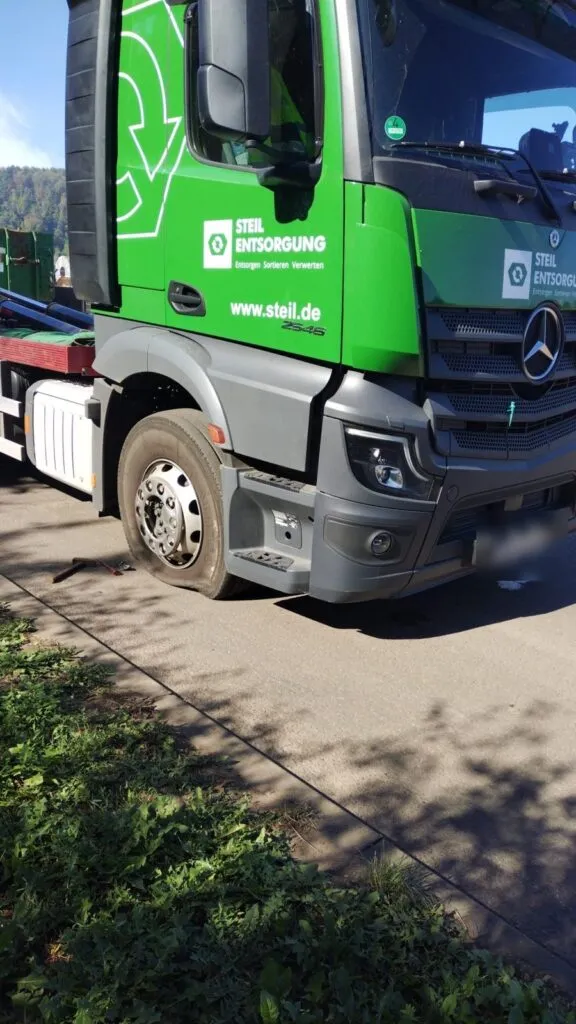
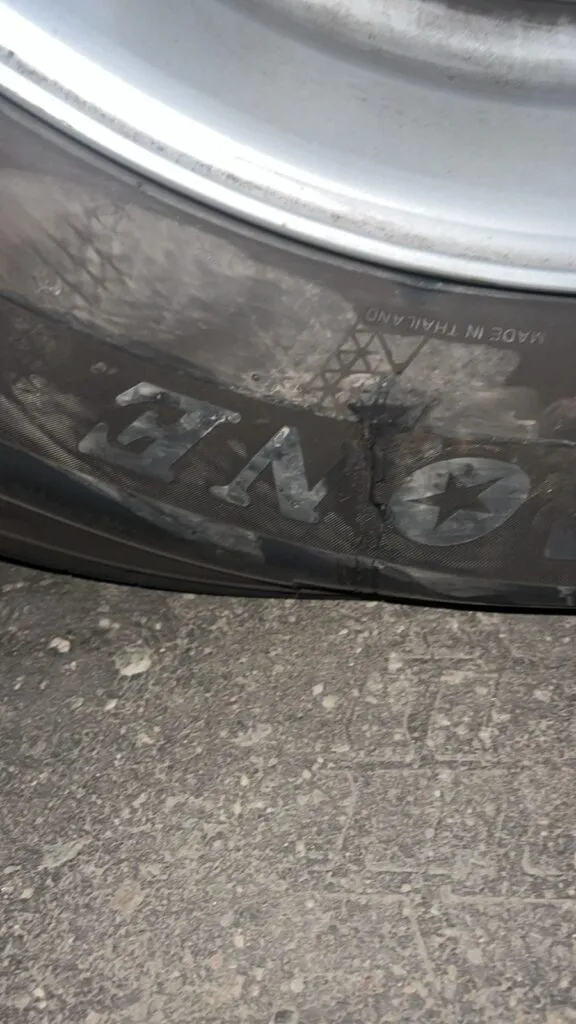
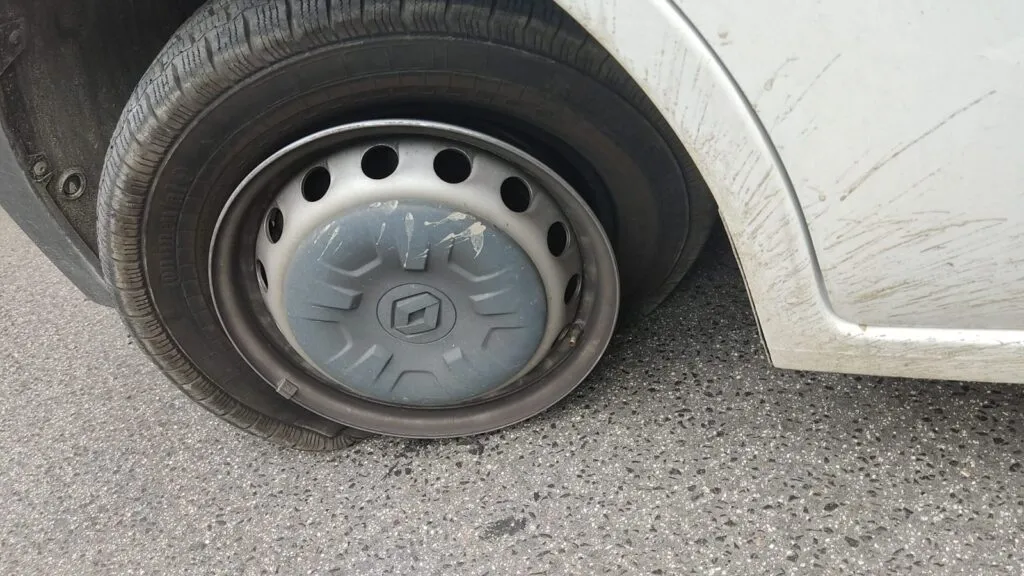
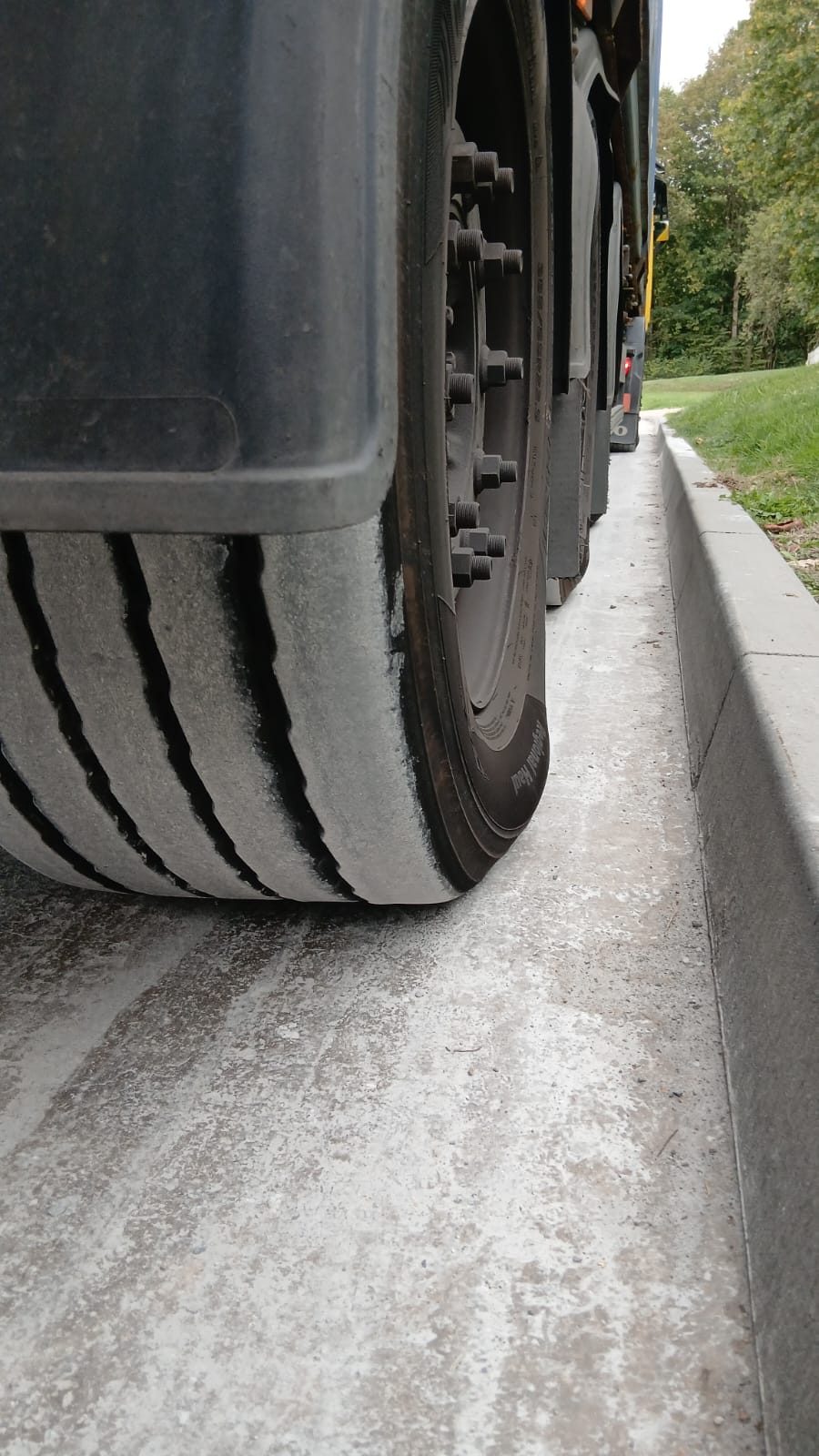
The driver had pulled into the rest area because the trailer felt wrong. A slight pull, a change in the road noise, then the tyre pressure warning. By the time he walked round the unit, the trailer tyre was sagging onto the kerb. The sidewall had flattened, white dust was smeared across the tread, and the rubber looked tired. The tread was worn well down, which matters for what happened next.
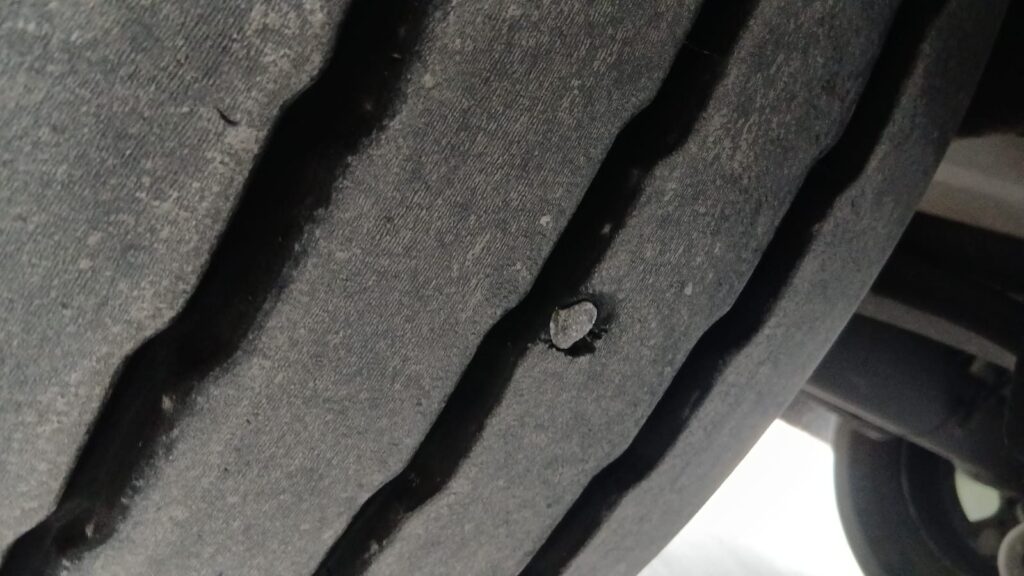
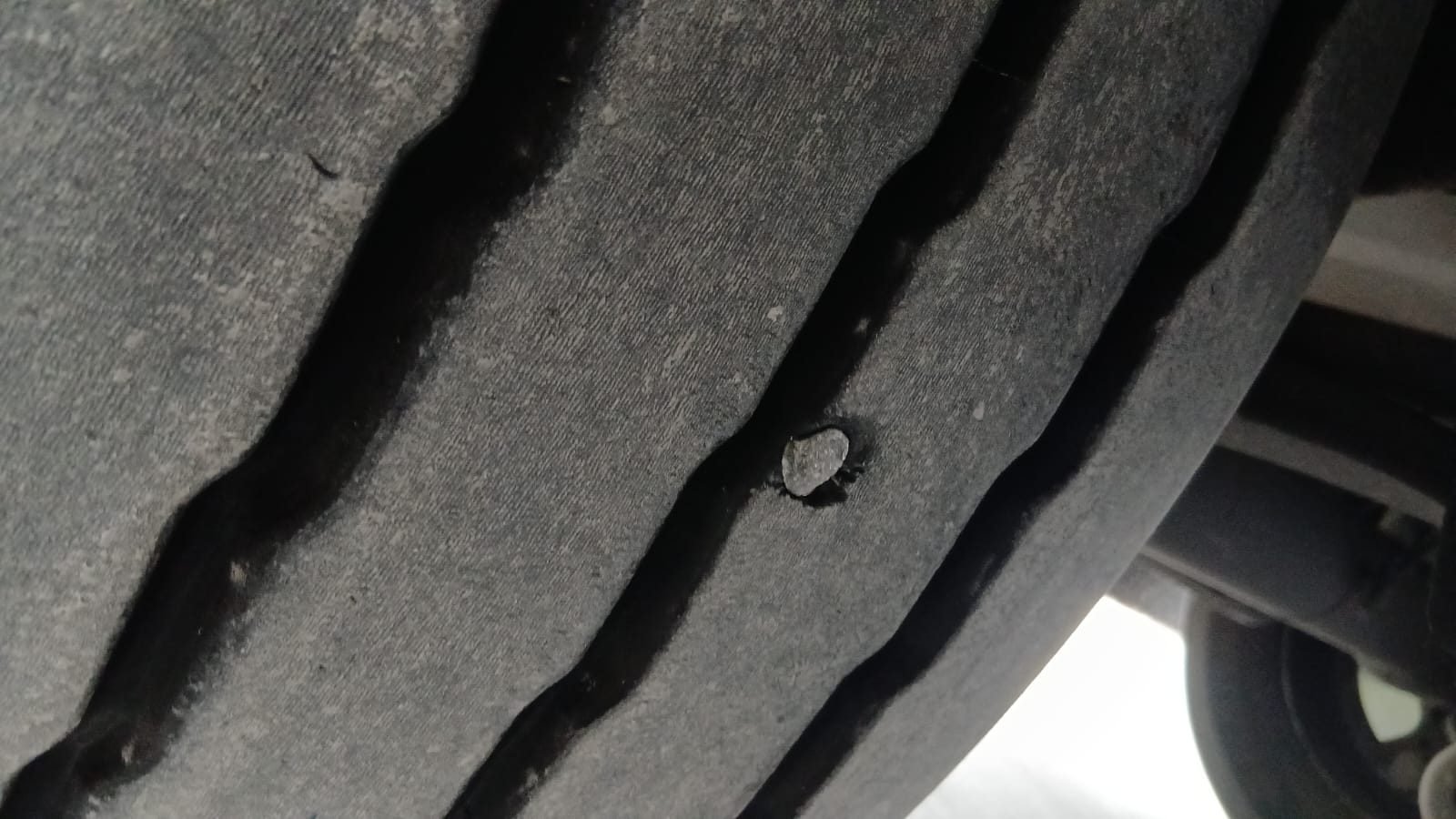
Between two tread ribs on the shoulder sat a hard foreign object, either a stone fragment or something nail-like. It had worked its way into the casing. Once the air started to leave, the tyre could no longer carry the axle load, and the driver, to his credit, stopped quickly instead of limping on to the next exit. It was a dry, overcast afternoon with the usual hum of traffic on the A5, and the rest area was quiet enough to make the job easy.
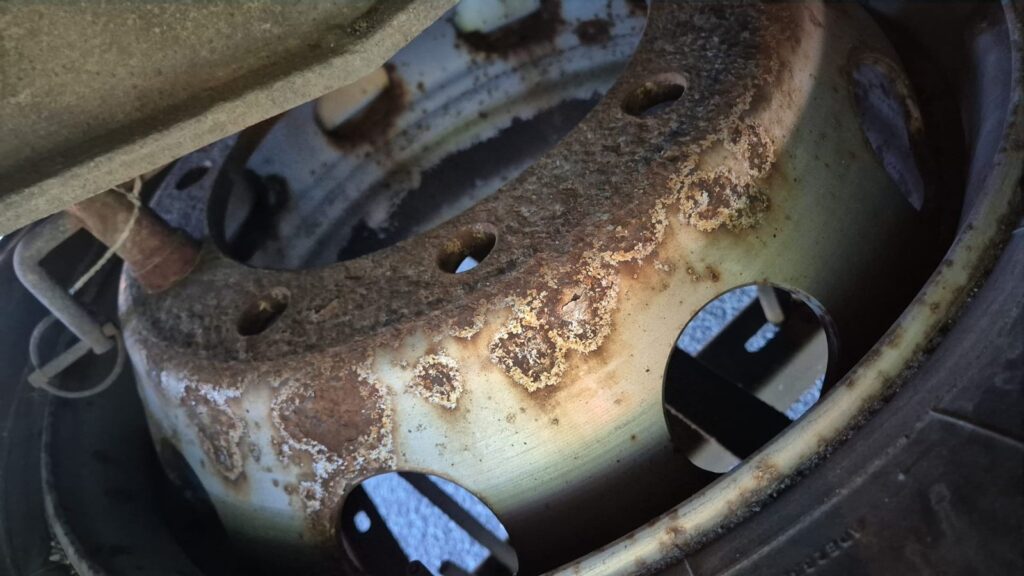
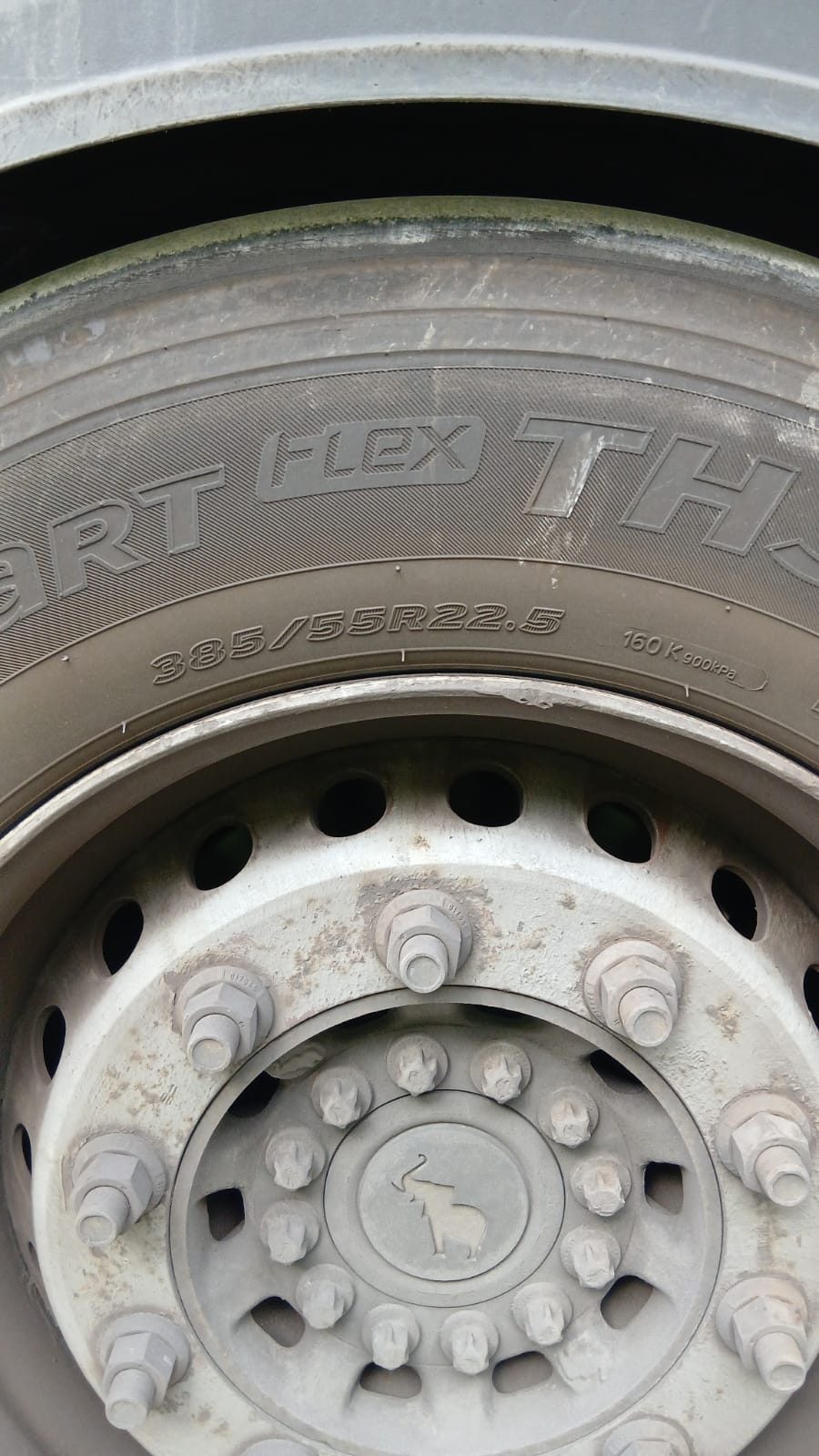
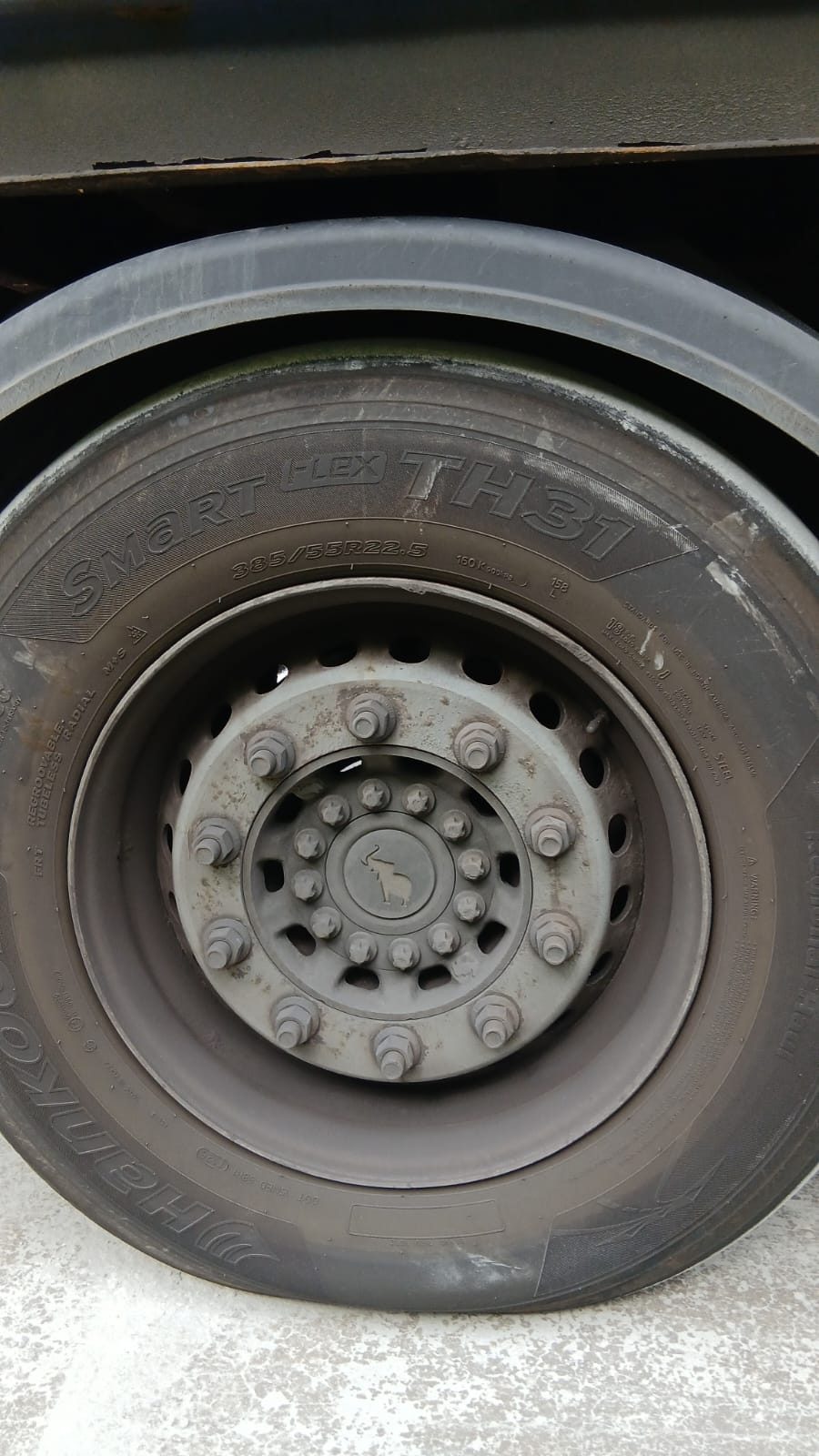
The tyre was a Hankook SmartFlex TH31 in size 385/55 R22.5, with a load index of 160 K, which corresponds to a maximum inflation pressure of 900 kPa, or 9.0 bar. The sidewall also carries the markings “regroovable”, “tubeless” and “radial”, and the second load rating 158 L for twin fitment. The rim was a steel one. The hub carried a cap with an elephant symbol that points to a BPW axle, though we phrase that carefully because the brand of the unit was not visible and the axle was never the problem.
Why a trailer tyre problem is never just a trailer problem
A flat on a trailer axle changes how the whole combination behaves. The remaining tyres on that axle take extra load, the braking balance shifts, and the sidewall of the flat tyre can be destroyed within a few hundred metres of rolling. A casing that has run flat is usually scrap, even if the tread itself could have been repaired.
For a loaded semi-trailer, the driver also faces a legal question. Tyre condition falls under § 36 StVZO, which covers tyre requirements and tread depth. A tyre that cannot hold air is not roadworthy, and nobody should drive on it, not even to the next workshop.
What to have ready when you call
A dispatcher can only act on what you tell them. Before you ring, take thirty seconds to gather these facts:
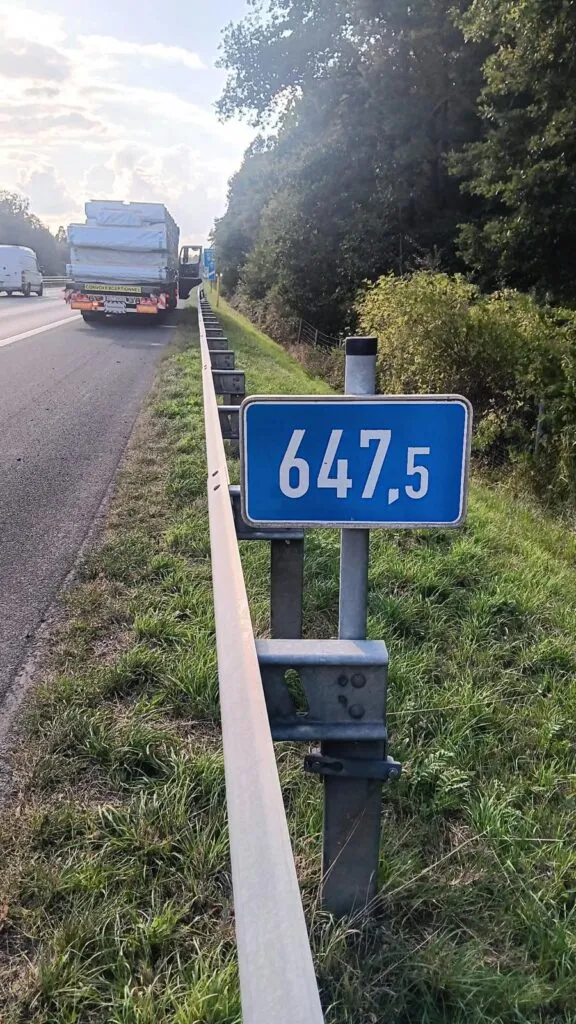
- The road and direction, plus the nearest exit, rest area or kilometre sign.
- Whether you are in a safe place such as a rest area, or on a hard shoulder.
- The tyre size from the sidewall, for example 385/55 R22.5, and the position of the wheel.
- Whether the unit is loaded, and whether the trailer is a single-tyre or twin-tyre axle.
- A phone number the crew can reach you on while they drive.
In this case the driver had the size ready, and that saved a call back. If you cannot read the sidewall, tell us the make and model of the trailer instead, and we will work out the likely size.
How we organised the help
Dispatch is where the first 15 minutes go, and they are not wasted. The driver rang our line at 14:40 and gave us three facts: autobahn A5, rest area near Alsfeld, direction Kassel, and a trailer tyre that was flat. We asked for the size, and he read it from the sidewall: 385/55 R22.5. That one detail decides whether the crew brings the right tyre on the first trip or has to come back.
Our dispatcher then worked through a short list:
- Confirm the exact position and the direction of travel, so the crew approaches from the correct side.
- Confirm the size, the load index and whether the unit runs singles or twins on that axle.
- Find the nearest crew in our partner network that has a 385/55 R22.5 on the van or in the depot.
- Quote the price to the driver before anyone starts driving, so there are no surprises later.
- Give the driver an arrival window and tell him what to do while he waits.
Between 14:40 and 14:55 all five points were done. The driver agreed to the price, and the crew of our service partner in the region confirmed a tyre in stock and left the depot. If your breakdown is further away from the nearest crew, the better answer may be a mobile truck service that comes from a different region, and our dispatchers will tell you straight which option is faster.
What the driver was asked to do while waiting
Waiting at a rest area is easier than waiting on a hard shoulder, but the basics still apply. The driver switched on the hazard lights, put on a high-visibility vest, and kept away from the flat wheel. He did not try to jack the trailer himself. He also checked that the trailer brake was applied, so the unit could not roll while he waited.
If you are ever in the same position on a live lane instead of a rest area, the sequence changes completely, and our checklist for a tyre blowout on the autobahn covers it in detail.
The situation on site: what the crew found at 15:50
The partner crew arrived at 15:50, after 55 minutes on the road. That is a normal figure for a rest area on a main autobahn at that time of day. Dry weather, light traffic, no roadworks on the route. In heavy rain, or with a closure ahead, the same drive can take an hour and a half.
The first 15 minutes on site went on inspection. The fitter checked the tread, found the foreign object in the shoulder, and looked at the sidewall, where the tyre had been resting on the kerb. He also looked at the steel rim and the hub. There was no visible deformation, no crack at the bead seat, no damage to the wheel studs. That is the best result you can hope for after a flat, because a bent rim or a damaged hub would have turned a one-hour job into a much longer one.
The verdict was clear: the tyre was beyond a sensible repair. The object had entered the shoulder, the tread was low, and the sidewall had taken the weight of the trailer on the kerb. A tyre in that state may hold air after a patch, but nobody can say what the inner liner looks like after it has been squashed. On a trailer axle that carries up to 10 tonnes, that risk is not worth taking.
Why 9.0 bar matters on a 385/55 R22.5
Truck tyres run at far higher pressures than car tyres. For this size and load index the sidewall marking points to 9.0 bar, and most operators run their trailer tyres between 8.5 and 9.5 bar depending on the axle load. A tyre that is 1 bar short loses a noticeable share of its load capacity and heats up faster, which is how many “mystery” blowouts start.
Load index 160 K means that a single tyre can carry up to 4,500 kg at a speed rating of 110 km/h when inflated correctly. In twin fitment the rating drops to 158, which is 4,250 kg per tyre. The ETRTO standards body publishes the dimension and load tables for this, and the ETRTO website is the right place to check a size you are unsure of.
Step-by-step repair: from the jack to the torque wrench
The actual work took 55 minutes, split into inspection, preparation, fitting and final check. Here is how it went, in the order the fitter did it.
Step 1. Inspection (15:50 to 16:05). Visual check of the tread, shoulder and sidewall. The fitter probed the tread with a pick, marked the position of the foreign object and checked the inside of the casing as far as the flat tyre allowed. He then checked the rim for cracks and the studs for thread damage. Result: replace the tyre, keep the rim.
Step 2. Securing the area and removing the wheel (16:05 to 16:25). The crew parked the service van so that it shielded the working area, put out the warning triangle, and chocked the wheels on the opposite axle. Then came the jack, set under the axle at the correct lifting point, and the wheel came off. Taking a wheel off a trailer axle takes longer than most people expect, because the nuts are torqued to a high value and the flat tyre gives no rigidity to work against.
Step 3. Fitting the new tyre (16:25 to 16:35). The old tyre came off the steel rim with a heavy-duty tyre changer. The bead seat, the rim flange and the valve hole were cleaned and checked. A new 385/55 R22.5 went on, with a fresh valve and a balance check. Then it was inflated to 9.0 bar in a safety cage, because the energy stored in a truck tyre at that pressure is enough to hurt someone badly if the bead lets go.
Step 4. Refitting the wheel (16:35 to 16:45). The wheel went back on the hub. The fitter ran the nuts down by hand first, then tightened them in a star pattern with a torque wrench, in two or three passes. The correct torque depends on the stud thread and the axle manufacturer. Our guide on truck wheel nut torque lists typical values and the right sequence.
Step 5. Final check (16:45). Pressure check with a calibrated gauge, a second look at the nuts, a quick walk-round, and a handover to the driver with the advice to re-check the nut torque after the first 50 to 100 km. The driver pulled out of the rest area right after.
What the crew deliberately did not do
The fitter did not attempt a quick plug in the shoulder. A repair in the shoulder zone is not permitted on a truck tyre under the usual repair standards, because the area flexes too much with every rotation. He also did not reuse the old valve, and he did not run the wheel on the hub with the nuts at “about right”. Those shortcuts save five minutes and cost far more later.
Full timeline: 125 minutes from call to departure
The table below shows every phase of the job. The three biggest blocks were dispatch (15 minutes), the drive (55 minutes) and the work on site (55 minutes). That split, 15, 55 and 55, is a good benchmark for a motorway breakdown in good conditions.
| Time | Phase | Action |
|---|---|---|
| 14:40 | Call | Driver reports a flat trailer tyre at the rest area, size 385/55 R22.5 and location confirmed |
| 14:40-14:55 | Dispatch | Nearest partner crew selected, tyre confirmed in stock, price agreed with the driver (15 min) |
| 14:55-15:50 | Arrival | Service crew on the road, 55 minutes of driving |
| 15:50-16:05 | Inspection | Tread, shoulder, sidewall and rim checked, foreign object found in the shoulder (15 min) |
| 16:05-16:25 | Preparation | Working area secured, jack placed, wheel removed (20 min) |
| 16:25-16:35 | Fitting | New 385/55 R22.5 mounted on the rim and inflated to 9.0 bar (10 min) |
| 16:35-16:45 | Final check | Wheel refitted, nuts torqued in a star pattern, pressure checked (10 min) |
| 16:45 | Done | Trailer released after the final check |
Total: 125 minutes (2 hrs 5 min) from the call to the trailer leaving the rest area. The photos were taken at 16:49.
Cost: what the roadside job cost, line by line
The job cost 920 EUR net, plus VAT. Nothing was added after the fact, and the driver knew the figure before the crew left the depot. This is how it breaks down.
| Item | Price (EUR) |
|---|---|
| Call-out (Anfahrt) | 260 |
| Labour, 1 hour (55 minutes, rounded up) | 115 |
| Tyre 385/55 R22.5 (trailer, new) | 480 |
| Fitting, balancing, valve | 45 |
| Disposal of the old tyre | 20 |
| TOTAL | 920 |
All amounts are net (zzgl. MwSt.).
What drives the price of a roadside tyre job
The call-out is the biggest block after the tyre itself, and it depends mostly on distance and time of day. Nights, weekends and public holidays add a surcharge of 25 to 50 percent. This job happened on a weekday afternoon, so the call-out stayed in the middle of the usual range.
The tyre price depends on size, brand and availability. A 385/55 R22.5 trailer tyre sits around 480 EUR for a new casing in this case. Premium brands and steer-axle versions cost more. Labour is billed per hour, and 55 minutes of work was rounded to one hour. If you want a broader overview of what to expect, we have a separate article on what a truck tyre change costs.
The comparison that matters: standstill versus repair
A semi-trailer that stands for a day costs between 800 and 1,200 EUR in lost revenue, driver time and missed delivery windows. Against that, a 920 EUR job completed in two hours is the cheaper option, even before you count the risk of a late-delivery penalty. A tow to a workshop would have added a further 900 to 1,800 EUR and probably most of a day.
Why you need a professional for a truck tyre
Changing a truck tyre by the roadside is a job for trained people with proper equipment. The common ways it goes wrong are worth knowing:
- A standard car jack cannot lift a loaded trailer axle safely.
- Wheel nuts on a truck are tightened to several hundred Newton metres; a normal wheel brace will not shift them, and a cheap extension can snap.
- Inflating a truck tyre to 9.0 bar without a cage or a restraining device is dangerous.
- Without a torque wrench, the nuts end up too loose or too tight, and both lead to broken studs.
- A tyre mounted on a damaged bead seat will lose air again within hours.
- Working next to a live lane is a real hazard, and a driver standing at the kerb is in the way of passing traffic.
There is also a plain insurance and liability angle. If an unqualified repair fails and causes an accident, the operator has a problem. A documented job by a service crew is far easier to defend, and the invoice shows exactly what was done.
Typical situations we attend across Germany
This job was a straightforward flat on a trailer. The calls we take most often fall into a few groups:
- Flat or damaged tyre on a trailer axle, as here.
- Blowout on a drive axle or steer axle, often with damage to the mudguard and air lines.
- Slow puncture on a twin wheel where the second tyre has taken the full load.
- Sidewall damage after kerb contact.
- Seized or damaged wheel nuts after an earlier change by someone else.
- Seasonal wheel changes and fleet inspections on the customer’s own yard.
- Tyre damage on vans and light commercial vehicles, from 235/65 R16C upwards.
If a breakdown goes beyond the tyre, say a damaged rim or a hub problem, we can bring in a towing service from the same dispatch desk. That is the point of one number for all of it.
Prevention: how drivers and fleets avoid the flat
Most roadside tyre jobs are not bad luck. They are the end of a slow process that someone could have spotted. These habits make a measurable difference:
- Check the pressure with a gauge at least once a week, cold. A tyre that has lost 1 bar looks fine from the cab.
- Walk round the unit at every stop. Look for objects in the tread, cuts in the sidewall and bulges.
- Measure the tread depth. The legal minimum for trucks is 1.6 mm, but most fleets replace well before that.
- Do not park with a tyre against a kerb for hours, especially in the heat.
- Match tyres within an axle. Mixed wear on twins puts one tyre under permanent overload.
- Plan replacement by age as well as by mileage. A tyre that is six or seven years old has a different rubber than a new one.
The trailer in this case had a tread that was already low. That is not a criticism of the driver; it simply shows that tread depth and shoulder condition are the first things to check on an older casing. A tyre that is still legal can be one stone away from a flat.
Weather, season and timing
Autumn brings wet leaves, early dusk and more debris on rest areas, while summer heat raises tyre temperature and exposes weak casings. Winter brings snow and ice that stretch every response time. If you know a cold snap or a heat wave is coming, check the pressure the day before, because pressure moves with temperature by roughly 0.1 bar for every 10 degrees.
Truck tyres and fleet maintenance: what operators should know
For fleets, tyres are among the largest running costs after fuel and drivers. The main manufacturers, among them Michelin, Continental, Goodyear, Bridgestone and Hankook, all sell casings that can be regrooved and retreaded. The Hankook tyre in this case is marked regroovable, which means extra tread rubber is built in so that a specialist can cut new grooves once the original pattern wears down.
A sensible tyre policy for a fleet covers the following points:
- Retreading: reusing a sound casing with a new tread, which cuts the cost per kilometre noticeably when the casing is in good shape.
- Axle matching: fitting tyres of the same make, size and wear level on the same axle.
- Documented checks: a simple log with date, pressure and tread depth for each wheel position.
- Emergency contact: one number the driver can call at any time of day, saved in the cab and in the phone.
Trailer axles deserve the same attention as the tractor. Axle makers such as BPW publish maintenance intervals for hubs and bearings, and a wheel that runs hot because of a worn bearing will damage the tyre as surely as a nail. For manufacturer information on the tyre itself, including the SmartFlex range, the Hankook Tire site is the reference.
If you would like to understand how to read the numbers on a sidewall, our article on 385/65 R22.5 truck tyres explains size, load index and speed rating step by step, and the logic is the same for the 385/55 R22.5 in this case.
Frequently asked questions
How long does a mobile truck tyre service take on the autobahn?
Expect between 1 hr 30 min and 3 hours from the call to the departure. In this case it took 125 minutes: 15 minutes for dispatch, 55 minutes for the drive and 55 minutes for the work. Night time, heavy rain and rush hour traffic all push the arrival time up.
What does a truck tyre replacement cost on the roadside?
A typical trailer tyre job comes to between 750 and 1,400 EUR net. This one, with a new 385/55 R22.5, cost 920 EUR net: call-out 260, labour 115, tyre 480, fitting 45, disposal 20. Night and weekend jobs carry a surcharge of 25 to 50 percent on the call-out.
Can a puncture in the tread shoulder be repaired?
No. The shoulder flexes too much for a safe repair on a truck tyre, and a tyre that has been run flat also has hidden damage inside. Replacement is the only sound answer. A small puncture in the central tread area is a different matter and can sometimes be repaired.
What pressure should a 385/55 R22.5 trailer tyre run at?
The sidewall of the tyre in this case shows 900 kPa, which is 9.0 bar, for load index 160. In practice, fleets run between 8.5 and 9.5 bar depending on axle load. Always check against the load table for your tyre and your axle weight.
Do I need to re-torque the wheel nuts after the job?
Yes. Check the nut torque again after 50 to 100 km, because the wheel seats itself on the hub during the first kilometres. A good crew will remind you of this at handover, and it takes two minutes at the next stop.
Who do I call if my truck has a flat tyre in Germany?
Call +49 160 5753826. The line is staffed round the clock, and our dispatchers can arrange a roadside tyre job, a tow or a workshop slot from one conversation. You can also read about our tyre service before you ever need it.
Why drivers and fleets choose Lkwhelp24
- 24/7 availability. Nights, weekends and public holidays are normal working hours for us.
- A vetted network. We work with service crews that carry real stock and proper equipment, and we know which crew is nearest to which stretch of autobahn.
- A price before the drive. The driver hears the figure at dispatch, not at the invoice.
- Multilingual dispatch. We take calls in several languages, which matters when the driver is far from home and the tyre size has to be right on the first attempt.
- A single contact. Tyre, tow, workshop and mobile repair run through one number, so nobody has to ring round at the roadside.
Summary
| Key figure | Value |
|---|---|
| Vehicle | Semi-trailer, trailer axle |
| Tyre | 385/55 R22.5, load index 160 K, 9.0 bar |
| Location | A5, rest area near Alsfeld, direction Kassel |
| Cause | Foreign object in the tread shoulder, air loss |
| Dispatch | 15 minutes |
| Drive of the service crew | 55 minutes |
| Work on site | 55 minutes |
| Total time | 125 minutes (2 hrs 5 min) |
| Cost | 920 EUR net |
| Secondary damage | None: rim and hub undamaged |
Need a truck tyre service right now?
If a tyre has gone on your unit anywhere in Germany, ring us first and sort the rest out afterwards. Call +49 160 5753826 or visit www.lkwhelp24.com. You can also find our contact page there. Round the clock across Germany.
Keywords: truck tyre service | mobile reifenservice | truck tyre replacement | truck tyre change | truck tyre callout | truck tyre roadside assistance | truck tyre repair | trailer tyre service | trailer flat tyre | truck tyre breakdown germany | truck tyre emergency | truck tyre puncture repair | mobile truck tyre service
Related articles
- Trailer Tyre Damage from Gravel at a Rest Area on the A31 near Gronau: How a Stone in the Tread Killed a Tyre
- Screw in the Shoulder of a Lorry Tyre on the A71 near Erfurt: Why a €910 Replacement Beat a €130 Repair
- Emergency Wheel Change on a Truck: What to Do After a Tyre Blowout on the Motorway
- How to Read Truck Tyre Markings: Size, Load Index and DOT Code Explained