Skip to content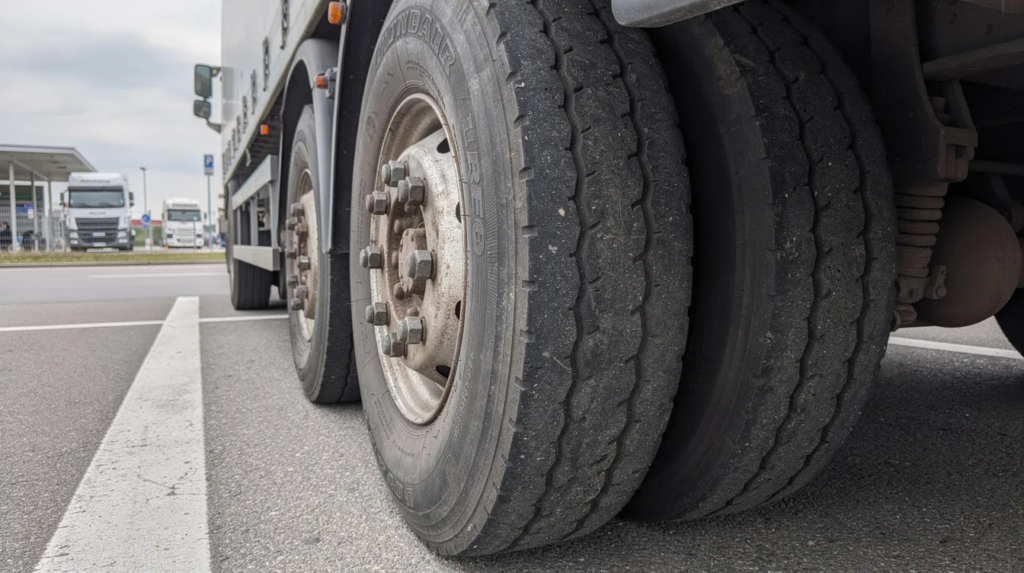
The tyre size 385/65 R22.5 is one of the most commonly fitted dimensions on trailer axles and steer axles of heavy commercial vehicles in Germany. This article explains what the designation means, which tyre pressure is correct, how to avoid damage — and what to do in case of a breakdown. LKWHelp24 offers 24/7 mobile truck tyre service and towing across Germany — exclusively for commercial vehicles from 7.5 tonnes.
Key Takeaways
- 385/65 R22.5 is a typical tyre size for steer and trailer axles on trucks, trailers and buses from 7.5 t. The choice is very wide, with offers from many manufacturers.
- Correct tyre pressure according to the manufacturer’s specification and regular checks prevent blowouts, long downtimes and unnecessary fuel consumption.
- In case of a tyre blowout or pressure loss with a 385/65R22.5, always stop safely, note the location and tyre size, and call mobile tyre service.
- LKWHelp24 offers 24/7 mobile truck tyre service and towing across Germany — only for commercial vehicles from 7.5 t. Response time is normally 30 to 60 minutes.

What Exactly Does 385 65 R22.5 Mean?
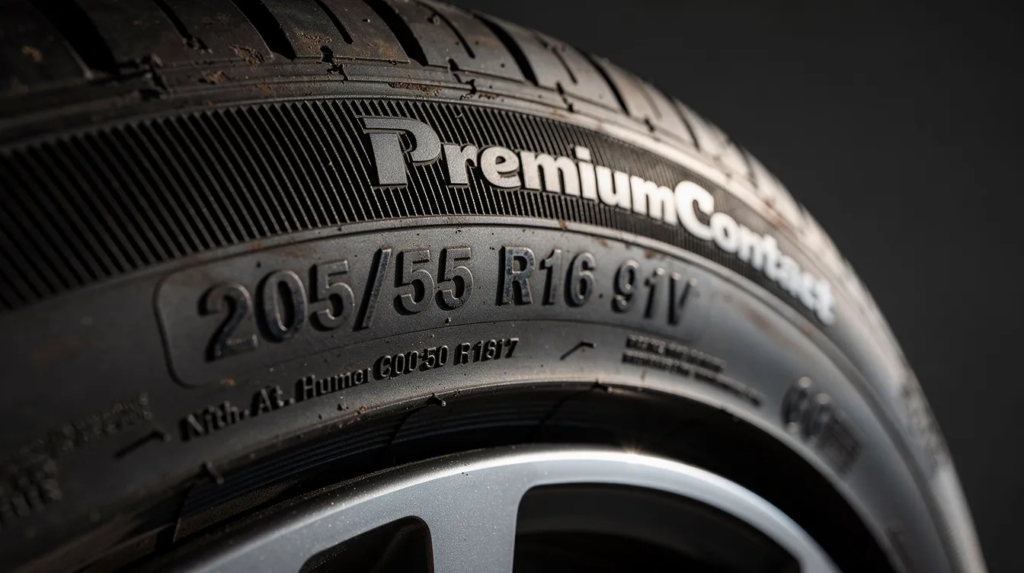
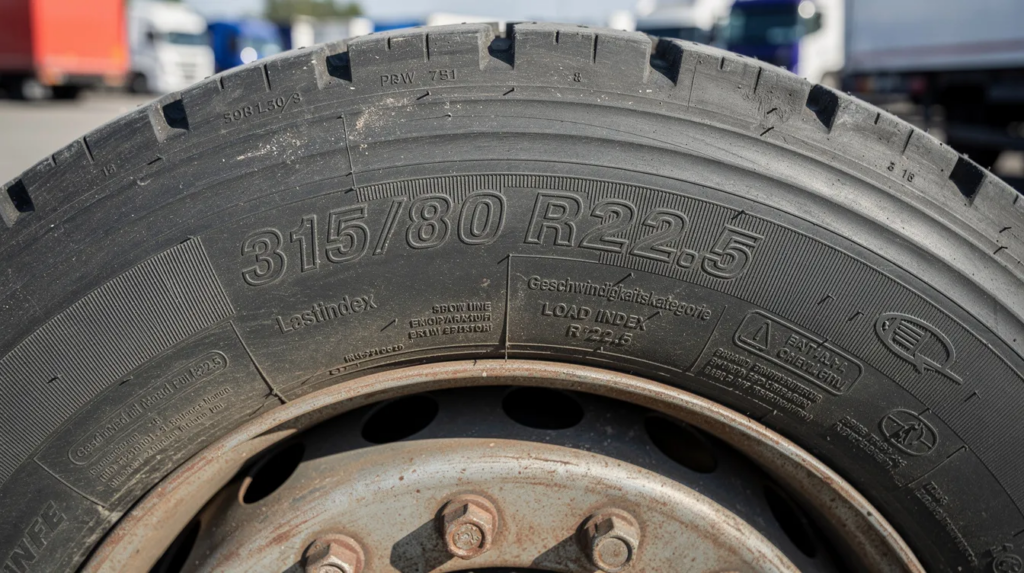
Anyone ordering tyres, giving the correct size in a breakdown call, or checking axle compatibility needs to be able to read the designation on the tyre sidewall. Wrong information costs time and money in a breakdown. Here is how the tyre size 385 65 R22.5 reads:
- 385 — the tyre width in millimetres. The width of a truck tyre in this dimension is 385 mm. That is a typical width for wide tyres on steer or trailer axles.
- 65 — the aspect ratio in percent of the width. The sidewall height is 65% of 385 mm, so around 250 mm. A lower ratio means less sidewall height — this affects stability and comfort.
- R — stands for radial construction. Radial tyres are the standard for modern truck tyres. The carcass cords run crosswise to the direction of travel, which gives better running characteristics and durability.
- 22.5 — the rim diameter in inches. The rim diameter is 22.5 inches. Only a rim with exactly this measurement may be used.
- In addition, the load index (e.g. 160 or 164) and the speed index (e.g. J, K or L) must always be observed. This data is shown on the tyre sidewall and determines load capacity and permitted top speed.
Typical Applications for 385/65 R22.5 Tyres
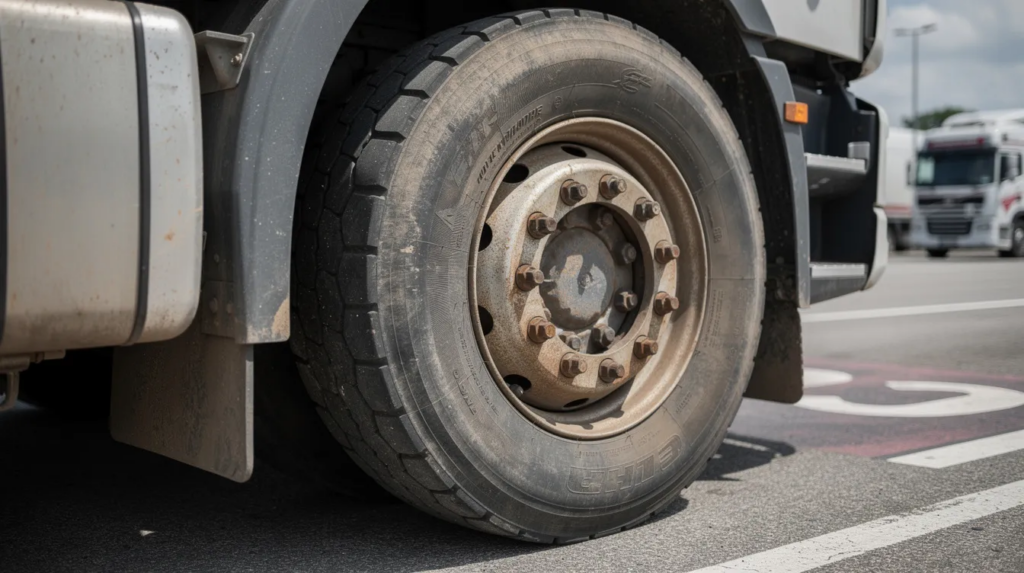
Tyres in the 385/65 R22.5 dimension are standard wide tyres in the commercial vehicle sector. They are used on very different vehicle types and axle positions:
- Steer axles of tractor units — in long-haul and regional transport. The wide tread offers stable tracking behaviour and pronounced straight-line stability.
- Trailer axles — on mega and standard semi-trailers, low-loaders and tipper trailers. Wide tyres often replace older twin tyre setups here and offer better weight distribution.
- Heavy commercial vehicles and buses from 7.5 t — also in long-distance haulage. Note: the size 385 65R22.5 is used exclusively in the commercial vehicle sector. Cars or vans under 7.5 t are not fitted with it.
- Axle positions — manufacturers distinguish between “Steer” (steer axle), “Trailer” (trailer axle) and “All Position”. Depending on the application (steer, drive, trailer) a different tread pattern makes sense.
- Tread design — there are products for long-haul, regional transport and construction sites. They are suitable for long-haul use as well as off-road applications. The tread must match the application so that wear and consumption stay in line.

385 65 R22.5 Truck Tyres: Construction and Key Markings
Besides the size, truck tyres carry numerous markings that are decisive for safety and legality. When buying, searching for offers online, or reporting a breakdown, this data should be known.
- M+S marking (mud and snow): This marking means the tyre type is designed for muddy and snowy conditions. However, since October 2024 M+S alone is no longer sufficient for winter use in Germany — the requirements have become stricter.
- 3PMSF symbol (three-peak mountain with snowflake): This symbol proves tested winter capability according to standardised tests. In Germany and many neighbouring countries, 3PMSF certification is mandatory for steer and drive axles under winter road conditions. Truck tyres with 3PMSF certification are winter-capable.
- Load index: These tyres have a high load index, often 160K or 164. This determines the maximum load capacity per tyre. Depending on the tyre, the capacity is often up to 9 or 10 tonnes per axle. Do not invent figures — the manufacturer’s specifications are binding. Example: the Sailun S825 has a load capacity of 4500 kg in single fitment.
- Speed index: Letters such as J, K or L indicate up to which top speed the tyre is approved. K means up to 110 km/h. The index must match the vehicle’s permitted top speed.
- Noise level and further data: Truck tyres in this category often have a noise level of 69 to 73 dB. Commercial vehicle tyres of this dimension have a robust carcass designed for commercial use. Construction and details are shown on the tyre sidewall and in technical data sheets — copy these exactly when ordering or reporting a breakdown.
Correct Tyre Pressure for 385/65R22.5 on Steer and Trailer Axles
Correct air pressure is crucial for 385 65 R22.5. These tyres carry high loads. Incorrect pressure leads to heat build-up, blowouts and costly downtime.
- The tyre manufacturer’s inflation tables are always binding (e.g. Continental, Michelin, Bridgestone, Goodyear, Dunlop, Yokohama, Firestone, Sava, Uniroyal, Falken, Petlas, Blacklion), along with the vehicle manufacturer’s specifications. Do not use figures from the internet that do not come from the respective manufacturer. Continental, for example, publishes detailed pressure tables for various axle loads and speeds.
- The required pressure depends on several factors: axle load, tyre design (single vs. twin tyres), application profile (long-haul, construction site, regional) and speed. A 385/65 R22.5 as a super single on a trailer axle often needs 8.5 to 9.0 bar at full load — but this is only guidance, not a binding value.
- Drivers and dispatchers should regularly check the specific inflation tables for 385/65 R22.5 for the manufacturer and model used. More detailed information can also be found on the Truck Tyre Pressure page.
- Do not use “rule of thumb” figures. With mixed or twin tyres, plan pressure per axle. On every axle, pressure and load index must match.
- Use neutral information sources: the brand’s inflation tables on their website, request technical data sheets from the dealer, get advice from specialist workshops. When comparing prices between suppliers and dealers, it also pays to consider service and sales competence — not just the price including VAT.
Measuring Tyre Pressure Correctly — Practical Tips for Drivers
Correct measurement is just as important as the target value. A correctly set pressure is useless if measured incorrectly.
- Always measure “cold”. That means: before driving, not after a motorway journey. Driving and sun exposure heat up the tyre, the pressure rises — the measurement is then distorted and too high.
- Recommended check frequency: At least once a week, plus before every longer trip. More often on construction sites or in extreme temperatures. In short: better to check once too often than once too little.
- Use quality gauges. Fuel stations with a commercial vehicle air connection or in-house test equipment are the right choice. Cheap hand gauges can deviate significantly.
- Twin tyres: Check both tyres of a twin pair — including the inner tyre. If the inner tyre is forgotten, a pressure loss is often only noticed at a blowout.
- Tyre pressure monitoring systems (TPMS): Modern trucks and trailers sometimes have TPMS installed. These systems warn of a pressure drop, but do not replace manual visual and measurement checks.

Consequences of Too Low Tyre Pressure with 385 65 R22.5
Imagine: summer in Germany, 35°C, your truck driving at 85 km/h on the motorway. The axle is fully loaded, but the pressure in the 385/65 R22.5 is too low. What happens?
- Increased flexing and heat inside the tyre. The sidewalls flex more strongly with every rotation. The temperature rises. In the worst case this leads to a tyre blowout on the motorway — with debris on the carriageway and a full closure.
- Longer braking distances and worse handling stability. The truck becomes harder to control, especially on wet roads and in corners.
- Increased fuel consumption due to higher rolling resistance. Across a fleet with dozens of trailers this adds up quickly.
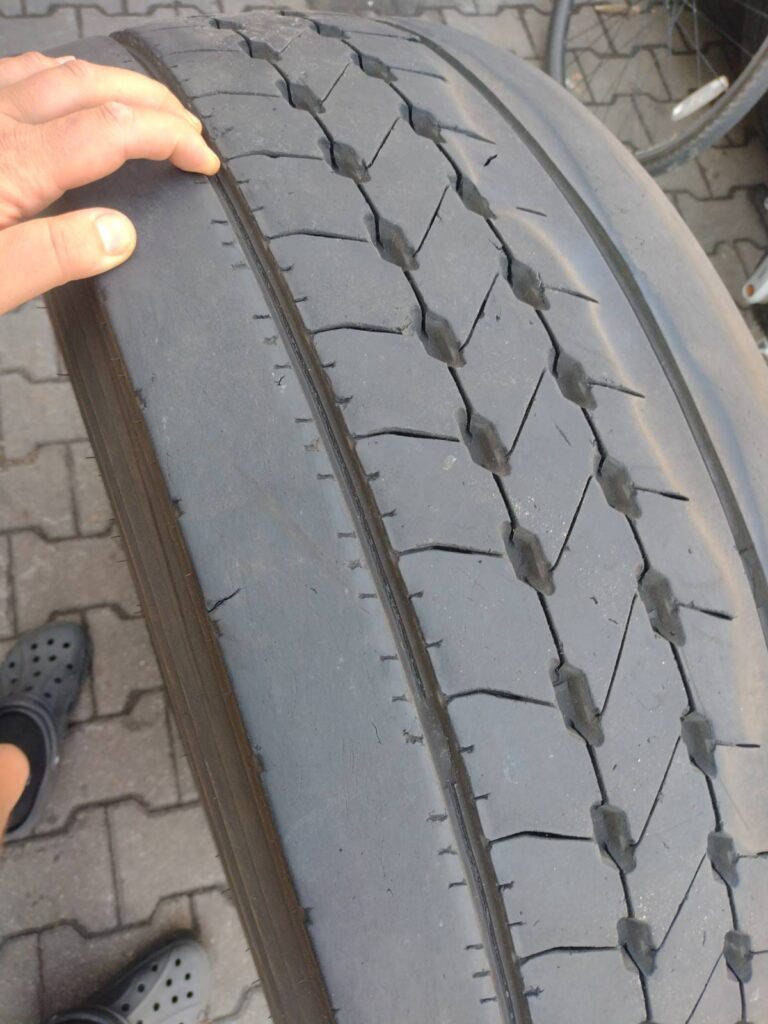
- Faster and uneven wear of the tread, especially at the shoulders. Tyre life drops noticeably.
- Consequential damage to the rim, wheel bearing or suspension parts from prolonged driving with massive underinflation. This makes a repair more expensive than a simple tyre change.
A concrete example: on the A8 near Merklingen a 385/65 R22.5 trailer tyre suffered a blowout. The cause was a combination of factors: summer heat, too-low pressure under heavy load and high speed.
Consequences of Too High Tyre Pressure with 385/65R22.5
Some drivers think: “Better too much pressure than too little.” But that is also problematic.
- Harder ride and a smaller contact patch. The contact area with the road shrinks. Traction decreases — especially dangerous in wet and snowy conditions.
- Uneven wear. The centre of the tread wears more, and the pattern becomes irregular.
- Higher shock loads on suspension and cargo. Potholes and bumps hit harder. Sensitive cargo can be damaged, and ride comfort decreases.
- Possible cracking in the carcass from prolonged overstress of the material. The construction is not designed for arbitrarily high pressure.
- Recommendation: Do not increase pressure “just in case”. Always use the manufacturer’s documented values and trust the measurement results.
The Role of TPMS with 385 65 R22.5 Truck Tyres
Tyre pressure monitoring systems (TPMS) monitor the pressure and, in some cases, the temperature of tyres while driving.
- Permanent monitoring: The system warns the driver of pressure drops or overheating — often already at around 20% pressure loss. This can prevent a blowout.
- Benefit for long-haul transport and fleets: Gradual pressure loss is detected early. Dispatchers can factor TPMS data into maintenance planning and fleet analysis.
- Regulatory developments: The EU has issued regulations on the installation of TPMS. However, different deadlines and categories partly apply to heavy commercial vehicles than to cars.
- Manual checks remain mandatory. TPMS does not replace regular visual inspection or cold measurement with a gauge. There are sensor limitations, especially on trailer axles and twin tyres.
- Tip for dispatchers: Take TPMS warnings seriously and document them internally. Anyone who systematically evaluates data spots patterns and can prevent failures; further practical examples can be found in the LKWHelp24 news section.
What to Do in Case of Pressure Loss or Tyre Damage with 385/65 R22.5 on the Road?
The driver feels vibrations, the TPMS warns, or there is a smell of rubber. Now correct action counts.
- Stay calm. Reduce speed slowly, drive as straight as possible. Look for a safe spot: parking bay, rest area or exit. Never stay on the hard shoulder if there is a safer option.
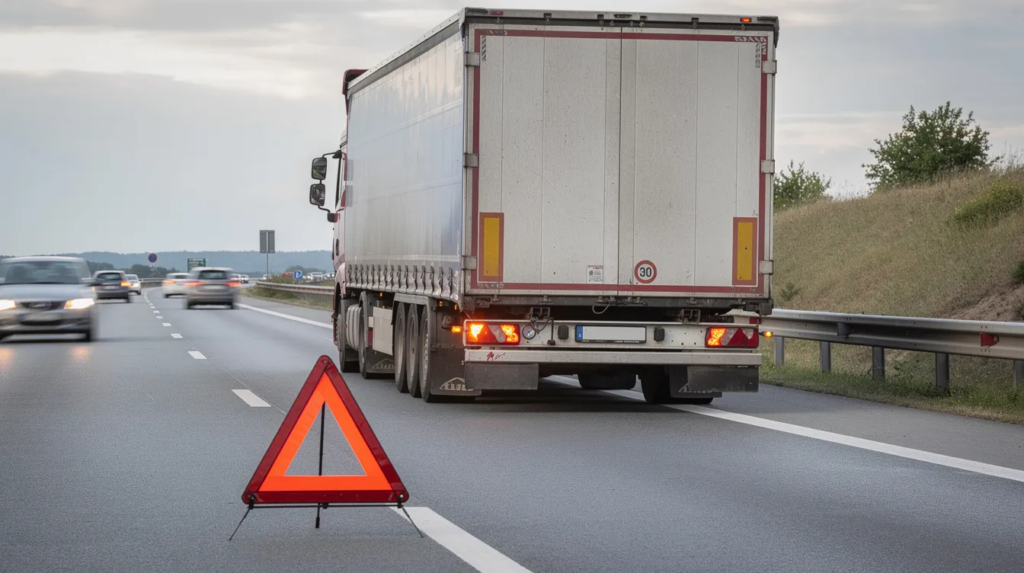
- Secure the vehicle. Switch on the hazard lights immediately. Put on a hi-vis vest before getting out. Set up a warning triangle as required by German traffic regulations — at least 150 m distance on the motorway.
- Do not continue driving on a flat or badly damaged tyre. Every additional metre destroys the carcass and rim. A new rim costs many times more than a tyre change.
- Document tyre size, axle position and damage. For example: “385/65 R22.5 160K, right side trailer, 2nd axle.” If possible, take photos of the tyre and the vehicle’s location.
- Record the location as precisely as possible. Motorway number, direction of travel, kilometre marker, nearest car park or GPS location from a smartphone. The more precise, the faster help arrives through truck tyre service in Berlin and nationwide.

Mobile Truck Tyre Service for 385/65R22.5 in Germany — LKWHelp24
LKWHelp24 is your mobile partner for tyre blowouts and breakdowns. We offer mobile truck tyre service, 24/7 truck breakdown service in Germany, roadside assistance and towing — exclusively for commercial vehicles from 7.5 tonnes. We do not serve cars, vans under 7.5 t or motorhomes.
- Core service: Mobile truck tyre service for truck tyres in Germany offers on-site tyre changes — for tyre sizes from R17.5, including 385/65 R22.5. The tyre change takes place on the motorway, at service areas, on company yards and in industrial areas.
- Response time: Normally 30 to 60 minutes. The mobile truck service in Germany 24/7 is available around the clock across Germany — 365 days a year.
- Scope: We only serve trucks from 7.5 tonnes.
- Languages: German, English, Polish and Russian. This matters for foreign drivers travelling in Germany who don’t speak German and need mobile truck breakdown assistance.
- Further services: We also offer truck service and 24/7 breakdown assistance across Germany, including jump-starts and minor repairs. Truck towing services are available around the clock across the whole of Germany. Prices start at 290 euros.
Truck tyre blowout? LKWHelp24 comes 24/7 with mobile tyre service. Arrival normally in 30–60 minutes. Contact us via WhatsApp or phone: +49 160 5753826. We speak German, English, Polish and Russian.
How Drivers and Dispatchers Order Help for a 385 65 R22.5 Tyre Blowout
In a breakdown, every minute counts. Clear information speeds up help.
- Primary contact channel: WhatsApp at +49 160 5753826 (wa.me/491605753826). The driver sends a location pin and photos directly via chat. This saves explanations and misunderstandings.
- Alternative: phone call to +49 160 5753826, when no mobile internet is available.
- Important details for the report:
- Vehicle registration number
- Vehicle type (tractor-trailer, solo truck, bus)
- Axle position of the damaged tyre
- Tyre size 385/65 R22.5
- Load index and speed index read off the tyre (e.g. 160K)
- Transparent pricing: Costs are discussed in advance. Payment is by cash or card, with no hidden fees.
- If needed: Truck towing or recovery can also be arranged through LKWHelp24.
Differences Between 385 65 R22.5 Steer Tyres and Trailer Tyres
Not every 385/65R22.5 is equally suitable for every axle. Different tread patterns are available for steer axles, trailers and construction site use.
- Steer axle tyres (Steer): Tread design with pronounced longitudinal grooves. Focus on tracking, steering precision and water displacement. Typically used on the front axle of tractor units.
- Trailer tyres: More robust carcass, wear-resistant shoulders. The tread is adapted for high vertical loads and manoeuvring stress. These tyres must withstand lateral forces during manoeuvring.
- “All Position” tyres: For mixed use, e.g. in smaller fleets that don’t want to keep separate tyres for every axle. The Sailun S825, for example, is suitable for all axle positions.
- Follow manufacturer recommendations: Applications are clearly defined in the technical data sheets. Fitting the wrong tyre on the wrong axle risks more wear and higher consumption.
- Legal requirements: With mixed tread depths or different brands on one axle, the requirements of § 36 of the German road traffic licensing regulation (StVZO) apply. Always make sure the combination is permitted.
Winter Use: 385/65R22.5 with M+S and 3PMSF
Winter capability is not an optional topic for truck tyres in Germany. Anyone driving in winter without suitable tyres risks fines and — far worse — accidents.
- M+S alone is no longer enough. Since October 2024, tyres must carry the 3PMSF symbol (alpine symbol) under winter road conditions in Germany. The old M+S marking alone no longer meets the legal requirements.
- For planned winter use, 385/65 R22.5 tyres with 3PMSF marking should be chosen. Manufacturers such as Michelin, Bridgestone, Continental, Goodyear, Dunlop, Yokohama and others offer winter and all-weather variants in this size.
- Braking distance and traction in snow: Winter and all-weather tread patterns with 3PMSF offer significantly shorter braking distances on snow and slush. The advantages show especially when pulling away and braking on gradients.
- Check in good time: Before the start of the winter season, check all fitted 385/65R22.5 tyres for marking and condition. Anyone who only discovers when it snows that their tyres don’t have the 3PMSF symbol may be stuck in the worst case.
Maintenance, Visual Inspection and Replacement of 385 65 R22.5 Tyres
Regular visual inspection catches tyre damage early and prevents costly breakdowns on the road.
- Watch for cracks, bulges, cuts, exposed carcass and uneven wear. Any of these findings can be a safety risk.
- Measure tread depth regularly. The legal minimum tread depth is 1.6 mm. In practice, replacement should happen earlier for safety-relevant conditions — in winter, many experts recommend at least 3 to 4 mm.
- Remove stones and foreign objects from tread grooves. Especially after construction sites or gravel use, stones get lodged and can damage the tread and carcass.
- Check rim condition and valves: Are the rims free of corrosion? Are valve caps present? No visible cracks or damage?
- Tyre changes and repairs on 385 65R22.5 should only be carried out by specialist personnel with truck mounting equipment. These tyres are often designed for high mileage and are retreadable — but only if the carcass is intact. More on this topic can be found under Truck Tyre Repair.
Practical Scenario: 385/65 R22.5 Blowout on the Motorway — How LKWHelp24 Helps
An international driver is travelling with his tractor-trailer on the A3 near Würzburg. Suddenly a loud bang — the right trailer tyre 385/65R22.5 has blown out. Rubber and carcass parts are lying on the carriageway. The driver stays calm, reduces speed and steers towards the nearest parking bay.
- The driver secures the scene. Hazard lights, hi-vis vest, warning triangle. He contacts LKWHelp24 via WhatsApp with an exact location (GPS pin) and a photo of the destroyed tyre.
- Dispatch by LKWHelp24. The team organises the nearest local mobile tyre service with the right dimension 385/65 R22.5 and the required load index 160K. For international drivers, a 24/7 truck roadside assistance service in Germany is also available. Response time is normally 30 to 60 minutes.
- On-site services: Truck tyre service in Germany 24/7, removing the damaged tyre, checking the rim for damage, fitting and balancing the new tyre, setting tyre pressure according to the manufacturer’s table. The driver does not need to go to a workshop — the tyre change for trucks from 7.5 tonnes takes place directly on site.
- Typical service duration: About 60 to 90 minutes until the vehicle is back on the road, depending on location and situation.
- Further tips and case reports can be found in the LKWHelp24 news section as well as under truck tyre repair.
Common Driver Mistakes with 385/65R22.5 Tyres
Even experienced drivers make mistakes that are easy to avoid. Here are the most common:
- Continuing to drive with too-low pressure “to the next workshop”. This often destroys the entire tyre and rim. Better: stop immediately and call mobile breakdown service.
- Ignoring visible damage. A bulge or “egg” in the tyre casing after hitting a kerb or pothole can lead to a blowout at any time.
- Mixed tyres with widely different tread depths or different load indexes on one axle. This is not only dangerous but can also result in a fine during a check.
- No re-check of torque on wheel nuts after a wheel change. The nuts must be re-torqued after about 50 to 100 km — according to the rim and vehicle manufacturer’s specifications.
- Missing documentation of tyre damage and incidents. Without a clean history, fleet managers cannot identify patterns or take preventive action.
FAQ on 385 65 R22.5 Truck Tyres
How often should I check the tyre pressure on a 385/65 R22.5?
Recommendation: at least once a week, plus before every longer trip — always cold. With high mileage or construction site use, shorter intervals make sense, e.g. every two to three days. Fleets should set and document their own routines for when and by whom checks are carried out. There are many good sources on tyre pressure questions — but what the tyre manufacturer specifies always remains binding.
May I fit a 385/65R22.5 with a higher load index than stated in the papers?
In many cases a higher load index is technically permitted — a tyre with load index 164 instead of 160 carries more, but can still be fitted on the same rim. Important: the load capacity may never fall below the value required in the vehicle papers. When in doubt, clarify with the vehicle manufacturer or a specialist workshop. Technical advice before a conversion saves later problems at inspection or during checks.
Can a damaged 385 65 R22.5 tyre be repaired or must it be replaced?
This depends on the type, location and size of the damage. A nail in the tread is often repairable, a cut in the sidewall is not. Only a specialist workshop can properly assess this after removal and internal inspection of the tyre. With truck tyres carrying high loads, safety always comes first. When in doubt, replacement is the better choice — the extra margin of safety is worth more than the price of a repair.
How can I tell if my 385/65 R22.5 tyre is still winter-capable?
Check the tyre sidewall for the 3PMSF symbol (three-peak mountain with snowflake) and the M+S marking. The 3PMSF symbol has been mandatory for winter conditions in Germany since October 2024. Also measure the tread depth: the legal minimum tread depth is 1.6 mm, but at least 3 to 4 mm is recommended for winter use. Check all fitted tyres before the winter season — marking and condition.
Does LKWHelp24 also support foreign drivers with limited German skills?
Yes. LKWHelp24 offers service in German, English, Polish and Russian. Communication via WhatsApp with a location pin and photos is particularly easy — no long phone call needed. The service is available across Germany for trucks, tractor-trailers and buses from 7.5 t. Contact: WhatsApp or phone +49 160 5753826.
Conclusion
Anyone who understands the tyre size 385/65 R22.5, keeps to the correct pressure according to the manufacturer’s specification and acts quickly when problems arise, saves time, money and stress. Regular checks, correct winter tyres with the 3PMSF symbol and clean documentation are not extra effort — they are an investment in safety and availability.
In a breakdown, every minute counts. LKWHelp24 is your mobile partner for tyre changes right at the roadside — 24/7, across Germany, only for commercial vehicles from 7.5 t. Send your location via WhatsApp, and we’ll take care of the rest.
Contact: 📱 WhatsApp: wa.me/491605753826 📞 Phone: +49 160 5753826 📧 Email: info@lkwhelp24.com