Skip to content
A drive-axle tyre came apart on the A7 near Kassel on a dry September evening, and the driver called us with the steel cord hanging off the carcass. Our truck tyre service crew reached him 58 minutes after the call. The lorry was rolling again after 2 hours 14 minutes, with a new tyre fitted, the rusty seat on the rim cleaned and the pressure set to 8.5 to 9.0 bar. The invoice came to €1,030 net.
This write-up walks through the whole job: what the driver saw, how the callout was organised, what happens on the hard shoulder step by step, and what it cost. If you run a fleet or drive yourself, you will find the timings and the price breakdown useful for planning, because a burst tyre on the autobahn is one of the most predictable breakdowns and still one of the most expensive when handled badly.
The emergency: a twin tyre shredded on the A7 near Kassel
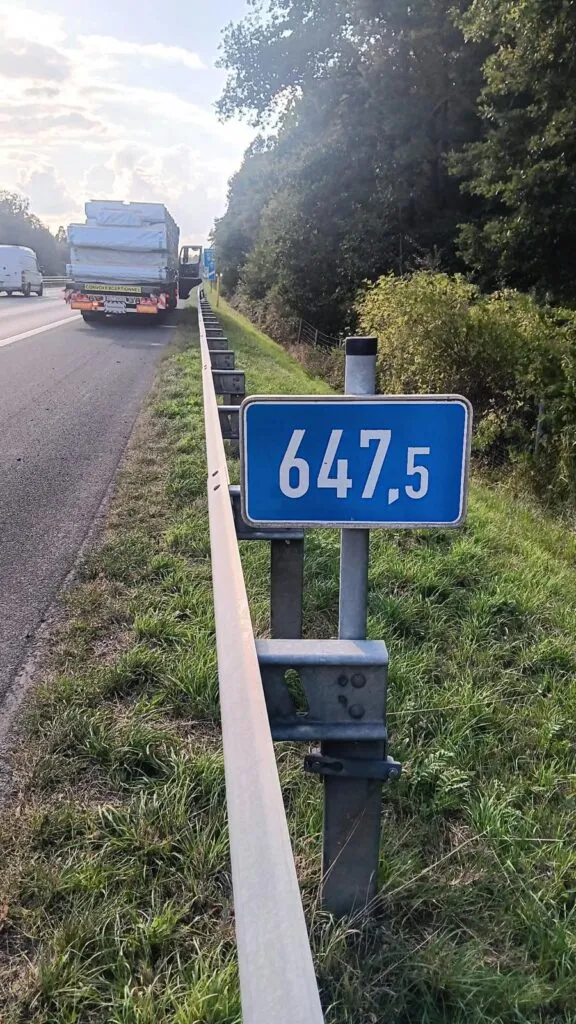
The call came in on 16 September 2026, shortly before the evening rush eased off. The driver was heading along the A7 in the Kassel area, in the direction of Hannover and Fulda, with a loaded tractor unit and semi-trailer. He felt a thump, then a flapping noise that got louder, and pulled onto the hard shoulder near a rest area as soon as it was safe.
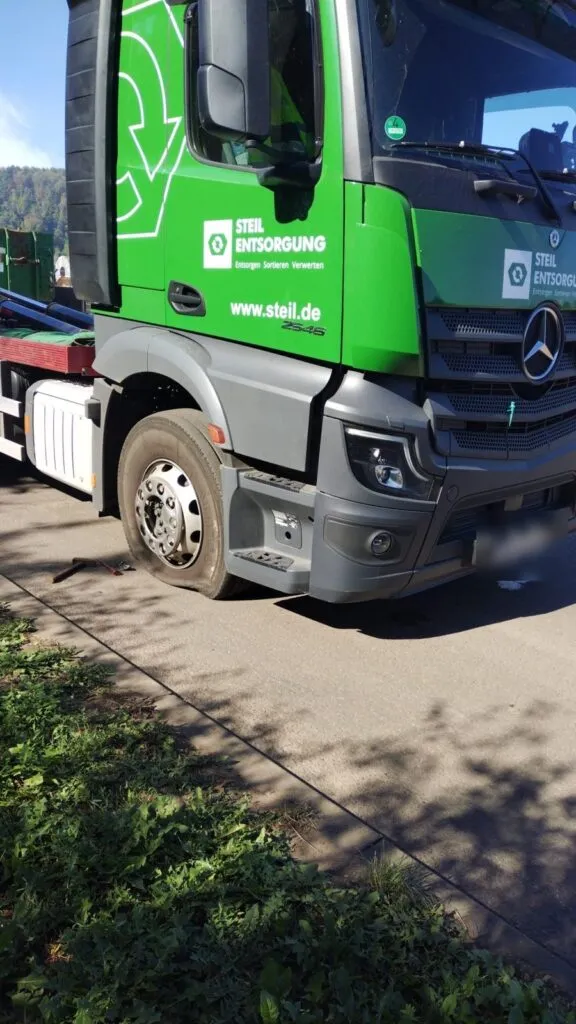
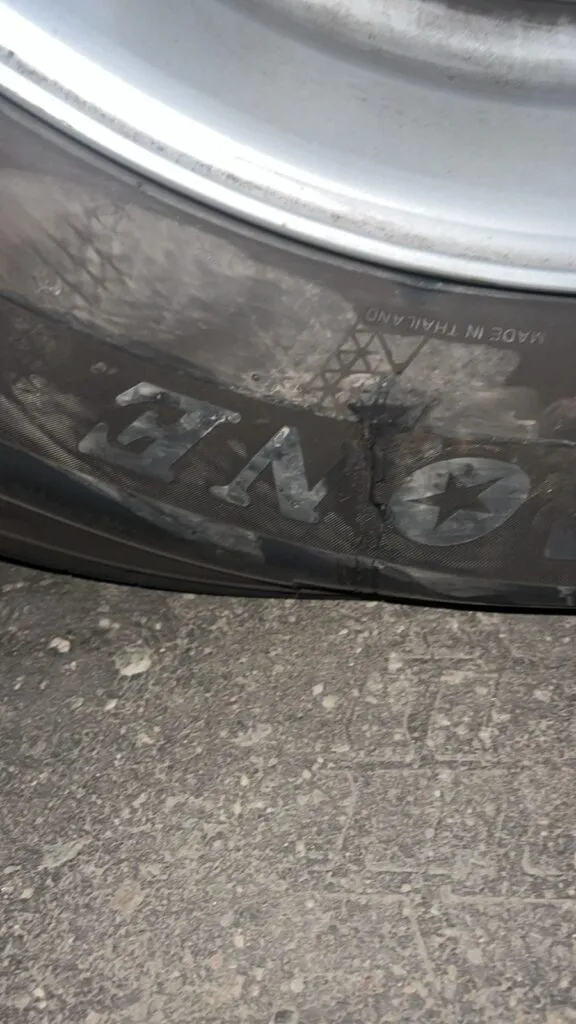
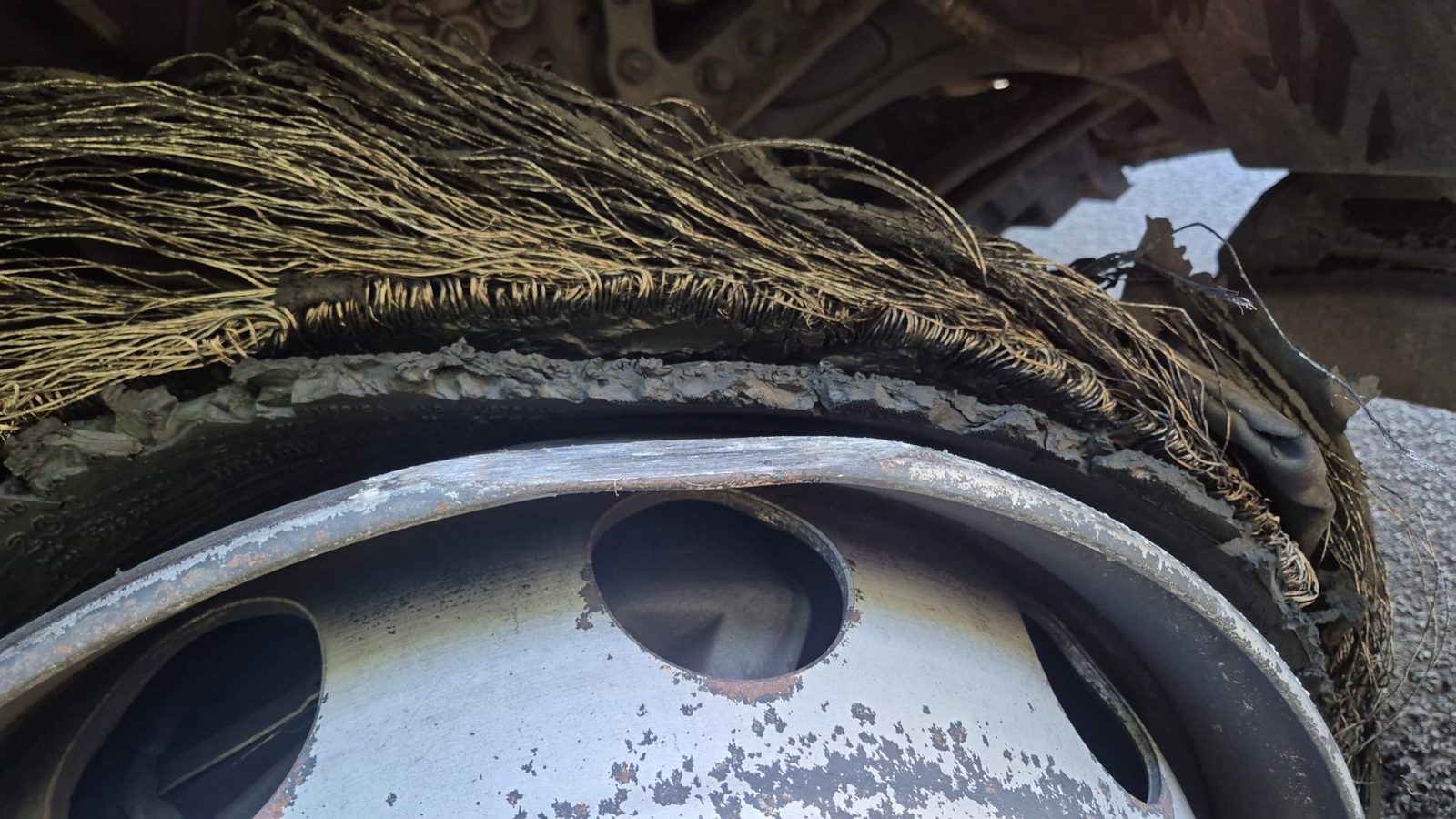
When he got out, the picture was clear enough. One tyre of a twin set on a driven axle had lost its tread band. The steel belt hung out in long strands, the inner liner was crumpled, and the carcass had split along the sidewall. His message to our dispatcher was short: tyre torn apart, cord hanging, cannot drive on.
We asked the usual questions: exact position, which axle, which side, whether the neighbouring twin tyre was still holding air, and what size he was running. The size is not readable on the photos from the scene, so for the quote we worked with the typical fitment for that kind of axle, 315/80 R22.5. That is the common size on drive axles of European tractor units, and it is the figure we used in the estimate.
What the photos show
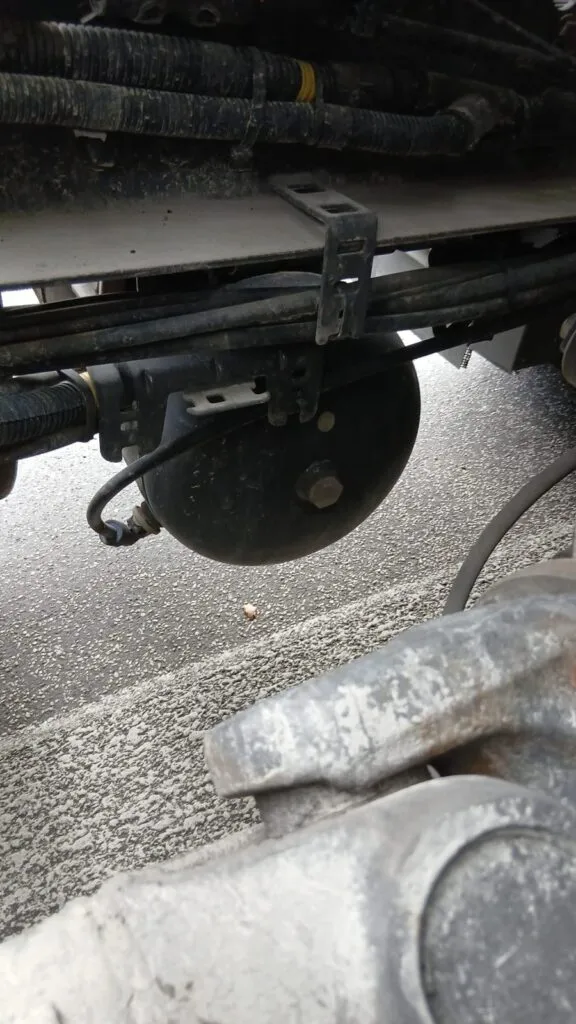
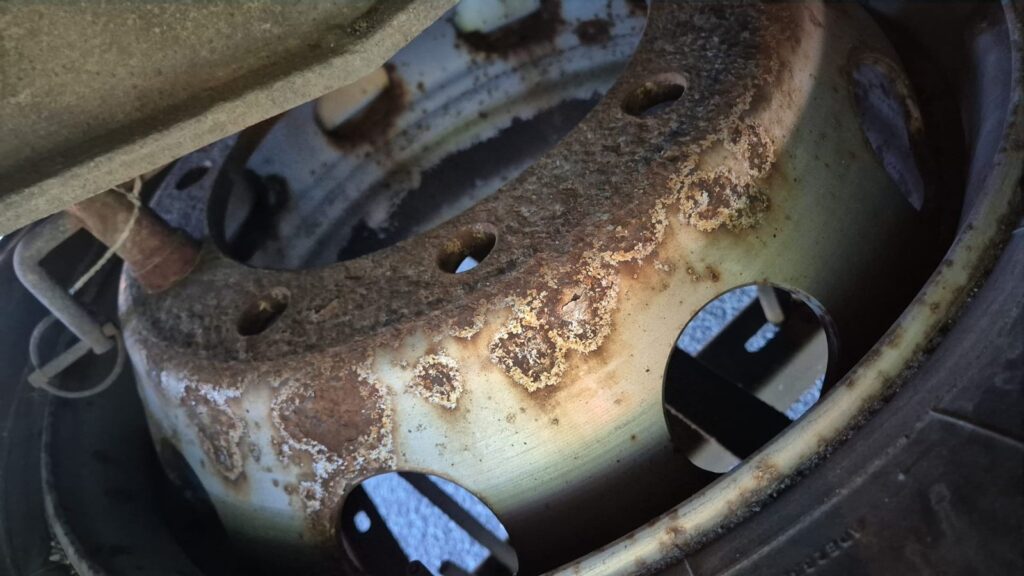
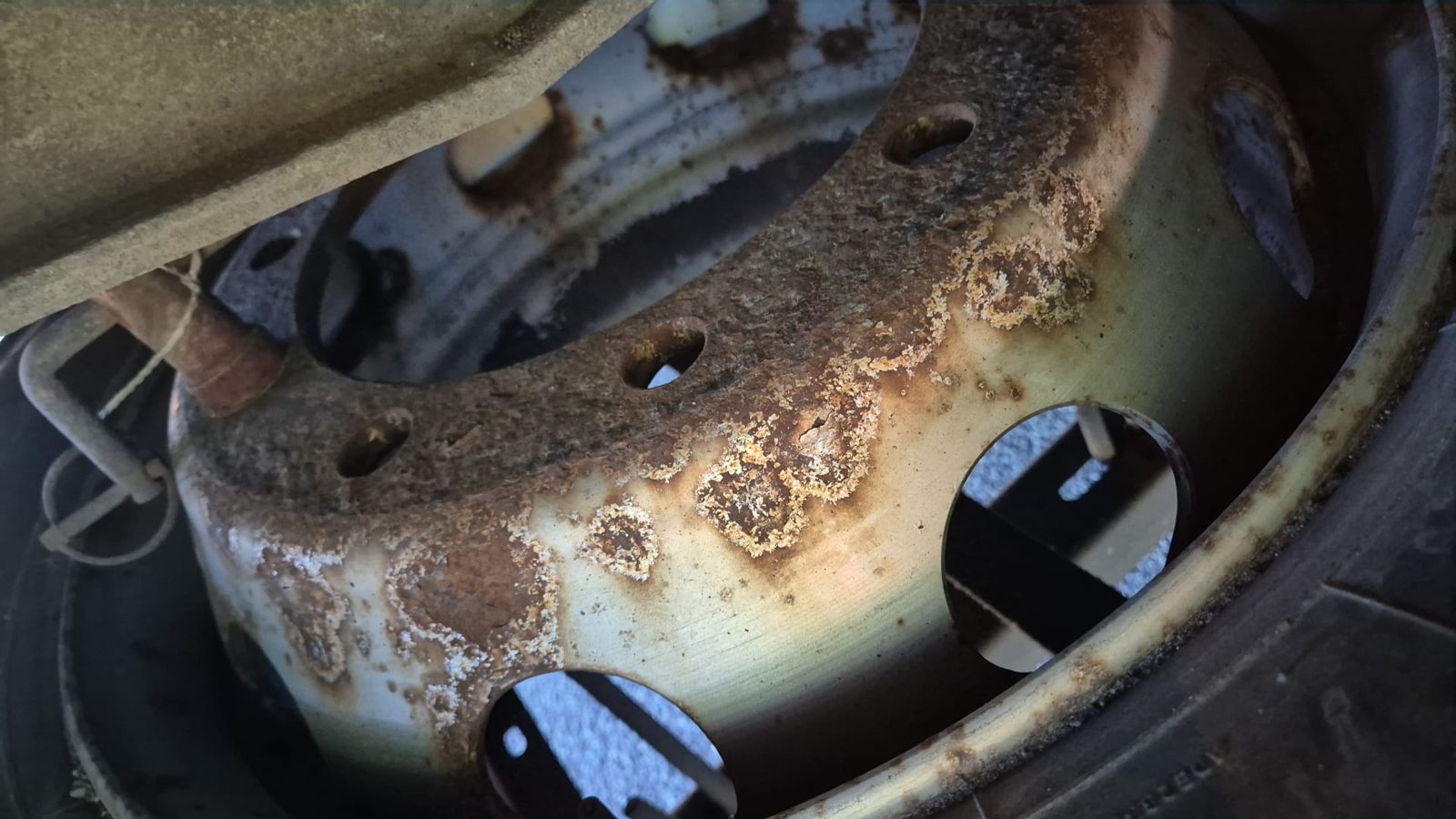
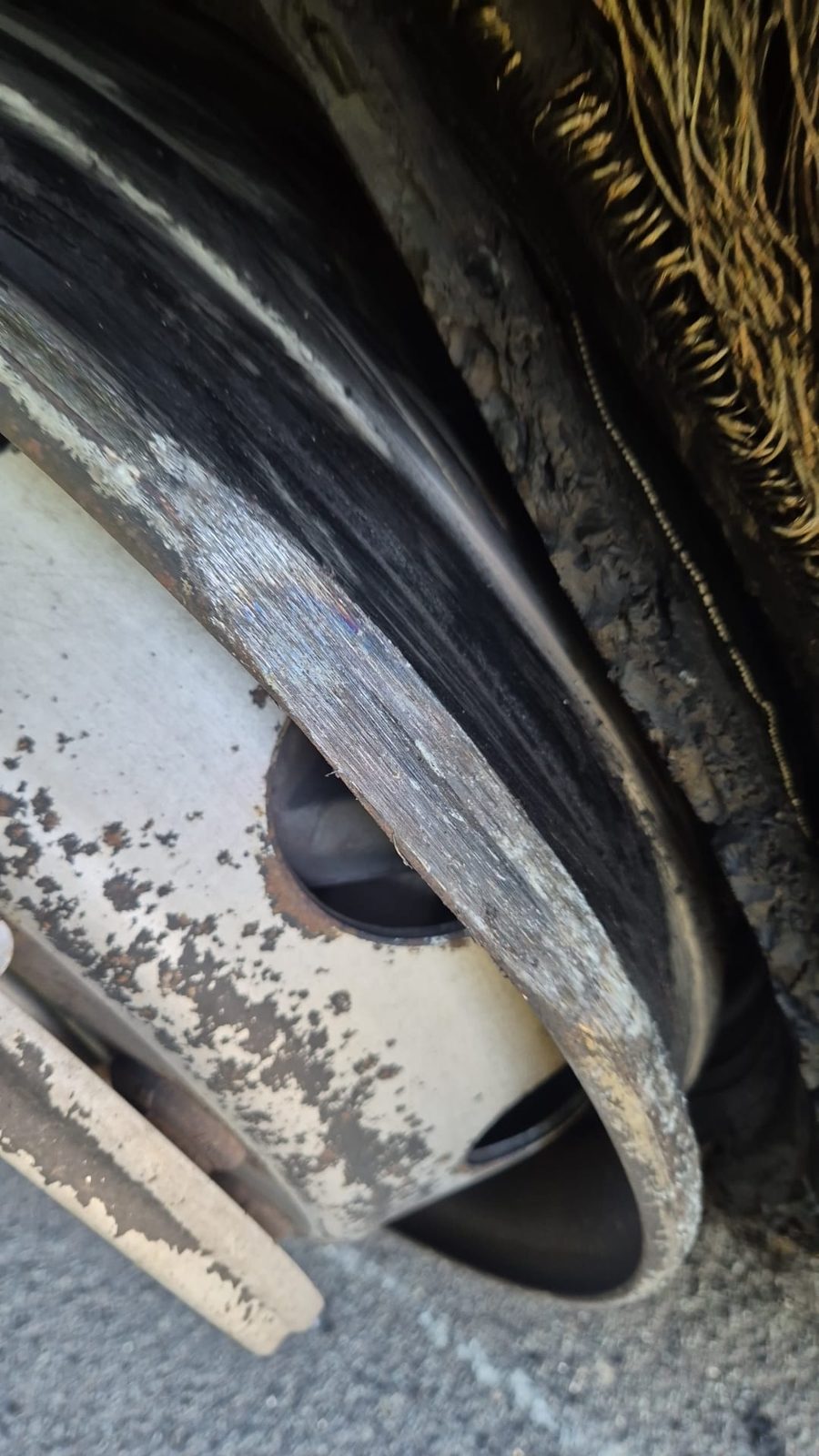
The pictures taken on site tell their own story. The first shows a heavily rusted steel wheel: corrosion around the stud holes and across the wheel dish, with salt deposits left over from winter. The second shows the rim flange polished bright by the casing grinding on it, with paint flaking off. The third shows the tyre itself, with the tread peeled away and the steel belt trailing in fringes next to the suspension components.
None of that is unusual after a high-speed failure. What mattered for the repair was the rim: a rusty seat surface can ruin even a brand new tyre, so it had to be cleaned and checked before anything was mounted.
How we organised the callout
The first 14 minutes after a call decide how the rest of the job goes. Our dispatch desk does not hand a driver a phone number and wish him luck. We take the position, confirm what is broken, and find the nearest crew from our partner network that has a matching tyre on the van.
For this job the sequence looked like this:
- The driver rang our emergency line at 00:00 and described the failure.
- The dispatcher confirmed the location (A7, Kassel area, hard shoulder near a rest area), the axle position and the likely size.
- Within 14 minutes a service partner in the region confirmed that a 315/80 R22.5 was in stock and a crew was free.
- The crew left with the tyre, a jack, a torque wrench and safety equipment.
- The dispatcher stayed in touch with the driver, told him to keep the hazard lights on and wait behind the barrier.
That matters for two reasons. First, a driver standing on a hard shoulder is in danger, so he should not be left guessing about the arrival time. Second, a crew that arrives without the right tyre achieves nothing, so the stock check comes before the departure, not after.
If you want to see how we handle roadside tyre emergencies in general, the page on our truck tyre service explains what we cover and how to reach us at any hour.
Why the nearest crew is not always the right one
Distance on a map is only half of it. A crew 20 kilometres away without a 315/80 R22.5 on board is slower than a crew 45 kilometres away with the tyre in the van. In this case the closest suitable team needed 44 minutes on the autobahn, which is a realistic figure for the A7 in the evening. Traffic was moving but busy.
Why you cannot just limp on
A shredded tyre is not a matter of comfort. A truck tyre runs at 8.5 to 9.5 bar, and once the casing has failed, the remaining twin partner carries the load of two tyres on that side. On a loaded drive axle that can mean several tonnes on one tyre that was never designed for it. It overheats within a few kilometres and can fail in turn.
There is a second problem. The steel belt that hangs off the carcass whips around at wheel speed. It can cut brake lines, air hoses, ABS cables and wiring on the axle. A driver who carries on to the next exit may save 20 minutes and lose a whole brake circuit.
The third problem is the rim. Without air, the steel wheel runs on its flange, and the metal wears bright and thin. In this case the flange showed grinding marks, but the wheel itself was still serviceable. Had the driver carried on for another kilometre or two, we might have been quoting a new rim as well.
Here is a short definition worth keeping: Karkasse (carcass) is the load-bearing structure of the tyre, made of steel cord plies under the tread. If it is gone, the tyre cannot carry weight, whatever the pressure.
What the law says
German rules do not leave much room for interpretation. Section 36 of the StVZO requires tyres to be suitable for the vehicle’s speed and load and to be in a safe condition. A tyre with exposed cord fails that test on the spot, and the police can stop a lorry on that basis. In a roadworthiness check, a driver with a visibly damaged tyre will not be allowed to continue.
Step-by-step: what the crew did on the hard shoulder
The repair itself took 76 minutes of hands-on work, from the first look at the damage to the handover. These are the steps in order.
Step 1: Inspection and securing the scene (10 minutes)
The crew arrived 58 minutes after the call. Before touching any tool, the technician put out the warning triangle at the proper distance, put on a high-visibility vest and checked where traffic was coming from. He then looked at the wheel hub (Radnabe), the rim and the surrounding components and photographed the damage. The photos matter for the driver’s records and for any claim with the haulier’s insurer.
Step 2: Lifting the axle and removing the wheel (20 minutes)
The axle was raised with a jack on solid ground. With the load off the wheel, the wheel nuts came off and the damaged wheel was pulled. The remains of the carcass and the steel cord were cut away and cleared from the axle area so nothing was left tangled in the suspension.
Step 3: Preparing the rim and mounting the new tyre (25 minutes)
This was the step that took thought. The steel rim had visible rust on the dish and at the bolt holes. The technician removed the corrosion from the contact surface with a wire brush and abrasive pad, checked the flange for cracks and distortion, and fitted a new valve. Then the new tyre was mounted and the assembly was balanced.
Rust on the contact surface does more than look bad. It stops the wheel from seating flat against the hub, which can cause the wheel nuts to lose preload and the wheel to wobble under load. Cleaning the seat is a small cost compared with a loose wheel at 85 km/h.
Step 4: Refitting the wheel and tightening in sequence (12 minutes)
The wheel went back onto the hub, and the nuts were tightened in a star pattern with a torque wrench, to the value specified by the axle manufacturer. A star sequence presses the wheel evenly against the hub face. Tightening round the circle one after another can leave the wheel slightly cocked. If you want the values, we have published a separate guide to truck wheel nut torque.
Step 5: Final pressure check and handover (9 minutes)
The tyre was inflated to 8.5 to 9.0 bar and the pressure was checked again after a short test run along the shoulder and back. The twin partner was also checked for pressure and damage. Finally, the technician went through the handover with the driver and gave him a short note on what was done.
Full timeline of the callout
Here is the complete sequence from the first ring to the moment the lorry moved off, with the call at 00:00. All times are taken from the job log.
| Time | Phase | Action |
|---|---|---|
| 00:00 | Call | Driver rings: tyre torn apart, steel cord hanging, cannot continue |
| 00:00-00:14 | Dispatch | Location, axle and size confirmed; nearest partner crew with the tyre in stock found (14 min) |
| 00:14-00:58 | Travel | Crew drives to the A7 with tyre and tools (44 min) |
| 00:58-01:08 | Inspection and securing | Warning triangle, hi-vis vest, check of rim and wheel hub, photos of the damage (10 min) |
| 01:08-01:28 | Removal | Axle jacked up, wheel removed, remains of carcass and cord cleared (20 min) |
| 01:28-01:53 | Tyre fitting | Rust removed from the seat, rim checked, new tyre fitted, balanced (25 min) |
| 01:53-02:05 | Wheel refit | Wheel nuts tightened in a star pattern to the axle maker’s torque (12 min) |
| 02:05-02:14 | Final | Pressure 8.5-9.0 bar, check after a short drive, handover to the driver (9 min) |
Total: 134 minutes (2 hours 14 minutes). The crew was on site 58 minutes after the call. The photos were taken at the scene at 18:42 and 18:43 in daylight.
Two things stand out. Travel was the largest single block, which is normal on a long autobahn stretch, and the work on site was shorter than the waiting. That is why dispatch speed and stock matter so much: you cannot make an axle jack faster, but you can avoid a crew that has to drive back for the tyre.
What does an emergency truck tyre change cost?
On this job the net cost was €1,030. That figure covers everything from the drive out to the disposal of the destroyed casing. Here is the line-by-line breakdown.
| Item | Price (EUR) |
|---|---|
| Call-out / crew travel (autobahn, 44 min drive) | 240 |
| New tyre 315/80 R22.5 (typical size) | 560 |
| Labour for wheel change and mounting, 1.5 h x 110 EUR | 165 |
| Fitting material, rust removal on the seat, valve | 45 |
| Disposal of the destroyed carcass | 20 |
| TOTAL | 1,030 |
All amounts are net, plus VAT (zzgl. MwSt.).
What drives the price up or down
Three factors moved the number. The first is time of day: the job was done in the evening before dark with no night or weekend surcharge. A night call can add 25 to 50 percent to the call-out fee. The second is the tyre size: a 315/80 R22.5 sits in the upper middle of the range, and a trailer tyre such as a 385/65 R22.5 is usually a bit cheaper. The third is the state of the rim: here it only needed cleaning. A bent or cracked wheel would have meant a replacement and a higher bill.
For a more general look at what drivers and fleets pay, see our article on what a truck tyre change costs.
The comparison that matters: standstill
A lorry parked on a hard shoulder earns nothing. Industry figures for a tractor unit and trailer standing idle run at roughly €800 to €1,200 per day once you add driver wages, leasing, schedule penalties and missed slots. Against that, a €1,030 repair that finishes in two hours and fourteen minutes is the cheaper option almost every time, particularly when the alternative is towing the unit to a workshop and waiting for it to be fitted in.
Why leave this to a professional
Some drivers carry a spare and a jack and consider changing a wheel themselves. On a car that is reasonable. On a heavy lorry, on a hard shoulder with traffic passing at 80 km/h, it is a different matter.
- Weight. A single truck wheel with tyre weighs 60 to 80 kg. Lifting it onto a hub overhead is a back injury waiting to happen.
- Jack and ground. A bottle jack from the cab is not rated for a loaded tractor unit. Soft verge, a slope or a tilted axle can end badly.
- Torque. Wheel nuts on a lorry need a high torque, applied with a proper wrench in sequence. A cordless impact driver without a calibrated final pass leaves nuts under- or over-tightened.
- Rim condition. Corrosion, cracks and flange wear show up only when somebody who knows what to look for takes the wheel off.
- Safety. Working next to live traffic needs proper equipment and a second pair of eyes.
- Liability. If a wheel comes off after a roadside repair done without correct torque, the driver and the haulier have a problem.
None of this means a driver should never touch a tyre. For a pressure check or a flat on a quiet yard, he can do the basics. But for a burst on the autobahn, the right call is a crew with the right tools.
Typical situations we attend across Germany
This job on the A7 is one of many similar callouts. The same crews and the same dispatch desk handle:
- tyre blowouts and cut sidewalls on drive, steer and trailer axles;
- slow punctures from screws and nails in the shoulder of a tyre;
- tyre damage from kerbs, potholes and debris on construction sites;
- wheel changes at the roadside, at rest areas and at truck stops;
- rim damage, cracked or bent steel wheels, and loose wheel nuts;
- tyre checks after a long haul or a long standstill;
- breakdowns where towing is needed as well: for those cases our towing service steps in.
The most common cause we see is simple: heat plus underinflation plus load. A tyre run at 1.5 bar below target pressure for a few weeks flexes more, heats up, and eventually delaminates. The blowout often happens on a hot afternoon on a long motorway stretch, but a failure like the one near Kassel can come on any day.
If you want a quick reference for what to do the moment it happens, our checklist for a tyre blowout on the autobahn lists the steps for the driver.
Prevention: how drivers and fleet managers avoid a shredded tyre
Most roadside tyre failures are not bad luck. They build up slowly, and a few habits catch the trouble early.
- Check pressure every week. Use a calibrated gauge on cold tyres. A drop of 1 bar over a fortnight points to a slow leak that needs finding.
- Look at both tyres of a twin pair. If one is soft, the other carries too much and wears faster. Tap the pair and check that both sound the same.
- Measure tread depth. The legal minimum is 1.6 mm, but many fleets change drive tyres at 3 mm for traction and safety in the wet.
- Inspect the sidewalls. Cuts, bulges and cracks mean the carcass is damaged even if the tread looks fine.
- Look at the rims. Rust around the stud holes and under the paint is a warning sign. Clean, repaint or replace wheels before corrosion eats into the seat.
- Keep a log. Write down fitted dates, sizes, pressures and repairs per wheel position. A log shows patterns that a single visit cannot.
- Do not ignore vibrations. A new shake in the steering wheel or a thump at motorway speed is a reason to stop at the next rest area and look.
A short tip for mixed fleets: do not pair tyres of different size or very different wear on a twin axle. The larger one rolls further per revolution, and the smaller one scuffs. Both overheat sooner.
When to plan a tyre check
Heavy use, long distances, salted winter roads and loads near the axle limit all shorten tyre life. A check every 4 to 6 weeks for long-haul units and before each season change is a sound routine. We also carry out mobile fleet inspections at depots and yards, so the check does not take a unit off the road for a day.
Truck tyres explained: what fleets should know
A short orientation for anyone who buys or looks after commercial tyres.
Size markings. A marking such as 315/80 R22.5 reads as follows: 315 mm section width, aspect ratio of 80 percent (sidewall height as a share of the width), radial construction, and 22.5 inch rim diameter. The standardisation body ETRTO publishes the permitted rim and tyre combinations. On drive axles you will mostly see 315/80 R22.5, on trailer axles 385/65 R22.5, on lighter distribution trucks 245/70 R19.5, and on vans 235/65 R16C.
Axle position matters. Steer tyres need good grip and precise handling, drive tyres need traction and tread depth, and trailer tyres are built for low rolling resistance and stability. Fitting the wrong type on the wrong axle can cause irregular wear.
Brands. The large manufacturers, among them Michelin, Continental, Goodyear and Bridgestone, all offer ranges for long haul, regional and mixed use. Michelin publishes technical documentation and tyre care advice on its international site. Which brand suits you depends on your routes, loads and budget, and a good fleet policy usually settles on one or two makes so that spare parts and pressure standards stay simple.
Retreads. Casings in good condition can be retreaded, which cuts cost per kilometre. Drive and trailer axles are the usual places for retreads, while steer axles usually get new tyres.
Pressure. Truck tyres run at 8.5 to 9.5 bar depending on load. Pressure that is too low raises heat build-up, and pressure that is too high shortens contact patch and grip. Check against the load tables from the tyre maker.
Mobile fitting. Many routine jobs, from valve replacement to a full wheel change, can be done at your yard or by the road. This is what a mobile tyre service means in practice: the workshop comes to the lorry. It saves a tow, a day of idle time and a detour that often costs more than the tyre itself.
Twin tyres need extra attention
The twin set is a system. Both tyres must have similar diameter, because even a few millimetres of difference make the larger one carry more load and the smaller one drag. If a tyre fails and you replace only one, check the other one for wear and match the diameter. During our checks of dual-wheel pairs in the 385/65 R22.5 size we found that unequal pressure was the most common fault, which is why we wrote up how a twin-tyre inspection is done properly.
Frequently asked questions
How much does a truck tyre change on the autobahn cost?
A typical mobile truck tyre change on a German autobahn costs between €750 and €1,400 net, depending on distance, tyre size and time of day. The A7 job described here came to €1,030 net: €240 call-out, €560 for the tyre, €165 labour, €45 material and €20 disposal.
How long does an emergency tyre change take?
Plan on 1.5 to 3 hours from call to departure. In this case the crew arrived after 58 minutes and the lorry was rolling after 134 minutes. Night, rain and heavy traffic add time. The hands-on work itself usually takes 45 to 90 minutes.
Can I drive on with a damaged truck tyre to the next exit?
No. A tyre with exposed steel cord or a split carcass can fail completely within a few kilometres, damage brake lines and cables, and overload the twin partner. Stop as soon as it is safe, switch on the hazard lights, set up the warning triangle and call for help.
What does the driver need to tell the dispatcher?
Give the autobahn number, direction and nearest exit or rest area, the axle and side of the damaged wheel, the tyre size if known, and whether the neighbouring tyre still holds air. With these details we can send a crew with the right tyre on the first trip.
Who pays for a roadside tyre repair?
Usually the haulier or the driver’s employer, as a running cost of the vehicle. Some fleets have a tyre contract or a breakdown policy that covers part of it. We issue a clear invoice with a line-by-line breakdown, so it is easy to pass on to an insurer or a customer.
Do you work at night and at weekends?
Yes. Our dispatch desk is staffed around the clock, every day of the year, and the callout covers the whole of Germany. Night and weekend jobs carry a surcharge of 25 to 50 percent on the call-out fee, which we state before the crew sets off.
Why drivers and fleets call us
Drivers call us because the phone is answered at any hour by a person who understands what a burst drive-axle tyre means. Our network of service partners across Germany keeps stock for common truck sizes, so most callouts end after one trip.
- Round-the-clock service. A line open 24 hours a day, 365 days a year.
- Checked partner network. Crews who work with the right equipment and torque tools, and who photograph the damage for your records.
- Price transparency. You see the call-out fee, the tyre price, the labour and the disposal before work starts and again on the invoice.
- Multilingual dispatch. Drivers come from many countries, and the desk speaks German, English, Polish and Russian.
- Nationwide cover. From the A7 near Kassel to the A8 in Bavaria and the coastal motorways in the north.
For contact options and the places we cover, see our contacts page.
Summary: the A7 job in numbers
| Parameter | Value |
|---|---|
| Location | A7 near Kassel (direction Hannover / Fulda), hard shoulder at a rest area |
| Date | 16 September 2026, dry, daylight |
| Damage | Twin tyre on a drive axle shredded, steel belt hanging out |
| Tyre | 315/80 R22.5 (typical size, not readable on photos) |
| Crew arrival | 58 minutes after the call |
| Total time | 134 minutes (2 h 14 min) |
| Cost | €1,030 net, plus VAT |
| Secondary damage | None to brake lines or axle; rim cleaned and reused |
| Final pressure | 8.5 to 9.0 bar |
A burst tyre cannot be avoided in every case, but how it plays out depends on the first call. A short, clear report to the dispatcher, a crew with the right tyre on board and a proper rim check turn a potential day-long standstill into an afternoon delay.
Need a truck tyre service right now?
If a tyre has gone on your lorry, stop safely, switch on the hazard lights and call us. We will find the nearest crew with the right tyre and tell you the arrival time and the price before anyone drives out.
Phone: +49 160 5753826 | Website: www.lkwhelp24.com | Round the clock across Germany.
Keywords: truck tyre service | mobile reifenservice | truck tyre replacement | truck tyre change | truck tyre callout | truck tyre roadside assistance | truck tyre repair | mobile reifenwechsel | truck tyre Germany | trailer tyre service | truck tyre burst | mobile truck tyre service