Skip to content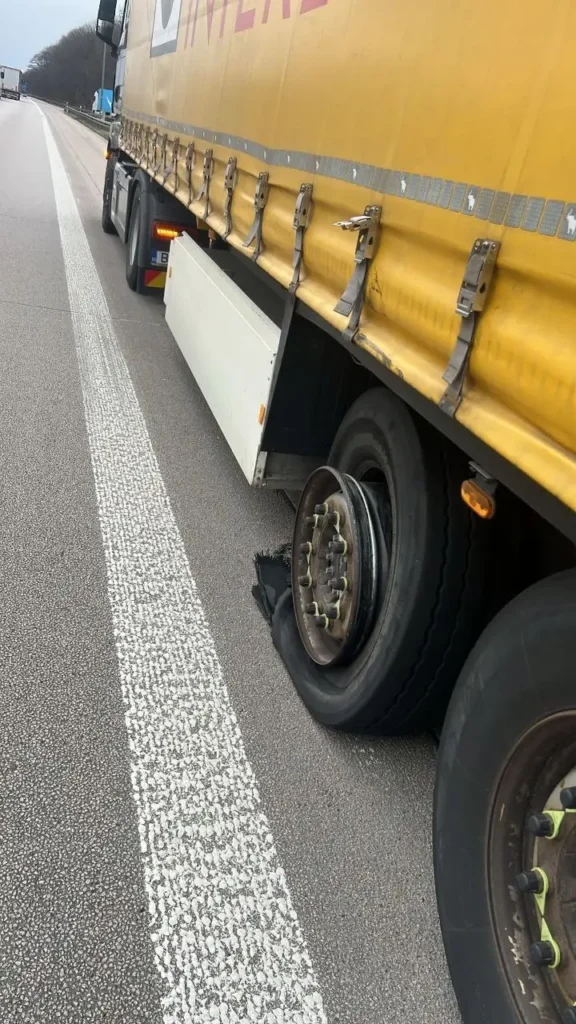
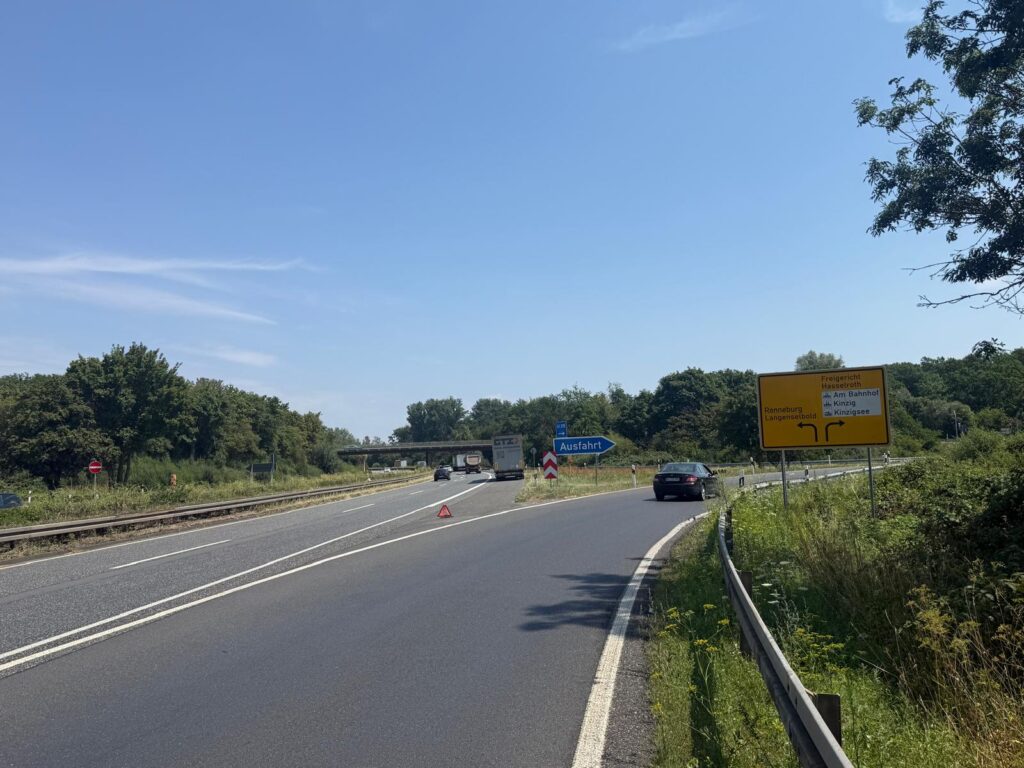
A tyre blowout on a semi-trailer is one of those breakdowns that looks dramatic and is genuinely dangerous. When a 385/65 R22.5 trailer tyre lets go at motorway speed, the carcass can tear itself off the rim in seconds, leaving rubber debris across two or three lanes and a fully loaded curtainsider stranded on the hard shoulder with nowhere safe to stand. That is exactly what happened on the A10 Berlin ring road near Michendorf, in the state of Brandenburg, on a weekday afternoon. This case study walks through what happened, how LKWHelp24’s tyre service partner network responded, and what the driver and haulage company can learn from it.
A trailer axle blowout carries a specific set of risks that a drive-axle failure does not always share. The trailer has no engine braking and no direct feedback to the driver’s hands, so a destroyed tyre on the rear axle can go unnoticed for several hundred metres before the driver feels the vibration or sees warning lights from a TPMS system, if one is even fitted. By the time the rig is brought to a stop, the tyre carcass is often already gone, the wheel has been running metal-on-tarmac, and there is a real risk of rim damage or a fire from friction heat. Add in the fact that the A10 around Michendorf carries dense ring-road traffic funnelling traffic around Berlin, and the margin for error on the hard shoulder shrinks considerably.
Hard-shoulder breakdowns on a ring road like the A10 are also exposed to a specific danger: drivers approaching from behind are often distracted, tired, or simply travelling too fast for the space available on the hard shoulder. Every minute a heavy vehicle spends parked there with only a warning triangle for protection is a minute of real risk to the crew. This is precisely why speed of response, correct securing procedure, and a properly equipped mobile tyre team matter so much in cases like this one.
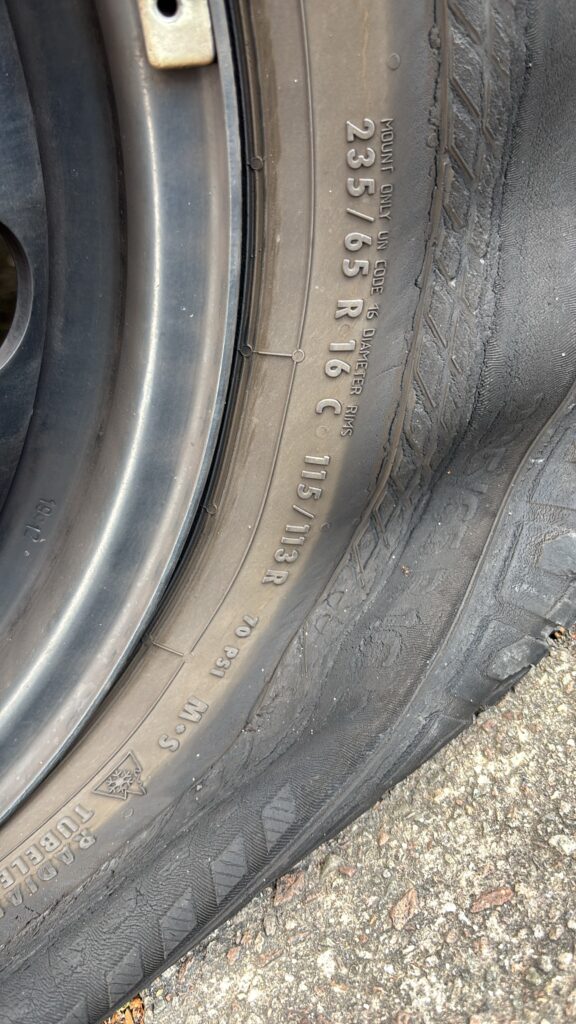
Photo caption: Reifenplatzer am Sattelauflieger (Planenauflieger) auf der A10 bei Michendorf – mobiler Reifenwechsel durch LKWHelp24.
The Emergency
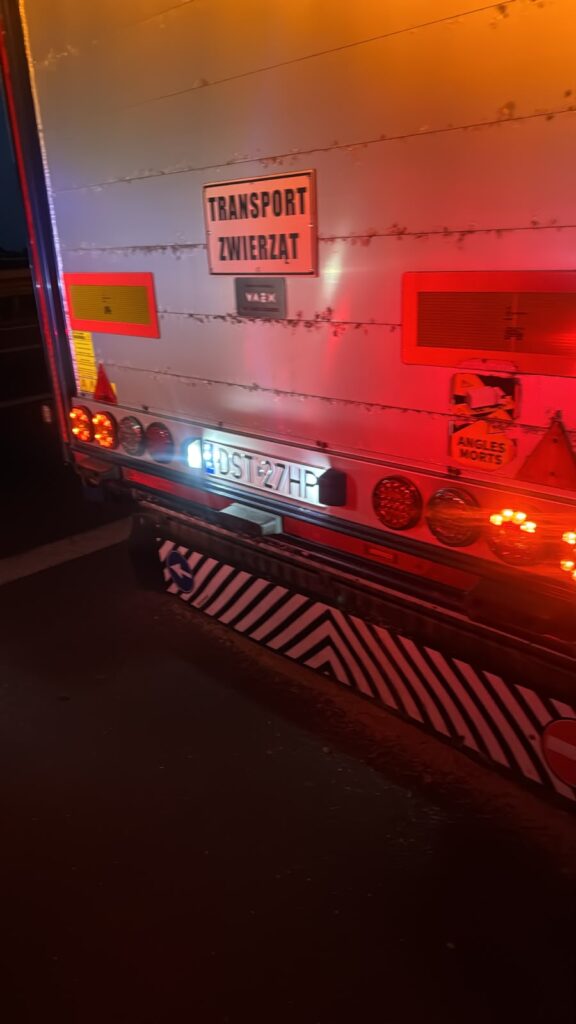
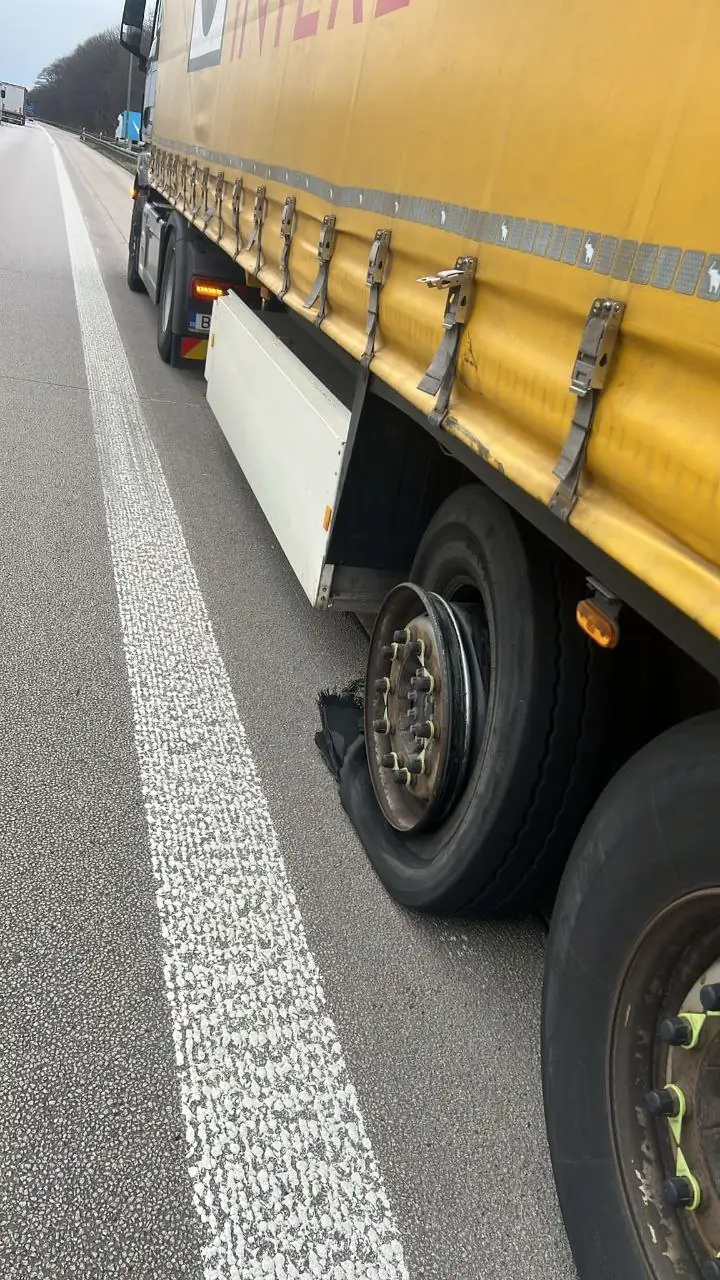
The driver was operating an articulated lorry with a yellow curtainsider semi-trailer, registered in Berlin, travelling on the A10 near Michendorf when a tyre on the trailer axle suffered a catastrophic blowout. The damage was severe: the tyre was completely destroyed and the carcass had torn away from the rim entirely, leaving nothing but a bare wheel running on the road surface by the time the vehicle came to a stop. The driver managed to bring the rig safely onto the hard shoulder, but with a fully loaded semi-trailer and a wrecked wheel on the trailer axle, there was no way to continue, and no way to change the wheel without the right lifting and fitting equipment. The call for help went out at 15:10.
How Help Was Organised
LKWHelp24 operates a round-the-clock dispatch service backed by a network of independent commercial-vehicle breakdown and tyre specialists across Germany. Rather than sending a single fixed team from a distant depot, dispatch identifies the nearest qualified partner for the specific type of failure and vehicle involved, which is what kept the response time on this call so tight.
For this case, the call was matched with a mobile commercial-vehicle tyre service operating in the Berlin/Brandenburg area, chosen because:
- The partner carries 385/65 R22.5 trailer tyres in stock on the service vehicle, avoiding a return trip to a depot.
- The team is equipped with a mobile jack and axle stands suitable for lifting a loaded trailer axle safely at the roadside.
- Response coverage includes the A10 ring road and the Michendorf area as part of the partner’s regular operating radius.
- The technicians are trained in hard-shoulder safety procedures specific to motorway ring roads, where traffic density and approach speed differ from rural trunk roads.
Dispatch confirmed the job and gave the driver an estimated time of arrival within fifteen minutes of the initial call, at 15:25.
The Situation On-Site
When the technician arrived at 16:05, the priority was safety before any tools came out. The lorry and trailer were positioned on the hard shoulder of the A10, a location that offers a strip of refuge but sits directly alongside live motorway traffic. The technician checked the vehicle’s position, confirmed the warning triangle was correctly placed, and added the service vehicle’s own hazard lighting and cones to extend the visible safety zone before anyone worked near the running lanes.
Inspection of the destroyed wheel confirmed the scale of the failure. The 385/65 R22.5 tyre was beyond any possibility of repair; the carcass had separated fully from the rim, meaning the wheel had likely run bare for some distance before the driver could stop safely. The rim itself was checked for cracking, deformation, and bead-seat damage, since a carcass tearing off at speed can sometimes bend or score the rim badly enough to require replacement. In this case the rim had survived intact, which meant the job was a straightforward tyre replacement rather than a more involved rim swap.
Because the damage was on the trailer axle rather than the drive axle, the wheel change required lifting the trailer itself rather than the tractor unit, using axle stands rated for the loaded weight sitting on that axle. No secondary damage was found to the mudguard, brake components, or suspension, which meant the technician could move directly into the wheel change once the axle was secured.
Step-by-Step
Step 1: Secure the vehicle. The rig was confirmed to be safely positioned on the hard shoulder, warning triangle placed at the correct distance behind the vehicle, and the service van’s own hazard beacons and cones added to widen the protected working area against passing motorway traffic.
Step 2: Raise the trailer axle. The technician positioned a mobile jack under the trailer chassis and lifted the affected axle, then supported it on axle stands rated for the load before any work began underneath.
Step 3: Remove the destroyed wheel and inspect the rim. The wheel nuts were released and the wrecked wheel, with the torn carcass still partially attached, was removed. The rim was inspected for cracks, bead-seat damage, and deformation before being cleared for reuse.
Step 4: Fit the new tyre. A new 385/65 R22.5 commercial trailer tyre was mounted onto the inspected rim and fitted to the axle hub.
Step 5: Torque, pressure, and function check. Wheel nuts were tightened crosswise to the correct torque specification to ensure even seating, the tyre was set to the correct trailer-axle pressure, and a final visual and function check confirmed the wheel was running true and the trailer was safe to move before the axle stands were removed and the vehicle released.
Full Timeline
| Time | Phase | Action |
|---|---|---|
| 15:10 | Call received | Driver reports trailer tyre blowout on the A10 hard shoulder near Michendorf |
| 15:25 | Technician dispatched | Nearest available partner confirmed, ETA given |
| 16:05 | On site | Technician arrives on the A10, safety zone set up |
| 16:20 | Wheel removed | Destroyed wheel taken off, rim inspected |
| 16:45 | New tyre fitted | New 385/65 R22.5 trailer tyre mounted |
| 16:55 | Torque and pressure check | Wheel nuts torqued crosswise, pressure set, function check completed |
| 16:55 | Vehicle released | Trailer lowered, driver cleared to continue |
Total time from call to release: approximately 1 hour 45 minutes. Time actually spent on site: around 50 minutes.
Cost
| Item | Price (EUR) |
|---|---|
| Call-out / 24-7 service | 180 |
| Labour / on-site fitting | 130 |
| New 385/65 R22.5 tyre | 350 |
| Old-tyre disposal + valve | 30 |
| TOTAL | 690 |
The largest single line item is the tyre itself. A 385/65 R22.5 trailer tyre from a recognised commercial brand is not a budget component, and prices vary depending on the manufacturer and whether the fitment is a premium tyre such as Continental or Michelin, or a mid-range alternative. The call-out fee reflects round-the-clock availability and the fact that a technician with the right stock and equipment had to be dispatched directly to a motorway hard shoulder rather than working from a fixed workshop. Disposal of the old tyre and the new valve is a small but necessary line, since a destroyed carcass cannot simply be left at the roadside.
Set against the alternative, the total of 690 EUR is modest. Without mobile assistance, the only other option would have been a flatbed recovery of the entire articulated combination to the nearest workshop, plus the tyre and fitting cost on top, plus the delay and demurrage while the vehicle waited its turn in a workshop queue rather than being fitted directly at the roadside. For a loaded curtainsider on a time-sensitive run, the recovery route would very likely have cost more in total and taken considerably longer.
Why a Professional Service Is Essential
A blown trailer tyre on a motorway hard shoulder is not a job for an untrained hand or a driver working alone. Lifting a loaded trailer axle safely — whether the axle itself is built by BPW or another major manufacturer — requires the right jack and axle stands rated for the actual load on that axle, not a passenger-car trolley jack. Working within touching distance of live motorway traffic requires proper hazard awareness and a correctly extended safety zone, which is second nature to a trained mobile tyre technician but genuinely risky for someone without that experience. And correctly torquing wheel nuts crosswise to specification is what prevents a repeat failure a few hundred kilometres down the road; a wheel that is not seated and torqued properly can loosen, and a loose trailer wheel at motorway speed is its own emergency waiting to happen.
There is also the matter of judgement. Knowing when a rim can be reused and when it needs replacing, recognising whether secondary damage has reached the brakes or suspension, and confirming the correct pressure for a specific trailer axle load are all decisions that come from doing this job daily, not from a general roadside toolkit.
Insurance and liability play a role too. A haulier that can show the tyre change was carried out by a qualified mobile tyre service, with the correct torque values applied and a documented visual check, is in a far stronger position if a wheel-related incident is ever queried later. A DIY change at the roadside, even a competent one, does not carry the same paper trail.
Typical Breakdown Situations We Handle
LKWHelp24’s partner network responds to a wide range of commercial-vehicle tyre and breakdown situations across Germany, including:
- Tyre blowouts on the motorway, on both drive axles and trailer axles
- Semi-trailer blowouts on curtainsiders, tankers, and flatbed trailers — comparable to a steer-axle blowout we handled on the A5 near Baden-Baden
- Trailer tyre replacement at the roadside, including 385/65 R22.5 and other common commercial sizes
- Hard-shoulder tyre changes on motorway rings and trunk roads
- Roadside assistance across the Berlin and Brandenburg region, and nationwide
- Rim damage assessment following a carcass separation
- Fleet call-outs where multiple trailers or units need coordinated response
Prevention Tips
A trailer tyre that separates this completely from its rim is rarely a sudden, unpredictable event. A few habits reduce the risk significantly — see also our general tyre emergency guide for what to do the moment a blowout happens:
- Watch trailer tyre age, not just tread depth. Trailer tyres often run fewer kilometres per year than drive-axle tyres, so they can reach the end of their safe service life on age and rubber degradation well before the tread wears down. Many fleets set a maximum age limit regardless of remaining tread.
- Check pressure regularly, including on axles that are easy to forget. Trailer axles are checked less often than the tractor’s own tyres simply because they are less visible during a routine walk-round. Under-inflation generates heat, and heat is what causes a carcass to fail catastrophically rather than simply losing air slowly.
- Know the correct hard-shoulder procedure before it is needed. Getting the vehicle as far left as possible within the hard shoulder, activating hazard lights immediately, placing the warning triangle at a safe distance behind the vehicle, and getting the crew behind the barrier rather than standing beside the vehicle are all decisions that need to be automatic, made in the first thirty seconds after stopping, not worked out under pressure with traffic passing at speed.
Trailer Tyres, Brands, and Fleet Service
The 385/65 R22.5 size fitted in this case is one of the most common trailer tyre sizes on European roads, used across curtainsiders, box trailers, and flatbeds. Reputable commercial brands such as Continental Truck and Michelin Truck are widely specified by fleets precisely because trailer tyre failure is expensive and disruptive, and a well-built carcass is far less likely to separate the way this one did. Goodyear is another brand frequently found on German trailers, and all three tend to hold up better under sustained motorway load than budget alternatives, which matters most on axles that rarely get a close visual check.
For hauliers running larger fleets, a mobile truck service that can reach any vehicle on any route, day or night, is not a luxury. It is what keeps a schedule intact when a single trailer tyre decides not to cooperate somewhere between Berlin and the next delivery slot. Fleet operators who plan for this in advance, agreeing coverage and stock availability with a mobile partner before a breakdown happens rather than after, tend to lose far less time per incident than those who search for help only once a vehicle is already stopped. LKWHelp24’s coordination role, matching each call to the nearest qualified partner rather than routing every job through one central depot, is what keeps response times workable across a country as large as Germany, whether the vehicle is on a Berlin ring road or several hundred kilometres away.
Why LKWHelp24
LKWHelp24 exists to remove the guesswork from a moment when a driver is standing on a hard shoulder with a wrecked wheel and a fully loaded trailer. The service is built around three things: a genuine 24-hour, 7-day dispatch line, a partner network dense enough to cover motorway breakdowns across the whole of Germany rather than one region, and a dispatch process that matches the failure type, not just the location, to the right specialist. In this case that meant a technician arriving with 385/65 R22.5 stock already on the van, the correct lifting gear for a loaded trailer axle, and the training to work safely on a busy ring road, all within fifteen minutes of the driver’s call.
Summary
- Vehicle: Articulated lorry with yellow curtainsider semi-trailer, Berlin plates
- Failure: Complete blowout on the trailer axle, carcass torn from rim
- Tyre fitted: New 385/65 R22.5 commercial trailer tyre
- Location: A10 near Michendorf, Brandenburg
- Call to release: 1 hour 45 minutes
- On-site time: Around 50 minutes
- Total cost: 690 EUR
- Secondary damage: None
Request Emergency Assistance Now
If your truck or trailer suffers a tyre blowout anywhere in Germany, call +49 160 5753826, see our contact details, or visit lkwhelp24.com. Available 24/7 across all of Germany.
You might also be interested in:
– Truck tyre blowout on the A9 near Dessau – drive axle wheel change
– Truck tyre blowout on the A1 near Bremen – drive axle wheel change
– Trailer tyre service on the A81 near Rottweil – car transporter