Skip to content
A tyre blowout on the drive axle of a fully loaded articulated lorry is not a minor inconvenience. It is a genuine roadside hazard, and anyone who has stood on the hard shoulder of the A1 with lorries thundering past at 130 km/h will tell you it concentrates the mind wonderfully. This case study walks through exactly what happened when a long-haul tractor unit suffered a violent drive-axle tyre failure near Bremen, and how LKWHelp24\’s partner network had the vehicle back on the road in under two hours.
n
We are publishing the full breakdown, timeline and invoice because transparency is, frankly, rare in this industry. Too many fleet managers and owner-drivers have been burned by vague call-out fees and \”we\’ll see when we get there\” pricing. Here you get the real numbers: what broke, why it was dangerous, who fixed it, how long it took, and what it cost down to the euro.
n
What Happened and Why It Matters
n
The vehicle involved was a long-haul tractor unit, roughly 40 tonnes gross combination weight, running one of the busiest north-south corridors in Germany. Somewhere on the A1 near Bremen, heading towards Osnabrück, one of the twin drive-axle tyres let go catastrophically. This wasn\’t a slow puncture the driver could nurse to the next lay-by. It was a full blowout: the tread and carcass shredded, with the steel belt left wrapped around the rim. The lorry was immobilised on the hard shoulder.
n
If you have never seen a drive-axle blowout up close, the damage is startling. A truck tyre running at 8.5 to 9.5 bar carries an enormous amount of stored energy, and when the carcass fails under load, that energy has to go somewhere. Debris can be thrown metres from the vehicle, the sudden loss of one tyre in a twin set shifts the load balance onto its partner, and the driver has only a fraction of a second to keep the rig straight. This is precisely the kind of incident that turns into a secondary collision if it isn\’t dealt with fast, correctly, and by people who do this every day.
n
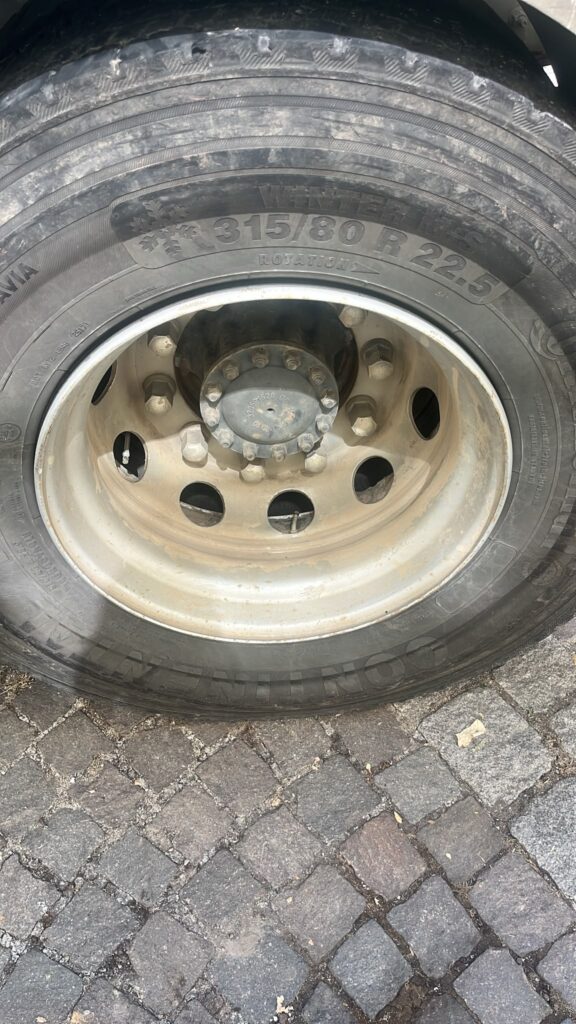
Tyre blowout on the drive axle (315/80 R22.5) on the A1 near Bremen – mobile truck tyre service by LKWHelp24.
n
The Emergency: A1 Near Bremen, Drive Axle Down
n
-
n
- Location: A1 motorway, hard shoulder near Bremen, direction Osnabrück.
- Vehicle: Articulated tractor unit, long-haul configuration, approximately 40 tonnes.
- Fault: Blowout on the twin drive-axle tyre — tread and carcass destroyed, steel belt left seated on the rim.
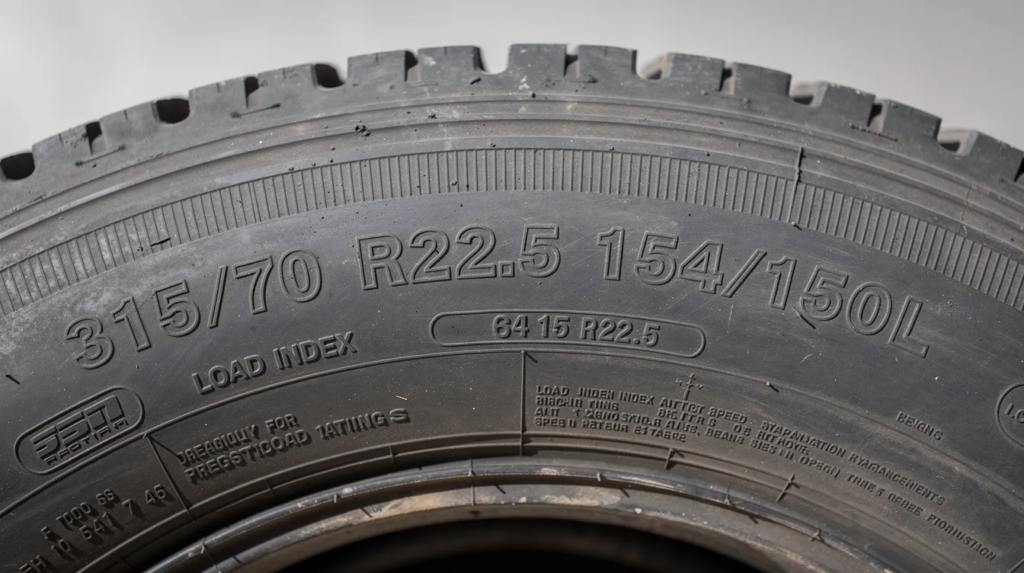
- Tyre specification: 315/80 R22.5, standard drive-axle fitment for long-haul tractor units.
- Vehicle status: Stationary on the hard shoulder, hazard lights and warning triangle deployed, driver safely clear of the carriageway.
n
n
n
n
n
n
This isn\’t the sort of job you want handled by whoever happens to answer the phone at the nearest garage forty minutes away. It needs a dispatcher who already knows which certified partner is closest, what stock they carry, and how fast they can mobilise.
n
How Help Was Organised
n
LKWHelp24 doesn\’t send a single van driving around hoping to find the right tyre. We run a nationwide network of vetted, certified truck tyre partners, positioned so that wherever a breakdown happens in Germany, someone qualified is realistically close by. For this call, here\’s what happened behind the scenes:
n
-
n
- The driver rang the LKWHelp24 emergency line and gave the exact location — A1, hard shoulder, direction Osnabrück, near Bremen.
- Our dispatcher immediately identified and briefed a certified LKW tyre partner covering the greater Bremen area, confirming they carried the correct 315/80 R22.5 drive-axle tyre in stock.
- The partner was given the estimated time of arrival and dispatched without delay — no back-and-forth, no \”let me check with the depot and call you back.\”
- The driver was kept informed throughout, so there was no uncertainty about when help would arrive — a small thing, but anyone who has waited roadside in the cold with traffic screaming past knows it matters.
- On arrival, the technician assessed the scene, secured the vehicle, and got to work immediately.
n
n
n
n
n
n
This is the entire point of a partner network model rather than a single-van operation: speed comes from already knowing who to call, not from searching for them after the phone rings.
n
The Situation On-Site
n
Once the technician arrived, the priority was securing the scene before touching a spanner. A tractor unit stopped on the hard shoulder of the A1 is exposed to fast-moving traffic, and drive-axle work means the vehicle has to be jacked and stabilised — not something you rush.
n
A few technical points worth understanding if you\’re not familiar with heavy commercial tyres:
n
-
n
- Drive-axle tyres on a tractor unit like this run in twin (dual) formation — two tyres mounted side by side on each end of the axle. When one fails, the load doesn\’t disappear; it shifts onto its twin, which needs to be inspected for damage before the vehicle moves again.
- Correct inflation for this tyre size sits in the 8.5–9.5 bar range depending on load and manufacturer spec — nowhere near the pressure of a car or van tyre, and precisely why a failure releases so much energy.
- The rim itself has to be checked for deformation. A blowout at speed can bend or crack a steel wheel, and fitting a new tyre to a damaged rim is a false economy that creates a second breakdown a few weeks later.
n
n
n
n
In this case, the rim was intact and the neighbouring twin tyre showed no damage — good news that kept the job to a straightforward tyre replacement rather than a more complex axle inspection.
n

n
Step-by-Step: What the Technician Did
n
Step 1 — Scene assessment and securing the vehicle. Warning triangle and hazard lights confirmed, the technician checked traffic flow before positioning the service vehicle to shield the work area, then assessed the extent of the tyre damage.
n
Step 2 — Jacking and stabilising. The tractor unit was jacked at the correct chassis point and stabilised. This step alone requires proper equipment and training — improvised jacking on a live carriageway is how roadside incidents turn into serious accidents.
n
Step 3 — Removing the destroyed tyre and inspecting the rim. The wrecked 315/80 R22.5 was demounted from the drive axle. With the wheel off, the rim was inspected for cracks, bends or bead damage, and the neighbouring twin tyre was checked for cuts, bulges or embedded debris.
n
Step 4 — Fitting and inflating the replacement. A new 315/80 R22.5 was mounted, balanced, and inflated to the specified 9.0 bar.
n
Step 5 — Torque and final check. Wheel nuts were tightened in a star pattern to the manufacturer\’s specified torque — the correct sequence matters, because tightening in a simple circular order can leave the wheel seated unevenly and prone to loosening under vibration. A final visual and pressure check confirmed the vehicle was roadworthy before it was released back into traffic.
n
Full Timeline
n
| Time | Phase | Action |
|---|---|---|
| 13:25 | Call received | Driver contacts LKWHelp24 emergency line, location confirmed |
| 13:36 | Partner dispatched | Certified Bremen-area tyre partner briefed, ETA confirmed |
| 14:10 | Arrival on site | Technician reaches the vehicle on the A1 hard shoulder |
| 14:18 | Vehicle secured | Scene secured, tractor unit jacked and stabilised |
| 14:38 | Old tyre removed | Destroyed tyre demounted, rim and twin tyre inspected |
| 14:54 | New tyre fitted | Replacement 315/80 R22.5 mounted and inflated to 9.0 bar |
| 15:02 | Torque and final check | Wheel nuts torqued in star pattern, final inspection completed |
| 15:05 | Vehicle roadworthy | Lorry released, driver back on schedule |
n
Total elapsed time: approximately 1 hour 40 minutes from the initial call to the vehicle being roadworthy again, with roughly 55 minutes of hands-on work once the technician arrived on site.
n
Cost Breakdown
n
| Item | Price (EUR) |
|---|---|
| Call-out / 24/7 motorway emergency service | 180 |
| Tyre 315/80 R22.5 (Continental Conti Hybrid HD3) | 330 |
| On-site fitting and balancing | 90 |
| Old tyre disposal | 20 |
| TOTAL | 620 EUR |
n
A few points on pricing that fleet managers and drivers often ask about:
n
-
n
- The call-out fee reflects a genuine 24/7 motorway emergency response, not a scheduled workshop visit. It covers a technician being available around the clock, fully equipped, and able to reach a hard shoulder on a major motorway within roughly 35–45 minutes of dispatch.
- Tyre pricing varies with brand and specification. In this case, a Continental Conti Hybrid HD3 was fitted — a well-regarded drive-axle tyre for long-haul work. Comparable alternatives include the Michelin X Multi D and the Goodyear KMAX D, both of which our partners also stock.
- Legal, compliant disposal of the destroyed tyre is included rather than left to the driver to sort out at the next depot.
n
n
n
n
Compare that 620 EUR and under two hours against the alternative: waiting for a flatbed recovery to a workshop, losing the better part of a working day, and potentially facing demurrage or missed delivery penalties that dwarf the repair cost itself. For a haulier running tight delivery windows, the maths on calling a specialist mobile service rather than gambling on a slower fix isn\’t close.
n
Why a Professional Service Is Essential
n
It\’s tempting, especially for an experienced driver, to think a tyre change is a tyre change. On a car, maybe. On a 40-tonne artic parked on a motorway hard shoulder, the risks stack up fast if it\’s done incorrectly:
n
-
n
- Traffic exposure. The A1 near Bremen carries dense freight traffic around the clock. Without proper scene management — correct positioning, warning triangles, high-visibility equipment — a breakdown becomes a secondary-accident risk within minutes.
- Jacking a 40-tonne vehicle safely. Heavy commercial vehicles have specific, load-rated jacking points. Improvised jacking risks the vehicle slipping off the jack, which at best damages the chassis and at worst injures whoever is underneath it.
- Torque and wheel security. Under-torqued or incorrectly sequenced wheel nuts are a leading cause of wheels working loose on the motorway — a fault that can take days to show up and then fail catastrophically at speed.
- Missed secondary damage. A blown tyre can bend a rim or damage the neighbouring twin tyre without it being obvious to an untrained eye. Fitting a new tyre onto a compromised rim just guarantees a repeat breakdown.
- Insurance and liability. Roadside repairs carried out by uncertified individuals can complicate insurance claims if anything goes wrong afterwards, particularly for commercial fleet policies.
n
n
n
n
n
n
A certified mobile truck tyre service exists precisely to remove these risks — proper equipment, trained technicians, and the right stock carried to the scene rather than improvised on the spot.
n
Typical Breakdown Situations We Handle
n
LKWHelp24\’s partner network covers the full range of heavy commercial vehicle breakdowns across Germany, not just tyre failures:
n
-
n
- Drive-axle and steering-axle tyre blowouts and punctures
- Trailer and semi-trailer tyre failures
- Battery failure and jump-starting for HGVs and buses
- Lockouts and key-related breakdowns
- Minor mechanical faults preventing onward travel
- Coach and bus breakdown support
- Coordination of recovery and towing where a roadside fix isn\’t possible
- Emergency support for gefahrgut (dangerous goods) transport, handled with the correct protocols
n
n
n
n
n
n
n
n
n
Whether it\’s a routine puncture on a rastplatz or a full drive-axle blowout on the autobahn, the same principle applies: a fast-dispatched, correctly equipped technician beats waiting for a generic breakdown truck that may not even carry the right size tyre.
n
Prevention Tips for Drivers and Fleet Operators
n
No tyre is immune to failure, but the odds can be shifted significantly with a bit of discipline:
n
-
n
- Check pressures regularly, not just at the depot. Drive-axle tyres running underinflated generate excessive heat, which is one of the most common causes of carcass failure at motorway speed.
- Inspect tread depth and sidewall condition before long runs. Cuts, bulges or embedded debris on a sidewall are early warning signs that a tyre is close to failing.
- Don\’t ignore vibration or pulling. A change in how the vehicle handles is often the first symptom of an already-degrading tyre.
- Match tyre load rating to the actual load carried. Running a tyre near or beyond its rated capacity, especially on the drive axle, dramatically shortens its safe working life.
- Keep an eye on age, not just tread. Rubber compounds degrade over time even with adequate tread remaining — a tyre well past five or six years in service, regardless of mileage, deserves closer inspection.
- Save the emergency number before you need it. Having LKWHelp24\’s number stored means no wasted minutes searching for help while stood on a live hard shoulder.
n
n
n
n
n
n
n

n
Fleet Maintenance and Tyre Brand Considerations
n
For fleet operators managing multiple vehicles across long-haul routes, tyre strategy is a cost-management decision as much as a safety one. The Continental Conti Hybrid HD3 fitted in this case is built for mixed motorway and regional use, offering a durable carcass suited to drive-axle demands on long routes. Fleets running predominantly motorway kilometres often also consider the Michelin X Multi D, known for even wear across long service intervals, or the Goodyear KMAX D, which is frequently specified for its balance of mileage and grip in wet conditions.
n
A sensible fleet maintenance approach pairs tyre brand selection with a proactive replacement schedule rather than a purely reactive one — tracking tread depth trends across the fleet, rotating where appropriate, and budgeting for planned replacement rather than treating every tyre failure as an unplanned emergency. That said, breakdowns happen even to the best-maintained fleets, which is exactly why having a trusted 24/7 partner on speed dial matters regardless of how good your preventive maintenance programme is.
n
LKWHelp24: Your Truck Emergency Partner
n
We built LKWHelp24 around one idea: when a lorry is stranded, every minute matters, and drivers and fleet managers deserve a service that reflects that urgency without cutting corners.
n
-
n
- Genuinely 24/7, across the whole of Germany. Not a call centre that takes a message — a live dispatcher who can mobilise a certified partner immediately, day or night, any motorway, any region.
- A certified partner network, not a single van. Because we work with vetted specialists positioned across the country, response times stay realistic wherever the breakdown happens.
- Transparent pricing, agreed before work starts. No surprises on the invoice — you see the breakdown, as shown in this case study, before the technician starts.
- Multilingual support. Drivers from across Europe get help in a language they\’re comfortable communicating in, which matters enormously in a stressful roadside situation.
- Full-service capability. Tyres, batteries, lockouts, minor mechanical faults and recovery coordination, all through a single call.
n
n
n
n
n
n
Summary
n
-
n
- Tyre size: 315/80 R22.5 (drive axle, twin configuration)
- Location: A1 motorway, hard shoulder near Bremen, direction Osnabrück
- Response time: 11 minutes from call to partner dispatch; 45 minutes from dispatch to arrival on site
- Total time (call to roadworthy): 1 hour 40 minutes
- On-site working time: approximately 55 minutes
- Total cost: 620 EUR
- Secondary damage: none — rim intact, twin tyre undamaged
n
n
n
n
n
n
n
n
Request Emergency Assistance Now
n
If you\’re facing a truck tyre blowout, breakdown or roadside emergency anywhere in Germany, call +49 160 5753826 or visit lkwhelp24.com. Available 24/7 across all of Germany.
n
n
You might also be interested in
n
-
n
- Mobile Truck Tyre Service on the Autobahn: Actros 2543 Wheel Change
- Truck Tyre Blowout on the Steering Axle: Roadside Service Case Study
- Truck Tyre Service on the A6 near Mannheim: Scania 385/55 R22.5
- Truck Tyre Service Near Me: How LKWHelp24 Fixed a Semi-Truck Blowout on the A2 Near Hannover in 1 Hour 42 Minutes
n
n
n
n
n
n
Further reading: Continental Truck Tyres · ADAC Truck Breakdown Assistance