Skip to content
A tyre blowout on a loaded 40-tonne artic is one of the most unforgiving things that can happen on a German motorway. There\’s no warning shot. One second the trailer is tracking straight, the next there\’s a bang loud enough to hear over the cab noise, the whole rig lurches sideways, and the driver is fighting the wheel while trying to work out which axle just let go. On the A7 near Hamburg, in the northbound carriageway towards Flensburg, that\’s exactly what happened to a driver on a long-haul run — and it\’s the case we want to walk through here, because it shows precisely what a properly organised roadside tyre network can do when the pressure\’s on.
n
This isn\’t a marketing story dressed up as a case study. It\’s a record of one breakdown, with the real timeline and the real invoice, because hauliers and fleet managers deserve to know what \”emergency tyre service\” actually costs and how long it actually takes — not vague promises, but numbers they can hold a dispatcher accountable to. Every haulier who\’s spent a night on the hard shoulder waiting for someone, anyone, to answer the phone knows why that matters.
n
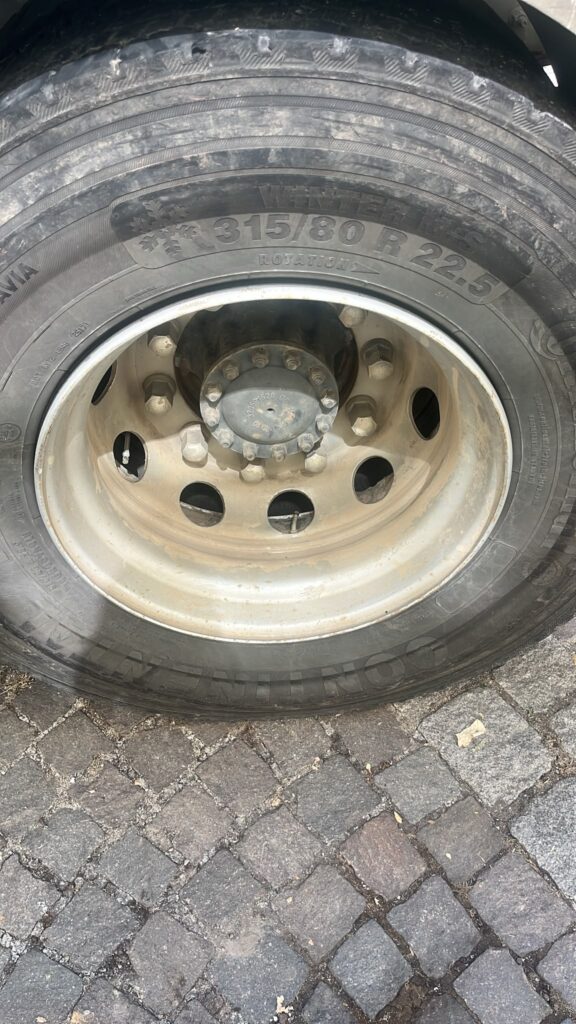
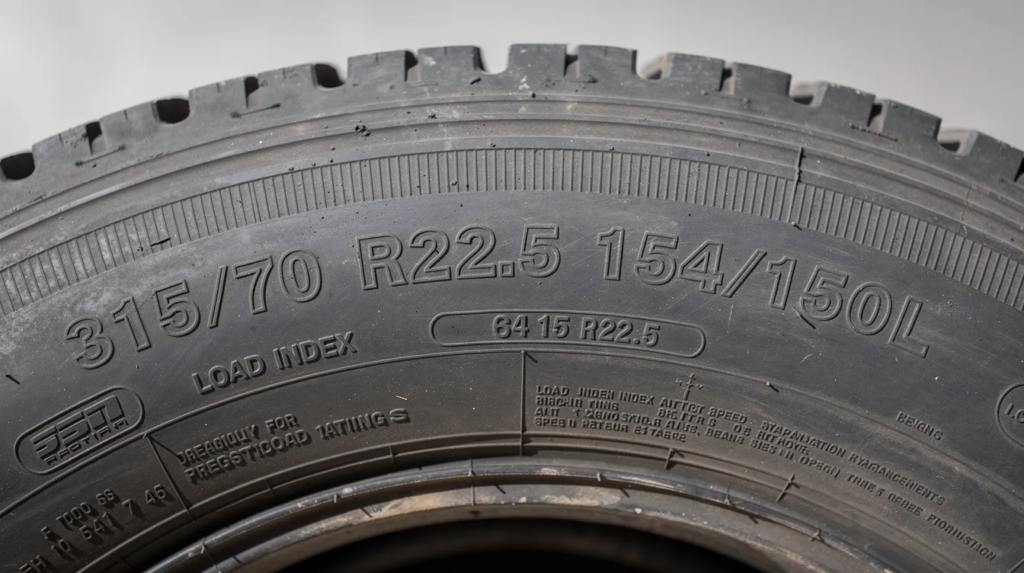
Severe tyre blowout (385/65 R22.5) on the A7 near Hamburg – mobile wheel change by LKWHelp24.
n
The Emergency
n
The vehicle was a semi-trailer combination running long-distance freight, carrying an estimated gross weight in the region of 40 tonnes — the standard maximum for combination vehicles on German roads. The affected wheel was fitted with a 385/65 R22.5 tyre, the wide \”super single\” trailer tyre commonly used to replace twin-wheel setups on modern trailers for weight savings and rolling resistance.
n
What the driver experienced was not a slow puncture. It was a full structural failure: the tread had separated completely from the carcass, the tyre itself was destroyed beyond any hope of a temporary repair, and the mudguard bracket had taken a light knock from debris thrown up as the tyre disintegrated. This is the failure mode hauliers dread most, because a blowout at motorway speed throws rubber and steel belting in every direction, can damage brake lines, air lines, or the mudguard assembly, and — worst of all — can happen without any prior symptom. A slow leak gives you a chance to find a lay-by. A catastrophic blowout gives you a bang and a hard pull on the wheel.
n
The driver did the right thing: got the vehicle onto the hard shoulder of the A7, activated the hazard lights, put out a warning triangle, and called for help rather than attempting to limp along on a wrecked tyre or, worse, trying to change it single-handed on a live carriageway. On a 385/65 R22.5 wheel assembly, that\’s not a five-minute roadside job for one person — the wheel alone weighs well over 80 kilograms, and doing this without the right jacking equipment, wheel dolly, and torque tools on a busy motorway shoulder is asking for a second accident on top of the first.
n

n
How Help Was Organised
n
This is where LKWHelp24\’s partner network earns its keep. We don\’t run one van covering the whole of Germany — nobody can do that credibly, and any provider claiming a two-hour ETA regardless of location is either lying or hasn\’t looked at a map. Instead, we work through a nationwide grid of vetted, equipped LKW tyre and breakdown partners, so that whichever motorway a truck breaks down on, there\’s a partner already close enough to reach it quickly.
n
For this callout, the process ran like this:
n
● Call received at our 24/7 dispatch line — driver gives location (A7, hard shoulder, direction Flensburg), vehicle type, and a description of the damage.
n● Dispatcher confirms the exact kilometre marker and carriageway using the driver\’s satnav or nearby signage, since precise positioning on a motorway hard shoulder is critical for the responding technician\’s own safety.
n● Nearest available LKW tyre partner in the Hamburg region identified and contacted — checked for tyre stock in the correct size and load rating before dispatch, since turning up without the right tyre wastes everyone\’s time.
n● Partner confirmed, ETA communicated to the driver, and the driver advised to stay well clear of the carriageway side of the vehicle and keep hazard warning gear visible until the technician arrived.
n● Technician dispatched directly to the breakdown location with a fully equipped service vehicle carrying jacks rated for heavy trailer axles, impact tools, and replacement tyre stock.
n
The gap between the initial call and the partner being on site was well under an hour — fast by any standard for a motorway breakdown in a major traffic corridor like the Hamburg approach to the A7.
n

n
The Situation On-Site
n
Once the technician arrived, the first job wasn\’t touching the wheel — it was making the scene safe. A stationary heavy vehicle on a motorway hard shoulder is a serious hazard, both to the crew working on it and to passing traffic, particularly on a route as heavily used as the A7 around Hamburg, where mixed truck and car traffic runs at speed around the clock. Cones, additional warning triangles, and hazard beacons went out behind the vehicle before any tools came out.
n
Then came the technical assessment. A tyre in this condition — full tread separation, exposed carcass, felgenhorn (the rim flange) visible where the tyre used to sit — isn\’t a repair job. There\’s no patch or plug that safely restores a tyre that\’s lost structural integrity like this; it has to be replaced, full stop. The technician also had to check whether the failure had done any collateral damage. In this case, the mudguard bracket had taken a light impact from the disintegrating tyre — noted and inspected, but not serious enough to affect roadworthiness. Critically, the rim itself was checked and confirmed undamaged, and the axle was inspected and found sound. That\’s not a given after a blowout of this severity — a violent tyre failure can bend a rim or, in the worst cases, damage a hub or brake components, and catching that early prevents a driver getting back on the road with a fault nobody noticed.
n
Correct inflation on a 385/65 R22.5 trailer tyre matters more than most drivers realise. These wide tyres typically run in the 8.5 to 9.5 bar range depending on load and manufacturer specification, and getting that wrong in either direction shortens tyre life dramatically and, at the extreme end, contributes to exactly the kind of catastrophic failure this driver had just experienced. Our partner inflated the new tyre to the manufacturer-specified 9.0 bar, not a rough guess.
n
Step-by-Step: What the Team Did
n
Step 1 — Assessment and securing the scene. Warning triangles and cones placed, hazard lighting confirmed, vehicle checked to ensure it was stable and wouldn\’t roll before jacking began.
n
Step 2 — Stabilisation. The trailer was jacked using heavy-duty equipment rated for the axle weight, with wheel chocks placed on the unaffected wheels to prevent any movement during the lift.
n
Step 3 — Wheel removal. The destroyed 385/65 R22.5 tyre and wheel assembly were removed. With the wheel off, the technician had a clear view of the rim and the mudguard bracket for inspection — both checked and confirmed fit for continued service.
n
Step 4 — Fitting the new tyre. A replacement Continental Conti Hybrid HT3 in the correct 385/65 R22.5 size was fitted, balanced, and inflated to 9.0 bar. The wheel nuts were torqued down in a star pattern — never a simple round-the-clock sequence — because tightening in a star pattern seats the wheel evenly against the hub and avoids the warping that leads to loose wheels further down the line, one of the more dangerous and entirely preventable causes of heavy-vehicle wheel-off incidents.
n
Step 5 — Final check and road test. Torque figures rechecked, tyre pressure rechecked, mudguard bracket given a final visual pass, and the vehicle lowered off the jack. The driver was walked around the repair before departure and given a short local test roll to confirm everything was sound before rejoining the carriageway.
n

n
Full Timeline
n
| Time | Phase | Action |
|---|---|---|
| 10:05 | Call received | Driver reports blown 385/65 R22.5 tyre, A7 hard shoulder near Hamburg, direction Flensburg |
| 10:17 | Partner dispatched | Nearest LKW tyre partner confirmed, ETA given to driver |
| 10:55 | Arrival on site | Technician reaches the breakdown location |
| 11:03 | Scene secured | Vehicle stabilised and jacked, warning equipment deployed |
| 11:25 | Wheel removed | Destroyed tyre demounted, rim and mudguard bracket inspected |
| 11:43 | New tyre fitted | Continental Conti Hybrid HT3 mounted, inflated to 9.0 bar |
| 11:53 | Torque and final check | Wheel nuts torqued in star pattern, full inspection completed |
| 11:56 | Roadworthy | Vehicle cleared to rejoin the A7 |
n
Total time from call to roadworthy: approximately 1 hour 51 minutes. Time spent physically on site: roughly 1 hour.
n
Cost of the Repair
n
| Item | Price (EUR) |
|---|---|
| Callout / 24/7 motorway emergency service | 190 |
| Tyre 385/65 R22.5 (Continental Conti Hybrid HT3) | 340 |
| On-site fitting and balancing | 90 |
| Old tyre disposal | 20 |
| TOTAL | 640 EUR |
n
A few things worth being straight about. The callout fee reflects genuine 24/7 motorway emergency response, not a standard workshop visit during business hours — a technician has to drop what they\’re doing, load stock and equipment, and drive to a live carriageway at any hour of the day or night. The tyre itself is priced at trade rates for a premium trailer tyre in this size; equivalent alternatives from Michelin (X Multi T) or Goodyear (KMax T) would sit in a broadly similar bracket. Fitting and balancing on a motorway hard shoulder, with all the additional safety precautions that involves compared with a workshop bay, carries a modest premium over an in-shop job, which is entirely reasonable given the conditions.
n
Compare that to the alternative: leaving a loaded artic stranded on the A7 for hours waiting for a slower-responding service, potentially missing a delivery window with contractual penalties attached, or — worse — a driver attempting a DIY wheel change on a live hard shoulder and getting hurt, or damaging the rim or hub through improper jacking. Six hundred and forty euros and under two hours is, frankly, cheap insurance against all of that.
n

n
Why a Professional Service Is Essential
n
It\’s tempting for an experienced driver to think they can handle a wheel change themselves, and for smaller vehicles that might sometimes be true. For a 385/65 R22.5 trailer wheel on a live motorway, it categorically isn\’t, and here\’s why:
n
-
n
- The wheel and tyre assembly weighs well over 80 kilograms — lifting or manoeuvring that without proper equipment risks serious injury.
- Jacking a loaded trailer axle without rated heavy-duty equipment can result in the jack failing or the vehicle shifting under load.
- Working on the traffic side of a stranded vehicle on a motorway hard shoulder, without professional traffic-awareness protocols and warning equipment, is genuinely one of the most dangerous activities a driver can undertake — passing HGVs generate enormous slipstream forces at speed.
- Incorrect torque sequencing on wheel nuts is a leading cause of wheels working loose over the following days, sometimes resulting in a wheel-off incident kilometres down the road, long after the driver has forgotten about the roadside repair.
- Getting tyre pressure wrong on a heavy trailer tyre — even by a bar or so — accelerates wear and can contribute to a repeat blowout.
- Without the right diagnostic eye, secondary damage to a rim, hub, or brake line caused by the original blowout can go unnoticed until it causes a second, potentially worse, failure.
n
n
n
n
n
n
n

n
Typical Breakdown Situations We Handle
n
LKWHelp24\’s partner network covers the full range of heavy-vehicle roadside emergencies across Germany, not just tyre blowouts:
n
-
n
- Tyre blowouts and punctures on steer, drive, and trailer axles, all common sizes including 385/65 R22.5, 315/70 R22.5, and 295/80 R22.5
- Mobile tyre replacement and roadside fitting on motorways, rest areas, and industrial sites
- Battery failure and jump-start assistance for trucks and trailers
- Towing and recovery for trucks, trailers, and buses following breakdowns or accidents
- Lockout and key-related emergencies for cabs and trailer units
- General mechanical breakdowns requiring on-site diagnosis or a workshop referral
- Support coordinating with Autobahn police (BALM) and traffic control during incidents on major routes
- 24/7 dispatch across the country, including nights, weekends, and public holidays, when many standard workshops are closed
n
n
n
n
n
n
n
n
n
Prevention Tips for Drivers and Fleets
n
A blowout like this one is rarely completely random. A few habits go a long way toward reducing the odds:
n
-
n
- Check tyre pressure regularly, ideally before every long run, using a calibrated gauge rather than judging by eye — a wide trailer tyre running even slightly underinflated builds heat rapidly at motorway speed and that heat is what ultimately causes tread separation.
- Inspect tread depth and look for uneven wear patterns, which often point to alignment or suspension issues worth catching before they wreck a tyre.
- Watch for sidewall cuts, bulges, or embedded debris picked up at loading yards or industrial sites — these are frequently the starting point for a catastrophic failure days or weeks later.
- Don\’t ignore a tyre that\’s noticeably older than its stablemates on the same axle set — tyre age matters even when tread looks fine.
- Keep a record of tyre installation dates and mileage per fleet vehicle, so ageing tyres get rotated out proactively rather than reactively.
- Make sure every cab carries a functioning warning triangle, hi-vis vest, and hazard lighting that actually works — basic kit that makes the difference in the minutes before help arrives.
- Save an emergency number that actually gets answered at 3am — a fleet manager finding this out for the first time during a real breakdown is the worst possible moment to discover it.
n
n
n
n
n
n
n
n

n
Fleet Tyre Maintenance and Choosing the Right Trailer Tyre
n
For fleet operators running multiple trailers, tyre strategy is a cost-control issue as much as a safety one. Wide single tyres like the 385/65 R22.5 fitted here have become the default on modern trailers because they cut rolling resistance and unladen weight compared with twin-wheel setups, which translates directly into fuel savings across a fleet\’s annual mileage. But that efficiency gain only holds if the tyres are properly maintained — an underinflated wide single loses its advantage fast, running hotter and wearing unevenly compared with a correctly pressured pair of duals.
n
Continental\’s Conti Hybrid HT3, the tyre fitted in this case, is built specifically for long-haul and regional mixed-use applications, balancing mileage life against grip in wet conditions — a sensible middle-ground choice for a general freight trailer that doesn\’t specialise in one road type. Fleets running predominantly motorway long-haul often lean toward Michelin\’s X Multi T for its wear life reputation, while operators prioritising wet-weather grip, particularly in northern Germany where the weather off the North Sea can turn quickly, sometimes prefer Goodyear\’s KMax T. There\’s no single correct answer — the right tyre depends on the routes a fleet actually runs, the typical load factor, and how aggressively the operator wants to trade tyre cost against fuel economy. What matters more than brand choice is discipline: consistent pressure checks, a documented rotation schedule, and swift replacement the moment a tyre shows structural warning signs rather than waiting for it to fail on the hard shoulder.
n
LKWHelp24: Your Truck Emergency Partner
n
When a wheel lets go on the A7, or anywhere else in Germany, what a driver needs isn\’t a call centre reading from a script — it\’s a dispatcher who understands the vehicle, a partner nearby with the right stock, and a clear number to communicate.
n
-
n
- 24/7 availability across all of Germany. Breakdowns don\’t check the clock, and neither do we.
- A vetted, equipped partner network, not a single overstretched van trying to cover an entire region.
- Full transparency on cost before work begins, so nobody\’s signing a blank cheque on the hard shoulder.
- Multilingual dispatch and driver support, recognising that international haulage means drivers from right across Europe.
- Correct equipment for heavy-vehicle work, from rated jacks to proper torque tools, because heavy trucks need heavy-duty solutions, not car-workshop kit stretched to fit.
- Coordination with Autobahn authorities where needed, so incidents on busy routes are handled safely and efficiently.
n
n
n
n
n
n
n

n
Summary
n
-
n
- Tyre size: 385/65 R22.5 trailer tyre
- Location: A7 hard shoulder near Hamburg, direction Flensburg
- Response time (call to arrival): 50 minutes
- Total time (call to roadworthy): 1 hour 51 minutes
- Total cost: 640 EUR
- Secondary damage: None to rim or axle; minor mudguard bracket contact noted, no impact on roadworthiness
- Replacement fitted: Continental Conti Hybrid HT3, inflated to 9.0 bar
n
n
n
n
n
n
n
n

n
Request Emergency Assistance Now
n
If you\’re stranded with a blown truck tyre anywhere on the German motorway network, don\’t wait it out. Call LKWHelp24 on +49 160 5753826 or visit lkwhelp24.com.
n
Available 24/7 across all of Germany.
n
n
You might also be interested in
n
-
n
- Truck Tyre Service on the A9 near Nuremberg: Volvo FH 460 Steer Axle Blowout
- Truck Tyre Blowout on the A1 near Bremen: Drive Axle Emergency Repair
- Mobile Truck Tyre Service on the Autobahn: Actros 2543 Wheel Change
- Truck Tyre Service Near Me: How LKWHelp24 Fixed a Semi-Truck Blowout on the A2 Near Hannover in 1 Hour 42 Minutes
n
n
n
n
n
External resources: Continental Truck Tyres · ADAC Truck Breakdown Assistance