Skip to content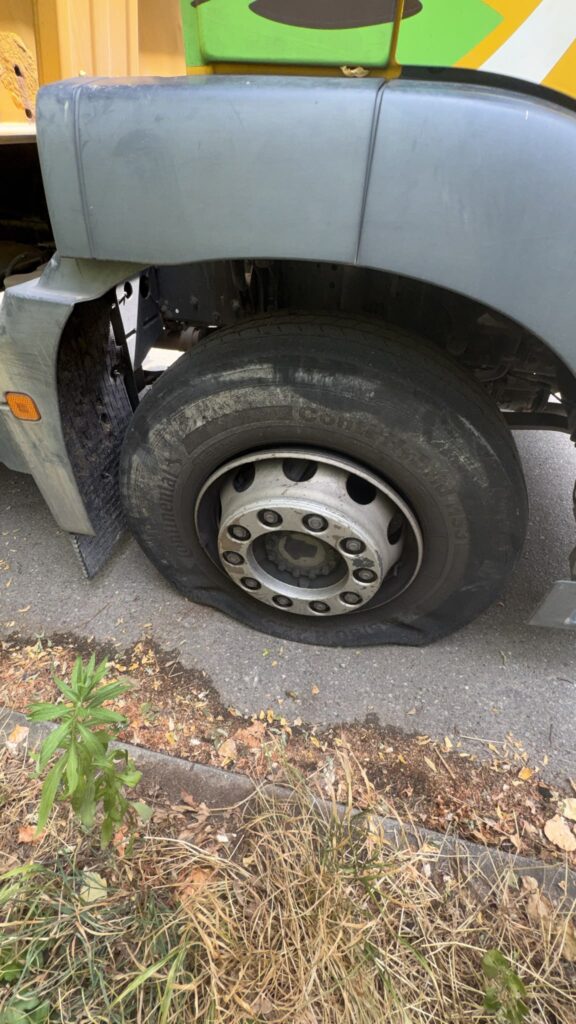
TL;DR: On 14 July, a scheduled coach suffered a drive-axle blowout on the A31 hard shoulder near Borken, North Rhine-Westphalia, with a full passenger cabin. A technician from our regional partner network arrived in 55 minutes, fitted a new 295/80 R22.5 tyre, and had the coach back on the road in 2 hours 30 minutes from the emergency call. Net cost: €990.
A blowout on a lorry is a cargo problem. A blowout on a coach with roughly 50 people on board is a different job entirely. There is no cargo to worry about, but there are passengers standing on a motorway hard shoulder, a driver responsible for their safety, and a clock that keeps running whether or not there is a toilet, air conditioning, or shade nearby.
This case walks through exactly what happened on the A31 near Borken on 14 July: the call, the dispatch, the on-site decisions about whether passengers should stay on the coach or get off, the repair itself, and the full cost breakdown. Every figure below (times, prices, tyre size) is drawn from the actual job log and stays the same across every language version of this article.
What Happened on the A31 near Borken?
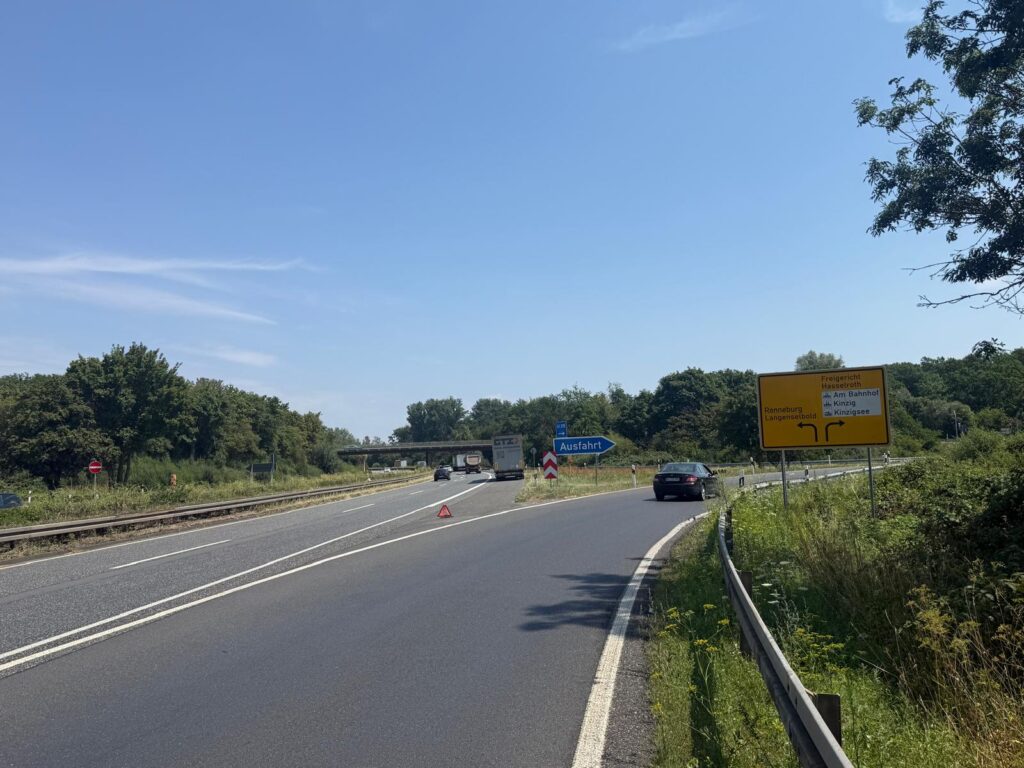
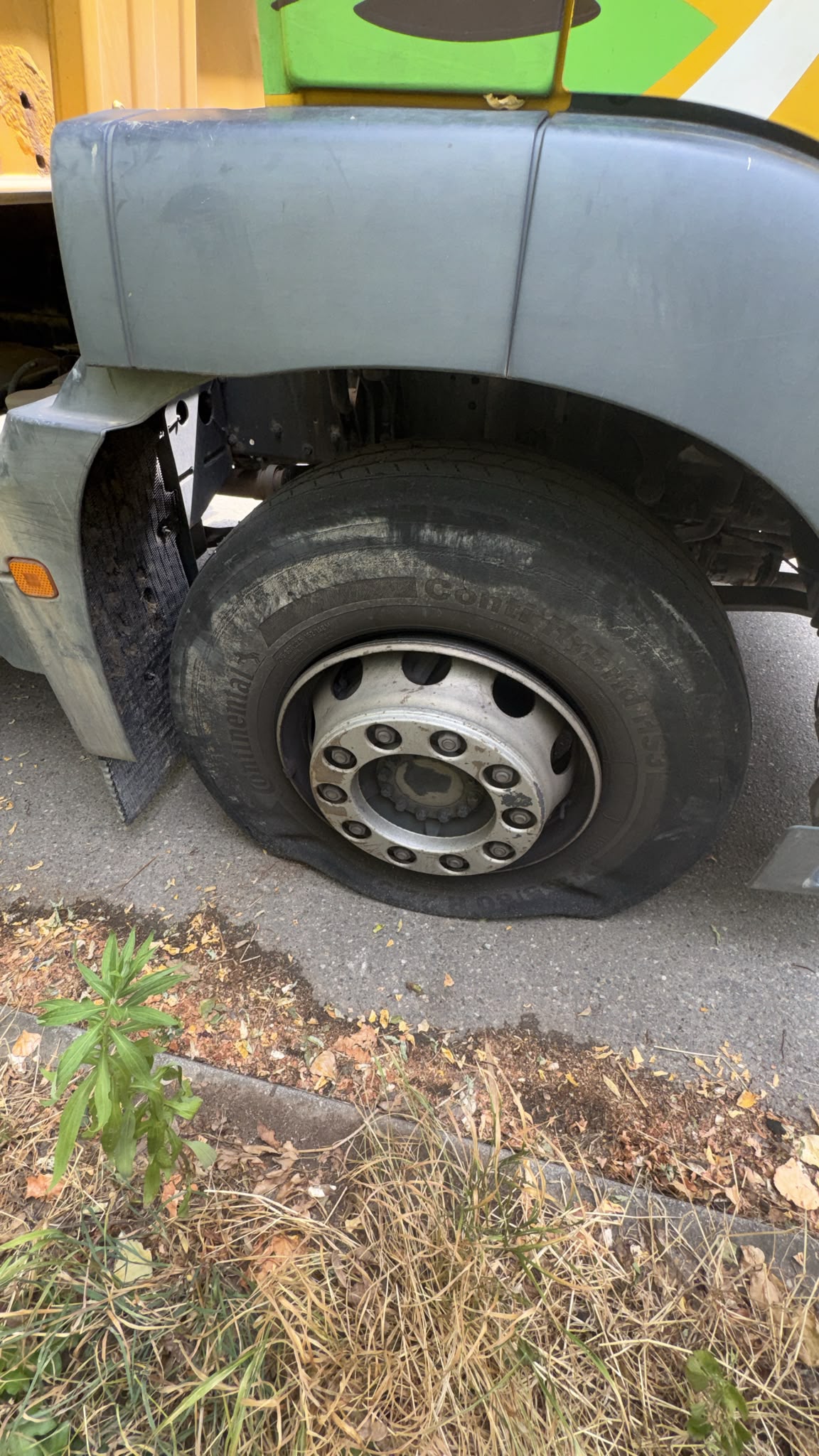
A scheduled long-distance coach, running in daytime traffic on 14 July, suffered a sudden blowout on one of its drive-axle tyres on the A31 near Borken, North Rhine-Westphalia. The driver felt the vibration immediately and pulled onto the hard shoulder without incident.
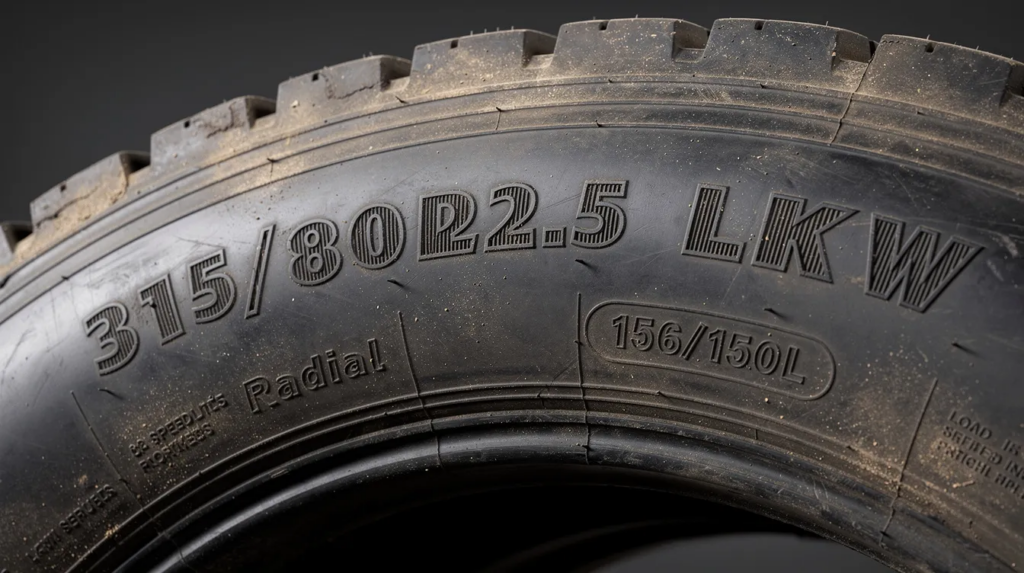
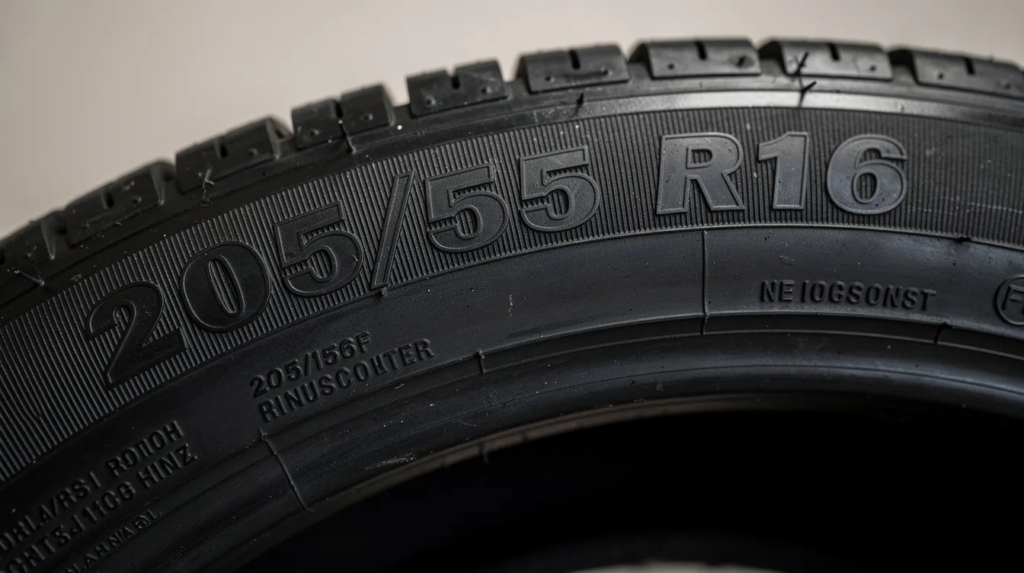
The tyre involved was a 295/80 R22.5, the standard size fitted to the drive axle of most European coaches. A blowout at this position is more disruptive than a trailer or steering-axle failure, because the drive axle carries the engine’s torque and a large share of the vehicle’s weight. On a coach, that weight includes passengers seated directly above and behind the affected wheel.
No injuries were reported. The coach came to a controlled stop entirely on the hard shoulder, which meant the immediate priority was not vehicle recovery but passenger safety on a live motorway.
How Was Help Organised?
Our multilingual dispatch line took the emergency call at 11:52. Within 15 minutes a technician from our regional service partner was on the road, which is the standard dispatch window for tyre emergencies involving passenger vehicles.
The steps that followed:
- Dispatcher logged tyre size (295/80 R22.5), axle position, and passenger count from the driver’s description.
- Job flagged as priority due to passenger transport, which triggers faster technician assignment than a standard freight callout.
- Technician confirmed stock of the correct tyre before departure, avoiding a wasted trip.
- Driver was talked through hazard triangle placement and warning-vest procedure while waiting.
- Dispatch stayed on standby in case the driver needed to escalate (heat, medical concern, or a passenger needing to disembark early).
The technician was dispatched at 12:07 and reached the scene at 13:02, a 55-minute drive that reflects both the distance from the nearest depot and the moderate midday traffic on the A31.
Why the Situation on Site Needed Careful Handling
A coach parked on a motorway hard shoulder with passengers aboard is not simply “a vehicle with a flat tyre.” It is a crowd-control and traffic-safety problem layered on top of a mechanical one, and the two have to be managed together.
Roughly 50 passengers sitting behind a broken-down coach on the hard shoulder of the A31 is its own logistical task, separate from the wheel change itself. The driver has to decide quickly whether people are safer staying seated inside or standing behind the crash barrier, and that decision depends on heat, how exposed the shoulder is to passing traffic, and how long the repair is expected to take.
On this job the tyre stock was confirmed before departure, so the driver kept passengers on board rather than organising a full disembarkation, since the expected wait was well under the point at which cabin heat becomes a serious concern.
Do Passengers Stay On Board or Get Off?
The decision depends mainly on three things: expected repair time, outside temperature, and how exposed the hard shoulder is to passing traffic. If a wheel change is likely to take under 30 minutes and the coach is stopped somewhere reasonably sheltered, passengers typically stay seated.
Once the wait stretches past that point, or the day is hot, staying inside stops being the safer option. With the engine switched off, the air conditioning stops running and the cabin heats up fast, sometimes within 10 to 15 minutes in direct July sun. At that point the driver’s job shifts from “manage a tyre problem” to “manage fifty people safely on a live carriageway,” which is a harder task than the repair itself.
How Should Passengers Disembark Safely on a Motorway?
Passengers should only leave the coach on the side away from moving traffic, move directly behind the crash barrier, and stay together as one group rather than spreading along the hard shoulder. This keeps everyone out of the traffic lane and in the driver’s line of sight.
In practice this means:
- Doors opened only on the verge side, never facing the carriageway.
- The group directed to one fixed point behind the barrier, not scattered along the shoulder.
- Children and passengers with reduced mobility kept under separate, direct supervision rather than assumed to be “with the group.”
- Warning triangle and hazard lights set well before anyone steps outside.
None of this is optional guidance. The ADAC publishes the same core sequence for any breakdown involving passengers on the hard shoulder: secure the scene first, then move people, never the reverse.
Why Are Coach Tyres Different from Lorry Tyres?
A coach tyre and a lorry tyre can share the same size, 295/80 R22.5 being a common example, but the requirements around them are not the same. Passenger transport in Germany undergoes more frequent roadworthiness inspection than freight, and retreaded tyres are not used on coaches at all, unlike on many trailer axles.
The steering axle carries the strictest requirements of all, since a failure there affects control at speed rather than just load capacity. Tread depth, sidewall condition, and age are all checked more conservatively on a coach than on an equivalent lorry, because a mechanical failure on a passenger vehicle has a different risk profile than one on a freight unit. DEKRA inspection protocols for buses reflect exactly this distinction.
How Was the Wheel Replaced? Step by Step
Step 1 — Inspection. The technician confirmed the blowout was isolated to the one drive-axle tyre, checked the rim for visible damage, and confirmed the neighbouring dual tyre (if fitted) was undamaged.
Step 2 — Securing the scene. Hazard triangle placed well back, warning lights active, technician and driver both in high-visibility vests before any tools came out.
Step 3 — Wheel removal. Jacking a coach is not the same as jacking a lorry. Ground clearance is lower, the jacking points sit in different positions, and luggage compartments run underneath much of the chassis. The jack cannot simply go “under the axle” the way it might on a rigid lorry; placing it wrong risks denting a luggage bay door or bending bodywork.
Step 4 — Fitting the replacement. A new 295/80 R22.5 tyre was mounted, seated, and inflated to the coach manufacturer’s specified pressure for the drive axle.
Step 5 — Final check. Wheel nuts torqued in a cross pattern to spec, a method that spreads clamping force evenly and prevents the disc from sitting unevenly against the hub. This step alone takes several minutes and is not one to rush.
Work began at 13:15, once the scene was secured, and the cross-pattern torque check was completed at 14:17. The coach pulled away at 14:22.
Full Timeline
| Time | Phase | Action |
|---|---|---|
| 11:52 | Emergency call | Dispatch takes the call, logs tyre size and passenger count |
| 12:07 | Technician dispatched | Regional partner en route with confirmed stock |
| 13:02 | Arrival on site | 55-minute drive to the A31 near Borken |
| 13:15 | Scene secured | Hazard triangle, warning lights, work begins |
| 14:17 | Wheel fitted | Cross-pattern torque check completed |
| 14:22 | Coach departs | Back on the road |
Total time from call to departure: 2 hours 30 minutes (150 minutes).
What Does a Coach Tyre Blowout Cost on the Motorway?
The total for this callout was €990 net, plus VAT, covering the emergency callout, technician labour, the replacement tyre, disposal of the old one, and a priority surcharge specific to passenger transport.
| Item | Price (EUR) |
|---|---|
| Callout | 220 |
| Labour (approx. 1.25 hrs at €120/hr) | 150 |
| Tyre 295/80 R22.5 | 520 |
| Old tyre disposal | 20 |
| Priority surcharge for passenger transport | 80 |
| Total | 990 |
What Drives the Price Up or Down?
Three factors move this figure: distance from the nearest technician (affects the callout fee), time of day (night and weekend jobs carry a surcharge), and whether the rim needs straightening in addition to the tyre. A daytime callout on a well-served route like the A31 sits toward the lower end of what a coach tyre emergency typically costs.
Coach Downtime vs. the Repair Cost
For a scheduled coach service, a stranded vehicle does not just cost the €990 repair. It risks a missed connection, a transfer of passengers to a relief vehicle, and potential compensation claims under EU passenger-rights rules for delayed coach services. Against that backdrop, a 150-minute on-site fix is the cheaper outcome by a wide margin, and it is the reason priority dispatch for passenger vehicles exists at all.
Why Call a Professional Instead of Handling It Yourself?
Attempting a coach wheel change without the right equipment carries real risk, and not only to the person doing it.
- Incorrect jacking points on a coach can damage the underslung luggage compartments or bodywork, turning a €990 repair into a much larger bill.
- Torquing wheel nuts without a calibrated tool and the correct cross pattern risks an uneven seat, which can loosen in transit.
- Working roadside without proper hazard signage puts the technician and any passengers nearby at serious risk from passing traffic.
- A misjudged call on whether to disembark passengers can leave a busload of people standing exposed on a hard shoulder for longer than necessary.
What Other Coach and Lorry Callouts Do We Handle?
The A31 job is one of hundreds of similar callouts across Germany. Our teams regularly respond to tyre blowouts on articulated lorries, blowouts with rim damage on the motorway, and coach recovery jobs where towing rather than an on-site repair is the safer option. Each callout gets logged with the same discipline: tyre size, axle position, time to arrival, and total time on site.
How Can Coach Operators Prevent Blowouts?
Most drive-axle blowouts trace back to under-inflation, age, or worn tread rather than a single sudden event. A pre-trip pressure check takes two minutes and catches the majority of developing problems before they become roadside emergencies.
For long-distance routes specifically:
- Check pressure on every axle before departure, not just visually but with a gauge, since a tyre can look fine and still be 20% under-inflated.
- Track tyre age, not only tread depth. Rubber compounds harden over years even with adequate tread remaining.
- Keep tread reserve higher than the legal minimum before a long route, since a marginal tyre that would pass inspection today may not survive several hundred kilometres at motorway speed and load.
Coach and Fleet Tyre Maintenance: What Matters Beyond the Wheel Change
Coach and lorry fleets both run predominantly on 295/80 R22.5 and 315/80 R22.5 sizes, but the maintenance regime around passenger vehicles is stricter by regulation. Germany’s technical inspection framework under §36 StVZO sets minimum tread depth and tyre condition standards that apply to all commercial vehicles, and passenger carriers are inspected more frequently than freight under the Federal Office for Goods Transport’s oversight of the sector.
Fleet operators generally choose between major manufacturers for their coach axles, and each has a slightly different profile on wear and heat resistance:
- Michelin tyres are widely specified for their tread-life consistency across long-distance routes; see Michelin’s commercial range.
- Continental tyres are common on German-registered coach fleets and are engineered for the country’s mixed motorway and urban duty cycles.
- Goodyear offers coach-specific compounds designed for heat management on sustained high-speed runs; see Goodyear’s fleet solutions.
- Bridgestone is frequently chosen for retread-eligible trailer axles on freight fleets, though this option does not apply to coach axles under passenger-transport rules.
None of these brands eliminates the need for a pre-trip check. Tyre choice affects how long a fleet goes between problems, not whether pressure and tread still need checking before every departure.
Why Choose LKWHelp24 for a Coach or Lorry Emergency?
We run a 24/7 multilingual dispatch line covering the whole of Germany, backed by a network of regional partners who carry the tyre sizes most commonly needed on coaches and heavy goods vehicles. Pricing is quoted upfront before work starts, and every job is logged with a real timeline, not an estimate given after the fact. Explore our tyre service, towing service, and mobile truck service pages for full coverage details.
Frequently Asked Questions
How much does a coach tyre blowout cost on the motorway?
In this case, the total net cost was €990, covering the callout, labour, the 295/80 R22.5 tyre, disposal, and a priority surcharge for passenger transport. Pricing varies with distance, time of day, and whether rim damage is involved.
How long does a coach tyre replacement take on the hard shoulder?
From the emergency call to the coach departing, this job took 2 hours 30 minutes. The physical repair, from securing the scene to the final torque check, took just over an hour.
Do passengers have to get off the coach during a tyre change?
Not always. It depends on expected repair time, temperature, and shelter on the hard shoulder. If the wait is short and the location reasonably safe, passengers often stay seated; longer waits or hot weather usually mean disembarking behind the crash barrier.
Why does the cabin get hot so quickly when the coach stops?
With the engine switched off, the air conditioning stops running immediately, and a sealed coach cabin in direct sun can become uncomfortably warm within 10 to 15 minutes, which is why disembarking becomes the safer option on longer waits.
Are coach tyres inspected more often than lorry tyres?
Yes. Passenger transport undergoes more frequent roadworthiness checks than freight vehicles under German regulation, with stricter requirements on the steering axle and no use of retreaded tyres on coaches.
Who pays if a relief coach has to be called?
Arrangements vary by operator and route, but a relief coach is typically only called when repair time would exceed what is reasonable for passengers to wait, and the cost is generally handled through the operator’s own breakdown and passenger-rights arrangements rather than the roadside tyre service.
Summary
A drive-axle blowout on a 295/80 R22.5 tyre stopped a scheduled coach on the A31 near Borken on 14 July, with passengers on board throughout. Dispatch took the call at 11:52, a technician was on site by 13:02, and the coach was back on the road at 14:22, a total of 2 hours 30 minutes. Net cost came to €990. No passengers needed to disembark, since the repair stayed within the window where staying seated remained the safer choice.
Need Roadside Help for a Coach or Lorry in Germany?
If you are dealing with a tyre emergency, breakdown, or recovery situation anywhere in Germany, call +49 160 5753826 or visit www.lkwhelp24.com. Available 24/7, nationwide.
Keywords: coach tyre service Germany | mobile tyre service motorway | 295/80 R22.5 tyre replacement | passenger coach breakdown assistance | HGV tyre blowout roadside | drive axle tyre change | 24/7 truck and coach tyre service Germany
Related Articles
- Truck Tyre Service Near Me: How We Got a DAF Artic Back on the Road in 2 Hours After a Tyre Blowout on the Autobahn Near Hof
- Truck Tyre Service for Blowout and Rim Damage on the Motorway near Trier: Complete Solution in Under 2 Hours
- Stranded on the Road Near Freiburg im Breisgau: How AutoHelp UG’s Trucks Towing Service Recovered an International Coach Bus
- Winter Tyres for HGVs in Germany – Legal Requirements, Safety & Service by LKWHelp24
- Truck Tire Service Near Me – 24/7 Mobile Truck Tire Service in Germany