Skip to content
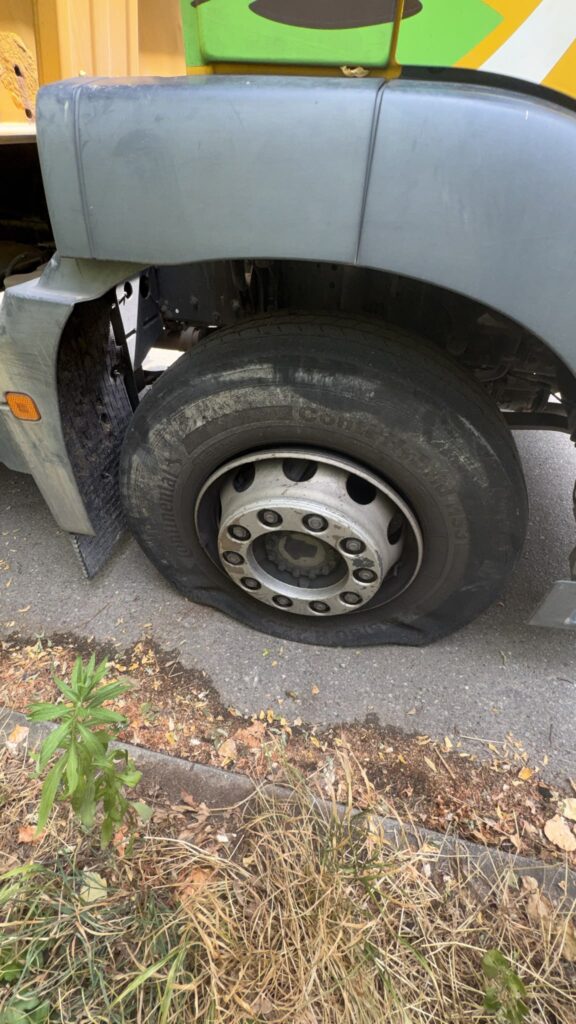
A blue curtain-sided semi-trailer, a routine walk-around check, and a tyre that had gone completely flat without a bang, a tear, or any warning at all. That is how most tyre failures on the autobahn actually happen, and it is not the version most drivers picture when they hear \”truck tyre service\”. On 22 July 2026, on the A30 near Osnabrück heading towards Hannover, a driver stopped at a service area for a scheduled break and found one trailer tyre sitting on the rim.
Slow leaks are the quiet cousin of the dramatic blowout, and they cost hauliers more money over a year than the loud failures do. A nail works its way into the tread, air escapes over hours or days, and by the time anyone notices, the tyre has already been driven on while under-inflated. That is the point where a €150 repair turns into a €480 replacement, and where the story below picks up.
This callout is a useful case study because nothing about it was dramatic. No hard shoulder, no warning triangle needed at the roadside, no recovery truck. Just a parked artic, a technician, and a decision that had to be made correctly the first time: repair the puncture, or replace the tyre. Getting that call wrong either wastes money or sends the vehicle back onto the autobahn on a tyre that will fail again within days.

The Emergency Situation on the A30
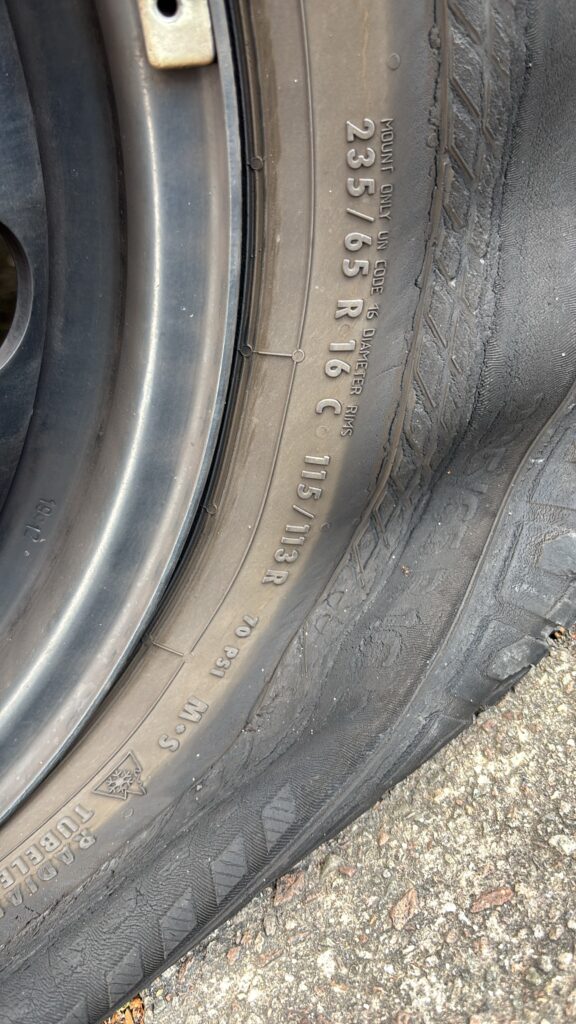
The driver had pulled the articulated lorry into a service area on the A30, direction Hannover, for a scheduled rest. Weather was calm, traffic light, nothing eventful about the stop itself. During the daily walk-around check, a habit that pays for itself more often than drivers expect, the flat became obvious immediately: the trailer tyre on the tandem axle bogie was sitting almost on the rim, the sidewall bulging outward under the weight of the load.
This was a trailer tyre, size 385/65 R22.5, the standard fitment for tandem and tri-axle semi-trailers running across Germany. Unlike a steer axle tyre, which fails visibly and often violently, a trailer tyre losing pressure slowly can go unnoticed for tens of kilometres if nobody is checking. In this case the driver caught it at the rest stop, before the vehicle re-joined the carriageway, which is exactly the outcome a proper walk-around routine is designed to produce.
On inspection, the cause turned out to be a nail lodged in the tread, the kind of puncture that a workshop can usually vulcanise and send back into service the same day. The complication was timing: the tyre had already been run in a badly under-inflated state before the leak was caught, and that had done damage a patch cannot fix.
How Help Was Organised
The driver rang the emergency dispatch line at 09:40. From there:
- Dispatch logged the location, tyre size, and symptoms (flat, not a burst) to route the right technician and stock straight away
- A regional service partner technician was assigned within 18 minutes, selected for proximity to the A30 corridor near Osnabrück
- The technician was briefed to bring a 385/65 R22.5 replacement tyre and a repair kit, in case the puncture turned out to be repairable after inspection
- Estimated arrival time was communicated back to the driver so the rest stop could double as a legitimate break rather than dead time
- Our multilingual dispatch team confirmed the vehicle was safely parked on hard standing, not the hard shoulder, before finalising the job
That last point matters more than it sounds. A trailer stuck on the hard shoulder of the A30 is a different, higher-risk job requiring a warning triangle, hi-vis vests, and traffic management awareness. A trailer parked at a rest stop is a controlled environment, and it changes how the whole callout is planned.
Situation on Site: Why a Flat Trailer Tyre Cannot Wait
Truck tyres run at 8.5 to 9.5 bar, roughly four to five times a car tyre\’s pressure. That figure alone explains why a \”slow leak\” on an HGV is a different animal from the same problem on a passenger car. A car tyre losing pressure over a day is a nuisance. A trailer tyre losing pressure at that operating range means the tyre\’s structure starts working far outside its design envelope within kilometres, not days.
The technician arrived at 09:58, thirty-seven minutes after being assigned, and began the inspection straight away. Three things needed checking, not one:
- Whether the puncture was repairable or the sidewall was compromised
- Whether the wheel hub, rim, and wheel bolts had suffered any secondary damage from running under-inflated
- Whether the neighbouring tyre on the same tandem axle bogie had picked up abnormal wear from carrying redistributed axle load
On a tandem bogie, two axles share the load through the suspension linkage. When one tyre goes flat, the geometry shifts and the neighbouring tyre absorbs more of the load than it was set up to carry. Left unaddressed, that produces uneven tread wear across the whole bogie, and eventually a second premature tyre replacement that nobody saw coming.
Step-by-Step: The Repair Process
Step 1: Inspection and pressure check (09:58–10:05). The technician confirmed the flat was total, checked tread depth and sidewall condition, and located the nail. Reading a completely flat tyre with a gauge is mostly academic, but it confirms there is nothing left to work with and rules out a partial leak that could still be salvaged on the spot.
Step 2: Securing the work area (10:05–10:10). Because the trailer was already parked on hard standing at the rest stop, this step was straightforward: wheel chocks, hi-vis vest, and a clear working zone around the tandem bogie. No warning triangle or carriageway closure was required, which shaved real time off the job compared with a hard-shoulder recovery.
Step 3: Repair-versus-replace decision (10:10–10:35). This is the step that separates a competent tyre technician from someone just swapping wheels. The nail itself sat in the tread zone, inside the roughly 6 mm limit where a proper vulcanised repair is normally viable. But the sidewall had already flexed and overheated from being driven on while under-inflated, and that damage does not reverse. The tyre was condemned for replacement, not the puncture.
Step 4: Wheel removal and new tyre fitting (10:35–11:05). The technician loosened the wheel bolts in the correct cross pattern, removed the damaged wheel, fitted the new 385/65 R22.5 tyre, and balanced it before remounting. Wheel balancing on a trailer axle is often skipped by less careful operators; skipping it shows up later as uneven wear and vibration at motorway speed.
Step 5: Final checks and neighbouring tyre inspection (11:05–11:25). Wheel bolts were torqued in cross-pattern sequence to the correct spec, and the neighbouring tandem tyre was checked for the uneven wear the axle-load shift had already started. Pressure was corrected on that tyre; it did not need replacing, but it was close enough to the line that leaving it unchecked would have been a mistake.
Full Timeline
| Time | Phase | Action |
|---|---|---|
| 09:40 | Call received | Driver reports flat trailer tyre found during walk-around check |
| 09:40–09:58 | Dispatch (18 min) | Regional partner technician assigned, briefed, stocked |
| 09:58–10:35 | Travel (37 min) | Technician travels to the A30 rest stop |
| 10:35–10:45 | Inspection (10 min) | Pressure check, sidewall assessment, repair-vs-replace decision |
| 10:45–11:25 | Repair (40 min) | Wheel removal, new tyre fitted, balanced, torqued, neighbouring tyre checked |
| Total | 1 hour 45 minutes from call to completion |
The vehicle was back on the autobahn well within the same rest break window the driver had already planned, with driving hours largely undisturbed.
Cost Breakdown
| Item | Price (EUR) |
|---|---|
| Call-out fee | 220 |
| Labour (1 hour) | 110 |
| Truck tyre 385/65 R22.5 (new) | 480 |
| Old tyre disposal | 20 |
| TOTAL | 830 |
Three things drove this figure. The tyre itself, at 480 euros net, is the largest single line and reflects the size and load rating required for a trailer axle position. The call-out fee covers dispatch and a dedicated technician reaching a rural stretch of the A30 within the hour. Disposal of the old tyre is a small but unavoidable cost, since a damaged carcass cannot legally or safely be left behind or reused.
It is worth being honest about the road not taken here. A straightforward tread puncture up to about 6 mm, caught before the tyre has run flat, can usually be repaired with a vulcanised patch for roughly €150 to €180, a fraction of the replacement cost. That window closed in this case because the leak was slow enough to go unnoticed until the tyre had already been driven on while badly under-inflated. The lesson is not that repairs are unreliable, it is that timing decides which repair is even possible.
Set against the daily standing cost of a long-haul articulated lorry, which typically runs €800 to €1,200 per day in driver time, fuel commitments, and missed delivery slots, an 830-euro tyre replacement that keeps the vehicle moving within 105 minutes is not an expensive outcome. It is close to a rounding error against what a full day of downtime would cost the haulier.
Why You Need a Professional for This Job
A flat trailer tyre looks like a job a competent driver could handle with a spare and a jack. In practice, several things go wrong when that is attempted roadside:
- Wrong torque sequence. Wheel bolts on a heavy trailer wheel must be tightened in a cross pattern to the correct torque figure. Uneven torque leads to wheel wobble, and in the worst case, wheel separation at speed.
- Missed sidewall damage. A tyre that looks fine at a glance can already have a compromised carcass from running under-inflated. Sending it back into service risks a second failure within days, often at a worse location.
- No load-rated spare on hand. Trailer tyres in this size are not something most vehicles carry as a matching spare, and fitting the wrong load index is a genuine safety risk under a loaded semi-trailer.
- Unassessed neighbouring tyre. Without checking the rest of the tandem bogie, a driver has no way of knowing whether axle-load redistribution has already started damaging the tyre next door.
None of these are things a roadside DIY fix reliably catches, and getting any one of them wrong turns a manageable delay into a genuine breakdown, or worse.
Typical Callouts We Handle Across Germany
Slow leaks like this one are one of several recurring patterns our regional partner network deals with on German motorways and at rest stops:
- Slow, gradual air loss from nail or screw punctures in the tread
- Sudden blowouts on steer or trailer axles at motorway speed
- Valve failures causing rapid deflation without visible tyre damage
- Uneven wear across tandem or tri-axle bogies from load imbalance
- Rim corrosion at the bead seat causing a persistent slow leak that mimics a puncture
Coverage runs 24/7 across the country, from dense corridors like the A2 near Hannover to quieter rural stretches such as this one near Osnabrück.
Prevention: What Drivers and Fleets Can Do
The daily walk-around check is the cheapest tool available, and it caught this problem before it became a roadside emergency rather than a rest-stop inconvenience. Tapping the tyre with a mallet or the back of a hand and listening for the dull thud of a soft tyre versus the sharp ring of a properly inflated one takes under a minute per axle. It is a useful first pass, but it is not a substitute for a gauge; a tyre can sound roughly right and still be several bar under its target pressure.
A handful of habits reduce the odds of a slow leak turning into a full tyre loss:
- Check pressure with a calibrated gauge at least weekly, not just by sound or sight
- Inspect tread for embedded debris, nails, and screws during every walk-around, not only before long trips
- Watch tandem and tri-axle bogies specifically for uneven wear patterns between neighbouring tyres, a sign one is compensating for the other
- Log any pressure top-ups; a tyre that needs air every few days has a leak, not bad luck
Tyre pressure monitoring systems (TPMS) on trailers remain the exception rather than the rule across the European fleet, largely because trailers get swapped between tractor units and operators, and retrofitting sensors across a mixed, rotating fleet has historically been seen as more trouble than it is worth. That calculation is shifting. A basic TPMS kit flags a slow leak within minutes of it starting, long before a driver\’s next scheduled walk-around, and the cost of the sensors is small next to a single avoided roadside replacement like this one.
Tyre and Fleet Maintenance: The Wider Picture
Trailer tyre quality varies more than many operators assume, and brand does affect how a slow leak plays out in practice. Continental and Michelin both build trailer-specific casings designed to tolerate a degree of under-inflation before carcass damage sets in, while budget tyres from less established brands tend to fail the carcass sooner under the same conditions. Goodyear and Bridgestone round out the segment most German fleets rely on for trailer axle positions, and tread compound and casing design across these four brands is where most of the practical difference between \”repairable\” and \”scrap\” actually shows up.
Axle and suspension geometry also plays into how quickly a flat tyre affects the neighbouring tandem position. Axle manufacturers such as BPW design bogies to share load evenly under normal conditions, but that design assumption breaks down the moment one tyre goes flat, which is exactly the mechanism that started affecting the neighbouring tyre in this callout.
German regulation is explicit about the baseline: §36 StVZO sets minimum tread depth and tyre condition requirements, and organisations like DEKRA and TÜV enforce these standards at periodic inspection. A tyre that has been run flat and then reinflated can pass a casual glance while still failing to meet the structural standard those inspections are designed to catch, which is part of why professional assessment matters more than it might seem after the fact. ADAC publishes regular guidance for commercial drivers on tyre checks that complements the daily walk-around routine described above.
FAQ
How do I know if a trailer tyre puncture is a slow leak or a fast one?
A fast leak or blowout is unmistakable: a loud bang, sudden vibration, or the vehicle pulling to one side. A slow leak gives almost no warning; the tyre gradually loses pressure over hours, sometimes days, and is usually only caught during a walk-around check or when the sidewall visibly bulges.
Can a nail puncture in the tread always be repaired instead of replaced?
Not always. A tread puncture up to roughly 6 mm can usually be vulcanised if caught early and the sidewall is undamaged. Once the tyre has been driven on while under-inflated, the sidewall typically overheats and the carcass is scrapped regardless of the puncture size.
Why does one flat tyre affect the tyre next to it on a tandem axle?
On a tandem bogie, two axles share the trailer\’s load through a common suspension linkage. A flat tyre shifts more weight onto its neighbour, which accelerates tread wear on that tyre and, left unchecked, can shorten its service life significantly.
Is it safe to keep driving a short distance on a half-flat trailer tyre to reach a workshop?
No. Even 30 to 50 kilometres on a significantly under-inflated tyre is usually enough to overheat the internal fabric and destroy the carcass, turning a repairable puncture into a mandatory replacement, and increasing the risk of a sudden failure at speed.
Do trailers need tyre pressure monitoring systems by law in Germany?
Not currently mandatory for trailers in the way it is for some newer tractor units. Many fleets still run trailers without TPMS, which is exactly why slow leaks go unnoticed until a walk-around check or a visible sidewall bulge reveals the problem.
How much does a mobile trailer tyre replacement typically cost?
In this case, the total came to 830 euros net, covering the call-out fee, one hour of labour, the new 385/65 R22.5 tyre, and disposal of the old one. A straightforward repairable puncture caught early would typically cost a fraction of that, around €150 to €180.
Summary
A blue curtain-sided semi-trailer on a tandem axle bogie developed a slow air leak from a tread nail on the A30 near Osnabrück, direction Hannover, discovered during a routine walk-around at a rest stop on 22 July 2026. The technician arrived 37 minutes after being dispatched, response time from call to arrival was 58 minutes, and the full job, from the 09:40 call to completion at 11:25, took 1 hour 45 minutes. The under-inflated sidewall had already overheated past the point of repair, so the 385/65 R22.5 tyre was replaced rather than patched, at a total cost of 830 euros net. Early uneven wear on the neighbouring tandem tyre was caught and corrected before it became a second failure.
Need Truck Tyre Service Anywhere in Germany?
Call +49 160 5753826 or visit www.lkwhelp24.com. Our regional partner network covers Germany 24/7, with multilingual dispatch and transparent, itemised pricing before any work begins.
Related services: mobile truck service | tyre service | towing service | truck service | contact us
Keywords: truck tyre service | mobile tyre fitting HGV | trailer tyre replacement Germany | slow tyre leak lorry | 385/65 R22.5 | tandem axle tyre wear | autobahn breakdown assistance | 24/7 truck tyre repair | emergency tyre service A30 | articulated lorry tyre puncture