Skip to content
A blown trailer tyre looks like a minor inconvenience right up until you see it on the motorway shoulder with the carcass shredded and the belts hanging out. On the A2 heading towards Berlin, a trailer running on a bare rim or a flapping tyre carcass is a real hazard for everyone behind it. Push on regardless, or bodge a fix with the wrong tyre, and you risk the axle, the braking system, and potentially the load itself.
On 20 July a driver called in with exactly this problem: a light trailer behind a van, one tyre in shreds, the cords exposed to the road. Our dispatch sent a technician from the region who reached the scene in 40 minutes and had the combination roadworthy again in under half an hour. This report walks through how the job was handled, what the “FOR TRAILER USE ONLY” marking actually means, and why trailer tyres get overlooked far more often than they should.
The breakdown on the A2
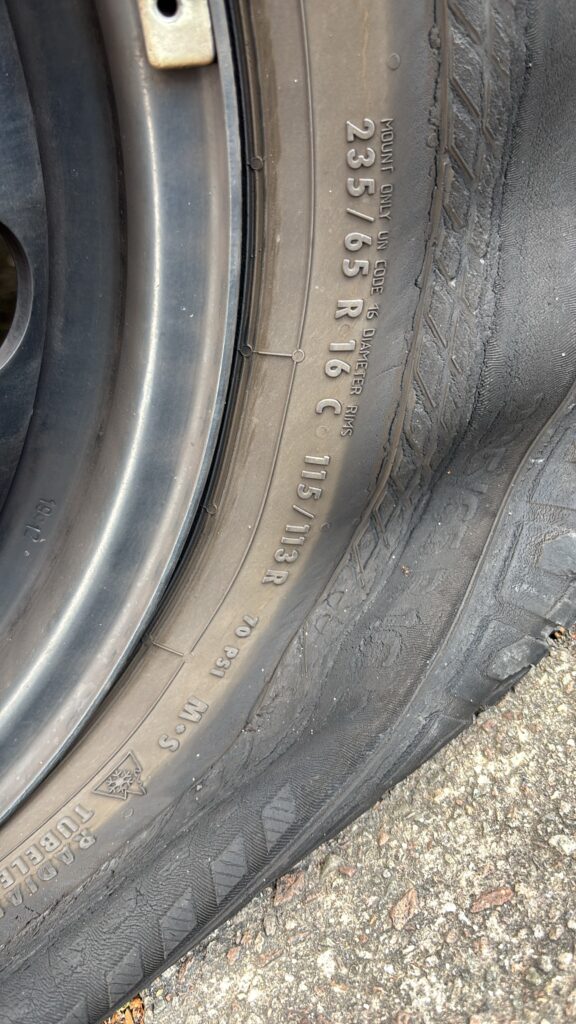
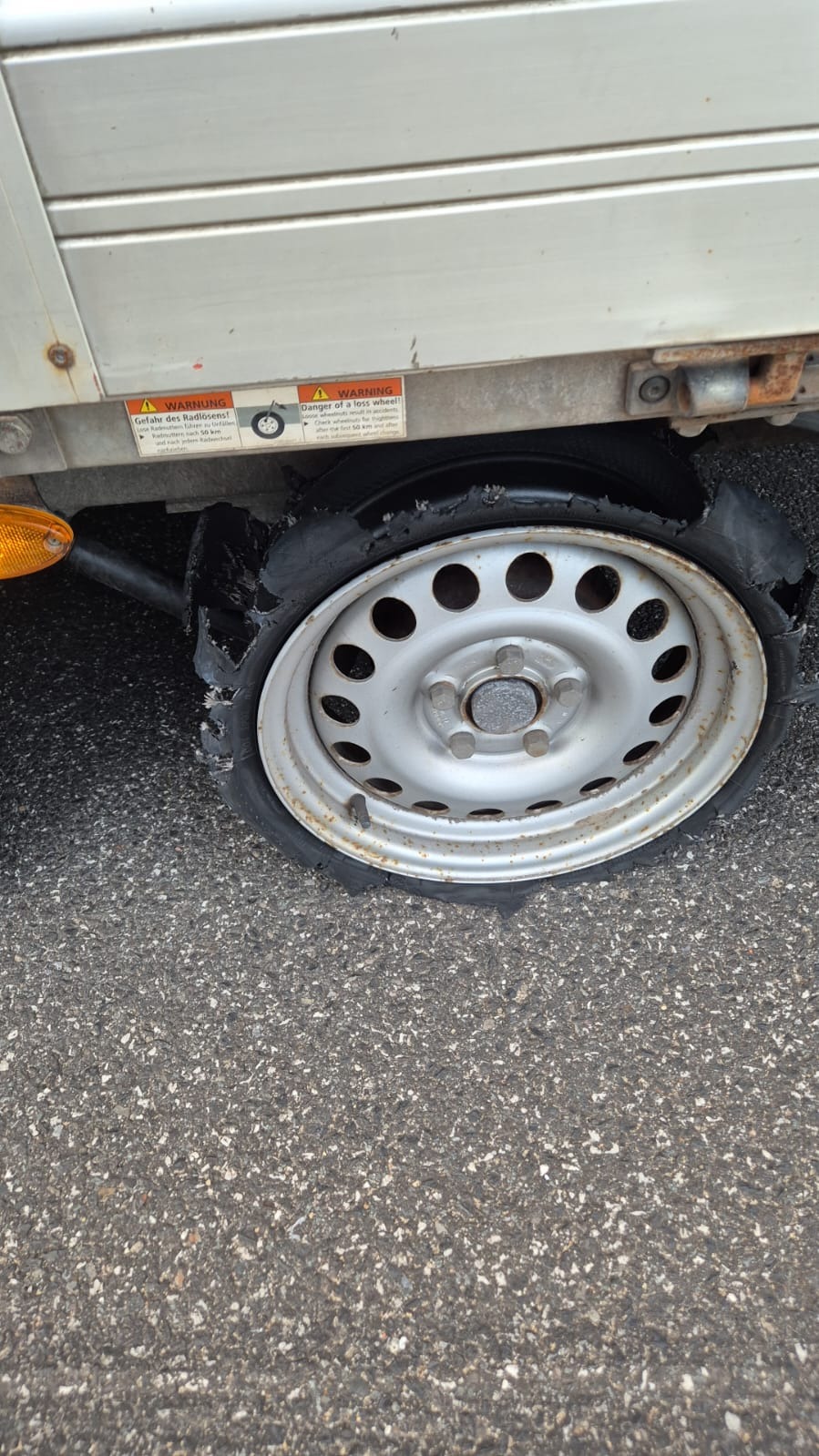
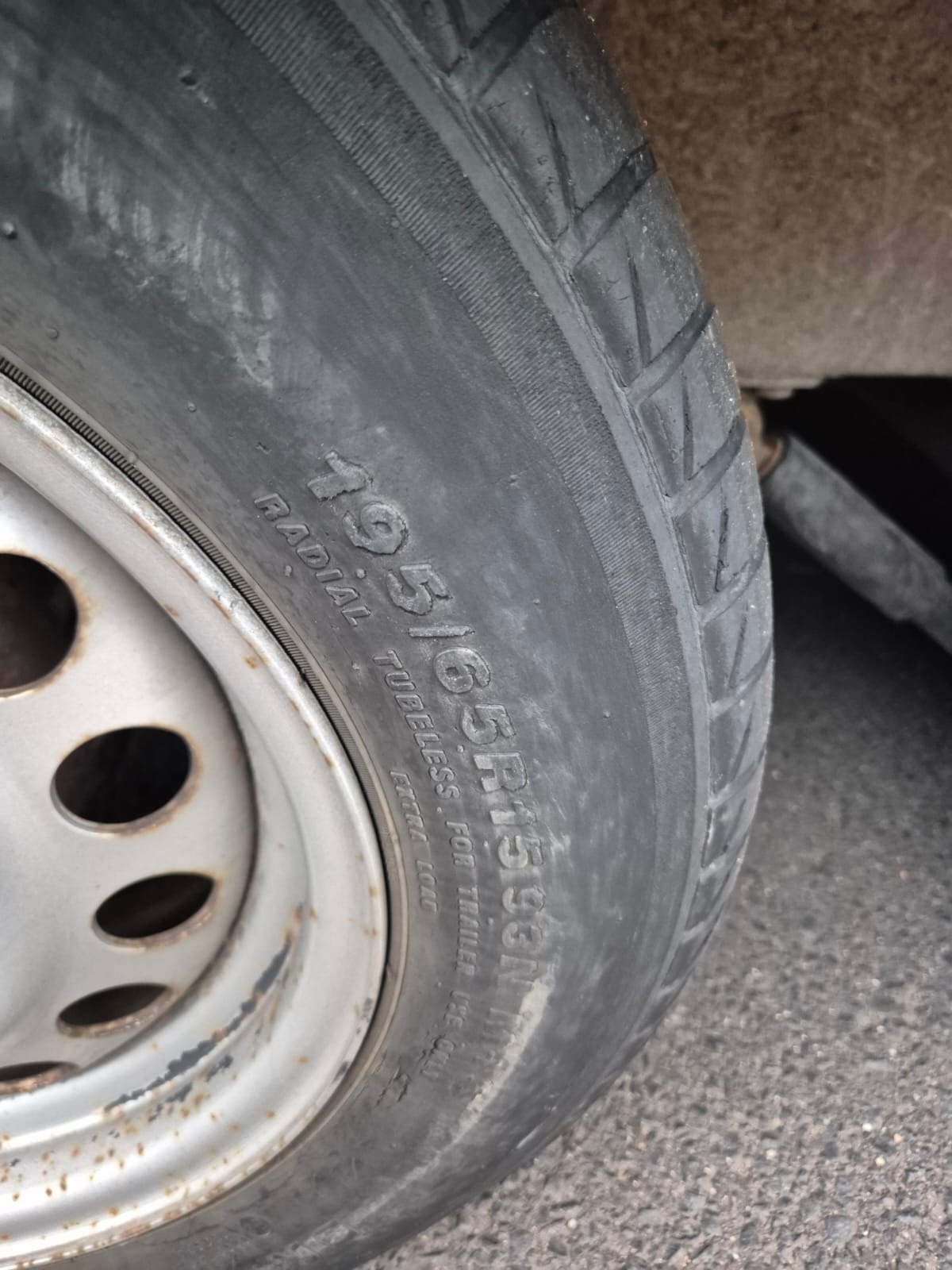
It happened mid-morning on the A2 near Magdeburg, direction Berlin. The driver of a van towing a single-axle trailer felt a flutter at the rear, then heard a bang. Pulled onto the hard shoulder, the tyre told the whole story at a glance: a 195/65 R15 93N, torn clean through, belt plies exposed, tread wrapped around the rim in strips.
What mattered for the repair was the sidewall marking: “FOR TRAILER USE ONLY”. That phrase isn’t a throwaway line, it’s a technical statement. It means the tyre is built exclusively for a non-driven, non-steered trailer axle. The speed rating N caps it at 140 km/h, and the load index 93 puts its rated capacity at roughly 650 kilograms per tyre at the correct pressure. Together those two figures describe a component engineered for different forces than an ordinary car tyre.
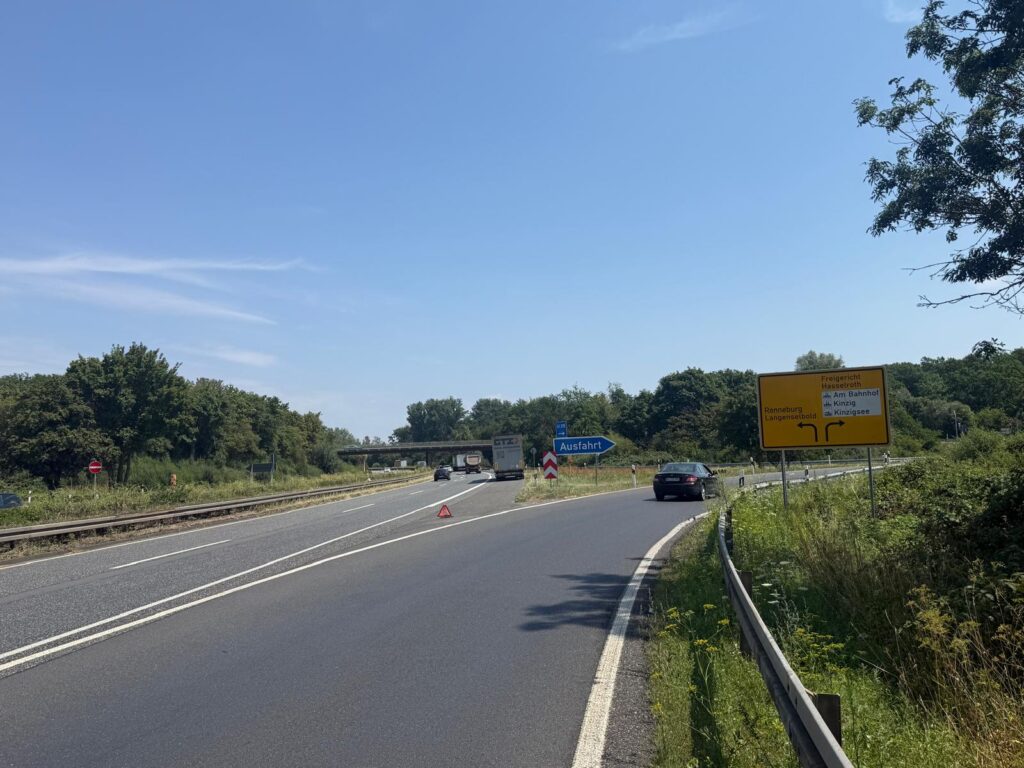
The trailer sat safely on the hard shoulder, the load was secured against rolling, and the driver had hazard lights and a warning triangle out. No injuries, but a stranded combination on one of Germany’s busiest east-west corridors: every minute on the shoulder there is a genuine risk, especially with lorries passing at speed.
How the assistance was arranged
Our dispatch runs multilingual around the clock, because breakdowns don’t keep office hours. First contact follows a set routine so nothing gets lost to back-and-forth questions:
- Call taken, location pinned via GPS or motorway marker, initial damage assessment from photos.
- Tyre size and existing trailer equipment confirmed so the technician brings the right replacement first time, rather than a second wasted trip.
- Nearest partner workshop in our nationwide network alerted, prioritised by distance and stock of the correct trailer tyre size.
- Safety instructions relayed to the driver: hi-vis vest on, warning triangle set far enough back, wait behind the crash barrier rather than beside the vehicle.
- Live tracking of the technician, with automatic updates to the driver on estimated arrival.
From the call to the technician’s arrival on scene took 55 minutes: 15 minutes of dispatch, 40 minutes on the road. For a light trailer case on a well-connected stretch of motorway, that’s a solid, realistic figure.
Why you shouldn’t just keep driving
A shredded trailer tyre is not a cosmetic problem. Keep the combination moving and the rim grinds on the tarmac, sparks fly, and the suspension takes damage. On a single-axle trailer, the entire lateral load of that axle also transfers onto the one remaining tyre, overloading it and setting up a second failure.
Braking suffers too. A wheel running on bare metal changes braking bite unevenly, and the trailer pulls sideways under braking. In dense traffic heading towards Berlin on the A2, that’s a scenario that can turn into a rear-end collision fast. So the rule holds: pull onto the hard shoulder, hazards on, get out of the vehicle, call for help. Don’t improvise, and definitely don’t fit a car spare, because the stud pattern on a trailer hub almost never matches a passenger car wheel anyway.
The tyre change, step by step
Step 1 – Visual inspection. The technician checks the rim, wheel studs, hub bearing, and brake lines for consequential damage. A tyre tearing apart can shred brake lines or wiring on its way out.
Step 2 – Securing the work area. Warning triangle, additional hazard lighting, hi-vis vest. The technician always works from the side of the vehicle away from live traffic, never facing the carriageway.
Step 3 – Removal. The trailer is raised on a jack at a suitable lifting point, the damaged wheel removed, and the hub cleaned of rubber debris and grit.
Step 4 – Fitting the new trailer tyre. A replacement of the exact same specification goes on: 195/65 R15 93N marked “FOR TRAILER USE ONLY”. That’s not optional. A standard car tyre has a softer, more flexible sidewall that won’t hold up long-term against a trailer’s lateral loads.
Step 5 – Final checks. Wheel nuts torqued in a star pattern to the manufacturer’s spec, tyre pressure set to the correct value, brake lines and lighting visually checked, short test roll on the shoulder.
Full timeline
| Time | Phase | Action |
|---|---|---|
| 07:50 | Call | Driver reports trailer tyre blowout on the A2 near Magdeburg |
| 07:50–08:05 | Dispatch (15 min) | Location and damage logged, technician alerted, correct trailer tyre confirmed |
| 08:05–08:45 | Travel (40 min) | Technician en route to the scene |
| 08:45–09:10 | On-site work (25 min) | Inspection, safety setup, wheel change, torque check |
| 09:10 | Done | Combination roadworthy, journey resumed |
Total time from call to departure: 1 hour 20 minutes.
What the job cost
| Item | Price (EUR) |
|---|---|
| Call-out/service fee | 150 |
| On-site labour (25 min) | 55 |
| Trailer tyre 195/65 R15 93N | 98 |
| Old tyre disposal | 18 |
| Total | 321 |
All figures net, plus VAT. That’s well below the cost of a blowout on an articulated lorry, which shows how much our tyre service pricing depends on vehicle type and tyre size: a 195/65 R15 trailer tyre is a light component, while a 385/65 R22.5 on a semi-trailer costs several times as much. For context, a lorry standing idle costs a haulier somewhere between 800 and 1,200 euros a day, by industry estimates. Even the smaller sum for a trailer tyre pays for itself easily if it prevents a multi-hour or multi-day standstill.
Why the “FOR TRAILER USE ONLY” marking matters
Plenty of drivers, and even some independent garages, underestimate that trailer tyres and car tyres are two different products technically, even when the size marking looks identical. A tyre marked ST (“Special Trailer”) or “FOR TRAILER USE ONLY” has a reinforced carcass and a stiffer sidewall. That construction is built for the lateral forces acting on a trailer through cornering, lane changes, and crosswinds, because a trailer tyre is never driven and never steered.
A standard car tyre, by contrast, is designed around driving and steering forces, with a more flexible sidewall that deforms cleanly when the wheel turns. That flexibility becomes a liability on a trailer axle: under higher lateral loading and a softer sidewall, heat builds up inside the carcass, fatigue sets in faster, and in the worst case it tears apart exactly as seen in this A2 case. The reverse holds too: a trailer tyre never belongs on a steering or drive axle, since its stiff sidewall causes unstable handling and poor traction there.
The N speed rating caps the tyre at 140 km/h. Push a combination faster than that on a tyre that’s aged or wrongly specified, and internal operating temperature climbs sharply, cutting service life dramatically. At 130 km/h or more on stretches of the A2, that difference is exactly what separates a tyre good for 40,000 kilometres from one that blows after a few thousand.
Tyre ageing: the real danger for trailers
On articulated lorries, tread wear is usually what forces a tyre change. On trailers, it’s often the opposite. The tyre looks brand new, hardly any tread lost, because the trailer sits idle for months or covers only a handful of kilometres a year. That’s exactly the trap. Rubber ages regardless of mileage. UV exposure, ozone, and temperature swings make the carcass brittle, and fine cracks form in the sidewall, often barely visible from outside.
The manufacture date sits on every tyre as a DOT code, with the last four digits giving the week and year of production. A rough but well-tested rule used by many inspection bodies: tyres older than six years should go to a specialist for inspection regardless of tread depth, and at ten years they should be replaced outright, whatever they look like. Trailers that sit parked between jobs for weeks at a time make checking that DOT date more important than measuring tread.
Under-inflation: the quiet killer of trailer tyres
The second big risk factor is tyre pressure. Trailers get checked far less often than the towing vehicle, sometimes only at the annual inspection. A tyre running underinflated for weeks flexes more than it’s designed to on every corner. That constant flexing builds heat inside the carcass, the rubber plies gradually separate, and the tyre fails suddenly under load, on a long motorway run on a warm day like 20 July, for instance. Checking pressure before any longer trip, or at minimum monthly, is not a formality on a trailer. It’s the single most effective step against exactly this failure mode.
If the tyre blows while driving
When a trailer tyre lets go on the move, the combination typically starts to sway or snake, because the sudden loss of lateral support sets the drawbar swinging. The driver’s response matters enormously:
- Hold the steering wheel steady, no sharp corrections.
- Don’t brake hard. Heavy braking amplifies the trailer’s sway.
- Ease off the accelerator and let the vehicle coast down, only steering carefully towards the shoulder once speed has dropped.
- Switch on hazard lights as soon as the driving situation allows.
- Get out only once fully stopped, hi-vis vest on, warning triangle placed.
That’s precisely the composed response the driver showed on 20 July, and it’s a major reason a technical failure never turned into something worse.
Load distribution on a single-axle trailer
A single-axle trailer carries its entire payload on one axle, unlike a semi-trailer spreading weight over several. Exceed the permitted noseweight or load the trailer unevenly, and the strain on a single tyre rises disproportionately. Correct loading, with the centre of gravity roughly over the axle and noseweight at the coupling within its rated range, meaningfully cuts the risk of tyre failure. Anyone running trailers commercially should check axle rating and tyre load index together, since the two figures have to match.
Why this is a job for a professional
Swapping a wheel sounds simple, but doing it roadside carries real risk:
- Working right beside live traffic without proper protection is dangerous, particularly on a busy motorway.
- Fitting the wrong replacement, a car tyre instead of a genuine trailer tyre, can lead to a repeat failure within a short distance.
- Without a torque wrench, wheel nuts often end up too loose or too tight, either of which can let the wheel work free while driving.
- Missing the technical knowledge to spot consequential damage to brakes, hub bearings, or suspension means faults get overlooked and turn into bigger repairs later.
Our technician arrives with the right tools, a torque wrench, and the correct tyre specification, and secures the work area properly so the driver stays safe throughout.
Typical jobs we’re called out for
Beyond trailer tyres like this one, our regular work includes blowouts on semi-trailers on the motorway, tyre failures on multi-axle car transporters, wheel changes on refrigerated trailers with a running reefer unit, rim damage after kerb strikes, and roadside assistance for foreign drivers whose fleet vehicles break down on German motorways. Our network covers the whole country, from Hamburg to Munich, from Cologne to Dresden.
Prevention for drivers and fleet managers
- Check the DOT date on every trailer tyre at least once a year, even if the vehicle rarely moves.
- Check tyre pressure monthly, especially before longer trips and after periods of standing.
- Fit only tyres marked “FOR TRAILER USE ONLY” or ST-rated on trailer axles, never a car tyre as a supposed equivalent.
- Have tyres older than six years inspected regardless of tread, and replace outright at ten years.
- Check noseweight and load distribution before every trip, especially on single-axle trailers.
- Any visible sidewall cracking, even with plenty of tread left, means a trip to a specialist straight away.
Extended guide: trailer tyres in fleet management
Compared with drive-axle tyres, trailer tyres are a bit of an afterthought in many fleets’ maintenance planning, yet they deserve their own attention. Manufacturers such as Continental, Goodyear, and Bridgestone build dedicated trailer tyre ranges tuned for durability under low mileage and high lateral load, rather than purely for tread life the way drive-axle tyres are. Anyone running a mixed fleet of tractor units and trailers should plan maintenance intervals separately for each: tractor tyres get changed by tread depth, while age is usually what decides a trailer tyre’s replacement date.
Storage matters too. A trailer parked in the same spot for weeks should be moved periodically, or at least have its tyre pressure checked, since flat spots and localised material fatigue can develop at the contact patch. Regular visual checks for sidewall cracking, discolouration, and deformation belong in the routine alongside checking wheel nut torque, since nuts can work loose over time on a trailer that rarely moves.
FAQ
What does “FOR TRAILER USE ONLY” mean on a tyre?
It marks the tyre as built exclusively for a non-driven, non-steered trailer axle. The carcass is engineered for lateral forces, not driving or steering loads, and it must never be fitted to a towing vehicle.
Can I run a normal car tyre on my trailer if the size matches?
The size may fit, but technically it’s not suitable. A car tyre’s softer sidewall holds up worse under sustained lateral loading on a trailer and ages faster under that strain.
How old can a trailer tyre be before it needs replacing?
As a rule of thumb: tyres older than six years should be inspected by a specialist regardless of tread condition, and replaced outright by ten years, even if there’s barely any visible wear.
What does a trailer tyre change on the motorway cost?
In this case the total was 321 euros net, covering call-out, labour, the trailer tyre, and disposal of the old one. The figure can vary with tyre size and distance travelled.
How long does a job like this take?
From the call to the journey resuming took 1 hour 20 minutes: 40 minutes travel and 25 minutes of actual on-site work.
What should I do if a trailer tyre blows while I’m driving?
Hold the wheel steady, don’t brake hard, ease off the accelerator and coast down, then steer carefully towards the shoulder and stop once speed has dropped.
Why choose LKWHelp24
We’re reachable 24 hours a day, seven days a week, across all of Germany. Our dispatch is multilingual, and our partner network covers everything from small trailer tyres to heavy articulated lorry rubber. We quote prices upfront, no hidden extras. Van with trailer, semi-trailer, or car transporter, we send the technician equipped for the actual tyre specification, not just whoever’s nearest.
Summary
- Specification: trailer tyre 195/65 R15 93N, marked “FOR TRAILER USE ONLY”
- Location: A2 near Magdeburg, direction Berlin
- Response time: 40 minutes travel after 15 minutes of dispatch
- Total time: 1 hour 20 minutes from call to departure
- Cost: 321 euros net
- Consequential damage: none, thanks to the driver’s quick, correct response and a prompt technician call-out
Get help now
Trailer tyre blown, combination stuck on the hard shoulder? Call us: +49 160 5753826, 24/7, anywhere in Germany. More on our services at www.lkwhelp24.com. We’re on the road across the whole country, around the clock.
Keywords: trailer tyre replacement | mobile truck tyre service | FOR TRAILER USE ONLY | tyre blowout A2 Magdeburg | trailer tyre 195/65 R15 | tyre ageing DOT code | trailer tyre pressure | roadside trailer breakdown assistance
Related articles
- Trailer Tyre Blowout on the A10 near Michendorf: Curtainsider Semi-Trailer Back on the Road in 1 Hour 45 Minutes
- Trailer Tyre Service Near Me: How LKWHelp24 Replaced a Flat Trailer Tyre on an Enclosed Car Transporter on the A81 near Rottweil in Winter
- Truck Tyre Service After a Trailer Blowout near Berlin: Air Spring Bellows Damaged
- Munich Truck Tyre Service – 24/7 Breakdown Help for Your Semi-Trailer
- Mobile Truck Tyre Service 24/7 – Trailer Blowout Wheel Change in Germany
More services: Tyre Service · Mobile Truck Service · Towing Service · Truck Workshop · Contact