Skip to content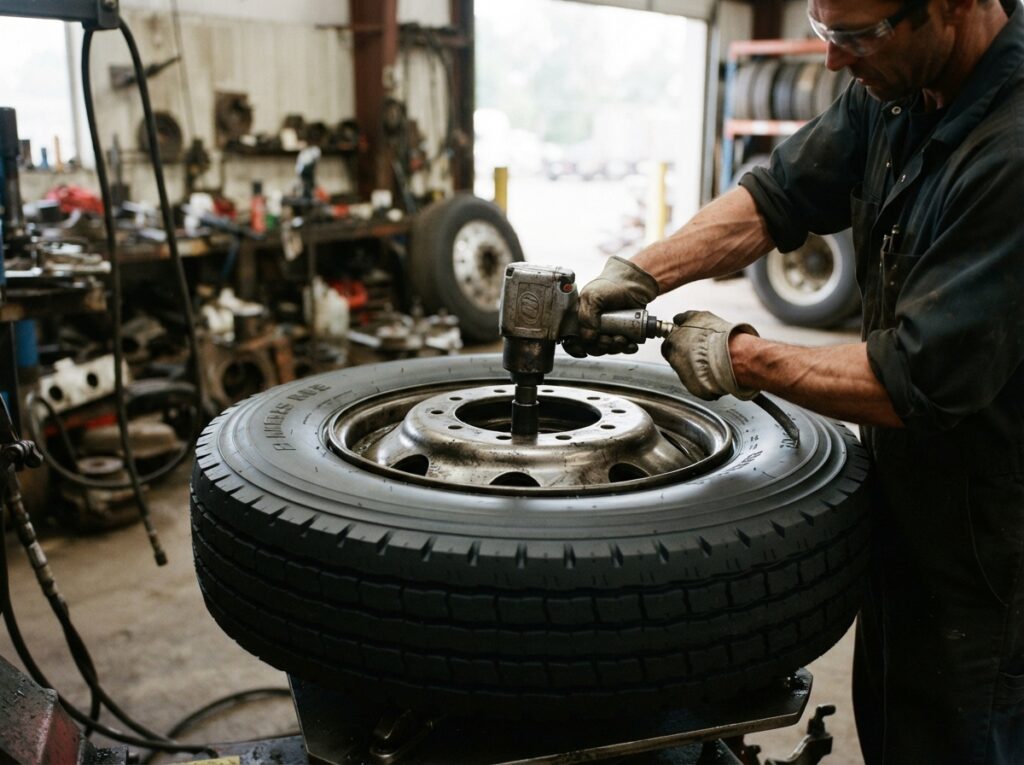
What a truck tire change really costs
A blown tire on the highway at three in the morning is not the moment to sit down and compare prices. Yet almost every driver and every dispatcher asks the same question once the initial shock passes: what is this going to cost? There is no single honest number to give, because a truck tire replacement is made up of several cost blocks that shift depending on the situation. In this article we go through each block one by one, so you end up with a realistic picture instead of relying on a single figure someone posted in a forum. Most price figures floating around online come from individual, one off experiences and rarely transfer to your own situation, because region, time of day, tire size and brand choice each change the outcome.
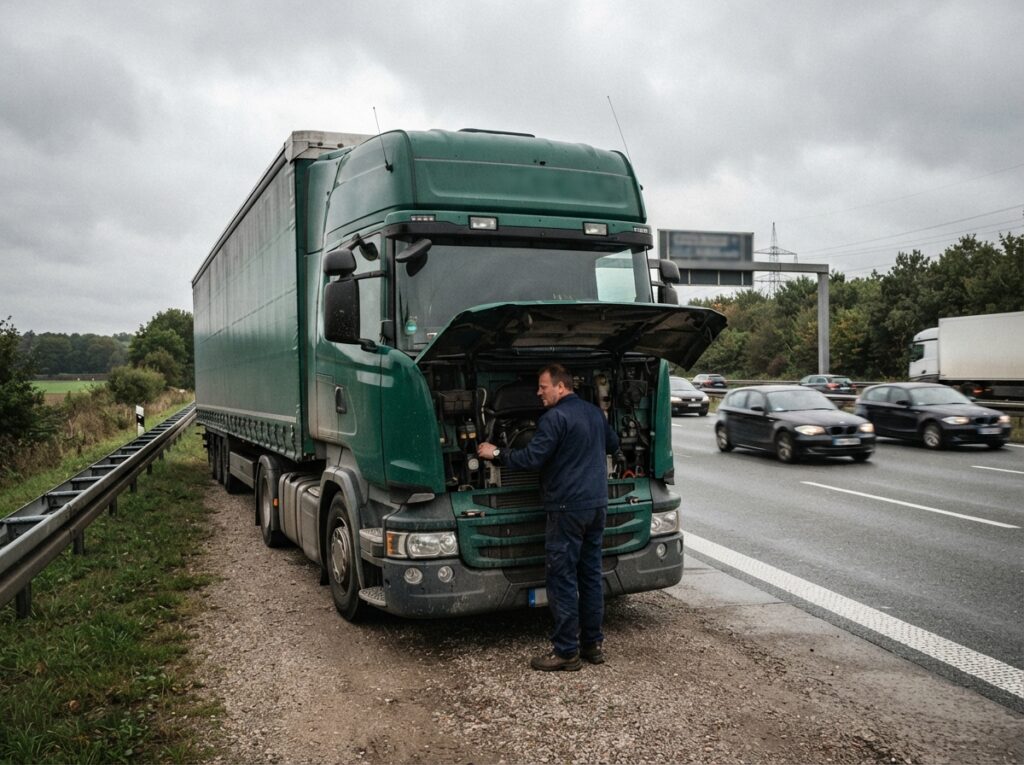
One thing up front: this article covers the tire change itself, not towing a vehicle that can no longer move at all. If your truck has a different fault and genuinely needs to be towed, you will find the relevant information and price ranges in our separate article on truck towing costs. A simple tire failure, whether a blowout, a nail in the tread or a cut in the sidewall, almost never requires towing. It calls for a mobile tire change right at the location where the truck stopped.
What the price is actually made of
Anyone asking about the price of a tire change is really asking about four separate cost items that need to be added together.
The first item is the tire itself. This is the variable with the widest range, since brand, size, tread type and condition (new versus retreaded) all affect the price heavily. More on that in the next section.
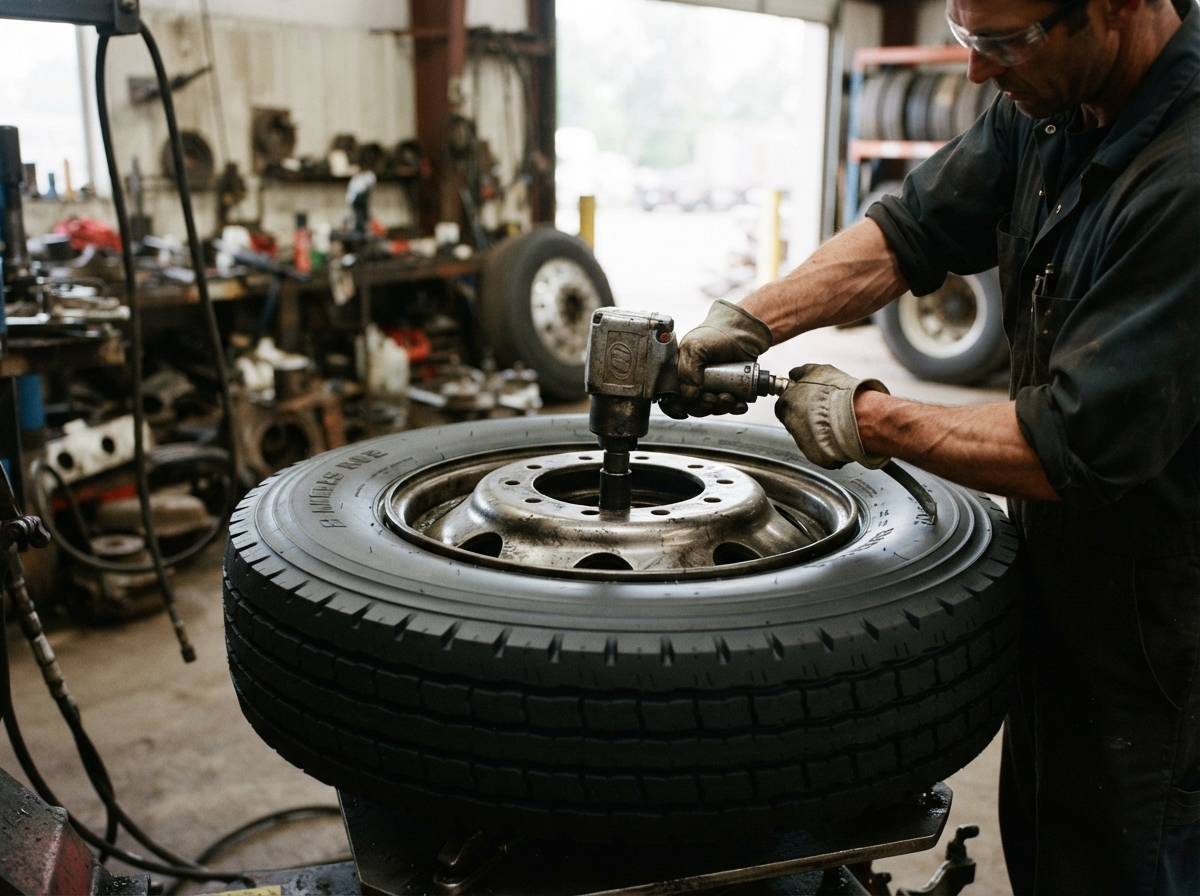
The second item is the actual mounting labor: loosening the wheel nuts, removing the wheel, balancing or at least a visual inspection, fitting the new or repaired tire, and tightening the nuts to the correct torque. If you want to know which torque values actually apply and why this is not a step to skip, check our truck wheel nut torque table for the exact figures.
The third item is the call out, meaning the mobile technician coming to you. This is where the biggest difference lies between a scheduled workshop appointment and an emergency on the motorway. A technician who arrives with full equipment, spare tires in stock and a service vehicle on the hard shoulder or at a rest area incurs different costs than a truck that is already parked in a workshop bay.
The fourth and often forgotten item is disposal of the old tire. Used tires cannot simply be left behind or thrown out with regular waste, they must be recycled properly, and this disposal usually carries a small but real fee that is normally already folded into the total price.
What a mobile call out costs as a baseline
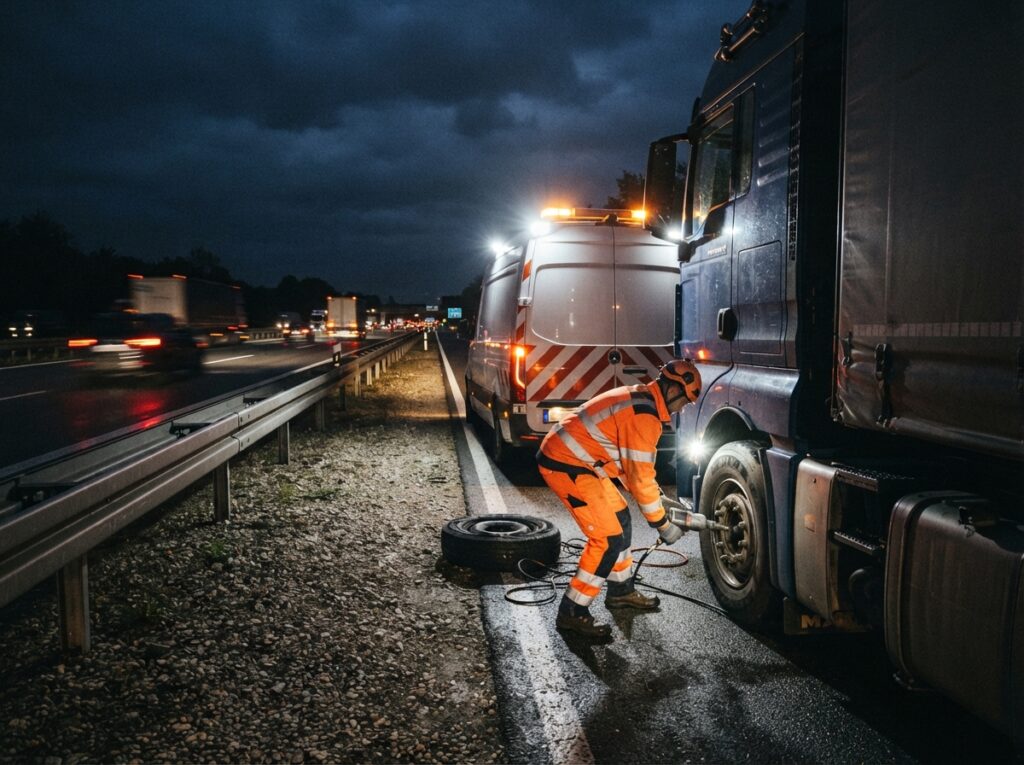
At LKWHelp24 we work exclusively with commercial vehicles from 7.5 tonnes upward, and we charge for mobile call outs on a clear, transparent structure. The base rate for the call out and basic service starts at 290 euros during the day, while it starts at 429 euros in the evening, at night and on weekends. This difference is not arbitrary, it reflects the real extra effort involved: night work means worse visibility, higher risk working next to live traffic, often longer travel distances because fewer technicians are on shift, and generally a higher standby cost for the team.
This base rate covers the call out, the technician and the mounting work. The tire itself is billed separately, because its price depends on too many factors to fold into one flat service fee. That is exactly why it helps to keep these two line items separate in your head: the service fee on one side, the tire price on the other.
Price ranges by tire size: what is realistic
Truck tires from size R17.5 upward vary enormously in price and availability. The most common sizes on long haul trucks and heavy semi trailers are 295/80R22.5, 315/70R22.5 and 385/65R22.5. The last of these is frequently fitted on trailer axles and certain tractor configurations, and you can read more details in our full guide on the 385/65R22.5 tire size.
We deliberately avoid inventing fixed prices per size here, because that would simply be dishonest. Tire price depends on too many variables: brand, region, what the technician has on the vehicle that day, season, and current raw material prices for rubber and steel belting. A realistic way to think about it: budget and second tier brands sit at the lower end, established mid range European brands sit in the middle, and premium manufacturers such as Continental, Michelin or Bridgestone sit at the upper end. Within a single size like 315/70R22.5, the pure tire price can easily vary by two to three times between these segments.
On top of the base mobile call out rate, whether 290 euros during the day or 429 euros in the evening, at night or on weekends, comes the individual tire price, which your technician will state clearly on site before mounting begins.
New, retreaded or used: understanding the price gap
One of the most important decisions in any truck tire replacement is whether to fit a new tire or a retreaded one. Retreading means reusing the load bearing carcass of a used tire and applying a fresh tread. This is an established, industrially tested process across Europe, not some inferior workaround.
Retreaded tires are typically noticeably cheaper to buy than comparable new tires, because a significant share of the material and manufacturing energy is being reused. The trade off shows up in tread life and sometimes in handling at very high speeds or under extreme loads, which is why many fleet operators favor retreaded tires on drive or trailer axles while keeping new tires on the steer axle, where precision and safety matter most.
For an unplanned tire change on the road, in the middle of the night on the hard shoulder, choice is limited anyway: the technician fits whatever is on the vehicle or nearby in stock. For planned maintenance in a workshop, on the other hand, you can deliberately choose between new and retreaded and steer your costs accordingly.
Premium versus budget: what the brand markup actually buys
Continental describes itself on its own website as one of the largest tire manufacturers in the world, with a wide range of truck and bus tires, currently including its Generation 5 product line for long haul use. Michelin also positions itself firmly in the premium segment and offers dedicated guidance and product lines for commercial vehicles, though the publicly available information tends to focus more on light commercial vans than on heavy 40 tonne trucks.
What does that mean for you in practice? Premium tires from manufacturers such as Continental, Michelin or Bridgestone cost more to buy but generally deliver longer tread life, more even wear, better rolling resistance and therefore lower fuel consumption over the tire’s lifetime. On a vehicle covering hundreds of thousands of kilometers a year, the higher purchase price can pay for itself over time, simply because the tire lasts longer and burns less fuel.
Budget tires are not automatically bad, but quality within that segment varies more widely. For vehicles with lower annual mileage, or for axles under lighter load, a solid budget or mid range tire can make good economic sense. There is no blanket recommendation here, the right choice depends on how your specific vehicle is used.
Factors that push the final price up or down
Several factors decide how the final invoice actually looks.
Time of day is the most obvious one. A change carried out mid morning in a workshop, or even mobile at an easily accessible spot, costs less than the same change at two in the morning on a poorly lit stretch of motorway. This is exactly what our base rate of 290 euros during the day versus 429 euros in the evening, at night and on weekends reflects.
Urgency matters too. A vehicle sitting fully blocked on the hard shoulder and endangering traffic needs immediate priority, while an appointment booked a week in advance can be scheduled with more flexibility. If you need fast help nearby, our overview of tire breakdown service near me points you to the right contact.
Availability of the right tire size on the technician’s vehicle is a third, often underestimated factor. Common sizes like 295/80R22.5 or 315/70R22.5 are generally well stocked. Rarer combinations, special load indices or unusual tread patterns can mean the tire has to be sourced first, which costs time and sometimes an extra call out charge.
Region plays a role too, since labor costs, the density of tire service providers and local stock levels all vary from place to place.
How to actually save money
The most effective lever for saving money is planned, forward looking maintenance. Anyone who checks tread depth regularly, keeps an eye on tire pressure and spots wear early can schedule a tire change at a workshop instead of experiencing it as an expensive emergency on the motorway. We explain how to check tire pressure correctly and which values apply to your vehicle in our article on truck tire pressure. Reading the tire sidewall correctly also helps you catch wear limits and manufacturing dates early, which we cover in our guide to truck tire markings.
Despite all the preventive care in the world, some situations simply cannot be planned: a nail in the tread, a sharp object on the road, or a sudden blowout from material fatigue. In moments like these, there is genuinely no alternative to mobile tire change assistance, because the truck needs to be back on the road quickly, both for economic reasons and for safety. If you want to prepare for the worst case, our article on emergency wheel change for trucks walks through exactly what to do before the technician arrives.
Another way to save is by deliberately combining new and retreaded tires according to axle position, as described earlier. Fleets that source larger tire volumes through a wholesaler rather than buying single units can also benefit from better terms, which we cover in our piece on the truck tire wholesaler and mobile tire service.
Price overview at a glance
The table below summarizes the main cost blocks discussed in this article. It does not replace an individual quote, but it gives you a sense of what each line item stands for.
| Cost block | Range or approach | Note |
|---|---|---|
| Service fee, daytime | from 290 euros | call out, technician, mounting |
| Service fee, evening/night/weekend | from 429 euros | higher effort, poorer visibility |
| New tire, budget segment | lower price range | wider quality variation within segment |
| New tire, premium brand | upper price range | Continental, Michelin, Bridgestone and similar |
| Retreaded tire | well below new tire price | commonly fitted on drive or trailer axle |
| Old tire disposal | small fee | usually already included in the total |
Why the availability of the right tire affects price
An aspect that gets lost in many price discussions is pure logistics. A mobile tire service cannot permanently carry every conceivable size, load index and tread depth on every single service vehicle. Common dimensions such as 295/80R22.5 are essentially standard stock everywhere, since they are fitted on a large share of European tractor units. Rarer combinations, such as special load indices for heavy haulage or unusual treads for construction site work, are not always immediately on hand.
When the right tire has to be fetched from a nearby warehouse, the vehicle’s downtime increases, and in some cases an additional call out component applies. This is exactly why it pays for fleet operators to know their own standard sizes and, ideally, to check in advance with a tire service which dimensions are well stocked in their region. A fleet manager who knows their trucks run on 385/65R22.5 can specifically ask a service partner whether that size is carried.
Season matters too. As winter approaches, demand for tires carrying the Alpine symbol jumps sharply, and shortages of certain sizes are not unusual during that window. Checking and, if needed, replacing tires in late summer avoids this seasonal demand pressure entirely.
Maintenance as a cost factor over the tire’s lifetime
A tire change is rarely an isolated event. How long a tire lasts before it needs replacing depends heavily on how it was treated over its life. Persistently low tire pressure increases flexing, causes uneven wear and can, in the worst case, lead to a sudden heat related blowout, especially on long summer motorway stretches. Checking tire pressure regularly, ideally before every long trip, extends service life noticeably and reduces how often you face an expensive emergency change.
Correct torque after every wheel change matters just as much. Wheel nuts that are too loose can work themselves free while driving, which can lead to complete wheel loss, while nuts tightened too hard can warp the brake disc or damage the thread. Both mistakes end up costing money, whether through consequential damage or another trip to the workshop.
A worked example for context
Picture an illustrative example, without naming specific brand prices, since as mentioned these vary too widely. A semi trailer combination breaks down on a Friday evening around ten o’clock with a blown tire on the trailer axle, size 315/70R22.5. The driver calls the mobile tire service.
Because the call out happens in the evening, the evening and night tariff of 429 euros applies as the base rate for the call out and mounting. On top comes the price of the replacement tire, which varies depending on the brand available and its condition (new or retreaded), and which is communicated clearly on site before mounting. The total is the fixed service fee plus the variable tire price. Had the same driver noticed the early wear days earlier during a routine check and booked a workshop appointment in broad daylight, the service fee alone would have been the lower 290 euros instead of 429, not to mention far less stress.
A second example illustrates the opposite case. A fleet manager schedules a routine tire inspection for four semi trucks in the company’s own workshop on a Tuesday morning. Two vehicles need new tires on the drive axle, the other two pass with just a tread depth check. Because the appointment is planned, happens during the day and involves no time pressure, no mobile service fee applies at all here, just the regular workshop price for tires and mounting. The difference compared to a night time emergency call out on the motorway is not just the 429 versus 290 euro service fee, it is also the lost time, the stress for the driver and the risk of a fine for extended standing on the hard shoulder.
This example shows the central point of this whole article: the biggest lever you control yourself is not the tire brand, it is the timing and predictability of the change.
Minimum legal requirements in brief
Under German road traffic regulations, § 36 StVZO, tread depth on the main grooves of air filled tires must be at least 1.6 millimeters across the entire circumference, applying to roughly three quarters of the tread width. Tires and tread must also be free of damage that could pose a hazard, and air filled tires must have continuous grooves or cuts running around the full circumference and width of the tread. Winter tires additionally need the Alpine symbol to be classified as such. These legal minimums are a floor, not a recommendation: in practice, replacing a tire well before this limit is reached usually makes sense, since braking performance and wet grip noticeably decline before the legal minimum is hit.
Frequently asked questions
What does a mobile truck tire change cost as a baseline? The base rate for call out and mounting at LKWHelp24 is 290 euros during the day and 429 euros in the evening, at night and on weekends. The tire price itself comes on top, depending on brand, size and condition (new or retreaded).
Is a retreaded tire as safe as a new one? Retreading is an established, industrially tested process across Europe. Retreaded tires are frequently used on drive and trailer axles, while many fleets prefer new tires on the steer axle for safety reasons.
Why is a night time tire change more expensive than a daytime one? Night work means worse visibility, higher risk next to live traffic and a higher standby cost for the service team, which is reflected in the higher tariff of 429 euros versus 290 euros during the day.
Is a premium tire from Continental or Michelin really worth it? For vehicles with high annual mileage, the higher purchase price often pays for itself through longer tread life and lower fuel consumption. For lower mileage vehicles, a solid mid range tire can be more economical.
What should I do if I get a flat tire at night on the motorway? Secure the vehicle, switch on hazard lights and set up a warning triangle, keep a safe distance from live traffic, and contact the mobile tire service. Our article on emergency wheel changes walks through the exact steps.
Can I reach the mobile tire service directly on WhatsApp? Yes, LKWHelp24 is available around the clock on WhatsApp at +49 160 5753826, in German, English, Polish and Russian, for commercial vehicles from 7.5 tonnes upward.
Do both tires on a dual wheel axle need to be replaced together? On dual wheel setups, common on most drive axles, many workshops recommend pairing tires with a similar tread condition to keep rolling circumference even. A significantly different condition between inner and outer tire can cause uneven load. Your technician on site is best placed to judge this in your specific case.
In short
The price of a truck tire change is made up of the tire itself, the mounting labor, the technician’s call out and disposal of the old tire. At LKWHelp24, the base rate for a mobile call out is 290 euros during the day and 429 euros in the evening, at night and on weekends, with the tire price billed separately and transparently. New premium tires cost more than budget or retreaded tires but often deliver longer tread life. The most powerful lever remains planning: spotting wear early and booking a daytime appointment instead of a night time one saves real money. But in a genuine breakdown on the road, one thing matters most: fast, professional help, reachable on WhatsApp at +49 160 5753826, around the clock, seven days a week, in four languages, for commercial vehicles from 7.5 tonnes upward.