Skip to content
A tyre blowout on the motorway brings the entire transport to a standstill. Every minute counts. This article explains, step by step, how truck drivers and dispatchers should handle an emergency wheel change correctly – and when it’s better to call professional help right away.
Key Points at a Glance
- This article applies exclusively to trucks and commercial vehicles from 7.5 tonnes with tyres from R17.5. Cars and light vans are subject to different rules.
- Truck tyre blowouts require immediate safety measures: turn on hazard lights, put on a hi-vis vest, set up a warning triangle, secure the vehicle with wheel chocks.
- Changing a wheel on a heavy truck yourself is risky and requires specialist tools. In most cases, a mobile tyre service is the safer and faster solution.
- Lkwhelp24 is reachable 24/7 across Germany. Response time is typically 30–60 minutes. Preferred contact via WhatsApp: +49 160 5753826.
- We only serve trucks and commercial vehicles from 7.5 tonnes. Fixed prices start at €290 net for the mobile tyre service during the day.
First Aid: What to Do When a Truck Tyre Bursts
A sudden tyre blowout on a fully loaded articulated truck on the motorway is one of the most stressful moments for any driver. The vehicle pulls to one side, debris flies, and the schedule is at risk. The first few seconds matter most.
Here’s how to react correctly:
- Hold the steering wheel firmly and brake in a controlled way – no sudden steering movements.
- Turn on the hazard lights immediately – for maximum safety in the first seconds.
- Roll slowly onto the hard shoulder or the nearest rest area.
- Park the vehicle in a safe place – ideally on level ground, aligned straight, with enough distance from the traffic lane.
- Apply the handbrake and engage a gear or park mode.
This is the correct procedure for dealing with a flat tyre.
Important: don’t check the tyre right away. First secure yourself and other road users. Only once the truck has come to a stop and is fully secured can you assess the damage and request breakdown assistance.
Changing a truck tyre requires a safe, level surface. Make sure the vehicle is standing on firm, even ground before taking any further steps.
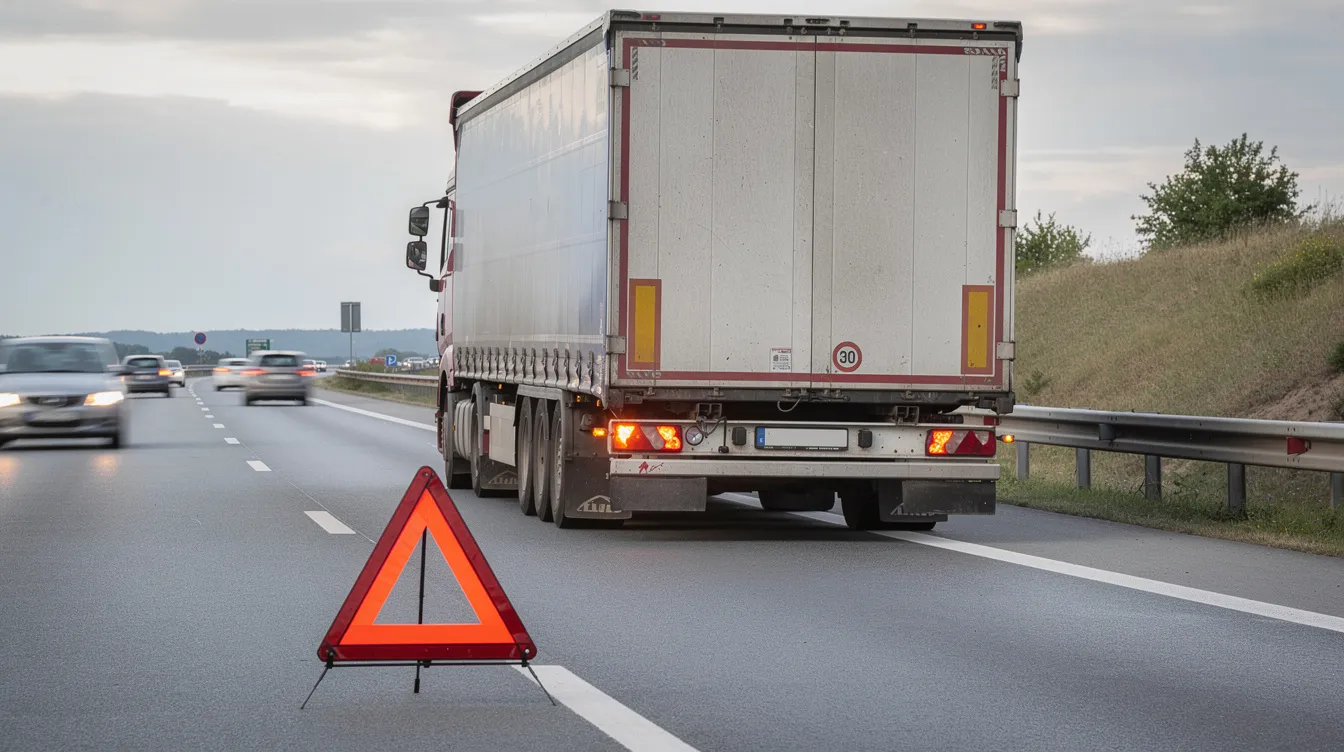
Safety Measures at the Breakdown Site: Using Hazard Lights Correctly
Before you leave the cab, all safety measures need to be in place – precisely because changing a wheel is a practical skill where safety always comes first. Working on the road in flowing traffic is life-threatening.
- Put on a hi-vis vest – while still in the cab, before you get out. Mandatory under German DGUV Rule 114-615.
- Set up a warning triangle – on the motorway at least 150 metres behind the vehicle, at a safe distance from the truck.
- Use wheel chocks to secure the vehicle against rolling. Place wheel chocks on the diagonally opposite axle so a flat tyre can’t cause the vehicle to roll away.
- In darkness or poor visibility: use additional lighting – warning flashers, a torch. Don’t dazzle other drivers.
- Never stand between the traffic lane and the vehicle. Position yourself behind the crash barrier.
- Inform the police or motorway maintenance service if the truck is standing dangerously or pieces of tyre are lying on the carriageway.
- Anyone not actively helping should stay off the carriageway and wait behind the crash barrier.
These steps protect you, your cargo and other road users.
Damage Check: Which Wheel Is Affected and How Badly?
Assess the situation only from a safe position and without time pressure. Rushing leads to misjudgements.
Proceed systematically:
- Check all tyres on the affected axle, not just the one with the visible flat. Neighbouring wheels can also be damaged.
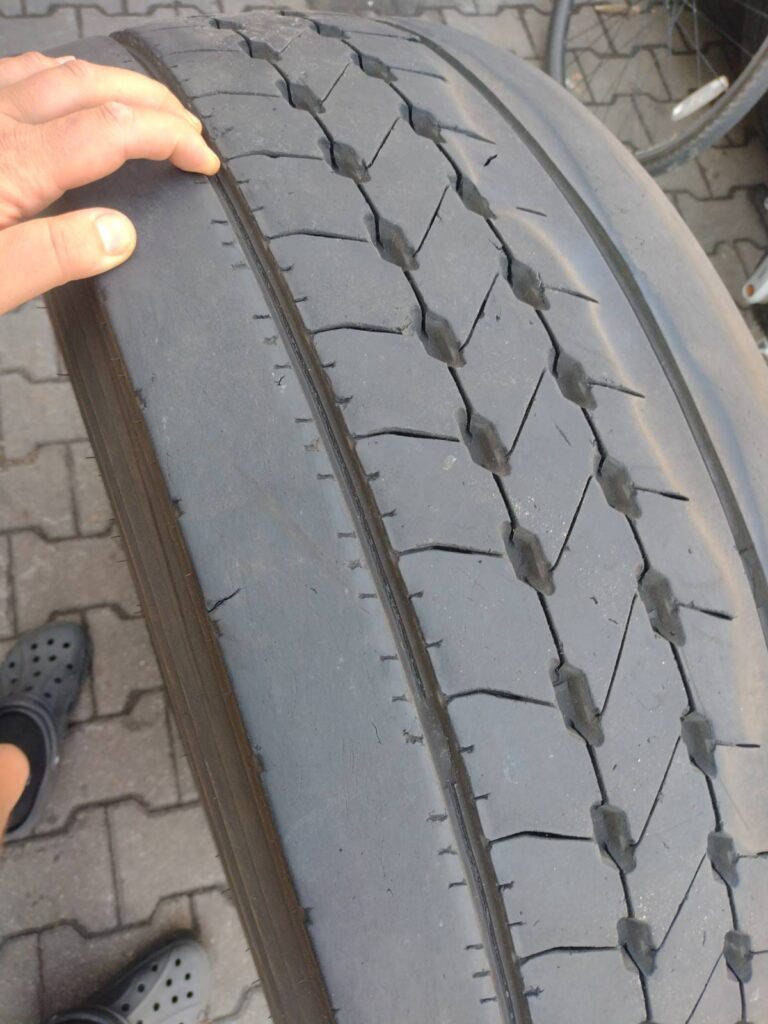
- Look for cuts, embedded debris, burst sidewalls and damage to the rim and wheel arch.
- Check the wheel hub for visible deformation or leaking fluid (a sign of bearing damage).
- On dual wheels: the “healthy” neighbouring tyre also needs checking. Overload and heat can already have damaged it, even if it looks intact on the outside.
Document with photos:
Take photos of the damage and the position on the road; photos of the damage and the surrounding tyres often make assessment easier. Send them to your dispatcher or directly to the breakdown service. The following information helps with quickly selecting the right tyre:
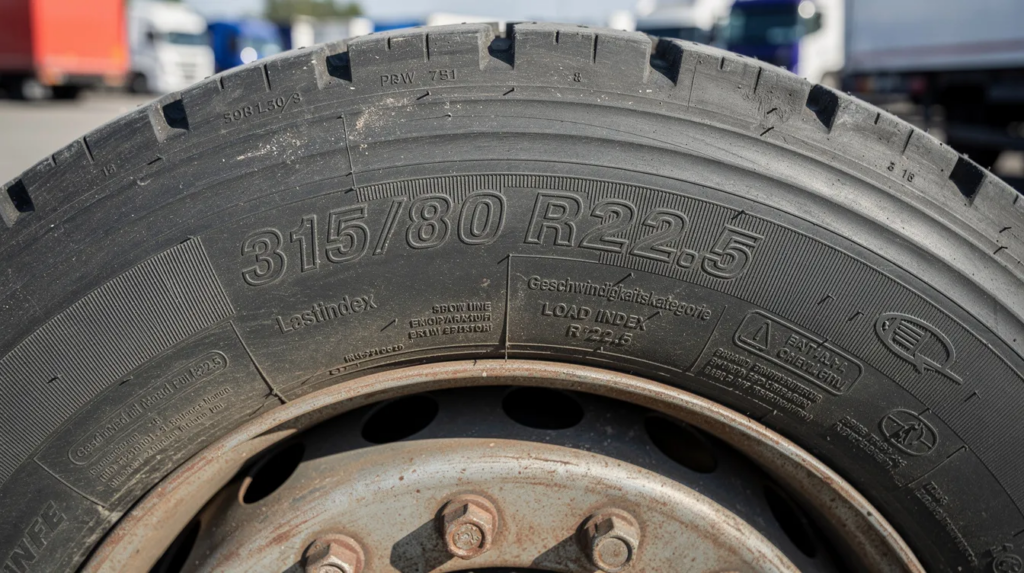
- Tyre size (e.g. 315/70 R22.5)
- DOT number
- Axle position (e.g. outer right, trailer axle 2)
- Surroundings and location
Tools, Jack and Equipment in the Truck – What’s Realistically Possible
A tyre change on a 40-tonne truck requires completely different force and tools than on a car. Wheel nuts on a truck wheel are torqued to 500–630 Nm – that’s not something a standard wheel brace can handle.
Typical on-board equipment:
Item | Usually on board? | Sufficient for a wheel change? |
|---|---|---|
Hi-vis vests | Yes | – (safety only) |
Warning triangle | Yes | – (safety only) |
Wheel chocks | Yes | Yes, for securing the vehicle |
Jack | Rarely | Only if rated for trucks |
Wheel brace / lug wrench | Rarely fits | Usually too weak |
Impact wrench | No (not standard equipment) | Required for trucks |
Many fleets deliberately don’t carry a jack or matching sockets for the wheel nuts on board – to prevent inexperienced drivers from changing wheels themselves; loose tools and spare parts should meanwhile be placed safely off the carriageway in a fixed, easily accessible spot. |
Recommendation for haulage companies: Define clear rules on whether and when drivers are allowed to carry out wheel-related work themselves. The DGUV recommends that such roadside work is carried out by trained specialists.
Lkwhelp24 service vehicles arrive with hydraulic jacks, pneumatic impact wrenches, a torque wrench and professional equipment – everything needed to change the wheel safely; the specialised 24/7 truck tyre service in Germany ensures vehicles are back on the road quickly and to standard.

Step by Step: Changing a Truck Wheel – Only If Safety Conditions Allow It
Important note: The following steps apply only to safe situations at a depot, workshop yard or a secured car park. Never work unsecured on the traffic lane or a narrow hard shoulder. If in doubt, don’t attempt it yourself – call the breakdown service.
Procedure in the correct order:
- Secure the vehicle: apply the handbrake, engage a gear. Use wheel chocks to secure the vehicle. Switch off the engine.
- Loosen the wheel nuts before raising the vehicle. The wheel is still in contact with the ground and can’t turn with it. Loosen the wheel nuts only slightly – don’t unscrew them fully yet.
- Position the jack: place the jack at the point specified by the manufacturer under the vehicle. Make sure the ground is firm and level. Raise the vehicle until the wheel with the damaged tyre hangs about 3–5 cm off the ground.
- Remove the wheel: unscrew the wheel nuts fully and remove the wheel. There must be enough space to safely set down the removed wheel. Remove the damaged wheel carefully – truck wheels weigh 50–80 kg depending on size.
- Fit the spare or emergency wheel: place the spare wheel onto the wheel hub and hand-tighten the wheel nuts; make sure the centring bore seats properly.
- Lower the vehicle: lower the vehicle carefully, only removing the jack and wheel chocks once the wheel nuts are fully tightened.
- Tighten the wheel nuts: tighten the wheel nuts in a criss-cross pattern to the specified torque (more on this in the next section).
An emergency wheel usually comes with a speed limit of 80 km/h maximum. Check the specifications in your vehicle’s manual. Anyone wondering how a safe wheel change works should follow this exact order.
Important Details: Wheel Nuts, Wheel Bolts, Tightening Order and How to Loosen Wheel Nuts
Incorrectly tightened wheel nuts are a safety-critical risk. Too little torque means the wheel can come loose while driving. Too much torque can overload the wheel bolts and cause cracking.
Basic rules:
- Wheel nuts should always be slightly loosened while the vehicle is still on the ground, before raising it – never the other way round. Loosen the nuts while the wheel still has ground contact.
- Wheel nuts should be tightened in a criss-cross pattern (a star pattern for more than 5 bolts). This distributes tension evenly and centres the wheel on the hub.
- Tighten the nuts in at least two passes: first to half torque, then to the full specified torque.
- According to the MAN TGX operating manual, the tightening torque for 10-hole rims (32 mm wrench size) is, for example, 600 Nm. Always check the manufacturer’s specifications for your vehicle.
- Use a torque wrench for final verification. An impact wrench alone isn’t enough – it doesn’t deliver precise torque.
- After the wheel change: have the wheel nuts re-torqued after 50–100 km of driving. This is especially important after an emergency wheel change.
Warning: Never apply lubricant to the contact surfaces between the wheel and the rim. Grease or oil on the contact surface can cause the wheel nut and the wheel to come loose while driving.
Checking Tyre Pressure After a Wheel Change
Incorrect tyre pressure on a heavy truck quickly leads to overheating, higher fuel consumption and further breakdowns. On commercial vehicle tyres, the tyre accounts for around 40% of operating costs – and correct air pressure plays a central role.
Check tyre pressure before continuing the journey:
- Check the pressure of the spare tyre before driving off. Use a calibrated gauge or the compressed-air unit at the nearest petrol station or service station.
- Follow the manufacturer’s recommended values. You’ll find these in the cab (a sticker on the B-pillar or door frame), in the manual, or on the type plate.
- Make sure the pressure of the remaining tyres is also correct – a blowout can be a sign of a systematic pressure problem.
What matters is that tyre pressure is correct before continuing the journey – regardless of which language is spoken in the cab; if needed, the specialised Polish-language truck tyre service in Germany 24/7 can also assist directly on site.
Also check the load index of the tyre to make sure the spare has the correct load capacity for your vehicle.
Common Mistakes During an Emergency Wheel Change – and How to Avoid Them
Rushing on the road leads to dangerous mistakes – especially when the haulage company is putting on pressure and the driver is left alone with the problem. Here are the most common mistakes and tips on how to avoid them:
- Raising the truck on soft ground: the jack sinks in, tips over, and the vehicle falls. Always work on firm ground. If you don’t have firm ground available, don’t change the wheel yourself.
- Jack too weak: car jacks aren’t designed for a truck. The vehicle’s weight far exceeds their capacity.
- Removing the jack too early: the vehicle is lowered before the wheel nuts are tightened. Result: the wheel doesn’t sit correctly.
- Tightening wheel nuts by hand only, without verification: without a torque wrench, it’s unclear whether the specified torque was reached.
- Wrong sockets or pipe extensions: improvised solutions with the wrong tools permanently damage the wheel bolts. The bolts can break or deform.
- No re-check after 50–100 km: even correctly fitted new wheels settle. Re-torquing is mandatory according to manufacturer guidelines.
Recommendation for fleet operators: Train your drivers regularly and create a clear policy on when only a professional service should intervene. The DGUV Rule 114-615 recommends exactly that.
When the Driver Should Call the Mobile Tyre Service Right Away
On the motorway, in a tunnel, on narrow country roads or in the dark, a wheel change should never be attempted alone. The risks far outweigh any time saved.
Call professional help immediately if:
- The truck is on the hard shoulder or a safe passing place, but traffic is flowing dangerously close by.
- The rim is badly damaged – a simple tyre change won’t be enough then.
- Several tyres are damaged at the same time.
- The right tools or a spare tyre are missing.
- There’s suspected damage to the brakes, air suspension or axle. In this case the vehicle must not be moved.
- The driver has no experience with truck wheel changes.
Lkwhelp24 offers towing services for vehicles from 7.5 tonnes if the truck can’t be repaired on site; a specialised 24/7 truck towing and emergency service in Germany minimises downtime and follow-up costs. However, around 90% of tyre problems are solved directly on site – without towing. The truck towing service is available as a backup.
Dispatchers should give their drivers clear guidelines: when is self-directed work allowed, and when should Lkwhelp24 be called?

Mobile Truck Tyre Service from Lkwhelp24 Across Germany
Lkwhelp24 offers a 24/7 mobile truck tyre service in Berlin and across Germany for trucks and commercial vehicles from 7.5 t. On-site tyre changes for trucks from size R17.5 – on the motorway, at a service area, or in an industrial estate. No service for cars or vans below this weight limit.
Service facts:
Detail | Info |
|---|---|
Coverage area | All of Germany, 24/7, 365 days |
Partner network | Around 2,500 vetted workshops |
Arrival time | Typically 30–60 minutes |
Tyre service price (day) | From €290 net |
Tyre service price (night/weekend) | From €429 net |
Tyres | From the partner’s stock, added to the service price |
Preferred brand | Possible on request, at extra cost |
24/7 truck breakdown assistance in Germany is available around the clock, everywhere in Germany. The mobile truck tyre service is available 24/7 across Germany. Prices start at €290 for breakdown assistance. Truck breakdown assistance also covers minor on-site repairs. |
The tyre comes from the service partner’s stock. A specific brand can’t be guaranteed in an emergency – outside an acute breakdown situation, a preferred brand can be requested for an extra charge.
Lkwhelp24 changes the tyre directly at the breakdown site, loosens and tightens the wheel nuts professionally, and usually gets the truck back on the road without towing; for Russian-speaking drivers, truck tyre service in Germany 24/7 (in Russian) describes this service in detail. More on the mobile truck tyre service.
Getting in Touch in an Emergency – How a Callout with Lkwhelp24 Works
Fast, clear communication saves time and reduces your vehicle’s downtime.
Here’s the fastest way:
- Open WhatsApp and send your location: wa.me/491605753826
- Send along the following details:
- Location (motorway number, kilometre marker, direction of travel)
- Vehicle type and permitted gross weight (> 7.5 t)
- Tyre size (e.g. 315/70 R22.5)
- Position of the damaged wheel (e.g. outer right, trailer axle 2)
- Photo of the damaged tyre and its surroundings
- The dispatcher confirms the price and arrival time – a transparent agreement before the job starts.
Contact channels:
- WhatsApp (preferred): +49 160 5753826
- Phone: +49 160 5753826
- Email: info@lkwhelp24.com
Lkwhelp24 communicates in German, English, Polish and Russian, offering structured, multilingual truck roadside assistance in Germany 24/7. That’s essential for international drivers who break down somewhere on their route through Germany and don’t speak the local language.
Fleet customers can request a company invoice. Individual drivers pay by cash or card – all with transparent price agreement before the job starts, no hidden costs.
Prevention: How Haulage Companies Can Prevent Truck Tyre Blowouts
Many emergencies are avoidable if fleets take maintenance routines and tyre checks seriously. According to the TÜV commercial vehicle report, the rate of significant defects is around 20.3% – roughly every fifth inspected truck shows significant defects.
Regular checks in the yard:
- Measure tread depth on all tyres – observe the legal minimum.
- Check tyres for foreign objects, cracks and uneven wear.
- Check for loose wheel nuts with a torque wrench. Loose wheel nuts are a common cause of wheel loss.
- Check tyre pressure at least weekly – especially on vehicles with high mileage or swap-body traffic.
Further measures:
- Use tyre pressure monitoring systems (TPMS) and evaluate the data in dispatch.
- Make drivers aware of how driving style matters: speed, kerb contact and overloading drastically shorten tyre lifespan.
- For drivers taking over from each other (shift operation), introduce clear handover checklists for tyre condition.
- Choose a garage or workshop as a fixed partner for regular tyre changes and checks, ideally with a reliable truck service in Germany 24/7 to minimise downtime.
Taking prevention seriously saves downtime, costs and protects your drivers; current practical examples and tips are available in the Lkw Help 24 news section. More on truck breakdown assistance across Germany. On the topic of tyre blowouts on the motorway, also read our related guide Emergency Wheel Change on a Truck: What to Do After a Tyre Blowout on the Motorway.

FAQ on Emergency Wheel Changes for Trucks
Can I change the tyre myself on the hard shoulder as a truck driver?
Usually, this is too dangerous. The weight of the vehicle, flowing traffic and the lack of professional equipment turn a self-directed wheel change on the hard shoulder into a significant safety risk. The driver should only carry out safety measures – hazard lights, warning triangle, hi-vis vest – and then call breakdown assistance. Lkwhelp24 is built exactly for such situations and takes care of the wheel change with the right tools and the necessary experience. Response time for breakdown assistance is typically 30–60 minutes.
What information does Lkwhelp24 need to help me quickly?
Send via WhatsApp: your exact location (motorway number, kilometre marker, direction of travel), vehicle type and permitted gross weight (> 7.5 t), the tyre size (e.g. 315/80 R22.5) and the position of the damaged wheel (e.g. inner left, drive axle). A photo of the damaged tyre and the DOT number significantly speeds up selecting the right tyre. Via WhatsApp, the dispatcher can read all the data without a language barrier – saving valuable minutes. Also have a photo of the surroundings ready so the technician can plan the approach optimally.
Does Lkwhelp24 also change tyres on vans or cars?
No. Lkwhelp24 works exclusively on trucks and commercial vehicles from 7.5 t, including trailers and semi-trailers. We don’t change tyres on cars, vans or light commercial vehicles such as Sprinters, Ducatos or Transits.
How long can I keep driving on a temporarily repaired tyre?
Emergency repairs are usually meant only to get you safely to the nearest workshop or your company’s premises. The permitted continued use depends on the individual case, the type of repair and the technician’s recommendation. Have the repaired tyre checked promptly by your tyre specialist or your own garage. An emergency wheel usually comes with a speed limit of 80 km/h maximum – check the specifications for your vehicle.
What payment methods does Lkwhelp24 accept for an emergency callout?
Cash and card payment are possible directly on site. Fleet customers can pay by invoice. All prices are communicated transparently before the job starts – there are no hidden extra costs. Dispatchers should clarify their internal approval processes for emergency callouts in advance so there are no delays when placing the order. The right preparation saves valuable time in an emergency.
Truck broken down? Tyre burst?
Call Lkwhelp24 or send your location via WhatsApp. We’re with you in 30–60 minutes – 24/7, across Germany, in your language.
📱 WhatsApp (preferred): +49 160 5753826 📞 Phone: +49 160 5753826 ✉️ Email: info@lkwhelp24.com
Lkwhelp24 – fast, professional help for trucks from 7.5 t. No risk, no long waiting times.