Skip to content
The marking “95W” on a tyre tells you two things at once: the load index 95 describes the maximum load capacity, and the speed rating W describes the maximum permitted speed. For drivers and dispatchers in commercial transport, understanding this marking is essential. Even though trucks above 7.5 tonnes use different tyre sizes in practice, the system works in exactly the same way. This article explains what 95W means, shows what matters for safety, and describes what to do when a tyre fails on the motorway.
Summary of the key points
- The tyre marking 95W is made up of the load index and the speed rating.
- A load index of 95 means a maximum load capacity of 690 kg per tyre.
- The speed rating W stands for a maximum speed of 270 km/h.
- The load index must never be undershot; a higher value is generally permitted.
- Truck and commercial vehicle tyres have much higher load indices, but the logic stays the same.
What exactly does the tyre marking 95W mean?
A tyre designation consists of several parts which together tell you everything about size, construction and performance. A typical designation such as “215/55 R16 95W” reads as follows:
- 215 – tyre width in millimetres
- 55 – ratio of sidewall height to width in per cent
- R – radial construction
- 16 – rim diameter in inches
- 95 – load index (load capacity per tyre according to the standard table)
- W – speed rating (maximum permitted speed)
The marking 95W is often found on mid-range to high-performance cars. Trucks and trailers use other sizes – typical load indices range from 120 to 160, and tyre sizes start at R17.5. But the logic is the same on every sidewall: the number stands for the load, the letter for the maximum permitted speed. If you are searching online for a tyre and see “95W” in the product description next to the EAN and price, you now know what is behind it.

Load index 95 – why the number matters so much
The load index must always match the actual axle load of the vehicle. According to the ADAC standard table, load index 95 corresponds to roughly 690 kg of load capacity per tyre at the correct inflation pressure. The combination of load index and speed rating should be chosen in line with the vehicle manufacturer’s recommendation.
A load index that is too low leads to overloading. The result: the tyre overheats, the rubber compound softens, and in the worst case the tread separates or the tyre bursts. The value required in the vehicle registration document must never be undershot. Tyres with a higher index than required are permitted, but must fit the overall approval.
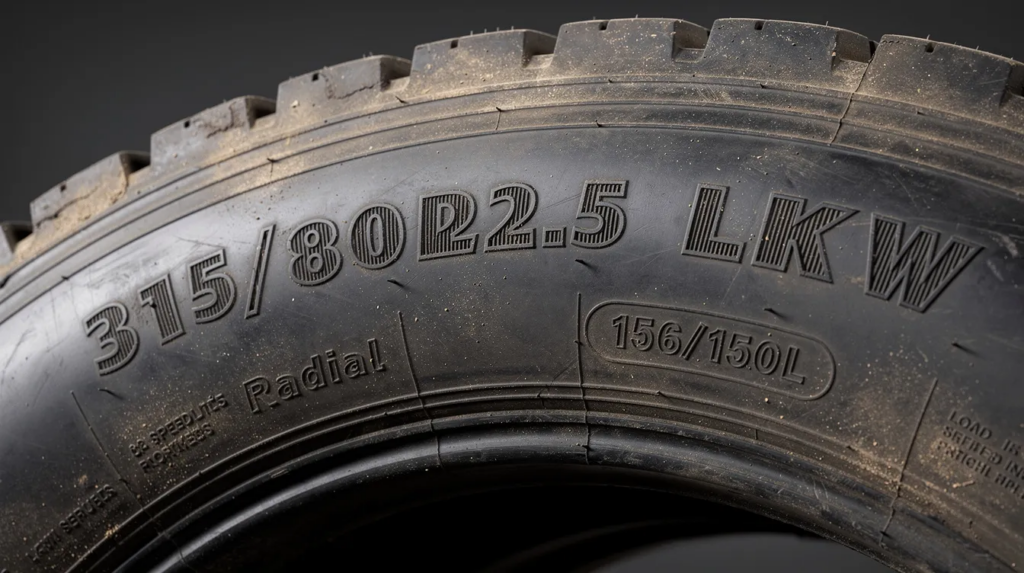
Truck tyres often carry dual load ratings, for example “154/150”. The first value applies to single fitment, the second to twin fitment. The principle remains the same – read more in our article on the load index of truck tyres. For commercial vehicle fleets, the correct load class is decisive to avoid downtime and tyre failures.
Speed rating W – up to 270 km/h, what does that mean in practice?
The speed rating W denotes a maximum permitted speed of up to 270 km/h. This means the tyre is designed thermally and structurally for these speeds. The rubber compound, the carcass construction and the production technology are tuned for high sustained loads at this speed.
On many cars, W-rated tyres are standard. On heavy trucks, lower classes are usually used instead, because the legally permitted top speed for commercial vehicles is generally between 80 and 100 km/h. In Germany, tyres with a lower speed rating than the one entered in the vehicle registration document must not be driven – this is regulated by § 36 StVZO. A higher rating is generally permitted, as long as load capacity and size are correct and there are no restrictions from the manufacturer.
The speed rating is not a permission to drive faster than legally allowed. It only defines the technical upper limit of the tyre.
Marking 95W compared with other speed classes
There are several speed classes that differ in the maximum permitted speed. Here is an overview of the most common ones:
Speed rating | Maximum speed |
|---|---|
T | up to 190 km/h |
H | up to 210 km/h |
V | up to 240 km/h |
W | up to 270 km/h |
Y | up to 300 km/h |
The rating W sits above H and V and is therefore approved for higher sustained speeds. Tyres with higher load and speed ratings have a stiffer sidewall construction. This can also bring advantages in handling and braking when the vehicle is fully loaded. | |
For trucks, much lower speed approvals are usually sufficient – the focus here is on extremely high load capacity and mileage, not on speed. When choosing a tyre, it is therefore not just the letter that counts, but the whole combination of load capacity, speed and tread pattern.
M+S marking, all-season tyres and 95W – how does it fit together?
All-season and all-weather tyres with the 95W marking and M+S marking are often offered for cars. They offer flexibility, because drivers do not have to switch between summer and winter tyres depending on the season. The principle applies similarly to commercial vehicles, although heavy trucks usually get specialised tread patterns.
The M+S marking alone does not automatically guarantee winter-grade quality. The Alpine symbol (3PMSF) is also decisive. Summer tyres do not carry this marking. Reviews and opinions on specialist portals show that wet-weather and winter performance differ considerably from product to product.
For winter tyres there is a special rule: the speed rating may be lower than the value required in the vehicle registration document if the driver is informed about the restricted top speed. For commercial use, it is advisable to follow the conditions of the manufacturer and the fleet policy closely. Good value for money often comes from choosing the right product rather than buying the cheapest one.
Tyre 95W and safety at high speed
The correct marking – load and speed together – is a basic requirement for safe driving. But the marking alone says nothing about the current condition of the tyre.
The following factors also affect safety:
- Tread depth – too little tread drastically reduces grip on wet roads
- Tyre age – even with sufficient tread, the rubber compound ages and loses quality
- Inflation pressure – too low a pressure causes strong heating, especially at high speeds
- Driving style and load – aggressive driving and overloading accelerate wear
On commercial vehicles, enormous loads act even at lower speeds. A truck with a gross weight of 40 tonnes on wet roads places different demands on the tyre than a car with the marking 95W at 250 km/h. That is why special truck tyres, designed for high load capacity and continuous operation, are required.

Special features of truck and commercial vehicle tyres (from 7.5 t)
Trucks and trailers above 7.5 tonnes use different tyre sizes than the marking 95W, but the same logic. Load indices are typically in the range of 140 to 160. Truck tyres must have a size of at least R17.5. On articulated lorries, the load capacity values are sometimes given twice – for single and twin fitment.
Truck tyres are mostly designed for a maximum speed of around 80 to 100 km/h. In return, they withstand extremely high axle loads and achieve mileages that would be unthinkable for car tyres. The role of the speed rating recedes into the background here; what matters are load capacity, wear resistance and suitability for the particular use – whether long-distance haulage, construction site or distribution traffic.
A wrongly sized tyre on a tractor unit or trailer can jeopardise the operating licence and lead to serious accidents. The insurer may refuse to pay in the event of a claim. Professional fleet care therefore always starts with choosing the correct tyre – not only after a blowout, where a specialised 24/7 truck tyre service in Germany plays an important role.
What to do when a tyre bursts on the road? (Practical advice for trucks from 7.5 t)
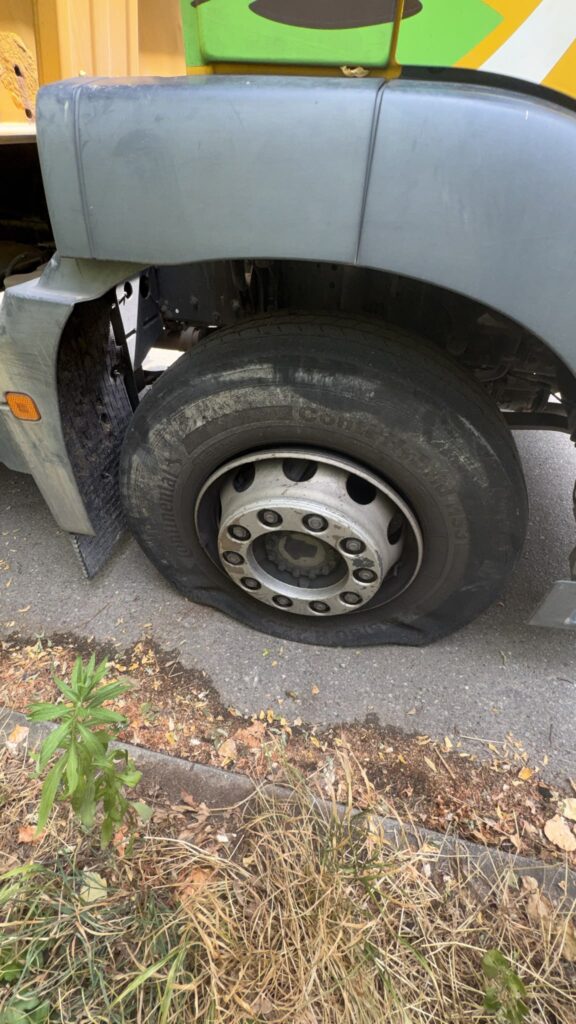
Tyre failures on trucks require fast help on the motorway, ideally from a specialised truck breakdown service in Germany with 24/7 availability. In the event of a blowout: switch on the hazard lights immediately, slow down gradually and stop in a controlled way on the hard shoulder.
Step by step:
- Put on a high-visibility vest before leaving the cab
- Set up the warning triangle – at least 150 metres behind the vehicle on the motorway
- Take passengers behind the crash barrier, away from the carriageway
- Contact a mobile breakdown service – no changing the tyre yourself on the motorway
A truck tyre change is carried out on site on the motorway by a professional mobile service such as a specialised truck tyre service in Germany 24/7. Trying to do it yourself is life-threatening on a vehicle over 7.5 tonnes – passing traffic and the weight of the vehicle make the risk too great.
When you call, have the following information ready:
- Location (motorway number, direction of travel, kilometre marker or name of the rest area)
- Vehicle type (tractor unit, rigid truck, trailer)
- Affected axle and position of the damaged tyre
- Tyre size and load capacity class (if legible)
How does Lkwhelp24 help with tyre failures on trucks and trailers?
Lkwhelp24 organises help throughout Germany as a mobile truck tyre service and breakdown service for commercial vehicles from 7.5 t – no cars, no vans under 7.5 tonnes – and additionally offers a comprehensive mobile truck service in Germany around the clock.
Services at a glance:
- Mobile tyre change directly on site – the service changes tyres on site on motorways and at rest areas
- Breakdown assistance and towing of trucks, trailers and commercial vehicles over 7.5 t, complemented by a specialised truck towing and emergency service in Germany
- Arrival usually within 30 to 60 minutes
- The mobile truck tyre service is available 24/7 throughout Germany
- Prices start at €290 during the day (net), evenings, nights and weekends from €429 net; tyre change prices start at €315 for truck tyres (tyre price extra)
- Around 90% of call-outs are completed directly at the breakdown location, without a visit to a workshop
Lkwhelp24 has around 2,500 partner workshops in Germany and, as an intermediary, coordinates the nearest suitable service, including a specialised truck towing service in Germany – 24/7. You can find more about the costs of towing on our site.

How an emergency call to Lkwhelp24 works in practice
The driver ideally gets in touch via WhatsApp or phone. WhatsApp is preferred because the driver can quickly send their location as a pin.
This information is needed:
- Location: motorway number, direction of travel, kilometre, name of the rest area
- Vehicle type: tractor unit, rigid truck or trailer
- Axle and position of the damaged tyre
- Tyre size and load capacity class (e.g. load index, speed rating)
What happens after the call:
- Lkwhelp24 takes down everything and looks for the nearest partner in the network
- Price and estimated arrival (30–60 minutes) are agreed
- The driver receives a confirmation
- A suitable tyre is delivered via the partner; the tyre change usually takes 30 to 60 minutes
Payment is made in cash or by card, with no hidden costs. Prices are exclusive of VAT. We speak German, English, Polish and Russian and therefore also offer an international truck towing service in Germany 24/7. The email address for enquiries outside acute emergencies: info@lkwhelp24.com.
Choosing a tyre in an emergency (brand, 95W, availability)
In an emergency on the motorway, safety and getting back on the road quickly matter more than a particular brand. In a call-out, Lkwhelp24 selects primarily by size, load index and speed approval – not by brand preference.
Whether a driver previously ran tyres from Michelin or another manufacturer makes no difference in an acute emergency – the goal is to make the vehicle roadworthy safely and quickly. A specific brand choice is only possible on request and usually at an extra charge, depending on the partner’s range and stock.
Even if tyres with the marking 95W were previously fitted to the vehicle, an equivalent or higher load index and speed rating can be used in an emergency, as long as it is approved. Drivers and dispatchers should always check the vehicle registration document when looking for a replacement tyre. Star ratings and offers for individual products are secondary in an emergency – safety comes first.
When should you have a tyre replaced as a precaution?
Replacing a tyre in good time avoids blowouts and unplanned downtime. This applies to every vehicle, from the car to the heavy truck.
Typical reasons for replacement:
- Visible damage: cuts, bulges or cracks in the sidewall
- Uneven wear – can point to axle problems
- Greatly reduced tread depth (legal minimum: 1.6 mm)
- High tyre age – quality declines even when there is enough tread
Regular visual checks before setting off are especially important on drive and trailer axles. If in doubt, contact a truck workshop or a mobile tyre service before problems arise on the motorway. Preventive service is always cheaper than unplanned downtime with pressure from customers and delivery deadlines.
FAQ – Frequently asked questions about the meaning of 95W and truck tyre failures
Does the explanation of 95W also apply to truck tyres?
The logic is the same for cars and trucks: the number stands for the load capacity, the letter for the maximum permitted speed. However, heavy commercial vehicles above 7.5 tonnes use different sizes. Instead of load index 95, values between 140 and 160 are usual. The system stays the same in every case – only the specific numbers and letters differ.
May I drive a tyre with a higher speed rating than prescribed?
Yes, a higher speed rating – for example W instead of V – is generally permitted, as long as load capacity and size suit the vehicle and there are no manufacturer restrictions. A higher rating usually means a sturdier construction, which can bring advantages under heavy loads. It does not, however, give you permission to drive faster than legally allowed. The information in the vehicle registration document is always decisive.
Who do I call if a tyre bursts on my truck in Germany?
International drivers can also use the multilingual towing and breakdown service for heavy vehicles in Germany.
Lkwhelp24 can be reached on the emergency number +49 160 5753826 – by phone or via WhatsApp. The truck towing service only serves vehicles from 7.5 tonnes and is available around the clock, 24/7 throughout Germany. We organise mobile tyre service, towing and breakdown assistance – the response time is normally 30 to 60 minutes.
How quickly is Lkwhelp24 on site after a truck tyre failure?
You can also find current information, practical examples and notes on response speed in our news and guides from LKW Help 24.
As a rule, a partner is on site within 30 to 60 minutes, depending on traffic and location. Thanks to around 2,500 partner companies, there is nationwide coverage, and international drivers can also rely on English-language truck roadside assistance in Germany 24/7. We only help trucks and commercial vehicles from 7.5 tonnes.
Can I choose the tyre brand in an emergency?
In an acute emergency, availability and suitable load capacity matter more than a particular brand. Lkwhelp24 makes sure that size, load index and speed approval suit the vehicle. A preferred brand is only possible by arrangement and usually at an extra charge. The goal is always to get the vehicle safely and quickly roadworthy again.
Is your truck stuck on the motorway? Send your location via WhatsApp to +49 160 5753826 or call directly. Lkwhelp24 organises fast, professional help for trucks and commercial vehicles from 7.5 t – 24/7 throughout Germany.