Skip to content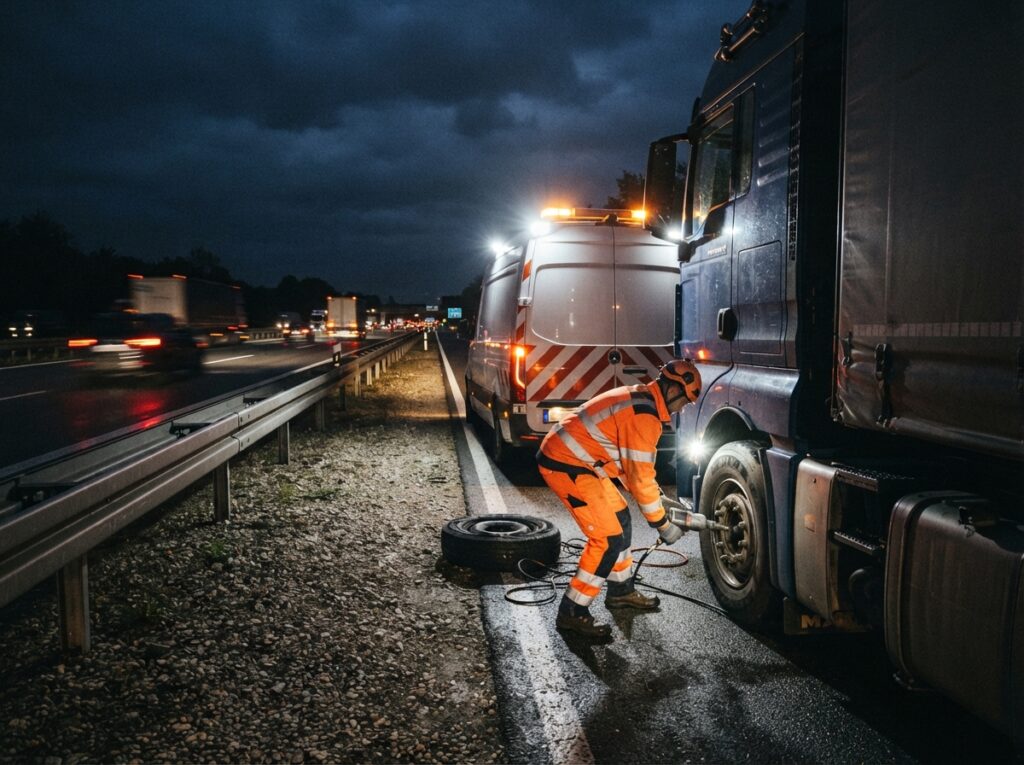
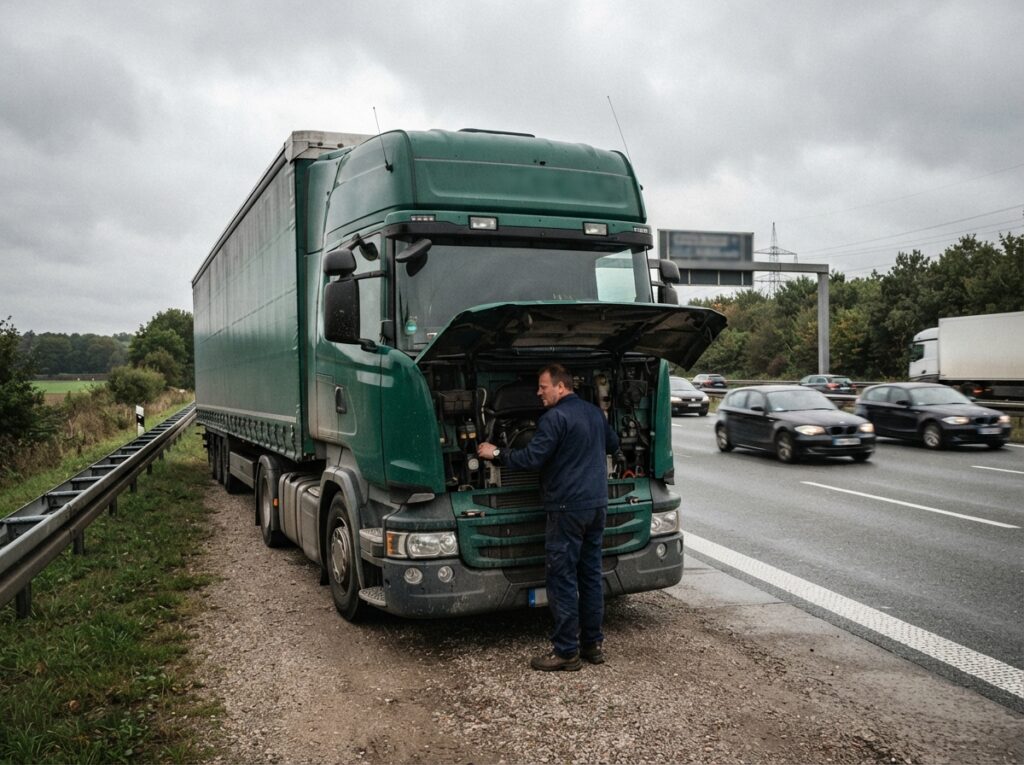
A Polish TIR driver crossing Germany will sooner or later hear a strange knock under the cab or see a pressure warning light on the dashboard. That is the moment when you start thinking about something rarely discussed at truck stops: truck tire service, meaning mobile tire assistance for heavy commercial vehicles. This is not the same as the shop you take a car to for a set of winter tires. Tire service for trucks works differently, is priced differently, and gets called out under different circumstances.
This article explains step by step what mobile truck tire service is, when it is genuinely needed, how a call out actually unfolds on a German highway, and what it costs. It is written for drivers from Poland working in Germany who often run into a language barrier at exactly the worst possible moment, standing on the emergency lane.
What separates truck tire service from a regular tire shop
A regular tire shop handles passenger cars and vans up to 3.5 tons. It has tire irons sized for light rims, a balancer for small wheels, and usually operates from a fixed location that the vehicle has to be brought to or drive to on its own wheels.
Truck tire service is a completely different category of equipment and expertise. The target group is vehicles from 7.5 tons and up: tractor units, trailers, buses, special vehicles, and wheeled construction machinery. Truck tires start at size R17.5 and go up through R19.5, R20, all the way to R22.5 and larger sizes used on trailers and drive axles. A wheel of that size with the rim can weigh more than 80 kilograms, and the torque needed to tighten the lug nuts is many times higher than on a passenger car. On top of that, the tire construction itself is different: steel belts, reinforced sidewalls, a radial design built for long distances and heavy axle loads.
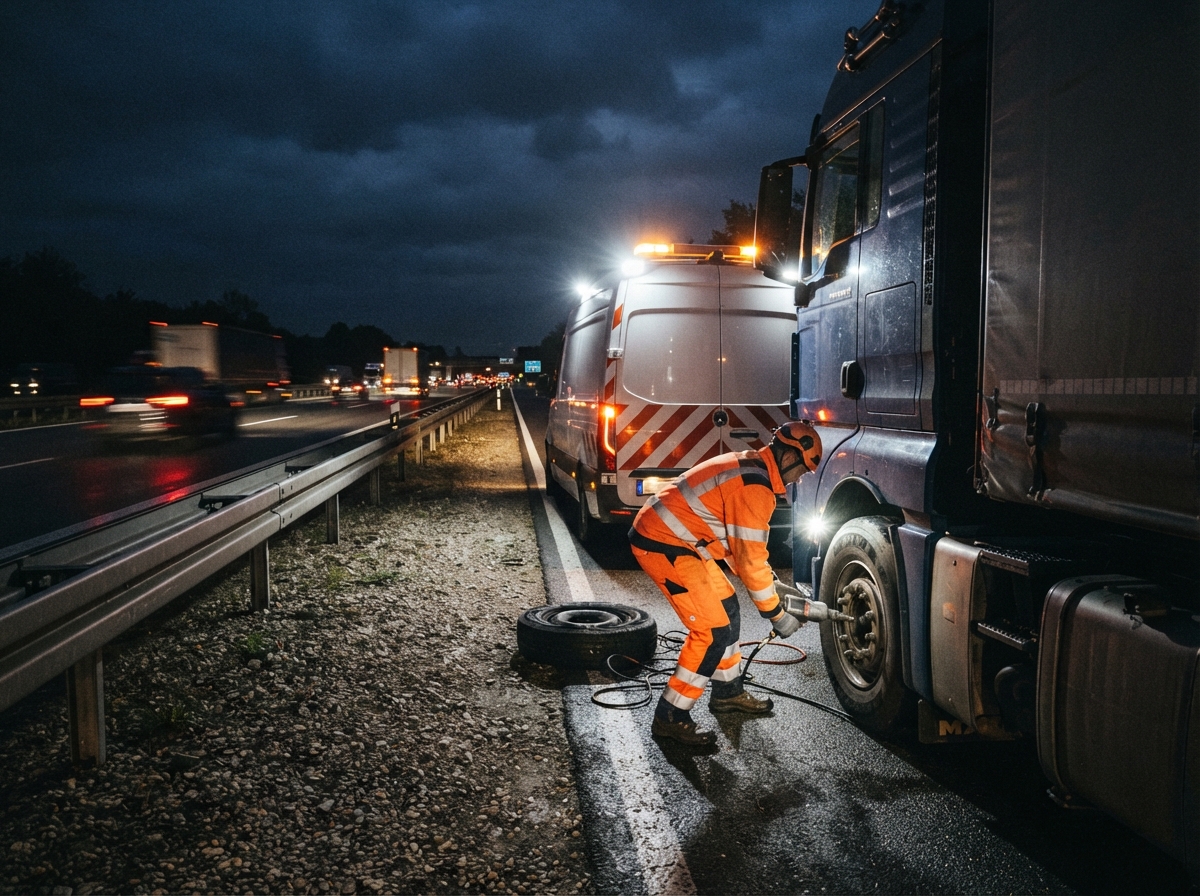
Mobile truck tire service works differently from a fixed workshop. The technician arrives in a specially equipped service vehicle: a hydraulic jack rated for truck weights, an impact wrench with the right torque setting, a compressor, a set of tools for different rim types (steel and aluminum), and a stock of tires in the most common sizes. He comes to the driver, not the other way around, because a truck with a damaged tire often cannot safely reach a workshop at all.
When you actually need mobile tire service
Not every tire problem calls for an immediate roadside emergency. It helps to separate a few typical situations.
The first is a puncture: a nail, a piece of metal, or a sharp stone that has gone through the tread. If the tire is losing air slowly, the driver usually has a few minutes, sometimes more, to safely pull into a parking area, a fuel station, or a truck stop. This is the safest scenario because it avoids stopping on the emergency lane.
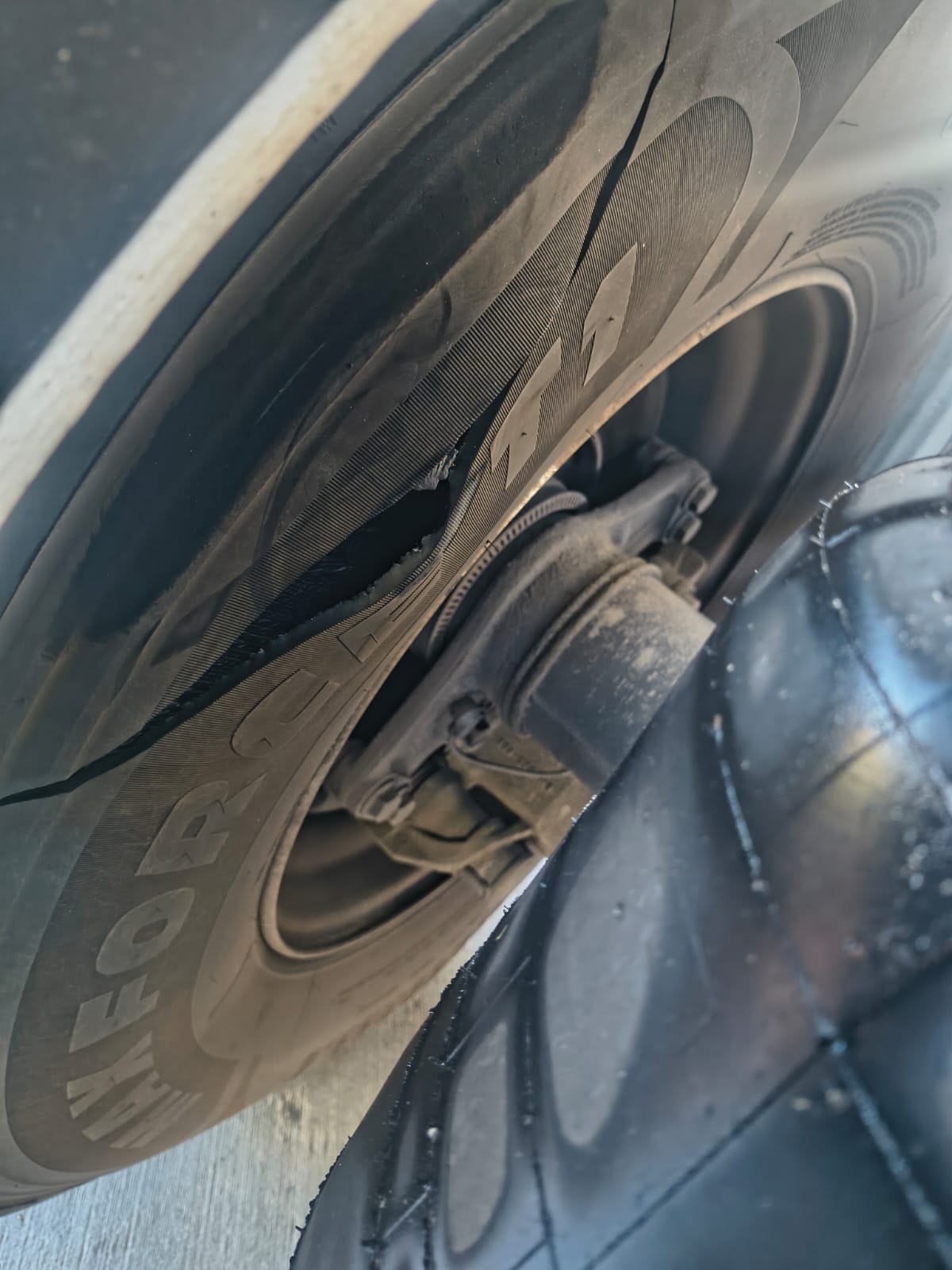
The second situation is a sudden blowout, an abrupt and violent rupture that often happens at high speed. This usually results from overheating, sidewall damage, or driving for a long stretch on underinflated tires. In this case the driver usually has no choice and must stop wherever he happens to be, often on the highway shoulder. This is the situation where response time and experience working next to moving traffic matter most.
The third situation is a slow leak, invisible to the eye, picked up by the tire pressure monitoring system (TPMS) in newer tractor units. Here the driver has the most time to decide, but delaying is risky because driving on an underinflated tire overheats it and leads exactly to a blowout.
The fourth situation, mentioned less often, is simple tread wear below the safety limit, caught during a roadside check or noticed by the driver himself. German road traffic law, paragraph 36 of the StVZO, requires a minimum tread depth of 1.6 millimeters for truck tires, the same as for cars. A police check or the BAG (Federal Office for Goods Transport) can pull a vehicle with tires below that limit off the road, and a fine along with a driving ban are then certain. In this case it is better to replace the tire early, at a parking area, than to wait for a roadside inspection on the highway.
The fifth situation is rim damage, for example after hitting a curb or a deep pothole. The tire itself may be fine, but a rim bent enough that it no longer holds pressure evenly also needs a professional assessment on site.
How calling a mobile tire service in Germany actually works, step by step
For a driver from Poland who does not speak fluent German, the moment of calling for help is often more stressful than the blowout itself. It is worth knowing the exact sequence of the procedure.
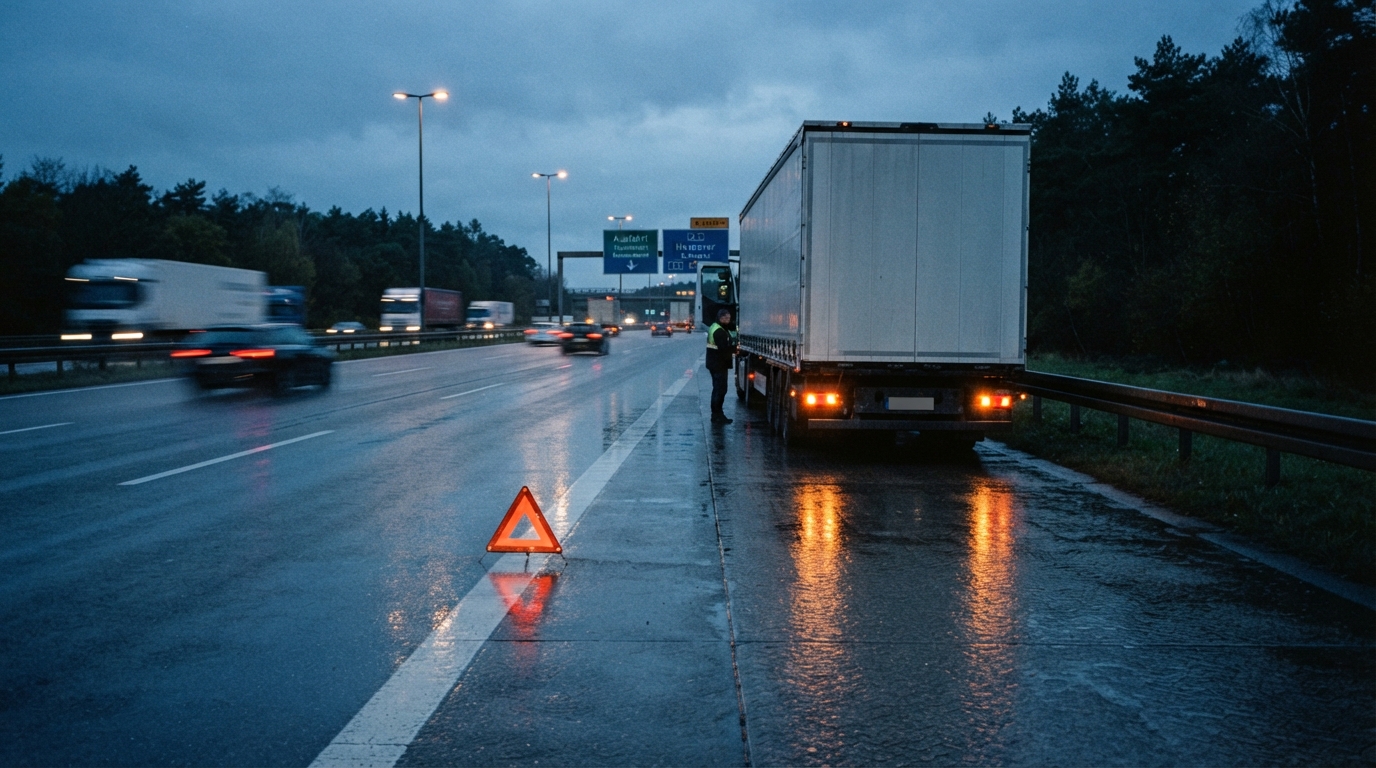
The first step is securing the scene according to German road traffic regulations, the StVO. Reflective vest, warning triangle placed at the correct distance (on the highway usually 100 meters behind the vehicle), hazard lights on. Only after that comes phone or messenger contact with the service provider.
The second step is reporting the incident. LKWHelp24 offers contact via WhatsApp at +49 160 5753826, available around the clock, seven days a week, in four languages: German, English, Polish, and Russian. That is a meaningful difference compared to many German service providers, where the dispatcher speaks only German and a phone call during a stressful moment, on a loud emergency lane, becomes an extra source of errors. Sending a GPS location via WhatsApp, a photo of the damaged tire, and the license plate lets the dispatcher already figure out what equipment and which tire will be needed.
The third step is the technician’s arrival. In practice the response time usually falls between 30 and 60 minutes, depending on location, time of day, and traffic volume on that stretch of highway. This is exactly the moment when a driver’s stress climbs the most, especially standing on the emergency lane with heavy truck traffic passing close by.
The fourth step is the on-site assessment. The technician checks whether the tire can be repaired or needs replacing, whether only one tire is affected or its twin as well (on the rear axle, truck tires are mounted in pairs, so-called dual wheels, and damage to one often means the other needs checking too).
The fifth step is the actual repair or replacement on site, if conditions allow, meaning there is enough space to work safely next to the road. If the spot is too dangerous (narrow shoulder, sharp bend, poor visibility), the second option comes into play: towing.
On-site service or towing to a workshop: what the difference actually looks like
This is one of the questions drivers ask most often, because the decision affects both downtime and cost.
An on-site tire change makes sense when: the technician has the right tire size in stock on the service vehicle, the location allows safe work (a wide enough shoulder or a parking area), and the damage is limited to a single wheel. In that case the truck is usually back on the road within one to two hours of the call, counting the technician’s travel time and the repair itself.
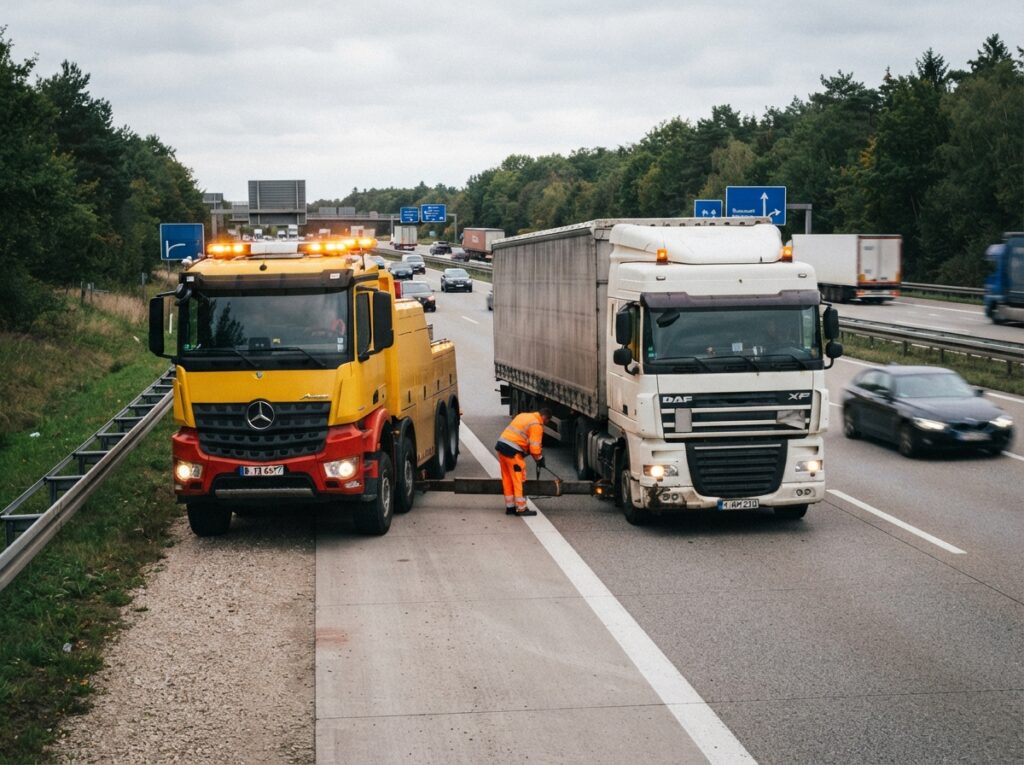
Towing becomes necessary when: two or more tires are damaged at once (which happens when a sharp object scattered across several lanes is run over), the required tire size is uncommon and no service provider has it in stock within dozens of kilometers, an axle or the suspension is damaged rather than just the wheel, or the location is too dangerous to work in traffic (a narrow bridge, a tunnel, a blind curve). It is worth noting that towing a tractor unit with a trailer is a completely different logistical operation from tire service and requires specialized equipment for vehicles of that size. More on towing itself and its cost can be found in a separate article about truck towing costs.
How much does mobile truck tire service cost in Germany
Prices in this industry depend on time of day, day of the week, and scope of work, but rough ranges look like this. A call out on a weekday during standard hours starts at around 290 euros net for the callout and labor, not including the price of the tire itself. A call out in the evening, at night, or on a weekend, when fewer technicians are available and work happens under worse visibility conditions, starts at around 429 euros net. On top of that comes the price of the tire itself, which depends on size, brand, and whether it is new or retreaded.
It is worth understanding why the night rate is higher: the technician works in poor visibility, on the shoulder of the highway, with truck traffic passing a meter from the work area, which is objectively more dangerous and requires extra securing of the work zone. This is not an arbitrary surcharge but a reflection of the real risk and real cost of working at night.
Prices are quoted net because the vast majority of customers are transport companies that reclaim VAT, not private individuals. Before calling out the service, it is worth asking the dispatcher for a rough estimate of the total cost to avoid misunderstandings on the invoice.
The language barrier: why it genuinely matters
A driver standing on the shoulder of a German highway, in the rain, with the noise of passing trucks, has to explain within a few minutes exactly what happened, where he is, and what help he needs. If he does this in a language he does not know well, the risk of misunderstanding rises dramatically. A wrongly stated location, a misunderstood tire size, or a mixed up highway number can add another hour to the wait, and in some cases send the technician to the wrong place entirely.
That is why contact in one’s native language, here specifically Polish, has a direct effect on safety and response speed. The driver can describe the situation precisely, ask a question if something is unclear, and confirm the dispatcher understood the location correctly. LKWHelp24 handles requests in Polish for exactly this reason: a significant share of the fleets working in Germany are drivers from Poland, Ukraine, and other Eastern European countries, for whom German is a second language or not spoken at all.
A real case: a blown tire near Cologne
It is worth showing this with a concrete example rather than pure theory. A driver from Krakow, hauling a refrigerated trailer toward Belgium, heard a loud bang around 10 p.m. and felt the vehicle pull to one side. A tire on the drive axle had blown near a highway interchange close to Cologne. The driver managed to pull safely onto the shoulder, set up the warning triangle, and switched on the hazard lights, following procedure.
Instead of calling and trying to explain the situation in German, which he only knew at a basic level, he sent a WhatsApp message with his GPS location and a photo of the damaged tire. The dispatcher replied in Polish within a few minutes, confirmed the tire size from the photo of the rim, and sent a technician with the right spare wheel loaded on the service vehicle. The technician reached the scene in under 45 minutes, despite the late hour. Changing the wheel on the drive axle, including checking the second dual tire, took another 40 minutes. The driver was back on the road less than two hours after the blowout, avoiding an overnight stop at a rest area and a full day’s delivery delay.
This case shows two things at once: how much a fast, clearly understood report in one’s own language matters, and how having the right tire size on the service vehicle determines whether the repair takes an hour or drags on for the whole day.
How to prepare for a tire failure before it happens
Good practice is to save a tire service contact number on your phone before a breakdown occurs, ideally one that handles calls in Polish. It also helps to know the tire size fitted on your own tractor unit and trailer in advance (it is printed on the tire sidewall, for example 315/70 R22.5), because giving that information right at the start of the call shortens the waiting time.
Checking tire pressure regularly, ideally once a week and always before a longer trip, lowers the risk of overheating and a blowout. More information on correctly checking truck tire pressure and the right values can be found in a separate article on truck tire pressure. It is also worth paying attention to uneven tread wear, since it often signals a suspension geometry problem rather than the tire itself, allowing a planned replacement instead of reacting to a breakdown on the road.
Documentation and settling up with the transport company
A driver employed by a transport company rarely pays for tire service out of his own pocket, but should know what to collect on site. First, it is worth photographing the damaged tire before it is replaced, ideally with the license plate visible in the frame. Second, keep the invoice from the service provider, which usually itemizes the callout, labor, and tire price separately, which makes settling up with the employer or an insurer easier if the damage came from hitting an object on the road. Third, after a blowout on the highway it helps to note the exact kilometer marker and the highway number from the information signs, since that detail helps both the service provider on the way there and any subsequent damage claim.
Some transport companies have framework agreements with specific tire service providers. Before setting off it is worth checking with dispatch or the fleet department whether a preferred contact exists for breakdowns. If not, it is worth keeping your own number saved, ideally one that handles calls in Polish, so as not to waste time explaining the situation in a foreign language under stress.
Seasonality and extra risk in winter and summer
The risk of a truck tire failure is not spread evenly across the year. In winter, at low temperatures, a tire loses pressure faster because air contracts in the cold, and even a drop of a few tenths of a bar can significantly raise the overheating risk on a longer trip once the tire warms up while driving. On top of that, winter road damage, road salt, and sharp edges left after roadworks increase the risk of a tread puncture or sidewall damage. Drivers crossing Germany in the winter season should check tire pressure more often, ideally at every longer stop at a fuel station.
In summer, the main danger is tire overheating on long stretches in high ambient temperature, especially with a fully loaded trailer. A tire working at the edge of its rated load, on road surface temperatures reaching up to fifty degrees Celsius on a sunny day, is far more prone to a blowout than in winter. That is why mobile truck tire services in Germany see two clear peaks over the year: one in winter, mostly tied to slow leaks and punctures, and one in summer, mostly tied to sudden blowouts at high temperatures.
Summary
Truck tire service is a specialized mobile assistance service for commercial vehicles from 7.5 tons up, requiring different equipment, different expertise, and different work organization than a regular car tire shop. The most common reasons for a call out are a puncture, a sudden blowout, a slow leak caught by TPMS, and tread wear below the permitted limit of 1.6 millimeters under German StVZO. Depending on the situation, the repair happens on site or the vehicle needs to be towed to a workshop. Prices in Germany start at around 290 euros net during the day and 429 euros net in the evening, at night, or on weekends, plus the tire price. For drivers from Poland, being able to report the emergency in Polish is crucial, because the language barrier during a stressful moment on the highway has a real effect on response time and safety.
LKWHelp24 serves vehicles from 7.5 tons across Germany, around the clock, seven days a week, in German, English, Polish, and Russian. Contact via WhatsApp at +49 160 5753826 lets you send the location and a photo of the damage right away, which shortens the technician’s response time. More information on the scope of tire service can be found on the tire service page and the mobile service page, step by step guidance on a roadside wheel change is in the emergency wheel change guide, and details on the tire wholesale side of the business on the truck tire wholesaler and mobile tire service page.
Frequently asked questions
What is the minimum legal tread depth for a truck tire in Germany?
Under paragraph 36 of the StVZO, the minimum tread depth is 1.6 millimeters, the same as for passenger cars. Below that value the vehicle may not legally use public roads, and a roadside check can result in a fine and an order to stop driving.
Does mobile tire service cover all truck tire sizes?
Yes, mobile tire services for trucks cover standard sizes from R17.5 up, including the common 295/80 R22.5 and 315/70 R22.5. For rarer sizes, the dispatcher checks availability before sending a technician, so it is worth stating the tire size right when reporting the issue.
How long does it take for a technician to reach the breakdown site?
In practice, response time usually falls between 30 and 60 minutes, depending on location, time of day, and traffic. The repair or wheel change itself typically takes another 60 to 90 minutes.
Does truck tire service operate at night and on weekends?
Yes, tire failures do not follow workshop opening hours, so the service is available around the clock, seven days a week. Evening, night, and weekend call outs are priced higher than daytime ones due to more difficult working conditions and fewer available technicians.
What should I do if I do not speak German and a tire failure happens?
It is worth contacting a service that handles calls in Polish right away, for example via WhatsApp, where you can describe the situation in Polish and send a photo and GPS location. This significantly lowers the risk of misunderstanding and shortens the wait compared to trying to explain the situation in a foreign language under time pressure.
Is it cheaper to drive to a workshop myself instead of calling a mobile service?
It depends on the tire’s condition. If the tire is only slightly punctured and holds pressure, driving slowly to the nearest workshop can be cheaper. But with a blown tire, a damaged rim, or no way to drive safely, trying to reach the workshop on your own wheels risks damaging the rim, the suspension, or even causing an accident, which ends up far more expensive than calling a mobile service to the scene.
What to look for when choosing a service provider
Before saving a tire service number on your phone, it is worth checking a few things. Does the service actually handle vehicles above 7.5 tons rather than just delivery vans. Does it operate around the clock rather than only during the day. Does the dispatcher respond within a reasonable time and in a language the driver understands. And does the quoted price clearly separate the callout, labor, and tire cost from the start. These four points help avoid unpleasant surprises at a moment when the driver is already dealing with a stressful roadside situation. The brand of tire the technician carries also matters: manufacturers such as Continental offer truck tires with different tread compound hardness, matched to distance and route type, so it is worth asking the dispatcher which model will be fitted, especially if the fleet has set brand preferences.