Skip to content
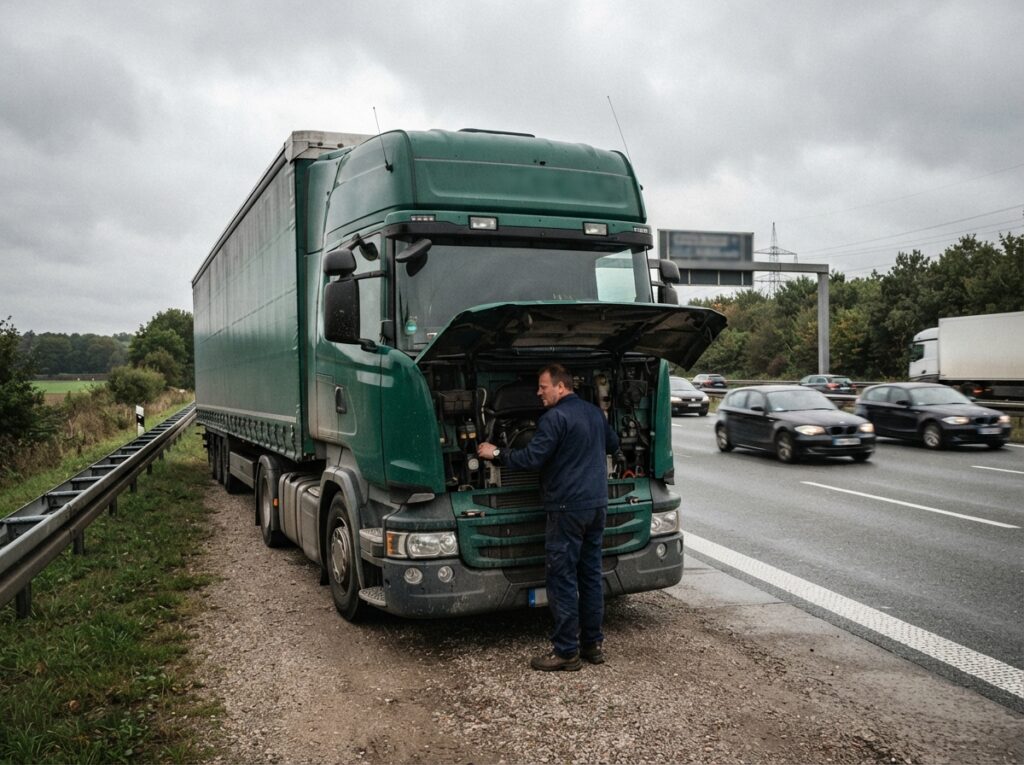
A dispatcher calls and asks whether he still owes toll for the stretch of autobahn where his truck broke down. It is a fair question, because few topics confuse drivers and fleet managers as much as the German LKW-Maut, the truck toll system. Who has to pay, how much, on which roads, and what happens when the vehicle is stranded with a technical fault or needs to be towed. This article works through each of these points, based on information from the Federal Office for Logistics and Mobility (BALM, formerly the Federal Office for Goods Transport), the toll operator Toll Collect, and the Federal Highway Toll Act (Bundesfernstraßenmautgesetz, BFStrMG).
Who actually has to pay the toll
The legal basis is Section 1 of the BFStrMG. Under this rule, the toll applies to motor vehicles and vehicle combinations intended for or used in commercial goods transport whose technically permissible gross mass exceeds 3.5 tonnes. This covers both single trucks and tractor units with a trailer or semi-trailer, and for combinations the gross mass is calculated as the sum of the individual vehicle masses.
The law also provides exemptions. Buses are generally exempt from the toll, as are vehicles of the fire brigade, police, disaster relief and similar emergency services, along with certain agricultural and forestry vehicles. A special rule applies to zero-emission commercial vehicles: for these, the toll obligation only kicks in at a higher gross mass, specifically 4.25 tonnes instead of 3.5 tonnes, to compensate for the extra weight of the battery. Smaller commercial vehicles between 2.5 and 3.5 tonnes are subject to a separate toll in certain cases, such as cross-border transport or cabotage operations.
For LKWHelp24 the practical consequence is simple: we serve exclusively commercial vehicles from 7.5 tonnes upward, meaning vehicles that clearly fall within the toll obligation regardless of the finer thresholds. Details about the vehicle classes we typically encounter are collected in a separate article: Trucks in Germany: models, drivetrains and breakdown assistance from 7.5 tonnes.
Which roads the toll actually applies to
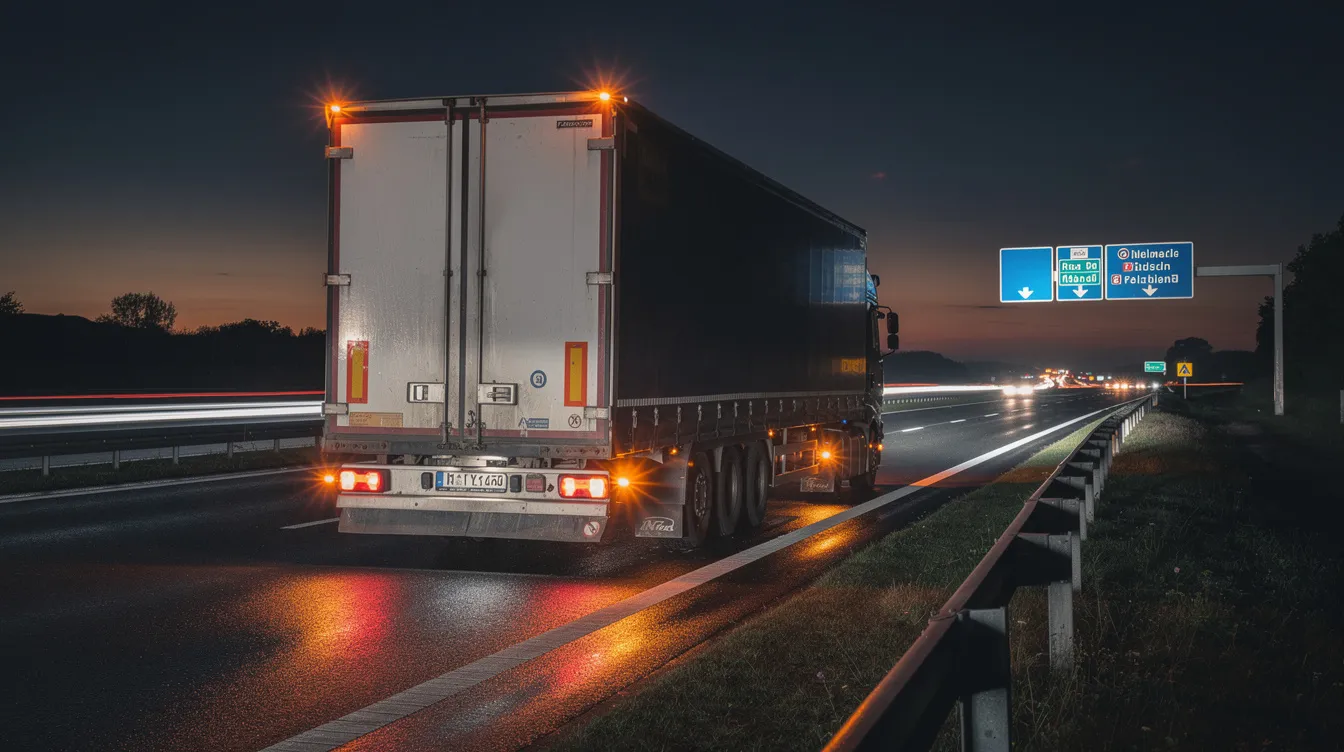
According to Section 1 of the BFStrMG, the toll applies to federal motorways (Bundesautobahnen) and certain federal highways (Bundesstraßen). Not every regional or municipal road is covered, so the toll does not blanket the entire German road network, it targets specifically the long-distance routes where the bulk of heavy freight traffic takes place. If a truck heads to a construction site, a depot, or a yard away from these routes, no toll obligation typically arises there, simply because those access roads are not part of the tolled network at all.
This point matters later when we get to breakdowns and towing, because not every kilometre a truck covers is automatically a tolled kilometre.
How the toll amount is calculated
Under Section 3 of the BFStrMG, the toll rate is made up of several partial rates: one for infrastructure costs, one for air pollution costs, one for noise costs, and one for CO2 costs. These four components are added together to form the per-kilometre toll rate, which is then multiplied by the distance actually driven on tolled roads and rounded to the nearest cent for each toll section. The concrete tariffs and their tiers by weight class, axle count and emission class are set out in Annex 1 to the act.
Toll Collect confirms on its website that the tariff structure is tied, among other things, to CO2 emission classes as well as weight and axle classes. In practice this means a modern truck with lower CO2 emissions per tonne-kilometre tends to pay less than an older vehicle with a comparable axle count. For fleet operators this is a solid argument for factoring toll costs over the vehicle’s service life into the purchasing decision, not just the sticker price.
Anyone curious about the technical side of the vehicles these tariff classes concern can find background in our article on drivetrains and models in the German truck fleet from 7.5 tonnes.
How the toll is technically recorded: OBU and manual booking
Toll Collect describes the system in the simplest possible terms: you drive, and the on-board unit (OBU) handles the toll booking automatically. The device is permanently installed in the vehicle, linked to GPS and mobile networks, and independently recognizes when the vehicle is on a tolled route. The resulting fees are then automatically charged to the linked payment account.
A technical shift is already on the horizon according to Toll Collect: some older OBUs still communicate over the 2G mobile network, which network operators in Germany will be shutting down in the foreseeable future. Fleet operators should keep an eye on whether their devices are technically up to date, so that toll recording does not suddenly fail.
For vehicles without a built-in unit, or for carriers who only occasionally use tolled routes, there are alternative ways to book manually: in advance via the internet, through a mobile app, or at terminals located at certain border crossings and rest stops. It is important that the route is entered correctly and completely, because manual booking only covers the distance actually specified. Anyone who takes a later exit than booked, or drives a detour, risks a gap in toll coverage.
Since 1 January 2026, the technical recording and tariffing for all toll service providers in Germany has run through the unified Toll Collection Service (Mauterhebungsdienst, MED), operated by Toll Collect on behalf of the BALM. For drivers and carriers, the basic payment obligation does not change, but the technical processing behind the scenes does.
What happens if the toll is not paid, or paid incorrectly
Here the rules get surprisingly concrete: Section 10 of the BFStrMG lists several regulatory offences that can be fined. These include failing to pay the toll, or paying it incompletely or late, ignoring enforceable orders from the control authority, not carrying or promptly presenting receipts and proof, and giving false, incomplete or delayed information during questioning. Employers can also be held liable if they instruct or allow their drivers to be on the road without the required documentation.
For the more serious violations, non-payment of the toll and disregarding official orders, the law provides for fines of up to 20,000 euros. For the other violations, such as missing documentation or incorrect statements, the range goes up to 10,000 euros. The actual amount in an individual case depends on the authority’s specific fine catalogue and the severity of the violation, but the statutory ceilings alone show this is not treated as a minor offence.
Enforcement is carried out by the BALM through its traffic control service, which is present on and alongside the motorways with its own staff. The authority itself uses the motto that trust is good, but control is better, underlining how seriously the monitoring is taken.
Toll and breakdowns: the questions that actually matter

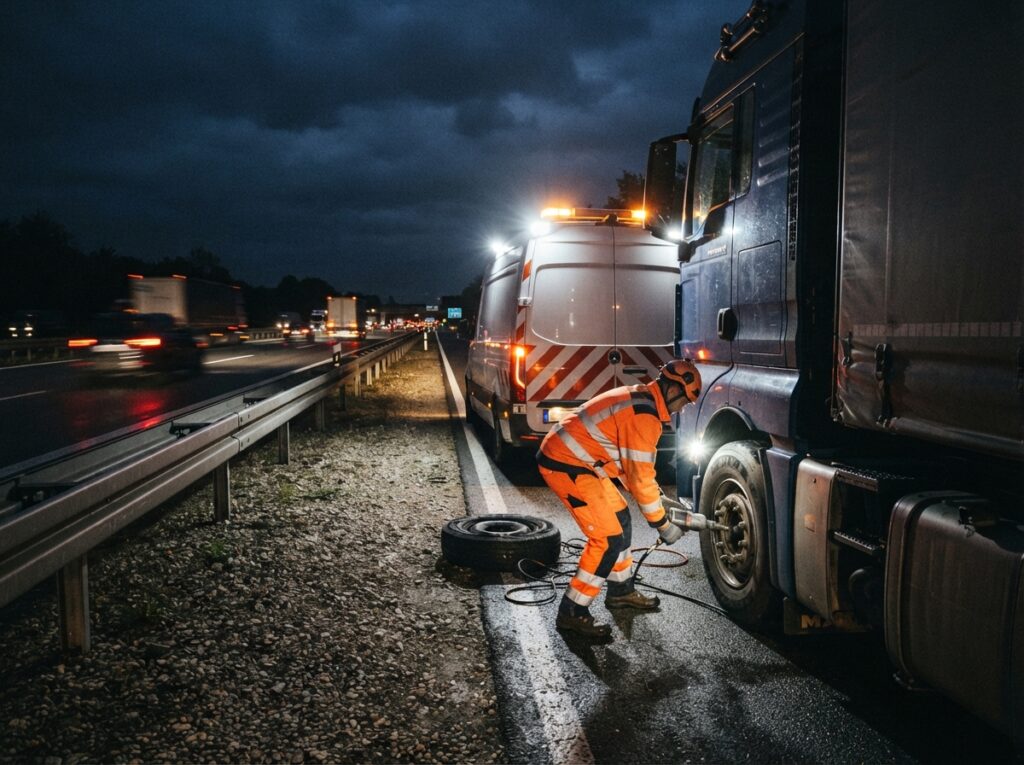
Now to the heart of the matter, the one we deal with daily at LKWHelp24. A truck has a tire blowout, an engine failure or some other technical problem and ends up on the hard shoulder or needs to be recovered from the motorway. What does that mean for the toll?
First: the toll is calculated per kilometre actually driven on a tolled route, not per unit of time. A truck stuck on the hard shoulder for hours due to a breakdown does not generate any additional toll during that time, because it is not covering any additional kilometres. The on-board unit books based on distance travelled, not on standing time. If a vehicle is stationary, there is no need to switch off or pause the OBU to avoid incurring toll, because without movement no additional tolled kilometre arises in the first place.
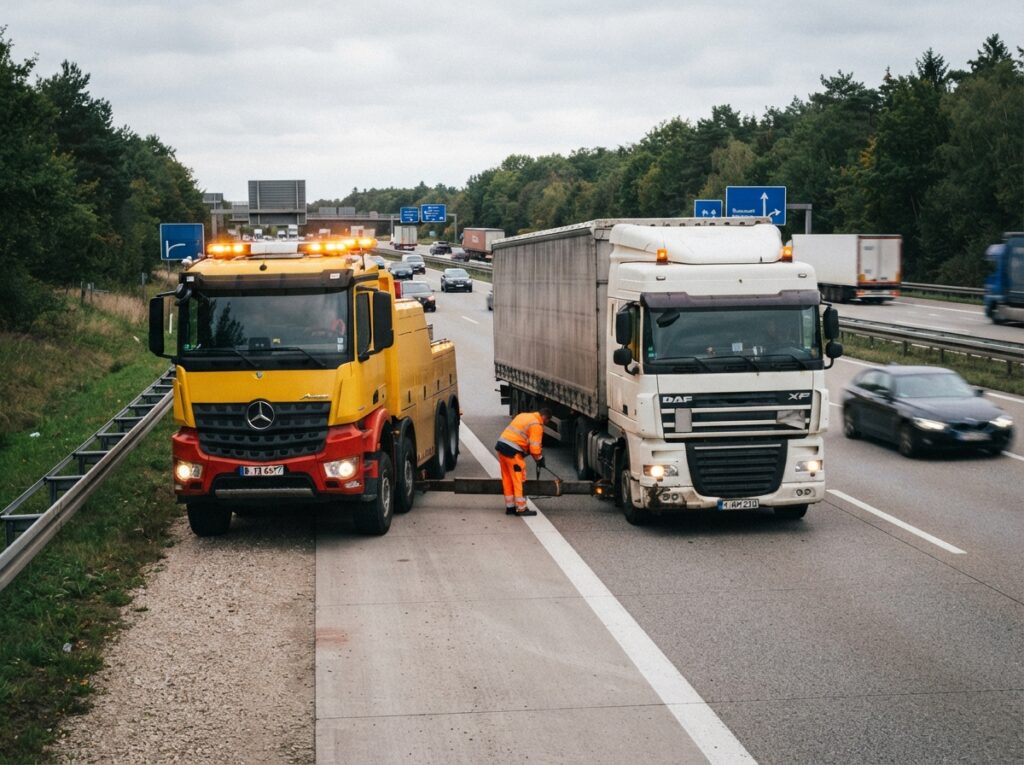
Second: if the vehicle is towed, what matters is which vehicle is actually travelling the route, and on which road category. If the disabled truck is loaded onto a low-loader and transported on ordinary roads or away from the tolled network, this transport generally does not generate any LKW-Maut under the BFStrMG, because no toll-liable vehicle within the meaning of the act is independently travelling on a tolled route. It is different if the recovery vehicle itself is a toll-liable commercial vehicle over 3.5 tonnes and the recovery takes place over a motorway stretch, because then that vehicle is liable for its own distance travelled, regardless of the fact that it is towing a disabled truck.
Third: if the recovery happens entirely away from tolled federal motorways and federal highways, for example when the truck is recovered on a company yard, a regional road, or directly at the breakdown site without using the motorway, no toll arises at all, because the basic requirement of Section 1 of the BFStrMG, a tolled road, is simply not met.
Anyone interested in the general recovery process, independent of the toll question, can find the practical details in our article What to consider when towing a truck.
When the OBU itself breaks down
A special case that occurs more often in practice than one might think: it is not the truck that has a breakdown, but the on-board unit itself stops working, shows an error, or loses connection. In this case the basic obligation to pay for the distance travelled still applies, the law does not recognize an exception for “the technology was broken.” The driver is required to rebook the route manually as soon as possible, via the app, the internet portal, or a terminal, so that no gap arises in the toll record that could later be treated as a regulatory offence.
In practical terms this means for drivers: if the OBU malfunctions, do not simply keep driving and hope the problem resolves itself. Document the fault (ideally with time, location, and the error message), inform the carrier, and use the next opportunity for manual rebooking. Anyone who is regularly on the road would do well to keep Toll Collect’s and their own carrier’s contact details on hand for exactly this kind of situation.
Practical checklist for drivers
A few points that follow from all of this for everyday life behind the wheel.
Anyone who has a breakdown and is stopped on the hard shoulder does not need to worry about the toll at that moment, the system books based on kilometres driven, not standing time. What matters more in that moment is personal safety: turn on the hazard lights, put on the high-visibility vest, set up the warning triangle, and get behind the crash barrier before thinking about technicalities or paperwork at all.
Anyone calling a towing service should not worry about toll-related questions personally, that is typically handled by the service provider or the carrier in the background, if a toll-relevant event arises at all.
Anyone who notices an OBU malfunction should arrange a manual rebooking right away and document the fault instead of waiting.
Anyone driving a new route or taking a construction detour should be particularly careful with manual bookings, because that is where gaps are most likely to occur, gaps that can later show up as a fineable offence.
Anyone managing a fleet should not delay upgrading to newer OBU generations, given the upcoming shutdown of older mobile network standards.
For more on typical roadside emergencies, such as tire blowouts, we have compiled a detailed guide: Emergency wheel change on a truck: instructions and help.
A look at BALM’s enforcement practice
Responsibility for toll control now lies with the BALM, the Federal Office for Logistics and Mobility, following the renaming of the former Federal Office for Goods Transport. The authority describes its task plainly: the traffic control service, with its own staff, patrols on and alongside the federal motorways and checks on a spot basis whether vehicles are correctly booked in. Alongside stationary checkpoints there are also automated control gantries that capture license plates and cross-reference them against the toll database. If a discrepancy is found, the vehicle can be stopped and the driver asked to present proof of payment.
For carriers operating internationally there is another layer to consider: following the reform of the toll rules, lighter commercial vehicles between 2.5 and 3.5 tonnes are now also subject to the toll in certain cross-border configurations, such as cabotage runs. Anyone operating a mixed fleet of heavy trucks and lighter vans should, when in doubt, check the classification of each vehicle individually rather than relying on a blanket rule of thumb.
Why the emission class determines your costs in the long run
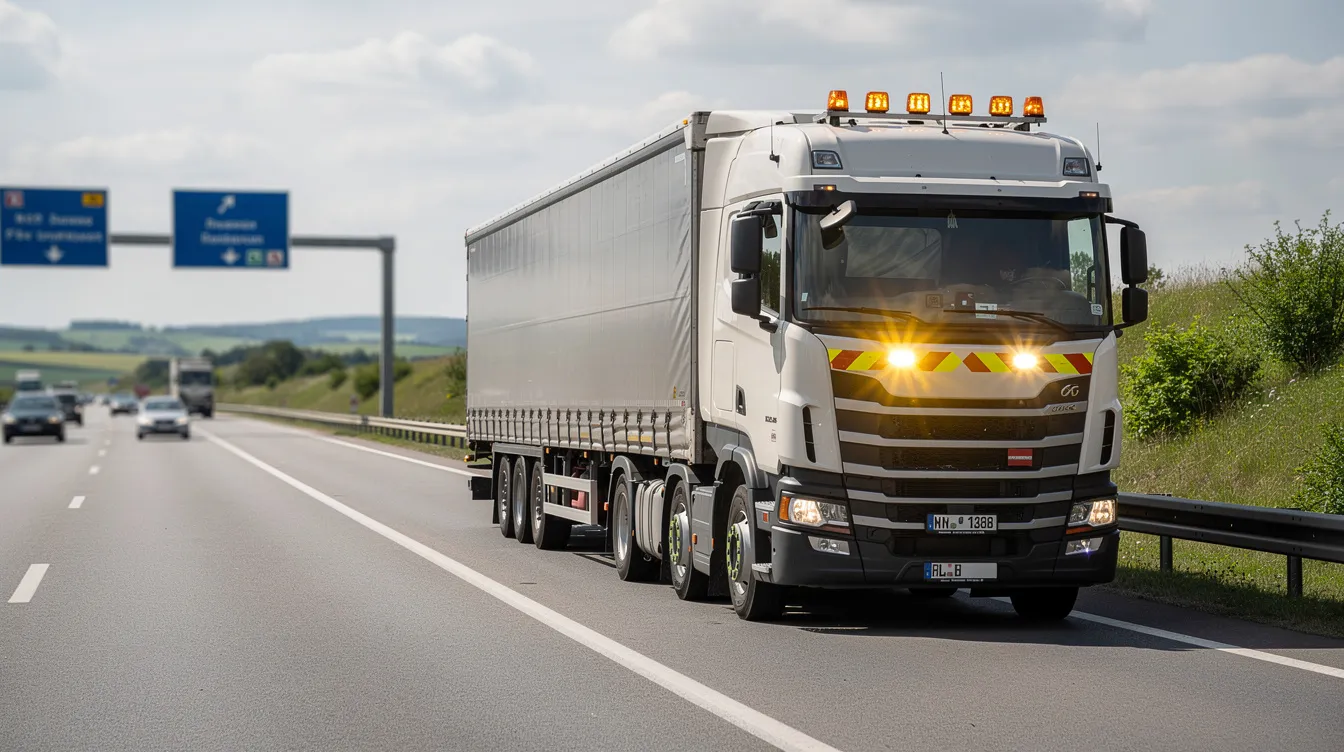
The division of the toll rate under the BFStrMG into infrastructure, air pollution, noise, and CO2 partial rates is more than a technical footnote. In practice it means that two otherwise identical tractor units with different drivetrains or different emission standards can generate noticeably different toll costs over their service life. Fleet managers weighing a new purchase would do well to run a calculation that includes not just fuel consumption and purchase price, but also the expected toll burden over several years. Electric and other zero-emission commercial vehicles benefit twice over here: through a lower CO2 partial rate, and through the raised weight threshold of 4.25 tonnes instead of 3.5, which offsets the extra weight of the battery.
Anyone interested in the different drivetrain types currently on German motorways can find an overview in our article on models and drivetrains in the German truck fleet, including how different drivetrains affect breakdown risk.
The role of traffic rules during a breakdown on a tolled route
Alongside the BFStrMG, the German road traffic regulations (StVO) also matter during a breakdown on the motorway, independent of the toll question. The StVO governs how a driver must behave during a breakdown or accident: switch on the hazard lights, steer the vehicle onto the shoulder if possible, put on the high-visibility vest before leaving the vehicle, and place a warning triangle at a sufficient distance. These duties exist regardless of how the toll question is resolved in a given case, and in practice they take priority over any administrative consideration. Only once personal safety and that of other road users is assured should attention turn to toll booking or notifying the carrier.
For context on accident numbers on German roads and the relevance of safety measures in heavy freight traffic, the Federal Statistical Office regularly publishes updated data on road accidents, showing how much correct behaviour in the first minute after a breakdown actually matters.
When the breakdown starts abroad and recovery leads into Germany
A special case that comes up more often than one might expect for international carriers: a truck already breaks down in a neighbouring country and is towed or transported across the border into Germany because that is where the nearest suitable workshop is located. Once the vehicle crosses the German border and is moved on a tolled federal motorway or federal highway, the same principle applies as with a domestic breakdown: what matters is which vehicle is actually driving, and on which road category. A disabled truck sitting on a low-loader does not generate a toll liability on its own, but the low-loader’s tractor unit does, provided it itself weighs over 3.5 tonnes and the recovery runs over tolled roads.
For international drivers and dispatchers unfamiliar with German rules, this is exactly the kind of area where fast, multilingual support is worth a great deal. That is why LKWHelp24 operates by default in four languages, German, English, Polish and Russian, so that a Polish or Eastern European driver does not additionally get stuck on the language barrier in an emergency.
Prevention is cheaper than any toll question
However detailed the toll rules may be, the best strategy remains not breaking down in the first place. A large share of the breakdowns our teams respond to trace back to avoidable causes: incorrect tire pressure, an overdue tire change, insufficient pre-trip checks. A regular departure inspection, which many carriers already require anyway, takes only a few minutes and prevents exactly the situations that end with a hard shoulder, a towing service, and possibly a toll question to untangle.
Why the toll topic matters to LKWHelp24
We are not a toll service provider and do not handle toll booking for our customers. But as a mobile breakdown and towing service for commercial vehicles from 7.5 tonnes upward, we regularly work precisely at the points where these questions become practical: on the motorway hard shoulder, at rest stops, at border crossings. A driver stuck in the middle of the night with a tire blowout on the A7 rarely has the time or the patience to deal with toll questions at the same time. That is exactly why our standard is that our teams not only fix the technical fault, but also know how to place a breakdown correctly in legal and organizational terms, so the driver can carry on afterwards without open questions.
Our tire emergency service covers exactly these situations, around the clock and in four languages: Tire emergency service near you. For larger recoveries, such as after an axle failure or in icy winter conditions, see our report on a winter recovery of a semi-truck, which shows how such an operation plays out in practice. For anyone wanting to understand towing costs, answers can be found under Truck towing service costs.
Beyond acute breakdowns, preventive maintenance pays off simply by making breakdowns less frequent in the first place. Our article on correct tire pressure for trucks and our overview of mobile tire service in Berlin around the clock help catch problems early, before they lead to a standstill on the motorway. For larger tire needs, for example after several failures across a fleet, our partner article on mobile tire service and wholesale supply points the way further.
Frequently asked questions
Do I have to pay toll for the time my truck stands still during a breakdown?
No. The toll is calculated based on kilometres driven on tolled roads, not on time. A stationary vehicle does not generate any additional toll liability as long as it is not moving.
Do I need to switch off the OBU if I am stuck on the hard shoulder?
No, this is not necessary, because without movement no additional tolled distance arises anyway. What matters more at that moment is your own safety, with hazard lights, a high-visibility vest, and a warning triangle.
Does towing my truck generate additional toll?
That depends on the specific process. If the disabled truck is loaded onto a low-loader and transported away from tolled roads, no additional toll generally arises. If the recovery vehicle itself is a toll-liable commercial vehicle travelling over a motorway, that vehicle is liable for its own distance.
What happens if my OBU fails while driving?
The payment obligation remains. The route must be rebooked manually as soon as possible, via the app, internet portal, or a terminal, to avoid a gap in the toll record.
How high can a fine be for toll violations?
Under Section 10 of the BFStrMG, fines of up to 20,000 euros are possible for non-payment of the toll and disregarding official orders, and up to 10,000 euros for other violations such as missing documentation. The actual amount in an individual case depends on the fine catalogue and the severity of the offence.
Does the toll obligation also apply to smaller commercial vehicles?
In principle, the toll obligation begins at a technically permissible gross mass of 3.5 tonnes. For zero-emission vehicles, the threshold is 4.25 tonnes. LKWHelp24 specializes exclusively in vehicles from 7.5 tonnes upward, which places them clearly within the tolled category regardless.
Conclusion
The German truck toll is not something you can simply hand over to the on-board unit and forget about. Knowing who pays, what determines the rate, and what happens during technical problems, standstills, or towing operations helps avoid unnecessary fines and unpleasant surprises during a roadside check. But for the breakdown itself, the moment the engine stalls or the tire blows, what matters most is a partner who arrives quickly and knows exactly what to do. LKWHelp24 is available around the clock for commercial vehicles from 7.5 tonnes upward, in German, English, Polish and Russian, via WhatsApp at +49 160 5753826.
Sources: Federal Office for Logistics and Mobility (balm.bund.de), Toll Collect GmbH (toll-collect.de), Federal Highway Toll Act via gesetze-im-internet.de.