Skip to content
In short: On 7 August, our team visited a private property near Bielefeld, North Rhine-Westphalia, to fit four 245/70 R17.5 tyres on a distribution truck (MAN TGM 12.250, 12.5 t gross weight), check the rims for deformation, and set tyre pressure to the vehicle’s actual load. Total time on site: 2 hours 15 minutes. Invoice total: €435 net. This wasn’t a breakdown callout — it was the kind of appointment that catches out mid-weight distribution trucks more often than passenger cars: tyres that age standing still, and rims chosen for the wrong load.
A 12–18 tonne distribution truck looks to many workshops like “just a bigger van”. Treat it that way and it gets expensive, and potentially dangerous. The load index on the tyre sidewall isn’t decorative — it flags a different construction, a different rim, and a far higher operating pressure than a car. Ignore it, and you risk carcass damage, overloaded rims, and in the worst case a blowout under full load on the motorway. This case shows what actually matters when maintaining wheels and tyres on a distribution truck.
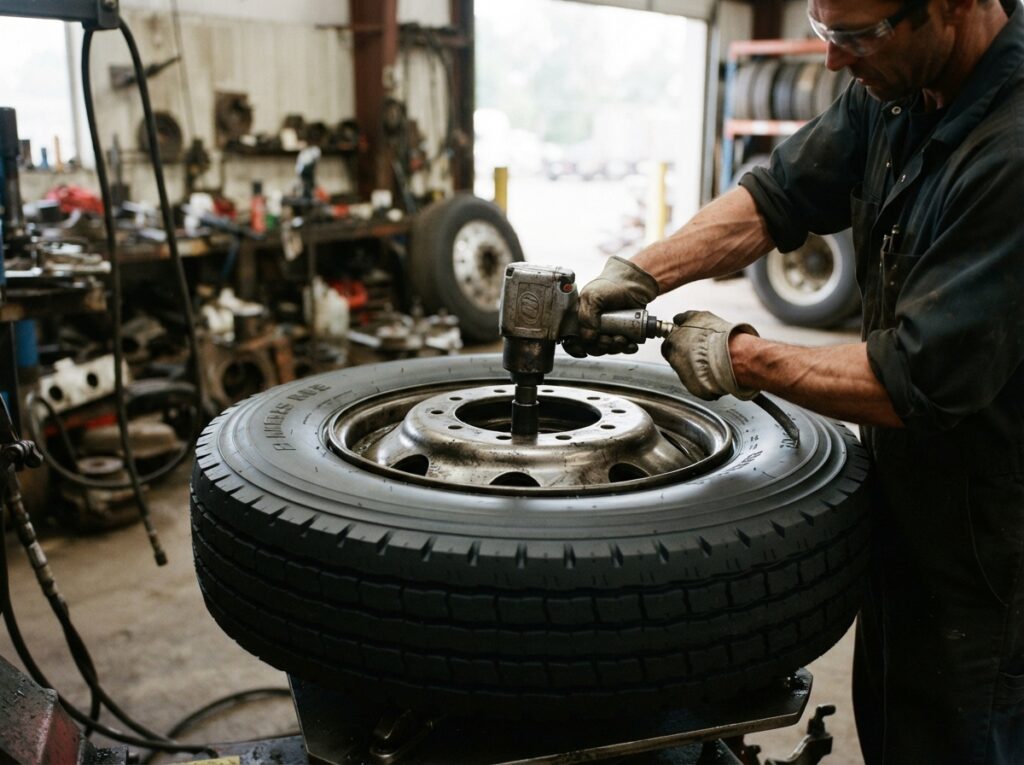
What Prompted the Visit: a Tyre Change on a Distribution Truck at a Private Property
The owner runs a small haulage business with a single distribution truck — a MAN TGM 12.250, used for regional runs and site deliveries. The vehicle stood idle longer than usual, but was loaded fully whenever it did run. Ahead of the new season, the owner needed a full set of 245/70 R17.5 tyres fitted and the rims checked.
The job took place on the owner’s private property near Bielefeld — no motorway, no workshop yard, just a flat, paved surface in front of the depot. That’s exactly where the problems many mid-weight commercial vehicle owners underestimate tend to show up: standing damage. A vehicle that covers few miles but sits loaded for long stretches ages differently to a well-used long-haul truck.
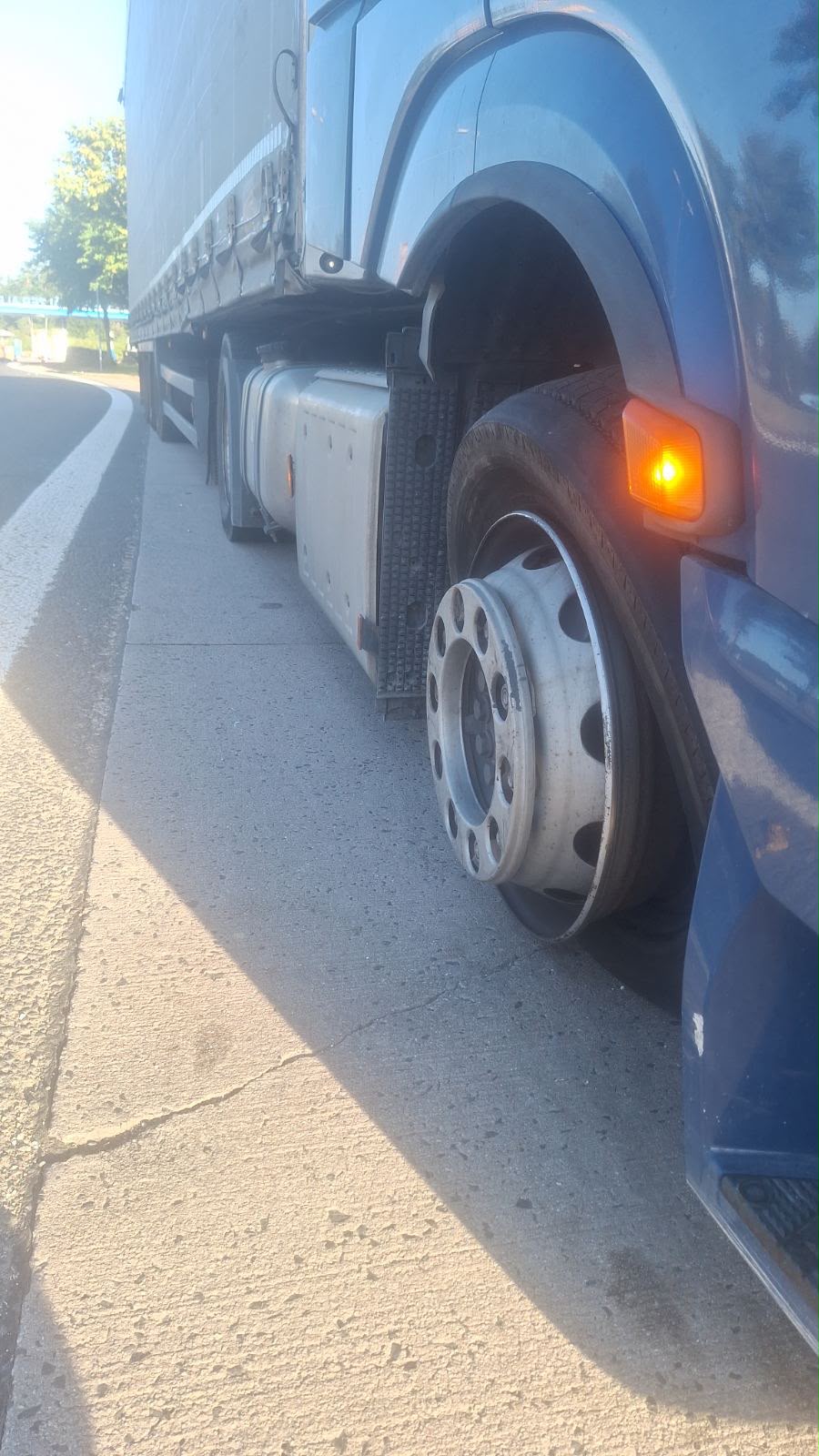
The on-site diagnosis: two tyres showed clear flat spots — flattened patches on the contact area, caused by weeks of standing under load. A third tyre’s DOT code showed it was over eight years old, despite visibly adequate tread. The rims themselves were undamaged, but showed light corrosion around the valve areas — a typical sign of infrequent inspection.
Why the Load Index Makes All the Difference on Truck Tyres
A truck tyre differs from a passenger tyre through a reinforced carcass, a far higher load index, and significantly higher operating pressure — 8.0 to 9.0 bar rather than around 2.2 bar for a car. The marking 245/70 R17.5 with load index 143/141 (single/twin fitment) and speed symbol J means a reinforced carcass with extra fabric and steel plies, built for the much higher axle load of a distribution truck from 7.5 t upward.
Fit a tyre with too low a load index by mistake, and the load capacity simply isn’t there. Under full load, the tyre runs permanently overworked — the sidewall flexes more, the carcass heats up faster, and failure risk climbs sharply. That wasn’t the issue here — the owner had consistently run correct truck tyres with the right load index. Which made the actual wear pattern — flat spots and age-related degradation — easy to distinguish from a load-rating mistake.
Pressure is the point that’s easiest to overlook. A driver used to cars or light vans will underestimate the fill pressure needed. A 245/70 R17.5 truck tyre runs at 8.0–9.0 bar as standard — noticeably under that and the tyre runs structurally under-inflated, flexes excessively, and generates extra heat in use — one of the most common causes of tyre failure on mid-weight trucks.
Why Tyres on Distribution Trucks “Die Standing Still”
Tyres on distribution and site trucks age from standing time more often than from mileage — cargo, attachments, and full loads create constant load while the vehicle sits unused for weeks. That’s a fundamental difference from a long-haul truck’s usage pattern.
A tractor unit on international runs wears its tyres down before the rubber compound goes brittle with age. A small-business distribution truck, by contrast, often sits in the same spot for days or weeks — loaded with materials, tools, or stock. That contact patch is exactly where the flat spot forms: a slightly flattened zone that produces a noticeable vibration when the vehicle first moves off, and structurally weakens the carcass.
At the same time, ageing by DOT date continues regardless of distance covered. A tyre with eight to ten years of standing time can still look like it has good tread and be structurally brittle underneath — the rubber compound hardens, and fine sidewall cracks become visible on close inspection. That’s exactly what we found here: the tyre with the oldest DOT code showed fine sidewall cracking easily missed on a casual check.
For owners of mid-weight commercial vehicles, this means tread depth alone isn’t a reliable indicator. The DOT date belongs in every seasonal check, regardless of mileage.
Retreaded Truck Tyres: What They Add — and Where the Limits Are
Retreaded tyres are standard practice in the truck segment, combining a checked carcass with a new tread — provided the base carcass is free of standing damage and structural cracks. For distribution trucks that regularly sit unmoved for weeks under full load, checking the carcass before retreading matters even more.
The difference from a new tyre comes down mainly to pre-inspection: a carcass with flat spots or age cracking should no longer be retreaded, because the structural weakness would stay hidden under the fresh tread. For vehicles that — like this distribution truck — regularly sit unmoved for weeks under full load, that’s a relevant point for the next tyre purchase.
Not every carcass qualifies for a second or third retreading run, and a checked retread is usually cheaper than a new tyre of the same size. On this job, the owner deliberately chose new tyres from a well-known manufacturer — a legitimate call, provided standing time is monitored and flat spots caught early. Anyone who regularly parks their vehicle for months at a time should discuss this with a specialist at the next tyre purchase.
Rims on Distribution Trucks: the Common and Costly Mistake
Rim choice is one of the most common mistakes on mid-weight trucks: aftermarket rims without documented load ratings often can’t handle this vehicle class’s high axle load and rarely have the correct offset (ET) and rim width.
A distribution truck structurally carries much more weight per axle than a van or car. The rim has to bear that load, not just the tyre. Uncertified 17.5-inch steel rims from the aftermarket are frequently not rated for that load at all, even if the bolt pattern and centre bore happen to fit. The result: a rim that develops micro-cracks over time, especially at stress points and after potholes.
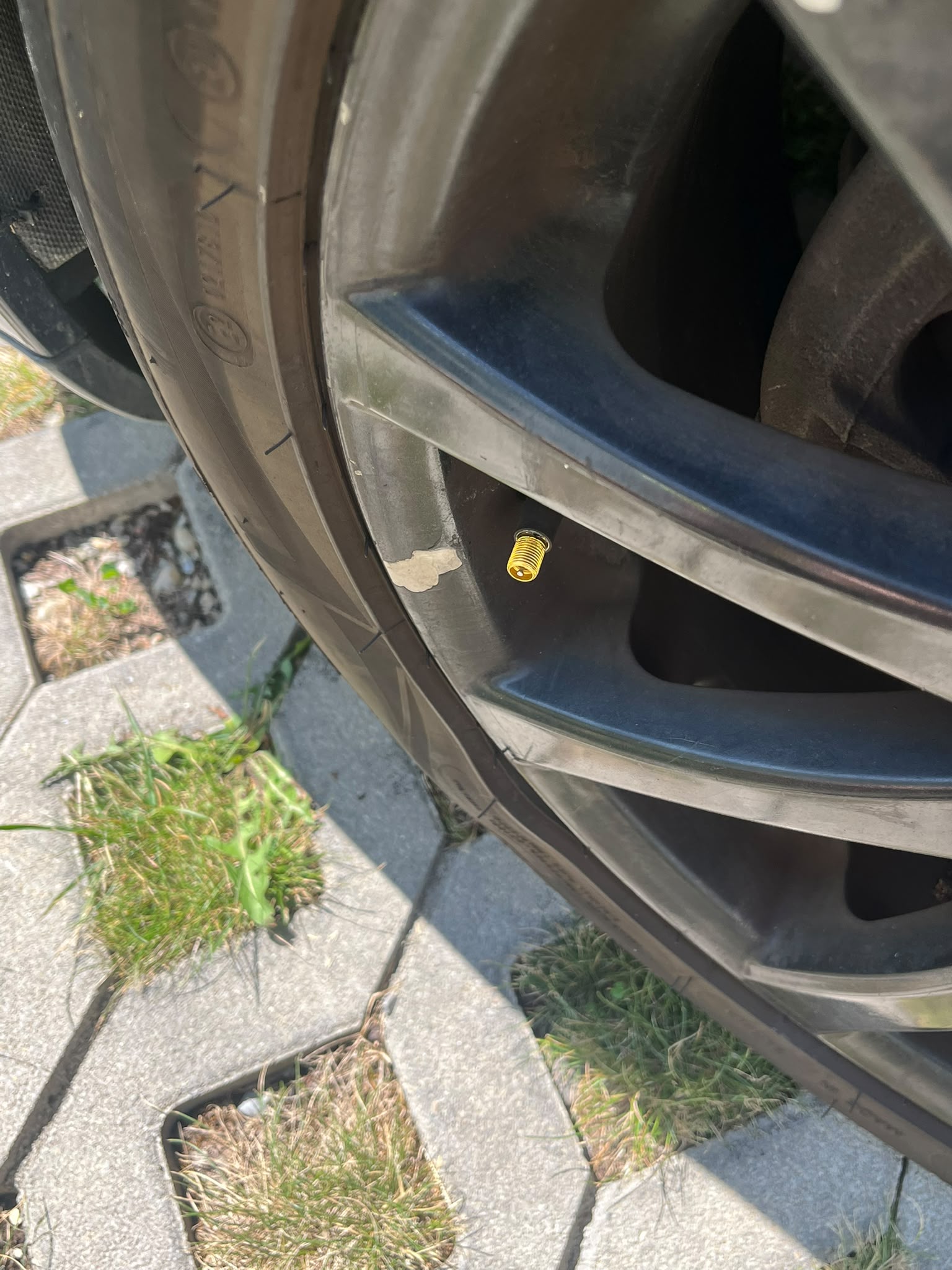
On this vehicle, the manufacturer’s original steel rims were fitted — correctly rated, but with visible corrosion around the valve areas, likely from irregular cleaning after winter salt exposure. We checked all four rims for deformation, cracking, and imbalance. Finding: no structural damage, but a clear need for better corrosion maintenance.
Rule of thumb for owners: when buying rims for a truck from 7.5 t upward, always check the rim’s own load rating, not just tyre approval. A qualified workshop can confirm this from the vehicle documents in a few minutes.
Torque and Its Verification: the Underrated Safety Factor
Wheel nuts on trucks from 7.5 t upward require far higher torque than on a car — on this distribution truck, the specified value was 630 Nm, against roughly 110 Nm for a typical car. This difference is frequently underestimated during tyre changes.
The problem usually doesn’t originate at first fitting by a qualified truck workshop, but at quick tyre changes at shops that mostly service cars and light vans. The impact wrench there is set to far lower torque, or run “by feel” — nowhere near enough for a truck wheel. Both extremes are dangerous: too little torque leads to loose wheel nuts and, in the worst case, wheel loss while driving. Too much torque overstretches the studs, which can then snap at the next removal.
On this job, every wheel was tightened with a calibrated torque wrench in a star pattern, to the exact value specified by the vehicle manufacturer. We generally recommend a torque re-check after the first few miles driven — advice many mid-weight commercial vehicle owners aren’t aware of, since it’s rarely discussed day to day.
How the Visit Was Organised
The appointment was booked two days in advance through our dispatch — no emergency, a planned seasonal service. The preparation sequence:
- Initial contact and appointment request from the owner, specifying tyre size 245/70 R17.5.
- Gathering vehicle data (year, gross weight, last tyre check) to prepare the correct tyre set.
- Dispatch of a technician from our partner network in the Bielefeld region.
- Preparation of four tyres in the required size, rim inspection tools, and a calibrated torque wrench for truck wheel nuts.
- Travel to the private property at the agreed time, on-time arrival within the booked window.
This planned process differs sharply from a motorway emergency: no hard shoulder to secure, no time pressure — instead a more thorough inspection than an emergency callout often allows time for.
Step-by-Step Work on Site
Step 1 — Visual inspection of all four wheels: checking tread depth, DOT date, visible damage, and flat spots on every tyre individually.
Step 2 — Rim inspection: checking for deformation, cracks, and corrosion, particularly around valves and spokes.
Step 3 — Removing the old wheels: raising the vehicle on stable ground, loosening wheel nuts in a star pattern.
Step 4 — Fitting the new tyres: mounting the four new 245/70 R17.5 tyres on the inspected rims, balancing each wheel individually.
Step 5 — Final check: tightening wheel nuts with a calibrated torque wrench to 630 Nm in a star pattern, setting tyre pressure to the actual load, visual check of all four wheels after fitting.
Full Timeline
| Time | Phase | Action |
|---|---|---|
| 08:00–08:20 | Arrival | Arrival at the private property, initial conversation with owner |
| 08:20–08:35 | Visual inspection | Checking tyres and rims on all four wheels |
| 08:35–09:35 | Wheel change | Removal and fitting of four wheels, 245/70 R17.5 |
| 09:35–09:55 | Balancing | Balancing all four wheels |
| 09:55–10:05 | Pressure check | Setting tyre pressure to actual load |
| 10:05–10:15 | Final check | Torque check, visual inspection, handover |
Total time on site: 2 hours 15 minutes (135 minutes).
Cost of the Seasonal Wheel Change
| Item | Price (EUR, net) |
|---|---|
| Callout (daytime) | €90 |
| Labour, truck wheel change (4 wheels) | €220 |
| Balancing, truck (4 wheels) | €60 |
| Rim visual inspection | €30 |
| Tyre pressure set to load | €20 |
| Small parts (valves) | €15 |
| Total | €435 |
All prices are net, plus statutory VAT, and sit above our entry-level daytime callout rate from €290. The tyres themselves had already been sourced by the owner and are therefore not included in the invoice — if sourced through us, four 245/70 R17.5 truck tyres would add from €315 per tyre, more depending on manufacturer. Outside normal hours — nights, Sundays, and public holidays — our rate starts from €549.
By comparison: a distribution truck broken down with a tyre failure on the motorway costs not just the emergency callout itself, but also vehicle downtime for a business running just one or two trucks. A lost day can quickly mean several hundred euros in lost revenue for a small haulier — a planned seasonal appointment avoids exactly that.
Why a Specialist, Not a Car Workshop “on the Side”
A tyre change on a distribution truck looks to many workshops like a slightly bigger van job — it isn’t. The risks of an amateur or unsuitable approach:
- Wrong torque from a generic car setting on the impact wrench, risking the wheel nuts.
- Wrong load index fitted out of inexperience or to save cost.
- Unchecked rims from the aftermarket, with no proof of load rating for the vehicle class.
- Wrong tyre pressure from a car table instead of actual load.
- Missed flat spots and DOT ageing, because attention focuses mainly on tread depth.
A specialist workshop experienced with trucks from 7.5 t upward knows these differences and checks for them routinely, not just on request.
Typical Situations We Respond to for Trucks from 7.5 t Upward
Beyond seasonal wheel changes, we cover distribution, site, and long-haul trucks nationwide, including:
- Tyre failures on the motorway — covered by our emergency truck tyre service — with no suitable spare wheel.
- Flat spots after standing time ahead of a new season.
- Rim damage after kerb contact or potholes.
- Tyre changes on vehicles with special bodies (box, flatbed, crane) where load and centre of gravity differ.
- Emergency wheel changes with a faulty jack or missing wheel wrench.
Prevention for Distribution Truck Owners
Anyone running a truck from 7.5 t upward should keep a few basic rules in mind:
- Check tyre pressure monthly, even while standing — not just before driving.
- Check the DOT date at every seasonal check, regardless of tread condition.
- Avoid flat spots by parking for longer periods on a clean, level surface with correct pressure where possible.
- Only buy rims with a documented load rating for the vehicle class, not by appearance.
- Set tyre pressure to actual load, not the factory figure for an empty vehicle — when in doubt, get the vehicle weighed.
- Have wheel nut torque checked after every change, especially after the first few miles driven.
Tyre Pressure by Load: Why the Table in the Vehicle Documents Isn’t Enough
Correct tyre pressure on a distribution truck depends on the actual load, not the empty-weight figure listed in the vehicle documents. That’s one of the most commonly overlooked points for this vehicle class.
A distribution truck loaded with materials, tools, and cargo weighs noticeably more than empty — often several hundred kilograms per axle. The standard pressure on the tyre placard is usually calculated for medium load. Anyone who applies that figure while running fully loaded drives on structurally under-inflated tyres — with more heat build-up, faster edge wear, and higher failure risk on long motorway runs.
Our recommendation, which we also gave on this job: get the vehicle weighed fully loaded on a public weighbridge, ideally axle by axle. The actual weight gives you the correct operating pressure, which is often notably above the empty-running figure. This small investment pays for itself quickly through extended tyre life.
Who This Topic Is Especially Relevant For
The issues described here affect a segment that often falls between the cracks: too big for the corner van workshop, too small for a classic long-haul fleet. That includes:
- Small hauliers and trades businesses running one or two distribution trucks.
- Construction firms running site trucks on short-haul routes.
- Municipal and regional fleets with individual trucks from 7.5 t upward.
- Businesses that regularly store materials and equipment in a distribution truck for long stretches.
In practice, these vehicles are often treated “like a bigger van” — for maintenance, tyre pressure, and rim choice. That treatment is exactly what leads to the problems described in this report.
Extended Overview: Tyres and Fleet Care for Distribution Trucks
Tyre manufacturers clearly separate their truck ranges from car and van lines. Well-known makers such as Continental and Michelin offer dedicated regional and distribution tyre lines with reinforced carcasses and proven retreadability. Fleet managers running several distribution trucks benefit from a fixed maintenance rhythm: pressure and DOT checks at every driver handover, visual rim inspection at every workshop visit, and a documented seasonal check ahead of summer and winter operation.
The legal basis matters too: under § 36 StVZO, the minimum legal tread depth is 1.6 millimetres — a figure that often isn’t the decisive factor for vehicles that stand still a lot and cover few miles, because ageing outpaces tread wear.
Why LKWHelp24 Is the Right Partner for Distribution Trucks Too
We’re reachable around the clock, 365 days a year, across Germany — for tractor units on the motorway just as much as for distribution, site, and regional trucks from 7.5 t upward in commercial use. Arrival typically takes 30 to 60 minutes. Our multilingual dispatch (German, English, Polish, Russian) organises both emergencies and planned seasonal appointments through our mobile truck tyre service like this one, via WhatsApp or phone at +49 160 575 3826. Through our partner network, we make sure a technician with the right tools and know-how for truck wheels is available at every job site, not just for standard car or van tyres.
Transparent pricing is standard for us: the fixed price is quoted before travel, every invoice line is known in advance, with no hidden surcharges.
Summary: the Key Numbers
- Vehicle: Distribution truck, 12.5 t gross weight (MAN TGM 12.250)
- Tyre size: 245/70 R17.5
- Location: Private property near Bielefeld, North Rhine-Westphalia
- Date: 7 August
- Total time on site: 2 hours 15 minutes
- Invoice total: €435 net (excluding tyre material)
- Torque: 630 Nm (truck wheel nut), versus roughly 110 Nm for a car
- Operating pressure: 8.0–9.0 bar (truck), versus roughly 2.2 bar for a car
Frequently Asked Questions
Can I run a normal car or van tyre on my truck?
No. Truck tyres from 7.5 t upward need a much higher load index and a different operating pressure than car or van tyres, and are built for this vehicle class’s high axle load.
How often should I check tyre pressure on my distribution truck?
At least monthly, even during longer standing periods. Under full load, check pressure again before any longer trip.
What does a seasonal wheel change with rim inspection cost on a distribution truck?
On this job, the total came to €435 net for callout, wheel change, balancing, rim inspection, and pressure setting — excluding tyre material. Our entry-level daytime callout rate starts from €290.
How do I recognise a flat spot on a tyre?
A noticeable vibration or thumping when moving off after standing points to a flattened area on the contact patch. A visual inspection by a specialist workshop confirms it reliably. When truck tyre repair is possible and when replacement is needed, we explain separately.
Are retreaded tyres a good choice for every distribution truck?
They offer a cost advantage but require a checked, undamaged carcass free of standing damage. On vehicles with frequent, long standing periods, the carcass should be inspected especially carefully before retreading.
Who is liable if the wrong rims were fitted and damage occurs?
Usually the owner, if the rims weren’t approved for the vehicle class. That’s why load rating should always be confirmed in writing with a specialist workshop before purchase.
More on this: our tyre service page, our towing service, our truck service overview, truck tyre repair guide, truck tyre pressure guide, the 2024/2025 all-season tyre ban, our tyre service page.
See also: https://lkwhelp24.com/en/truck-tyre-blowout-a1-bremen-drive-axle-2026/.
More: https://lkwhelp24.com/en/, https://lkwhelp24.com/reifenservice/.