Skip to content
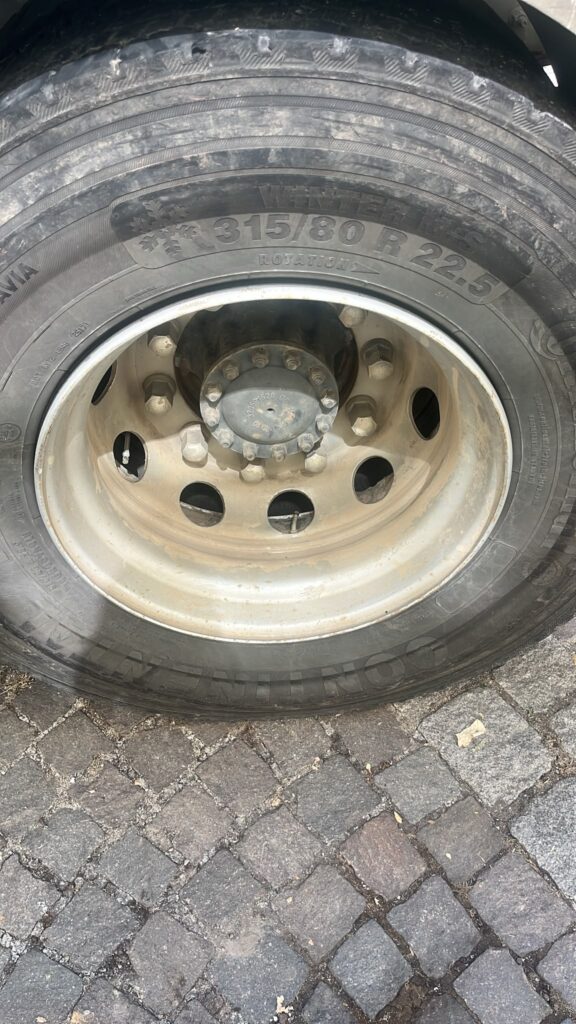
TL;DR: On 12 July, an articulated tractor unit with a semi-trailer stood on the grass verge of the B188 near Wolfsburg, Lower Saxony, with a damaged 315/80 R22.5 tyre. This federal road has no hard shoulder, so the wheel change happened on soft ground metres from passing traffic. From the call at 12:40 to the lorry rolling again at 14:40, the whole job took 2 hours. Net cost: €1,140.
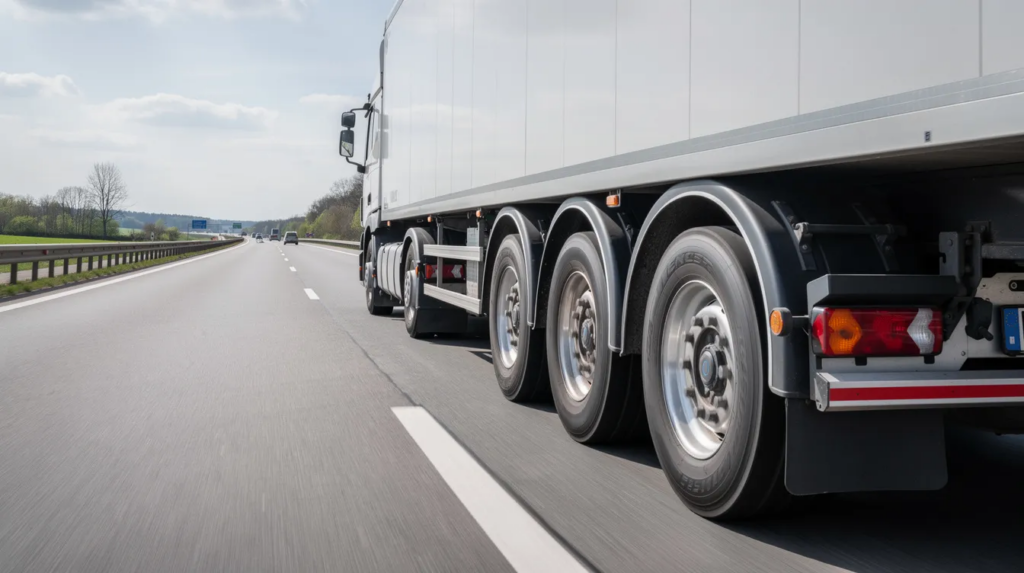
This wasn’t a motorway breakdown. There was no paved shoulder to pull onto, no crash barrier separating the work area from the carriageway, and no gentle slope down to a service lane. Just a narrow two-lane B-road, a ditch, and a driver who had to decide, in the space of a few seconds, where exactly to stop a 40-tonne combination with a wrecked tyre.
Most of the case studies we publish involve motorway hard shoulders — wide, paved, protected by a barrier. This one is different, and that difference is the whole story. Working a tyre change on an unpaved verge (in German, Bankett) next to a federal road changes almost everything about how the job gets done, how long it takes, and what it costs.
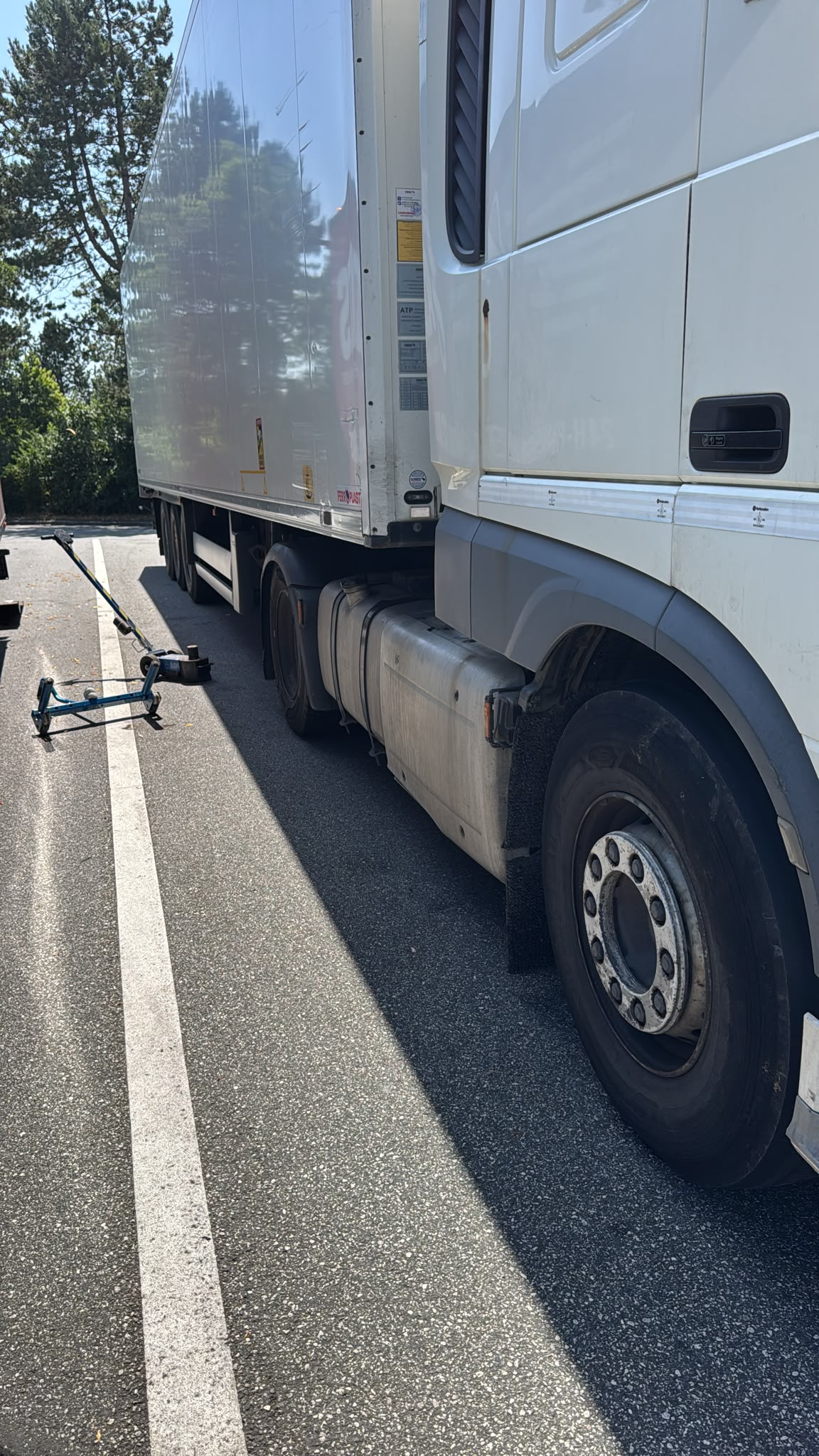
The emergency situation on the B188
The call came in at 12:40 on a July afternoon. The driver of an articulated tractor unit was hauling a loaded semi-trailer south on the B188 when he felt the rear right tyre on the trailer’s drive-side axle start to shudder. He eased off, watched the mirrors, and pulled as far left onto the verge as the ditch allowed — there was no shoulder to speak of, just a strip of grass and gravel between the white line and the drainage channel.
That’s a normal, sensible reaction. It’s also the point where a routine breakdown on a federal road (Bundesstraße) starts to look different from the same problem on an autobahn. A B-road hard shoulder, where it exists at all, is often narrower than motorway standard, unpaved, or simply absent — as it was here. The vehicle came to rest with its nearside wheels partly off the tarmac, on ground that hadn’t been driven on in weeks and was still faintly soft under the topsoil from earlier rain that month.
The driver switched on hazard lights, pulled on a hi-vis vest, and walked back along the verge — further than the standard 50 metres, because the road curves gently just past the breakdown point and oncoming sightlines are shorter than on a straight stretch. He placed the warning triangle, then called our dispatch line.
How the help was organised
Coordinating a wheel change on an unprotected federal road takes a different shape from a standard motorway call-out. The crew needs to know before they leave the yard whether they’re driving into a job that needs extra safety kit, not find out on arrival.
- 12:40 — call received; dispatcher logs GPS position, tyre size (315/80 R22.5), and road type — B188, no hard shoulder.
- 12:40–12:55 — our regional partner crew is located and briefed specifically on the road conditions: verge parking, oncoming traffic, no barrier.
- Crew confirms they’re carrying load-spreading plates, extra cones, and a spare hi-vis vest for the driver.
- 12:55 — technician departs with a replacement 315/80 R22.5 tyre already loaded, avoiding a second trip if the damaged tyre proves unrepairable on site.
- Dispatcher stays on the phone with the driver, confirming exact position relative to the nearest kilometre marker and advising him to stand well back from the carriageway, not near the vehicle.
Fifteen minutes for dispatch and partner search is tight but achievable when the crew is already briefed on what a Bankett job requires before they get in the van. Arriving without load plates or extra cones would have meant a wasted trip back.
Situation on site: soft ground, camber, and a loaded axle
The technician arrived at 13:35, forty minutes after leaving. First job wasn’t the tyre — it was reading the ground. A verge on a rural federal road slopes gently towards the ditch for drainage, which means any vehicle parked on it sits with a slight lean away from the carriageway. Combined with topsoil that hadn’t fully dried out, that camber matters.
Tyre pressure on the damaged wheel had dropped to roughly 2 bar against a normal operating pressure of 8.5 to 9.5 bar for this axle position — enough sidewall flex to have caused visible heat damage on the last few hundred metres of driving. The axle load on a laden trailer bogie easily runs 8-9 tonnes per axle, and that weight was now sitting partly on ground rated for foot traffic, not for a hydraulic jack pad.
The technician checked the rim for damage — running underinflated even briefly can dent or crack a rim edge, and a cracked rim doesn’t get reused regardless of how good the new tyre is. No damage found this time, which was fortunate; a bent rim on this job would have meant a second parts run and another hour minimum.
Why you can’t just jack up on soft ground
A hydraulic jack needs firm, flat, load-bearing footing to work safely. On tarmac that’s a given. On a grass verge softened by rain, it isn’t. If the jack base sinks even a centimetre unevenly under the axle load as the wheel lifts, the whole tractor unit can tip off the jack point.
That’s not a minor inconvenience — it’s potentially fatal for whoever is working under or beside the vehicle at that moment. Our crews carry load-spreading plates, flat steel or composite boards that go under the jack base to distribute the weight over a wider footprint of ground. On this job, two plates went down before the jack touched the ground, and the technician tested the load incrementally rather than lifting in one motion, watching for any sink or tilt.
Step-by-step: the repair on an unprotected verge
- Secure the scene first, work second. Cones went out in a longer, wider pattern than a standard shoulder job — extended further back up the road because of the bend, and set further from the vehicle to give a buffer against traffic that, on a B-road, passes within a metre or two of the work area at 80-100 km/h.
- Ground assessment and load-spreading plates. The technician walked the verge, chose the firmest available spot within reach of the wheel, and laid plates under the jack position before touching the vehicle.
- Wheel security check. With the vehicle chocked on the roadside wheels, the technician loosened the wheel bolts on the damaged wheel, checked wheel hub condition, and confirmed the jack was seated correctly before applying full lift.
- Lift, remove, and fit. The damaged 315/80 R22.5 was pulled clear, the new tyre mounted, and bolts torqued to spec in the manufacturer’s sequence — not just tightened by feel, since an unevenly torqued wheel on a laden axle is its own hazard a few kilometres down the road.
- Pressure set and final checks. Tyre inflated to the correct 8.5-9.5 bar for the axle position, torque re-checked after a short settling period, cones and triangle cleared only once the technician confirmed the lorry could pull away cleanly onto the carriageway without reversing near traffic.
Roughly a third of the on-site time went to scene safety rather than the tyre itself — laying plates, positioning cones for the bend, and re-checking the vehicle’s footing before lifting. On a paved motorway shoulder, most of that time simply isn’t needed.
Full timeline: call to completion in 2 hours
| Time | Phase | Action |
|---|---|---|
| 12:40 | Call received | Driver reports tyre damage, gives B188 location and 315/80 R22.5 size |
| 12:40–12:55 | Dispatch | Regional partner crew located, briefed on verge conditions, loads spare tyre and plates |
| 12:55–13:35 | Travel to site | Crew drives to breakdown point (40 minutes) |
| 13:35–14:40 | Work on site | Scene secured, ground assessed, wheel changed, pressure and torque checked (65 minutes) |
| 14:40 | Vehicle back on the road | Lorry rejoins B188 traffic under its own power |
Total elapsed time: 2 hours 0 minutes, in line with what we typically see for breakdown assistance call-outs of this complexity — see our tyre service page for standard response windows.
Cost breakdown and what drives the price up
| Item | Price (EUR, net) |
|---|---|
| Call-out/travel | 260 |
| Labour (1.5 hrs at €120) | 180 |
| Tyre 315/80 R22.5 | 560 |
| Old tyre disposal | 20 |
| Surcharge for difficult conditions (verge/federal road without hard shoulder, extra scene safety) | 120 |
| Total (net, plus VAT) | 1140 |
Three things push this above a straightforward motorway wheel change: the tyre itself at €560 for a premium-grade 315/80 R22.5, the labour hour and a half largely spent on securing rather than repairing, and a €120 surcharge that reflects the load-spreading plates, extended cone run, and the extra time the crew needs to work safely without a barrier between them and traffic.
Set against downtime, it’s still the cheaper option. A laden lorry sitting idle on a delivery run typically costs a haulier somewhere between €800 and €1,200 a day once you count missed slots, driver hours, and knock-on delays to the next job. Two hours from call to completion, even with the surcharge, keeps that cost contained to a fraction of a lost day.
Why you need a professional for a Bankett wheel change
A driver changing a wheel alone on a soft verge next to live traffic is taking on risks that go well beyond the tyre itself.
- No load-spreading plates on hand, so the jack can sink or tip mid-lift on wet or uneven ground.
- No second person to watch traffic while working close to the carriageway edge.
- Standard hazard triangle placement assumes visibility that a bend or verge often doesn’t give.
- Wheel bolts torqued by feel rather than to spec risk a wheel working loose within a few kilometres.
- No spare 315/80 R22.5 on board, meaning a wrecked tyre gets driven further than it should, risking rim damage.
- Underestimating how close passing HGVs and cars actually come to a vehicle parked on an unprotected verge.
Typical call-outs we handle on federal roads
Rural and semi-rural federal roads produce a steady stream of jobs that look nothing like the classic motorway blowout. Deliveries to farms, building sites, and factories routinely run on B-roads without hard shoulders, and that’s also where gravel edges, potholes, and soft verges do the most tyre damage. We regularly attend punctures from debris kicked up on unpaved access tracks, sidewall cuts from kerb strikes on tight village turns, and slow leaks that only become critical once a driver has covered another 20 or 30 kilometres on a road with nowhere safe to stop. Similar road-edge cases are covered in our write-up of a motorway tyre service call involving rim damage near Trier.
When the crew refuses to work on site
Not every verge is workable. If the ground is too soft, the bend too tight, or traffic speed too high for cones to give a safe margin, our crews are trained to say no to an on-site repair and instead recommend towing the vehicle to the nearest safe pull-in, fuel station, or lay-by. That’s not a failure of the job — it’s the job working as intended. A technician’s safety on an open carriageway is not something we treat as negotiable, whatever the pressure to get a lorry moving again. Our towing service exists precisely for the cases where a roadside repair simply isn’t safe.
What a driver should do on a narrow B-road breakdown
If a tyre starts going on a road without a hard shoulder, the instinct to find a “convenient spot” further ahead can make things worse. Driving on a wrecked tyre risks the rim and can shred the tyre entirely, scattering debris across the carriageway.
- Stop as soon as it’s safely possible, choosing the widest verge or lay-by within reach rather than pushing on.
- Hazard lights on immediately, before getting out of the cab.
- Hi-vis vest on before opening the door on the traffic side.
- Place the warning triangle further back than the standard distance on bends or where sightlines are short — visibility is the main variable that changes on rural roads.
- Call for help and give an exact position: nearest kilometre marker, direction of travel, and a description of the verge (grass, gravel, slope).
- Stay well clear of the vehicle and the carriageway edge while waiting, not beside the trailer.
Prevention: route planning and tyre checks for rural runs
Fleets running regular deliveries to sites off the motorway network can cut this kind of call-out with a few habits. Route planning that flags known B-roads without shoulders lets a fleet manager brief drivers in advance on where a breakdown would be harder to manage safely. After any stretch on unpaved ground — a farm track, a building site access road, a gravel yard — a quick walk-round tyre check catches cuts or embedded stones before they become a blowout further down the road.
Tread depth and sidewall condition should be part of every pre-trip check, not just the annual inspection. The legal minimum tread depth for HGV tyres in Germany is 1.6 mm under § 36 StVZO, though most fleets replace well before that point given how tread affects grip and heat build-up on long hauls. The ADAC publishes seasonal guidance on commercial tyre condition that’s worth building into a fleet’s inspection routine.
Tyres and fleet maintenance: what matters for a 315/80 R22.5
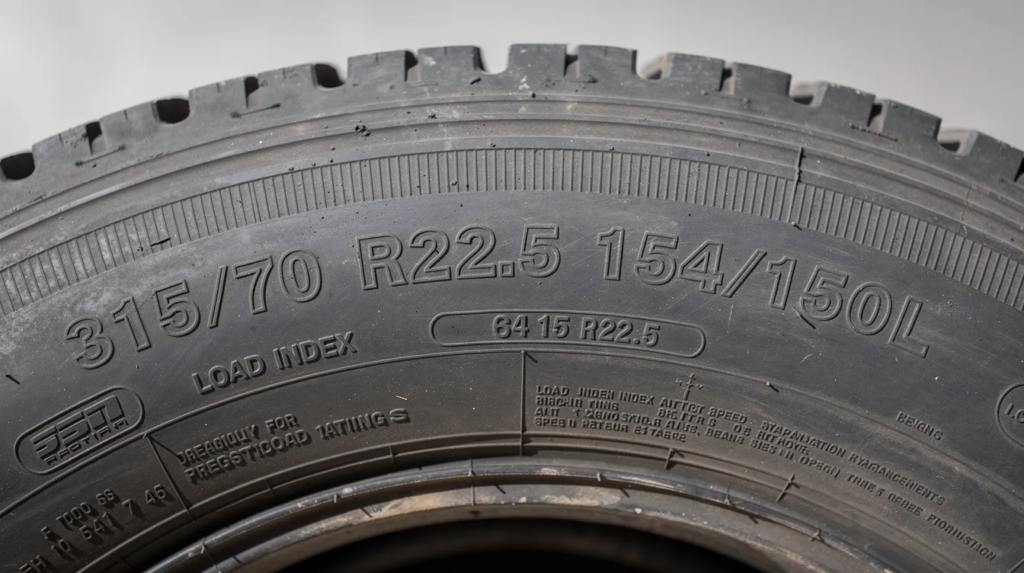
The 315/80 R22.5 size sits on drive and trailer axles across a huge share of European HGV fleets, which is why we carry it as standard stock. Tyre choice on this axle position affects everything from fuel consumption to wet-weather grip, and the major manufacturers — Michelin, Continental, Goodyear, and Bridgestone — all produce dedicated long-haul and regional patterns for this size, with different carcass constructions suited to steer, drive, or trailer positions.
Getting the tyre matched to the axle and duty cycle isn’t cosmetic. A trailer tyre on a drive axle, or vice versa, wears unevenly and can shorten service life significantly. Wheel balancing after any fitting job also matters more on long-distance routes, where an out-of-balance wheel shows up as vibration that fatigues both the driver and the suspension components over thousands of kilometres. Fleets that standardise on a single brand and pattern across their rim sizes tend to simplify stock management and get more predictable wear patterns, which pays off at renewal time.
Rim – dash – the metal wheel structure the tyre mounts onto; damage here (cracks, bent flanges) usually means the whole wheel assembly needs replacing, not just the tyre.
Why choose lkwhelp24 for roadside truck tyre service
We run 24/7 dispatch across Germany, with a vetted network of regional partner crews who carry the right kit for the road type they’re being sent to — not just a generic tyre van. Dispatch is multilingual, since drivers on German roads come from right across Europe and explaining a breakdown location clearly matters more than anything else in the first five minutes of a call. Pricing is transparent and quoted before work begins, itemised the way it’s shown above rather than bundled into a vague lump sum. For the full range of what we cover, see our truck service page, or reach our contacts page for direct booking.
FAQ
Can a tyre be changed safely on a road with no hard shoulder?
Yes, if the ground is firm enough and traffic can be managed with cones and distance. Our crews assess ground and visibility on arrival; if conditions are too risky, we tow the vehicle to a safer point instead of working roadside.
Why did this job cost more than a standard motorway tyre change?
The €120 difficult-conditions surcharge covers load-spreading plates, extended traffic cone setup, and the extra time needed to secure an unprotected verge before any wheel work begins.
What is a Bankett and why does it matter for breakdowns?
A Bankett is the unpaved verge alongside a road, often gravel or grass. It can be soft, sloped towards a ditch, and unsuitable for a jack without extra support, unlike a paved motorway hard shoulder.
How fast can you reach a breakdown on a B-road near Wolfsburg?
On this 12 July call-out, total time from call to the lorry moving again was 2 hours, including a 15-minute dispatch window and 40-minute travel time. Response times vary with location and traffic.
What tyre pressure is normal for a 315/80 R22.5 on a laden trailer axle?
Typically 8.5 to 9.5 bar, depending on axle load and manufacturer spec. Always check the vehicle’s placard or manual, since underinflation is the most common cause of roadside tyre failure.
Summary
An articulated tractor unit with a 315/80 R22.5 tyre problem on the B188 near Wolfsburg, Lower Saxony, was back on the road in 2 hours from the 12:40 call to 14:40 departure, at a net cost of €1,140. The job took longer and cost more than a comparable motorway repair because of the road itself: no hard shoulder, a sloping unpaved verge, and traffic passing within a metre or two of the work area. Scene safety, not the wheel change itself, was the main driver of both time and cost.
Need roadside truck tyre service in Germany?
Call +49 160 5753826 any time, day or night — we cover breakdowns 24/7 across Germany, on motorways and federal roads alike. More at www.lkwhelp24.com.
Keywords: truck tyre service | HGV breakdown assistance federal road | tyre change verge Bankett | 315/80 R22.5 roadside repair | articulated lorry tyre service Germany | B188 Wolfsburg breakdown | Bundesstraße hard shoulder tyre change | 24/7 truck roadside assistance