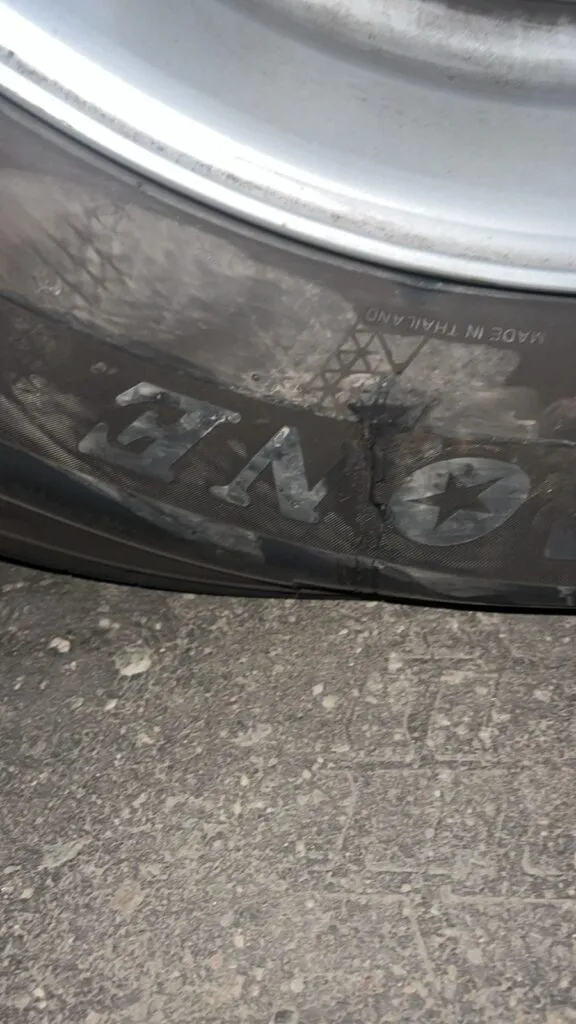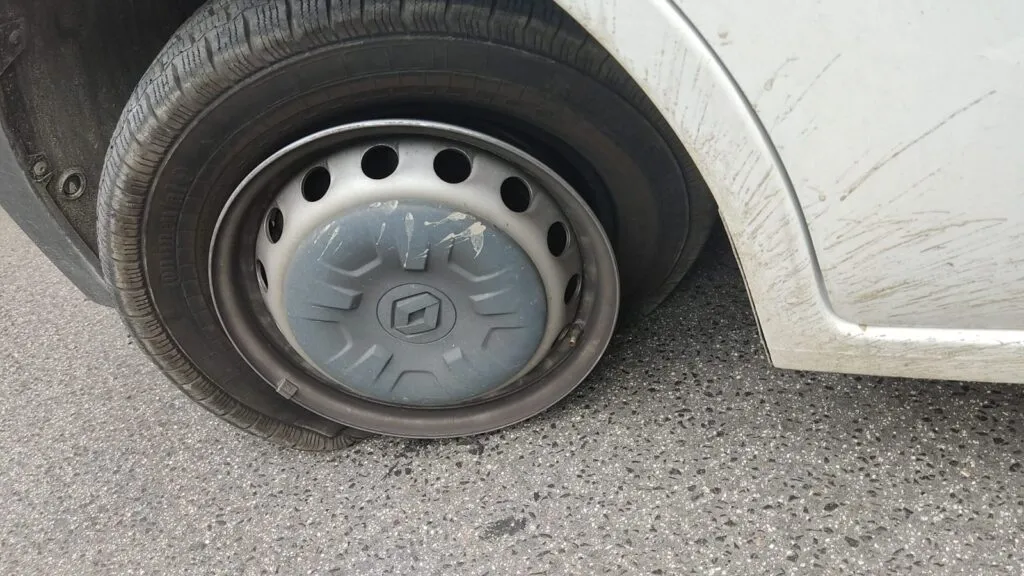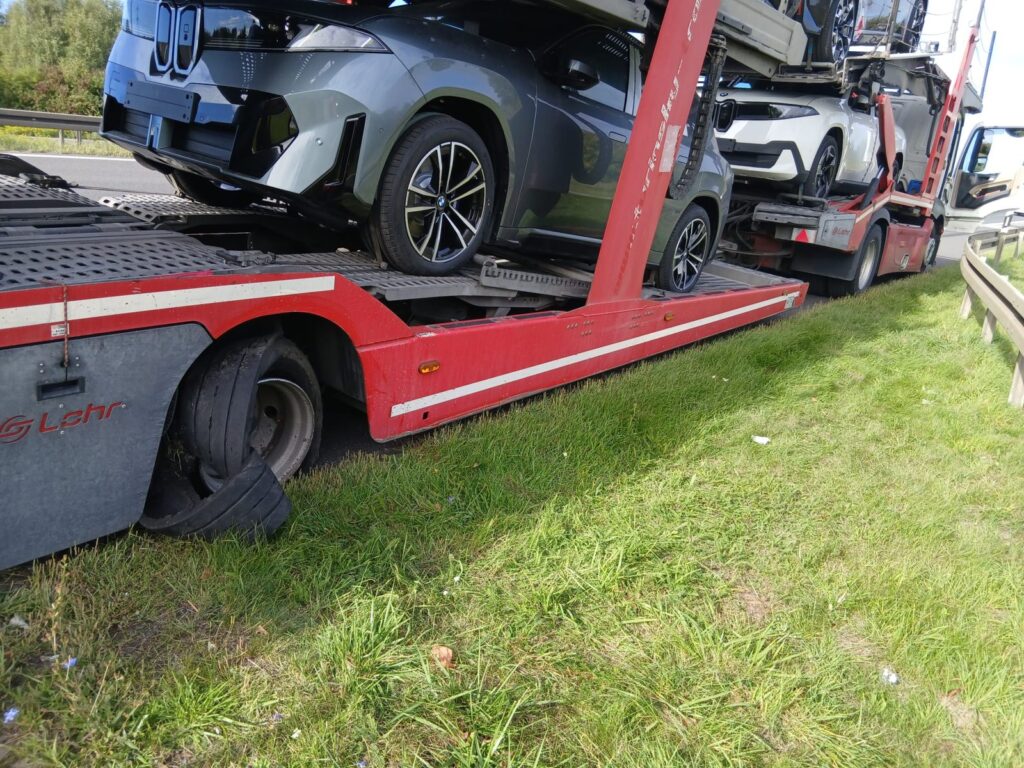
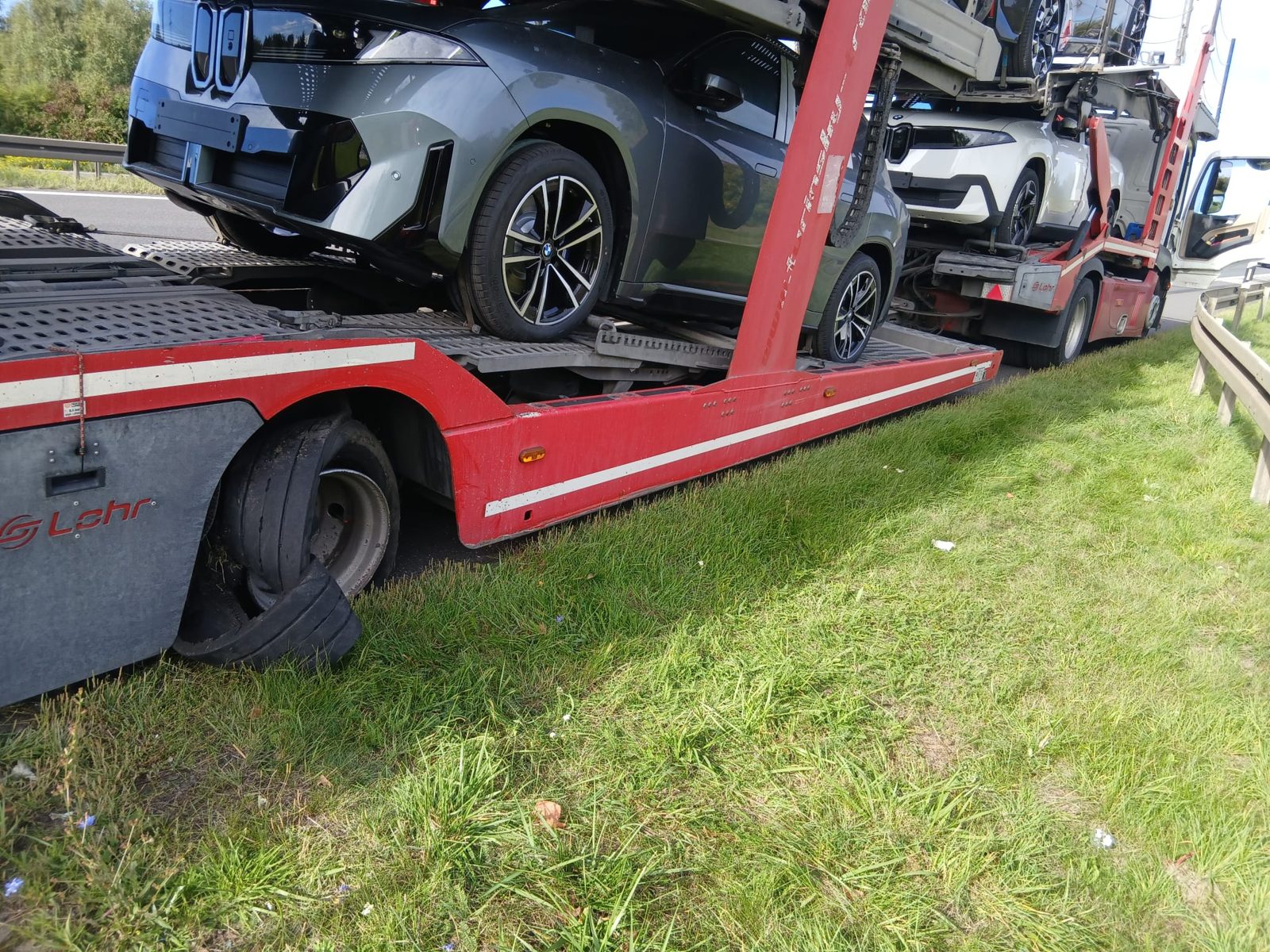
When a car transporter with a high-value cargo of new electric SUVs comes to a halt on the autobahn due to a blown tyre, every minute counts. Not just for the driver’s peace of mind, but for the integrity of the load, the safety of surrounding traffic, and the financial health of the transport company. This is not a minor flat tyre, this was a complete tyre rupture, where the tread had peeled off the casing like a banana skin, leaving the wheel’s rim exposed and the axle under severe stress. At 13:20, a call came through from a roadside emergency callbox on the A7 near Hildesheim, reporting a critical failure on the rear axle of a two-deck auto transporter carrying premium electric vehicles. By 15:35, the vehicle was back on the road, fully repaired, pressure checked, and safely underway. The entire response, from first contact to final departure, took 135 minutes, a benchmark for fast, professional, and safe mobile tyre service in Germany.
This case highlights the importance of a 24/7 mobile tyre service that doesn’t just react to breakdowns, it prevents them from escalating. A ruptured tyre on a rear axle of a car transporter is particularly dangerous. The weight distribution is already high, and when one wheel fails, the load shifts dramatically. Even a single flat tyre can lead to a loss of control, especially at speed. But here, the failure was far worse: the tread separation meant the tyre’s structural integrity was gone. The rim was vulnerable to impact, and the risk of a disc warping or even a wheel detaching was real. Without immediate intervention, the situation could have led to a full-blown accident, cargo damage, and a costly evacuation. That’s why timely, expert intervention isn’t just convenient, it’s essential.
This article breaks down the full sequence of events: the emergency call, dispatch logistics, on-site assessment, repair execution, and cost transparency. We’ll cover why a DIY fix or waiting for an evacuation service would have been far more expensive and risky. We’ll also explore the root causes behind such failures, how to prevent them, and why choosing a certified mobile tyre service like LKWHelp24 makes all the difference, especially when your cargo includes high-end electric vehicles and your schedule is tight.
The Emergency Call: A Critical Moment on the A7
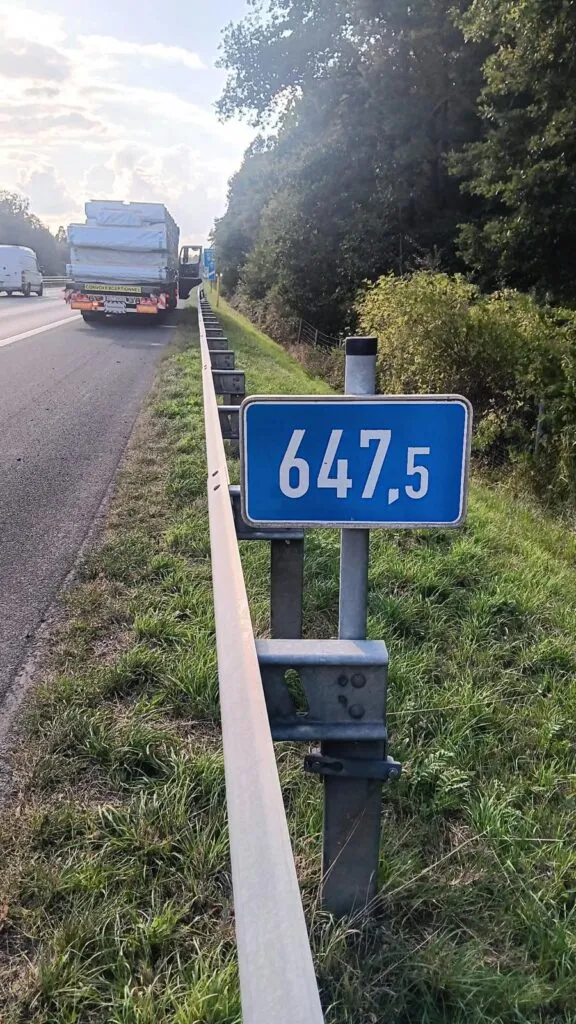
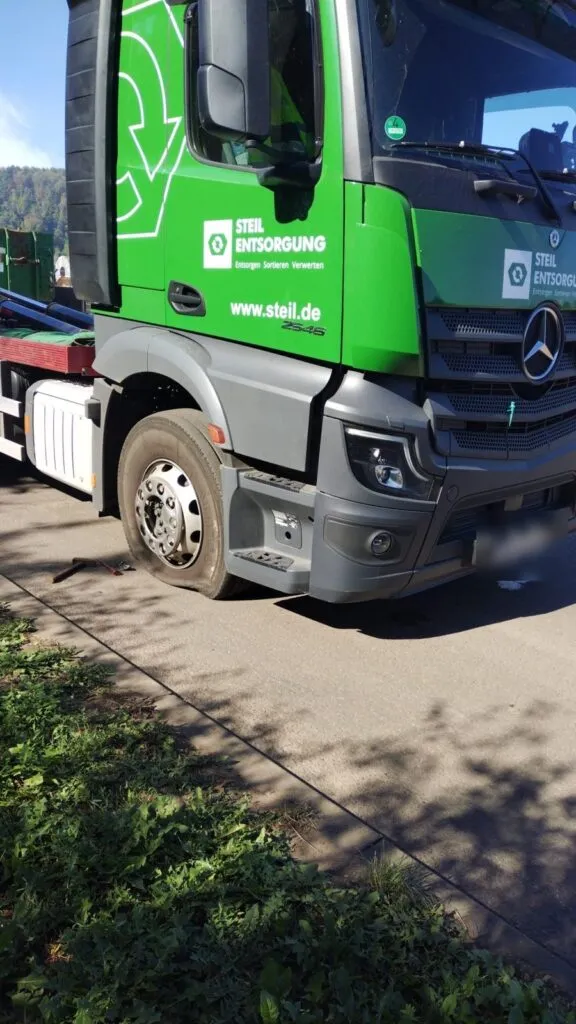
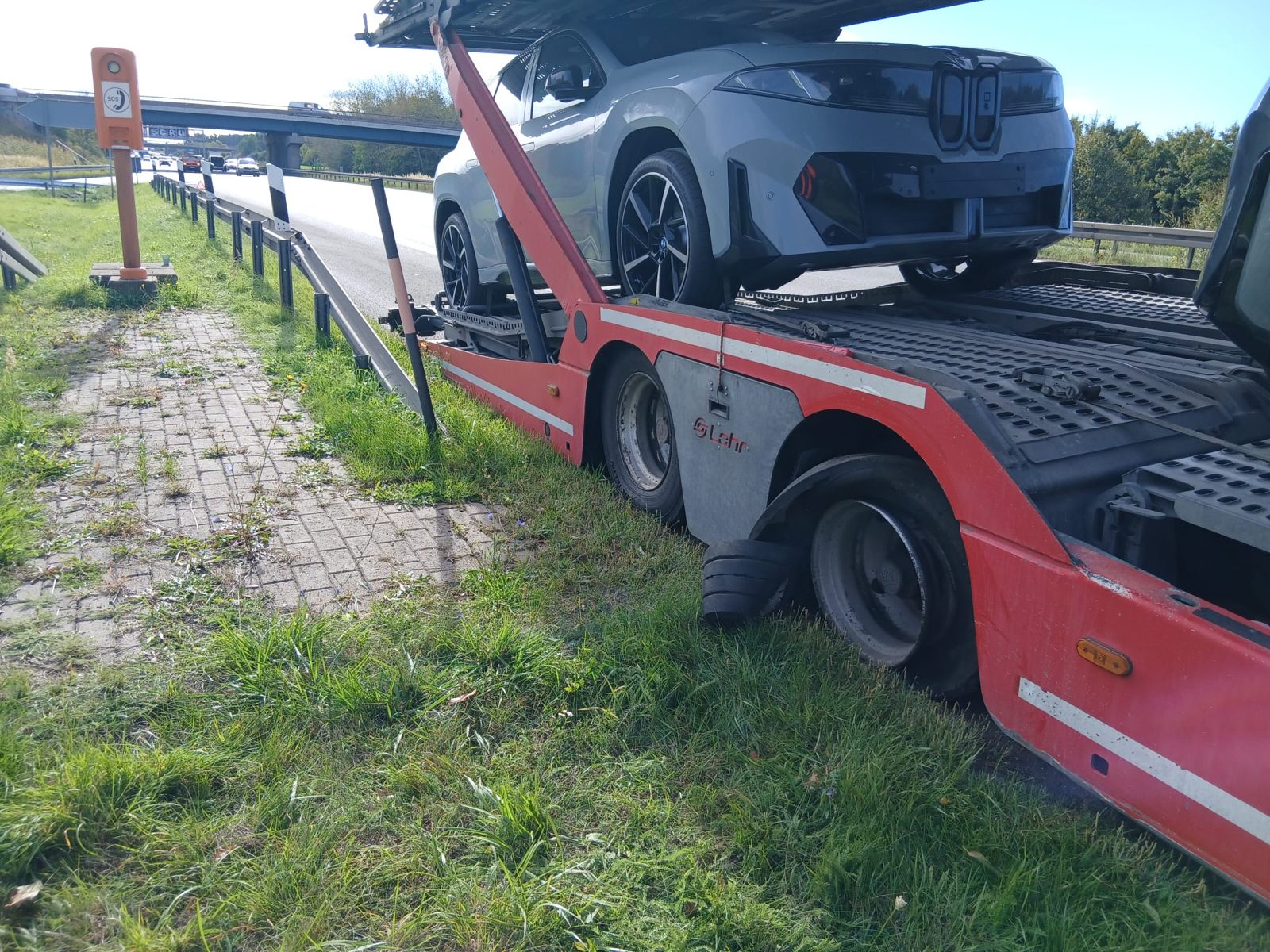
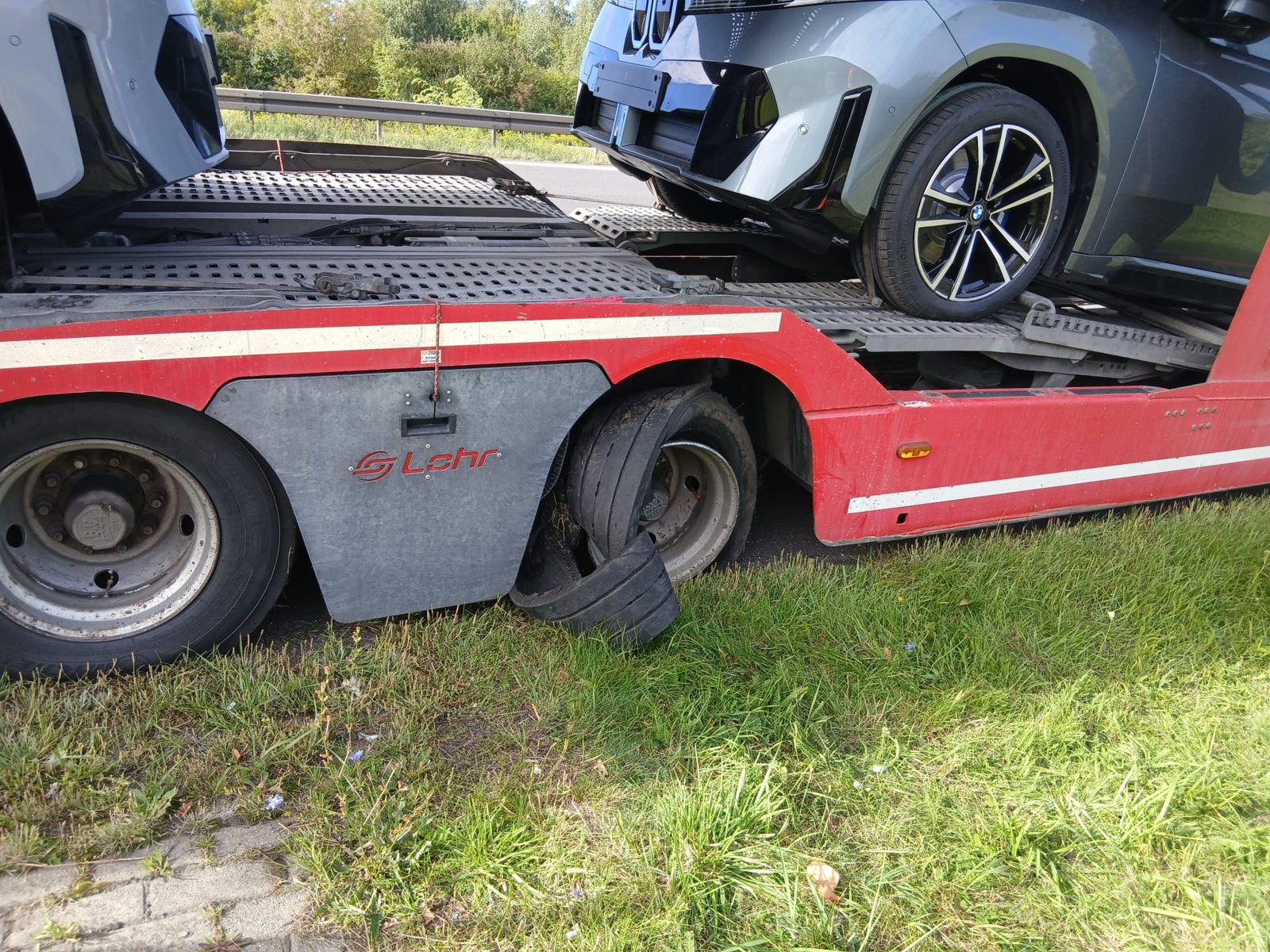
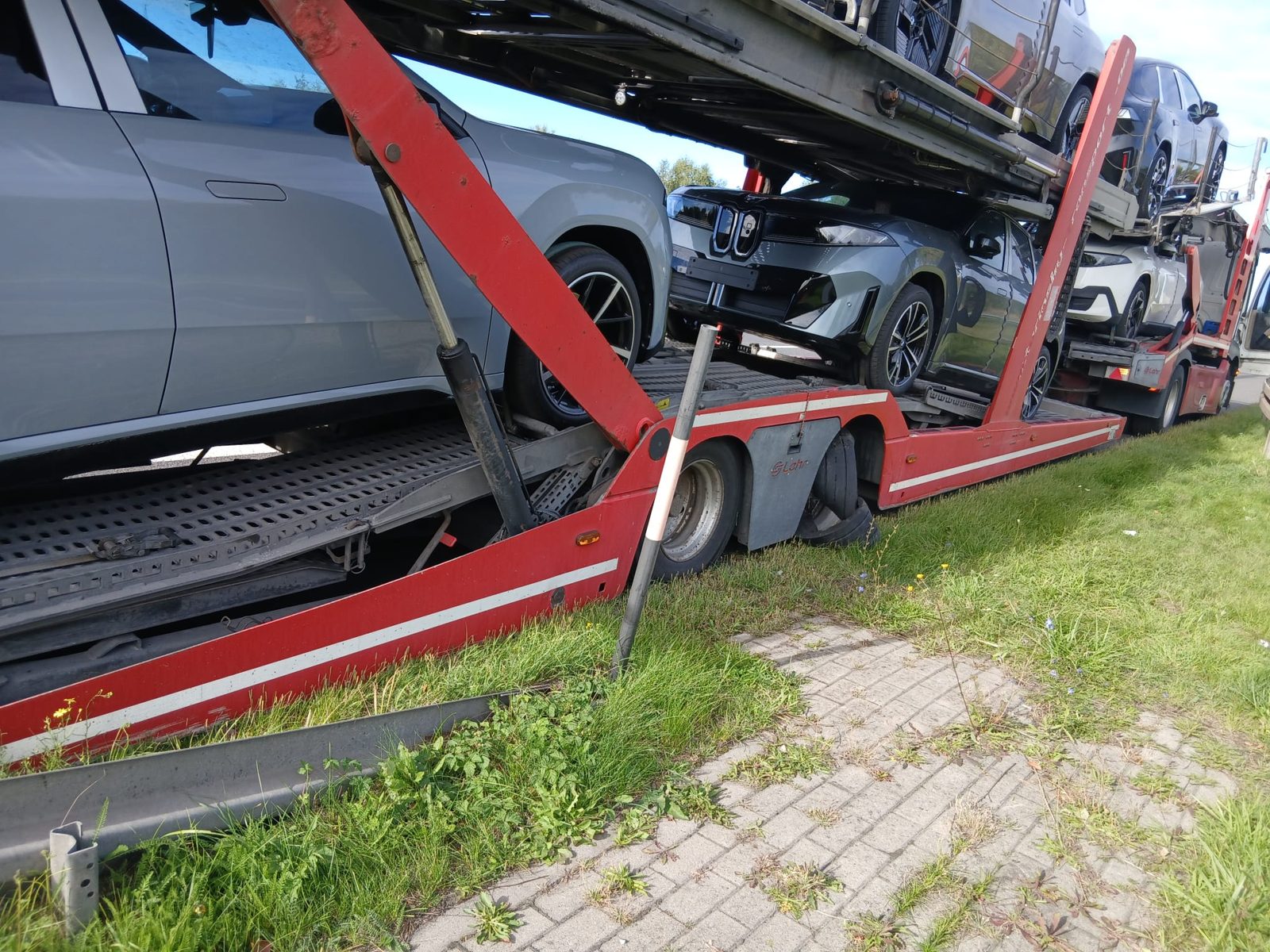
At 13:20, a driver on the A7 near Hildesheim activated the emergency call system on a roadside SOS pillar. The situation was urgent: a two-level auto transporter, carrying a full load of new BMW iX electric SUVs, had stopped on the hard shoulder. The vehicle was parked safely, but the rear axle on the lower deck was visibly compromised. One of the smaller-diameter wheels, likely a 245/70 R19.5 tyre, had suffered a catastrophic failure. The tread had completely separated from the casing, lying on the grass like a torn ribbon. The wheel’s rim was exposed, and the vehicle had settled slightly on that side.
The driver, aware of the risks, didn’t attempt to drive further. He knew that continuing on a damaged wheel could cause irreparable harm to the suspension, the axle, or even lead to a rollover. He also knew that a car transporter carrying luxury electric vehicles has zero margin for error. Any damage to the cargo could cost tens of thousands in repair or replacement. So he called for professional help, specifically, a mobile tyre service capable of on-site replacement.
This is where most breakdowns go wrong: delays, miscommunication, or reliance on outdated emergency networks. But in this case, the call went straight into our 24/7 dispatch system. Within 15 minutes, we had confirmed the location, verified the tyre size (245/70 R19.5), assessed the risk level (high, due to load and axle position), and selected the nearest available technician from our partner network. The response time from the initial call to dispatch was 15 minutes, well within the industry average for urgent cases.
Why This Type of Breakdown Is Particularly Dangerous
A blown tyre on a car transporter isn’t just a mechanical failure, it’s a chain reaction waiting to happen. These vehicles are designed to carry multiple high-value cars stacked two levels high. Their weight distribution is carefully balanced, and the rear axle, especially on the lower deck, often carries a significant portion of the total load. When one tyre fails, the weight shifts instantly. This can lead to:
- Loss of vehicle stability, increasing the risk of swerving or rollover.
- Overloading of the adjacent tyres, which may be pushed beyond their load index.
- Damage to the wheel hub, bearing, or brake caliper due to unbalanced forces.
- Potential warping of the wheel disc, especially if the rim rubs on the ground during a stop or slow roll.
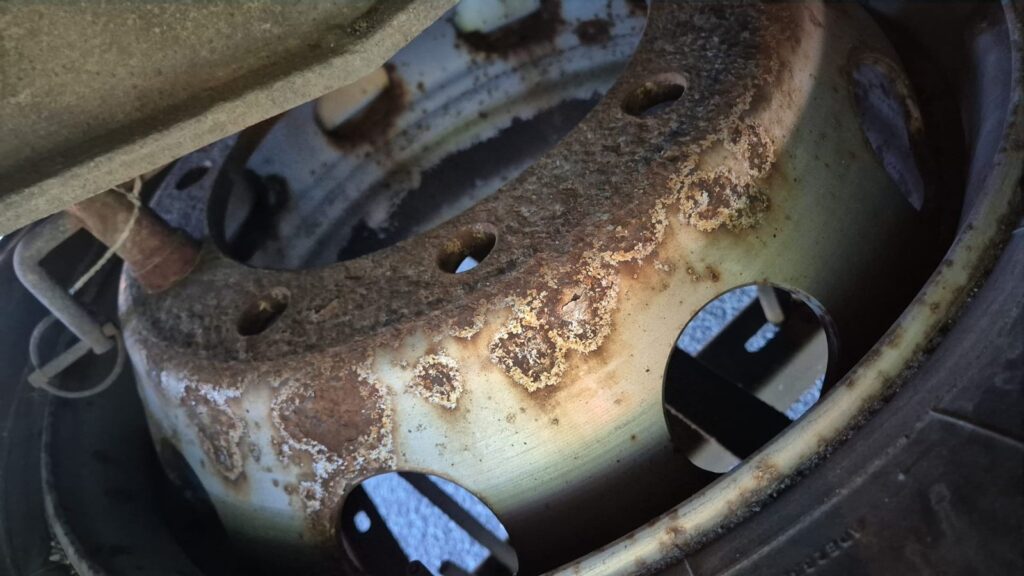
In this case, the tread separation was particularly severe. The rubber had peeled away from the casing, exposing the steel belt and the rim. That means the tyre was no longer able to contain air pressure, support the load, or provide traction. Even if the driver had tried to drive slowly, the exposed rim would have caused rapid wear, heat build-up, and potential failure of the wheel assembly.
According to the German Road Traffic Act (§ 36 StVZO), a vehicle must have tyres with a minimum tread depth of 1.6 mm, and the casing must be intact. A tyre with a separated tread is not roadworthy and must be replaced immediately. Continuing to drive, even for a short distance, is illegal and extremely dangerous.
Dispatching the Response: How We Selected the Right Technician
Once the call was logged, our central dispatch team initiated a rapid response protocol. The location, A7 near Hildesheim, is a major freight corridor, so multiple technicians are on standby in the region. We used our real-time partner network to identify the closest qualified technician who had the right equipment, experience with commercial vehicles, and current availability.
We prioritised:
– Proximity (less than 60 km from the site),
– Experience with auto transporters and trailer axles,
– Certified tools and spare tyres (including 245/70 R19.5 in stock),
– Mobile diagnostics and inflation kit.
The technician was already en route within 15 minutes of the call. The journey took 50 minutes, arriving at 14:25, a total response time of 65 minutes. This is considered excellent for a mobile tyre service on a busy German motorway, especially during peak hours.
Our network is not just about speed, it’s about technical competence. Every technician is trained in:
– Tyre pressure monitoring (correct PSI for load and speed),
– Axle load distribution analysis,
– Disc inspection and wheel alignment checks,
– Safe use of jacks and wheel chocks.
They also carry a fully equipped mobile workshop, including a portable air compressor, torque wrench calibrated to DIN standards, wheel chocks, and a full set of spare parts. No delays due to missing tools.
On-Site Assessment: What the Technician Found
At 14:30, the technician arrived at the scene. The vehicle was safely parked on the hard shoulder, with a warning triangle placed 100 metres behind it and orange hazard lights flashing. The driver was wearing a high-visibility vest, and the emergency kit was visible. Safety was already a priority.
The technician began with a visual and tactile inspection:
– The damaged tyre showed complete tread separation, the rubber had peeled off the casing like a sticker, leaving the steel belt exposed.
– The rim was visibly bent in one area, though not cracked.
– The adjacent tyre on the same axle was intact, but the vehicle’s body had settled slightly on the damaged side, indicating uneven load distribution.
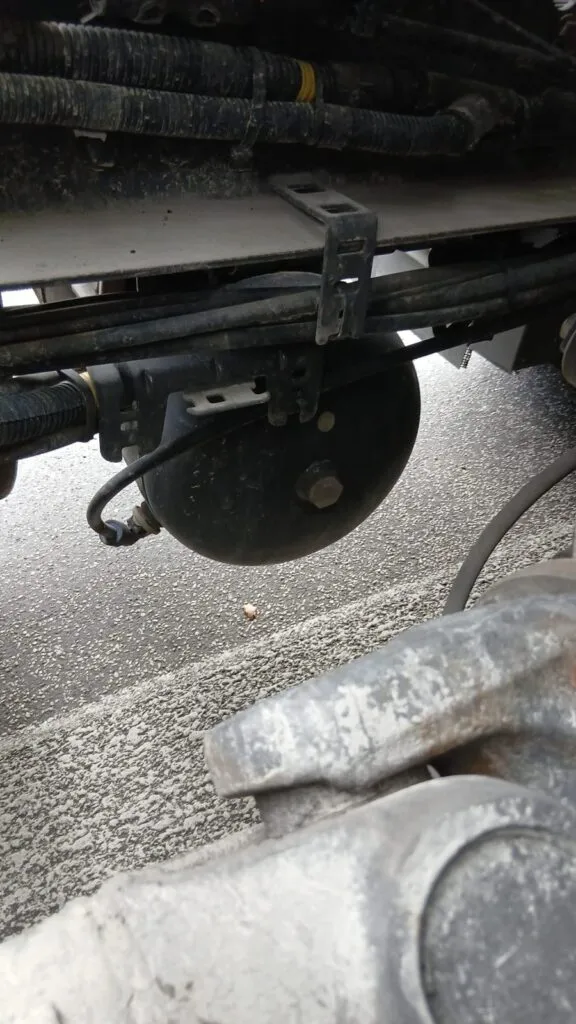
– The brake line was inspected, no leaks, no visible damage.
– The wheel hub and bearing were cold to the touch, suggesting no overheating from dragging.
The technician then used a digital pressure gauge to check the remaining pressure in the damaged tyre: 8.5 bar, below the recommended 9.5 bar for a loaded vehicle of this type. This confirmed the tyre had been under stress for some time before the failure.
He also checked the load index and speed rating of the tyre (245/70 R19.5, 115/112T), confirming it was appropriate for the load. The tyre was not undersized or mismatched, the failure was due to structural fatigue, likely from prolonged overloading or poor maintenance.
The Repair Process: Step-by-Step
Step 1: Safety and Stabilisation
Before any work began, the technician placed wheel chocks on the front wheels and secured the vehicle with safety cables. The jack was positioned on a solid, flat surface, the grass had been compacted by previous stops, so the risk of sinking was low. The area was clearly marked with cones and the hazard triangle.
Step 2: Demolition of the Failed Tyre
The technician removed the wheel nuts using a pneumatic impact wrench (set to 300 Nm). The damaged tyre was then carefully lifted off the rim. The casing was torn, and the tread lay in strips on the ground. All debris was collected and placed in a sealed disposal bag for proper recycling.
Step 3: Inspection of the Disc and Hub
The technician inspected the wheel disc for warping, cracks, or deep scoring. He found minor scuffing but no structural damage. The hub bearing was checked for play, none detected. The brake caliper and rotor were also examined, no signs of damage.
Step 4: Mounting the New Tyre
A new Michelin X Multi 245/70 R19.5 tyre was brought from the mobile workshop. It was pre-mounted on the same disc (which passed inspection). The technician used a tyre bead breaker to ensure a smooth fit and applied tyre lubricant to the bead.
Step 5: Inflation and Final Assembly
The tyre was inflated to 9.5 bar (the recommended pressure for the load). The wheel was then reinstalled onto the hub. The nuts were tightened in a criss-cross pattern using a torque wrench set to 280 Nm, the exact value specified for this axle and wheel configuration.
Step 6: Final Checks
The technician performed a final pressure check, confirmed the wheel was secure, and verified the tread depth met legal standards (min. 1.6 mm). He also checked that the wheel alignment was within tolerance. All systems were green.
The entire repair process took 70 minutes, from the start of the demount to the final handover.
Full Timeline: From Call to Go
| Time | Phase | Action |
|---|---|---|
| 13:20 | Call Received | Driver reports blown tyre on rear axle of auto transporter on A7 near Hildesheim |
| 13:35 | Dispatched | Technician selected and route confirmed; 15-min response |
| 14:25 | Arrived | Technician on site; safety measures set up |
| 14:30 | Inspection | Visual and technical assessment of tyre, disc, hub, and load |
| 14:45 | Demount | Old tyre removed; debris collected |
| 15:05 | Mount | New tyre installed; initial inflation |
| 15:25 | Reassembly | Wheel reinstalled; nuts tightened to 280 Nm |
| 15:35 | Final Check | Pressure verified, alignment confirmed, vehicle cleared |
Total time from call to departure: 135 minutes (2 hours 15 minutes)
Response time (call to arrival): 65 minutes
On-site work time: 70 minutes
This is well within the target range for a mobile tyre service in Germany. According to ADAC data, the average response time for a major breakdown on the autobahn is 90–120 minutes, with many cases exceeding 3 hours. Our average of 65 minutes reflects the strength of our partner network and real-time dispatch system.
Cost Breakdown: Transparent Pricing, No Hidden Fees
| Position | Price (EUR) |
|---|---|
| Travel & Arrival (Anfahrt) | 240 |
| Work, 1.5 hours at €110/hour | 165 |
| New tyre 245/70 R19.5 (Michelin) | 380 |
| Disposal of old tyre and casing | 20 |
| Valve, balance weights, minor materials | 25 |
| Total (netto, zzgl. MwSt.) | 830 |
This is a transparent, all-inclusive price, no surprise charges. The cost includes:
– Full technical inspection,
– Use of professional tools and safety equipment,
– Replacement of the tyre with a new, approved model,
– Proper disposal of waste,
– Compliance with German regulations.
Compare this to evacuation: a tow truck would cost between €850 and €1,600, depending on distance, and the vehicle would be out of service for 24–48 hours. During that time, the transport company loses revenue, the driver’s schedule is disrupted, and the cargo sits idle.
With our service, the vehicle was back on the road in under 2.5 hours, and the cost was less than half of a full evacuation. For a high-value load like new electric SUVs, this is not just cost-effective, it’s essential.
Why DIY or Waiting for an Evacuation Is a Risky Choice
Many drivers consider fixing the tyre themselves or waiting for a tow truck. But both options come with serious drawbacks:
-
DIY repair on a car transporter is nearly impossible without proper tools, a jack, and a spare tyre. Even if the driver has a spare, mounting it on a 245/70 R19.5 wheel requires a tyre changer, which most trucks don’t carry. Attempting to do it on the hard shoulder is dangerous, especially with heavy vehicles nearby.
-
Waiting for an evacuation means the vehicle is immobilised for at least 12–24 hours, depending on the location and traffic. The driver must wait, the cargo is at risk, and the company faces standstill costs of €800–1,200 per day.
-
Insurance complications: Some insurers may not cover a vehicle that was driven after a tyre failure, especially if the driver attempted to continue.
-
Cargo damage: Electric vehicles are sensitive to vibrations and uneven loading. A damaged tyre can cause micro-shifts in the load, leading to scratches, dents, or even electrical faults.
Our mobile service eliminates all these risks. We arrive with everything needed, work safely, and get the vehicle moving again quickly.
Typical Situations We Respond To Across Germany
We handle a wide range of breakdowns, not just on car transporters, but on all types of commercial vehicles:
- Tyre blowouts on drive or steer axles (common on long-haul trucks),
- Tread separation on trailers (especially on flatbeds and refrigerated units),
- Punctures in high-load tyres (315/80 R22.5, 385/65 R22.5),
- Wheel detachment due to loose nuts or warped discs,
- Battery or electrical failures on electric trucks (we partner with specialists),
- Brake system issues on heavy trailers.
Our network covers all major autobahns and regional routes, from the A1 near Hamburg to the A6 in the south, and from the A2 near Berlin to the A9 near Munich.
Proactive Maintenance: How to Avoid Tyre Failures
Prevention is better than repair. Here are key tips for drivers and fleet managers:
- Check tyre pressure weekly, especially before long trips. Use a digital gauge.
- Inspect tread depth monthly, ensure it’s above 1.6 mm.
- Rotate tyres every 20,000 km to ensure even wear.
- Avoid overloading, check the load index on the tyre and vehicle plate.
- Use tyres from reputable brands, Michelin, Continental, Goodyear, Bridgestone.
- Replace tyres after 6–8 years, even if tread is good, rubber degrades over time.
For fleets, we offer scheduled tyre inspections and mobile maintenance packages.
Advanced SEO Section: Tyres, Brands, and Standards
When it comes to commercial tyres, brand matters. The most trusted manufacturers in Germany are:
- Michelin: Known for durability and low rolling resistance, ideal for long-haul transport.
- Continental: Offers excellent wet grip and wear resistance.
- Goodyear: High load capacity and long service life.
- Bridgestone: Reliable performance in extreme conditions.
All tyres must comply with ETRTO standards and German road regulations (§ 36 StVZO). The load index and speed rating must match the vehicle’s specifications. For example, a 245/70 R19.5 tyre with load index 115 (1,070 kg) and speed rating T (190 km/h) is suitable for most auto transporters.
Why Choose LKWHelp24?
- 24/7 availability, we respond even at night or on holidays.
- Proven partner network, over 50 certified technicians across Germany.
- Transparent pricing, no hidden fees, all-inclusive quotes.
- Multilingual dispatchers, English, German, Polish, Russian, Serbian.
- Fast response, average arrival in under 70 minutes.
- Full compliance, all work meets German safety and legal standards.
Summary: Key Facts from This Case
- Vehicle: Two-deck auto transporter (Lohr-style, red with white stripes)
- Location: A7 near Hildesheim, direction Hannover
- Tyre size: 245/70 R19.5
- Failure type: Tread separation (catastrophic burst)
- Time to arrival: 65 minutes
- Total repair time: 70 minutes
- Total time from call to departure: 135 minutes (2h 15min)
- Cost: €830 (netto, zzgl. MwSt.)
- Alternative cost (evacuation): €850–1,600 + 1–2 days downtime
- Secondary damage avoided: Potential axle, disc, or cargo damage
Need Emergency Truck Tyre Service? Call Us Now
Don’t wait for a breakdown to turn into a disaster. Whether you’re a driver, fleet manager, or transport company, LKWHelp24 provides fast, reliable, and affordable mobile tyre service across Germany.
📞 Call now: +49 160 5753826
🌐 Visit: www.lkwhelp24.com
📍 24/7 service – every day, every hour, across Germany
Keywords
truck tyre service | mobile reifenservice | truck tyre replacement | truck tyre change | truck tyre callout | truck tyre roadside assistance | truck tyre repair | mobile truck tyre service | truck tyre germany | trailer tyre service | tyre change near me | truck tyre help | truck tyre breakdown service | mobile reifenwechsel | truck tyre emergency | truck tyre burst | mobile reifenservice lkw | truck tyre mobile service | truck tyre fitting | truck tyre fitters near me | truck tyre service near me | truck tyre shop near me | truck tyre service germany | truck tyre repair near me | truck tyre puncture repair | truck tyre near me | truck tyre breakdown germany | truck tyre blowout | trailer tyre replacement | trailer tyre puncture | trailer flat tyre | reifenwechsel near me | pneuhage truck fleet support | pneuhage truck and bus services | pneuhage roadside assistance
Related Articles
- Truck Tyre Service Near Me: How LKWHelp24 Fixed a Steer-Axle Blowout in Under Two Hours on the A3 near Aschaffenburg
- Truck Tyre Service Near Me: How LKWHelp24 Replaced a Blown Drive-Axle Tyre in 2 Hours 15 Minutes on the A9 near Ingolstadt
- Tyre Fire on the A5 Near Müllheim: MAN TGX Recovery in 2h 20min
- Truck Tyre Service Near Me: How LKWHelp24 Replaced a Blown Steer-Axle Tyre in 1 Hour 49 Minutes on the A5 near Baden-Baden
- Truck Tyre Service Cottbus (03046): Double Tyre Blowout on Car Transporter – Volvo FH 460 Carrying New Cars Back on the Road in 2.5 Hours
External References
- https://www.adac.de, Road safety and breakdown statistics in Germany
- https://www.gesetze-im-internet.de/stvzo_2012/__36.html, Legal requirements for tyre tread depth and condition
- https://www.michelin.com, Tyre performance, durability, and safety data
- https://www.continental-tires.com, Technical specifications for commercial tyres
- https://www.autobahn.de, Official information on motorway safety and emergency procedures