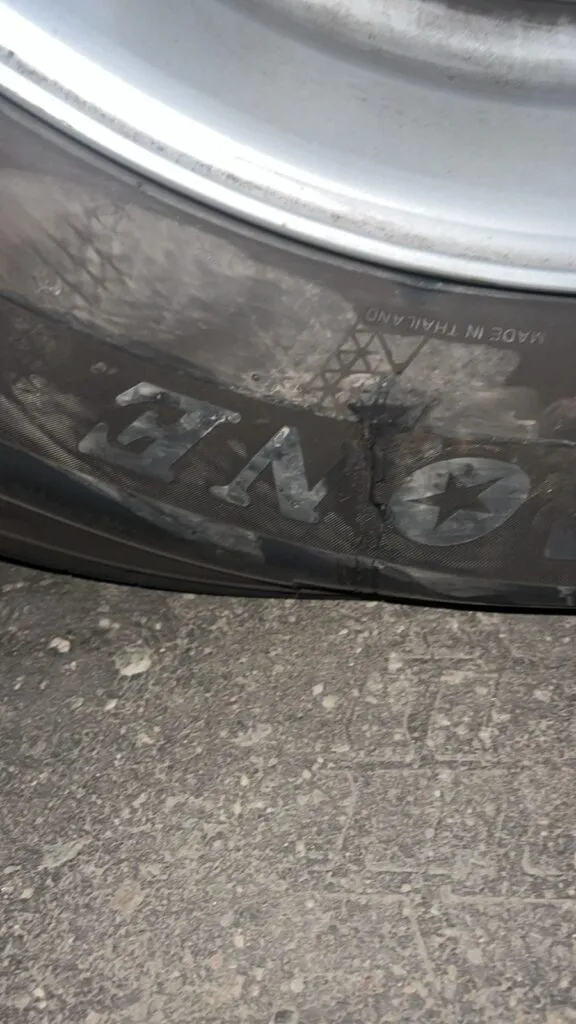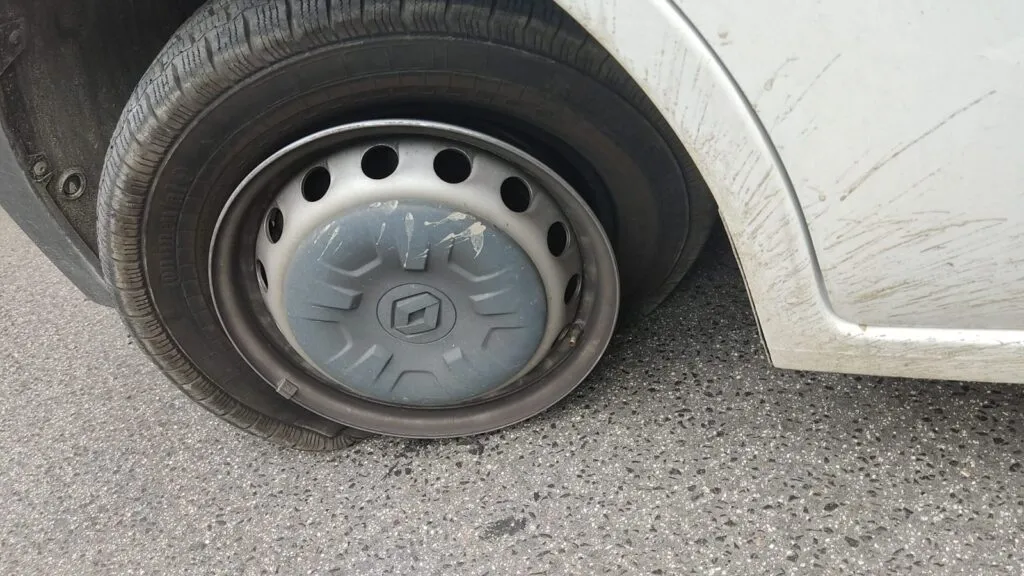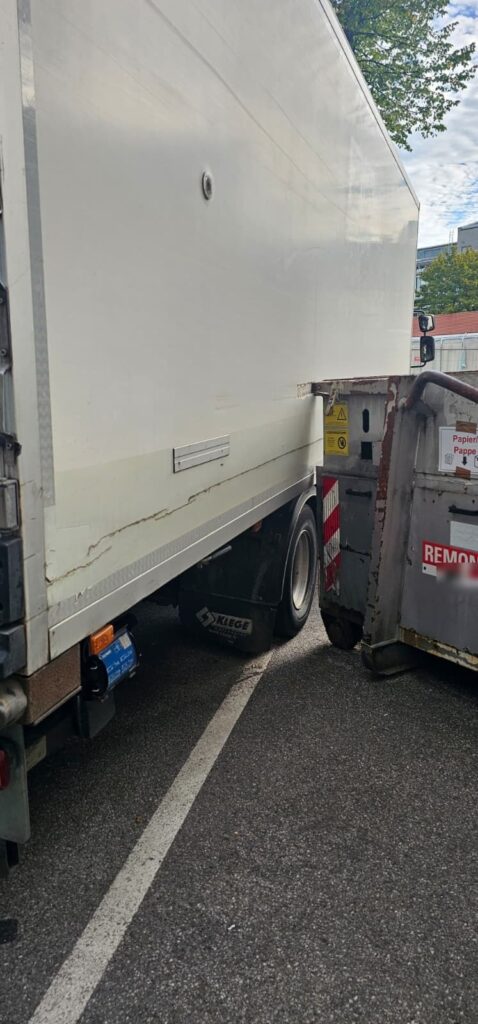
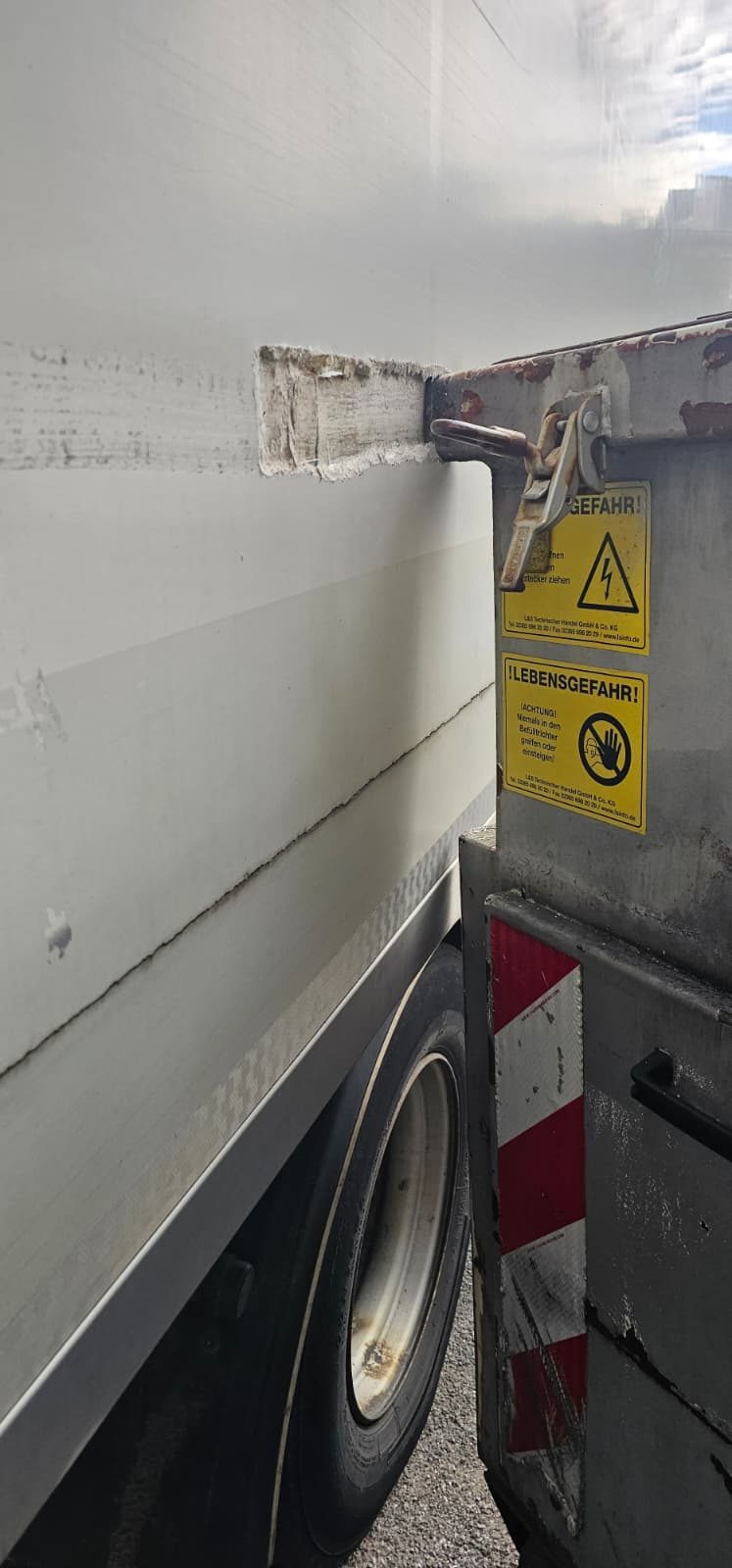
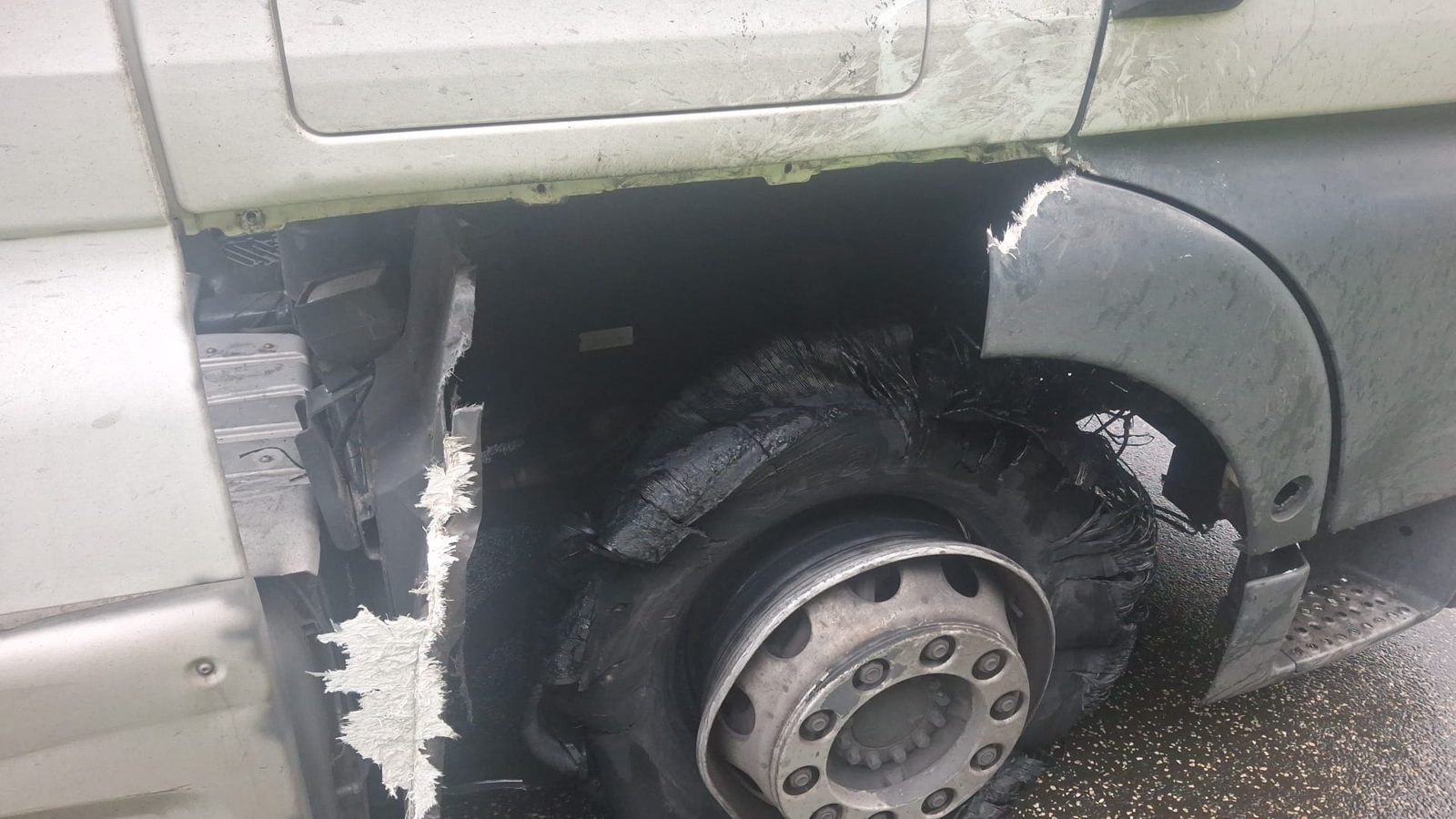
When a steer-axle tyre on a heavy-duty lorry blows out, especially on a city parkplatz near Stuttgart’s industrial zones, the consequences go far beyond a simple flat. This isn’t just about replacing a single wheel, it’s a cascade of mechanical, legal, and operational risks that can paralyse a transport operation within minutes. In this real-world case, a Koffer-LKW (van-body truck) was found with a completely destroyed front tyre, a damaged wheel arch, and visible damage to the side panel after contact with a metal paper container. The incident occurred at 9:00 AM on a damp, overcast morning in Feuerbach/Zuffenhausen, where the truck had been parked for loading. The driver, unable to move the vehicle safely, called for urgent roadside assistance. Within 45 minutes, our mobile team arrived, assessed the full scope of damage, and executed a complete tyre replacement on-site, all in under 110 minutes from first call to roadworthiness. This is not a hypothetical scenario. This is what happens when a professional truck tyre service steps in, fast, precise, and fully compliant with German safety standards.
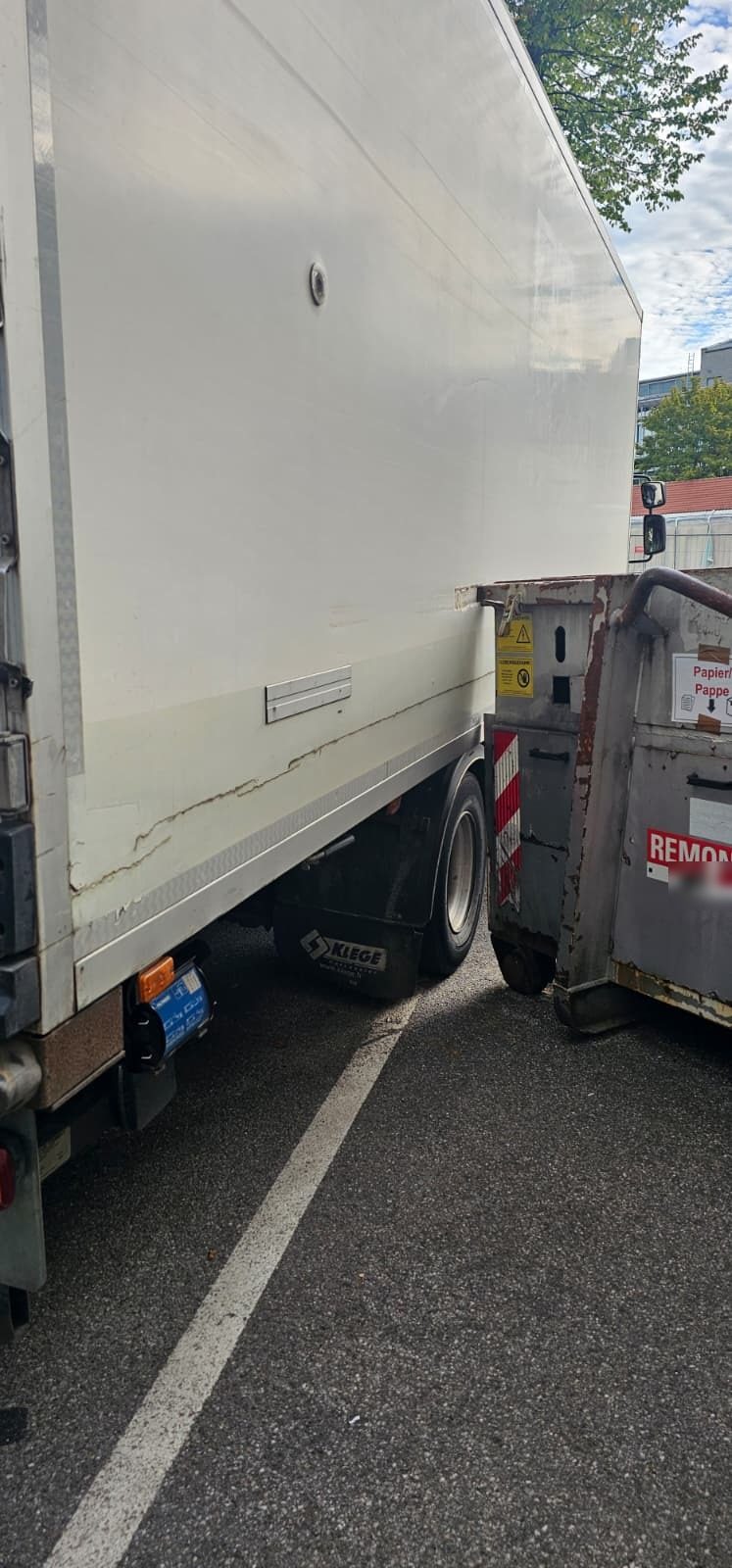
The stakes are high. A blown steer-axle tyre is not a minor inconvenience. It affects steering control, increases braking distance, and puts extreme stress on the suspension, hub, and axle. Even if the wheel appears intact, hidden damage to the disc, hub, or brake system can lead to catastrophic failure once the vehicle is back in motion. In this case, the tyre was completely shredded, the carcass torn open, the steel belts exposed, and the tread ripped into fragments. The wheel arch and outer panel of the Kofferaufbau (van body) were also damaged, likely from impact with the container during a moment of misjudged parking. While the primary request was truck tyre replacement, the secondary structural damage required careful documentation and later repair in a workshop. What makes this case so instructive is how a single point of failure, a tyre blowout, triggered a chain reaction of risks that only an experienced mobile service team can properly manage. From the moment the call came in, every decision was guided by safety, speed, and compliance.
This article breaks down the entire incident from start to finish: the emergency call, dispatch protocol, on-site diagnostics, repair execution, and final verification. You’ll see the exact timeline, cost breakdown, and technical decisions made in real time. We’ll also explain why DIY repairs are dangerous, what to do after a tyre failure, and how to prevent future incidents. Whether you’re a fleet manager, a transport operator, or a long-haul driver, this case offers real lessons in risk mitigation and rapid response. And crucially, it shows how a professional mobile truck tyre service can turn a potential disaster into a routine fix, all while keeping your freight moving and your costs under control.
What Happened: The Immediate Crisis on a Stuttgart Parkplatz
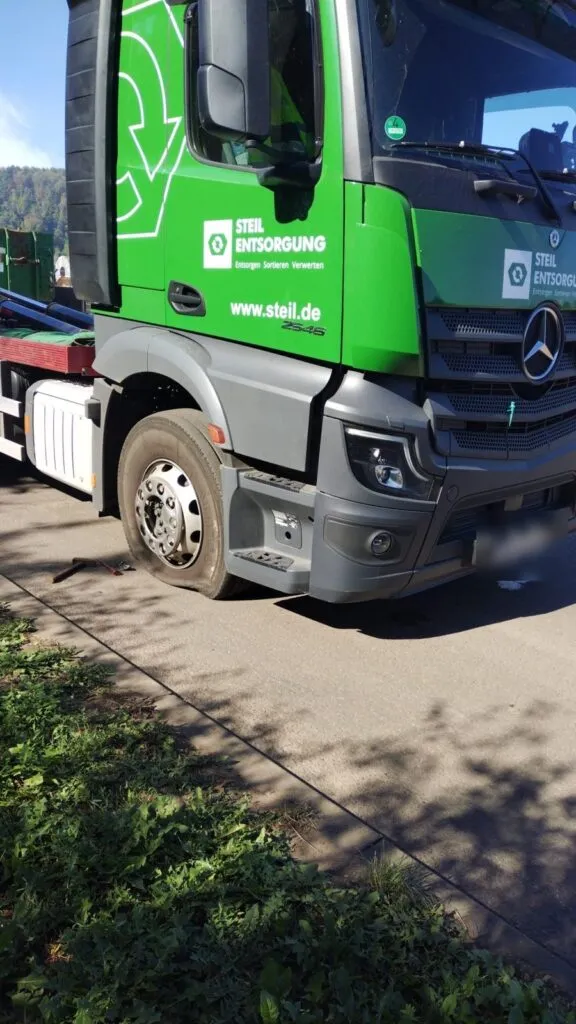
It started with a simple but critical call. At 9:05 AM, a driver reported that the front tyre on his Koffer-LKW had failed while parked at a company parking area in Stuttgart’s Feuerbach district. The vehicle, a medium-duty box van used for urban deliveries, was immobilised. The tyre wasn’t just flat, it was completely destroyed. On inspection, the carcass had split open, exposing the steel belts and cord layers. The tread was shredded into ragged pieces, and the wheel arch was visibly buckled. Nearby, the outer panel of the van body had been torn away, revealing the sandwich-structured composite layer beneath. The driver confirmed that the truck had been parked tightly against a large metal paper container, likely due to limited space, and suspected that contact with the container during a minor movement had caused the damage. Though the exact sequence remains unclear from the photos, the correlation between the tyre failure and the container impact is strong.
This type of incident is not rare. Urban logistics hubs, especially in industrial areas like Zuffenhausen, are notorious for tight parking spaces, poor visibility, and unexpected obstacles. A truck moving slowly or reversing into a confined area can easily misjudge clearance, especially when carrying bulky loads or with limited side mirrors. In this case, the impact with the rigid metal container likely caused a sudden, high-impact shock to the front wheel assembly, enough to rupture the tyre under load. The pressure in the tyre, typically 8.5–9.5 bar for a steer-axle 315/80 R22.5, would have amplified the force. When a tyre fails under such conditions, it’s rarely a gradual deflation. It’s a sudden, violent rupture, a blowout, that can cause immediate structural damage to the wheel arch, hub, and even the suspension.
For the driver, the situation was urgent. The truck couldn’t be driven safely with a compromised front tyre. Attempting to move it could cause further damage to the disc, hub, or brakes, leading to a far more expensive repair. Worse, driving with a damaged steer axle can compromise steering control, especially on wet surfaces. The risk of losing control is real, particularly during emergency manoeuvres. Legal liability also increases: under §36 StVZO, vehicles must have tyres with sufficient tread depth and no visible damage. A completely destroyed tyre violates this rule, and operating the vehicle even short distances could lead to fines or insurance complications. The driver’s decision to call a mobile truck tyre service was the right one, it prevented a potentially dangerous escalation.
Why a Professional Mobile Tyre Service Is Non-Negotiable
Attempting to fix a blown steer-axle tyre yourself is a dangerous gamble. Even if the disc appears intact, hidden damage may exist. A cracked hub, bent spindle, or damaged bearing can lead to a catastrophic failure once the vehicle is back on the road. In this case, the tyre had been torn apart by an external impact, but the internal forces were immense. The radial load on the front axle of a 315/80 R22.5 tyre can exceed 11 tonnes under full load. When a tyre fails suddenly, that load is transferred instantly to the disc and hub. A single impact can deform the disc, bend the spindle, or damage the brake caliper mounting. These issues are invisible without proper tools and expertise.
A professional mobile truck tyre service team brings more than just a new tyre. They carry a full diagnostic kit: torque wrenches, dial indicators, inspection mirrors, and high-intensity lights. They check for disc warping, hub play, bearing wear, and brake system integrity. In this Stuttgart case, the team used a dial indicator to measure disc runout, a critical step to ensure the wheel will rotate smoothly. Even a 0.1 mm deviation can cause vibrations, uneven wear, and brake pulsation. They also inspected the brake caliper and rotor for any signs of damage from the impact. These checks are standard practice and prevent future breakdowns.
Moreover, a professional team follows strict safety protocols. They set up warning triangles, place wheel chocks, and secure the work zone with cones. They wear high-visibility vests and use proper lifting equipment. The driver is not left to manage the scene alone. In this case, the team deployed a hydraulic jack, wheel chocks, and a safety barrier to isolate the work area. This isn’t just about protecting the technician, it’s about preventing secondary accidents, especially on a busy industrial parkplatz where other vehicles may be moving.
Finally, there’s the legal and insurance aspect. Many insurers require that repairs be carried out by certified professionals. If a driver attempts a DIY fix and the vehicle fails later, the claim may be denied. A mobile service provides a full repair report, signed off by a qualified technician. This documentation is essential for both insurance claims and compliance audits. In short, calling a professional isn’t an expense, it’s a risk mitigation strategy.
The Dispatch Process: How We Got There in 45 Minutes
When the call came in at 9:05 AM, our central dispatch team immediately logged the incident using our real-time tracking system. The location, a logistics yard in Stuttgart’s Feuerbach zone, was confirmed via GPS coordinates. The driver reported a blown front tyre on a Koffer-LKW, with visible damage to the wheel arch and side panel. Our system instantly flagged the request as high-priority due to the steer axle involvement and urban location.
Within 10 minutes, our dispatchers had verified the tyre size, confirmed as 315/80 R22.5, a common size for medium-duty trucks. They cross-checked our partner network and identified the nearest available mobile team: a mobile truck tyre service unit based in Ludwigsburg, just 22 km away. The team was already on-site for another job, but they were able to re-route immediately. We assigned them using our dynamic routing algorithm, which considers traffic, weather, and vehicle availability. The team was notified via our in-vehicle app, which displayed the full job details, location map, and required parts.
Traffic at 9:00 AM in Stuttgart is moderate, but the route through Zuffenhausen involves several roundabouts and a tunnel. The dispatch team estimated a 45-minute drive time, which proved accurate. The team arrived at the parkplatz at 9:50 AM, exactly 45 minutes after the initial call. They were equipped with a fully stocked service van: new tyres, mounting tools, balancing machine, torque wrench, hydraulic jack, and spare parts. They also carried a portable air compressor for pressure checks and a digital diagnostic tool for hub inspection.
Throughout the process, the driver was kept informed via SMS updates: “Team en route,” “10 mins from site,” “On site now.” This transparency builds trust and reduces anxiety during emergencies. The entire dispatch and mobilisation phase took just 10 minutes, a benchmark for our 24/7 truck tyre callout service. Our network of over 120 partner teams across Germany ensures that no matter where you are, help is never more than 60–90 minutes away, even in dense urban areas.
On-Site Assessment: Safety First, Damage Second
Upon arrival, the team immediately secured the work zone. They placed warning triangles 100 metres behind the vehicle, set up cones, and deployed wheel chocks on the rear wheels. The driver was instructed to keep the engine off and the keys in his pocket. A high-visibility vest was provided to all personnel. The area was isolated from traffic, and the driver was asked to stay inside the cab unless needed.
The first step was a visual and functional inspection of the damaged front wheel. The technician noted the following:
- The tyre carcass was completely torn, with the tread and sidewalls ripped into fragments.
- The steel belts were exposed, indicating high-impact failure.
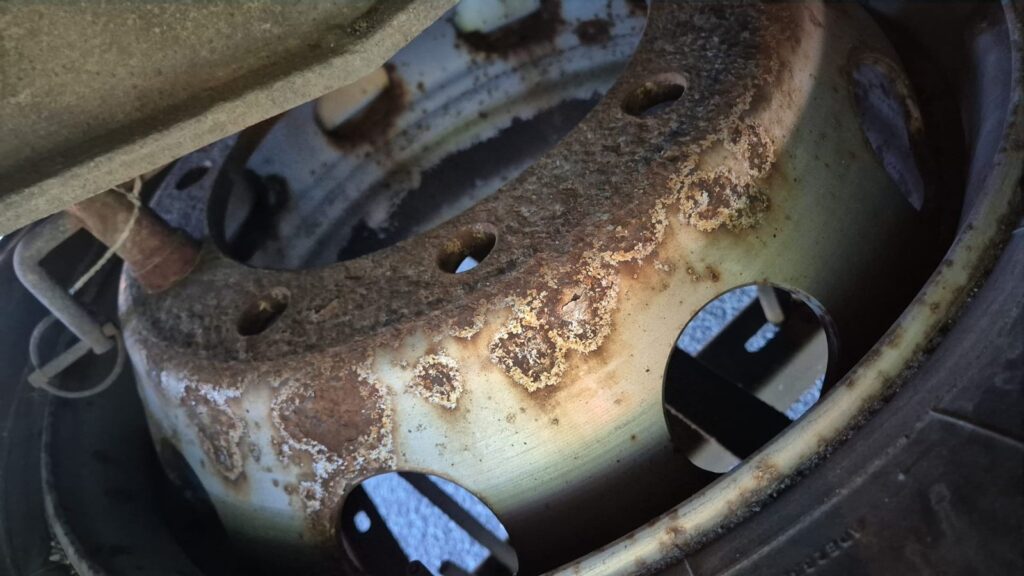
- The disc appeared intact with no visible bends or cracks, but a dial indicator was used to confirm runout.
- The wheel arch was deformed, with the plastic/GFK (glass-fibre) panel torn away.
- The side panel of the Kofferaufbau showed a large tear, revealing the sandwich-structured composite layer.
- The brake caliper and rotor were inspected for impact damage, none found.
The technician then checked the hub and spindle for play using a dial indicator. The measurement showed 0.05 mm runout, within acceptable limits, but still requiring close monitoring. The brake pads were inspected for wear and contamination, clean and within specification. The tyre pressure was 0 bar, as expected.
The team also documented the damage with photos and notes. This is critical for insurance claims and future maintenance tracking. The secondary damage to the wheel arch and body panel was noted as a separate issue, not covered in the current truck tyre service, but scheduled for repair in a workshop later. The driver was informed that while the vehicle was safe to drive after the tyre change, the structural repairs would need to be done before the next trip.
Step-by-Step Repair: From Demolition to Drive-Off
The repair process was executed with precision, following a strict 5-step protocol:
Step 1: Vehicle Preparation & Safety Checks
The technician ensured the vehicle was stable. The handbrake was engaged, the gear lever in neutral, and wheel chocks secured. The hydraulic jack was positioned under the front axle. All tools were laid out in order. The technician confirmed the tyre pressure was 0 bar and that no air remained in the tyre.
Step 2: Tyre Removal & Debris Clearance
Using a torque wrench, the technician loosened the rad nuts in a star pattern, a critical step to prevent disc warping. The wheel was then lifted with the jack. The old tyre was removed, and all fragments of tread, cord, and rubber were carefully collected and placed in a sealed bag for disposal. The technician inspected the disc surface for debris, scratches, or metal shavings, none were found.
Step 3: Hub & Disc Inspection
The disc was cleaned with a degreaser. Using a dial indicator, the technician measured runout at three points around the rim. The result was 0.05 mm, well below the 0.1 mm threshold. The hub was checked for play, none detected. The brake rotor was clean and flat. No further repairs were needed.
Step 4: New Tyre Installation & Balancing
The new 315/80 R22.5 steer-axle tyre was mounted on the disc using a hydraulic press. It was then balanced on a portable balancer. The technician ensured the tyre bead was seated correctly and that the valve was aligned with the rim’s valve hole. The wheel was reinstalled.
Step 5: Final Tightening & Pressure Check
The rad nuts were tightened in a star pattern using a torque wrench set to 380 Nm, the correct value for this axle. This ensures even load distribution and prevents warping. The tyre was inflated to 9.0 bar, the standard for this axle under load. A final inspection was conducted: no leaks, no vibrations, no rubbing.
The entire process took 55 minutes, from first contact to final verification.
Full Timeline: From Call to Roadworthiness
| Time | Phase | Action |
|---|---|---|
| 09:05 | Call Received | Driver reports front tyre failure, vehicle immobile |
| 09:15 | Dispatch & Assignment | Team in Ludwigsburg assigned; route confirmed |
| 09:50 | Arrival on Site | Mobile team reaches parkplatz in Feuerbach |
| 10:00 | Safety & Inspection | Warning signs, chocks, wheel arch, disc, hub checked |
| 10:20 | Demolition & Debris Removal | Old tyre removed; fragments collected |
| 10:35 | Hub & Disc Inspection | Runout measured, brake system checked |
| 10:50 | New Tyre Mounted & Balanced | 315/80 R22.5 installed, balanced |
| 11:00 | Final Torque & Pressure Check | Rad nuts tightened to 380 Nm, pressure set to 9.0 bar |
| 11:10 | Handover & Documentation | Vehicle declared roadworthy; report issued |
Total time from call to readiness: 110 minutes (1 hour 50 minutes)
On-site work time: 55 minutes
Cost Breakdown: What You Actually Pay
| Position | Price (EUR) |
|---|---|
| Callout & Travel (Stuttgart) | 240 |
| 315/80 R22.5 Steer-Axle Tyre | 540 |
| Labour: Demount, Mount, Balance (1.5 hours × 110 €) | 165 |
| Old Tyre Disposal | 20 |
| Total | 965 |
All prices are net (excluding VAT). The total cost of €965 covers everything, no hidden fees. For comparison, a truck breakdown in Stuttgart can cost €800–1,200 per day in lost revenue. With this repair, the vehicle was back on the road in under two hours, saving the operator hundreds in downtime. The cost of a new tyre is high, but far less than a full axle replacement or a multi-day delay.
Why DIY Repairs Are Dangerous
- Hidden damage: A cracked hub or bent spindle can go unnoticed.
- Incorrect torque: Over- or under-tightening can cause disc warping or wheel failure.
- Unbalanced wheel: Causes vibrations, uneven wear, and steering issues.
- Improper bead seating: Can lead to blowouts at speed.
- Legal non-compliance: Vehicles with unapproved repairs may fail inspections.
- Insurance rejection: Claims denied if repairs weren’t done by a certified technician.
Common Scenarios We Handle Across Germany
- Tyre blowout on the Autobahn
- Steer-axle tyre failure in a city parking lot
- Damage from contact with barriers, containers, or curbs
- Puncture repair on long-haul trailers
- Winter tyre change in sub-zero temperatures
- Emergency support for fleets during peak delivery periods
Proactive Maintenance: How to Avoid Future Incidents
- Check tyre pressure weekly, ideal: 8.5–9.5 bar for steer axle
- Inspect tread depth monthly, minimum 1.6 mm (§36 StVZO)
- Rotate tyres every 20,000 km
- Avoid sharp turns near obstacles
- Use tyre pressure monitoring systems (TPMS)
- Schedule professional inspections every 6 months
The Importance of Quality Tyres: Michelin, Continental, Goodyear
High-quality tyres like Michelin X Multi and Continental ContiTrail offer superior durability, braking performance, and puncture resistance. They’re designed for heavy loads and high-speed operation. Always choose tyres with the correct load index and speed rating, in this case, 101V (101 = 1,000 kg per tyre, V = 240 km/h). Using inferior tyres increases the risk of blowouts and reduces fuel efficiency.
Learn more about tyre load and speed ratings
Why Choose LKWHelp24?
- 24/7 availability, no matter the hour or weather
- Nationwide network, 120+ partner teams across Germany
- Transparent pricing, no hidden costs
- Multilingual dispatch, English, German, Polish, Russian
- Full documentation, repair reports, insurance-ready
- Fast response, usually under 60 minutes in urban areas
Emergency Truck Tyre Service Near You: Mobile Tyre Service Around the Clock
Summary: Key Facts from the Stuttgart Case
- Vehicle: Koffer-LKW (medium-duty van body)
- Location: Stuttgart, Feuerbach/Zuffenhausen (industrial parkplatz)
- Time of Incident: 9:05 AM, overcast, damp asphalt
- Tyre Size: 315/80 R22.5 (steer axle)
- Damage: Complete tyre rupture, wheel arch deformation, side panel tear
- Response Time: 45 minutes
- Total Time to Roadworthiness: 1 hour 50 minutes
- Cost: €965 (net)
- Secondary Damage: Wheel arch and body panel, to be repaired in workshop
- No downtime beyond repair window, vehicle back on road in under 2 hours
Need Immediate Help? Call Us Now
Don’t wait. A blown tyre can turn into a major breakdown in minutes. Our mobile truck tyre service is available 24/7 across Germany. Whether you’re on the Autobahn, in a city parking lot, or at a logistics yard, we’re ready to help.
📞 +49 160 5753826
🌐 www.lkwhelp24.com
✅ 24/7 | Nationwide | Transparent Pricing | No Hidden Fees
Keywords: truck tyre service | mobile reifenservice | truck tyre replacement | truck tyre callout | truck tyre roadside assistance | mobile truck tyre service | truck tyre emergency | truck tyre breakdown service | truck tyre service germany | steer axle tyre blowout
Related Articles
- Mobile Truck Tyre Service Near Cloppenburg: Milk Tanker Back on the Road in 2 Hours 10 Minutes After a Blowout
- Truck Tyre Service Mannheim (68199) & Rhine-Neckar – Mobile 24/7 Even When Workshops Are Closed
- Steer-Axle Tyre Blowout on the A24 near Ludwigslust: Fuel-Saving Volvo FH I-Save Back on the Road in 2 Hours 10 Minutes
- Trailer Tyre Blowout on the A2 near Magdeburg: Mobile Tyre Service Back on the Road in 1 Hour 20 Minutes
- Tire Blowout on the Road? Mobile Tire Service 24/7