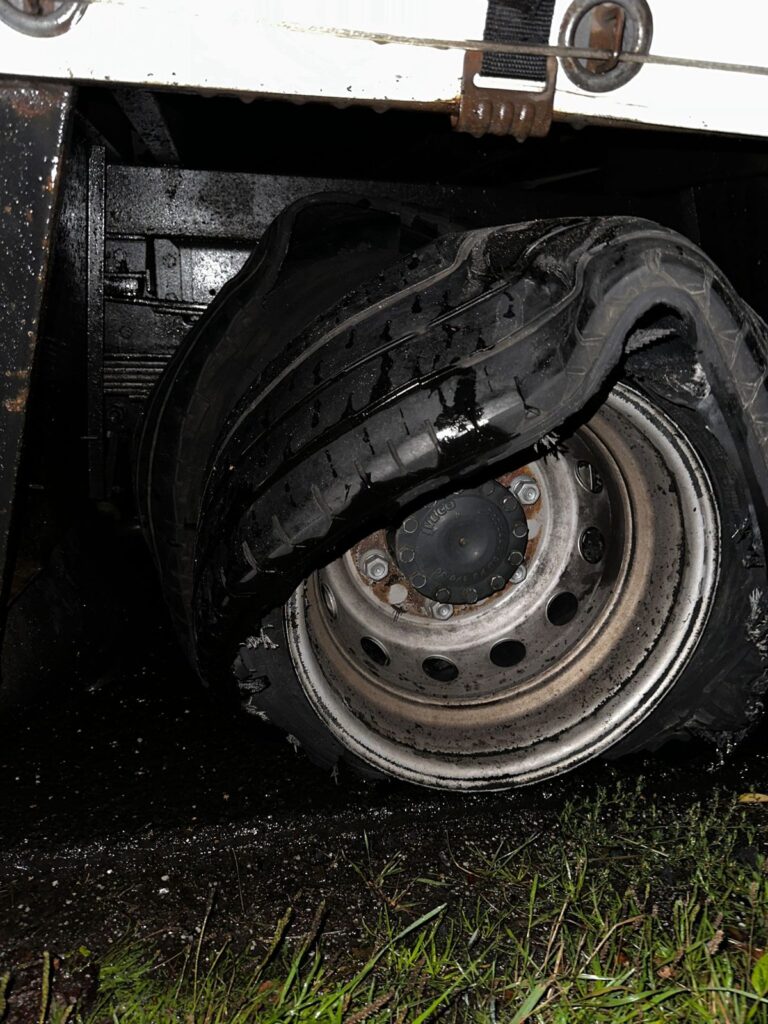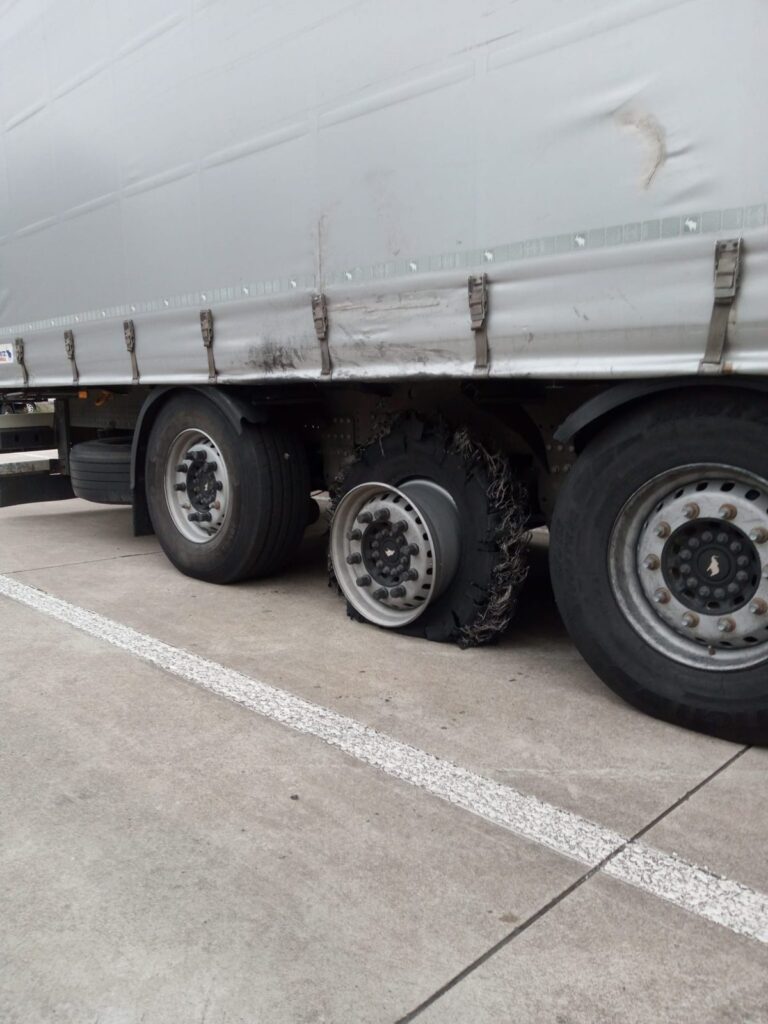
On Friday morning, 28 August 2026, a Latvian-registered semi-trailer lost a tyre on the A4 near Gotha in Thuringia, heading west towards Frankfurt. The driver called us at 08:53. By 10:43 the trailer was rolling again with a new 385/65 R22.5 on the centre axle. The whole job took 110 minutes from call to departure, and the invoice came to EUR 895 net. Our truck tyre service crew reached the site 47 minutes after the call, and nobody had to tow anything.
This write-up walks through that callout hour by hour. We use it because it is a very ordinary breakdown with a clean paper trail: one burst tyre, an undamaged alloy rim, a trailer with a full load of freight and a driver who needed to be in Frankfurt that evening. If you run lorries, manage a fleet or simply want to know what a roadside tyre change on a three-axle trailer involves, the numbers below are real.
What happened on the A4 near Gotha?
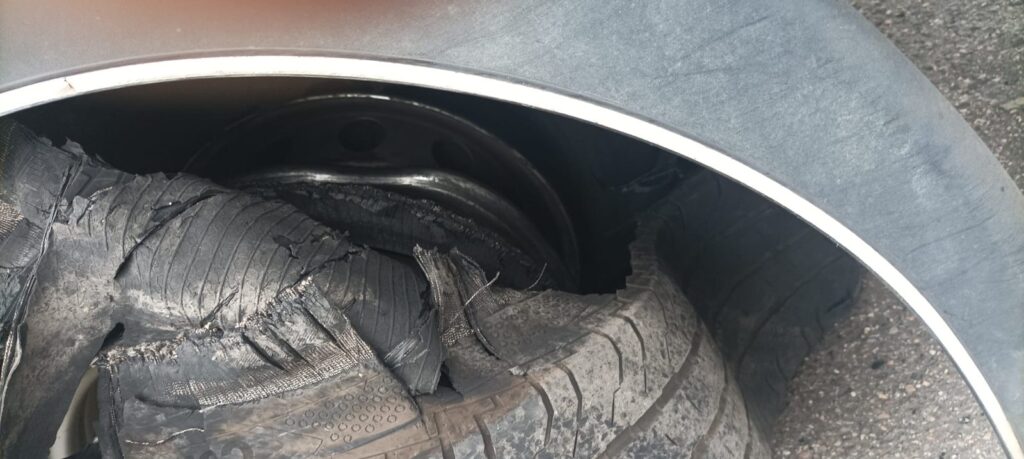
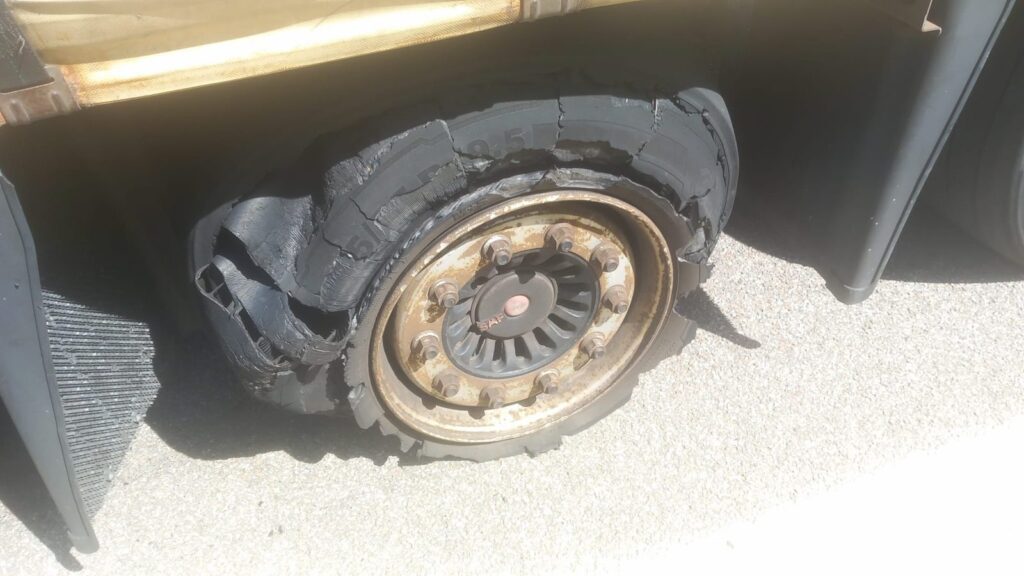
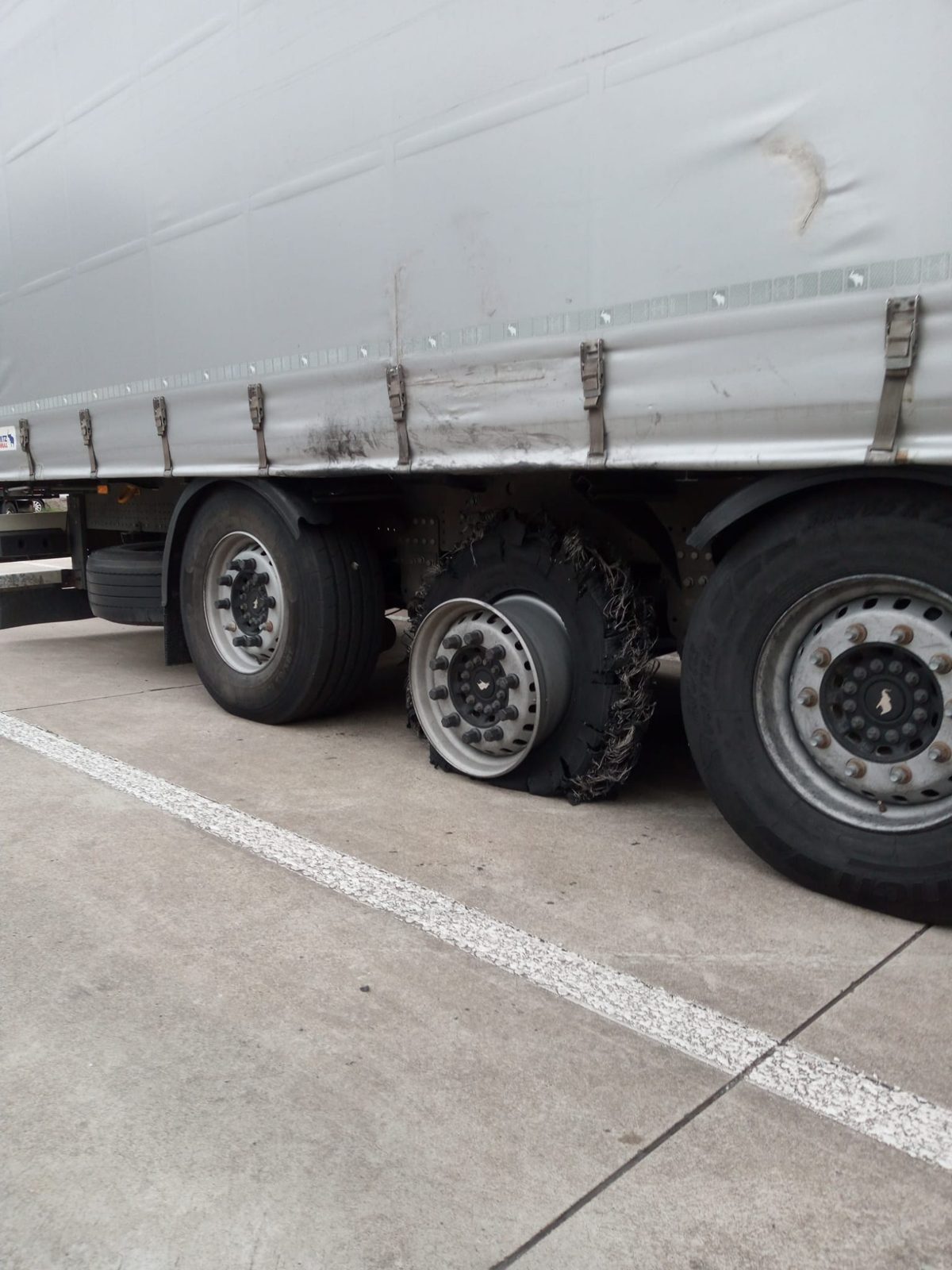
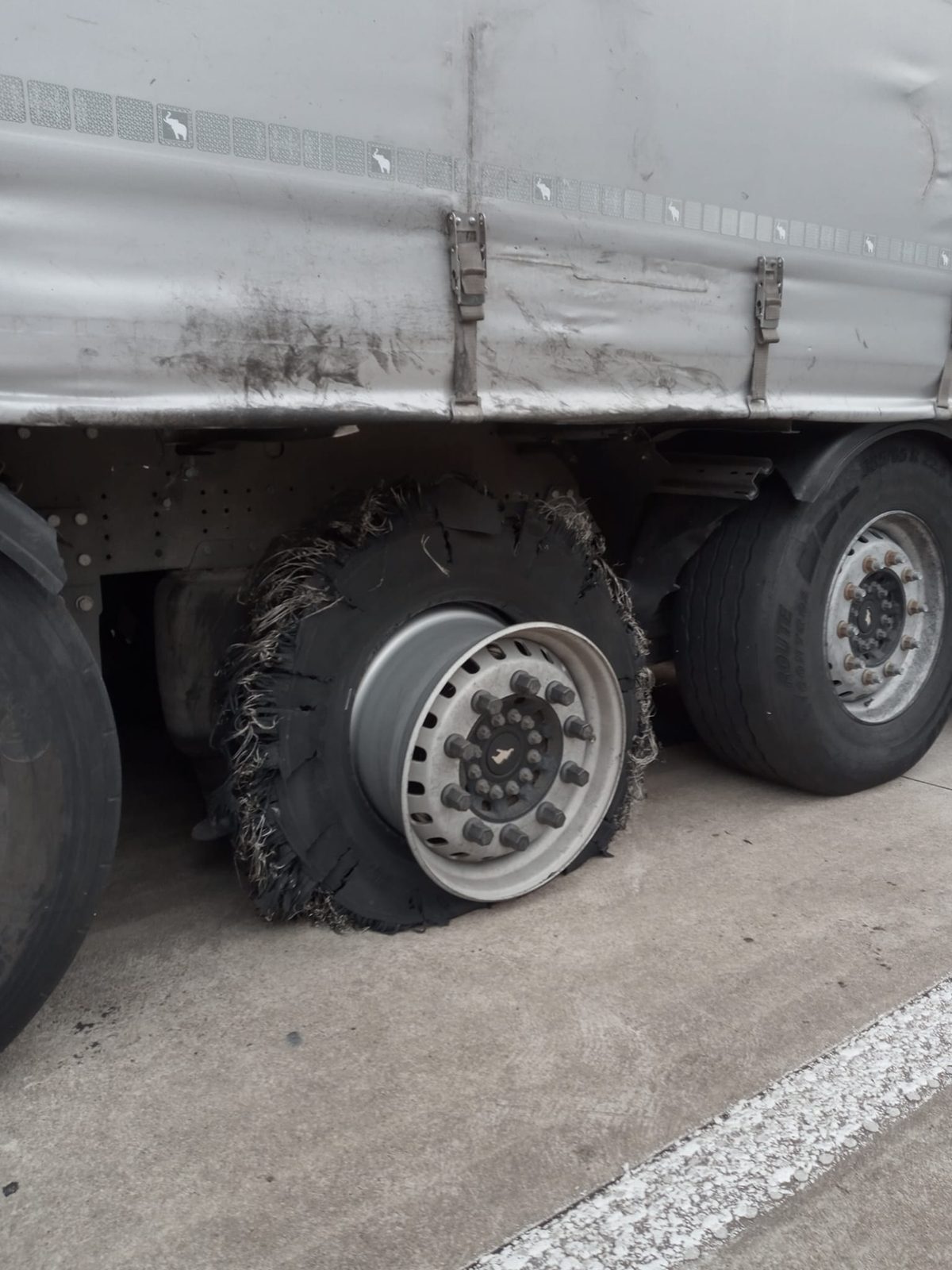
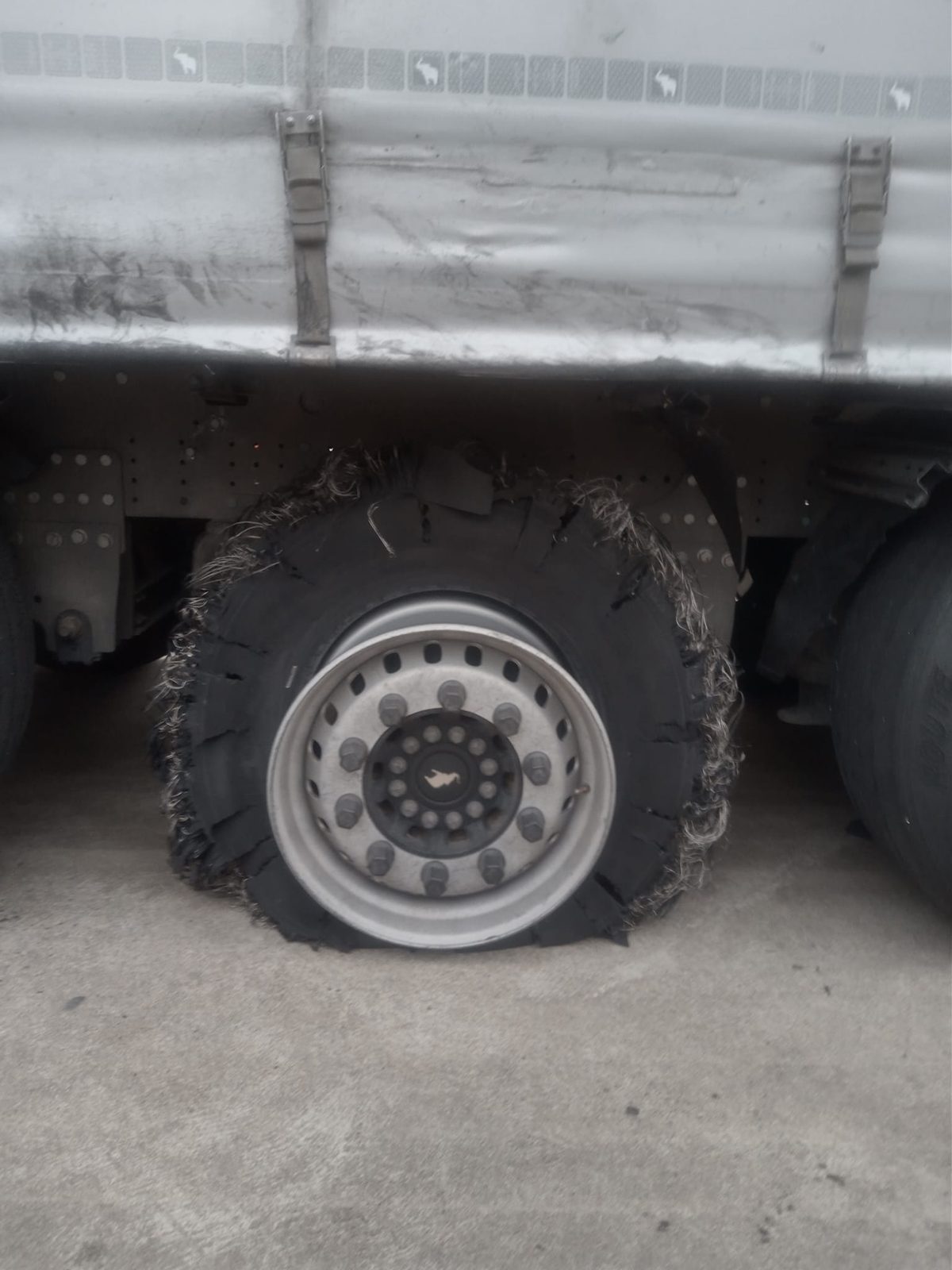
A tyre on the centre axle of a three-axle curtainsider trailer burst at motorway speed, shredding the tread and the sidewall; the alloy rim survived. The driver managed to bring the unit to a stop on a paved strip beside the carriageway, put the hazard lights on and phoned us. That is exactly the right sequence, and it is the reason the rim came out clean.
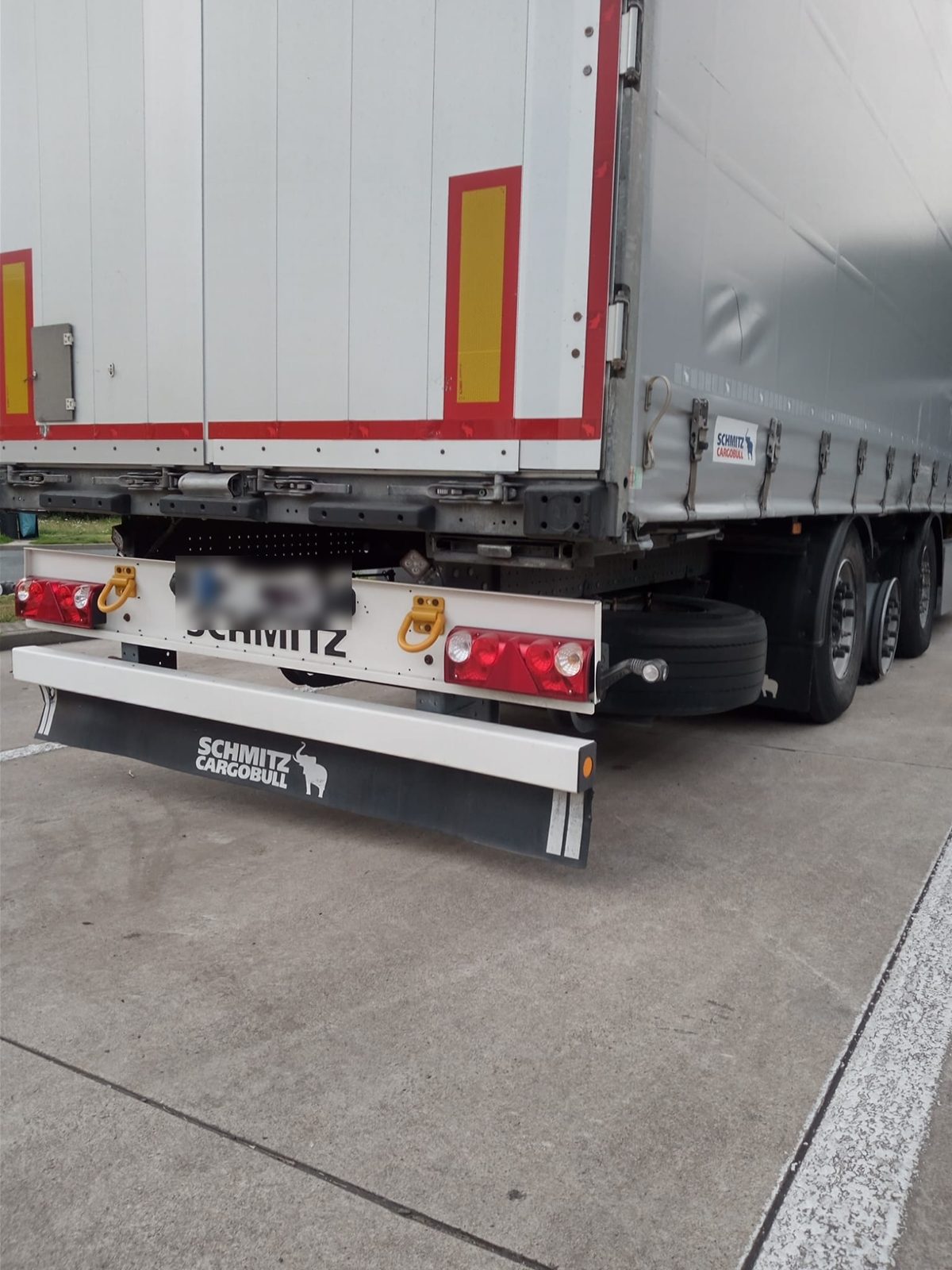
The trailer was a Schmitz Cargobull curtainsider, the kind you see on every German motorway, with ten-stud alloy wheels and 385/65 R22.5 tyres on all three axles. When we arrived, the ruined tyre looked as these things usually do: tread in ribbons, steel cord sticking out like wire wool, the bead still seated on the rim but the sidewall opened up. Nothing was leaking, no brake line was cut, and the neighbouring tyre on the same axle was intact. The weather was grey, dry and mild, which helps. In rain or at night the same job takes longer.
The driver told our dispatcher that he had felt a thump and a pull to one side, then a flapping noise. He had kept his hands firm on the wheel, lifted off the accelerator and let the unit slow down without braking hard. That detail matters, because a sudden stab on the brake with a burst tyre on a loaded trailer is how a tyre problem turns into a jack-knife.
How did we organise help for this truck tyre service callout?
We confirmed tyre size, axle position and exact location during the first phone call, found a free crew in our partner network within 12 minutes, and sent them out with the right tyre already on the van. Speed comes from preparation, not from driving fast.
Here is what our dispatch desk did, in order:
- 08:53, call received. The driver reports a burst tyre on the A4 near Gotha. We ask four things: which axle, what size is printed on the sidewall, whether the rim looks bent, and whether the trailer is loaded.
- Size confirmed. 385/65 R22.5, centre axle, loaded, rim apparently fine.
- Crew search. We call partner crews in Thuringia and the surrounding region. A mobile team that carries 385/65 R22.5 in stock is the one we want, because ordering a tyre from a wholesaler adds hours.
- 09:05, crew dispatched. Twelve minutes after the call, a team from our partner network is on the road. We send the driver their ETA by message.
- Safety instructions. While the crew travels, we tell the driver to stay behind the barrier, wear a hi-vis vest, set the warning triangle and keep the doors closed.
Our dispatchers speak German, English, Polish and Russian, which in this case mattered: the driver’s first language was not German, and a size or axle position misunderstood on the phone is how the wrong tyre ends up on the van. The same logic applies to any callout, whether it is a mobile truck service job or something more serious.
Why can’t you just keep driving on a burst truck tyre?
You cannot, because a destroyed tyre on a multi-axle trailer overloads its neighbours, cooks the rim and can tear off brake and air lines. A truck tyre runs at roughly 8.5 to 9.5 bar. When one fails, the energy released is large and the flailing tread acts like a whip on everything behind the wheel arch.
There are four practical reasons to stop and fix the tyre on the spot:
- Axle load. On a tri-axle trailer the load is spread across six tyres. Take one away and the neighbour carries extra weight it was never rated for, which pushes it towards a second failure within a few kilometres.
- Rim damage. Driving on a deflated tyre grinds the bead seat of an alloy rim. A rim that was fine at 08:53 can be scrap by 09:10 if the driver tries to limp to the next exit.
- Lines and sensors. Strips of tread can cut ABS cables, air hoses and wiring along the axle beam.
- The law. Section 36 of the German road vehicle licensing regulation (§ 36 StVZO) requires tyres that are fit for the load and speed of the vehicle. A shredded tyre is not.
Our driver did none of this. He stopped at once. That decision is the difference between a EUR 895 callout and a three-figure recovery bill on top.
What did the damaged tyre look like on arrival?
The tyre showed a full tread separation with exposed steel cord, and the sidewall was torn open along roughly a third of its circumference. The alloy rim looked intact, and the next job was to prove it.
The crew arrived at 09:40 after 35 minutes on the road. They parked the service van ahead of the trailer, switched on the amber beacon, placed warning triangles and set up a protected working area. They then checked the situation around the wheel before touching anything: the tyres on the other axles, the air lines, the brake chambers and the condition of the spare.
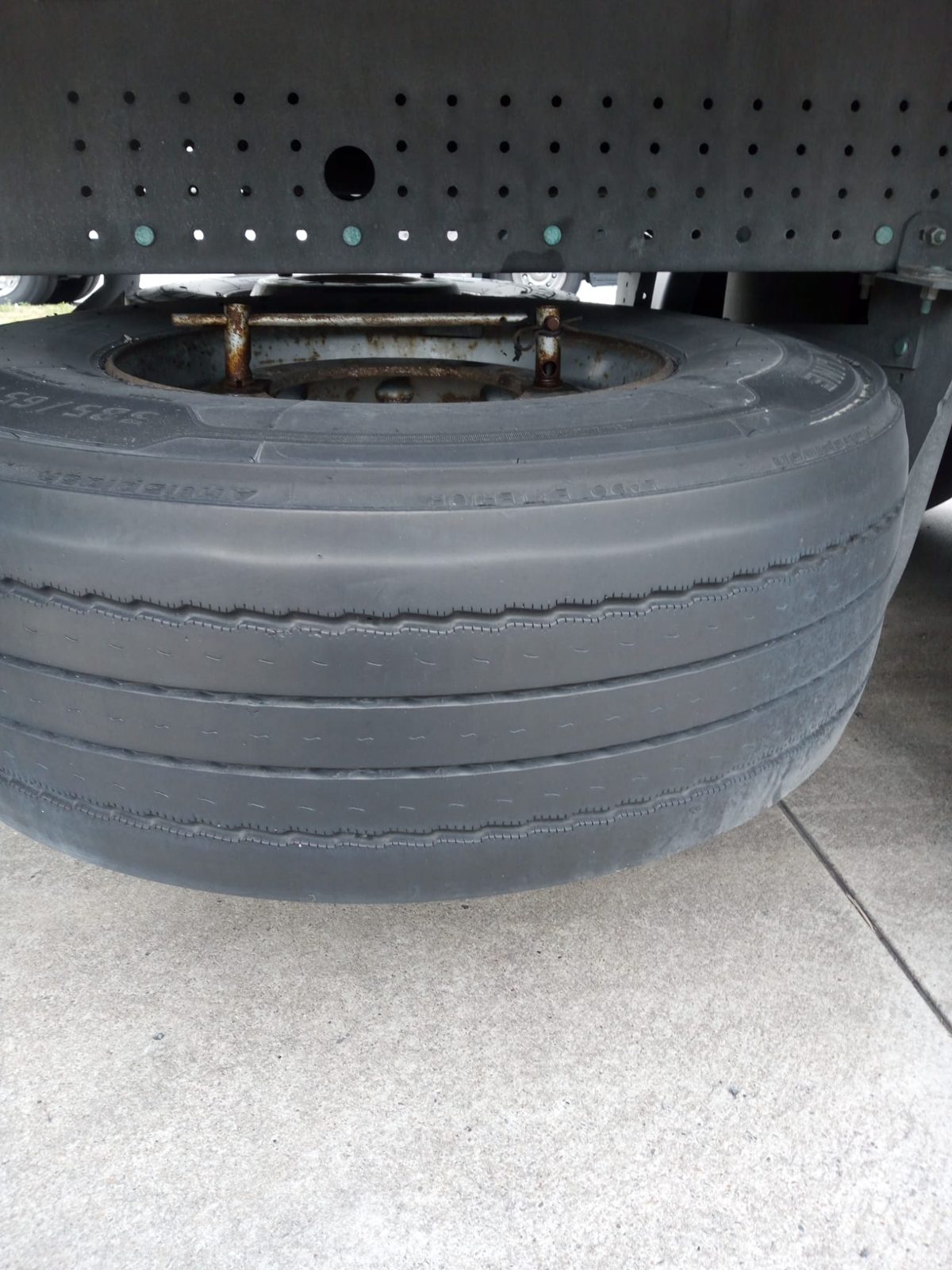
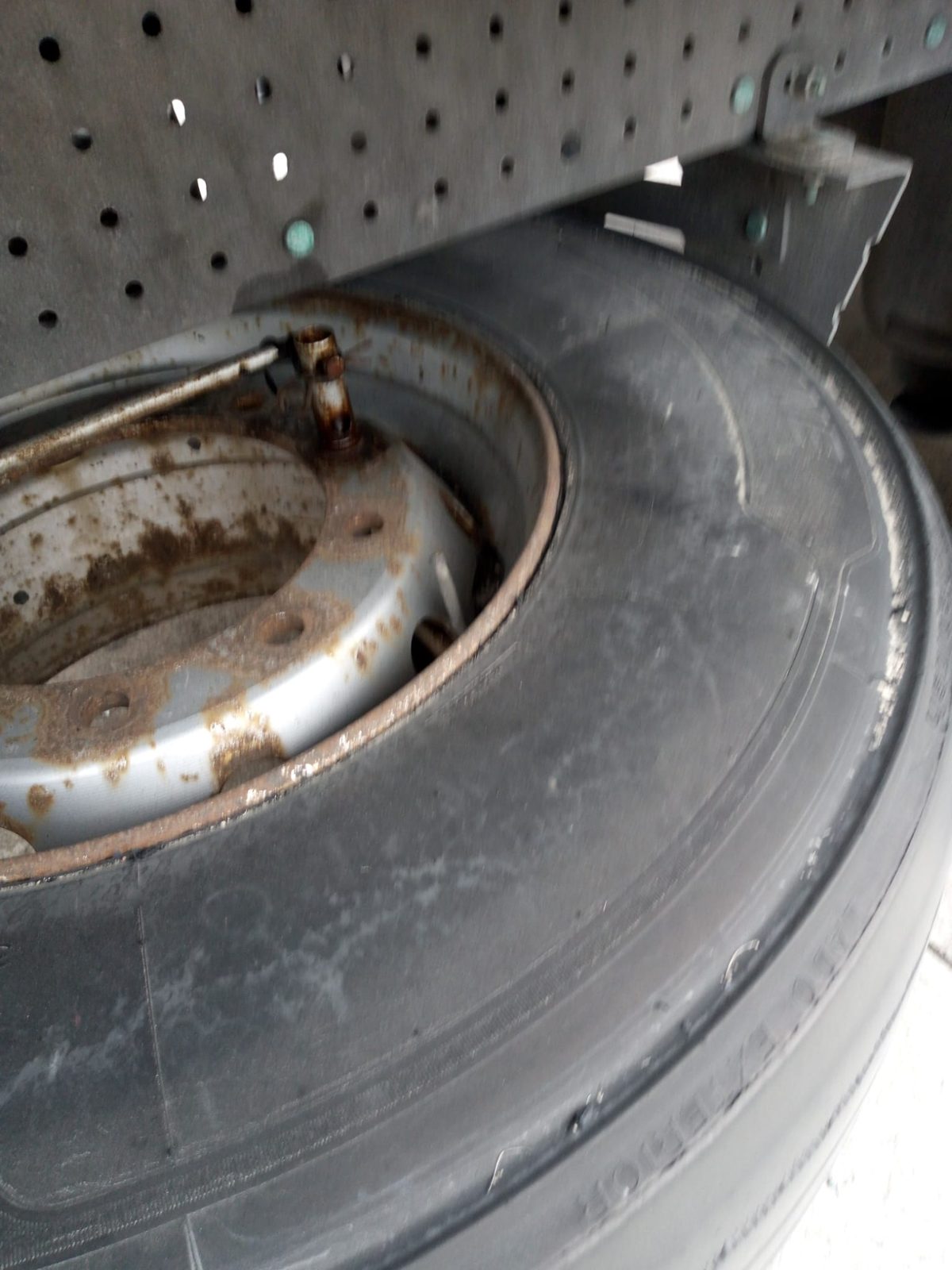
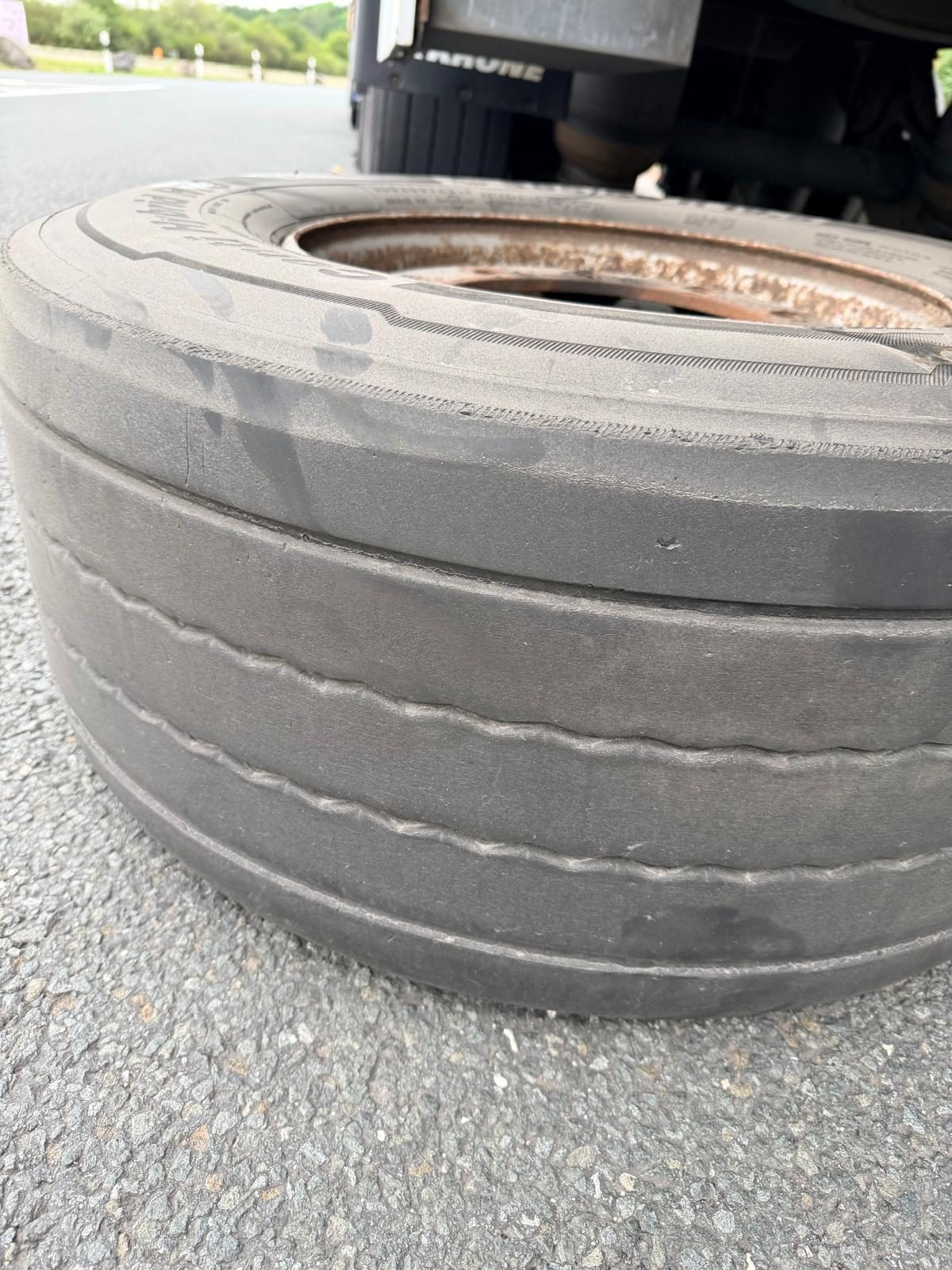
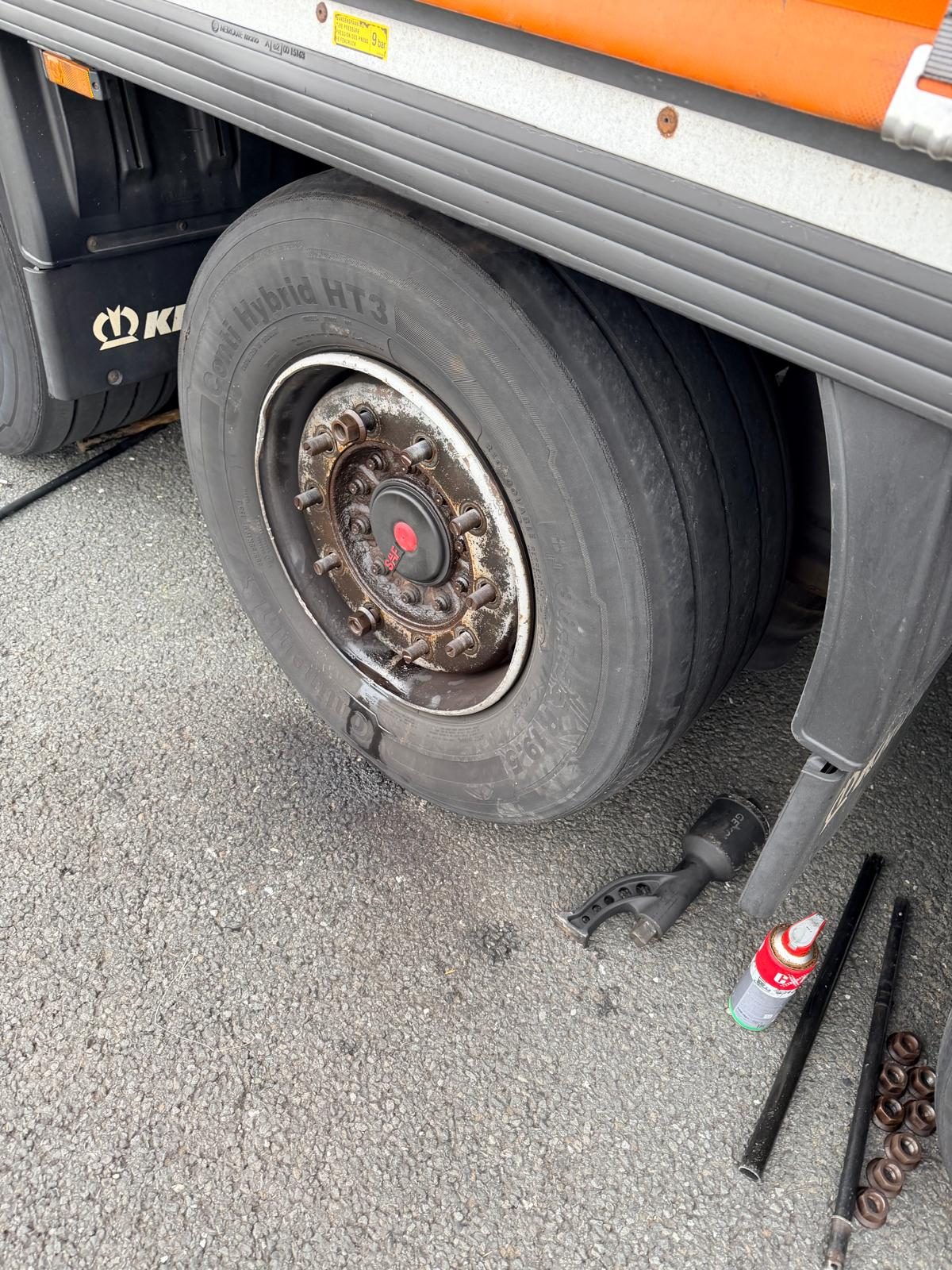
The spare was a 385/65 R22.5 hanging from the carrier under the trailer frame. Its tread was partly worn and the steel rim carried surface rust, so the crew decided against using it as the replacement. A rusty spare with worn tread is a spare you hope you never need. The healthy tyre on the same axle was inspected too, and it turned out to be wearing unevenly across the shoulders, which suggests the trailer’s axle alignment or its pressure habits deserve attention. We come back to that in the prevention section.
Step by step: how a roadside truck tyre replacement works
A roadside truck tyre replacement on a trailer takes five stages: inspect, secure, remove, fit, and check. Each stage has its own tools and its own reasons.
Step 1: Inspection
The crew looked over the whole axle group before anything was lifted. They checked the rim for cracks and bent flanges, the hub for oil seepage, the brake drum for heat marks and the air lines for chafing. Only when the rim passed this look did the job go ahead. If the rim had been bent, the price would have gone up and the timeline would have stretched.
Step 2: Securing the site
The trailer stayed coupled to the tractor unit with the parking brake on. The crew chocked the wheels on the opposite side, set the suspension to the right height and placed a certified jack under the axle beam, not under the chassis. This is the step many drivers skip when they change a tyre themselves, and the one that hurts people.
Step 3: Removing the wheel
At 09:55 the wheel came off. The crew loosened the ten wheel nuts with a torque multiplier and two extension pipes, then lifted the damaged wheel free using a wheel dolly. A single 385/65 R22.5 weighs well over 60 kilos with the rim, which is heavy enough that nobody should be wrestling it alone beside the hard shoulder. The old tyre was broken down from the rim and laid on the tarmac, where the uneven wear on its shoulders became obvious.
Step 4: Mounting the new tyre
The new tyre, a 385/65 R22.5 Cetroc Line A30, was mounted on the cleaned rim. The crew inspected the bead seat, wiped away rust and old rubber, fitted a new valve and inflated carefully inside a safety cage. This phase ran from 09:55 to 10:25, so about 30 minutes for removal, tyre change and refitting preparation.
Step 5: Final check
At 10:43 the wheel was back on the axle. The crew tightened the ten nuts in a star pattern with a calibrated torque wrench, in two or three passes, up to the manufacturer’s value. They then set the pressure on the new tyre and checked the neighbouring ones, which they brought to the correct level. If you want the exact values for your own fleet, we explain them in our guide to wheel nut torque for trucks.
What did the full timeline look like?
The job ran 110 minutes from the first ring to the last tightened nut. The table below shows each phase with the clock times we logged.
| Time | Phase | Action |
|---|---|---|
| 08:53 | Call | Driver reports a tyre burst on the A4, stopped on a paved strip; dispatcher confirms size and axle |
| 09:05 | Dispatch | Partner crew found, tyre 385/65 R22.5 confirmed, departure after 12 minutes |
| 09:40 | Arrival | Mobile service on site after 35 minutes on the road, site secured, inspection |
| 09:55 | Removal | Wheel removed, rim checked for cracks and deformation |
| 10:25 | Fitting | New tyre mounted, inflated, wheel refitted |
| 10:43 | Completion | Nuts tightened in a star pattern with a torque wrench, pressure checked, trailer leaves |
Total: 110 minutes (1 hour 50 minutes) from call to departure.
Two things to notice. First, only 12 minutes went on dispatch, which is the quickest phase you can control. Second, the long block is the road: 35 minutes of travel are physics, not inefficiency. In heavy traffic or at night it would be longer, and you should plan for 90 minutes to 3 hours as the realistic range for a motorway callout.
How much does a roadside truck tyre change cost?
The invoice for this callout was EUR 895 net, plus VAT. That figure includes the call-out, the tyre, the labour and the disposal of the old casing. Nothing else was added.
| Item | Price (EUR) |
|---|---|
| Call-out (Anfahrt) | 240 |
| Tyre 385/65 R22.5 (Cetroc Line A30) | 470 |
| Labour: removal, fitting, balancing, 1.5 h at 110 | 165 |
| Disposal of the old tyre | 20 |
| TOTAL | 895 |
All amounts are net (excluding VAT). A fair reading of that table is that roughly half the bill is the tyre itself, a quarter is getting a crew to a motorway at short notice, and the rest is labour and disposal. If you want to see how these figures compare across other jobs, our overview of what a new truck tyre really costs covers the common sizes.
What changes the price
Several factors move the total up or down:
- Distance and time of day. A callout at night or at the weekend carries a surcharge of 25 to 50 per cent on the call-out fee. This was a Friday morning, so no surcharge applied.
- Tyre size and brand. A 385/65 R22.5 for a trailer sits at the lower end of truck tyre prices; a 315/80 R22.5 steer-axle tyre or a premium brand costs more.
- Rim condition. A bent or cracked rim means a replacement rim, which can double the repair cost.
- Valve and sensor work. If the burst tyre took the valve or a pressure sensor with it, add a small amount for parts.
Compare with the alternative
A standing lorry costs money every hour. For a loaded semi, industry experience puts idle cost at around EUR 800 to 1,200 per day once you add the driver’s wages, the missed delivery slot and the contractual penalties. Against that, EUR 895 for a repair finished before lunch is cheap. The alternative, a recovery truck to a workshop followed by a queue for the bay, would also have started at EUR 850 and gone up with the distance, and the trailer would have lost the rest of the day. If your problem is that big, our towing service handles it, but here it was not necessary.
Why you should not change a truck wheel yourself
Replacing a truck wheel is not a driver’s job, and the reasons are mechanical, not bureaucratic. A wheel and tyre of this size weigh over 60 kilos, and the nuts are tightened to several hundred newton metres.
The main risks of doing it yourself:
- Wrong torque. Under-tightened nuts let the wheel work loose; over-tightened studs stretch and shear. Neither shows until the motorway.
- Wrong jack position. A trolley jack designed for a van will not lift a loaded tri-axle, and a trailer that slips off a jack can kill.
- No safety cage. Inflating a truck tyre without a cage and a remote hose is an invitation for a bead to blow.
- Hard shoulder exposure. On a motorway every minute outside the cab counts. A trained crew sets up warning signs, uses reflective workwear and works away from live lanes.
- No tools. A torque multiplier, a wheel dolly and a bead breaker are not items a driver carries.
Plenty of drivers can change a wheel on a quiet industrial estate; the A4 on a Friday morning is not the place to practise. If you want to understand the dangers before they hit you, read the checklist in the related articles below.
Which situations do we attend across Germany?
A burst tyre is only one of the callouts our network covers, and the same crews cope with most roadside faults on trucks, trailers and vans. We are on call 24/7 across the whole of Germany.
Typical callouts include:
- Burst or punctured tyres on tractor units, trailers, tippers and refrigerated vehicles
- Flat tyres on vans and light commercial vehicles (for example 235/65 R16C)
- Seasonal wheel changes at depots and car parks
- Valve and rim damage
- Air system leaks, brake faults and failed lights
- Dead batteries and 24 V jump starts
- Mobile diagnostics when a warning light comes on
- Recovery when the vehicle cannot move
We see the busiest periods in the early hours on the A2, A3, A4 and A7, where long-distance traffic from Poland, Lithuania, the Baltics and the Netherlands meets heavy summer heat or winter frost. If your vehicle needs more than a wheel, our partner workshop network can take over.
How to avoid a tyre burst in the first place
Most tyre bursts do not come from nowhere. They come from low pressure, overloading, old casings and damage nobody checked. A few habits cut the risk sharply.
For drivers:
- Check pressure cold, every week. Under-inflation is the single biggest cause of heat build-up and blowouts. The correct value for your axle and load is in the manufacturer’s table; many trailers run around 8.5 to 9 bar.
- Walk round before every trip. Look for bulges in the sidewall, cuts, embedded stones and screws. Run a hand across the tread for uneven wear.
- Do not ignore vibration. A shimmy at speed is a warning, not a feature.
- Know your spare. Is it inflated, is it the right size, can you actually reach it? In our case the spare had worn tread and a rusty rim.
For fleet managers:
- Keep a written tyre log with tread depth, DOT date and pressure per position.
- Replace tyres by age as well as by tread depth.
- Schedule alignment checks if you see shoulder wear, as we saw on this trailer.
- Rotate tyres between axles before wear becomes uneven.
Our guide to correct truck tyre pressure, linked below, explains how to measure it and which values to use.
Tyres and fleet maintenance: what we recommend
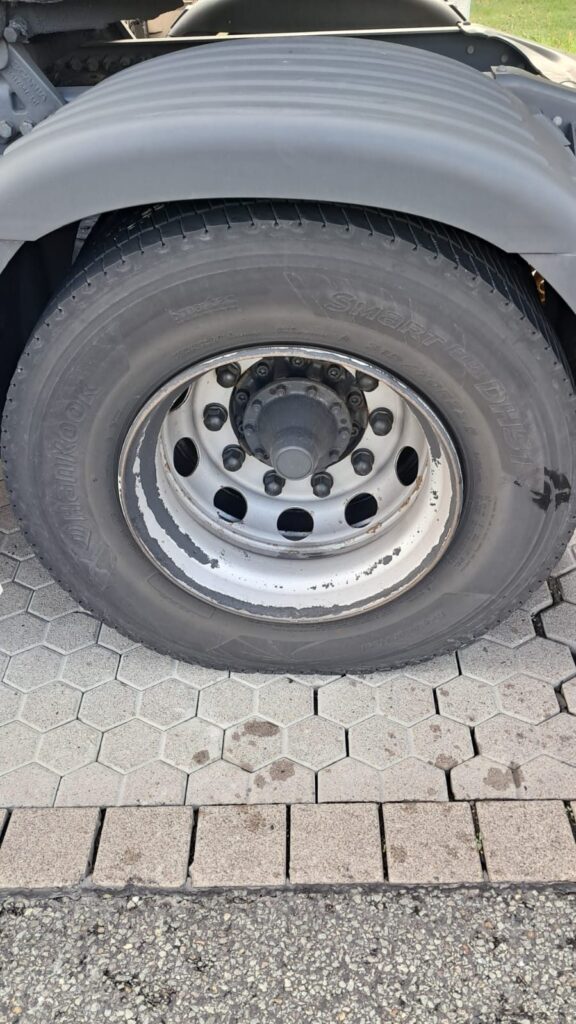
Tyre choice matters, but how you maintain them matters more. Premium brands such as Continental, Michelin, Goodyear and Bridgestone offer casings that can be retreaded and long-haul compounds that resist heat. Our driver’s tractor unit, for example, was running a Continental Conti Hybrid HT3 with 9 bar printed on the sidewall, a sensible drive-axle tyre for regional work.
On a trailer the pressure is the thing. Because trailers do not have the same electronic monitoring as modern tractor units, a slow leak can run for weeks. A tyre pressure monitoring system for trailers is cheap compared with the cost of one callout. The European tyre standards body ETRTO publishes the size and load tables that define what a 385/65 R22.5 can carry at which pressure, and the axle manufacturer BPW provides the maintenance intervals for the axle itself.
A replacement tyre from a mid-range line like the Cetroc Line A30 is a reasonable choice for a trailer axle that does not steer or drive. It is not a tyre we would put on a steer axle, and we will say so when asked. The right answer depends on where the vehicle runs, how heavily it is loaded and how often it is checked. A truck tyre service call is best used as an opportunity to review those three questions. If the casing is repairable, our article on when repair works, linked below, explains the limits.
Why drivers and fleets choose lkwhelp24
We run one number for the whole country, answered round the clock, and the job is dispatched by people who know what a 385/65 R22.5 is. That is the whole pitch.
- 24/7 availability. Nights, weekends and public holidays included.
- A vetted partner network. Crews that carry tyres, tools and certificates, selected region by region.
- Transparent pricing. You get a quote with the call-out, the tyre, the labour and disposal separately, as in the table above.
- Multilingual dispatch. German, English, Polish and Russian, so the size on the sidewall is understood correctly the first time.
- Documented work. Photos of the damage and of the finished job, plus an itemised invoice.
You can see more callouts like this one on our tyre service page, where we list the sizes and services we cover.
Frequently asked questions
How long does a truck tyre service callout on the autobahn take?
Expect 90 minutes to 3 hours from your call to departure. This case took 110 minutes: 12 minutes dispatch, 35 minutes on the road, and about 60 minutes of work on site. Night, rain and heavy traffic add time.
What does a truck tyre replacement on the motorway cost?
A typical callout for a trailer tyre costs EUR 750 to 1,400 net. Our A4 job was EUR 895 net: call-out 240, tyre 470, labour 165, disposal 20. Weekend and night work carries a surcharge on the call-out.
Can a burst tyre be repaired instead of replaced?
Almost never. A burst tyre with torn sidewall and exposed steel cord is scrap. Repair is only possible for small punctures in the tread area of an otherwise sound casing, and only by a qualified workshop.
Who pays when a tyre bursts on the road?
Normally the operator of the vehicle. Some fleet service contracts, tyre warranties or comprehensive insurance policies may cover part of the cost, so keep the itemised invoice and the photos of the damage.
What should I do first after a tyre burst on the motorway?
Hold the wheel firmly, lift off the accelerator, do not brake hard, and steer to the hard shoulder or the nearest safe strip. Switch on the hazard lights, set the warning triangle, put on a hi-vis vest, stand behind the barrier and call for help.
Summary
The key figures of this callout, for quick reference:
- Specification: tyre 385/65 R22.5 on the centre axle of a three-axle curtainsider trailer
- Location: A4 near Gotha, Thuringia, towards Frankfurt
- Response time: 12 minutes to dispatch, crew on site 47 minutes after the call
- Total time: 110 minutes (1 hour 50 minutes) from call to departure
- Cost: EUR 895 net (excluding VAT)
- Consequential damage: none, the alloy rim stayed intact because the driver stopped promptly
Need a truck tyre service right now?
Call us. A dispatcher answers, confirms the tyre size and the location, and sends a crew from our network. Tell us the axle, the size printed on the sidewall and where you are standing.
+49 160 5753826 | www.lkwhelp24.com | Around the clock, anywhere in Germany
Keywords: truck tyre service | truck tyre replacement | truck tyre change | truck tyre callout | truck tyre roadside assistance | truck tyre repair | mobile reifenservice | trailer tyre service | truck tyre burst | mobile truck tyre service | truck tyre breakdown | truck tyre emergency | trailer tyre replacement | truck tyre germany
Related articles
- Truck Tyre Pressure: Correct Values, How to Measure and Mobile Help
- Emergency Wheel Change on a Truck: What to Do After a Tyre Blowout on the Motorway
- Truck Tyre Repair 2026: When It Works and When Only Replacement Will Do
- Mobile Truck Tyre Service on the A19 near Malchin: Scania Artic Back on the Road in 2 Hours 16 Minutes After a Blowout