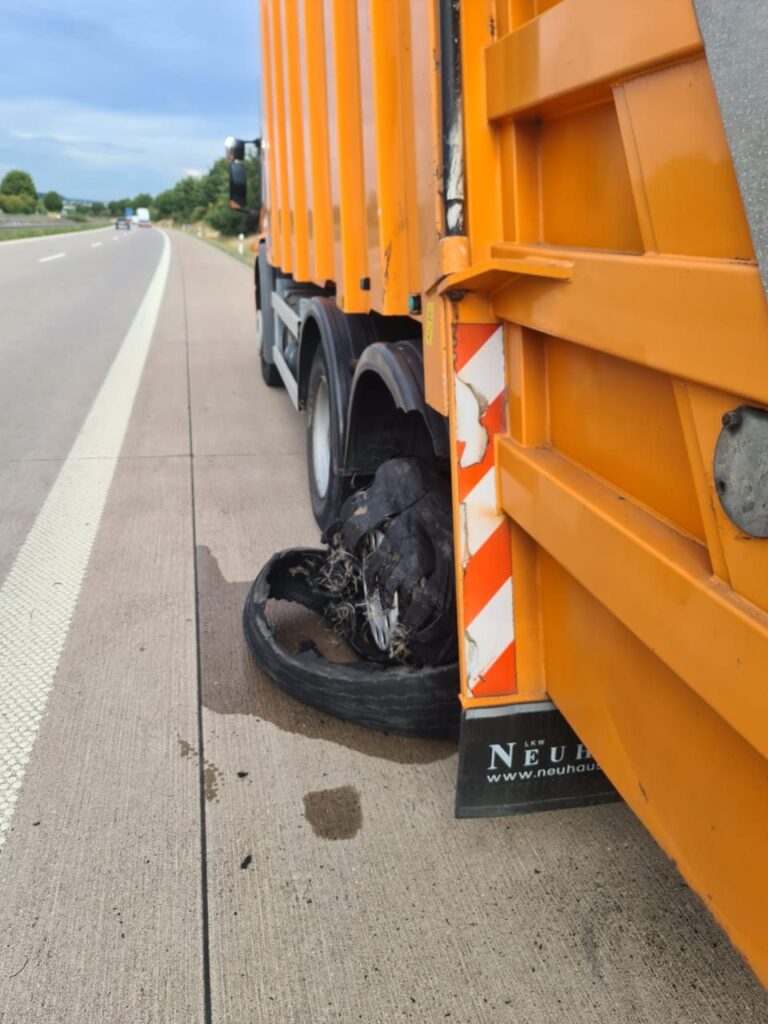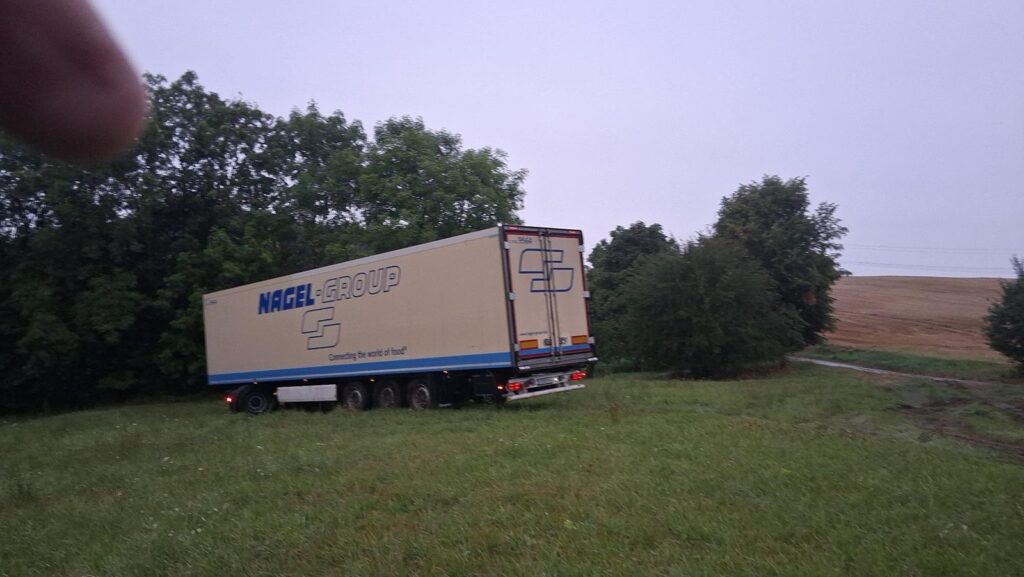
In short: on a wet Friday evening in August 2026 a refrigerated semi-trailer slid off a slip road onto a soaked meadow beside the B27 near Fulda in Hesse. Our dispatchers sent a heavy-duty recovery vehicle with a winch, the crew arrived 52 minutes after the call, and the trailer was back on tarmac, recoupled and checked 145 minutes after the driver phoned. Nobody was hurt, the frame was undamaged, and the final bill was 1,120 EUR net.
If you ever need a tow truck for a loaded artic that has left the road, this write-up shows what really happens between the phone call and the moment you drive away: who decides what, how long each phase takes, what it costs, and where the real risks sit. It is a working account from our dispatch desk, not a sales brochure, and the numbers are the ones we invoiced.
Why a trailer in a field is more serious than it looks
A fully loaded artic weighs around 30 tonnes, and wet grass gives it almost no grip. Once the wheels of a trailer sink into soft ground, the vehicle cannot simply be driven out: the drive wheels of the tractor unit spin, dig deeper and may pull the whole combination further down the slope. That is why a field recovery is a job for a proper tow truck with a winch and ground protection, and not for a friendly farmer with a tractor.
There is a second pressure on top of the physical one. Inside this trailer was chilled food, and the refrigeration unit was running on its own diesel. Every hour of standstill burns fuel, and every hour in a tilted position raises the risk of cargo shifting. A driver in that position is often tempted to try one more reverse, one more rocking manoeuvre. In our experience that is exactly the moment when a recoverable situation turns into a rolled trailer and a damaged frame.
The emergency: B27 near Fulda, dusk, steady rain
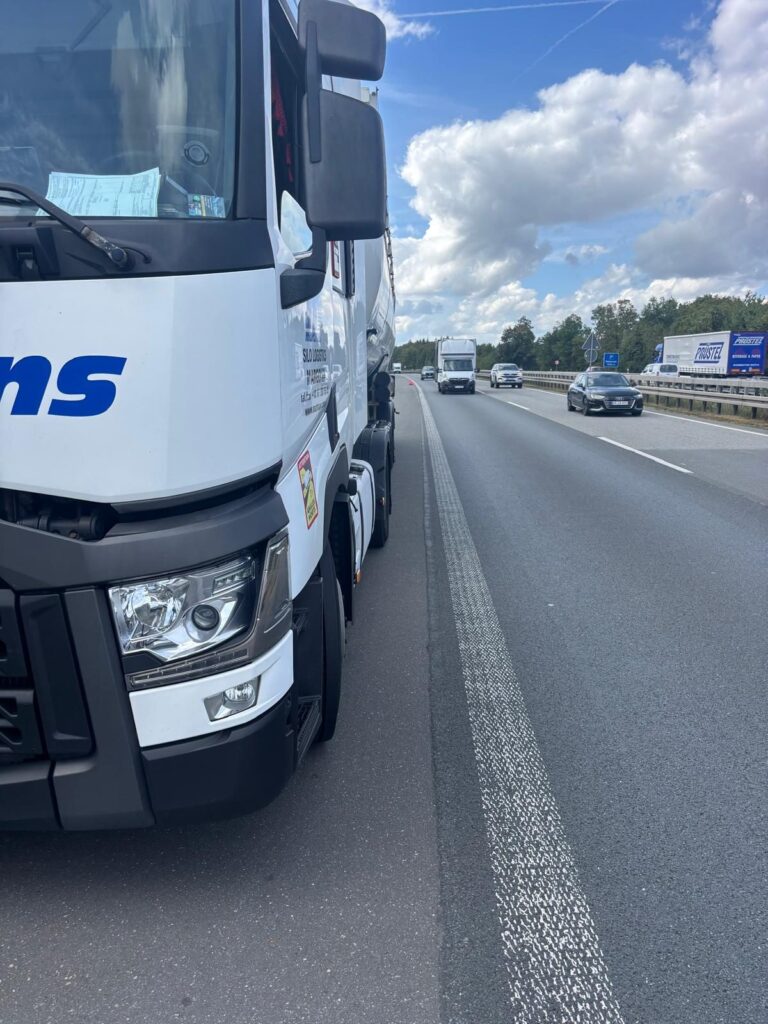
The driver of a European haulier was running a tractor unit with a three-axle reefer semi-trailer along the B27 when he turned onto a service track beside the main road, a place where drivers sometimes swing round or pull in to check a load. The verge was far softer than it looked. The trailer wheels left the hard surface, sank into the saturated meadow, and the whole trailer settled at an angle: rear higher, front axle noticeably lower.
He stopped at once, which was the right decision. He switched on the hazard lights, left the refrigeration unit running, and phoned our number at 19:30. No one was injured, the trailer had not tipped, and there was no leak. What he could not do was leave: with 30 tonnes behind him and wet turf under the wheels, any attempt to pull away risked an overturn on the incline.
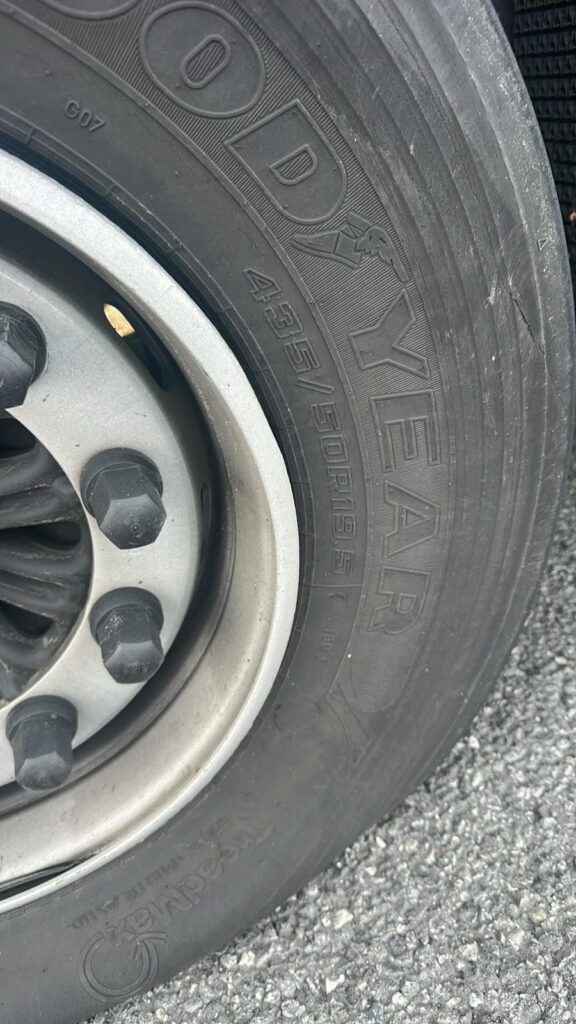
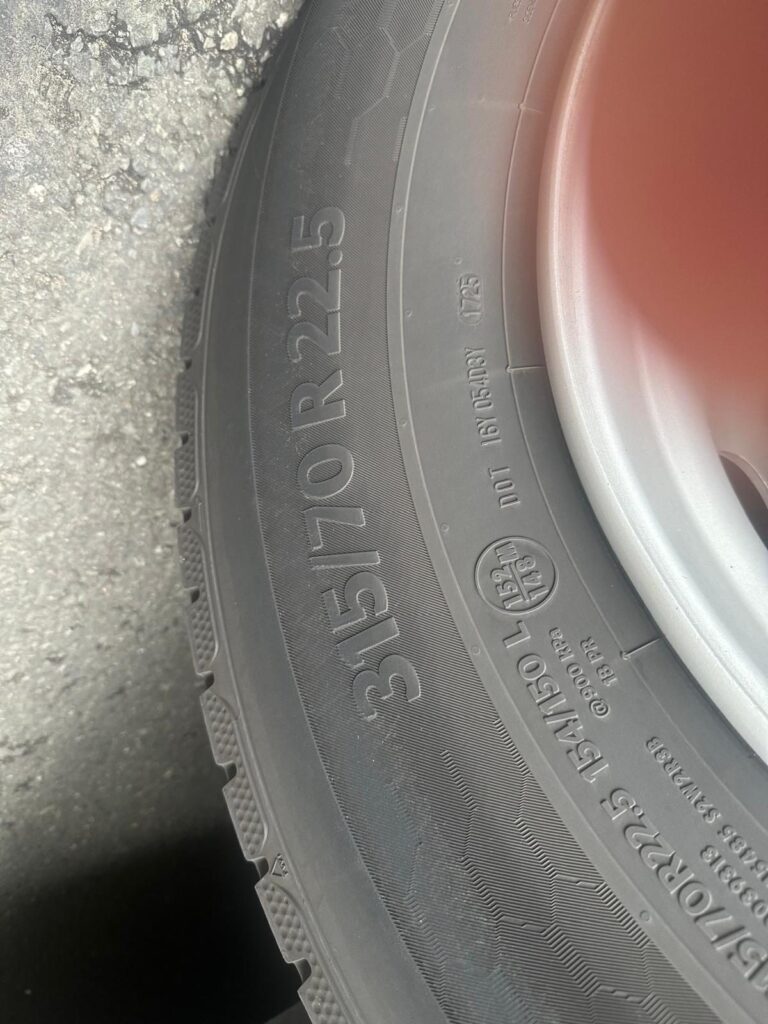
For tyre planning we assumed the usual 385/65 R22.5 trailer size, which is standard on this kind of three-axle reefer. The photo does not show the marking, so treat that as a typical specification rather than a reading from the picture.
How we organised the recovery
The first call decides how the rest of the evening goes. Our dispatcher asked five things in a calm order: exact position, whether anyone was hurt, whether the trailer was stable, what the cargo was, and whether the unit was still coupled. From those answers the picture was clear within minutes. A stable trailer, no casualties, a temperature-sensitive load and soft ground meant the job needed a heavy recovery vehicle, not a light breakdown truck.
Dispatch took 15 minutes, from 19:30 to 19:45. In that time the following happened:
- The dispatcher estimated the gross weight (about 30 t) and the likely ground bearing capacity after hours of rain.
- The nearest suitable crew in our partner network was chosen and confirmed by phone, together with a heavy-duty towing vehicle that carries a winch.
- The driver was told to stay in the cab with the hazard lights on, to keep the engine running only if the refrigeration needed it, and to put out the warning triangle only where it was safe to walk.
- We gave him an arrival window, and he confirmed the load could tolerate the delay.
Because we work as a coordination desk with a network across Germany rather than from one depot, there was no need to hunt for a free vehicle. That is the practical difference between calling a random local firm and calling a 24-hour tow truck service that already knows who is available within reach of Fulda. For a fuller picture of how a night call is handled, see our piece on 24-hour truck towing at night.
On site: why you do not just pull it out
The crew reached the field at 20:22, 52 minutes after the call, in rain and fading light. Before any chain was touched, the lead recovery operator walked the ground. He was checking three things: how steeply the trailer was leaning, how far the wheels had sunk, and which direction offered the firmest path back to the road.
Pulling straight out the way the trailer came in sounds logical, but it is usually wrong. The wheels have already churned the soil into mud along that line. A diagonal pull towards firmer ground, applied slowly, keeps the trailer from slewing and spreads the load across wheels that still have some bite.
The operator also set up the scene properly. A recovery vehicle on a public road needs to be seen, and in the dusk that meant flashing beacons, a warning triangle and reflective clothing. The rules on stopping in an emergency are set out in § 15 of the StVO, and a crew that works near a main road treats them as the minimum, not the target.
Tyre pressure matters here too. Truck tyres run at roughly 8.5 to 9.5 bar, and a trailer lying at an angle puts uneven load on the lower-side tyres. Any sidewall that has been squeezed against a hidden stone or a rut gets checked before the trailer moves, because a tyre that fails halfway through a winch pull would add a second problem to the first.
Step by step: the recovery in five stages
Step 1: Assess the ground and the slope
The first 18 minutes after arrival (20:22 to 20:40) went on observation. The operator tested the turf with a probe, judged the lean angle and decided where the recovery vehicle could stand safely on firm ground. Rushing this step is how recovery vehicles end up stuck themselves.
Step 2: Secure the scene and protect the ground
Between 20:40 and 21:00 the crew cordoned off the working area and laid heavy road plates and protective mats under and ahead of the trailer wheels. This ground protection is the item on the invoice that looks small and does the most work: it spreads the weight, gives the tyres something solid to climb onto, and keeps the meadow from being torn up more than necessary.
The tractor unit was uncoupled at this stage and prepared separately. Taking 30 tonnes down to the weight of an empty trailer plus cargo already makes the pull gentler, and it keeps the tractor away from the soft ground.
Step 3: Attach the straps and take up the slack
At around 21:00 the recovery crew connected straps to the trailer frame at the designated recovery points, not to axles, suspension arms or the refrigeration unit. Anchoring the load to the wrong part of a trailer is the most common way that a recovery causes new damage. The slack was taken up slowly so that every strap was loaded evenly before any real force was applied.
Step 4: Winch the trailer out on a diagonal
The recovery itself was a patient, controlled pull. The winch drew the trailer across the mats and diagonally towards firm ground, with one crew member watching the wheels and another watching the lean. Speed was walking pace or slower. By 21:35 the trailer had reached the hard surface and was standing level on the road, and the tractor unit was recoupled.
Step 5: Inspect everything before releasing the vehicle
The last twenty minutes, until 21:55, were the check. The crew inspected the axles, brakes, lights and the refrigeration unit, looked for any bent mounting or scraped air line, and refitted and re-tightened the wheel nuts in a star pattern to the manufacturer’s torque. Only then was the combination released. If you want the reasoning behind the pattern, our guide on truck wheel nut torque explains the sequence and values.
Full timeline: 145 minutes from call to departure
The table shows the clock times as logged on the evening. The arrival time of 52 minutes is quite typical for a rural location in Hesse; in heavy rain or on a Friday evening with traffic, expect a little more.
| Time | Phase | Action |
|---|---|---|
| 19:30 | Call | The driver phones the dispatch desk and describes the position, the stop and the cargo |
| 19:45 | Dispatch | Ground and weight assessed (about 30 t), crew and heavy recovery vehicle with winch chosen (15 min) |
| 20:22 | Arrival | Crew on site 52 minutes after the call, rain, dusk, inspection, cordon, warning triangle and beacons |
| 20:40 | Preparation | Slope and ground checked, road plates laid under the wheels, tractor unit uncoupled and prepared separately |
| 21:00 | Recovery | Straps attached to the trailer frame, slow diagonal winch pull onto firm ground |
| 21:35 | Back on the road | Trailer on the carriageway, recoupled to the tractor unit |
| 21:55 | Check and departure | Axles, brakes, lights and refrigeration unit checked, wheels tightened in a star pattern, journey continued |
Total: 145 minutes. Of those, 52 minutes were travel to the scene and 93 minutes were work on site.
What does the recovery cost?
A field recovery of this kind cost 1,120 EUR net (plus VAT). That is a typical figure for a loaded artic with a winch pull of about two hours, and it is within the usual range for evening recovery work in Germany. The price is built from clear items, and each of them is explained below.
| Item | Price (EUR) |
|---|---|
| Call-out of recovery vehicle (evening, +25 %) | 250 |
| Recovery work on site, 2 hrs at 120 EUR | 240 |
| Heavy-duty recovery vehicle with winch, flat call-out rate | 480 |
| Road plates and ground protection mats | 90 |
| Check of axles, brakes and lights (0.5 hr) | 60 |
| TOTAL | 1,120 |
All amounts are net, excluding VAT. For comparison, a refrigerated vehicle that sits for a day costs roughly 800 to 1,200 EUR in lost use, before you add the risk of a spoiled load and a missed delivery slot. The recovery cost less than the downtime it prevented.
What moves the price up or down
- Time of day. Evening, night and weekend call-outs carry a surcharge of 25 to 50 percent; here it was 25 percent on the call-out.
- Weight and ground. A heavier combination or deeper mud needs a stronger vehicle and longer work, which can mean a second winch point or a crane.
- Distance. The further the crew drives, the higher the travel item. Fulda is well served; a remote stretch of the A7 or the Bavarian Forest is not.
- Damage. Bent suspension or a punctured air line adds repair time and parts. In this case the inspection found none.
- Waiting. If the crew has to wait for a police closure or the weather to ease, the working time grows.
If you want a wider look at what drivers and fleets pay, we have collected the typical ranges in truck towing costs.
Why a tow truck with a winch, and not just any vehicle?
A winch-equipped recovery vehicle is built for pulling, while a standard tow truck is built for lifting and carrying. A standard breakdown vehicle can lift the front axle of a rigid truck and tow it away, but it cannot safely drag a 30-tonne trailer out of a bog. That is why the first question on our dispatch desk is always what has actually happened, and not just where the lorry is.
If you search for a tow company near me or vehicle recovery near me from the verge, you will find plenty of advertising but little information about whether the firm owns a heavy-duty vehicle. The right equipment is only half of the answer, though. The other half is experience in reading the ground, setting up a safe pull and knowing what not to touch. Germany’s recovery trade has its own professional body, the Verband der Bergungs- und Abschleppunternehmen, which is a useful starting point if you want to understand what the standards for this work look like.
When the job is bigger than a winch pull, for example a trailer on its side or a tractor unit down an embankment, a crane is needed. We explain where that limit lies in heavy truck recovery.
Why professionals, and why not DIY
Attempting the recovery yourself rarely saves money. Here is what can go wrong when drivers try to solve it alone:
- The tractor unit sinks too. Spinning the drive wheels digs the unit in as well, and you now have two vehicles to recover.
- The trailer tips. On a slope with a high centre of gravity, a sudden grip can flip it, with the cargo shifting at the same moment.
- Wrong anchor points. A tow strap on an axle or a suspension arm can bend it, and the damage only shows at the next inspection.
- Damaged tyres. A sidewall pinched between a rut and a stone fails later on the autobahn, not in the field.
- Insurance and liability. An unqualified pull that causes damage is hard to defend later, and a recovery documented by professionals is easy to claim.
- Personal danger. Taut winch lines store a great deal of energy, and a snapped strap can be lethal.
A properly equipped tow truck crew carries the right gear, works to a plan and records what it did. That documentation is useful later if the cargo owner or the insurer asks questions.
Typical situations we respond to across Germany
The case near Fulda is one of many. Our dispatch desk handles these situations every week, around the clock:
- Trailers or semi-trailers that have slid off a verge, a slip road or a yard entrance onto soft ground
- Tractor units stuck in a farm track or a building site after a satnav detour
- Breakdowns on the autobahn that need a tow to the nearest workshop
- Jackknifed combinations after a sudden brake in the wet
- Vehicles stuck in snow or ice at a rest area in winter
- Trucks with a failed gearbox or a locked brake that cannot be driven
- Tyre blowouts that damage a wheel arch or an air line and make the combination unsafe to move
If the fault turns out to be mechanical, we send a mobile mechanic instead of, or as well as, the tow. Our mobile truck service covers everything that can be fixed on the spot, and our truck service workshops take over when the vehicle must be repaired in a bay. A long-distance example from the A30 is in our write-up on truck recovery on the A30.
How to avoid ending up in a field
Most of these incidents are avoidable. These habits help drivers and fleet managers:
- Do not leave the paved surface on wet ground. If a verge looks firm, test it on foot first. Grass hides soft soil, especially after several days of rain.
- Plan turning points. Dispatchers and drivers should agree on proper turning places and avoid improvised manoeuvres with a loaded trailer.
- Take the satnav with a grain of salt. Navigation systems for cars send lorries down farm tracks. Use a truck-specific system and check the route on the map.
- Reduce speed on slip roads in the wet. A loaded trailer on a wet camber has far less margin than the same vehicle in the dry.
- Check tyres and brakes regularly. Tread depth and correct pressure matter on wet roads. Inspections by organisations such as DEKRA help to catch worn components early.
- Keep the emergency number saved. At 19:30 on a wet evening, you do not want to be searching for a number. Save +49 160 5753826 before you need it.
- Carry a torch, a warning vest and gloves. They sound obvious, and yet we regularly arrive at scenes where the driver has none.
Tyres, axles and fleet maintenance: the wider picture
An incident like this one is rarely about the tyres, but the recovery shows how much depends on the running gear. A trailer axle takes a hard shock when the wheels drop into a rut, and the check at the end of the job is there to make sure nothing was bent. Axle makers such as BPW publish service intervals for trailer axles that fleets should follow, and a regular look at the hubs, brake chambers and bearings is far cheaper than a failed axle at 80 km/h.
Tyres deserve the same attention. A 385/65 R22.5 trailer tyre must carry its full load at the correct pressure, and brands like Michelin, Continental, Goodyear and Bridgestone give clear guidance on load index and pressure. For general information on the range, Michelin is a reasonable starting point. If a tyre takes a hit during a recovery, the fix is an inspection at the scene or, if the damage is serious, a replacement. Our emergency tyre service for trucks deals with this around the clock.
For fleet managers, the sensible approach is simple. Schedule inspections before the wet season, train drivers on soft ground and turning points, log every near miss, and keep one reliable emergency contact. A fleet that treats a stuck trailer as a process problem rather than bad luck tends to see it less often.
Why drivers and fleets choose LKWHelp24
We are a 24-hour tow truck service and breakdown coordination desk for commercial vehicles, and our work is built around the situation the driver is actually in:
- Always reachable. The line is staffed around the clock, on weekdays, weekends and public holidays, anywhere in Germany.
- A tested network. Recovery crews, mobile mechanics and tyre technicians are vetted before they join, so the first call leads to someone who has done this before.
- A clear price. You receive an itemised estimate with net amounts, and nothing is added on the road without agreement.
- Multilingual dispatch. Many of the drivers who call us are from Poland, Lithuania, Romania, Ukraine or the Netherlands, and the desk can handle the call in the language the driver is comfortable in.
- One contact for the whole problem. Whether it is a winch pull, a tow, a tyre or a repair, the driver speaks to one person, and not to five.
You can find our coverage and details on the contact page, and our dedicated towing service page describes the recovery and towing options in more detail.
Frequently asked questions
How long does it take for a tow truck to reach a truck in Germany?
In this case the crew arrived 52 minutes after the call. On the autobahn and in built-up areas the figure is often 35 to 70 minutes, and in remote places, at night or in bad weather it can be longer. Dispatch itself takes 10 to 20 minutes.
What does truck towing in Germany cost?
A recovery with a winch for a loaded artic cost 1,120 EUR net in this case. As a rule, towing a tractor unit costs between 850 and 1,600 EUR net depending on distance, and evening or weekend work adds 25 to 50 percent. All our quotes show net amounts plus VAT.
Can I pull my trailer out of the mud myself?
You should not. A loaded trailer weighs about 30 tonnes, wet ground gives no grip, and a failed attempt can sink the tractor unit or tip the trailer. A recovery crew uses plates, straps at the correct points and a slow diagonal winch pull.
What do I do first when my truck leaves the road?
Switch on the hazard lights, stop and do not try to drive out. Check that nobody is injured, secure the vehicle as far as it is safe to do so, and call for help with your exact position. Stay in a safe place away from traffic until the crew arrives.
Does the refrigeration unit have to keep running?
Yes, if the cargo is temperature-sensitive. Tell the dispatcher about the load and the fuel level of the unit. During the recovery, the crew checks that the unit works properly afterwards, as it did here.
Who pays for the recovery?
The vehicle operator is invoiced for the work, and many fleets reclaim the cost from their insurer. We provide an itemised invoice and a short report of the work so that the claim is straightforward.
Summary
- Situation: reefer semi-trailer (about 30 t) slid off a slip road onto a wet meadow beside the B27 near Fulda, Hesse
- Call: 19:30 on a rainy Friday evening in August 2026
- Dispatch: 15 minutes, crew with a heavy-duty winch vehicle
- Reaction time: 52 minutes from call to arrival
- Work on site: 93 minutes
- Total time: 145 minutes, from call at 19:30 to departure at 21:55
- Cost: 1,120 EUR net (excluding VAT)
- Secondary damage: none, no injuries, frame, axles, brakes, lights and refrigeration unit checked and in order
Need a tow truck? Call us now
If your truck or trailer has left the road, do not wait and do not try to drive out. Call +49 160 5753826. Our dispatchers are on the line around the clock, and the nearest crew is on its way within minutes.
Website: www.lkwhelp24.com
24 hours a day, anywhere in Germany
Keywords: tow truck | i need a tow truck | tow truck germany | truck towing germany | tow service | heavy towing | heavy duty towing near me | vehicle recovery near me | recovery vehicle near me | tow truck recovery | 24 hour tow truck service | urgent towing | call tow truck | tow company near me | truck towing | reefer trailer recovery | winch recovery B27 Fulda