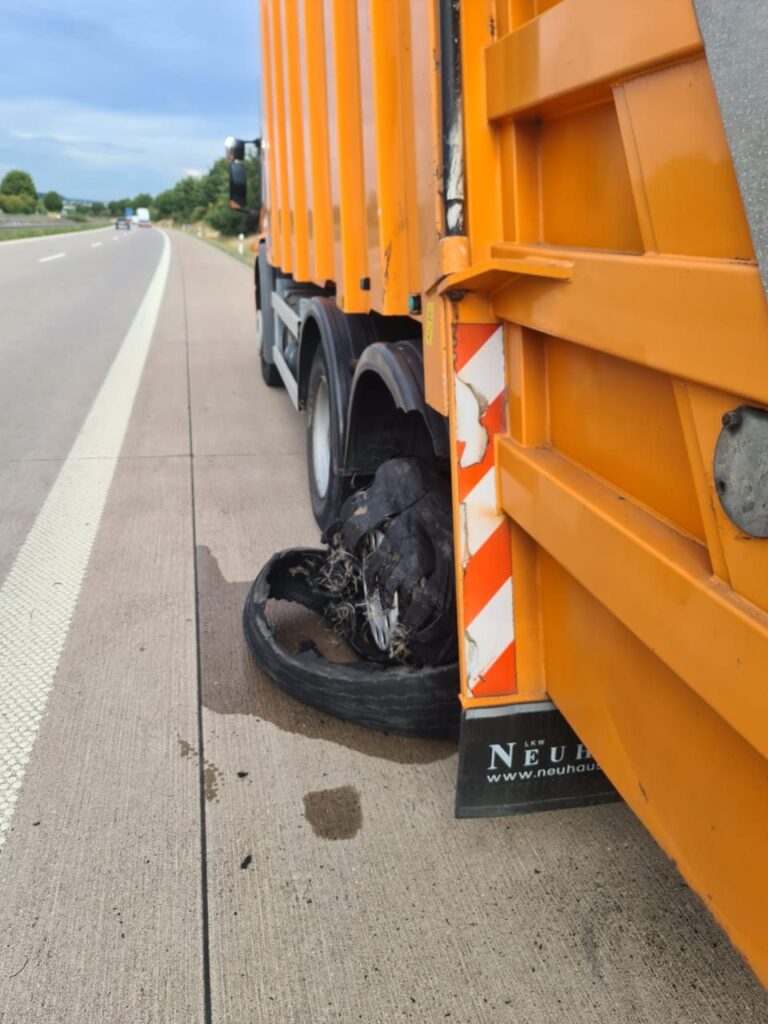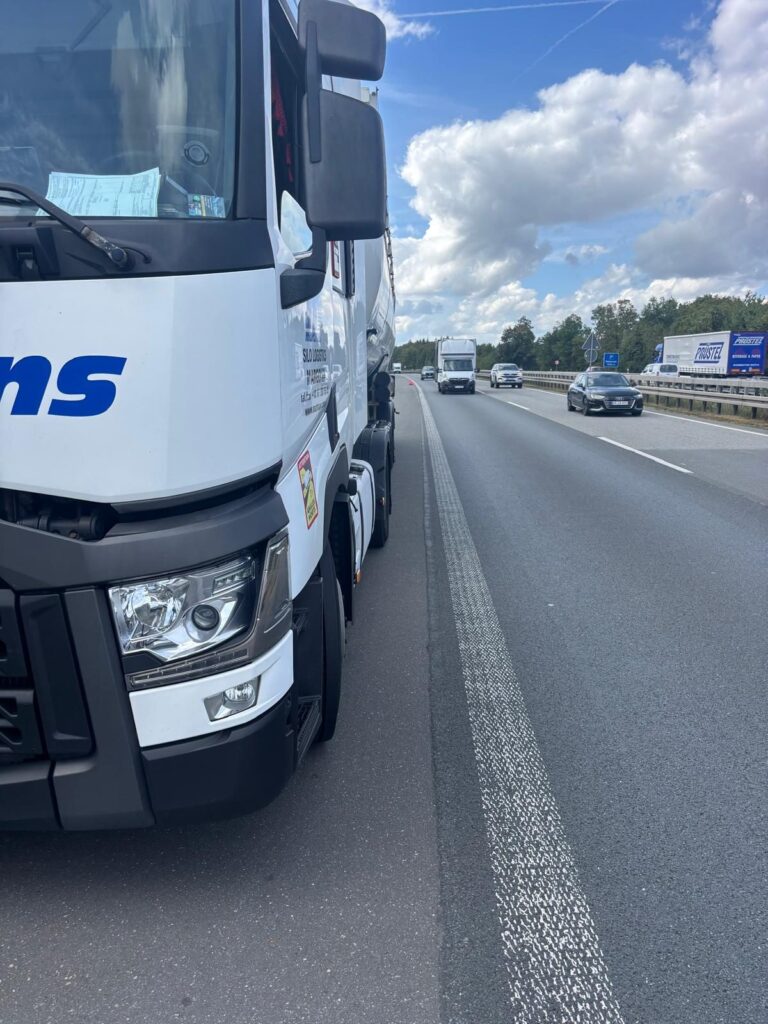
In short: on a sunny weekday afternoon a driver called us from the hard shoulder of the A3 near Würzburg, heading towards Nuremberg. One tyre on the rear bogie of his silo trailer was damaged. Our dispatchers found a matching 385/65 R22.5 Hankook TH31, sent the nearest partner crew, and the artic was rolling again 108 minutes after the call. The bill came to 905 EUR net, with no secondary damage to the rim, the axle or the load.
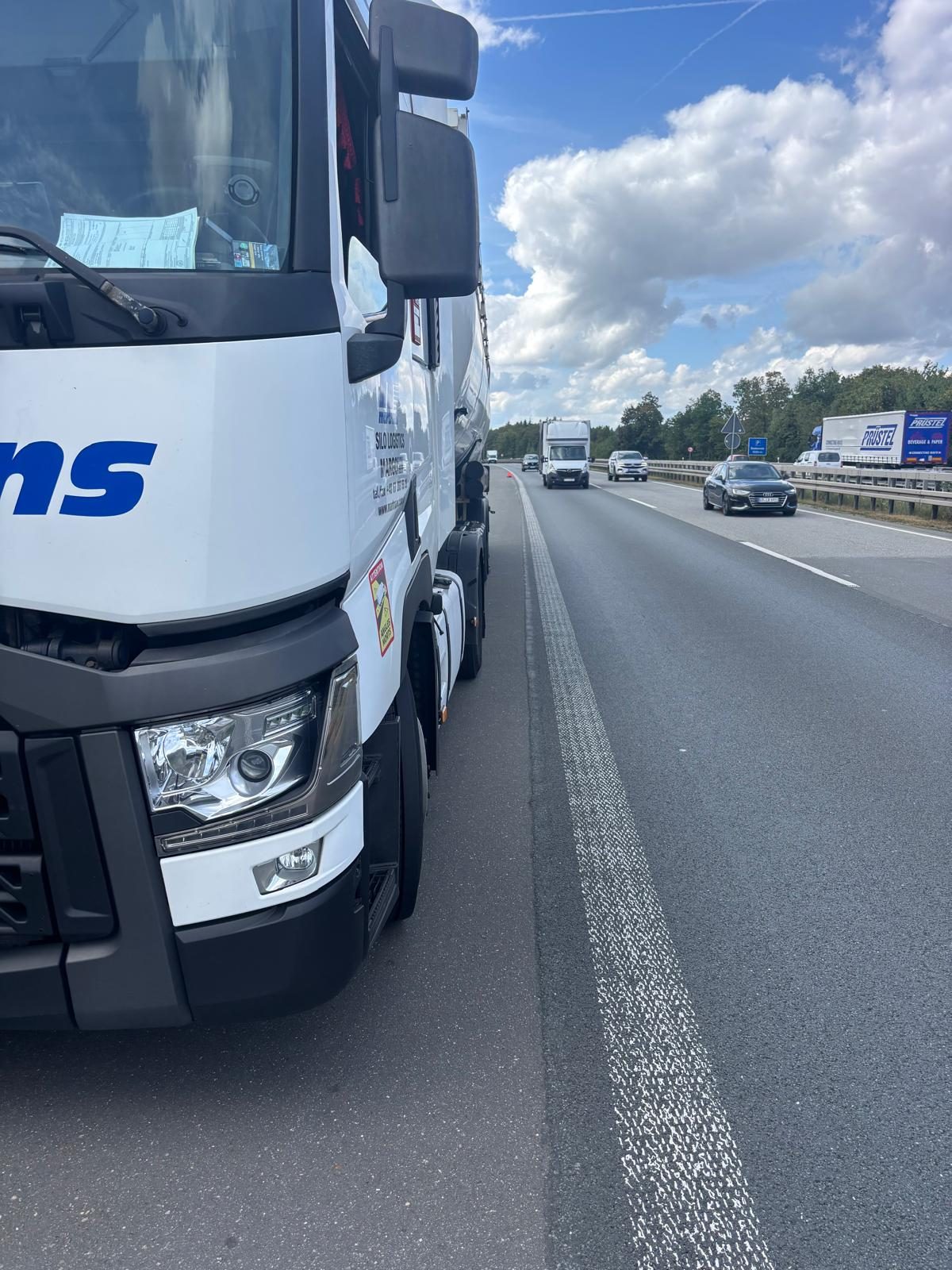
A damaged trailer tyre is rarely dramatic at first. The driver feels a vibration, glances in the mirror, sees a sagging sidewall, and pulls over. What happens in the next two hours decides whether it stays a routine job or turns into a wrecked rim, a tow bill and a missed delivery slot. This write-up follows one real call-out from the first phone call to the last wheel nut, with the real timings and the real price.
If you run a fleet, drive a tractor unit yourself, or dispatch for a haulier and wonder what a proper truck tyre service on the autobahn looks like in practice, this is a fair picture. We name no customer and no registration plates, but every number below comes from the job sheet.
The emergency: a damaged trailer tyre on the A3
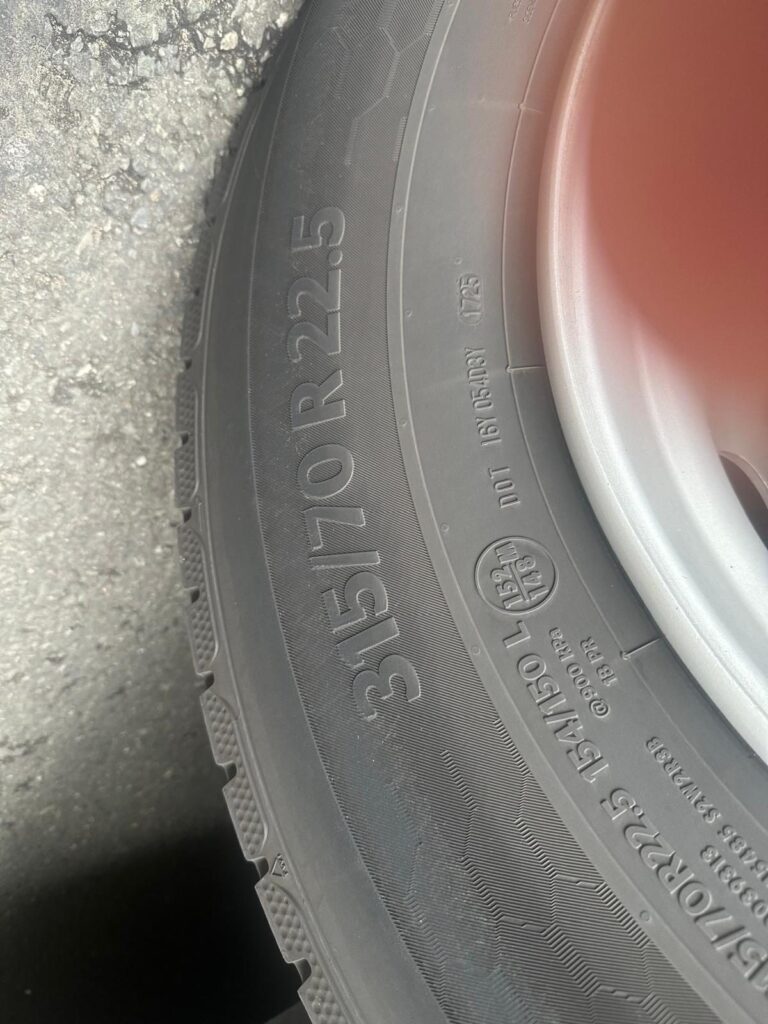
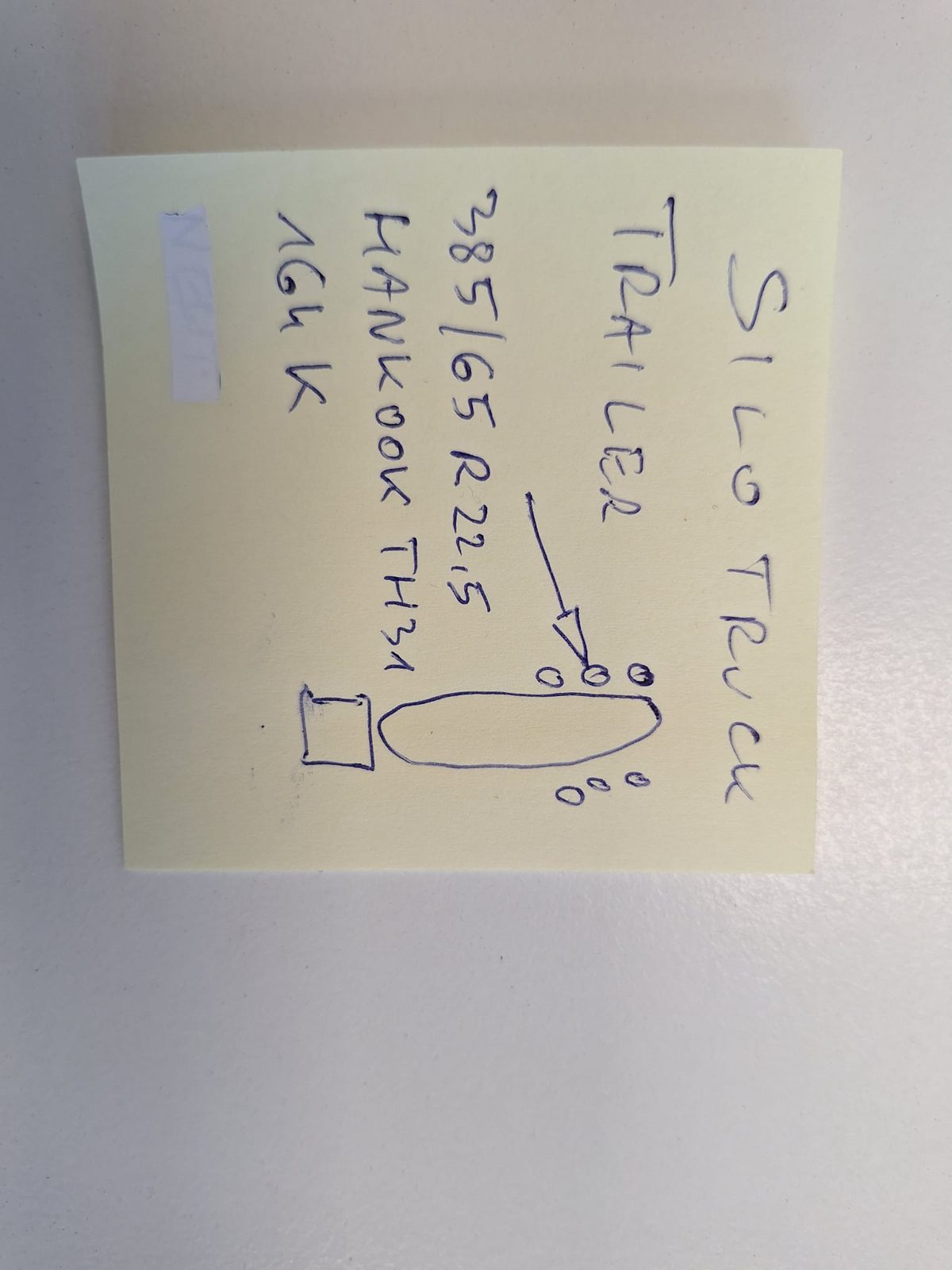
The vehicle was a white Renault Trucks tractor unit pulling a silo semi-trailer, the kind that hauls powders and bulk material such as flour, cement or plastic granulate. The damaged tyre sat on the rear bogie of the trailer. Size and model were printed on the sidewall: 385/65 R22.5, Hankook TH31, a tyre made for trailer axles.
The driver stopped on the hard shoulder (the Standstreifen, in German) before the tyre could fall apart. He switched on the hazard lights, put on his high-visibility vest and set up the warning triangle at the distance the rules require. Then he rang our 24/7 number. That sequence is exactly what we want to hear, and it is the reason the rest of the job went so smoothly.
Time of call: 14:04. Weather: bright sun, light traffic with a steady stream of vans and lorries, dry tarmac. Good conditions, which matter more than people think: a crew working beside three lanes of traffic in rain or darkness needs more time and more care. We say so in the timing section below.
How we organised the help
Dispatch turned a vague “tyre problem” into a precise order in 12 minutes. That is the real skill behind any mobile reifenservice: finding out exactly what is needed before anyone drives anywhere.
The dispatcher worked through a short list of questions with the driver:
- Which wheel position is affected: steer axle, drive axle or trailer axle, and which side?
- What does the sidewall say? In this case 385/65 R22.5 and the Hankook TH31 pattern.
- Is the vehicle fully on the hard shoulder, and are the warning triangle and hazard lights out?
- Is the trailer loaded, and how heavy is it roughly?
- Does the rim look bent, cracked or scored?
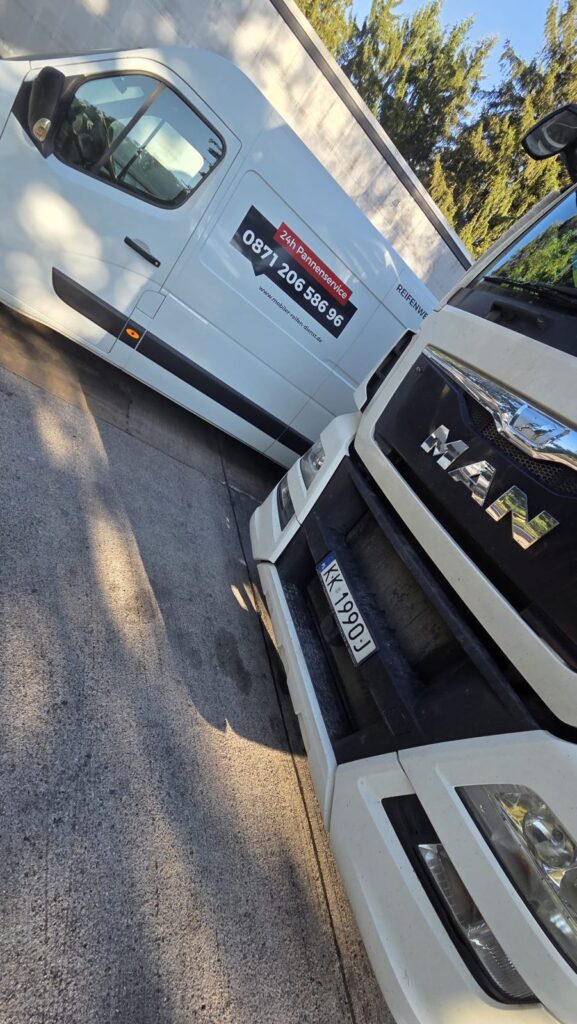
Answers in hand, we located the nearest partner crew in the Würzburg area that had the tyre on the van or could collect it within minutes. We deliberately do not name our service partners. What matters for you is that they belong to our vetted network, carry calibrated torque wrenches and a proper truck jack, and are insured for work beside live traffic.
At 14:16 the crew set off with the tyre loaded. The driver got a text with an estimated arrival time and a reminder to stay behind the crash barrier while waiting. If you have ever searched for a truck tyre service near me at the roadside, you know how welcome a clear arrival time is.
Why a damaged tyre on a trailer axle cannot wait
A tyre in this size runs at 8.5 to 9.5 bar, roughly four times the pressure in a car tyre. At that pressure a small cut or a failing bead does not stay small. Heat builds up in the carcass as the tyre flexes, and a tyre that has lost pressure or been run flat can shed its tread without warning.
There is a second problem: the twin-tyre arrangement. Dual wheels carry the load together. When one tyre goes soft, the neighbour takes on more weight than it was designed for and overheats. Within a few kilometres you can lose both. That is why drivers who “just limp to the next car park” often end up with a bill for two tyres and a rim.
On a loaded silo trailer the stakes are higher still. The axle load is close to the legal limit, and a bulk load sits high and shifts. A tyre failure at speed can upset the whole combination. Under section 36 of the German road vehicle licensing regulation (StVZO), tyres must suit the vehicle’s load and speed and must be free of damage that endangers safety. A sagging sidewall fails that test on sight.
Secondary damage means everything that breaks because the first tyre failed: the second tyre of the pair, the rim, wheel studs, brake lines, mudguards and the axle body. In this job the driver stopped early, and we recorded none of it.
Quick definitions
Carcass: the internal structure of steel and textile cords that gives the tyre its strength. Bead: the reinforced rim edge that seals the tyre against the wheel. Load index: the number on the sidewall that tells you how much weight one tyre may carry. For 385/65 R22.5 you will typically see 160 for single use.
Step-by-step: how the tyre was replaced
The crew arrived at 14:52, after a 36-minute drive on the A3. That is a typical figure for a motorway call-out in daylight: between 35 and 70 minutes depending on distance, traffic and weather.
Step 1: Inspection and assessment (14:52 to 15:00)
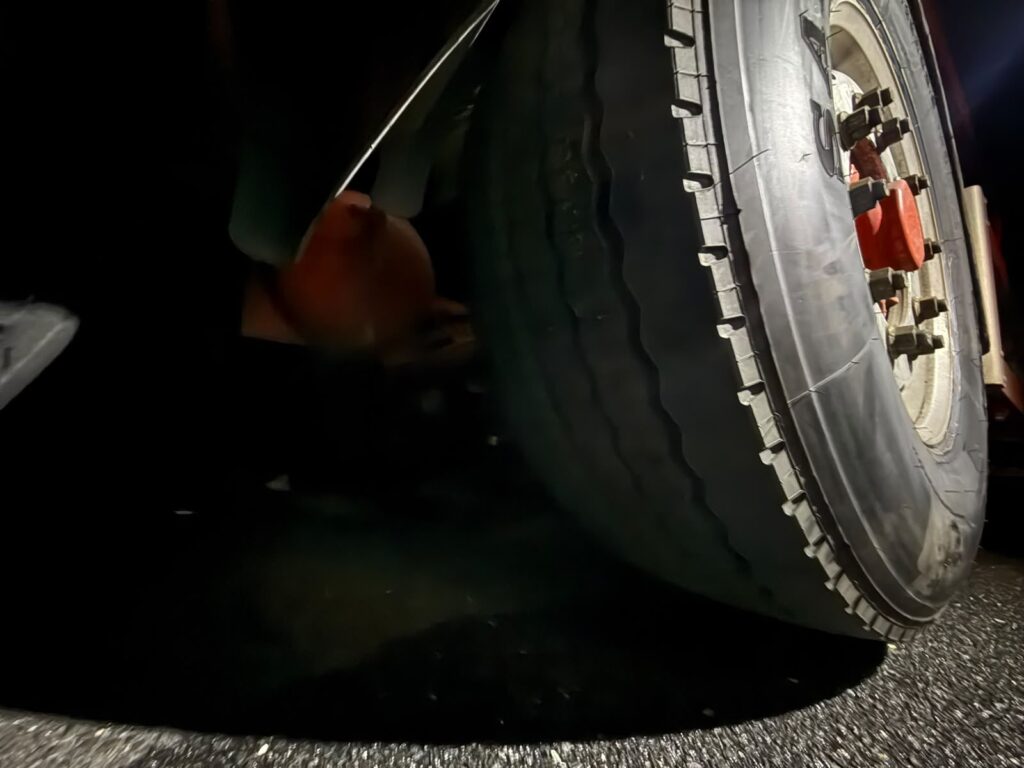
Before touching a wheel, the technician walked around the trailer. He checked the damaged tyre, the neighbouring tyre of the twin pair, the rim flange and the valve. He looked for bent flanges, cracks near the stud holes and heat marks. In this case the rim was sound, which kept the job at a straightforward tyre swap.
Step 2: Securing the scene
Safety comes before speed. The crew parked the service van behind the trailer, switched on the amber beacon, placed an orange cone on the approach side and chocked the wheels of the trailer so it could not move. The driver stayed behind the barrier, away from the lane. Most people underestimate how close a passing 40-tonner feels when you are kneeling at a wheel.
Step 3: Lifting the axle and removing the wheel (from 15:00)
The technician lifted the trailer axle with a hydraulic truck jack on the correct jacking point, never on the air bellows or a brake component. He loosened the wheel nuts while the wheel still touched the ground, raised the axle fully, then took off the nuts and removed the wheel with a wheel lifter.
Step 4: Fitting the new tyre
The old tyre came off the rim and the rim was cleaned and inspected a second time. The new Hankook TH31 385/65 R22.5 was mounted, the bead seated, and the tyre inflated in a safety cage to 8.5 bar. Demounting and fitting, lifting included, took 34 minutes (15:00 to 15:34).
Step 5: Torque and final checks (15:34 to 15:46)
Wheel nuts were tightened in a star pattern with a calibrated torque wrench to the manufacturer’s specification, usually in the range of 600 to 700 Nm for this wheel type. Then the pressure was checked again. The technician also looked at the twin partner and set it to the same pressure. For the full procedure, read our guide to truck wheel nut torque.
By 15:52 the old tyre was loaded, the paperwork was signed and the artic pulled back onto the A3.
Full timeline: 108 minutes from call to departure
Here is the exact sequence, with the minutes each phase took.
| Time | Phase | Action |
|---|---|---|
| 14:04 | Call | Driver reports a damaged trailer tyre, is stopped on the hard shoulder, warning sign set up |
| 14:04-14:16 | Dispatch | Size and wheel position confirmed, Hankook TH31 385/65 R22.5 located, nearest partner chosen (12 min) |
| 14:16-14:52 | Drive out | Partner crew drives along the A3 with the tyre and jack (36 min) |
| 14:52-15:00 | Inspection and protection | Tyre and rim checked, scene secured with cone and beacon, wheels chocked (8 min) |
| 15:00-15:34 | Removal and fitting | Axle lifted, wheel off, tyre changed, wheel refitted, inflated to 8.5 bar (34 min) |
| 15:34-15:46 | Torque and checks | Nuts tightened in a star pattern with a torque wrench, pressure rechecked (12 min) |
| 15:46-15:52 | Finish | Old tyre disposed of, documents signed, back on the motorway (6 min) |
Total: 108 minutes (1 hour 48 minutes) from the call to the departure.
Two things in this table are worth noting. First, dispatch took 12 minutes. A rushed dispatch sends the wrong tyre and costs two hours. Second, the hands-on work took 60 minutes in total, from inspection to the last torque check. Most of the clock time goes on getting a crew and a tyre to the spot, not on the work itself.
What did it cost? A transparent price for a truck tyre replacement
The total was 905 EUR net for this truck tyre replacement on the hard shoulder. Here is the itemised bill.
| Item | Price (EUR) |
|---|---|
| Call-out (Anfahrt) | 240 |
| Labour, 1.5 hours at 110 EUR | 165 |
| Tyre Hankook TH31 385/65 R22.5 | 480 |
| Disposal of the old tyre | 20 |
| TOTAL | 905 |
All amounts are net, plus VAT (zzgl. MwSt.). The call was at 14:04 on a weekday, so there was no night or weekend surcharge. Such surcharges typically add 25 to 50 per cent to the call-out and labour lines.
What moves the price up or down
- Time of day. Night, Sunday and public holiday calls cost more because crews are on standby.
- Distance. A call-out in the middle of Franconia is cheaper than one at the far end of Mecklenburg.
- Tyre choice. A 385/65 R22.5 trailer tyre ranges from about 420 to 540 EUR net, a 315/80 R22.5 drive tyre from 480 to 620 EUR.
- Rim condition. A bent or cracked rim means a new wheel, which changes the order of magnitude.
- Number of tyres. If the twin partner is also damaged, a second tyre goes on the invoice. A second tyre in the same visit costs far less than a second call-out.
If you want the full picture of what drivers and fleets pay, our article on truck tyre change cost breaks it down by size and situation.
The comparison that matters
A standing tractor unit with a loaded silo trailer costs a haulier roughly 800 to 1,200 EUR per day in lost revenue, driver time and missed slots. A silo load usually has a tight delivery window as well, because the receiving plant schedules its unloading. Spending 905 EUR to be moving again within two hours is the cheaper option by a wide margin. Waiting until the next morning for a workshop appointment, or limping to a yard on a damaged tyre, is almost always more expensive, even before you count the risk.
Why a roadside tyre change should be left to professionals
Changing a wheel on a 40-tonne combination is not a job for a driver with a breakdown kit. It is risky, and it is also usually physically impossible. A single 385/65 R22.5 wheel weighs well over 60 kg, and the nuts need a torque that a standard wheel brace cannot deliver.
The main risks of doing it yourself:
- Injury. Wheels slip, jacks fail on soft ground, and the hard shoulder is a narrow strip beside fast traffic.
- Wrong torque. Under-tightened nuts can work loose within a hundred kilometres. Over-tightened studs stretch and can snap. A wheel that comes off at 80 km/h is a headline waiting to happen.
- Unsafe inflation. Seating a bead at 8.5 bar without a cage or a proper hose is dangerous. Tyre explosions injure people every year.
- Missed damage. A trained technician spots a cracked rim, a leaking valve or a damaged brake line at a glance. A driver in a hurry does not.
- Insurance and liability. If a self-fitted wheel contributes to an accident, the consequences for the driver and the company can be severe.
The equipment also matters: a hydraulic truck jack, a wheel lifter, a calibrated torque wrench, a safety cage and tyre irons. That is a van full of kit, not a toolbox.
Common situations we attend across Germany
This job was a trailer tyre on the A3. In practice our teams handle a wide range of tyre and wheel problems every week. The most common are:
- Sudden tyre bursts on tractor units and trailers, often in summer heat.
- Punctures from screws, nails, metal fragments and stones in the tread. We covered one in detail in a tipper truck near Regensburg.
- Slow leaks from damaged valves, which drivers notice only at the next check.
- Wheel hub problems and loose wheel nuts after a recent tyre change.
- Bent or damaged rims after hitting a kerb or a pothole.
- Tyre failures with a coach or a livestock lorry on board, where time pressure is greater still.
- Sudden damage on the steer axle, which is the most dangerous position.
Whatever the cause, the pattern is the same: stop safely, secure the scene, call a single number, and give dispatch the tyre size. Our mobile units across the country also cover related jobs such as brake faults, electrical issues and fluid leaks. See our mobile truck service for what we can do at the roadside. If the vehicle cannot be repaired on the spot, we arrange recovery to a workshop for trucks.
Prevention: tips for drivers and fleet managers
Most tyre failures are not bad luck. They are the end of a chain that started days or weeks earlier. These habits cut your risk noticeably:
- Check pressure when the tyres are cold. Do this at least once a week and always before a long trip. A tyre 20 per cent under-inflated runs hotter and wears faster.
- Walk around the vehicle every morning. Look for cuts, bulges, embedded stones and uneven wear. It takes three minutes.
- Measure tread depth. The legal minimum for trucks is 1.6 mm, but most fleets replace steer tyres well before that.
- Pair tyres sensibly. Twin tyres should have similar diameter and wear. A mismatch overloads one of them.
- Respect the load index. Overloading is the quickest way to a blowout.
- Check after every impact. A kerb strike or a pothole can damage a carcass invisibly.
- Keep a record. A simple tyre log per axle shows trends before they become breakdowns.
Fleet managers should schedule a pre-trip tyre check before long-haul runs and keep a standing arrangement for emergencies. If your drivers know exactly who to call and what to say, the first ten minutes of a breakdown shrink to two. For a bigger picture, see what to do after a tyre blowout on the autobahn.
Truck tyres in detail: sizes, brands and maintenance
The 385/65 R22.5 is the standard size for trailer axles and is also used on some tractor unit positions. The three numbers describe the tyre: 385 mm width, a sidewall height of 65 per cent of the width, and a 22.5-inch rim diameter. The “R” stands for radial construction. Size standards are maintained by the European Tyre and Rim Technical Organisation (ETRTO), which sets the compatibility between tyre and rim. If you want a plain-language walk-through, our guide to the 385/65 R22.5 truck tyre size covers it.
Hankook is one of several premium and mid-range manufacturers that fit the trailer segment. Their TH31 pattern is designed for trailer axles on long-haul routes: low rolling resistance, even wear and good stability at motorway speeds. Other brands such as Michelin, Continental, Goodyear and Bridgestone offer comparable ranges, and the right choice depends on your routes, loads and budget. We do not push a single brand. When a customer’s fleet standard is a different make, we try to match it, because mixing brands within one axle group is bad practice.
Which tyre for which position?
| Position | Typical size | Typical use |
|---|---|---|
| Steer axle | 315/80 R22.5 or 315/70 R22.5 | Directional control, highest safety priority |
| Drive axle | 315/80 R22.5 | Traction and load transfer |
| Trailer axle | 385/65 R22.5 | Load carrying, low rolling resistance |
| Distribution truck | 245/70 R19.5 | Urban and regional delivery |
| Van | 235/65 R16C | Light commercial use |
Retreads, pressure monitoring and rotation
Retreaded tyres are a legitimate option for drive and trailer axles when the casing is sound. They cost less and conserve resources, but never on the steer axle in most fleet policies. Tyre pressure monitoring systems (TPMS) give an early warning of slow leaks and are worth fitting on any trailer that sits in a yard for days. Rotation between axle positions evens out wear, and wheel alignment checks reduce the edge wear that kills tyres early.
One more detail from the A3 job: the technician balanced nothing at the roadside, because truck tyres on trailers are rarely balanced as a matter of course, but he did check for even seating all the way round. A tyre that sits crooked on the rim will wobble at 85 km/h and wear in a week.
Winter, summer and all-weather
In Germany the rule for trucks is situational: winter conditions require winter-capable tyres on the drive axle at least. Many hauliers fit M+S or 3PMSF marked tyres year-round to avoid trouble in the mountains of Bavaria and Baden-Württemberg. If you are comparing options, our piece on winter truck tyres explains the rules.
Frequently asked questions
How much does a truck tyre change on the autobahn cost?
A truck tyre change on the autobahn typically costs 750 to 1,400 EUR net, depending on tyre size, time of day and distance. In this job, a 385/65 R22.5 trailer tyre cost 905 EUR net in total: 240 call-out, 165 labour, 480 tyre and 20 disposal. Night and weekend calls add 25 to 50 per cent.
How long does it take to get a truck tyre replaced on the hard shoulder?
From phone call to departure, expect about 1.5 to 3 hours. In this case it was 108 minutes: 12 minutes dispatch, 36 minutes drive, 60 minutes of work and checks. Rain, darkness or heavy traffic can add 30 to 90 minutes, because the crew needs more time to secure the scene.
Can I drive on a damaged trailer tyre to the next service area?
No. A damaged or deflated tyre can burst, shed its tread or destroy the twin partner and the rim within a few kilometres. Stop at the first safe point, put on your hazard lights and warning triangle, and call for help. Continuing usually turns a 905 EUR job into a much larger one.
Do you carry the right tyre with you?
Our network crews carry common sizes, and dispatch confirms the exact size and pattern with the driver before anyone sets off. For the rarer sizes, the crew collects the tyre on the way. That is why dispatch asks you to read out the sidewall.
What is the correct torque for truck wheel nuts?
Most 22.5-inch truck wheels need roughly 600 to 700 Nm, but the exact value depends on the hub and the wheel system. A technician uses a calibrated torque wrench and tightens in a star pattern. After 50 to 100 kilometres, the nuts should be rechecked.
Who pays for the roadside tyre service?
The vehicle operator pays the invoice, and in most cases the haulier recovers part of the cost through fleet or breakdown insurance. Check your policy for breakdown cover. We issue itemised quotes so you can submit them straight away. All prices are net, plus VAT.
Why drivers and fleets choose us
We are a dispatch centre, not a single workshop, and that is the point. Calls come in 24 hours a day, every day, from every part of Germany, and a dispatcher who knows the network assigns the nearest crew, not the cheapest one on a list.
- Round-the-clock availability. The number answers at 3 a.m. on a Sunday as it does at noon on a weekday.
- A vetted partner network. Crews carry calibrated tools, insurance and the right tyres. We test who we send.
- Clear prices. You see the call-out, labour, parts and disposal before the work starts.
- Multilingual dispatch. Drivers from across Europe call us. We handle German, English, Polish and Russian, so a driver from Lithuania or the Netherlands does not have to explain a tyre size in a foreign language.
- Single point of contact. If a tyre job turns into a tow, or a tyre failure reveals a brake defect, we manage the whole chain through one conversation. For recovery we run a separate towing service with the same dispatch.
For more on our general approach to emergency tyre work, see our tyre service page and the contact page.
Summary
| Parameter | Value |
|---|---|
| Vehicle | Renault Trucks tractor unit with silo semi-trailer |
| Tyre | Hankook TH31 385/65 R22.5, trailer bogie |
| Location | A3 near Würzburg, direction Nuremberg, hard shoulder |
| Dispatch | 12 minutes |
| Drive out | 36 minutes |
| On-site work | 60 minutes (inspection, fitting, torque and checks) |
| Total time | 108 minutes (1 h 48 min) |
| Cost | 905 EUR net |
| Secondary damage | None |
The lesson of this job is simple: stop early, secure the scene, call with the tyre size ready, and let a trained crew do the work. A tyre swap that takes under two hours beats a tow, a damaged rim and a lost day.
Need help with a truck tyre on the road?
Call our 24/7 line now: +49 160 5753826. Tell us where you are, the tyre size and which wheel is affected. We will send the nearest crew.
www.lkwhelp24.com | Round the clock across Germany
Keywords: truck tyre service | mobile reifenservice | truck tyre replacement | truck tyre change | trailer tyre service | truck tyre callout | truck tyre roadside assistance | truck tyre repair | truck tyre breakdown | truck tyre blowout | truck tyre emergency | truck tyre germany | 385/65 R22.5 | Hankook TH31 | A3 Würzburg