In short: on 20 August a touring coach lost the whole tread of a 315/70 R22.5 tyre at a rest area on the A7 near Kassel, heading south. Our dispatcher took the call at 10:38, a partner crew arrived at 11:32, and the coach rolled on at 12:40, which is 2 hours 2 minutes after the first ring. The invoice came to 945 EUR net, and the rim, the wheel arch and the brake lines were undamaged.
A burst tyre on a coach is a different animal from a burst tyre on a flatbed. There are passengers waiting, a timetable to keep and a driver who has to explain to forty people why the engine is off. This write-up follows the job from the first phone call to the moment the coach pulled out, and it is meant as a practical reference if you ever need truck tyre service on a German motorway. Everything below is what actually happened, including the 42 minutes spent waiting for the crew to arrive.
What happened on the A7 near Kassel
The coach had a total tyre failure on a single-fitted axle, and the driver managed to reach a rest area on the A7 south of Kassel before stopping. That decision mattered more than anything we did afterwards. A burst tyre on a motorway verge or hard shoulder puts the crew within a metre or two of traffic doing 80 to 100 km/h, whereas a rest area gives room to place cones and work in peace.
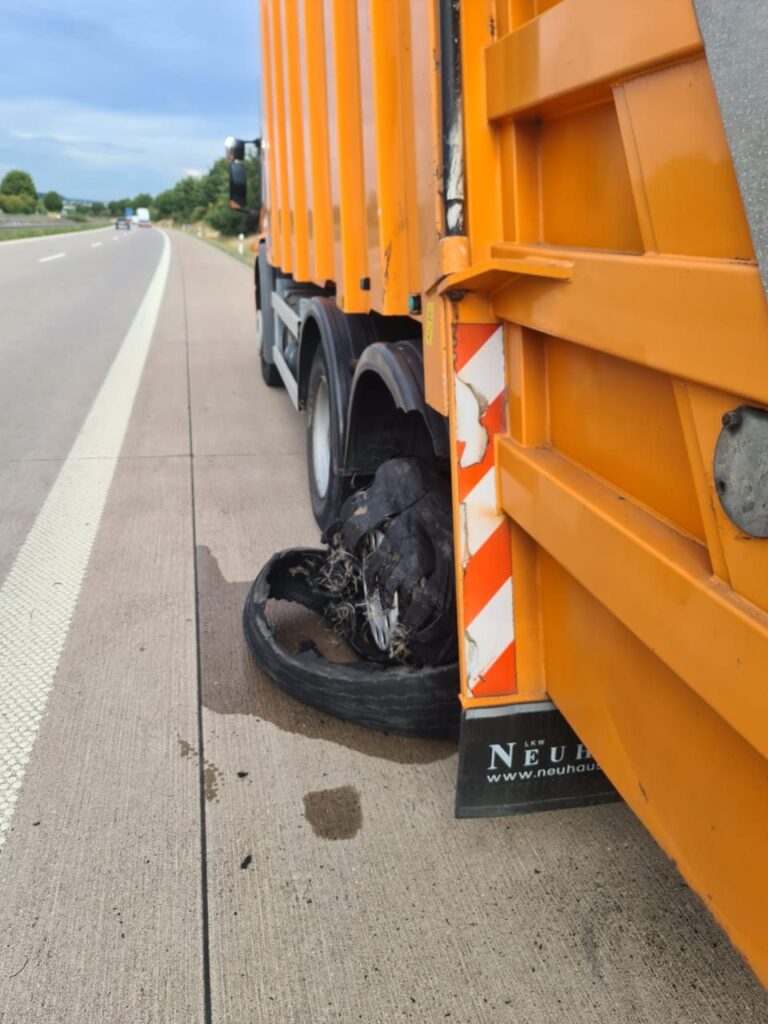
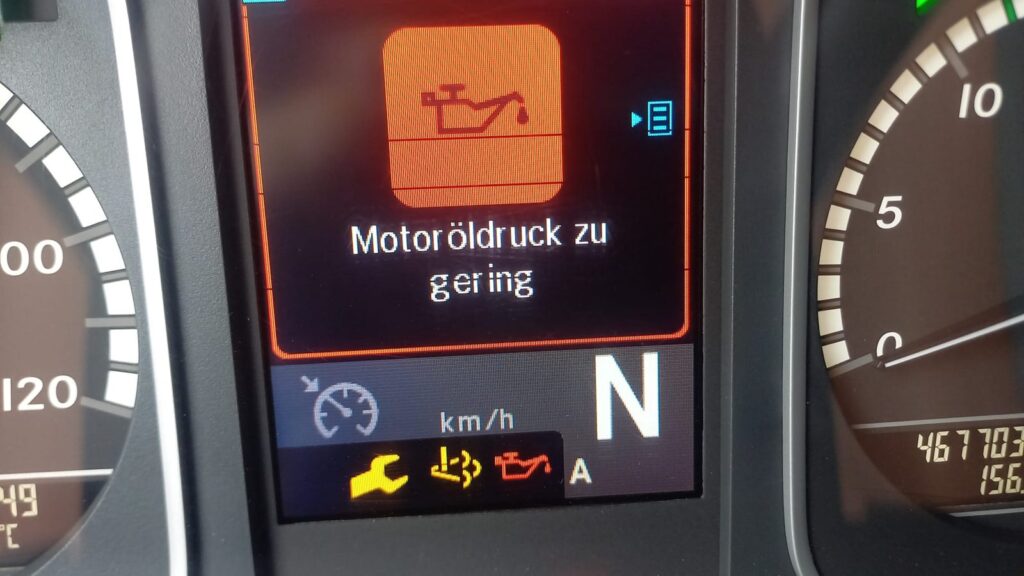
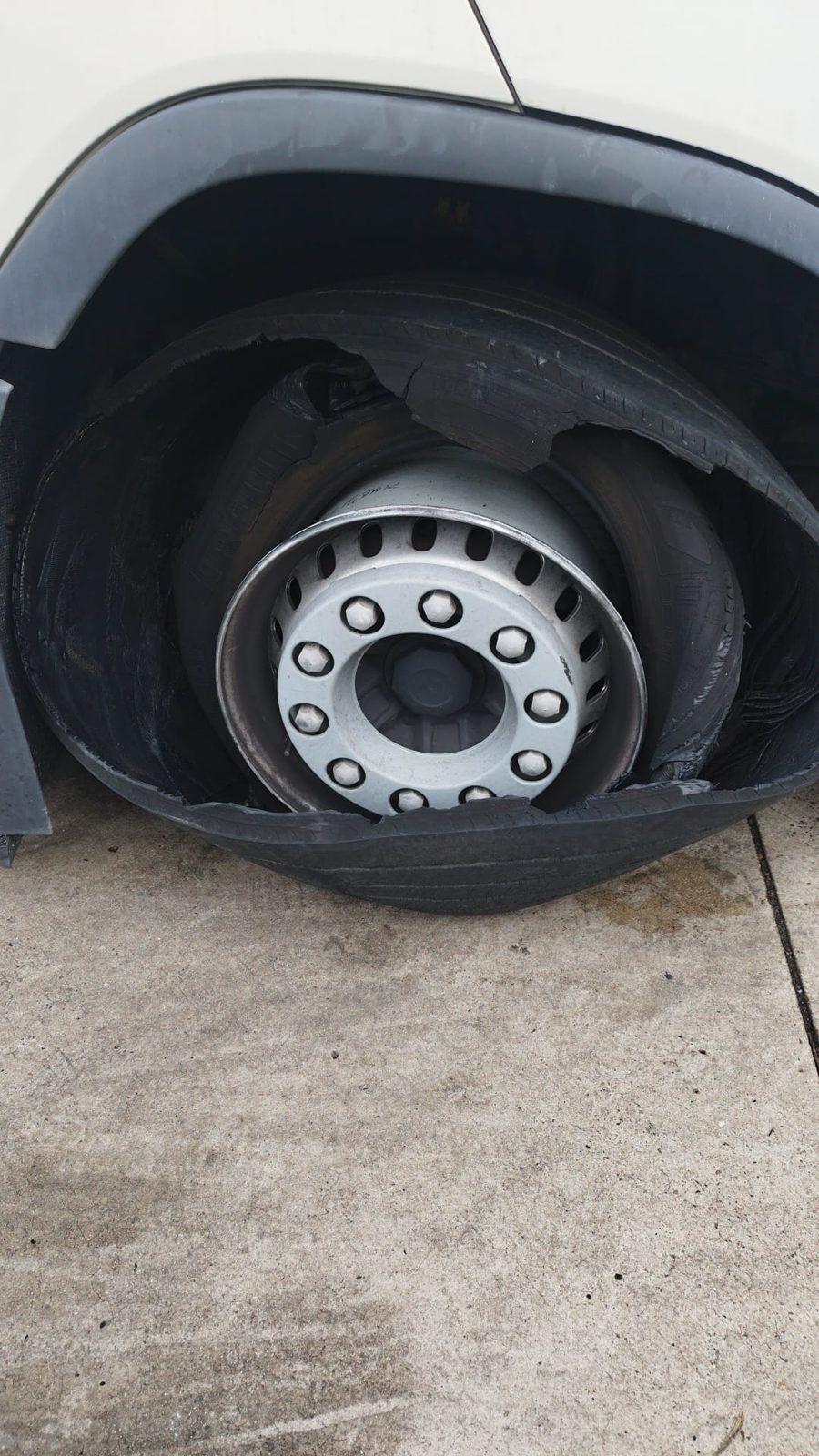
The driver rang our 24/7 line at 10:38. The weather helped: overcast, dry, about 18 degrees. The tread had come away in strips, and the fabric of the casing hung down into the wheel arch like torn cloth. The passengers were out of the vehicle and standing well clear in hi-vis vests, so nobody was hurt.
The likely cause was familiar to anyone who has spent time around fleets. The tyre had been running under-inflated for some time, the sidewalls had overheated from constant flexing, and the casing finally gave up. In the trade this is called a flex failure, and it very often follows a slow leak that nobody noticed or a driver who carried on for a few more kilometres to reach a better stopping place.
The tyre in numbers
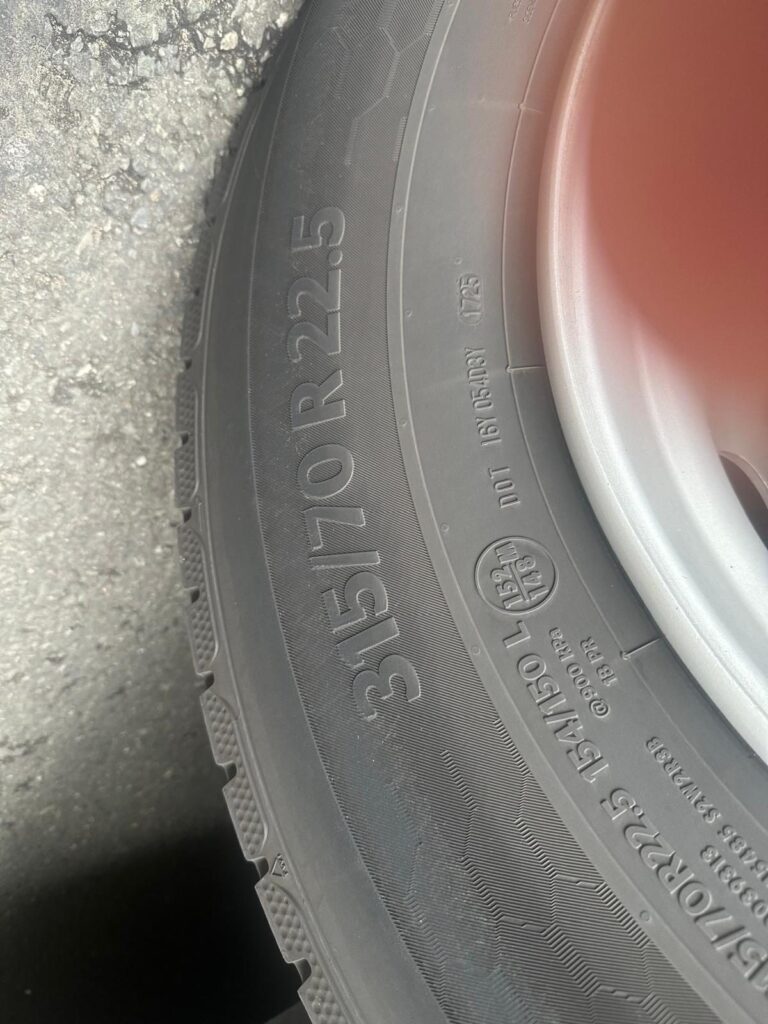
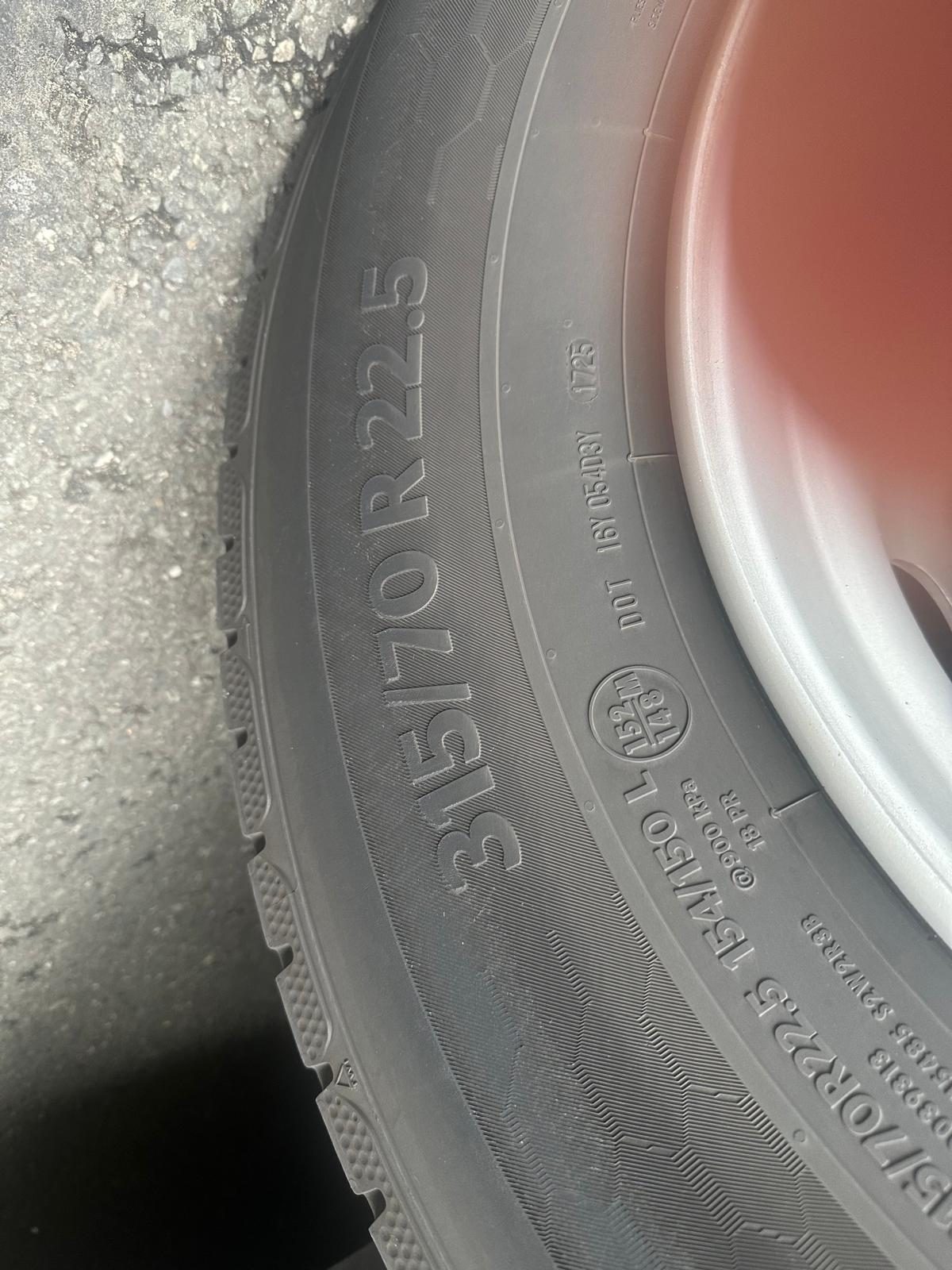
The replacement was a 315/70 R22.5 with a load index of 154/150 L (152/148 M in twin fitting), 18 ply rating and a maximum pressure of 900 kPa, which is 9.0 bar. The coach carries a steel rim with ten wheel nuts per hub. If you need to decode a sidewall yourself, the ETRTO standards body publishes the dimension tables that most manufacturers follow.
How our dispatch handled the call
A truck tyre callout works only if three things are known within the first few minutes: where the vehicle is, which size is on the axle, and whether anyone is in danger. Our dispatcher asked for exactly those three things, then asked the driver to send photos by WhatsApp.
The photos did real work. They showed that the steel rim was still in one piece, that the rubber had not been wrapped around the hub, and that a standard wheel change would be enough. If the pictures had shown a bent rim or a damaged hub seal, we would have sent a different vehicle and a different set of tools.
Here is how the first twelve minutes went:
- 10:38: call received, rest area on the A7 near Kassel confirmed, tyre size 315/70 R22.5 noted.
- 10:40: photos arrive by WhatsApp, passengers confirmed safe.
- 10:45: stock check across the partner network: a new tyre in the right size is available.
- 10:50: crew from our partner workshop in the region selected, driver informed.
That is 12 minutes from first ring to dispatch. We could have been faster if the size had been unknown, but in that case it would have been slower, and that is why the size question comes first.
Truck tyre roadside assistance: why 42 minutes is a normal wait
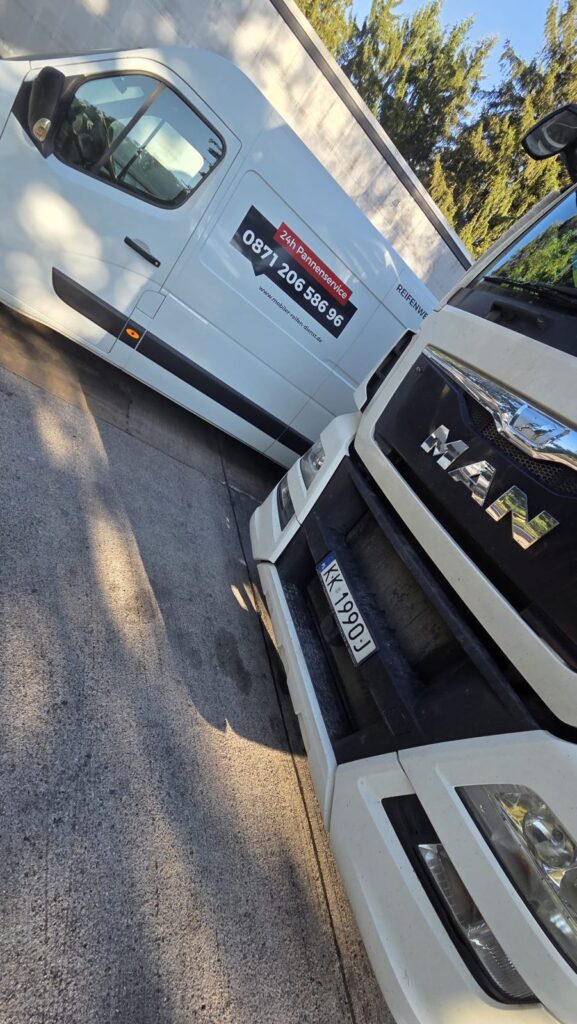
The service vehicle arrived at 11:32, 42 minutes after dispatch. On the German motorway network, anything between 35 and 70 minutes is realistic for a mobile truck tyre service, depending on the time of day, the traffic around the nearest base and the weather. In heavy rain or at night the figure goes up.
This is the honest part of the story, and operators who promise “30 minutes everywhere in Germany” are either lucky or not telling the whole truth. A crew has to come from where it was when the call arrived, usually from another job, and it has to bring the right tyre. What we can control is the quality of the information passed on, so the crew leaves with the correct size, the right tools and a clear idea of the location.
If you want to understand what a mobile truck service can and cannot do at the roadside, the short version is that tyre replacement, wheel work, minor repairs and diagnostics are done on the spot, while anything needing a lift or a heavy gearbox repair goes to a workshop.
Why a burst coach tyre cannot wait
A tyre like this one cannot be nursed to the next exit. The casing is gone, the rim has little protection, and every metre driven raises the chance of hitting the rim, the brake lines or the air bags. A coach fully loaded with passengers and luggage puts several tonnes on that axle, and a single-fitted wheel has no twin partner to carry the load.
Truck tyres run at much higher pressure than car tyres. For this size the printed maximum is 9.0 bar, roughly four times what a family car uses. That stored energy is the reason for a few rules we follow on every job:
- Never stand in front of the tread when a damaged tyre is deflated or inflated.
- Never use a damaged wheel as a base for a jack.
- Never inflate a tyre that has been run flat without first inspecting the bead and the rim.
- Always use a safety cage or a restraint when inflating off the vehicle.
German rules also set a floor for tyres: Section 36 of the StVZO covers tyre requirements including tread depth. A tyre with its tread torn off does not meet any of them, so continuing to drive is not an option, legally or physically.
Step-by-step: how the tyre was changed
The job took 70 minutes from arrival to the moment the coach was released. That is a reasonable time for a single wheel on a coach with full inspection of the surrounding parts. Here are the five stages as they happened.
Step 1: Inspection and securing the site (11:32 to 11:40)
The crew parked the service vehicle behind the coach with its beacon on, set out warning cones and chocked the wheels on the opposite side. Then came the visual check of the rim, the hub, the wheel arch and the brake lines. Fabric remnants hanging into the arch were cut away and removed. This is where problems show up: an air line cut by a flailing tread strip would have meant a longer job and a different invoice. Not this time.
Step 2: Removing the wheel (11:40 to 11:55)
All ten nuts were loosened while the wheel was still on the ground, since a wheel in the air would simply turn. Then the jack went under the axle at the designated lifting point, the wheel came off, and the ruined tyre was broken down and removed from the rim. Tyre fitters call this stage demounting, and on a 22.5-inch steel rim it takes strength and the right machine.
Step 3: Rim check and new tyre (11:55 to 12:25)
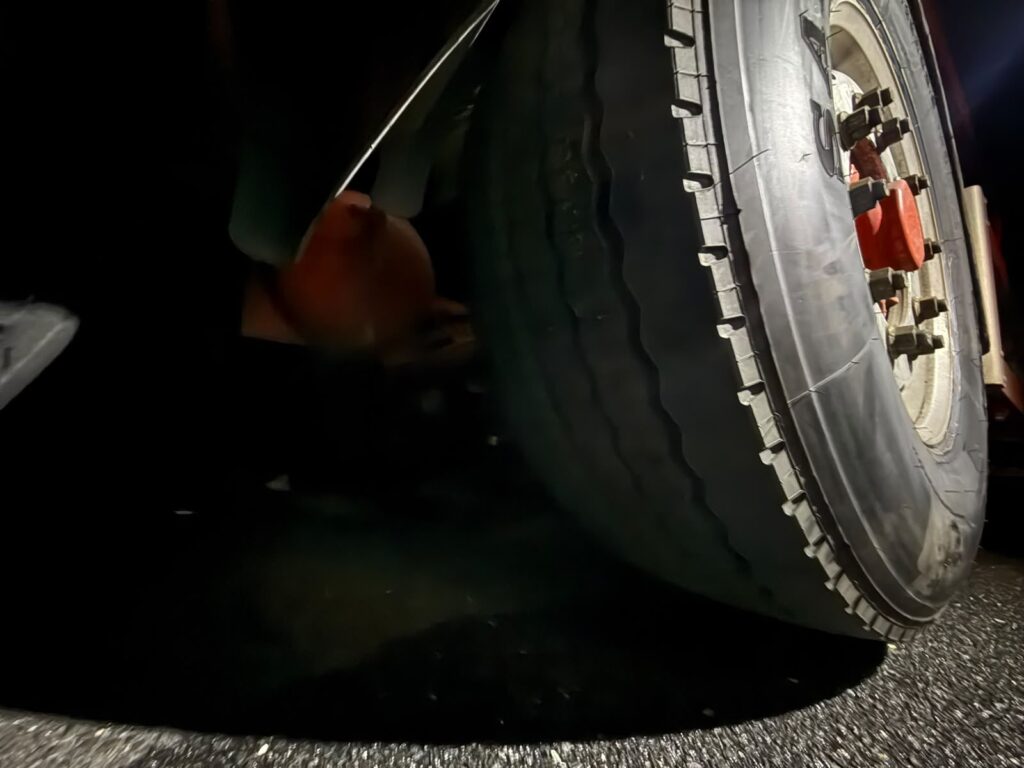
The rim was examined for cracks and for flat spots on the bead seat. It passed. A new 315/70 R22.5 was mounted, the valve was replaced (old valves on a failed tyre are always suspect) and the wheel was balanced. This was the longest single stage at 30 minutes, and it is not a place to save time.
Step 4: Refitting the wheel (12:25 to 12:40)
The wheel went back on the hub, the nuts were run on by hand first to avoid cross-threading, and then tightened in a star pattern in two or three passes. The final pass was done with a torque wrench to the manufacturer’s value for that axle. If you want the general numbers and the correct sequence for trucks, our guide to truck wheel nut torque gives a table.
Step 5: Final check and release (12:40)
Tyre pressure was set to 9.0 bar, as shown on the sidewall, and the crew did a short test run in the car park. The driver signed off, and the coach left at 12:40 with its passengers.
Full timeline of the job
| Time | Phase | Action |
|---|---|---|
| 10:38 | Call | Driver reports the tyre burst; location and tyre size 315/70 R22.5 taken; photos arrive by WhatsApp |
| 10:50 | Dispatch | Dispatcher confirms the tyre is in stock and picks the partner network crew in the region (12 min) |
| 11:32 | Arrival | Service vehicle arrives (42 min travel) |
| 11:40 | Securing and inspection | Warning cones, wheel chocks, visual check of rim, hub, wheel arch and brake line; fabric remnants removed |
| 11:55 | Demounting | Ten nuts loosened, jack positioned, wheel removed, tyre taken off the rim |
| 12:25 | Mounting | New 315/70 R22.5 fitted, rim checked for cracks, valve replaced, wheel refitted |
| 12:40 | Completion | Nuts tightened in a star pattern to specified torque, pressure 9.0 bar verified, test run, release |
Total: 122 minutes (2 hours 2 minutes) from call to departure.
A few details about that table. The 12 minutes of dispatch is the figure most operators leave out; it is also the one we work hardest to shorten. The 42-minute drive is the part we cannot shorten at will. And the 70 minutes of actual work is about what a coach wheel takes when nothing goes wrong.
What does a truck tyre replacement on the motorway cost?
This job cost 945 EUR net (plus VAT), and a single-wheel replacement on a coach or lorry usually lands between 750 and 1,400 EUR net on a German motorway. The figure depends mostly on the tyre itself, the time of day and the distance the crew has to cover.
| Item | Price (EUR) |
|---|---|
| Call-out and emergency fee | 240 |
| Labour, 1.5 hours at 110 EUR (demounting, mounting, balancing, torque) | 165 |
| Truck tyre 315/70 R22.5 (new, branded) | 520 |
| Disposal of the old tyre and casing remnants | 20 |
| Total (net) | 945 |
With 19 % VAT of 179.55 EUR, the gross total is 1,124.55 EUR. Companies that can reclaim input tax care about the net figure, and private owners of camper vehicles should look at the gross one.
What moves the price up or down
- Time of day: night and weekend call-outs typically carry a surcharge of 25 to 50 %. This job was done on a weekday morning.
- Tyre size and brand: a 315/80 R22.5 steer tyre is dearer than a trailer tyre such as 385/65 R22.5, and premium brands cost more than budget lines.
- Distance: a crew travelling 20 km costs less than one travelling 90 km.
- Extra damage: a bent rim or a damaged hub seal changes the quote straight away.
If you want a broader view of the numbers, our article on what a new truck tyre really costs goes into brand and size differences.
Compared with the cost of standing still
A touring coach with a group on board and a schedule to keep loses roughly 800 to 1,200 EUR per day when it stands idle, and that is before the knock-on costs: missed hotel check-ins, rebooked excursions, unhappy customers. A haulier with a loaded artic faces similar numbers, plus the risk of a late-delivery penalty. The 945 EUR invoice looks different against that background, and the time saved matters as much as the money.
Why a professional should handle a truck tyre burst
A truck wheel is not a car wheel, and several things can go wrong when an untrained person tries to change one on the roadside. The risks are well known to every fleet manager:
- Wrong jack or wrong lifting point: a vehicle weighing 12 to 18 tonnes can slip off an inadequate jack.
- Missing torque control: wheel nuts tightened by feel can loosen and a wheel can leave the vehicle at speed.
- No safety cage: inflating a heavy-duty tyre without restraint is one of the more dangerous jobs in the trade.
- Missed hidden damage: a cracked rim or a damaged valve stem will not show up unless someone looks for it.
- Hard shoulder risk: working beside live traffic without cones, beacons and training is a fast route to a second incident.
The Federal Highway Research and traffic safety organisations publish accident figures every year, and breakdowns on motorways are consistently among the more dangerous situations a driver can face. That is why the standard advice is to switch on the hazard lights, put on a hi-vis vest, get everyone behind the barrier and call for help, rather than attempt the repair alone.
For the first steps after a burst on the motorway, our checklist for a tyre blowout on the autobahn is worth printing and keeping in the cab.
Situations we attend across Germany
Truck tyre service is only one part of what the network does, though it makes up a large share of the calls. A typical week brings a mix like this:
- Tyre blowouts and punctures on tractor units, trailers and coaches, mostly on the A2, A3, A5, A7 and A8 corridors.
- Trailer tyre service for refrigerated and curtain-sider trailers that stop at a lay-by with a slow leak.
- Wheel and rim damage after kerb contact, potholes or debris on the road.
- Valve and sensor faults on tyres that lose pressure for no visible reason.
- Roadside tyre checks before a long journey, when a driver wants a second opinion.
- Combined jobs, where a tyre problem turns out to be linked to brakes, suspension or an air leak.
When the vehicle cannot be repaired at the roadside, we arrange recovery. Our towing service handles that, so the customer deals with one dispatcher from the first call until the vehicle is moving or in a workshop.
Prevention: how to avoid a tyre burst
Most truck tyre failures that we see could have been avoided with a few minutes of attention before departure. The checks below are not exotic, but fleets skip them under time pressure.
- Check pressure cold, every week at least. An under-inflated tyre generates heat, and heat destroys the casing. A drop of 1 bar below the target is enough to shorten the tyre’s life noticeably.
- Look at the sidewalls. Bulges, cuts and cracks mean the tyre should be inspected by a specialist before the next trip.
- Measure tread depth. The legal minimum for heavy vehicles is covered in the StVZO; many fleets replace earlier than the minimum.
- Check twin tyres against each other. A pair that differs by more than a few millimetres in diameter will overload the larger tyre.
- Do not drive on after a pressure warning. A few kilometres on a deflating tyre can turn a repair into a replacement.
- Keep a log. Rotation, repair and replacement dates help to spot a pattern before it becomes a breakdown.
The tyre manufacturers publish good technical guidance. Michelin and Continental both have material on pressure, load and inspection intervals for commercial vehicles, and it is worth reading for anyone who manages a fleet.
Truck and coach tyres in a fleet: what to know
A modern fleet tends to use a handful of sizes: 315/80 R22.5 on steer and drive axles, 385/65 R22.5 on trailers, 245/70 R19.5 on distribution vehicles and 315/70 R22.5 on many coaches, as in this case. Standardising on a small number of sizes makes spare stock simpler and shortens the time to replace a tyre.
Brands also matter, though not in the way the marketing suggests. The big names, including Michelin, Continental, Goodyear and Bridgestone, all offer well-built casings for long-haul work, and the differences between them are smaller than the differences between a correctly inflated tyre and an under-inflated one. Retreading is worth a look for drive and trailer axles, because a good casing can carry a second tread, but steer-axle tyres on coaches are usually kept new.
Seasonal rules apply too. In Germany the winter tyre obligation depends on conditions, and truck drivers should know which axles it covers. When in doubt, call a specialist before the first frost, not after.
Questions fleet managers ask us
Fleet owners often want to know whether it is cheaper to keep a spare wheel on board or to rely on a callout. The honest answer is that a spare saves the cost of a tyre fitter only if the driver can change a 60 kg wheel safely, which most cannot, and it adds weight. Calling an experienced crew usually wins on safety and often on cost.
Another frequent question is about tyre pressure monitoring. A system that warns the driver of a slow leak is cheap compared with a burst. In this case a warning light or a regular check might well have saved the casing, and the 945 EUR.
FAQ
How long does a mobile truck tyre service take to arrive?
On German motorways our partner crews usually arrive 35 to 70 minutes after dispatch. In this case on the A7 near Kassel it took 42 minutes. At night, in heavy rain or at peak holiday times the wait can be longer, and we tell the driver an honest estimate at the time of the call.
How much does a truck tyre change on the motorway cost?
A single truck tyre replacement on the roadside typically costs 750 to 1,400 EUR net, depending on tyre size, distance and time of day. Our coach case came to 945 EUR net, including call-out, labour, a new 315/70 R22.5 tyre and disposal. Night and weekend jobs carry a 25 to 50 % surcharge.
Can a burst truck tyre be repaired instead of replaced?
If the tread is torn off and the casing is in shreds, as it was here, repair is not possible and the tyre must be replaced. A small puncture in the tread area can sometimes be repaired, but a damaged sidewall cannot. The technician decides on site after inspecting the casing and the rim.
What should I do while waiting for truck tyre help?
Move to a rest area or the hard shoulder if you can, switch on the hazard lights, put on a hi-vis vest, set up the warning triangle at the distance the StVO requires, and get all passengers behind the barrier. Then ring the 24/7 line and have the tyre size ready.
Do you help foreign drivers and fleets in Germany?
Yes. Our dispatch handles calls from drivers across Europe, and the crews work with the vehicles and tyre sizes common on German motorways. Tell us your location, the tyre size and what you can see, and we take it from there.
Who pays for the roadside tyre service?
The vehicle owner or operator pays the invoice, and many fleets pass it on to their insurer or leasing company. We issue a clear itemised quote before work starts, so the paperwork is simple for accounts and claims.
Why drivers and fleets choose us
LKWHelp24 is a dispatch and partner network, not a single workshop, and that has practical effects for the person standing at the roadside.
- Available 24/7, including nights, weekends and public holidays, anywhere in Germany.
- Vetted partner crews with tyre stock, jacks, torque wrenches and safety equipment on the vehicle.
- Price quoted before the work, so there are no surprises on the invoice.
- Multilingual dispatch, which matters when the driver speaks Polish, Lithuanian or Romanian rather than German.
- One contact for tyre service, repair and recovery, so a tyre job that turns out to need a tow does not mean starting again.
If you want more detail on how we handle tyre jobs, our page on tyre service lists the vehicle types and the work we do on site.
Summary
| Item | Detail |
|---|---|
| Vehicle | Touring coach, single-fitted axle |
| Tyre | 315/70 R22.5, 154/150 L, 18 PR, 9.0 bar |
| Location | Rest area, A7 near Kassel, southbound |
| Call received | 10:38 |
| Dispatch | 12 minutes |
| Arrival of crew | 42 minutes after dispatch (11:32) |
| Work on site | 70 minutes |
| Total time | 122 minutes (2 h 2 min), departure at 12:40 |
| Cost | 945 EUR net, 1,124.55 EUR gross |
| Secondary damage | None: rim, hub, wheel arch and brake lines intact |
The takeaway for drivers and fleet managers is short. Stop early, call early, send photos and the tyre size, and let a trained crew do the wheel work. A burst tyre is an unpleasant event, but with the right help it is a two-hour problem rather than a lost day.
Need truck tyre help in Germany?
Call our 24/7 line on +49 160 5753826 or visit www.lkwhelp24.com. Tell the dispatcher where you are and what size is on the axle, and we will send a crew. You can also reach us through the contact page. Round the clock, across Germany.
Keywords: truck tyre service | mobile reifenservice | truck tyre replacement | truck tyre change | truck tyre callout | truck tyre roadside assistance | truck tyre repair | truck tyre burst | truck tyre germany | trailer tyre service | mobile truck tyre service | truck tyre breakdown | truck tyre emergency | truck tyre blowout | truck tyre fitting | coach tyre A7 Kassel
Related articles
- Mobile Coach Tyre Service on the A31 near Borken: Blowout with Passengers on Board Fixed in 2 Hours 30 Minutes
- Emergency Tire Service for Trucks: Fast Help Around the Clock
- Run Flat Truck Tyres: Do They Exist and Are They Worth It?
- Livestock Lorry Tyre Blowout: A29 Fixed in 2h 13min
- Twin-Tyre Checks Done Right: How We Inspected 20 Dual-Wheel Pairs (385/65 R22.5) Near Krefeld in 6 Hours