In short: on a Friday afternoon a Bulgarian DAF tractor unit with a curtainsider trailer slid off a service road beside the A3 near Passau and sank into a soft grass verge. We took the call at 13:40, a heavy recovery crew from our partner network arrived at 14:50, and at 16:10 the artic drove away under its own power. Total time from call to departure: 150 minutes. Total price: €1,410 net. No damage to tyres, axles or body.
Every driver who has ever needed a tow truck in Germany knows the feeling: the lorry is not broken, nothing is smoking, and yet it will not move. A rig that has dropped a wheel set into soft ground is as stuck as one with a seized gearbox, and every extra hour on the verge costs money, delivery slots and nerves. This write-up walks through a real recovery from start to finish: who we spoke to, what we asked, what the crew did on site, how long each phase took and what the invoice looked like.
If you run a fleet or drive for one, treat it as a reference. The numbers are real, the timeline is unedited, and the lessons about soft ground apply on any German autobahn feeder road, not just near Passau.
The emergency: an artic stuck on a soft verge beside the A3
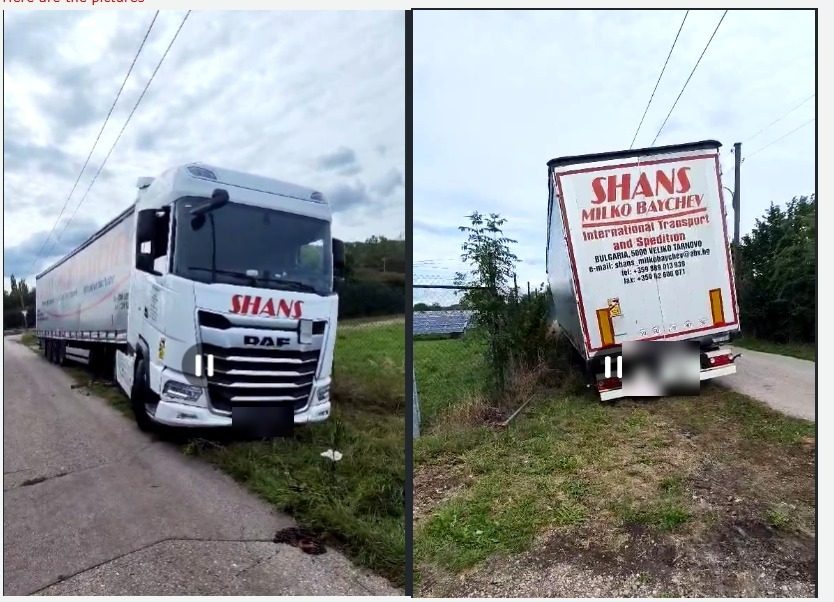
A Bulgarian driver heading towards Austria left the service road at a junction near Passau, in Lower Bavaria, and put the right-hand wheels of his unit on the grass. The rear of the trailer settled down the edge of a small embankment. It had rained for several days before that Friday, so the topsoil under the grass was saturated and gave way under the weight of a loaded combination.
The rig was a modern DAF tractor unit coupled to a Schmitz Cargobull curtainsider, a very common combination on the Bavarian and Austrian corridors. The sky was overcast, the air dry, and the shoulder of the road was cracked and crumbling at the edge, which is typical for secondary roads that carry heavy goods traffic. Behind the verge there was a field with solar panels and a line of pylons, so there was no lay-by, no hard standing and no firm ground anywhere nearby.
The driver tried to pull forward twice. On the second attempt the drive wheels spun, the trailer dropped a few more centimetres and he stopped, wisely. He did not know why he had drifted off the tarmac, and he did not need to: the cause (a moment of distraction, an evasive move, a verge that looked firmer than it was) matters far less than the next hour. What mattered was that the unit could not leave under its own power and that further attempts would only dig it in deeper.
He called our number at 13:40 and sent two photos and his GPS position through WhatsApp. That gave our dispatcher the first and most useful piece of information: the combination was upright, not on its side, and no one was hurt.
How we organised the tow truck: from the call to a crew on the road
When a driver rings for a tow truck in Germany, the first fifteen minutes decide how the next two hours go. In this case the dispatcher worked through a fixed set of questions while the driver was still on the line:
- Is anyone injured, and is the vehicle blocking a live lane? (No and no.)
- What is the gross weight of the combination, and is it loaded? (Loaded with general cargo, around 36 tonnes.)
- Is any dangerous cargo on board, or any refrigeration unit that must keep running? (Neither.)
- What is the ground like, and how deep are the wheels? (Wet grass over clay, wheels sunk to the hubs on the trailer side.)
- Can the driver stay with the vehicle and set out a warning triangle? (Yes.)
From those answers the dispatcher decided that a standard light recovery vehicle would be useless. A loaded artic on soft ground needs a heavy-duty recovery truck with a winch, long straps and enough pulling angle to bring the unit back onto the carriageway diagonally. Between 13:40 and 13:55 the dispatcher phoned the partner crews around Passau, checked who had a heavy tow truck free and who could be on site soonest, and confirmed the job.
The partner was 55 minutes away. That is a realistic figure for a regional job in Lower Bavaria on a weekday afternoon with moderate traffic. In heavy rain, at night or on a holiday weekend it can be considerably longer, and we say so at the start of every call. Honest arrival times help the driver plan his tachograph break, call his consignee and decide whether to wait or look for another solution.
Our dispatch desk works in German, English, Polish and Russian, which covers most of the drivers on the German road network. The driver here spoke only a little English, so the call switched to Russian halfway through and became much quicker. You can find the service details on our towing service page, and the 24-hour number is +49 160 5753826.
Reading the situation on site: why you must not keep pulling
Heavy vehicles on soft ground behave differently from cars. A loaded semi-trailer carries roughly 24 tonnes on its tandem or tri-axle set, and the pressure under each tyre is far higher than most people expect. A 385/65 R22.5 tyre inflated to around 9 bar exerts a very concentrated load on the surface it stands on. Once the grass root layer is broken, the wheel cuts through it like a knife through cake, and the sub-soil turns to paste.
This is why a driver who keeps spinning the drive wheels almost always makes the situation worse. The tyres polish a groove, the groove fills with water, and the traction that remained is gone. The trailer axles then sink further, the kingpin angle becomes steeper, and the coupling takes side loads it was never designed for. A recovery that would have taken an hour can turn into a three-hour job with a crane.
Here is what the crew assessed when they arrived at 14:50:
- Position of the combination: tractor unit with a slight lean on the verge, trailer rear dropped about 30 cm at the embankment edge.
- Bearing capacity of the ground: wet clay under a thin turf layer, unsuitable for a heavy truck to drive onto.
- Tyres and rims: no cuts, no sidewall damage, no rim contact with stones.
- Escape path: a diagonal pull to the hard shoulder, away from the embankment.
- Safety: warning triangle, hazard lights and an amber beacon on the recovery vehicle, with a second person watching traffic.
A tow truck in Germany must also respect the rules for stopping and securing vehicles. Section 15 of the StVO covers vehicles that have stopped because of a breakdown and states that they must be marked as soon as possible. Our crews treat that as a minimum, not a goal.
Step by step: how the recovery worked
The actual heavy truck recovery took 45 minutes, but those minutes were built on careful preparation. The sequence below is how a competent crew handles a loaded artic on soft ground, and it is what you should expect from any provider you call.
Step 1: Inspect and decide on the pulling scheme
Before touching anything, the lead technician walked the whole combination and the ground around it. He checked where the tyres were buried, how far the trailer had slipped and whether the fifth wheel was still square. He then chose the direction of pull. In this case that was diagonal, across the verge, towards a flat section of the hard shoulder where the ground was firmer.
Step 2: Secure the scene
The crew placed a warning triangle behind the vehicle, switched on the amber beacon and positioned the recovery truck so that it protected the working area from the service road. On a motorway a hard shoulder recovery needs far more protection, with the Autobahn GmbH guidance as a good baseline for drivers, but even on a feeder road drivers go past quickly.
Step 3: Rig the straps and the back-up line
The technician attached a recovery strap to the front of the tractor unit at the proper towing eye, not to the bumper or the axle tube. A second line went to the trailer as a back-up. Straps were laid out so that nobody stood in the line of pull. The driver sat in the cab with the engine running and the steering held straight. He was told to leave the throttle alone until asked.
Step 4: Pull the combination out
The recovery truck took up the slack and began a slow, steady pull. At the same time the driver applied light, even power on request only. The tractor unit came onto the hard shoulder first. The trailer followed, rising out of the soft ground as the pulling angle flattened. The crew stopped twice to clean the wheel arches of mud and to check that the straps had not slipped. Between 15:05 and 15:50 the whole combination was back on solid ground.
Step 5: Check, test and release
Once the unit was on the tarmac, the crew did what many people skip: a post-recovery check. They looked at tyre sidewalls and rims, tapped the lug nuts, inspected the trailer axle beam and the air lines, and checked pressure on all axles. They also examined the fifth wheel and the kingpin for any sign of twisting. Only after that did the driver make a test run of about 300 metres, braking from walking pace and listening for noises from the running gear.
At 16:10 the unit was released. The invoice for the job was then discussed on the spot, as it always is in our case, before the crew left.
You can see how this fits our wider offer on the mobile truck service page.
Full timeline: 150 minutes from call to departure
The table below shows exactly how the afternoon went, without rounding in our favour.
| Time | Phase | Action |
|---|---|---|
| 13:40 | Call | Driver sends photos and GPS position and describes the combination on grass, unable to pull out |
| 13:40–13:55 | Dispatch | Dispatcher checks weight, cargo (no dangerous goods), ground condition and books a crew with a heavy recovery truck and straps |
| 13:55–14:50 | Journey | Partner crew drives to the site (55 minutes) |
| 14:50–15:05 | Assessment and securing | Crew inspects the position, sets warning triangle and lights, tests ground bearing capacity, chooses the pulling scheme |
| 15:05–15:50 | Recovery | Straps and lines prepared, trailer and tractor unit pulled diagonally to firm ground, second line as back-up |
| 15:50–16:10 | Check | Tyres, rims, axle and coupling inspected, pressure checked, short test run |
| 16:10 | Done | Combination leaves under its own power, 150 minutes after the call |
The longest single block was the journey, which is typical. Dispatch itself took fifteen minutes, and the actual pulling took forty-five. People often assume the recovery is the slow part. In practice the answer to “how long will it take?” depends mostly on how far the nearest suitable crew is.
What did the recovery cost?
A heavy recovery in Germany generally costs between €850 and €1,600 net, depending on the distance, the weight of the vehicle and the time of day. This job landed in the middle of that range because it was a daytime call with a short pull and no crane.
| Item | Price (EUR) |
|---|---|
| Call-out (crew with heavy recovery truck, daytime rate) | 250 |
| Recovery of the articulated lorry (heavy tow truck, straps, ropes, pull from the verge) | 980 |
| Additional work: securing the scene and guiding, 1.5 hours at €120 | 180 |
| TOTAL | 1,410 |
All amounts are net, plus 19 % VAT where it applies. For a German-registered business that is €267.90 in VAT, bringing the gross total to €1,677.90. Foreign hauliers with a valid VAT number are often invoiced under the reverse-charge rules, and our office explains this on the phone before the work starts. The price was agreed with the driver before the crew started pulling, and the final bill matched the quote.
What shapes the price of a tow truck in Germany
Prices are not random. These are the factors that moved this quote, and they will move yours:
- Weight and size of the vehicle. A 7.5-tonne box van is cheap to recover. A loaded 40-tonne artic needs a bigger truck and more time.
- Distance to the nearest suitable crew. The call-out fee reflects the journey.
- Time of day. Nights, weekends and public holidays carry a surcharge of roughly 25 to 50 %.
- Ground and access. Soft verges, ditches and steep slopes slow the job and may need a second vehicle or a crane.
- Extra equipment. Air cushions, a crane, a low-loader or a lorry for transhipping the load all raise the bill.
For a deeper look at how fleets budget for these jobs, read our article on truck towing costs.
Compared with the alternative
A parked artic costs a fleet roughly €800 to €1,200 for each day it does not run. That figure includes driver wages, lost freight revenue, penalties for missed slots and the cost of a replacement vehicle where one is needed. If the driver here had tried to dig out alone, or waited until the next morning for a farmer with a tractor, the delay could easily have passed a full day. Getting the combination out in 2.5 hours meant the driver reached his delivery before the consignee closed its gate, and he stayed inside his driving-time limits.
Why a professional recovery beats improvising
Plenty of drivers try to solve the problem themselves, and many of them end up with a bigger problem. These are the risks we see most often:
- Wrong attachment points. Straps looped round an axle tube or a bumper can bend the axle, tear the bumper off or damage the steering linkage.
- Overloaded equipment. A car-class recovery strap or a tractor with a tow rope will fail under the load of a loaded semi, and a snapping strap is a lethal projectile.
- No back-up line. If the main strap lets go, nothing stops the vehicle rolling back or sideways.
- Damage to the trailer. A pull at the wrong angle can twist the kingpin plate or crack the upper coupling, a repair that costs thousands.
- Liability and insurance. An incident caused by an improvised recovery may not be covered by your policy, and a contractor with proper training and insurance is.
- Legal exposure. A vehicle left half on the carriageway can be treated as an obstruction, with fines and a mandatory removal.
The German industry body for recovery firms, the VBA, publishes standards for exactly this kind of work, and our partner crews operate to them.
Why the DAF and its Schmitz Cargobull trailer came through unscathed
The component that matters in a soft-ground recovery is the combination, not the single vehicle. Modern tractor units such as the DAF XF and XG ranges have a reinforced chassis, towing eyes designed for recovery, and a short front overhang that suits a straight pull. A Schmitz Cargobull curtainsider, built for heavy-duty use, has a rigid frame and a robust rear underrun bar. Neither usually suffers when the load is applied correctly.
What tends to break are the small things: hose clips, ABS sensor cables, mudguard brackets and mud flaps. That is why our crew included a walk-round after the pull. In this case every wheel nut was tight, the tyres held pressure, and the axle alignment looked normal. The driver also reported that the trailer tracked straight during the test run, a quick way to rule out a bent axle beam.
When a trailer axle is suspected of damage, the driver should not simply drive on. A trailer axle bearing that has been stressed sideways can run hot within 50 kilometres. Axle specialists such as BPW publish inspection guidance for operators, and in doubtful cases we send a mobile technician to measure toe-in and camber before the vehicle travels any further. Our truck workshop service covers those follow-up checks.
Typical situations where we recover trucks across Germany
Soft verges are only one of many reasons a lorry needs a tow truck. These are the callouts we handle most often, from Flensburg to Garmisch:
- Vehicles on verges and in ditches after evasive manoeuvres, mirror clashes or fatigue.
- Wheels sunk at motorway roadworks, where temporary lanes are narrow and the shoulder is soft.
- Loading yards and building sites where a rig sinks in gravel, mud or frozen ground.
- Breakdowns that cannot be fixed on the spot, for instance a failed gearbox, a clutch or a damaged turbocharger, where the tractor unit must go to a workshop.
- Accident recovery after a collision, with the vehicle needing a safe move off the carriageway.
- Jackknifed or tipped trailers that require a crane and air cushions.
- Snow and ice recoveries in winter on the Bavarian Forest and Black Forest routes.
- Trailer-only recoveries, where a semi-trailer is unhooked and moved separately.
If the vehicle is simply stuck, we use a straightforward pull. If it is damaged, we combine recovery with a repair plan. Our article on heavy truck recovery with a crane explains where the line between the two lies.
Prevention: how to avoid ending up on the grass
You cannot control the weather, but you can control a few things that make a recovery less likely. Here is the advice we give to fleets and drivers:
- Avoid soft verges after rain. If you must pull over, choose a hard shoulder, a lay-by or a paved yard. A grass verge that looks flat may have no bearing capacity at all.
- Walk the ground before driving on it. At a building site or a farm entrance, step on the surface. If your boot sinks, a 40-tonne rig will not cope.
- Keep to the carriageway when tired. Fatigue is a leading factor in lane departures. Stop at a rest area if your eyes feel heavy. The tachograph is not your enemy.
- Check your tyre condition and pressure. Tyres with good tread and the correct pressure grip better and are less likely to cut into soft ground. The legal minimum tread is set in Section 36 of the StVZO, but a safer working figure for commercial vehicles is 3 mm or more.
- Know your emergency number. Save the dispatch line in your phone before you need it, and have the vehicle weight and your position ready.
- Send photos at the first call. A picture of the wheels and the ground saves ten minutes of questions.
- Do not keep spinning the wheels. One failed attempt is understandable. Three make a two-hour job into a four-hour one.
Fleet managers can reduce their exposure further by training drivers on soft-ground behaviour, fitting a rear camera and including a “verge and ground” briefing in their annual safety sessions. Our truck tyre blowout checklist is a handy template for that kind of briefing.
Tyres and recovery: a short guide for fleet operators
Tyres are rarely the reason a lorry ends up on a verge, but they decide how easily it comes out again. Tyre makers such as Michelin and Continental offer commercial ranges tuned for different jobs: long-haul steer tyres with low rolling resistance, drive tyres with deep lugs for traction, and trailer tyres built for durability and even wear. Goodyear and Bridgestone sit in the same segment, with similar product families.
For a soft-ground exit the most useful property is not the brand but the condition. A drive tyre with 8 mm of tread clears mud and grips; a worn one with 2 mm clogs and slides. The pattern depth on a new truck drive tyre is typically 16 to 18 mm, and many fleets pull them at 3 mm for steer axles and 2 mm for trailers, though the legal limit is lower. Retreaded tyres can serve well on trailers where cost matters.
Pressure matters just as much. Lorry tyres in the 315/80 R22.5 and 385/65 R22.5 sizes usually run between 8.0 and 9.5 bar depending on load. An under-inflated tyre overheats and wears unevenly; an over-inflated one has a smaller contact patch and sinks more easily. Check every wheel, including the spare, at least once a week and before any long trip. If you want a refresher on tyre markings, see our truck tyre inspection guide for a look at what we check after a recovery.
Between the tyre and the ground sit the rims. After a recovery with the wheels buried, look for scratches on the rim flange, small dents in the bead seat and any loose valve stems. Even a small rim defect can lead to a slow puncture a few days later. This is why our crew checks the rims as part of the post-recovery routine and not only the tyres.
Why drivers and fleets choose Lkwhelp24
Here is what you can expect when you call us for a tow truck in Germany:
- 24/7 availability. We take calls at 3 a.m. on a Sunday exactly as we do at noon on a Tuesday.
- A vetted partner network. Recovery crews are checked for equipment, insurance and experience before we send them to your vehicle.
- A clear price before work begins. You hear the call-out fee, the hourly rate and any extra cost, and you decide.
- A multilingual dispatch desk. German, English, Polish and Russian, so that the driver can explain the problem in the language he thinks in.
- Nationwide coverage. Passau, Hamburg, Cologne, Dresden, Stuttgart and everywhere between.
- One point of contact. The same dispatcher follows the case from the first call to the handover.
For contact details and the nearest base, see our contact page.
FAQ: tow truck and heavy recovery in Germany
How much does a tow truck for a lorry cost in Germany?
A heavy recovery typically costs between €850 and €1,600 net, depending on distance, weight and time of day. In this case the total was €1,410 net for a daytime recovery of a loaded artic from a soft verge. Nights and weekends add 25 to 50 %.
How fast can a tow truck reach a lorry on the autobahn?
Arrival usually takes 35 to 70 minutes on the motorway network, plus 10 to 20 minutes for dispatch. On this job the crew needed 55 minutes. Heavy rain, rush hour and remote areas can add time, and the dispatcher tells you the realistic figure on the phone.
Can I pull my lorry out of the mud myself?
You can try once, gently, but repeated wheel spin digs the vehicle in and can damage the drivetrain. Never use a car-class strap or a farm tractor on a loaded artic. If the unit does not move on the first try, stop and call for a heavy recovery truck.
Who pays for the recovery?
The vehicle owner or the haulier pays the recovery bill. Some breakdown or fleet insurance policies reimburse it, and some customers pass it on to the consignor. Ask your insurer before you need it, and keep the invoice.
Is the lorry safe to drive after being pulled out?
Only after a check. The crew inspects the tyres, rims, axles, air lines and coupling, then a short test run follows. If anything looks off, a mobile technician measures the axle alignment before the vehicle drives on.
Do you recover vehicles from foreign hauliers?
Yes. Many of our calls come from Polish, Lithuanian, Bulgarian, Romanian and Dutch drivers. Our dispatchers speak German, English, Polish and Russian, and invoices are issued in a form that foreign companies can process.
Summary
- Vehicle: DAF tractor unit with a Schmitz Cargobull curtainsider, loaded, around 36 tonnes.
- Location: service road at the A3 near Passau, direction Austria.
- Problem: combination stuck on a soft verge, trailer sunk at an embankment.
- Response time: dispatch in 15 minutes, crew on site after 55 minutes of travel.
- Total time from call to departure: 150 minutes (2 hours 30 minutes).
- Price: €1,410 net (€250 call-out, €980 recovery, €180 additional work).
- Secondary damage: none, tyres, axles and body intact.
Need a tow truck in Germany? Call now
If your lorry is stuck, off the road or unable to move, do not wait and do not keep revving. Send us a photo, your position and the vehicle weight, and we will organise a crew.
Phone: +49 160 5753826
Website: www.lkwhelp24.com
Round the clock, across Germany.
Keywords: tow truck germany | i need a tow truck | tow service | tow vehicle | truck towing germany | heavy towing | heavy duty towing | tow truck recovery | 24 hour tow truck service | urgent towing | towing and roadside assistance | call tow truck | vehicle recovery | lorry recovery Passau | artic recovery A3