Skip to content
The load index of a tyre determines far more than comfort or handling in the commercial vehicle sector. For tractor units, swap-body trucks and long-haul vehicles, the correct load capacity index is a mandatory requirement for operational safety, roadworthiness, and insurance cover. This article explains how to correctly read the load index on the tyre sidewall, which values are required for which axle loads, and what consequences a wrong choice can bring.
Table of Contents
- Basics: what does the load index mean for truck and commercial vehicle tyres?
- Reading the load index correctly on the tyre sidewall and in vehicle documents
- Load index table for truck tyres (excerpt with load capacity in kg)
- Calculating the required load index for trucks, vans and trailers
- Safety and legal consequences: what happens with the wrong load index?
- Influencing factors: tyre pressure, temperature, speed and usage profile
- Reinforced truck and van tyres: C, LI pairs, “Reinforced” and special markings
- Practical tips for drivers and fleet managers
Introduction: Why the Load Index Is Crucial for Truck Tyres
In the commercial vehicle sector, tyres carry loads many times greater than anything a car tyre will ever have to bear. A standard 40-tonne truck distributes up to 27,000 kg on the semi-trailer’s axles alone. The trailer axles of such a combination must reliably absorb these extreme static and dynamic loads.
The load index – also known as the load capacity index or, internationally, the Load Index (LI) – is the numerical code on the sidewall of every tyre. This figure states exactly which maximum load per tyre, in kilograms, is permitted. While car tyre load indices typically range between 80 and 100 (corresponding to 450-800 kg), truck tyres range from around 120 to over 170. That corresponds to a load capacity of 1,400 kg up to 6,500 kg or more per tyre.
The consequences of an incorrectly chosen load index are severe:
- Operational safety at risk: tyre blowouts at motorway speed with 40 tonnes
- Roadworthiness certificate voided: TÜV/DEKRA refuse the periodic inspection
- Insurance cover at risk: recourse claims in accidents involving undersized tyres
- Fines and penalty points: police checks for axle overload
Below you will find all the information on the meaning, reading, and correct calculation of the required load index for your fleet.
Basics: What Does the Load Index Mean for Truck and Commercial Vehicle Tyres?
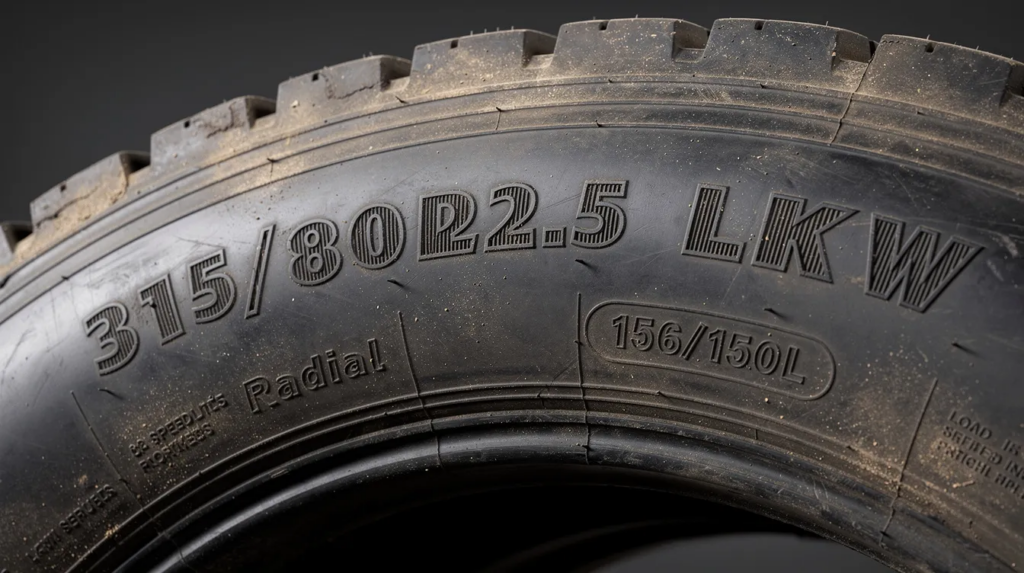
The load index is a number stamped on the tyre sidewall that, according to standardised tables from the European Tyre and Rim Technical Organisation (ETRTO), corresponds to an exact load capacity in kilograms. For a typical truck tyre marking such as 315/70 R22.5 154/150 L, the figure 154/150 represents the load index – the dual figure distinguishing between single and twin-tyre fitment.
Single vs. Twin Tyres
For truck tyres marked, for example, 154/150:
- First value (154): load capacity for single fitment – here 3,750 kg per tyre
- Second value (150): load capacity for twin fitment – here 3,150 kg per tyre
The lower second value for twin fitment accounts for increased heat build-up and the less favourable load distribution between the inner and outer tyre on an axle. Twin tyres share the load, but generate more heat through mutual friction. This reduces the effective load capacity by 10-20% compared to single fitment.
Typical LI Ranges in the Commercial Vehicle Sector
Vehicle type | Typical LI range | Load per tyre |
|---|---|---|
3.5 t van | 109-121 | 1,030-1,450 kg |
Distribution truck 7.5-12 t | 120-130 | 1,400-1,900 kg |
Long-haul 18 t (4×2) | 146-154 | 3,000-3,750 kg |
40 t semi-trailer | 154-164 | 3,750-5,000 kg |
Heavy haulage/construction | 160-170+ | 4,500-6,000+ kg |
Load capacity applies only under two conditions: correct, manufacturer-specified tyre pressure, and within the approved speed range (indicated by the speed rating, e.g. “L” for max. 120 km/h). |
Reading the Load Index Correctly on the Tyre Sidewall and in Vehicle Documents
Correctly reading the tyre load index requires knowledge of the tyre marking and the relevant fields in the vehicle documents.
Position on the Tyre
The load index appears directly after the tyre size and construction marking on the sidewall:
- Example 1: 385/65 R22.5 160 K
→ LI 160 for single fitment, speed rating K (max. 110 km/h) - Example 2: 315/70 R22.5 154/150 L
→ LI 154 single (3,750 kg), LI 150 twin (3,150 kg), speed rating L (max. 120 km/h) - Example 3: 235/65 R16C 115/113 R
→ C-rated tyre for vans, LI 115 single (1,215 kg), LI 113 twin (1,150 kg)
Relevant Fields in the Vehicle Registration Certificate Part I
Field | Content | Relevance for LI |
|---|---|---|
F.1/F.2 | Technically permissible gross weight | Vehicle total weight |
F.7 | Permissible front axle load | Front axle LI calculation |
F.8 | Permissible rear axle load | Rear axle LI calculation |
15.1/15.2 | Tyres (axle 1/2) | Prescribed tyre size and LI |
Practical Example: 4×2 Tractor Unit
A typical long-haul tractor unit has the following axle loads:
- Front axle (steering axle): 7,500 kg, two single tyres
- Rear axle (drive axle): 11,500 kg, twin tyres (4 tyres)
Front axle calculation:
7,500 kg ÷ 2 tyres = 3,750 kg → LI 154 minimum required
Rear axle calculation:
11,500 kg ÷ 4 tyres = 2,875 kg → LI 146 (twin value) minimum required
When converting – for example, from twin to super-single tyres – the LI must always be re-checked and entered in the vehicle documents. A single super-single tyre must carry the vehicle load of a pair of tyres and therefore requires an LI 15-25% higher than the previous twin fitment.
Load Index Table for Truck Tyres (Excerpt with Load Capacity in kg)
The following table shows the load indices relevant to the German truck market, with the corresponding maximum load in kilograms for single fitment. The values are based on ETRTO standards and apply at correct tyre pressure.
Load index (LI) | Load capacity (kg) | Typical use |
|---|---|---|
120 | 1,400 | Light distribution, 7.5-tonners |
121 | 1,450 | Van upgrades |
125 | 1,580 | Municipal vehicles |
130 | 1,900 | 12-tonne chassis |
140 | 2,500 | Medium-heavy trailers |
146 | 3,000 | Drive axle, distribution truck (18 t) |
150 | 3,150 | Swap-body front axles |
154 | 3,750 | Long-haul semi-trailer, steering axles |
156 | 4,000 | Heavy regional transport |
160 | 4,500 | Construction trucks, heavy trailer axles |
164 | 5,000 | Heavy haulage, reinforced trailers |
LI 204 | over 6,000 | Special vehicles, low-loaders |
Complete load index tables extend into ranges above 170 for special applications. For everyday fleet operation, values between 146 and 160 are most commonly relevant. | ||
 |
Using the Load Index Table Day to Day
The table serves as a reference for fleet managers and drivers when buying tyres and checking existing fitments:
- Determine the axle load from the vehicle registration document (fields F.7/F.8)
- Divide by the number of tyres (for twin fitment: 4 tyres per axle)
- Choose a suitable LI with a margin – don’t cut it close
Recommendation: always choose the LI with a safety margin of at least 10-15%. For a calculated requirement of 2,875 kg per tyre (which corresponds exactly to LI 146), you should prefer LI 150.
For special applications, additional margin makes sense:
- Tanker semi-trailers: liquid loads create dynamic fluctuations → LI +2 steps
- Refrigerated trailers: account for unit weight plus temperature effects
- Construction-site trucks: frequent kerb impacts and poor roads → higher loads, which is why reliable 24/7 truck tyre service in Germany gives internationally operating fleets extra protection against downtime
Calculating the Required Load Index for Trucks, Vans and Trailers
Calculating the required load index follows a simple principle: axle load divided by number of tyres gives the minimum load capacity per wheel. From this figure you derive the appropriate LI.
Calculation Example 1: 18-Tonner in Distribution Traffic (4×2)
- Permissible rear axle load: 11,500 kg
- Tyres: twin tyres (4 tyres on the axle)
- Calculation: 11,500 ÷ 4 = 2,875 kg per tyre
- Required LI: 146 (3,000 kg) – better 150 for margin
Calculation Example 2: 40-Tonner with Three-Axle Semi-Trailer
- Total semi-trailer axle load: 27,000 kg
- Tyres: 3 axles with 2 single tyres each = 6 tyres
- Calculation: 27,000 ÷ 6 = 4,500 kg per tyre
- Required LI: 160 (exactly 4,500 kg)
For summer operation in Southern Europe or long motorway stretches, you should factor in an additional margin, as high temperatures can reduce load capacity by up to 15%.
Calculation Example 3: 3.5 t Van
- Typical tyres: 235/65 R16C 115/113 R
- The “C” designates commercial tyres with a reinforced carcass
- LI 115 single = 1,215 kg, LI 113 twin = 1,150 kg
- Sufficiently sized for a 3,500 kg permissible gross weight
Taking Additional Factors into Account
Besides the calculated minimum requirement, other aspects play a role:
Factor | Effect | Recommendation |
|---|---|---|
Poor roads | Impact loads +20% | LI +1-2 steps |
Temperatures >35 °C | Load capacity -10-15% | Check summer tyres |
Continuous 90 km/h operation | Increased flexing | Step up pressure checks |
Load peaks | Short-term overload | Choose a higher LI |
Safety and Legal Consequences: What Happens With the Wrong Load Index?
An undersized tyre load index leads to a cascade of risks – technical, legal, and financial. More than 30% of commercial vehicle tyre breakdowns in fleet studies are attributed to undersized load capacity ratings at full load.
Technical Risks
With prolonged overload, the following occurs:
- Sidewall overheating: carcass temperature can rise above 100 °C
- Belt delamination: the steel layers separate from the rubber
- Structural failure: high-speed blowout at 90 km/h with 40 tonnes
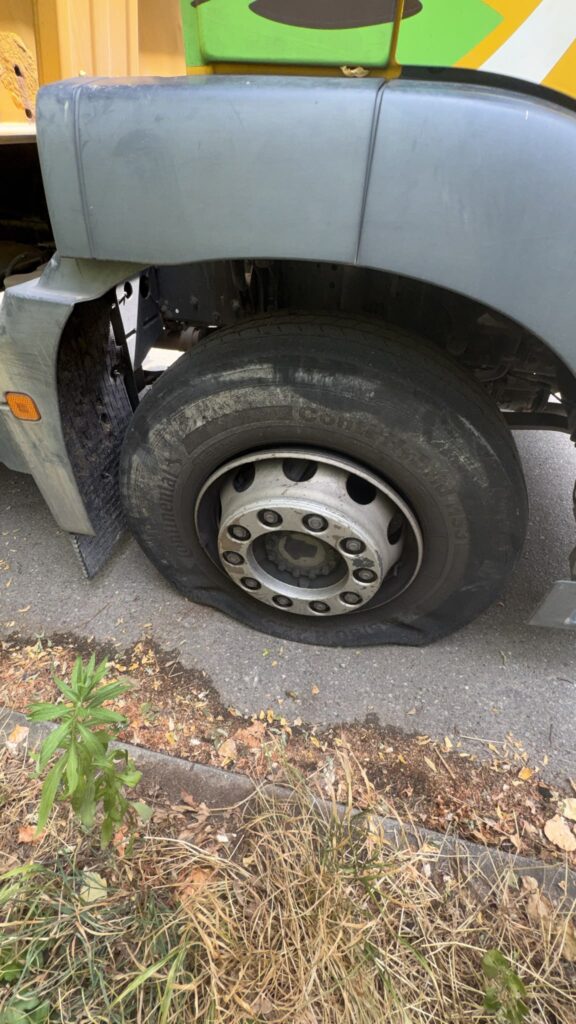
A burst drive-axle tyre on a fully loaded truck on the motorway can lead to uncontrolled lane changes, loss of vehicle control, and severe damage to the vehicle and cargo. Especially in metropolitan areas such as the capital region, a 24/7 truck tyre service in Berlin can help get you moving again quickly after such an incident. ADAC data shows that about 25% of serious truck accidents have tyre-related causes.
Legal Consequences
Violation | Consequence |
|---|---|
LI below minimum requirement | Roadworthiness certificate voided |
TÜV inspection | Sticker refused |
Police check | Vehicle taken off the road, no continued travel |
Class 4 overload | EUR 75-150 fine + 1 point in Flensburg per axle |
Repeated violations | Up to EUR 500 and more |
Insurance Aspect
The most critical point for transport companies: after an accident, insurers examine the tyres. If the investigation finds that the fitted LI was below the required load capacity, the motor insurer can:
- Reduce or fully deny the payout
- Pursue recourse against the operator
- Terminate the policy for cause
A documented case from Bavaria in 2022: a 32-tonne truck with LI 148 on an axle requiring 3,200 kg per tyre suffered a blowout. The cargo integrity was destroyed, and the damage amounted to EUR 250,000 – at the operator’s expense.
Influencing Factors: Tyre Pressure, Temperature, Speed and Usage Profile
The load index shown on the tyre sidewall only applies under ideal conditions. In real operation, several factors influence the actual load capacity of a tyre.
Tyre Pressure
- 22.5″ truck tyres, tandem/trailer: typically 8.5-9.0 bar
- Steering axles: often 7.5 bar
- Effect of underinflation: 0.5 bar less = 10-20% lower capacity
Underinflated tyres are especially critical in long-haul transport. Increased flexing leads to significant heat build-up, gradual carcass damage, and ultimately failure – often without warning, meaning a mobile 24/7 truck tyre service in Germany is needed to get the vehicle back on the road quickly and safely.
Temperature
Condition | Effect on load capacity |
|---|---|
Normal operation, 20 °C | 100% |
Summer operation, 40 °C ambient | -10-15% |
Southern Europe midsummer | Up to -20% |
For every 10 °C rise in temperature, effective load capacity drops by 5-8%. On long motorway stretches in Southern Europe, carcass temperature can be 30 °C above ambient temperature. |
Speed and Usage Profile
- Continuous 90 km/h operation: higher centrifugal forces require a 10% buffer compared to city traffic
- Construction site vehicles: frequent kerb impacts and off-road sections increase impact loads by 20%
- Scheduled coaches: constant loads, lower margins are sufficient
The letter after the LI – the speed rating – indicates the maximum permitted speed. Typical values:
- J: 100 km/h (construction vehicles)
- K: 110 km/h
- L: 120 km/h (standard long-haul)
- M: 130 km/h
- ZR: over 240 km/h (car tyres only)
Reinforced Truck and Van Tyres: C, LI Pairs, “Reinforced” and Special Markings
In the commercial vehicle sector, various markings and variants exist that go beyond standard car-tyre distinctions such as “XL”.
C-Rated Tyres for Vans and Light Trucks
The abbreviation “C” stands for Commercial and marks tyres with a reinforced carcass for vehicles under 7.5 t permissible gross weight. C-rated tyres typically carry dual LI figures:
- Example: 225/75 R16C 121/120 R
- Meaning: LI 121 single (1,450 kg), LI 120 twin (1,400 kg)
LI Pairs for Twin Fitment
For all truck tyres with twin fitment on drive or trailer axles, the paired principle applies (e.g. 154/150):
- First value: maximum load for single fitment
- Second value: maximum permitted load for twin fitment
The lower twin value compensates for:
- Increased heat build-up between the tyres
- Uneven load distribution (the inner tyre often carries more)
- Mutual deformation effects
Load Range and Ply Rating
Heavy truck tyres are additionally classified by carcass strength:
Load range | Ply rating | Use |
|---|---|---|
E | 10 | Standard long-haul |
F | 12 | Heavy-duty applications |
G | 14 | Construction, heavy haulage |
H | 16+ | Extreme loads, low-loaders |
Notes for the Fleet
Strict rules apply when converting between different tyre types:
- Switching from C-rated to truck tyres: only with vehicle manufacturer approval
- Super-single instead of twin: single LI must carry 1.8 times the dual load
- Run-flat tyres: rare in the commercial vehicle sector, but TPMS mandatory from 2024 for new fleets
Recommendation for long-haul semi-trailers and swap-body combinations: choose tyres with a sufficiently high LI and matching load range. Any savings from cheaper, narrowly-sized tyres are more than eaten up by higher wear, failure risk, and potential damage.
Practical Tips for Drivers and Fleet Managers
Correct handling of the load index is not a one-off decision but part of ongoing fleet management. The following points summarise the key measures.
When Purchasing New Truck Tyres
- Systematically check LI against maximum axle load + 20% margin
- Check DOT number and production date (no older than 3 years when in storage)
- obtain manufacturer approvals for special applications
- Keep documentation for TÜV inspection and insurance
During Operation
- No mixed fitment: different load indices on one axle are not permitted
- Check tyre pressure: at least weekly, mandatory before long trips
- Use TPMS: modern systems demonstrably reduce failures by 40%
- Visual inspection: check sidewalls for damage, cracks or bulges, and contact a mobile 24/7 truck tyre service in Germany immediately if anything looks abnormal
Driver Training
Include the following topics in regular training:
Topic | Learning goal |
|---|---|
Reading tyre specifications | Driver can identify LI, tyre width and speed rating |
Recognising overload symptoms | Hot sidewalls, unusual handling |
Performing pressure checks | Correct use of the gauge |
Winter vs. all-season tyres | Differences in load capacity and approval |
Economic Aspect
The optimal load index is not only a safety question. Correctly sized tyres with appropriate pressure lead to:
- 10-15% fuel savings through optimal rolling resistance
- Longer service life through even loading
- Less downtime through fewer breakdowns
- Lower insurance costs through documented compliance
Conclusion
The load index for truck and commercial vehicle tyres is not an optional technical detail but a legal and safety-critical foundation for every professional vehicle operation. Choosing the correct load capacity index, matched to axle loads, usage profile, and environmental conditions, prevents tyre damage, safeguards roadworthiness, and protects against recourse claims.
For fleet managers and drivers: systematically check axle loads against the required LI with every tyre purchase. Factor in margins for temperature, load peaks, and route profile. Document your tyre fitment carefully – in the event of a check or a claim, that documentation is worth real money.
A correctly chosen load index is the cornerstone of safe, economical, and legally compliant tyre use across the entire commercial vehicle sector.