Skip to content
Every tyre has a maximum load limit. That number is printed on the tyre sidewall and in the vehicle registration document. Ignore it, and you risk a blowout, downtime and high costs. This article explains the load index in plain terms – with a table, worked examples and practical tips for truck drivers, dispatchers and fleet operators.
Reading time: about 20 minutes.
Table of Contents
- Key points at a glance
- Introduction: why the load index matters so much for truck tyres
- Terms explained: load index, load capacity index and Load Index
- Reading the load index on the tyre sidewall
- Where does the load index appear in the vehicle registration?
- Working out tyre load capacity with an example
- Load index table
- XL tyres: what “XL” and Extra Load mean
- C-tyres and reinforced truck tyres
- Load capacity and tyre pressure
- Speed rating and load index
- Can the load index be higher than in the registration document?
- Can the load index be lower than in the registration document?
- Load index and seasonal tyres
- Typical load index values and examples
- Load index for truck and bus fleets
- What to do in case of a truck tyre breakdown
- What data the driver should have ready
- What determines the cost?
- Types of roadside assistance available for trucks
- How LKWHelp24 helps
- Safety checklist
- Common mistakes
- Summary
- FAQ
Key points at a glance
The load index (also called load capacity index or Load Index) is one of the most important figures on your tyre. Here’s the essential summary:
- The load index states the maximum load a tyre can carry. It appears as a two- or three-digit number on the tyre sidewall.
- The vehicle registration document (Zulassungsbescheinigung Teil I) lists the approved tyre combinations in fields 15.1 and 15.2. The required load index is stated there too.
- A load index lower than required is not permitted. For trucks from 7.5 t upward, this is a major safety risk – with possible tyre blowout, downtime and loss of the vehicle’s operating licence.
- A higher load index is generally allowed. It does not, however, change the vehicle’s approved axle load or gross weight.
- LKWHelp24 organises a matching truck tyre with the correct load index and speed rating around the clock in case of a tyre breakdown in Germany – Phone/WhatsApp: +49 160 575 3826.
Introduction: why the load index matters so much for truck tyres
Trucks from 7.5 t upward, articulated trucks, trailers and buses run with axle loads from 7,000 to over 11,000 kilograms. The tyres carry this load over hundreds of thousands of kilometres, at speeds of 80 to 90 km/h, in heat, rain and on all kinds of roads. Tyre load capacity is safety-critical here.
An incorrect load index can lead to tyre failures. An overloaded tyre overheats, deforms and can burst. On a 40-tonne truck on the motorway, a blowout is a serious risk to everyone on the road.
The difference from the passenger car segment is significant. While a car tyre might need to carry around 615 kilograms, the load on a truck tyre is 3,000 to over 4,000 kilograms. The tyre categories differ too: reinforced truck tyres from R17.5 upward, C-tyres for vans, and special tyres for twin-wheel axles. The entries in the vehicle registration document look different as well.
The load index matters for both safety and the vehicle’s operating licence. Fitting the wrong tyre risks not just a breakdown, but also a fine and the loss of insurance cover.
How do you identify the load index on the tyre and in the registration document? The following sections explain this step by step.

Terms explained: load index, load capacity index and Load Index
The load index has several names. It is often called the load capacity index. Internationally it is known as the Load Index, abbreviated LI. All three terms mean the same thing.
What does this figure actually mean?
- The load index is a code – a two- or three-digit number on the tyre sidewall. It states the maximum load capacity of the tyre in kilograms. The number itself is not a kilogram value, though – it is converted using a standardised conversion table.
- Example: a tyre with load index 94 can carry 670 kg. A load index of 91 means a maximum load capacity of 615 kg per tyre. For truck tyres, values like LI 148, 152 or 156 are common – equivalent to loads of 3,150 to 4,000 kg.
- The load index alone is not enough. It only applies together with the speed rating. This letter after the number shows up to which speed the tyre reaches its full load capacity.
- The load capacity index is therefore clearly different from the speed rating. Both appear together on the tyre sidewall. Example: “152/148 L” – the numbers are the load index, the letter “L” is the speed rating.
Reading the load index on the tyre sidewall
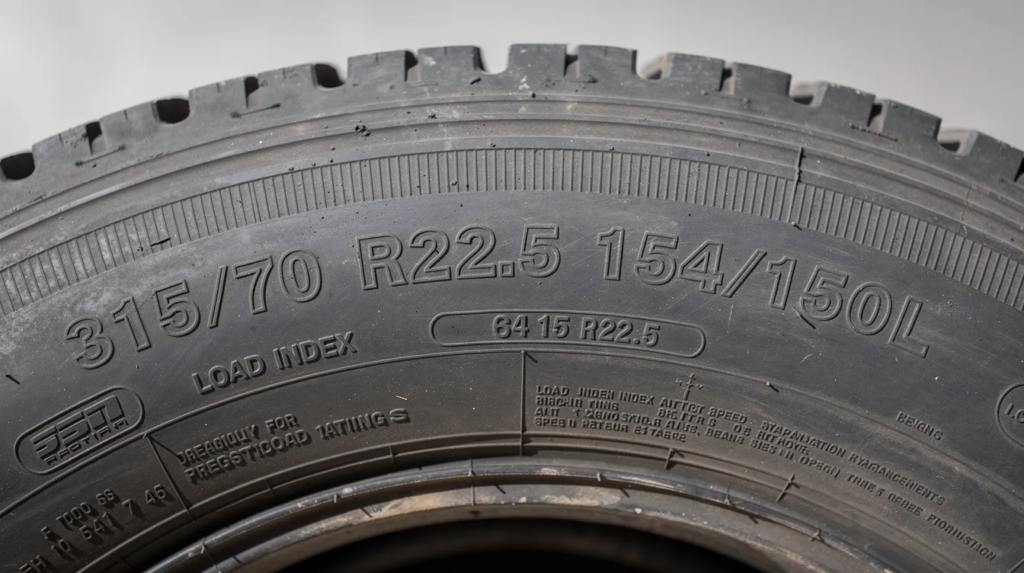
The load index is printed on the tyre sidewall, together with all the other tyre markings. Here’s how to read the tyre marking correctly:
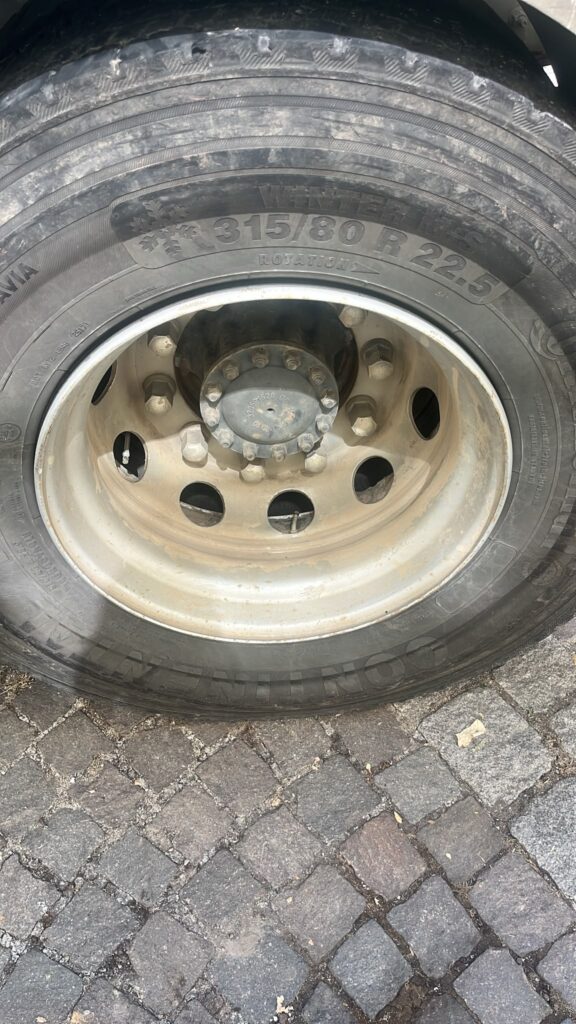
Take a typical truck tyre as an example: 315/70 R22.5 154/150 L.
- 315 – tyre width in mm
- 70 – aspect ratio in percent (sidewall height to width)
- R – radial construction
- 22.5 – rim diameter in inches
- 154/150 – the load index on truck tyres: first number for single mounting (154 ≈ 3,750 kg), second number for twin mounting (150 ≈ 3,350 kg)
- L – speed rating (L = up to 120 km/h)
For passenger cars, the tyre marking looks similar, just smaller. Example: 205/55 R16 91V. Here 91 is the load index (615 kg) and V the speed rating (up to 240 km/h).
The load index is printed on the sidewall of every tyre, car or truck alike. Many drivers know the tyre size, such as “205 55 R16”, but overlook the load index that follows it. This is especially important on truck tyres with dual values (e.g. 152/148), because single and twin mounting allow different loads.
Truck tyres commonly come in dimensions such as 295/80 R22.5, 315/80 R22.5 or 385/65 R22.5. The load index figures vary by dimension and manufacturer.
Where does the load index appear in the vehicle registration document? (15.1 and 15.2)
Since 2005 the German vehicle registration document has officially been called Zulassungsbescheinigung Teil I. It lists all the approved specifications for your vehicle – including the tyres.
Here’s how to find the load index in the registration document:
- The load index appears in the Zulassungsbescheinigung Teil I under fields 15.1 and 15.2. Field 15.1 describes the front axle, field 15.2 the rear axle. Vehicles with more than two axles may also have a field 15.3.
- These fields show the full tyre size including load index and speed rating. Example entry: “315/70 R22.5 154/150 L”.
- Fields 7.1 and 7.2 (or 8.1/8.2, depending on the document) show the maximum approved axle loads in kg. These axle load figures determine the minimum load index required.
- The load index must be checked against the registration document. Fitting tyres that don’t reach the value entered there is not permitted.
On modern vehicles, the registration document often lists only one standard wheel/tyre combination. Further approved wheel/tyre combinations can be found in the CoC document (Certificate of Conformity). The load index is listed there too, alongside all approved tyre sizes.

Working out tyre load capacity with an example
The load index helps determine the correct tyres based on axle load. The calculation is simple: axle load divided by the number of tyres on that axle. The result is the minimum load capacity required per tyre.
Example 1 – car (for illustration):
The front axle has an approved axle load of 1,200 kg. Two tyres sit on the axle. So each tyre must carry at least 600 kg. The load capacity of a tyre effectively doubles on an axle with two tyres – i.e. two tyres with 600 kg capacity each carry 1,200 kg together. According to the table, that corresponds to a load index of at least 90. A tyre with load index 91 (615 kg) would fit.
Example 2 – truck with single mounting:
Steering axle with 7,500 kg approved axle load, two tyres. Per tyre: 3,750 kg. A minimum load index of 154 (≈ 3,750 kg) is required.
Example 3 – truck with twin mounting:
Rear axle with 11,500 kg approved axle load, four tyres (twin mounting). Per tyre: 2,875 kg. According to the load index table, you need at least LI 146 (≈ 3,000 kg) – better LI 148 (≈ 3,150 kg) for a safety margin.
In practice, fleets and workshops use the load index table to select the next higher matching value. The exact requirement always comes from the entry in the registration document under 15.1 and 15.2.
Load index table: turning the code into kilograms
The tyre load index itself is not a kilogram value. It is a standardised index that a table converts into the actual load capacity. The table is based on ETRTO standards and used by all major tyre manufacturers.
Here’s an overview of typical values, from cars to heavy trucks:
Load Index (LI) | Load capacity per tyre | Typical segment |
|---|---|---|
87 | 545 kg | Compact cars |
91 | 615 kg | Mid-size cars |
94 | 670 kg | Cars, SUVs, XL tyres |
99 | 775 kg | Heavy cars, electric vehicles |
102 | 850 kg | Large SUVs, light vans |
120 | 1,400 kg | Light trucks, local delivery |
146 | 3,000 kg | Drive axles, 18-tonne trucks |
148 | 3,150 kg | Twin mounting, long-haul |
150 | 3,350 kg | Front axles, swap-body trucks |
152 | 3,550 kg | Single mounting rear axle, long-haul |
154 | 3,750 kg | Steering axles, heavy trailers |
156 | 4,000 kg | Regional traffic, heavy load distribution |
160 | 4,500 kg | Construction vehicles, high-capacity |
168 | 5,600 kg | Heavy haulage, special bodies |
You can use this table for a quick check when buying tyres or during a breakdown. For XL, C or truck tyres, the same base table applies. The full table is available in the Continental Technical Guide. |
XL tyres: what “XL” and Extra Load mean for load capacity
XL (Extra Load) tyres are reinforced tyres with a higher load capacity than standard tyres of the same dimension. The letters “XL” or the marking “Extra Load” appear on the sidewall.
The difference shows directly in the load index:
- Standard tyre: 205/55 R16 91V → load index 91 = 615 kg
- XL tyre: 205/55 R16 94V XL → load index 94 = 670 kg
Same tyre size, but 55 kg more load capacity per tyre. That sounds small, but across four tyres it’s a 220 kg difference.
Important notes on XL tyres:
- XL tyres often need higher inflation pressure to reach their full load capacity. The required value is stated in the manual or on the sticker in the door frame.
- “XL” is an addition to the construction type, not a substitute for the load index. The load index remains decisive – it determines whether the tyre is approved.
- Many heavier vehicles (SUVs, vans, electric vehicles) require XL tyres because the vehicle weight exceeds the capacity of standard tyres.
For trucks from 7.5 t upward, XL tyres play a smaller role. Reinforced commercial vehicle tyres are used from the outset instead.
C-tyres and reinforced truck tyres
C-tyres carry the letter “C” (for Commercial) in the tyre designation. They are designed for vans and light commercial vehicles (e.g. the 3.5-tonne class). C-tyres have reinforced sidewalls and a noticeably higher load index than comparable car tyres.
Other designations in this segment:
- “CP” – camping tyres for motorhomes
- “Reinforced” – reinforced construction, similar to XL
- “LT” (Light Truck) – common internationally
These categories don’t apply to heavy trucks from 7.5 t upward. Specialised commercial vehicle tyres with their own dimensions and load index ranges are used instead. Typical truck tyre sizes and load index values:
- 315/80 R22.5 with LI 156/150
- 315/70 R22.5 with LI 154/150
- 385/65 R22.5 with LI 160/158
LKWHelp24’s target audience is exclusively commercial vehicles from 7.5 t upward and buses – not typical C-class vans or light delivery vehicles. For vehicles under 7.5 t, we recommend ADAC or a local breakdown service.
Tyre load capacity and inflation pressure: why bar value and index belong together
The stated load index only applies at the prescribed inflation pressure. This is a crucial point that many drivers underestimate.
What happens with incorrect tyre pressure?
- Too low a pressure reduces the effective load capacity. The tyre flexes more, heats up and loses stability. Under sustained load on the motorway, this can quickly become dangerous.
- Too high a pressure causes uneven wear and reduces the contact patch. This worsens handling, especially in wet conditions.
- At high loads, with XL tyres or truck twin mounting, higher bar values are usually needed than in standard operation.
You can find the correct pressure figures:
- On the sticker in the door frame (on trucks often on the B-pillar)
- In the operating manual
- In the telematics system (on modern fleets)
In practice, the mobile tyre service often asks about the current load and tyre pressure during a breakdown call. This lets the technician fit the right replacement tyre with the correct load index and inflation pressure – exactly how a specialised Truck Tyre Service in Germany, available 24/7 operates.
Speed rating and load index: load capacity at higher speeds
Load capacity and top speed belong together. The full load index often only applies up to a certain speed. At higher speeds, the permitted load can decrease.
The key speed rating values for trucks:
Letter | Top speed |
|---|---|
J | 100 km/h |
K | 110 km/h |
L | 120 km/h |
M | 130 km/h |
N | 140 km/h |
For passenger cars, values such as H (210 km/h), V (240 km/h) or W (270 km/h) are common. Sports tyres even reach Y (300 km/h). |
For trucks running at 80 to 90 km/h under sustained load, the correct combination of load index and speed rating is essential. A tyre with an “L” rating (120 km/h) and LI 154 is designed for a long-haul truck. A tyre with too low a speed rating under the same sustained load would not be permitted.
Important: a tyre’s load index does not increase the vehicle’s approved axle load. Even if a tyre could theoretically carry more, the vehicle limits stated in the registration document still apply.
Can the load index be higher than in the registration document?
Yes. A higher load index can be used as long as the other specifications match (tyre size, rim, speed rating). This is generally permitted and even sensible.
- A tyre with LI 152 instead of LI 150 may be fitted, as long as the tyre size and speed rating match.
- This does not increase the vehicle’s approved axle load or gross weight. A tyre with higher load capacity simply provides an extra safety margin.
- Possible effects: a slightly stiffer tyre, but more stable handling and more reserve at high loads.
- For fleet vehicles, we recommend coordinating any changes with the tyre dealer or a testing organisation – especially for special bodies or specialised tyres.
Can the load index be lower than in the registration document?
No. A lower load index than required is not permitted and endangers safety. The consequences are serious:
- Operating licence: the vehicle’s operating licence can be voided for an incorrect load index. Under StVZO § 36 (German road traffic licensing regulations), tyres must match the vehicle’s operating conditions, particularly regarding load and speed.
- Fine: disregarding the load index can result in fines of up to 90 euros. For serious violations or accident consequences, the penalties can be significantly higher.
- Insurance: in the event of a claim, the insurer can reduce or refuse the payout if it’s proven that non-compliant tyres were fitted.
The technical risks are equally serious:
- Overloading and overheating of the tyre
- Longer braking distances
- Higher risk of a blowout, especially under sustained load on the motorway
An exception exists only with official approval from a testing organisation or through individual vehicle approval. Independent decisions by the driver or dispatcher are not sufficient.
Load index and seasonal tyres: summer, winter and all-season
Whether summer, winter or all-season, load capacity always has to match. Summer, winter and all-season tyres are subject to the same load index rules.
- On winter tyres, the speed rating may in certain cases be lower than stated in the registration document. The load index, however, must not be lower.
- When switching seasonally (e.g. from summer to winter tyres), drivers should always check the registration document: fields 15.1 and 15.2 specify the approved tyre size and load index.
- For truck fleets, there’s an added complication: the tractor and trailer often have different load and speed rating combinations. Dispatchers must ensure the correct tyres are fitted on every axle.
Incidentally, the German winter tyre requirement for trucks applies only to the drive axle. Still, the correct load index is mandatory on every axle and with every tyre.
Typical load index values and real-world examples
Here’s an overview of typical load index values – for reference when buying tyres, during a breakdown, or for fleet documentation.
Passenger car segment (for comparison):
- Load index 87 = 545 kg (compact class)
- Load index 91 = 615 kg (mid-size class)
- Load index 94 = 670 kg (SUV, XL tyres)
- Load index 99 = 775 kg (heavy cars)
- Load index 102 = 850 kg (large SUVs)
Truck segment (from 7.5 t upward):
- Load index 120 = 1,400 kg (light trucks, local delivery)
- Load index 148 = 3,150 kg (twin mounting, long-haul)
- Load index 152 = 3,550 kg (single mounting rear axle)
- Load index 156 = 4,000 kg (regional traffic)
- Load index 160 = 4,500 kg (construction vehicles)
An illustrative example: four tyres with LI 94 on one axle (e.g. a car’s twin axle) together carry an axle load of 2,680 kg. Four truck tyres with LI 152 carry 14,200 kg together – many times more.
Fleet operators running mixed tyre setups (e.g. different tyres on the tractor and trailer) need to manage multiple load index ranges. Central documentation saves valuable time in the event of a breakdown.
Load index for truck and bus fleets: special requirements
Haulage companies, bus operators and international TIR drivers have particular tyre requirements. Trucks rack up high mileage, run frequently at full load, and cover long motorway stretches. Incorrect tyres are especially sensitive to this.
What fleets need to watch for:
- Twin mounting, lift axles and steered trailing axles each have their own load index combinations. Every axle must be checked individually.
- Fleets often choose different tyres depending on location or application. Regional traffic needs different load index ranges than long-haul.
- A load index that just barely meets requirements offers no reserve. Under sustained load, such a tyre overheats faster and wears noticeably more.
- Load index and tyre data should be documented centrally. This lets dispatchers and drivers give the correct information quickly in a breakdown.
Tyres with the wrong load index can negatively affect handling – a serious danger on a fully loaded 40-tonne articulated truck. Current practical examples and tips can be found in the LKWHelp24 news on truck roadside assistance.
What to do in case of a truck tyre breakdown due to incorrect or overloaded load index
A tyre failure on the motorway is a stressful situation. Follow these steps:
- Safety first: put on a hi-vis vest. Move the vehicle to the hard shoulder or a parking area if possible. Set up a warning triangle (at least 100 m back on the motorway). The driver stays behind the crash barrier.
- Determine your location: note the motorway number, direction of travel and kilometre marker. Or send a GPS pin via WhatsApp.
- Check the tyre data: take out the registration document, read fields 15.1 and 15.2. Photograph the tyre size and load index on the affected axle.
- Assess the damage: with overloading or an incorrect load index, the tyre is often thermally damaged. Repair is then not possible – the tyre has to be replaced entirely.
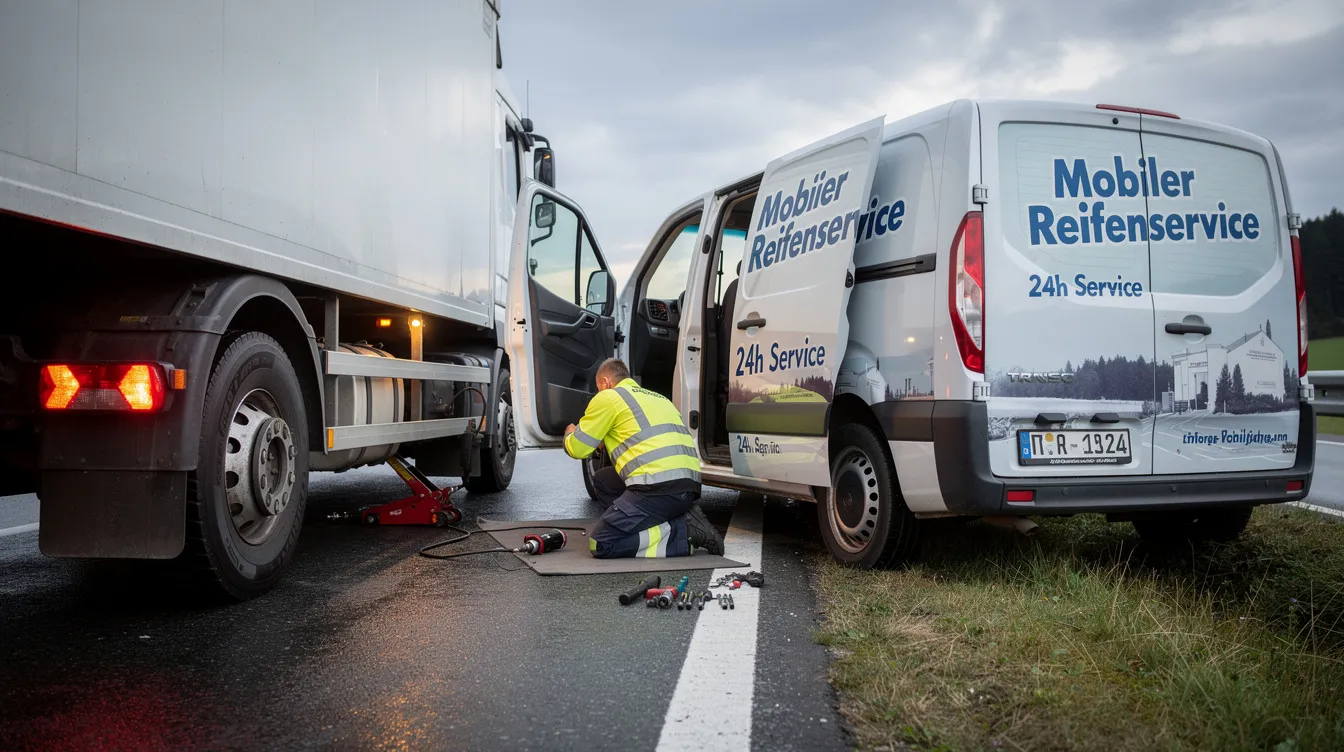
- Call for professional help: contact a mobile tyre service specialised in commercial vehicles. LKWHelp24 acts as a broker, organising a suitable replacement around the clock through vetted service partners across Germany. More information on Truck Roadside Assistance in Germany and the nationwide 24/7 Truck Roadside Assistance Service from LKWHelp24.
What data the driver should have ready when reporting a breakdown
Anyone wanting fast help needs to provide clear data. The driver should have this information ready:
- Exact location: motorway number, direction of travel, kilometre marker, rest area name or a GPS pin via WhatsApp.
- Vehicle type and weight class: tractor unit, solo truck, bus, trailer. Always state that the vehicle is 7.5 t or above – especially important when contacting a Truck roadside assistance service in Germany 24/7 as an international driver.
- Tyre data: tyre size (e.g. 315/70 R22.5), load index, speed rating, single or twin mounting, wheel position (e.g. rear axle, outer left) – this information speeds up the deployment of a Truck tyre service in Berlin and nationwide, available 24/7.
- Damage description and photos: a close-up of the damaged tyre, an overall view of the vehicle, and if possible a photo of the registration document (fields 15.1, 15.2 and axle loads).
- Additional information: current load in tonnes, whether hazardous goods are on board, and whether the vehicle is secured – these details are especially important for safe truck towing.
The more precise the information, the faster the service partner can bring the right replacement tyre. Photos of the tyre sidewall and registration document can replace long phone descriptions if you’re unsure of the details.
What determines the cost of a truck tyre breakdown?
Total costs for a truck tyre breakdown are made up of several factors:
- Time of day: mobile tyre service from €290 net during the day, from €549 net at night, on weekends or public holidays, when a specialised Truck Tyre Service in Germany, available 24/7 is deployed.
- Distance and location: city, country road, motorway, construction site or difficult access – each location means different effort.
- Tyre dimension and load index: large truck tyres from R17.5 upward cost more than car tyres. Rare dimensions can carry a surcharge. Sizes such as 205/55 R16 belong to the passenger car segment and are not covered by LKWHelp24. More details on costs and services are on the Mobile Truck Tyre Service page.
- Waiting time and extra services: recovery, towing or dismounting a heavily damaged rim create additional costs. Information on Truck Towing and Recovery is available on our site. The Cost of truck towing in Germany 2026 is broken down there too.
- Price transparency: a fixed price is agreed and confirmed by phone before dispatch. No hidden costs. Payment is possible in cash or by card.
In a breakdown situation, the immediately available tyre in the right size and index is fitted. Preferred brands generally cannot be accommodated – only on special request, at extra cost and with a wait. A professional mobile truck tyre service in Germany, available 24/7, ensures correct fitting and advice.
Types of roadside assistance available for trucks
There are several types of roadside assistance. Here’s a neutral overview:
- Automobile clubs and manufacturer emergency services: many fleets have contracts with manufacturer-tied services or automobile clubs. These are often limited to specific brands or contract partners.
- Independent mobile breakdown and tyre services: local companies with their own service vehicles. Usually regionally limited, not always available around the clock – unlike a nationwide mobile truck service in Germany, available 24/7.
- Brokers and coordinators: companies like LKWHelp24 coordinate vetted service partners nationwide, 24/7, also for drivers who don’t speak German. The advantage: a single point of contact who organises the entire deployment.
For cars, vans and motorhomes, ADAC or a local breakdown service is usually the right contact. LKWHelp24 deals exclusively with commercial vehicles from 7.5 t upward and buses, and also offers multilingual Roadside assistance for trucks in Germany, available 24/7.
How LKWHelp24 helps with load index and truck tyre problems
LKWHelp24 is a broker and coordinator for mobile roadside assistance for heavy commercial vehicles across Germany. Here’s how the service works:
- 24/7, 365 days a year: LKWHelp24 coordinates mobile truck tyre service, roadside assistance and towing and recovery services through vetted service partners.
- Commercial vehicles from 7.5 t upward and buses only. No cars, vans, Sprinters, Ducatos, Transits, Dailys or motorhomes.
- The right tyre: a tyre with the correct size, load index and speed rating is always fitted. A preferred brand only by arrangement, at extra cost and with a wait.
- Response time typically 30–60 minutes, depending on location.
- Multilingual: communication in German, English, Polish and Russian.
- Contact: Phone/WhatsApp: +49 160 575 3826. WhatsApp with a location pin is preferred. The dispatch team handles the entire organisation.
Important: we serve trucks and commercial vehicles from 7.5 t upward only. For drivers with cars or light vans, we recommend ADAC or a regular breakdown service.
Safety checklist: checking load index and tyres before departure
A short checklist for drivers and dispatch – these points help prevent tyre breakdowns:
- [ ] Visual check before departure: check all tyres for tread depth, damage and uneven wear. Compare tyre data with the vehicle file.
- [ ] Check tyre pressure regularly: especially on tyres with a high load index. Follow manufacturer specifications. Particularly after extended standing time or a load change.
- [ ] Load index check: fitted tyres must at least meet the load index required in the registration document (fields 15.1 and 15.2).
- [ ] Fleet documentation: record tyre dimension, load index, speed rating, age and position of every tyre. Digital storage helps in a breakdown.
- [ ] Training: train drivers on the meaning of load index, load capacity and correct loading (axle load). Many drivers know the tyre size but not the load index.
Common mistakes around load index, load capacity and tyre selection
These are the mistakes we see again and again in practice:
- Confusing tyre size with load index: drivers know the tyre width and rim diameter but don’t check the load capacity index. Tyre size alone says nothing about the approved load.
- Wrong tyre category: car tyres or light C-tyres fitted on vehicles that actually need reinforced truck tyres. This leads to overloading.
- Underestimated axle load: uneven loading (e.g. heavy cargo positioned too far back on the trailer) can overload individual axles – even when the total weight is correct.
- Incorrect tyre pressures: after a tyre change or workshop visit, standard values are often set instead of load-specific ones. This reduces the effective load capacity.
- Mistakes during seasonal changeover: winter tyres with the wrong load index or without XL marking on heavy vehicles. The rule is clear: the load index must never be undercut, regardless of the season.
Summary: using the load index in the registration document correctly
The load index in the registration document and on the tyre sidewall sets the approved load capacity of the tyre. Anyone who knows and respects this figure protects their vehicle, their cargo and everyone else on the road.
The key takeaways at a glance:
- The load index appears in the registration document under 15.1 and 15.2, and on the sidewall of every tyre. It must never be undercut.
- A higher load index is generally allowed but does not change the vehicle registration. The axle load in the registration document remains the upper limit.
- The correct load capacity, correct tyre pressure and appropriate driving style prevent tyre breakdowns and downtime on the motorway.
- Keep tyre data and the registration document within reach. Every minute counts in a breakdown. LKWHelp24 organises professional help for commercial vehicles from 7.5 t upward around the clock: WhatsApp/Phone +49 160 575 3826.
FAQ on the load index in the registration document and truck tyres
What is the minimum load index the tyres must have?
The tyres must have at least the load index entered in the registration document at 15.1 and 15.2. A higher load index is allowed, a lower one only with explicit approval from a testing organisation. If unsure, you can send photos of the registration document and tyres via WhatsApp to LKWHelp24 – we’ll help clarify it.
Where can I find the load index on my truck fastest, day to day?
Look first at the sidewall of the affected axle’s tyre. The number before the last letter is the load index. Example: on “315/70 R22.5 154/150 L”, 154 is the load index for single mounting. The Zulassungsbescheinigung Teil I should also be kept in the cab – mark fields 15.1 and 15.2 so you can find the right spot immediately in an emergency. Fleet operators should store tyre data and photos digitally.
Does the load index still apply at reduced tyre pressure, e.g. after extended standing time?
The stated load index only applies at the prescribed tyre pressure. If the pressure is too low, actual load capacity drops and the tyre heats up faster, which can cause damage. Check tyre pressure before any longer trip with a full load and bring it to the value specified by the manufacturer.
Can I have a tyre with a different load index fitted during a breakdown?
The new tyre must at least meet the required load index. Higher is generally allowed. Mixed load index values on one axle (e.g. 148 and 152) can be critical and should be assessed by a specialist. During a breakdown, clarify with the mobile service which index is being fitted, and have it noted in the report.
Does LKWHelp24 also help with cars or vans with an incorrect load index?
No. LKWHelp24 deals exclusively with trucks, commercial vehicles from 7.5 t upward and buses. For cars, light vans (e.g. Sprinter, Ducato, Transit, Daily) and motorhomes, please call ADAC or a local breakdown service. LKWHelp24 focuses on the heavy commercial vehicle segment to provide fast, professional help there.