Skip to content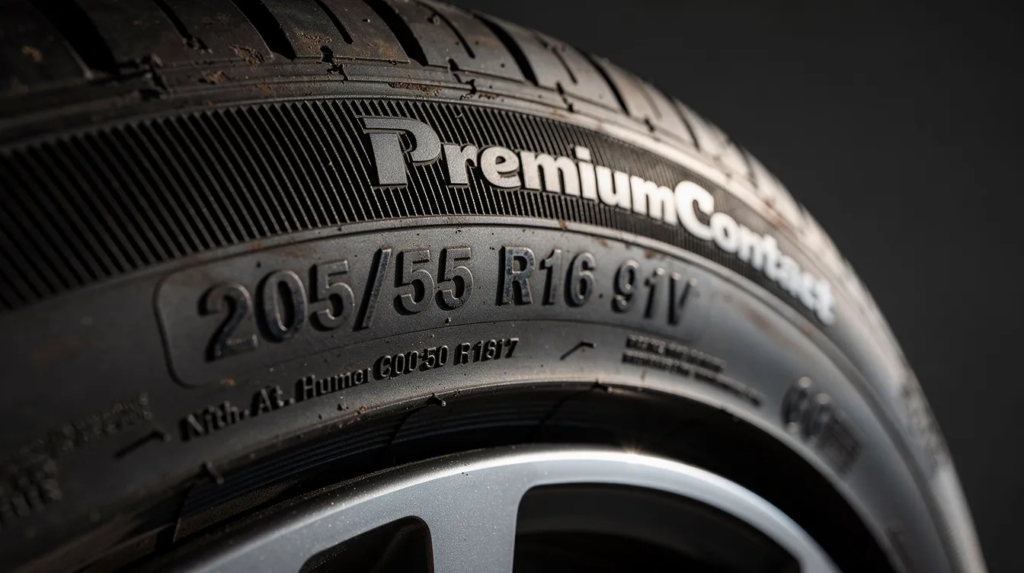
The marking 91H on a tyre tells you two things: how much weight the tyre can carry and how fast you’re allowed to drive on it. The values behind 91H are crucial for safety and vehicle handling. In this article we explain what each number and letter means, where to find these details, and why heavy commercial vehicles over 7.5 t need completely different index values.
Reading time: approx. 12 minutes.
Key points at a glance
- The marking 91H combines a load index (91 = 615 kg per tyre) and a speed rating (H = 210 km/h). Both values are printed directly on the tyre sidewall.
- 91H is a typical index for compact and mid-size car tyres. Heavy commercial vehicles over 7.5 t, tractor-trailers, semi-trailers and buses require far higher load indices – a car index would be life-threatening here.
- A load index or speed rating that’s too low can cause overheating, a tyre blowout and loss of the vehicle’s operating permit. Drivers must never fit tyres with a lower index than stated in the vehicle documents.
- Drivers can find the required index on the tyre sidewall, in the vehicle registration certificate (fields 15.1 / 15.2) and in the CoC document.
- Lkwhelp24 arranges 24/7 mobile tyre service for trucks and commercial vehicles over 7.5 t across Germany. Tyre changes on site, on the motorway or at a rest area. Contact via WhatsApp: +49 160 575 3826 or by phone.
What does 91H on a tyre actually mean?
The tyre designation 91H combines two standardised values that together describe a tyre’s load capacity:
- Load index 91 = the tyre may carry a maximum load of 615 kg at the correct air pressure and permitted speed. The load index is a numeric code on the tyre that appears directly before the letter.
- Speed rating H = the tyre is tested and approved for a maximum speed of up to 210 km/h. The speed rating shows the maximum permitted speed of a tyre.
So the marking 91H tells you how much weight a tyre can carry at most and at what speed it still works safely.
A typical example from the car segment: the tyre size 195 65 R15 91H means 195 mm tyre width, 65% aspect ratio, radial construction, 15-inch rim size, load index 91 and speed rating H.
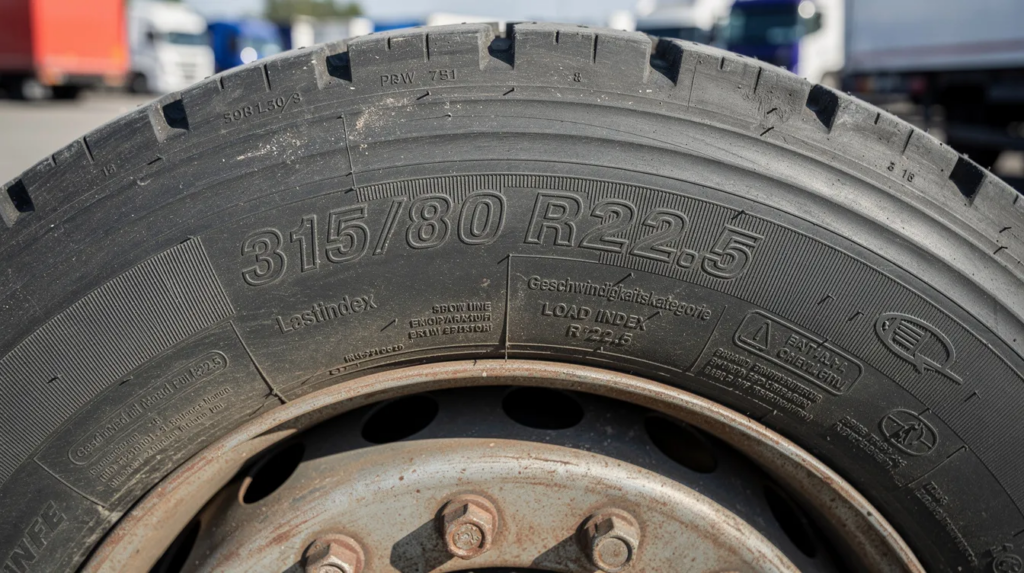
By comparison: a truck tyre marked 315/70 R22.5 154/150L has a load index of 154 (single fitment) or 150 (twin fitment) and a speed category L for a maximum of 120 km/h. These are entirely different dimensions. A detailed comparison of the 91H load and speed index is also available in the article Tyre 91H: Load Index 91 & Speed Rating H Explained.
In short: 91H is designed for typical car dimensions. Trucks and commercial vehicles over 7.5 t need different classes with a much higher load capacity.
Reading the tyre marking: where does 91H appear?
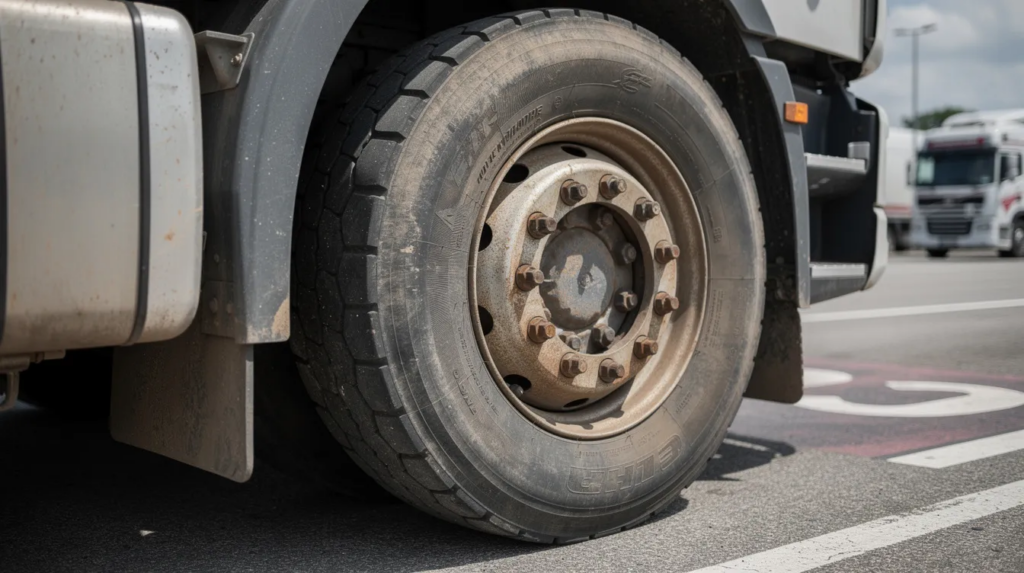
The complete tyre marking is printed on the sidewall of every tyre. The speed rating appears on the tyre flank, directly after the load index. The tyre marking covers width, height, diameter, load index and speed rating. A detailed guide to reading a commercial-vehicle tyre sidewall is available in the article How to Read Truck Tyre Markings: Size, Load Index and DOT Code Explained.
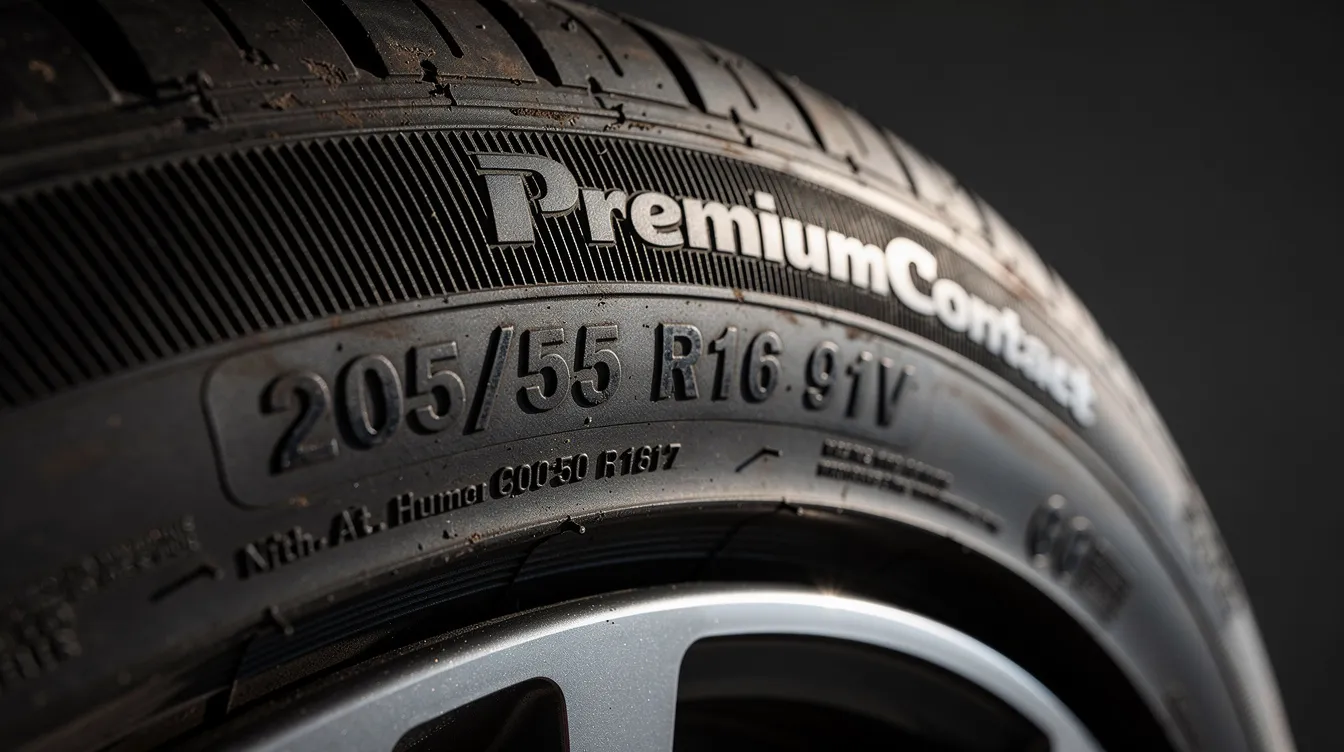
Using the example 205/55 R16 91H, the individual components look like this:
Character | Meaning |
|---|---|
205 | Tyre width in mm |
55 | Aspect ratio in % |
R | Radial construction |
16 | Rim size in inches |
91 | Load index (615 kg) |
H | Speed rating (210 km/h) |
The load index appears before the speed rating in the tyre designation – digits first, then the letter. |
Where do you find the minimum values for your vehicle? The officially required tyre indices are listed in the vehicle registration certificate, in fields 15.1 and 15.2. For trailers or semi-trailers, also check the axle load entries.
Load index 91: how much weight does the tyre carry?
The load index indicates a tyre’s maximum load capacity. It’s the number that appears directly before the letter – in the case of 91H, that’s the figure 91. A tyre with load index 91 can carry 615 kg. A tyre’s load capacity is determined by its load index.
These values come from a standardised load capacity table maintained by ETRTO. Here’s an excerpt with the most common values:
Load index | Load capacity per tyre |
|---|---|
85 | 515 kg |
88 | 560 kg |
91 | 615 kg |
94 | 670 kg |
100 | 800 kg |
Example calculation for a car: with four tyres at index 91, the maximum axle load comes to up to 2,460 kg (4 × 615 kg). A tyre with a load index of 91 suits compact to mid-size vehicles. This value must match the vehicle’s permitted gross weight. |
For trucks, tractor units, semi-trailers and buses, completely different load indices apply – often in the range of 148 to 160 and higher. An index of 91 would be far too low for such vehicles. A real-world example of a typical commercial-vehicle dimension is shown in the article 385/65 R22.5 Truck Tyre Size Explained.
Tyres with too low a load index can overheat and burst under load. Tyres marked XL are designed for higher loads and offer more reserve.
Important: never fit tyres with a lower load index than stated in the vehicle registration document.
Speed rating H: how fast can a 91H tyre go?
The speed rating indicates a tyre’s maximum speed. On a 91H tyre, the index H stands for a top speed of 210 km/h. Tyres with speed rating H are approved for 210 km/h.
H is a common speed rating for many mid-size car tyres. Heavy commercial vehicles usually use other letters – for example J (100 km/h), K (110 km/h) or L (120 km/h). Tyres with a higher speed rating can drive more safely at high speeds, since they’re built from better materials and can withstand greater forces. To see what another truck-specific speed rating looks like in practice, read the article Speed Rating Q on Truck Tyres.
Why do these limits exist? The physical reasons are clear:
- At higher speeds, heat build-up inside the tyre increases due to friction
- Centrifugal forces put greater strain on the carcass, tread and sidewalls
- Material stress increases with every additional km/h
Tyre manufacturers such as Continental test every tyre model on test rigs under defined conditions. The speed rating describes the speed a tyre can sustain safely at correct load and air pressure.
If the maximum speed of the rating is exceeded, the risk of a tyre blowout rises sharply. On the road, this can have fatal consequences.

Speed rating table: placing H and T
There are 32 speed categories in total, from A to Y. The letters aren’t in strict alphabetical order – the H rating sits between U and V, which often confuses drivers.
Here are the most important classes for cars and commercial vehicles as a speed rating table:
Speed rating | Maximum speed |
|---|---|
J | 100 km/h |
K | 110 km/h |
L | 120 km/h |
M | 130 km/h |
N | 140 km/h |
P | 150 km/h |
Q (speed rating Q) | 160 km/h |
R | 170 km/h |
S (speed rating S) | 180 km/h |
T (speed rating T) | 190 km/h |
H (speed rating H) | 210 km/h |
V (V-rated tyre) | 240 km/h |
W | 270 km/h |
Y (speed rating Y) | 300 km/h |
For trucks, the speed ratings J, K and L are usually the relevant ones, since commercial vehicles in Germany are rarely allowed to travel faster than 80–90 km/h. For cars, T, H and V dominate. |
The table shows: between T (190 km/h) and H (210 km/h) there’s a 20 km/h gap. Between H and V (240 km/h) it’s already 30 km/h. Each step up means a different tyre construction and different materials.
Difference between load index and speed rating
Many drivers mix up the two tyre indices, or only pay attention to one of them. Yet they describe two entirely different properties:
Load index (number):
- Indicates the maximum load capacity in kilograms
- Example: 91 = 615 kg per tyre
- Applies at correct air pressure and permitted speed
Speed rating (letter):
- Indicates the maximum permitted top speed in km/h
- Example: H = 210 km/h
- Applies to continuous operation at the correct load
For the code 91H, that means in practice: 615 kg per tyre and 210 km/h maximum speed – both must be satisfied together. Load capacity can be reduced at very high speeds. Manufacturers provide correction factors for this. At speeds above 210 km/h, the permitted load can drop to as low as 85–91% of the stated value.
So never look at just one figure. Always check both values and compare them against the vehicle registration document.
Relevance of 91H for trucks and commercial vehicles over 7.5 t
Right off the bat: 91H is a typical car specification. For trucks over 7.5 t, this combination is practically insufficient.
Why? The differences at a glance:
- Commercial vehicles often show dual load figures, e.g. 154/150. The first number applies to single fitment, the second to twin fitment. C-rated tyres and dedicated truck tyres are standard.
- For tractor-trailers and buses, tyre dimensions such as 295/80 R22.5 or 315/70 R22.5 with load indices in the range of 148 to 160 are common.
- For fleet operators and hauliers, the correct load capacity per axle matters most. A car index like 91H would be life-threatening on a truck.
In a breakdown, Lkwhelp24 always arranges tyres with the correct size and matching indices. In an emergency, an immediately available tyre is fitted that matches the size, load index and speed rating.
Important: Lkwhelp24 serves exclusively trucks and commercial vehicles over 7.5 t as well as buses. Lkwhelp24 does not offer service for cars, vans and motorhomes under 7.5 t.
Speed rating on truck tyres: differences from cars
Truck tyres have different requirements than car tyres. They carry extremely high continuous loads but tend to travel at lower speeds over very high mileage.
- For trucks, speed ratings such as J (100 km/h), K (110 km/h) and L (120 km/h) are usually the relevant ones. H or V-rated tyres play virtually no role here.
- Load capacity and speed rating are more tightly linked than for cars. High load creates extreme stress on the tyre even at 90 km/h.
- Truck tyres often carry a dual load index (e.g. 154/150) to reflect single and twin fitment. Load capacity in twin fitment is lower, because heat is harder to dissipate.
- Motorcycles and vans also use different classes than a tractor-trailer.
If in doubt, contact a specialised truck-tyre workshop or a broker such as Lkwhelp24, who knows the right tyre type for your vehicle.
Tyre age, DOT code and 91H
Besides the index, tyre age plays an important role for safety. The DOT code on the sidewall reveals when a tyre was manufactured.
- The DOT code is a four-digit number. Example: 2319 means production week 23 of 2019.
- A 91H tyre may formally match the required load and speed class. But at an advanced age (8–10 years), it becomes a safety risk. Rubber ages, becomes brittle and loses its properties.
- Car tyres should be critically inspected from around 6 years. Truck and trailer tyres, depending on use, even earlier, since they’re under higher continuous load.
- In a breakdown, Lkwhelp24 always arranges tyres with a sufficient index and roadworthy condition. Brand preferences are usually secondary in an emergency – the immediately available tyre in the right size takes priority. Preferred brands are only possible with advance arrangement and at extra cost.
Reading the DOT code: the last four digits on the sidewall indicate the week and year of manufacture. Example: 0524 = week 5, year 2024.
Tyre speed rating & legal requirements
In Germany, the tyre speed rating is regulated under StVZO (§ 36) and is safety-relevant. Load and speed index values are legally binding and must be correctly stated in the vehicle documents.
- The minimum speed rating stated in the vehicle registration document must not be undercut on summer tyres – neither for cars nor for trucks.
- For winter tyres and all-season tyres, a lower speed rating is permitted. Condition: a sticker showing the permitted maximum speed must be placed within the driver’s field of view.
- Failing to comply with the required values can lead to the loss of the vehicle’s operating permit. Fines and the charge of “driving without an operating permit” can follow.
- Insurers check, among other things, whether the fitted speed rating was sufficient in the event of a claim. If it was too low, they can refuse to settle. Inspection bodies such as DEKRA check tyre values as part of the periodic technical inspection.
So always check the information in the vehicle registration document before buying or fitting tyres.
91H in the context of winter tyres and speed rating T
Many drivers switch in winter from a summer tyre with index H to a winter tyre with index T. In practice, this is completely normal. For the rules on winter tyres for commercial vehicles, see the article Winter Tyres for Trucks: Rules, Safety and Breakdown Help.
- Speed rating T means 190 km/h. That’s 20 km/h less than H. Legally this is allowed if a sign showing the permitted speed is placed within the driver’s field of view.
- The load index must stay the same or higher. Example: 91T or 94T instead of 91H is fine. An 88T, on the other hand, would not be permitted, because the load capacity would be too low.
- Why does the law accept a lower speed rating in winter? Simply because no one drives 210 km/h on snow and ice. In practice, speeds are much lower.
Property | Summer tyre 91H | Winter tyre 91T |
|---|---|---|
Load capacity | 615 kg | 615 kg |
Maximum speed | 210 km/h | 190 km/h |
Sticker required? | No | Yes, if speed < registration document |
When buying winter tyres, always check the load index – the value must never be lower than on the summer tyre. |
How drivers and fleet managers check whether 91H or another index is right
Choosing the right tyre starts with the right sources of information. You should check these:
- Vehicle registration document: lists the approved tyre sizes with minimum load index and minimum speed rating.
- CoC papers (Certificate of Conformity): especially useful for imported or new vehicles.
- Door-frame sticker or fuel-flap sticker: many cars show the recommended tyre size and pressure there.
- Vehicle manual: contains further details on all approved dimensions.
Recommended sequence:
- Check the approved tyre dimension (e.g. 205/55 R16)
- Read off the minimum load index and minimum speed rating
- Assess the usage profile: load, speed, route (motorway or regular road?)
- For semi-trailers and commercial vehicles over 7.5 t, pay particular attention to axle loads and the dual load index
Tyres with a higher index (load or speed) are permitted and sometimes sensible. But never lower than what’s stated in the vehicle registration document. For mixed fleets (trucks + cars), separate tyre strategies should be used. Never mix up car and truck indices.
What information the driver must provide during a tyre breakdown
Imagine this: your truck has a tyre blowout on the motorway. You’re under time pressure, and every hour costs money. For the breakdown service to bring the right tyre quickly, it needs accurate information.
- Location: motorway number, direction of travel, kilometre marker and the nearest parking area. The simplest way: send your GPS location via WhatsApp.
- Vehicle data: registration plate, vehicle type (tractor-trailer, solo truck, bus), permitted gross weight (over 7.5 t).
- Tyre size: read from the tyre, e.g. 315/70 R22.5. If visible, also pass on the load and speed index.
- Position of the damaged tyre: describe the axle and side, e.g. left twin tyre on the drive axle or trailer axle 2, outer right.
- Photos: send photos of the damage and the DOT code to the breakdown service via WhatsApp. This significantly speeds up sourcing the right replacement tyre.
The more information the driver provides, the faster and more precisely the tyre change can be carried out on site. A detailed step-by-step guide for this situation is available in the article Emergency Wheel Change on a Truck: What to Do After a Tyre Blowout on the Motorway.

What to do in a truck tyre breakdown on the motorway
Safety comes first. Heavy commercial vehicles pose a high risk in the event of a motorway breakdown.
- Switch on the hazard lights immediately. If possible, roll onto the hard shoulder or a parking area.
- Put on a high-visibility vest before getting out. Move all passengers out of the danger zone – ideally behind the crash barrier.
- Place the warning triangle at a sufficient distance. For trucks on the motorway, at least 200 metres behind the vehicle.
- Then contact the truck breakdown service. You can reach Lkwhelp24 via WhatsApp or phone at +49 160 575 3826. Provide all the important details (location, vehicle, tyre).
- DIY repairs at the roadside are life-threatening with truck tyres. Truck tyres are under extremely high pressure and can explode if handled incorrectly. Leave the tyre change to a professional.
What determines the cost of a mobile truck tyre service
The cost of breakdown assistance is made up of several components and can vary considerably depending on the situation.
- Time of day and day of week: mobile tyre service from €290 net during the day. From €429 net for night and weekend call-outs, plus the tyre.
- Distance: the further away the nearest service partner, the higher the call-out cost. Remote industrial areas or motorway exits far from built-up areas can extend the journey.
- Tyre price: truck tyres from R17.5 upward are significantly more expensive than typical 91H car tyres. Size, load index and speed rating determine the price of the replacement tyre.
- Additional costs: waiting time, difficult recovery situations or work in moving traffic can raise the price. More on this in the article How Much Does Truck Towing Cost in Germany.
- Transparency: at Lkwhelp24, the fixed price is confirmed by phone or WhatsApp before dispatch. No hidden costs. Payment by cash or card.
How Lkwhelp24 helps with a truck tyre breakdown and the wrong index
Lkwhelp24 arranges and coordinates 24/7 mobile truck tyre service, towing service and breakdown assistance across Germany. Exclusively for commercial vehicles over 7.5 t and buses.
- How it works: the driver sends their location and tyre data via WhatsApp to +49 160 575 3826. Lkwhelp24 finds the nearest available service partner.
- Tyre selection: in a breakdown, an immediately available tyre matching the size, load index and speed rating is fitted. Brand preferences are secondary and only possible with advance arrangement at extra cost. Fitted tyres are excluded from exchange.
- Response time: usually 30–60 minutes, depending on location. Also on motorways and rest areas across Germany.
- Languages: communication available in German, English, Polish and Russian. Ideal for foreign drivers travelling in Germany who don’t speak German.
For a truck breakdown or tyre blowout over 7.5 t, message or call via WhatsApp now: +49 160 575 3826.
Types of truck breakdown services at a glance
There are several ways to get help during a truck breakdown. Here’s a neutral overview:
- Automobile clubs and manufacturer services: often tied to authorised workshops and specific brands, such as Mercedes-Benz Trucks or MAN. Can be helpful under manufacturer warranty, but not always flexible for tyre breakdowns.
- Independent mobile services: businesses with their own vehicles that operate regionally and bill the driver directly. Advantage: quick on site. Disadvantage: often regionally limited.
- Brokers such as Lkwhelp24: a network of vetted partners across Germany is coordinated. Lkwhelp24 selects the right service provider on site and handles the entire organisation.
Pros and cons at a glance: manufacturer services are often contractually tied, independent services regionally limited. Brokers cover many regions and languages.
Lkwhelp24 generally does not operate its own tow trucks or workshops. Its service consists of organising and coordinating – among other things, sourcing the right tyre with the correct index.
FAQ on 91H, speed rating and truck breakdowns
Is a 91H tyre suitable for my truck over 7.5 t?
No. 91H is a typical car index with a load capacity of only 615 kg per tyre. For trucks, semi-trailers and buses over 7.5 t, that’s nowhere near enough. Commercial vehicles need load indices in the range of 148 to 160 or higher, depending on axle load and vehicle type.
Can I fit tyres with a higher speed rating than H?
Yes. A higher speed rating such as V (240 km/h) or W (270 km/h) is allowed, as long as tyre size and load index match the information in the vehicle registration document. A higher rating often means better materials and more safety margin. However, the index must never be lower than required for summer tyres.
How do I find the right index for my truck tyre?
Check the vehicle registration document, the axle load figures and the sticker in the cab. If you’re unsure, simply send photos of the tyre and vehicle papers via WhatsApp to Lkwhelp24 (+49 160 575 3826). The dispatchers will help you choose.
What happens if I drive on tyres below the required speed rating?
The tyre can overheat under continuous load and high speed, risking material damage and a blowout. Legally, the charge of “driving without an operating permit” can apply. In addition, insurers can refuse to settle a claim if the fitted index didn’t meet requirements.
How fast can Lkwhelp24 help with a tyre breakdown?
The average response time is 30–60 minutes, depending on location and traffic conditions. Lkwhelp24 is available 24 hours a day, 7 days a week – including public holidays. Contact via WhatsApp: +49 160 575 3826 or by phone at the same number.