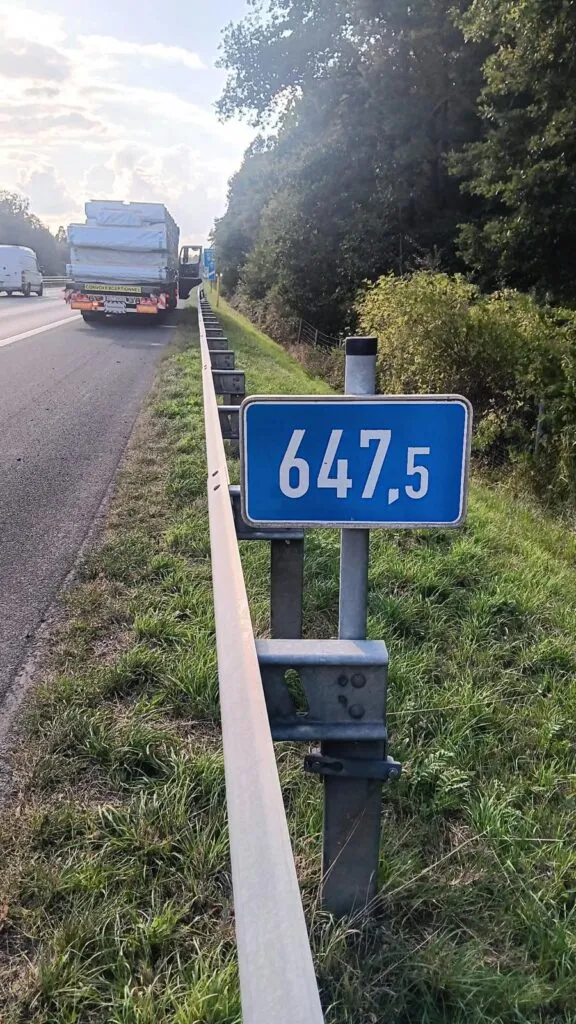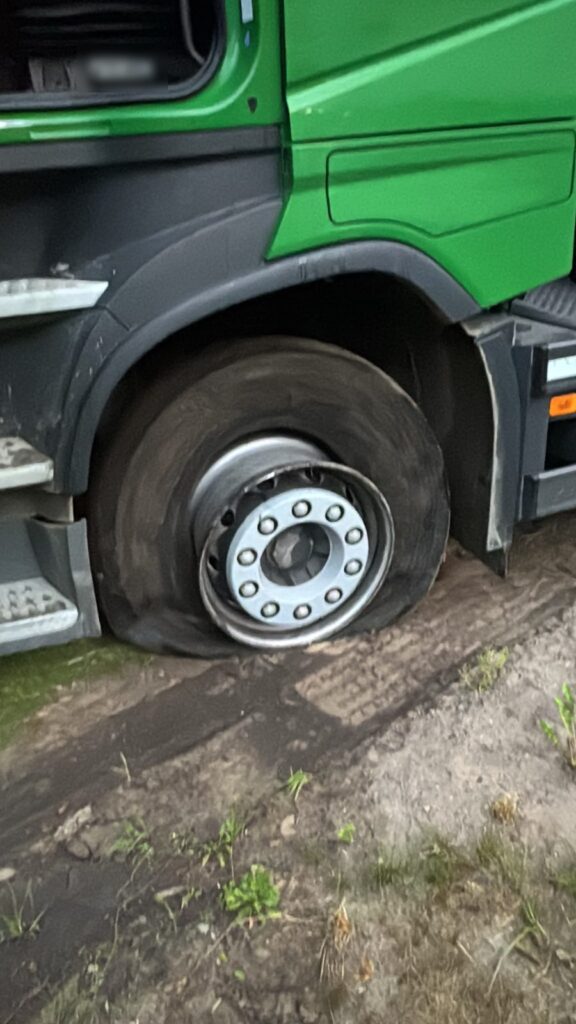
A tractor unit with a completely flat steer-axle tyre was stranded on a sandy track beside the A24 near Wittstock in Brandenburg, heading towards Hamburg. The driver rang us at 06:51; our truck tyre service had a crew on site 55 minutes after dispatch, and the lorry rolled back onto firm ground at 08:36. That is 105 minutes from the first call to the finished job, for a net total of 1,000 EUR, with no damage to the rim or the hub.
A flat steer-axle tyre is not a nuisance you can drive away from. The front wheels carry the steering, and a tyre that has lost all its air can collapse its sidewall, tear itself off the bead and bite into the rim within a few hundred metres. This write-up walks through what happened, who did what, what it cost and what you can learn from it if you run a lorry or manage a fleet.
The emergency: a flat steer-axle tyre on a dirt track near Wittstock
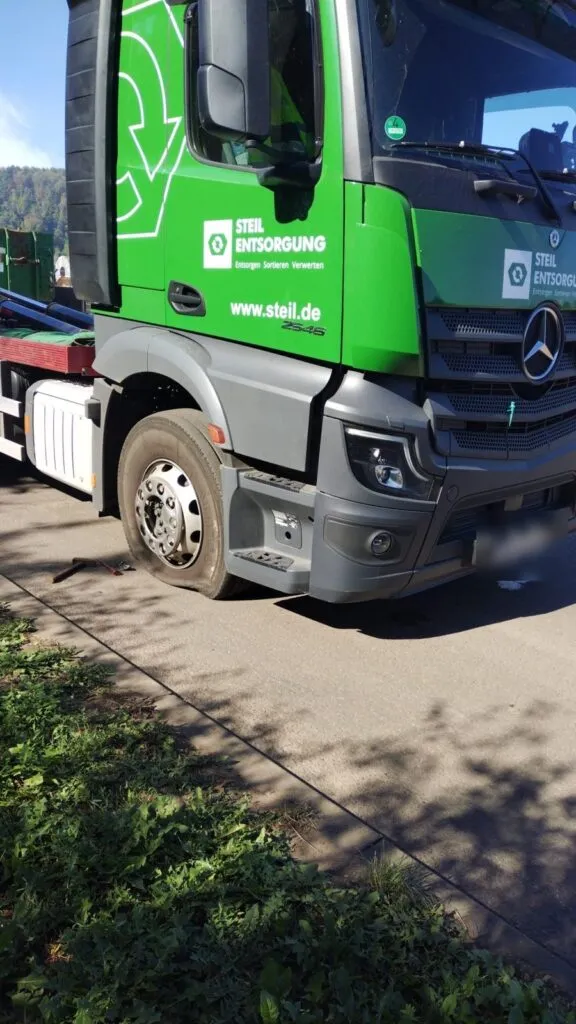
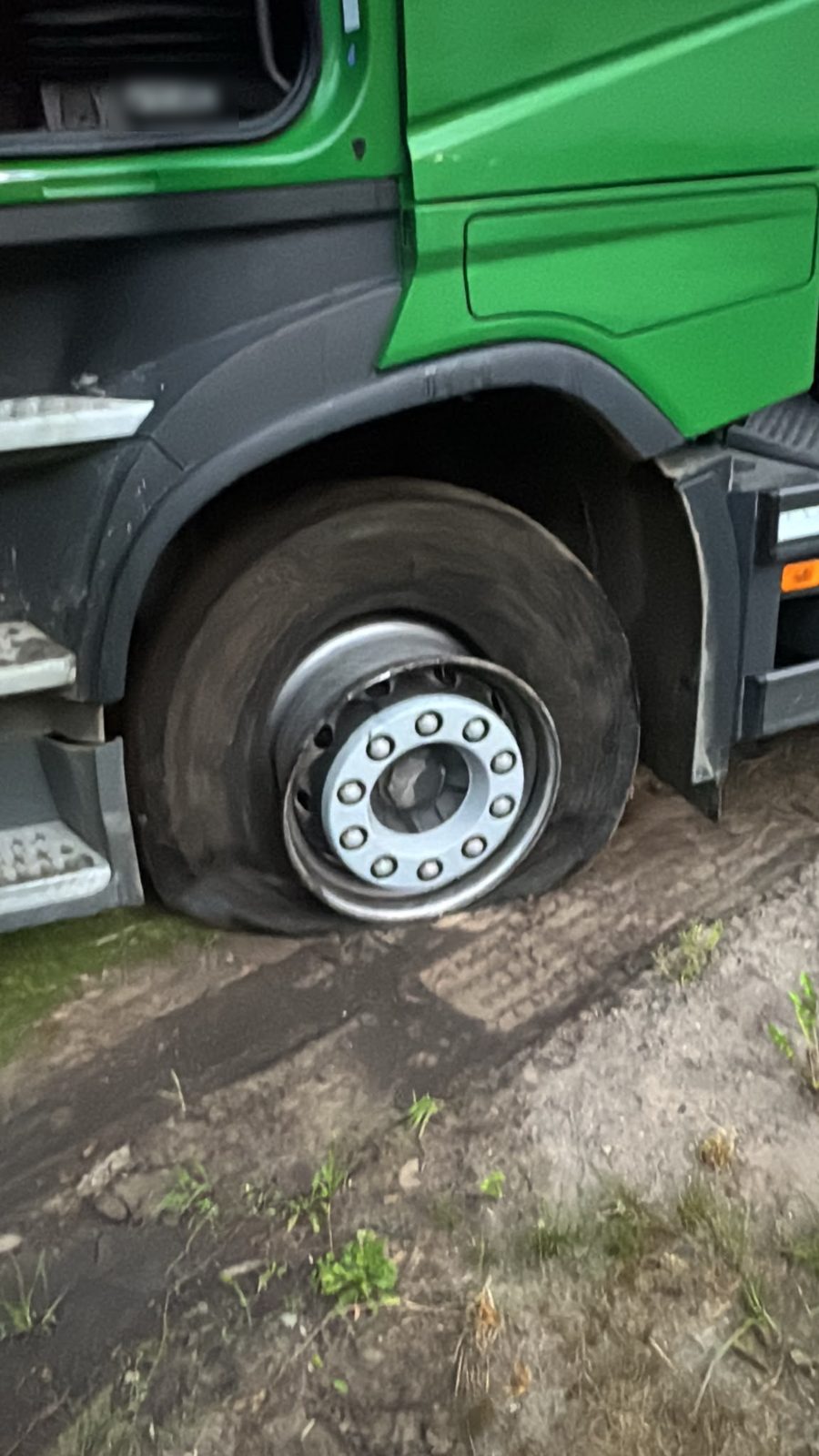
The vehicle was a green tractor unit (Sattelzugmaschine) that had pulled off the A24 onto a technical access track beside a parking area near Wittstock/Dosse. The surface was sand and mud with a rut down the middle and wet grass along the edge, still damp after the night. It was just before seven, overcast, dry, with the first grey light coming up over the fields.
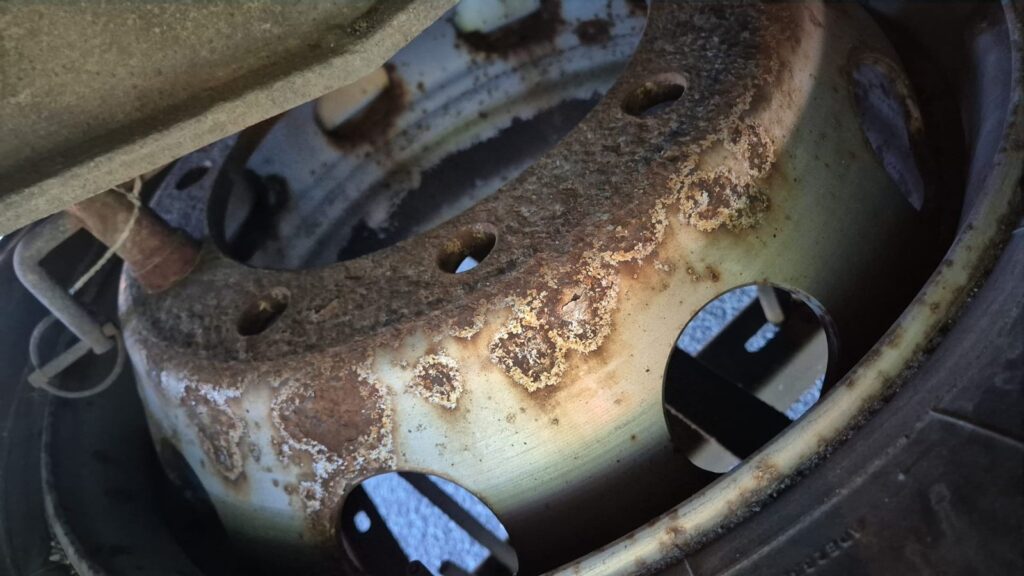
The left front tyre, a 315/80 R22.5 on a steel rim, had lost all its pressure. The sidewall had folded and the bead was resting on the ground. Ten wheel studs ran around the hub in a neat circle, and the rim itself looked intact in the photo the driver sent us. He told our dispatcher that he had heard a bang about twenty minutes earlier, felt the steering pull to the left and managed to bring the lorry to a stop before the tyre came apart completely.
He did two things right. He did not carry on to the next services, and he stayed off the hard shoulder, where a stationary lorry is a target for traffic doing 90 km/h. He also sent a photo and his location pin straight away, which saved us several minutes of questions.
If you search for a truck tyre service near me or a truck tyre breakdown service at that hour, you will find plenty of listings that open at eight. A real truck tyre emergency does not wait for opening times, and that is the gap our dispatch centre exists to fill.
How we organised the call: the first 10 minutes decide everything
Dispatch took ten minutes: from 06:51 to 07:01 we identified the axle, the size and the access conditions, and chose the nearest mobile crew. Those ten minutes look unspectacular on paper, but they are where most of the time on a job like this is won or lost.
Our dispatcher worked through the same short list that we use on every truck tyre callout:
- Which axle is affected: steer, drive or trailer? Here it was the steer axle, which means no spare option from the trailer side and no driving on.
- Which tyre size is on the vehicle? The sidewall was not readable in the photo, so the driver read it off the other front tyre: 315/80 R22.5.
- What is the ground like? Soft sand and mud meant the crew needed a support plate under the jack and wedges for the other wheels.
- Is the driver safe? He was told to switch on the hazard lights, put on his high-visibility vest, set out the warning triangle and wait away from the vehicle.
- Are there load or time constraints? Not here, but we always ask, because a reefer with a temperature-controlled load changes the priority.
By 07:01 the nearest crew from our partner network was on the road. They loaded a new 315/80 R22.5 steer-axle tyre, a hydraulic jack, a support plate, wedges, a torque wrench and the portable compressor before leaving the depot. We do not name our partners publicly, but every crew in the network is a qualified commercial-vehicle technician who works through our dispatch system, so the price and the process are the same whichever team is nearest.
You can read more about how the network is set up on our page for truck tyre service across Germany, and about the wider mobile truck tyre service offer on the mobile truck service page.
Why you must not drive on a flat steer-axle tyre
A steer-axle tyre that has lost all its air must never be driven on, because the rim, the hub and the steering geometry are all at risk within a few hundred metres. A truck tyre is designed to run at around 8.5 to 9.5 bar. At zero bar the carcass folds under the axle load, which on a front axle of a loaded tractor unit is typically between 7 and 8 tonnes.
What happens next is predictable. The sidewall is crushed between the road and the rim flange, and the steel cords in the carcass overheat and shred. The rim edge digs into the rubber, and a steel rim that has been run flat for even a short distance can be bent or cracked. On soft ground like this one, the tyre can also roll off the rim and jam under the wheel arch.
There is a second risk that people underestimate. A flat front tyre pulls the lorry hard to one side. At motorway speed that can mean a lane change you did not choose. This is why you stop, signal and wait, rather than limp to the next exit.
Under Section 36 of the German road vehicle licensing regulations (StVZO), tyres must be suitable for the vehicle’s speed and load and have adequate tread depth. A tyre with a torn sidewall fails that requirement outright, and driving on it can cost you points, a fine and your insurer’s goodwill if something goes wrong afterwards.
What a tyre burst on a lorry actually looks like
A truck tyre burst rarely happens as a dramatic bang. More often it is a slow puncture that goes unnoticed, a worn shoulder that gives way, or a sudden loss of pressure from a damaged valve or a hit kerb. On this job the technician found a split in the lower sidewall about 20 centimetres long, consistent with an impact or with long running at low pressure before the final failure. We cannot say which, and the driver could not either.
Step-by-step: truck tyre replacement on soft ground
A professional truck tyre replacement on a track like this takes five steps and about 40 minutes of hands-on work. The crew arrived at 07:46, 55 minutes after leaving the depot, and went through the job in this order.
Step 1: inspect the tyre, the rim and the hub
The technician walked around the vehicle, then crouched at the wheel. The sidewall was torn, which confirmed that the tyre was beyond repair. He checked the steel rim for cracks and bends by eye and with a straight edge, looked at the wheel studs and nuts, and felt the hub for heat marks. The rim was straight and the studs were clean. That was the best news of the morning, because a bent rim would have meant a second part and another hour.
Step 2: secure the work area
At 07:56 the crew laid the support plate under the jack point to spread the load on the soft ground. They chocked the rear wheels, set the warning signs and made sure the parking brake was on. This took ten minutes, and nobody who has watched a jack sink into wet sand will call it wasted time.
Step 3: remove the wheel and strip the old tyre
Starting at 08:11, the technician loosened the ten wheel nuts, raised the axle, took off the wheel and rolled it onto a clean mat. The old tyre was demounted from the rim, and the rim and hub face were cleaned and inspected a second time with the wheel off.
Step 4: mount the new tyre and inflate
The new 315/80 R22.5 steer-axle tyre went onto the steel rim by 08:26. It was inflated to 9.0 bar, the working pressure for this axle load, with a check on the valve for leaks. Balancing was done on the vehicle with the wheel mounted, which is standard practice for mobile service on a steer axle.
Step 5: refit, torque and final check
The wheel went back on the hub, and the nuts were tightened in a star pattern with a calibrated torque wrench. For a ten-stud M22 wheel the manufacturer’s figure is usually in the region of 600 to 650 Nm, and the crew uses the value for that specific vehicle. Pressure was checked again, the lorry was lowered, and at 08:31 the technician gave the all-clear. We always remind drivers to re-check the nuts after the first 50 to 100 kilometres. Our guide to wheel nut torque for trucks explains the figures and the correct tightening sequence.
The lorry then drove off the track onto firm ground, and the job was closed at 08:36.
Full timeline: from the call to the finished job
The whole job took 105 minutes (1 hour 45 minutes) from the first phone call to the lorry driving off. Here is the timeline exactly as it happened on 11 September 2026.
| Time | Phase | Action |
|---|---|---|
| 06:51 | Call | Driver sends a photo and his location; the dispatcher confirms axle, tyre size and access (dirt track, slope) |
| 07:01 | Dispatch | Nearest mobile crew from the partner network chosen; driver given safety instructions |
| 07:01 | On the road | Crew leaves with a 315/80 R22.5 tyre and a hydraulic jack |
| 07:46 | Arrival | 55 minutes later the crew is on site; sidewall torn open, rim undamaged |
| 07:56 | Preparation | Support plate under the jack on soft ground, wedges, warning signs |
| 08:11 | Removal | Wheel off, old tyre removed from the rim, rim and hub inspected |
| 08:26 | Fitting | New tyre on the rim, inflated to 9.0 bar, wheel refitted |
| 08:31 | Check | Nuts torqued in a star pattern with a torque wrench, pressure checked |
| 08:36 | Done | Lorry back on firm ground; 105 minutes from the call |
The 55-minute drive is the biggest single block, and it is the part nobody can shorten with willpower. Brandenburg is a big, thinly populated state, and a crew from the nearest base has to cover real distance on a Friday morning when the A24 is already busy. In heavy rain, snow or at night, expect that figure to rise.
What did the truck tyre service cost?
The net total for this job was 1,000 EUR (excluding VAT), and every line was agreed before the crew started work. Our dispatcher quotes the call-out and the tyre by phone, and the driver confirmed before the crew left the depot.
| Item | Price (EUR) |
|---|---|
| Call-out (Anfahrt) to the site on unpaved ground | 240 |
| New tyre 315/80 R22.5 (steer axle) | 560 |
| Labour, 1.25 hours at 120 EUR per hour | 150 |
| Support plate, wedges, small materials (soft ground) | 30 |
| Disposal of the old tyre | 20 |
| TOTAL (net, plus VAT) | 1,000 |
There was no secondary damage. The rim and the hub were intact, so no additional parts were needed.
What drives the price of a truck tyre change
Four things move the number up or down on any job like this:
- Distance and location. The call-out fee depends on how far the crew travels and how hard the site is to reach. A dirt track costs more than a lay-by with solid ground.
- Tyre size and brand. A 315/80 R22.5 steer-axle tyre in the premium range costs more than a budget casing; 385/65 R22.5 trailer tyres usually cost a little less, and 245/70 R19.5 tyres on lighter rigid trucks less again.
- Time of day. Nights, weekends and public holidays add a surcharge, usually 25 to 50 per cent on the call-out.
- Condition of the rim. If the rim is bent, add the price of a new or reconditioned rim and the extra labour.
For more figures, our article on what a truck tyre change really costs breaks down typical bills by tyre size.
The real comparison: the cost of waiting
A parked tractor unit with a late load costs a haulier somewhere between 800 and 1,200 EUR per day in lost earnings, driver wages, delayed delivery penalties and lost slots. That makes a 105-minute roadside job the cheaper path by a wide margin compared with towing the unit to a workshop. Recovery over a distance of 100 kilometres or more would easily have cost more than the whole job did, and the lorry would still have needed a new tyre at the end of it. If a tow does turn out to be necessary, our towing and recovery service handles that side as well.
Why you should leave truck tyre fitting to a professional
Truck tyre fitting is heavy, high-pressure work, and doing it yourself on the roadside is the fastest way to turn a 1,000 EUR problem into a much bigger one. A single 315/80 R22.5 tyre with its rim weighs well over 100 kilograms, and the tyre inflates to a pressure about four times that of a car tyre.
The main risks of a do-it-yourself job look like this:
- A jack that is too small, or set on soft ground without a plate, can tip and drop the axle.
- An incorrectly seated bead can burst during inflation, and a burst truck tyre is a serious injury risk.
- Nuts tightened by feel rather than to torque can loosen, stretch the studs or crack the rim. A wheel that comes off at 80 km/h is a catastrophe.
- Damaged studs or a bent rim can go unnoticed and fail later.
- Standing on the hard shoulder with a jack and a wheel exposes you to passing traffic.
There is also the question of tools. Most drivers carry a jack that is fine for a minor adjustment, not for lifting a loaded steer axle on wet sand. A mobile crew arrives with a hydraulic jack rated for the axle, a compressor with a safety cage, a calibrated torque wrench and a proper bead breaker. The whole kit is in the van, because it has to be.
Typical situations where we are called out
We attend truck tyre breakdowns all over Germany, and the circumstances vary far more than most drivers expect. The same crews that fixed this steer axle also handle jobs like these:
- A blowout on the drive axle of a heavy tractor unit with a full load on the A2, A7 or A9.
- A trailer tyre puncture from a screw or a nail picked up at a loading ramp; our case on a screw in the shoulder of a lorry tyre near Erfurt shows when a repair makes sense and when it does not.
- Flat tyres on vans and light commercial vehicles (235/65 R16C and similar).
- A truck wheel change on a damaged rim after hitting a kerb or a pothole.
- Overheated dual tyres on a trailer after a long descent.
- Tyres damaged by stones at a gravel rest area.
- Valve failures and slow leaks found during a driver’s pre-trip walk-around.
In every case the first call is the same: tell us where you are, what vehicle you drive and what you can see on the wheel. A photo helps more than a long description, as it did here.
Prevention: how drivers and fleets avoid a roadside flat
Most roadside tyre failures give a warning that drivers can catch with a two-minute walk-around. The advice below is what our technicians repeat most often.
- Check pressure cold, every week. Do it with a calibrated gauge and tap the valve cores. A tyre that sits 1 bar low runs hotter, wears faster and is more likely to fail.
- Look at the sidewalls. Cuts, bulges and cracks are red flags. A bulge means the cords have gone and the tyre must come off.
- Measure the tread. The legal minimum for lorries is 1.6 mm, but most fleets replace steer-axle tyres much earlier because grip in the wet falls away fast.
- Match the dual tyres. Twin tyres of different diameters force one to drag on the other and overheat. The pair should be within a few millimetres.
- Keep a note of the tyre size and axle load in the cab. It saves a minute on every call and prevents wrong-size deliveries.
- Do not ignore a vibration. A steering wheel that suddenly shakes or pulls could be an early sign of tyre damage, a wheel balance problem or a hub issue.
- Plan seasonal changes. Winter and all-weather tyres need to be on the right axles before the first frost, not after.
For fleets, a scheduled tyre inspection beats an emergency every time. It costs less, and it turns an unplanned stop into a planned one.
Truck tyre know-how for fleet managers
A well-run tyre programme is built on four things: the right size, the right quality, the right pressure and the right maintenance interval. The size and load rating you need are on the sidewall, and the standards are published by bodies such as the European Tyre and Rim Technical Organisation, which sets the rim and tyre dimensions used across the industry.
The premium manufacturers each have a long record in commercial tyres. Michelin and Continental are the two names most German fleets mention first, with Goodyear and Bridgestone close behind in the long-haul and regional segments. Brand matters less than fit: a steer-axle tyre should be a steer-axle pattern, a drive-axle tyre a traction pattern, and a trailer tyre a trailer-specific casing. Mixing them to save money is where the trouble begins.
Retreaded tyres are a legitimate option on drive and trailer axles, but never on the steer axle for safety reasons in many fleets. Tread depth, age of the casing and a regular alignment check are the cheapest ways to extend tyre life.
Here are the sizes our crews carry most often:
| Size | Typical use |
|---|---|
| 315/80 R22.5 | Steer and drive axle on tractor units |
| 385/65 R22.5 | Trailer axles, mega-trailers |
| 245/70 R19.5 | Lighter rigid trucks, distribution |
| 235/65 R16C | Vans and light commercial vehicles |
If you want to read more about decoding the size marking, our guide to the 385/65 R22.5 truck tyre explains how to read the numbers on the sidewall.
Frequently asked questions
How much does a truck tyre replacement on the road cost?
A roadside truck tyre replacement typically costs 750 to 1,400 EUR net for a lorry, depending on size, distance and time of day. In this case it was 1,000 EUR net, including call-out, tyre, labour and disposal. Vans are cheaper, usually 350 to 600 EUR.
How long does a truck tyre change on the autobahn take?
From the call to the finished job, expect about 1.5 to 3 hours. The actual work on site took around 40 minutes here, but the drive of the crew was 55 minutes. Night, rain and heavy traffic add time.
Can I drive on a flat truck tyre to the next services?
No. Driving on a flat truck tyre destroys the carcass, can bend the rim and, on a steer axle, makes the vehicle hard to control. Stop, switch on the hazards, wear your vest, set out the warning triangle and call for help.
Who pays for a truck tyre breakdown service?
Usually the operator or the haulier, then the cost passes to the insurer or customer depending on the contract. Some fleet and tyre contracts include roadside cover. Check your policy before you call; we invoice net, with VAT shown separately.
Do you work on unpaved ground?
Yes. This job was on a sand and mud track, and the crew brought a support plate and wedges for exactly that reason. Soft ground adds time and a surcharge on the call-out, but it does not stop the job.
What should I tell the dispatcher when I call?
Give your location (a pin from your phone is best), the vehicle type, which axle is affected, the tyre size if you can read it, and send a photo. With those five facts, dispatch is a matter of minutes.
Why drivers and fleets choose Lkwhelp24
We answer the phone around the clock, 365 days a year, and we send the nearest qualified crew to you wherever you are in Germany. You get a fixed quote before anyone starts the engine, and the invoice matches it.
What that means in practice:
- A 24/7 dispatch centre that handles German, English, Polish and Russian, so a driver does not have to explain a tyre in a foreign language at six in the morning.
- A network of vetted mobile technicians that carry the common truck tyre sizes in the van.
- Transparent pricing, quoted net, with no hidden fees for the call-out or the disposal.
- One point of contact from the first call to the finished job, with updates by phone or message.
- The ability to escalate: if the tyre is not the only problem, we can call a commercial vehicle workshop or arrange a tow without starting over.
If you want to know more, our contact page lists all the ways to reach us.
Summary: key figures of the case
| Item | Value |
|---|---|
| Vehicle | Tractor unit (Sattelzugmaschine), steer axle |
| Tyre | 315/80 R22.5, steel rim, ten wheel studs |
| Location | A24 near Wittstock/Dosse, Brandenburg, towards Hamburg |
| Date and time | 11 September 2026, call at 06:51 |
| Response time | Crew on site 55 minutes after dispatch |
| Total time | 105 minutes (1 hour 45 minutes) |
| Inflation pressure | 9.0 bar |
| Net cost | 1,000 EUR (excluding VAT) |
| Secondary damage | None: rim and hub intact |
Broken down on the autobahn? Call us now
Flat tyre, blowout or a wheel that looks wrong? Ring our 24/7 dispatch and have your location and a photo ready.
+49 160 5753826 | www.lkwhelp24.com | Round the clock across Germany
Keywords: truck tyre service | truck tyre replacement | truck tyre change | truck tyre callout | truck tyre roadside assistance | truck tyre repair | truck tyre burst | truck tyre breakdown service | truck tyre emergency | truck tyre fitting | truck wheel change | trailer tyre service | mobile truck tyre service | truck tyre service Germany | truck tyre service near me | A24 Wittstock
Related articles
- Emergency Wheel Change on a Truck: What to Do After a Tyre Blowout on the Motorway
- Tire Blowout on the Autobahn: The Immediate Action Checklist for Truck Drivers
- Truck Tyre Service on the A28 near Westerstede: Irish DAF Artic Back on the Road in 2 Hours 15 Minutes After a Drive-Axle Blowout
- Tire Breakdown Service Near Me: What Actually Helps Right Now