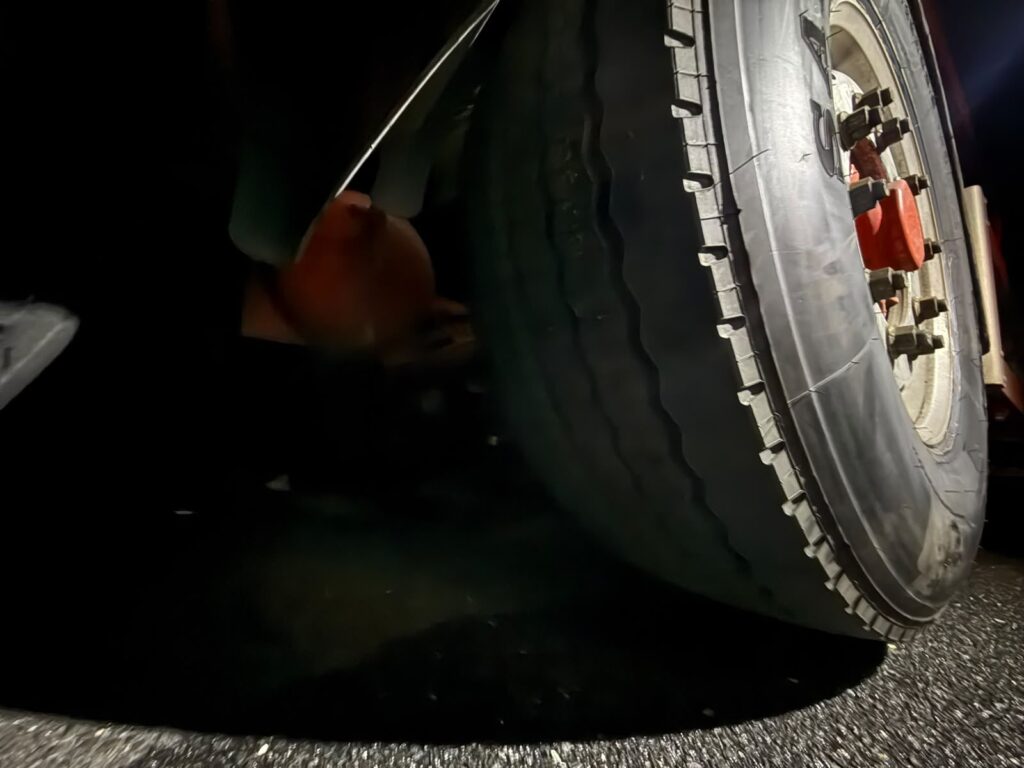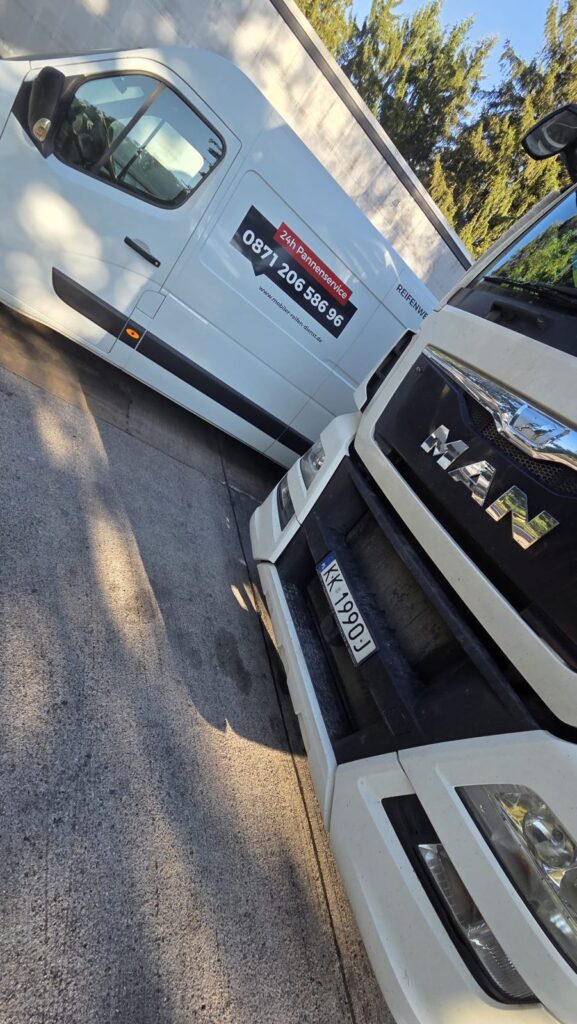
On 19 August 2026 a MAN tractor unit lost pressure on its drive axle at a rest area on the A9 near Bayreuth, heading towards Nuremberg. Our dispatchers took the call at 17:30, a mobile crew was on site 65 minutes later, and the truck pulled out at 19:35 on a new 315/70 R22.5 tyre. The total bill was €965 net, with no damage to the rim, hub or load.
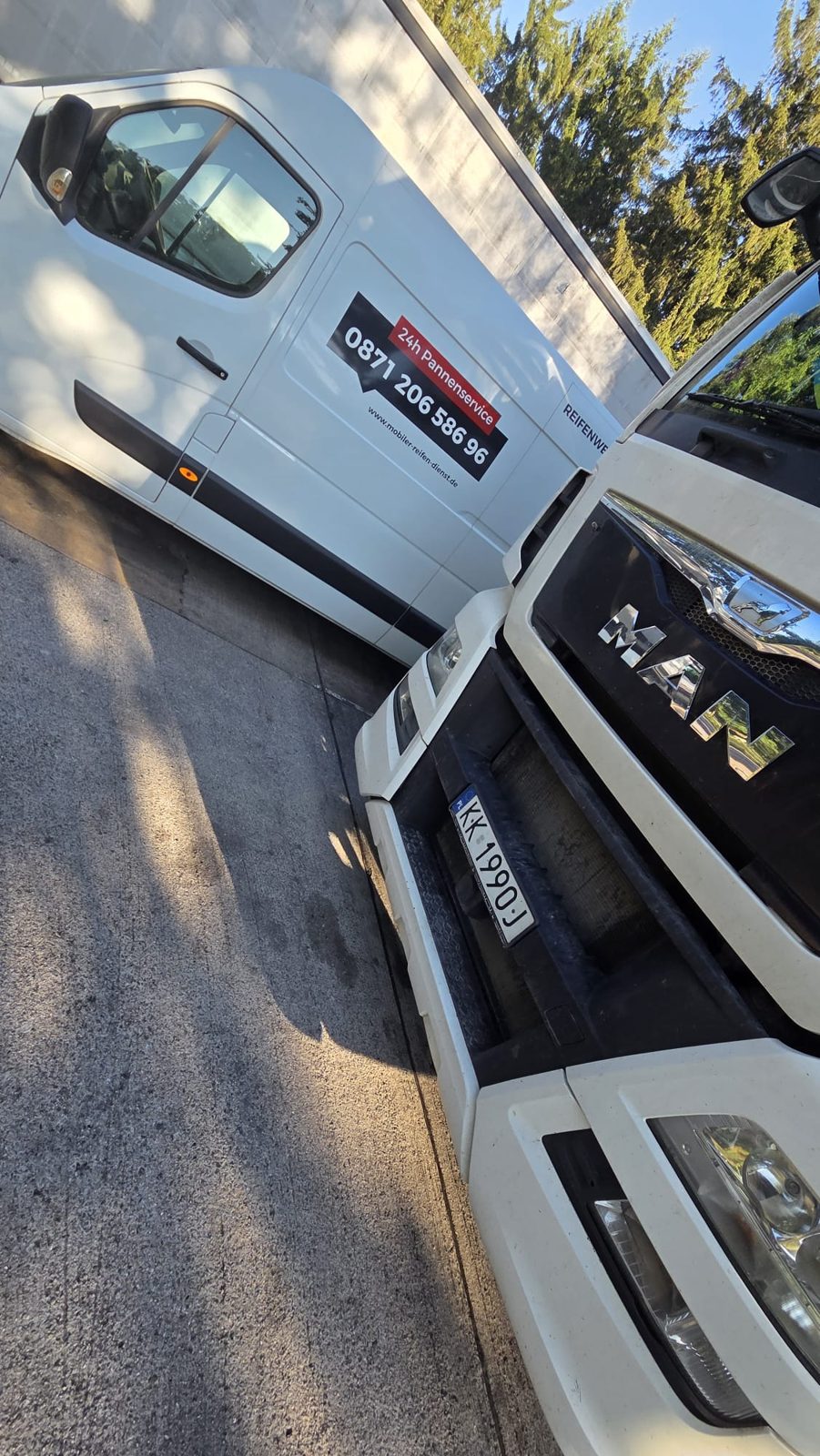
This is a straightforward truck tyre service job, and that is exactly why it is worth writing up. Most breakdowns of this kind are not dramatic. A driver feels the unit pull, checks the mirrors, sees a tyre sitting low, and has to decide within minutes whether to keep going. Below you will find the full timeline, the itemised price, the technical reasoning and a few practical lessons for drivers and fleet managers.
Why a pressure loss on the drive axle cannot wait
A drive-axle tyre that has lost pressure should not be driven on, full stop. The drive axle of a loaded artic carries somewhere around 10 to 11.5 tonnes, and every tyre on it is sized to run at roughly 8.5 to 9.5 bar. Take most of that air away and the sidewall folds under the load. Within a few kilometres the carcass overheats, the plies separate, and what began as a slow leak turns into a blowout at 85 km/h.
The damage does not stop at the rubber. A run-flat tyre on a steel 22.5 inch wheel will chew the bead seat, can bend the rim flange and, on a twin fitting, hammers the neighbouring tyre as well. The truck’s tyre repair bill then multiplies, and the driver is left sitting in a lane or on the hard shoulder with a far bigger problem. That is why we tell every caller the same thing: stop, park safely, and ring us before the tyre decides for you.
Section 36 of the German road vehicle licensing regulations also sets limits here. The § 36 StVZO requires tyres to suit the vehicle’s speed and load, and a tyre that cannot hold pressure clearly does not. In practice, a driver who continues on a flat drive tyre risks both a fine and an uninsured follow-on loss.
The call: what the driver reported
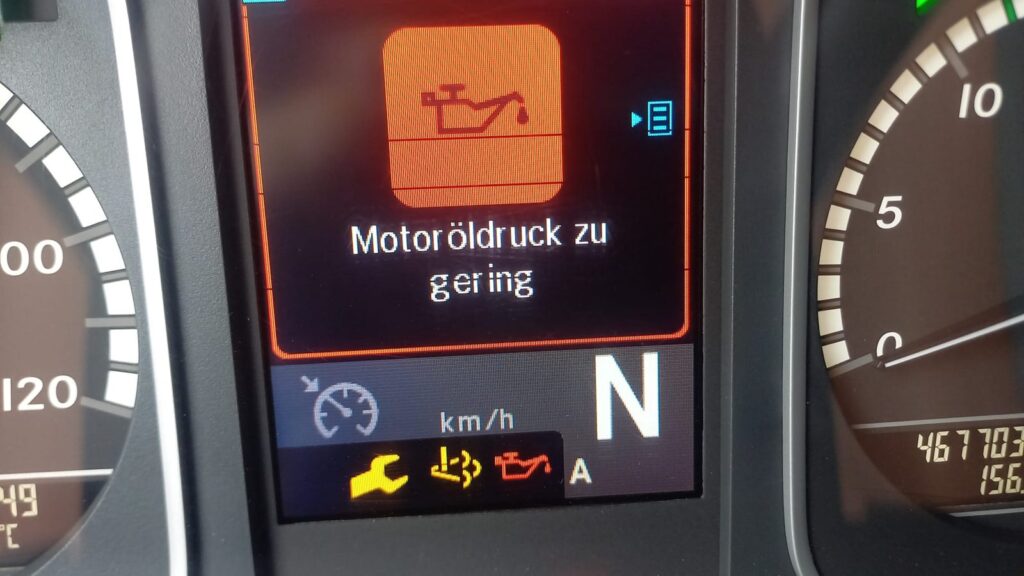
At 17:30 the driver of a foreign-registered MAN tractor unit rang our dispatch line. He was pulling a curtainsider semi-trailer on a regular run towards Nuremberg, and had noticed the unit pulling slightly to one side. The tyre pressure monitor on the dash confirmed it: one drive-axle tyre was losing air fast. He had the sense to leave the carriageway at the next rest area, where concrete hardstanding and plenty of room made the stop far safer than any hard shoulder.
That decision saved the tyre carcass and probably saved the rim. Experienced drivers know the rule, but it is worth stating plainly for anyone newer to the job. If the pressure warning lights up, you pick the nearest safe place, not the nearest convenient one. A rest area, a lay-by or a truck stop beats the hard shoulder every time, because the hard shoulder is where trucks get hit.
Our dispatcher asked five quick questions: the tyre size, which axle, whether the wheel was visibly damaged, whether the trailer was loaded, and the exact position on the A9. Five answers gave us everything needed to prepare the right tyre and the right crew.
How we organised the mobile truck tyre service
Dispatch is where most of the clock is won or lost. Between 17:30 and 17:45 our team confirmed the specification and found the closest available crew in our partner network. Nothing about the tyre was guesswork: the driver read the size from the sidewall, 315/70 R22.5, and we loaded a matching tyre onto the service vehicle before it left.
The sequence looked like this:
- Call received at 17:30, with location, size, axle and load status confirmed during the call.
- Crew assigned from our regional partner network, the nearest team with a drive-axle tyre in stock.
- Tyre loaded onto the service vehicle together with a torque wrench, impact gun, bead tools, wheel chocks and a pressure hose.
- Driver informed of the arrival window and told to keep the hazard lights on and stay clear of the trailer side.
- Handover to the crew, with the dispatcher staying available until the truck was released.
Fifteen minutes from call to departure is a normal figure for us. The honest limiting factor is the drive. The nearest crew with the right tyre was 50 minutes away on the A9, so arrival came 65 minutes after the first call. In heavier traffic or rain that gap grows, and we say so upfront rather than promising a number we cannot keep.
If you want to understand how this fits into our wider mobile offering, the page on mobile truck service across Germany explains how the partner network and dispatch work together.
What the crew found on arrival
The service vehicle drew up beside the MAN cab at 18:35, and the crew began with a ten-minute assessment. The visible damage was a tyre that had lost its pressure and could no longer be reinflated reliably. The rim looked sound: a 22.5 inch steel wheel with ten stud holes, no cracks around the flange, no flat spots, and no scoring on the bead seat. The wheel hub and studs were intact, and the neighbouring twin tyre showed no heat marks.
That last point matters more than it sounds. When a drive tyre goes soft and the truck keeps rolling, its twin often suffers. Heat discolouration, scuffing on the shoulder and a bulge in the sidewall are the signs we look for. None of them appeared here, because the driver had stopped quickly.
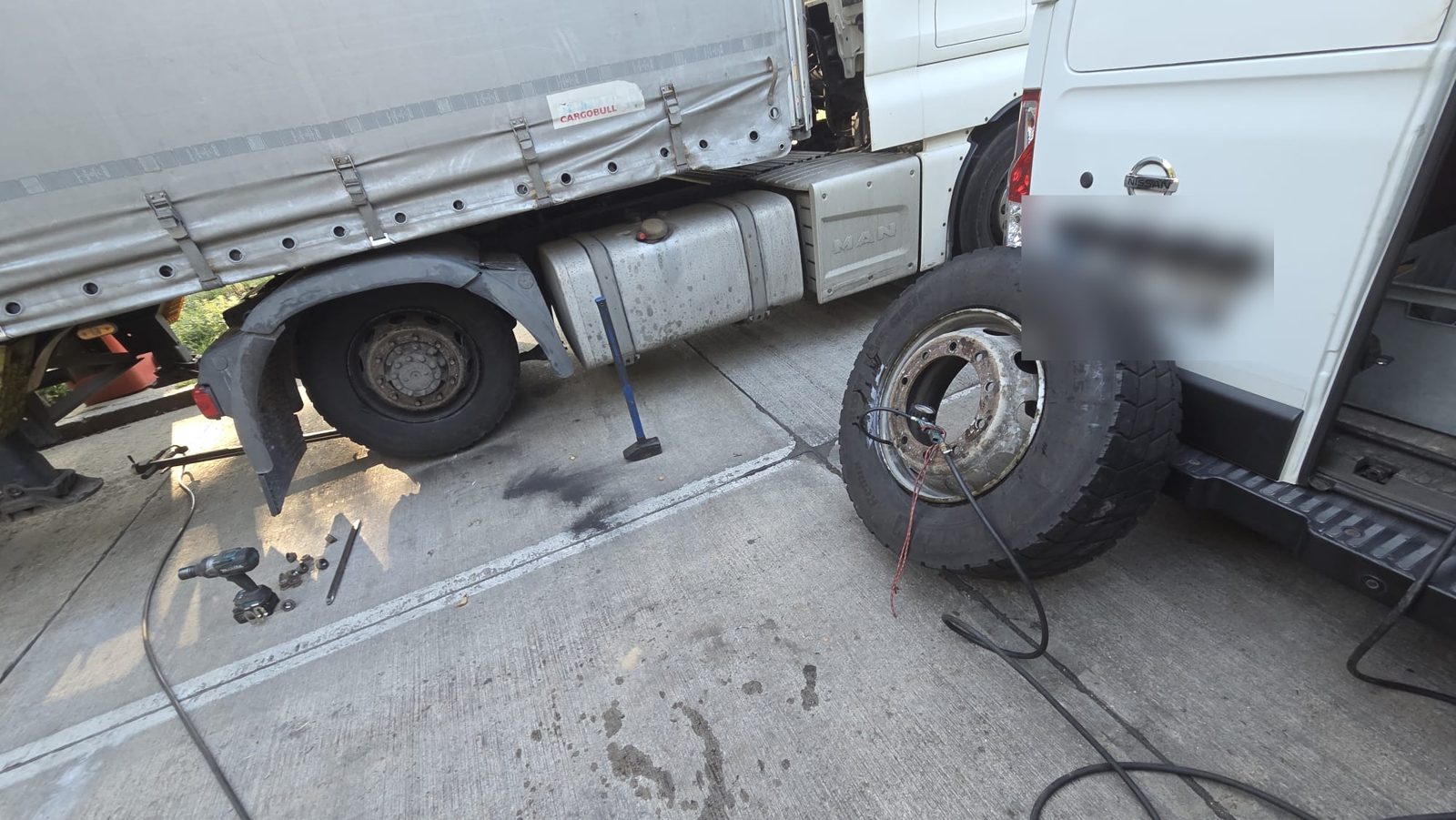
Safety on site came before any spanner touched a nut. The crew chocked the trailer wheels, lifted the drive axle with a hydraulic jack until the tyre was clear of the ground, and marked a working zone around the vehicle. The concrete surface made all of this simple. On soft ground the same job needs load-spreading plates and takes longer.
Truck tyre replacement, step by step
The work followed a fixed order. Each step exists for a reason, and skipping any of them is how roadside repairs go wrong.
Step 1: Inspection and axle support
The crew checked the tyre, the valve, the rim flange and the studs before lifting. Then they raised the axle, set a stand under it and chocked the opposite wheels. A jack alone never carries the load while someone works at the wheel.
Step 2: Securing the working area
Cones, a warning triangle and the hazard lights of the service vehicle marked the zone. The driver stayed beside the cab, away from the work. This sounds basic, yet it is the single step that most often decides whether a roadside job ends safely.
Step 3: Removing the wheel
With a battery-powered impact wrench the crew loosened the ten wheel nuts and slid the wheel off the hub. A drive-axle wheel of this size weighs well over 70 kilograms with the tyre on, so a wheel dolly or two people handle it.
Step 4: Dismounting and mounting the new tyre
The technician broke the bead, dismounted the old tyre and inspected the rim carefully. A fresh valve went in. The new 315/70 R22.5 drive tyre, with its block-pattern drive tread, was mounted and the bead seated with a hose and pressure gauge, as you can see on the working photograph. Seating a truck bead takes controlled pressure, not a quick blast of air, and the safety cage and distance rule apply every time.
Step 5: Refitting and torque
The wheel went back on the hub and the nuts were tightened in a star pattern with a torque wrench, in stages, to the manufacturer’s value. For many 22.5 inch wheels this sits around 600 to 700 Nm, but the figure varies by hub system, so we always check the specification for the truck in front of us. Our guide to the correct wheel nut torque for trucks lists typical values and the correct tightening procedure.
After a short roll the crew re-checked the nuts. This re-torque is not optional. Seats settle, and a nut that held 700 Nm at 18:55 can lose some of it within a few kilometres.
Full timeline: 125 minutes from call to departure
The table below shows every phase of the job. Times are from 19 August 2026.
| Time | Phase | Action |
|---|---|---|
| 17:30 | Call | Driver reports pressure loss on the drive axle, vehicle parked at a rest area on the A9 |
| 17:30 to 17:45 | Dispatch | We confirm size and axle, assign the nearest partner crew, load a 315/70 R22.5 tyre |
| 17:45 to 18:35 | Anfahrt | 50 minutes on the A9 to the vehicle |
| 18:35 to 18:40 | Inspection and securing | Damage assessment, axle lifted, wheel chocks, working zone marked |
| 18:40 to 19:10 | Dismounting and mounting | Wheel off, old tyre removed, rim and valve checked, new tyre mounted and bead seated |
| 19:10 to 19:25 | Refitting the wheel | Wheel on the hub, nuts tightened in a star pattern with a torque wrench |
| 19:25 to 19:35 | Final check | Pressure checked at 8.5 bar, nuts re-torqued after a short roll, paperwork, departure |
Total: 125 minutes (2 h 5 min) from call to departure. The crew arrived 65 minutes after the call and spent 60 minutes on site.
Looking at the numbers, two things stand out. First, the single longest block is not the repair, it is the drive to the truck. Second, the actual hands-on work of dismounting, mounting and refitting took 45 minutes, which is typical for a drive-axle wheel when the rim is undamaged.
What did the job cost?
The final price was €965 net (excluding VAT). Here is where every euro went.
| Item | Price (EUR) |
|---|---|
| Call-out / Anfahrt | 240 |
| Labour, 1.5 hours at €110 | 165 |
| Truck tyre 315/70 R22.5 (drive axle) | 540 |
| New valve and balance check | 0 (included in labour) |
| Disposal of the old tyre | 20 |
| TOTAL | 965 |
All amounts are net, plus VAT.
What drives the price up or down
Four things move a roadside bill. The call-out fee rises with distance, and evenings, nights and weekends carry a surcharge of roughly 25 to 50 per cent. The tyre itself varies by size and brand: a 315/80 R22.5 steer tyre usually costs a bit more than a 315/70, and a premium casing costs more than a budget one. Labour time depends on how clean the job is, since a seized nut or a corroded rim adds minutes. Finally, secondary damage can double the invoice. If the rim had been bent, or the twin tyre ruined, we would be looking at a different figure altogether.
This job was early evening on a weekday, so no night surcharge applied. The rim was undamaged, so no extra parts were needed.
The cost of not calling
A fair comparison is the alternative. A tractor unit and trailer standing idle costs a haulier around €800 to €1,200 per day in lost revenue, driver time and missed delivery slots. Against that, a €965 truck tyre replacement that returned the truck to the road after just over two hours is plainly the cheaper route. If you want a wider picture of typical costs, our article on what a new truck tyre really costs breaks down the figures.
Why a professional crew matters
Changing a drive-axle tyre looks like a job any workshop can do, and in a workshop it largely is. On a rest area at dusk, with a loaded trailer behind you, it is a different matter. Here is what goes wrong when drivers or inexperienced helpers try it themselves:
- The jack in the cab is rated for a light vehicle, not for a drive axle carrying several tonnes.
- Without a proper bead seating cage, a tyre that lets go during inflation can injure or kill.
- Nuts tightened with a wheel brace and a foot are almost never at the right torque, so wheels loosen.
- Studs and threads are damaged by impact guns used without the right sockets or settings.
- A tyre mounted with a pinched bead or damaged valve leaks again within days.
- Working beside live traffic without a marked zone puts the driver in genuine danger.
A trained crew carries all the equipment, knows the torque specifications and, just as important, documents the job. That paperwork can matter when a fleet manager or an insurer asks later what was done and when.
Reading the numbers on a 315/70 R22.5
The tyre size is a short code that tells a technician almost everything. The first number, 315, is the section width in millimetres. The 70 is the aspect ratio, meaning the sidewall height is 70 per cent of the width. The R shows radial construction, and 22.5 is the rim diameter in inches. Together with the load index and the speed symbol, that code decides whether a tyre is suitable for a given axle.
Drive axles typically use a block or lug tread for traction under load, steer axles use ribs for stable tracking, and trailer axles use a profile built to carry weight with low rolling resistance. Fitting the wrong pattern in the wrong position changes handling and wear, so we match each replacement to the axle it came from. The industry body ETRTO publishes the standards for rim and tyre dimensions, which is why a 315/70 R22.5 from one maker fits the same rim as another.
If you want a deeper explanation of size markings, our article on the 385/65 R22.5 trailer tyre walks through the same logic for trailers.
Situations where we regularly go out
The A9 job is one of many. In practice our crews attend a fairly consistent list of cases across Germany, from the Bavarian autobahns to the Ruhr and the Baltic coast:
- Truck tyre blowout on a steer, drive or trailer axle, often with rim damage.
- Slow puncture from a nail, screw or stone in the tread, where repair may still be possible.
- Truck tyre emergency at night or on a weekend, when workshops are shut.
- Trailer tyre service for curtainsiders, reefers, tippers and mega trailers.
- Valve and wheel nut problems, including loose or sheared wheel studs.
- Flat spots and sidewall damage after braking incidents or kerb strikes.
- Roadside tyre checks after a long haul or before a border crossing.
- Fleet tyre replacement at a yard, where a whole tractor unit needs new rubber.
Not every case ends in a new tyre. Sometimes a plug-and-patch repair is correct, sometimes the rim has to be replaced, and occasionally the vehicle needs recovery instead. If the damage is beyond a roadside fix, we can arrange towing and recovery as part of the same call.
How to prevent a pressure loss on the road
Most tyre failures give warnings long before the roadside. A short checklist for drivers and fleet managers:
- Check pressure cold, weekly. Use a calibrated gauge, not a boot kick. A tyre that drops 0.3 bar a week has a slow leak.
- Walk round before every trip. Look for cuts, bulges, embedded objects and uneven wear. Thirty seconds can save two hours.
- Check tread depth. The legal minimum for trucks is 1.6 mm, but most fleets replace steer tyres well before that.
- Fit a tyre pressure monitoring system. It is the reason the driver in this case stopped within minutes.
- Keep spare valve caps and fit them. A missing cap lets dirt into the valve and invites leaks.
- Match twins. Dual fittings should have similar tread depth and the same pressure, otherwise one tyre carries more load.
- Re-torque after any wheel change. Do it after the first 50 to 100 kilometres.
For a deeper checklist on what to do if something goes wrong at speed, see our guide to the immediate action checklist after a tyre blowout on the autobahn.
Tyre brands and fleet maintenance
Fleet tyre choices are a long-term cost decision. The big four on German roads are Michelin, Continental, Goodyear and Bridgestone, and each has strengths. Continental, for instance, publishes extensive guidance on casing life and retreading on continental-tires.com, while Michelin and Goodyear lean on fuel-saving ranges for long-distance work. Bridgestone and its retreading arm are common in mixed-use fleets.
A few principles hold across brands. Buy by cost per kilometre, not by purchase price. Keep a log of tyre positions and rotations. Use retreaded casings on drive and trailer axles where your policy allows, and keep new premium tyres on the steer axle. Train drivers to report slow leaks and tyre noise rather than finishing the shift first. And agree an emergency procedure with your service provider before you need it, so that a breakdown at 17:30 on a Wednesday becomes a routine call, not a panic.
For a fleet with many vehicles, a standing arrangement with a mobile provider can also cut the call-out time, since the provider already knows your vehicle types, tyre sizes and typical routes.
Frequently asked questions
How long does a mobile truck tyre service take to arrive?
Arrival usually takes 35 to 70 minutes on the autobahn, depending on where our nearest crew is. In this case the crew drove 50 minutes and was on site 65 minutes after the call. Rain, roadworks and night hours add time, and we tell the driver the realistic window during the call.
How much does a truck tyre change on the autobahn cost?
A typical roadside job with a new truck tyre runs between €750 and €1,400 net, depending on distance, tyre size and time of day. This A9 job cost €965 net, made up of a €240 call-out, €165 labour, a €540 tyre and €20 disposal. Night and weekend work carries a surcharge.
Can I drive on a tyre that has lost pressure?
No. Driving on a deflated truck tyre damages the carcass within a few kilometres, can destroy the rim and risks a blowout. Park at the nearest safe place, preferably a rest area rather than the hard shoulder, switch on the hazard lights and call for help.
Which tyre sizes do you carry for a roadside job?
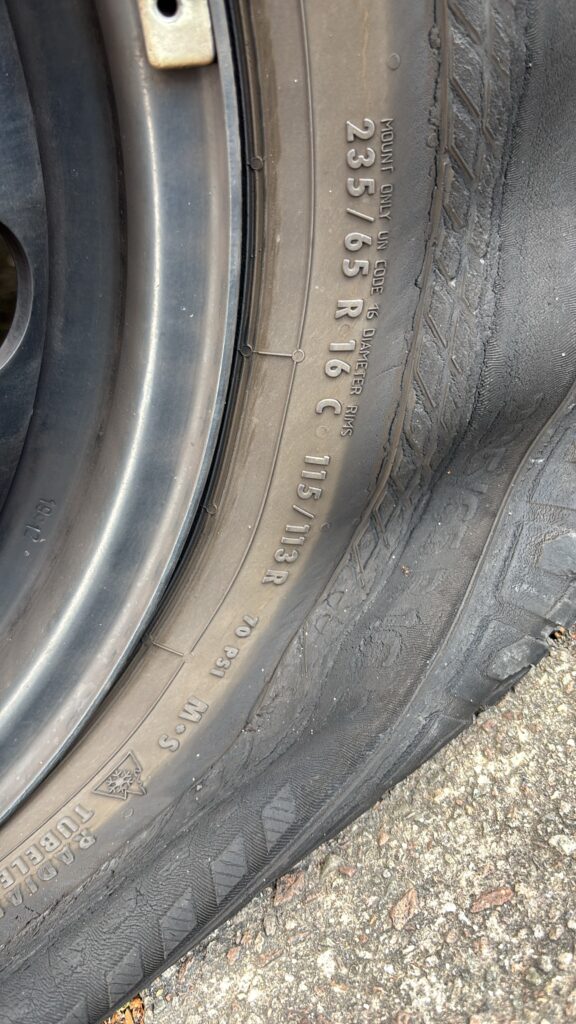
We carry the common commercial sizes, including 315/80 R22.5, 315/70 R22.5, 385/65 R22.5 for trailers, 245/70 R19.5 and 235/65 R16C for vans. We ask for the size and axle during the call so the right tyre is already on the vehicle when the crew leaves.
Do you work at night and on weekends?
Yes, we work 24 hours a day, seven days a week, all over Germany. Night and weekend jobs carry a surcharge and may take longer to staff, but the dispatch line is always answered and the process is the same.
What happens if the rim is damaged as well?
If the rim is bent or cracked, it has to be replaced, and the bill rises accordingly. In this case the rim was intact, so only the tyre was changed. A damaged hub or studs add further parts and labour, which is why stopping early matters.
Why drivers and fleets choose us
Haulage is a deadline business, and the people who call us are often under pressure from a dispatcher, a customer or a driving time clock. What they need is clarity.
- Round-the-clock dispatch. Calls are answered day and night, with no queue behind an office hours schedule.
- A vetted partner network. Crews work to the same standards across Germany, so a job in Bavaria feels the same as one in Lower Saxony.
- Transparent pricing. The quote is itemised and given in net terms, as in the table above.
- Multilingual dispatch. We take calls in German, English, Polish and Russian, which matters for the many international drivers on German roads.
- Realistic timing. We give an arrival window we can keep, not a number that looks good on a screen.
If you want to see how this works for your own route or fleet, our contact page lists every way to reach the team, and our truck tyre service page describes the full range of tyre jobs we handle.
About the vehicle: MAN tractor units and Cargobull trailers
The tractor unit in this case was a MAN, one of the most common long-haul tractors on German roads, and it was pulling a tarpaulin semi-trailer built by Cargobull. MAN trucks use a standard ten-stud wheel mounting on their 22.5 inch drive axles, and the manufacturer publishes service information on man.eu for owners and workshops. Trailer makers such as Cargobull likewise set rules for axle loads and tyre fitment, which is one more reason a crew must match tyre ratings to the actual vehicle rather than only to the size on the sidewall.
Summary
- Vehicle: MAN tractor unit with a curtainsider semi-trailer, foreign-registered.
- Damage: Pressure loss on a drive-axle tyre, 315/70 R22.5.
- Location: Rest area on the A9 near Bayreuth, direction Nuremberg.
- Date: 19 August 2026, early evening.
- Response: Crew on site 65 minutes after the call, 60 minutes of work.
- Total time: 125 minutes (2 h 5 min) from call to departure.
- Cost: €965 net, excluding VAT.
- Secondary damage: None. Rim, hub and load were undamaged.
- Working pressure: 8.5 bar, with nuts re-torqued after a short roll.
Need help with a truck tyre on the road?
Call us whenever a tyre loses pressure, bursts or looks wrong. A dispatcher will answer, ask five quick questions and have a crew moving within minutes.
Phone: +49 160 5753826
Website: www.lkwhelp24.com
24/7 across Germany
Keywords: truck tyre service | mobile truck tyre service | truck tyre replacement | truck tyre change | truck tyre roadside assistance | truck tyre breakdown | truck tyre callout | truck tyre repair | trailer tyre service | truck tyre emergency | truck tyre fitting | mobile tyre service Germany | A9 Bayreuth | 315/70 R22.5 | MAN tractor unit
Related articles
- Emergency Tire Service for Trucks: Fast Help Around the Clock
- LNG Volvo Tyre Change at a Recklinghausen Yard in 2h 5min
- Truck Tyre Service on the A28 near Westerstede: Irish DAF Artic Back on the Road in 2 Hours 15 Minutes After a Drive-Axle Blowout
- Tire Breakdown Service Near Me: What Actually Helps Right Now