Skip to content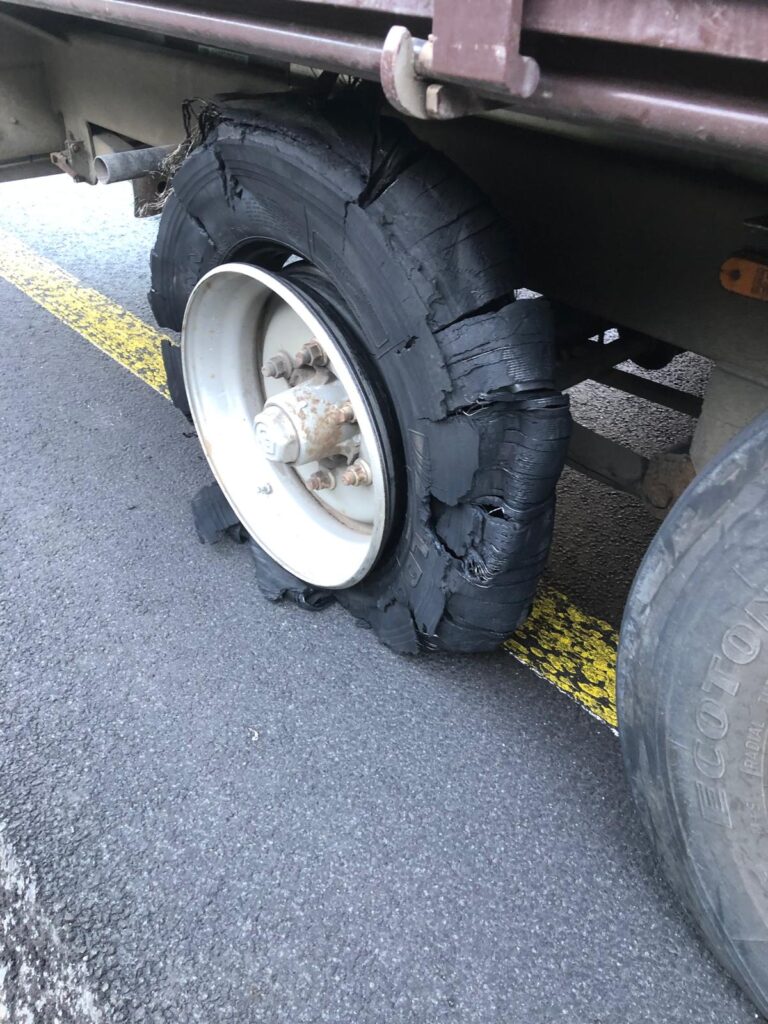
A tyre blowout on a semi-trailer is one of those roadside events nobody on the motorway should shrug off. At 80 km/h or more, a lorry tyre carcass can tear apart in a split second, rubber debris scatters across two lanes, and the driver has to bring the whole articulated combination onto the hard shoulder under control, without endangering the load. That is exactly what happened just before eight in the morning on 13 August 2026, on the A28 near Oldenburg, heading towards Bremen.
This callout is a good example of how mobile truck tyre service should work when properly organised: a fast phone diagnosis, a short drive to the scene, a wheel change carried out to spec, and the driver back on his driving hours instead of losing a full day on the verge. Below is the full record of the job — times, costs, and the technical background every professional driver and haulage manager should know.
The Emergency: Location, Spec, Damage
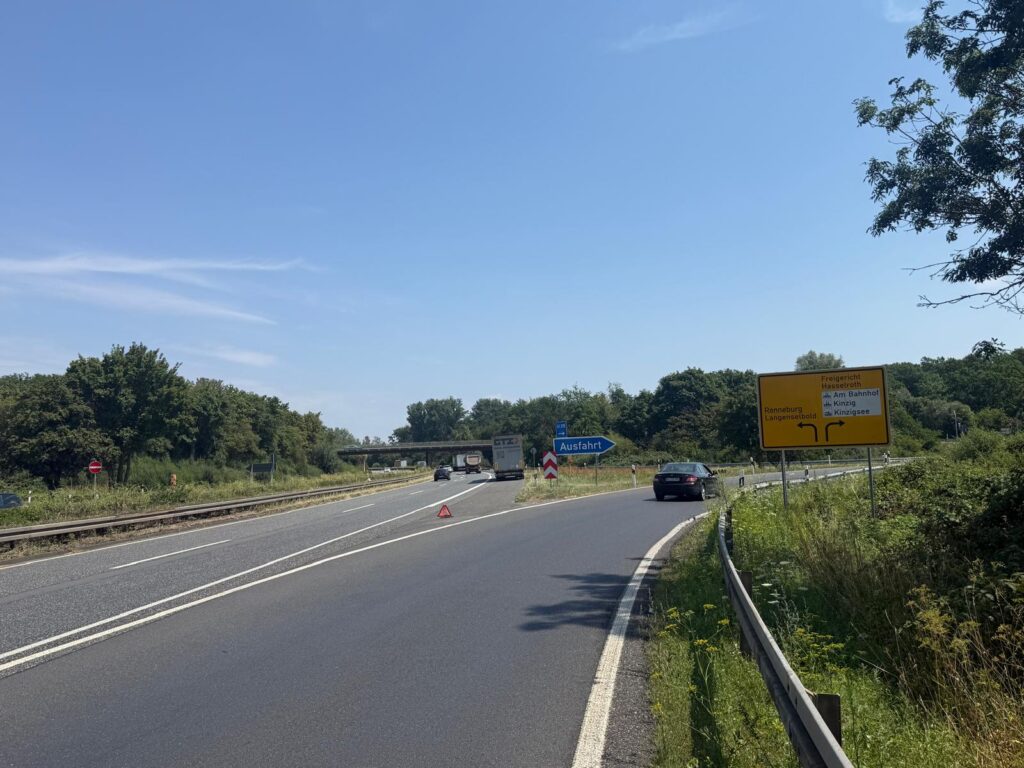
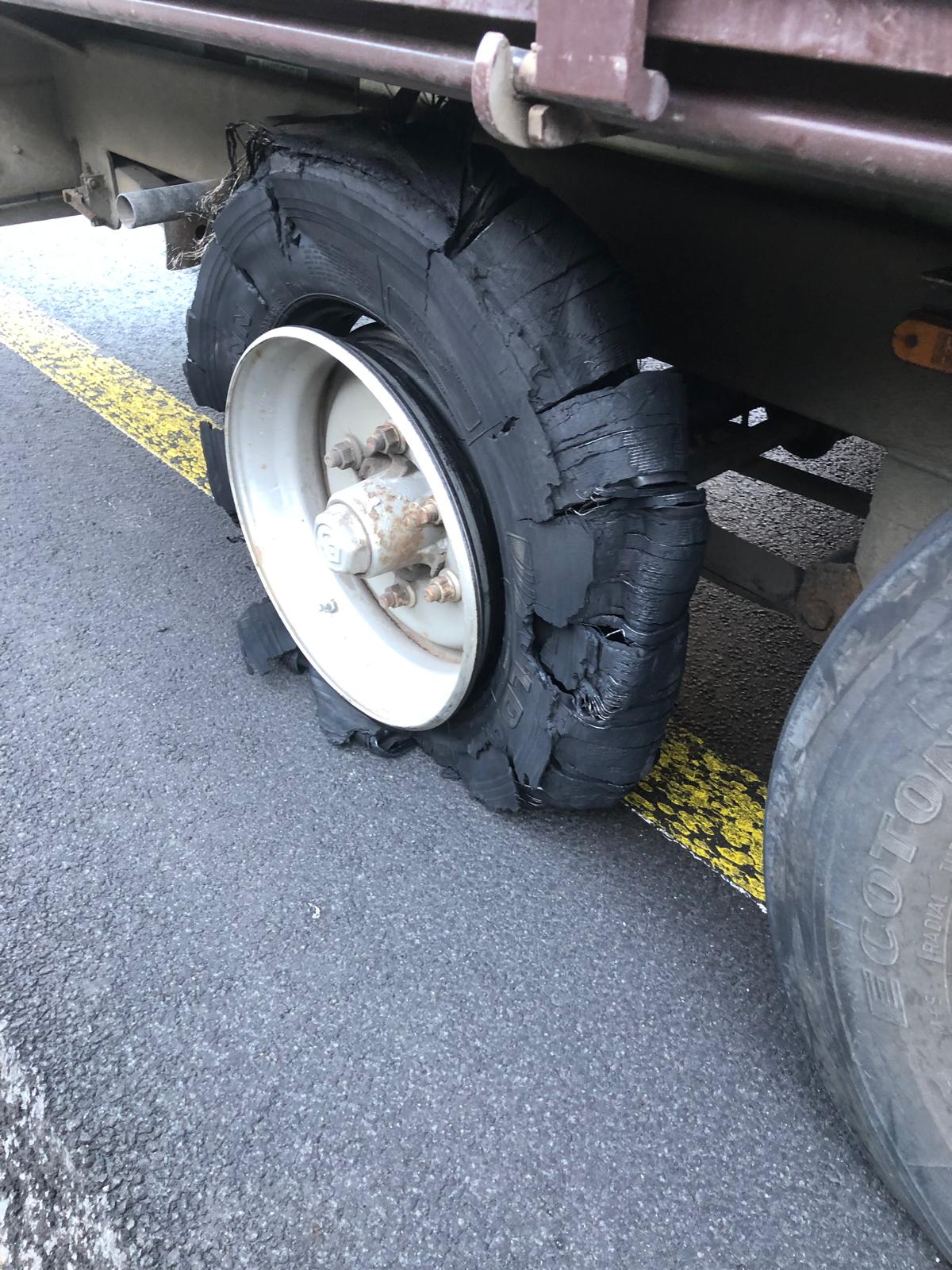
At around 07:50, a professional driver hauling a semi-trailer combination called our emergency line. He was on the A28 near Oldenburg, direction Bremen, and had heard a loud bang on the right-hand side of the vehicle moments earlier. The trailer pulled slightly to one side — the classic warning sign of a blown tyre. The driver did the right thing: no hard braking, just easing off the throttle and steering smoothly onto the hard shoulder.
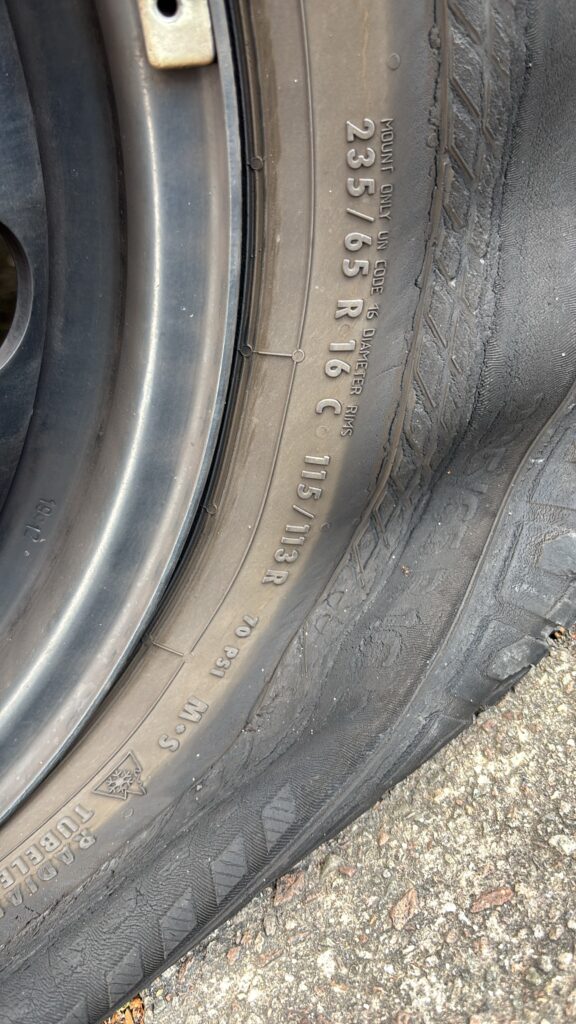
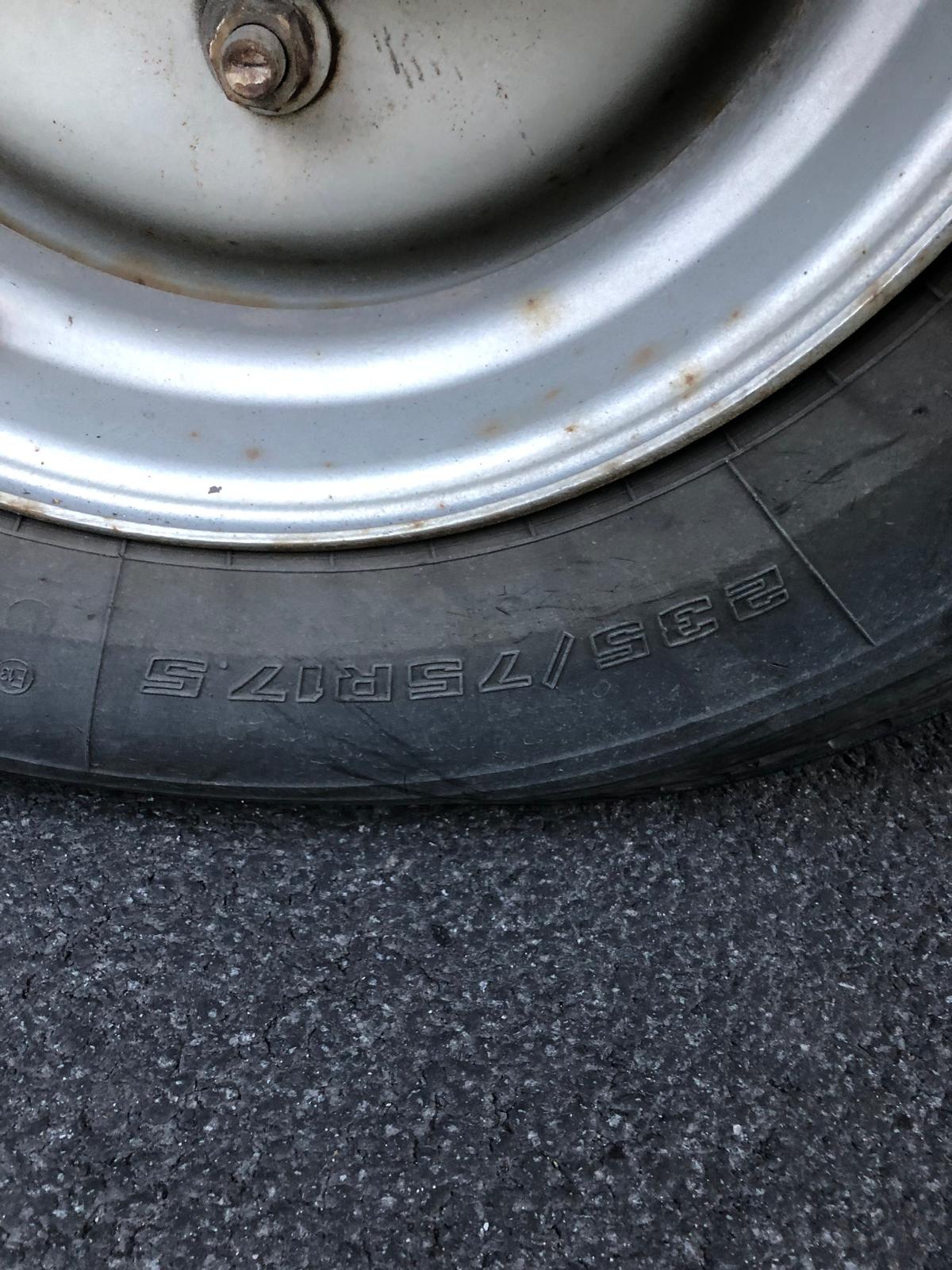
On arrival, the suspicion was confirmed straight away. A tyre on the trailer axle had blown out completely, the carcass shredded, part of the tread separated from the casing. The spec: 235/75 R17.5 on a steel rim, a standard fitment on semi-trailers and lighter trailer units. A visual inspection of the rim showed no deformation, no impact marks, no cracking on the rim flange — a stroke of luck, because when a tyre blows, the rim can strike the road surface and take damage, which would have driven repair costs up considerably.
At first glance, a trailer tyre blowout looks less dramatic than a steer-axle failure. Technically that view only holds up so far. Trailer axles also carry several tonnes under full load, and a missing tyre instantly shifts that load onto the twin tyre next to it. If the vehicle keeps rolling in that condition, secondary damage to the wheel hub, the braking system, and in the worst case a second blowout, all become real risks.
The morning was dry, lightly overcast, with good grip on the road surface — conditions that at least didn’t compound the blowout with wet roads or low-sun glare. The driver later told the technician he’d first assumed it was a stone hitting the underside, until the vehicle started pulling noticeably. That brief moment of uncertainty is typical. Plenty of drivers hesitate for a second or two before they register that a tyre, not road debris, is the cause. Hesitate too long, and you cover extra metres in which the damage to the rim and the neighbouring tyre can get worse.
How the Assistance Was Organised
Our dispatch operates 24/7 across multiple languages and is built for exactly this kind of situation. The sequence behind the scenes:
- Take the call, verify the location via GPS coordinates or motorway markers.
- Get the damage picture over the phone: axle, tyre size, visible rim damage, load security.
- Identify the nearest available technician from our partner network.
- Confirm a matching tyre in size 235/75 R17.5 either in stock or with a regional tyre partner.
- Dispatch the technician with tools, torque wrench and replacement tyre to the A28 near Oldenburg.
- Brief the driver on expected arrival time and remind him about warning triangle, hi-vis vest and safe distance from the carriageway.
From the first call to confirmed dispatch, this took around 15 minutes. With a clearly identified standard size like 235/75 R17.5, dispatch time drops noticeably because there is little back-and-forth needed on parts availability.
The Situation on Site: Why This Cannot Be Ignored
According to ADAC, Germany’s largest motoring organisation, tyre failures rank among the most common breakdown causes for commercial vehicles on German motorways. A lorry tyre runs, depending on axle and load, at an inflation pressure between 8.5 and 9.5 bar — more than four times a typical car tyre. When the carcass tears at that pressure, the stored energy releases in an instant. Rubber fragments can be thrown several metres, and technicians working near a still partially inflated neighbouring tyre have to stay aware of the forces at play.
The second risk is structural. When one tyre in a twin set fails, the remaining tyre temporarily has to carry double the load. That causes overheating, accelerated wear, and in the worst case a second blowout, this time on the tyre that was already overloaded. This is why the rule holds: after a blowout on a twin-tyre axle, never keep driving normally, even if the vehicle still feels stable.
Third, the rim itself is at stake. Even a few hundred metres driven on an already-shredded carcass can damage a steel rim — nicks on the bead flange, minor imbalance, or in extreme cases a crack. In this case, the driver reacted quickly enough that the rim came through completely undamaged, which cut both the repair time and the cost significantly.
The Wheel Change, Step by Step
Step 1 — Visual inspection and assessment. The technician first checks the full extent of the damage: tyre condition, rim condition, the state of the twin tyre, and whether the brake disc or wheel hub made contact with anything.
Step 2 — Secure the scene. Warning triangle placed at a safe distance, hi-vis vest on, vehicle positioned as far onto the hard shoulder as possible. On a motorway this step is not optional, it is a survival step — the hard shoulder on the A28 leaves little buffer from live traffic.
Step 3 — Remove the wheel. Wheel nuts loosened, vehicle jacked just enough (with twin tyres, a moderate lift usually suffices since the neighbouring tyre is still carrying weight), damaged wheel taken off.
Step 4 — Fit the replacement wheel. The replacement tyre, 235/75 R17.5, is either mounted on the existing, undamaged steel rim or a complete spare wheel is fitted, whichever is faster. In this callout, the inspected rim could be reused directly.
Step 5 — Final check with the torque wrench. Wheel nuts are tightened in a star pattern to the specified torque, followed by a tyre pressure check and a quick visual pass over the whole axle before the combination is cleared to move.
That star-pattern tightening sequence is not a fussy detail for purists. Tightening the nuts straight round instead can warp the rim slightly, leading to imbalance and, in the worst case, wheel stud failure.
The Complete Timeline
| Time | Phase | Action |
|---|---|---|
| 07:50 | Emergency call | Driver reports tyre blowout, A28 near Oldenburg |
| 07:50–08:05 | Dispatch | Location verified, technician and tyre confirmed |
| 08:05–08:47 | Drive to scene | Technician travels to the location |
| 08:47–08:55 | Securing the scene | Warning triangle, hi-vis, visual check |
| 08:55–09:05 | Diagnosis | Rim, neighbouring tyre, wheel hub inspected |
| 09:05–09:25 | Removal | Wheel taken off |
| 09:25–09:43 | Fitting | New wheel fitted and secured |
| 09:43–09:48 | Final check | Star-pattern torque, tyre pressure, clearance to go |
Total time: 1 hour 58 minutes, from the first call to the driver moving again.
What the Callout Cost
| Item | Price (EUR, net) |
|---|---|
| Callout / travel | 240 |
| Labour (approx. 1 hour) | 130 |
| Tyre: Continental Conti Hybrid HT3, 235/75 R17.5 | 345 |
| Old tyre disposal | 20 |
| Total | €735 net (plus VAT) |
A mobile trailer tyre replacement on the motorway typically runs between €550 and €900 net, depending on distance, time of day and tyre size. At night or on weekends, the travel component usually rises by 25 to 50 percent. For comparison: a stranded articulated combination costs a haulier roughly €800 to €1,200 per day in lost freight, standing time and missed delivery windows. A callout under two hours is, economically, by far the cheaper option compared with any kind of downtime or improvisation.
Why This Is Not a Job for Amateurs
- Without a proper jack and axle stands, working under the vehicle carries a real crush-injury risk.
- A wheel fitted incorrectly, or not torqued to spec, can work loose within a few kilometres.
- Without a warning triangle and proper scene security on a motorway, rear-end collisions with passing traffic are a real danger.
- A damaged rim that gets reused anyway can fail again at speed.
- Not knowing the permitted axle load can, in the worst case, cause a second, entirely avoidable breakdown shortly after the first.
Steer Axle, Drive Axle, Trailer Axle: Not All Blowouts Are Equal
Not every tyre failure carries the same weight. A blowout on the steer axle of a tractor unit causes an immediate loss of steering control, which is why it always gets top priority. On the drive axle, traction and braking forces add another layer of risk, since a damaged tyre there can cause wheel slip. The trailer axle, the one affected here, carries “only” the load, but thanks to the twin-tyre setup it’s structurally better protected, provided the driver reacts in time. That was the decisive factor in this case: the driver’s quick response kept the problem from spreading to the rim or the wheel bearing.
Another point that matters during diagnosis is wheel stud condition. After any wheel change, fleets should schedule a torque re-check after the first 50 to 100 kilometres driven, since studs can settle slightly during the initial run-in. Our technician flagged this to the driver and noted it on the job report.
Typical Callouts We Attend
Besides trailer blowouts on semi-trailers, our everyday work covers steer-axle tyre failures, double tyre blowouts on car transporters, drive-axle failures on fully loaded articulated trucks, and tyre damage on tankers, tippers and heavy-haulage vehicles. We’re reachable across the whole of Germany, around the clock, from the A1 in the north to the A8 in the south.
Prevention for Drivers and Fleet Managers
Regular tread-depth checks, correct tyre pressure according to the load table, and a visual inspection of the carcass before any longer trip cut the risk of a blowout significantly. Fleets should also work to a fixed tyre replacement interval on trailer axles regardless of visible condition, because the carcass fatigues over the years even when the tread still looks acceptable.
Tyres and Fleet Maintenance: The Bigger Picture
Semi-trailers commonly run on tyres from Continental, Michelin, Goodyear or Bridgestone, each with a different balance of mileage and performance. For the trailer axle, tread-optimised models such as the Continental Conti Hybrid HT3 fitted in this callout are a strong fit, built for a good balance between mileage and rolling resistance. A well-managed fleet tyre programme not only saves fuel but also cuts unplanned downtime substantially. That includes regular tread-depth checks in line with the statutory minimum under Section 36 StVZO, the German regulation setting minimum tread depth for commercial vehicle tyres.
Why Hauliers and Drivers Choose Us
We’re reachable 24 hours a day, seven days a week, through multilingual dispatch that works smoothly even with drivers who don’t speak German or English. Our partner network covers the whole of Germany, so arrival times stay predictable even outside the major conurbations. Pricing is transparent, with clear fixed rates for travel and labour and no hidden line items on the invoice.
Fleets, Hauliers and Standing Time: The Economics of It
For a haulage company, a tyre blowout isn’t just a technical problem, it’s above all a logistics one. Every hour lost on the motorway shifts delivery windows, can trigger penalty clauses on time-sensitive freight, and ties up the dispatcher on the customer’s side too. A combination scheduled to reach a loading ramp at midday often misses not just that single appointment when a breakdown isn’t handled well, but the entire day’s schedule, backhaul included. That’s why what matters with a blowout isn’t just the repair time itself, but the whole chain from the first call to clearance to move again. In this case that chain came in under two hours, a solid result for an early-morning motorway callout.
Timing matters too. A callout just before eight in the morning usually benefits from moderate traffic on the technician’s route in, while a comparable incident during the afternoon rush between four and six can take considerably longer because of congestion on the feeder roads. Fleet managers who know this build buffer time into their route planning, especially on stretches with a known history of breakdowns.
Frequently Asked Questions
What does a tyre change on a semi-trailer cost on the motorway?
Depending on tyre size, time of day and distance, a typical callout runs between €550 and €900 net. In this case the total came to €735 net, including travel, labour, tyre and disposal.
How long does a callout like this take?
From the first call to the driver moving again took 1 hour and 58 minutes. With a shorter drive or during daytime it’s often quicker; at night or in bad weather it can take longer.
Who pays for the tyre replacement?
Usually the haulage company or the vehicle owner covers the cost. Where the damage is covered, reimbursement through motor insurance may be possible afterwards, depending on the cause.
Can you keep driving on a blown tyre?
No. Even though the twin tyre carries the load for a while, the risk of secondary damage to the rim, the hub or the second tyre rises sharply. Drive only as far as the next safe stopping point, then call for help immediately.
Does the rim always need replacing after a blowout?
Not necessarily. An undamaged rim, as in this case, can be reused after a visual check. If it shows deformation, cracks or heavy corrosion, replacement is mandatory.
What happens if a matching tyre isn’t immediately available?
In rare cases, a spare wheel with a fitted tyre is sourced from a regional partner’s stock, or the combination is briefly towed until the correct tyre can be obtained.
Summary
- Tyre spec: 235/75 R17.5, steel rim, no deformation
- Location: A28 near Oldenburg, direction Bremen
- Response time to arrival: 57 minutes from the call
- Total duration: 1 hour 58 minutes
- Cost: €735 net
- Secondary damage: none, rim intact
Get Help Now
A tyre blowout on the motorway doesn’t wait for a convenient moment. Call us on +49 160 5753826 — 24/7, across Germany, multilingual dispatch. More information at www.lkwhelp24.com. We’re on call 24/7 across the whole of Germany.
Keywords: mobile truck tyre service | semi-trailer tyre blowout | truck breakdown assistance A28 | tyre change motorway | trailer tyre 235/75 R17.5 | 24/7 truck tyre emergency service
Related Articles
- Trailer tyre 385/65 R22.5 replaced on the A10 near Michendorf
- Drive-axle tyre blowout on the A1 near Bremen
- Mobile trailer blowout wheel change across Germany
- Blown tyre on a semi-trailer fixed on the A7 near Hamburg
- Handling a trailer tyre blowout near Berlin
- Our mobile truck tyre service, in full
Truck Service in Your Region
Our workshop and roadside service network also covers Bad Oeynhausen, Bad Reichenhall and Bad Salzuflen.