Skip to content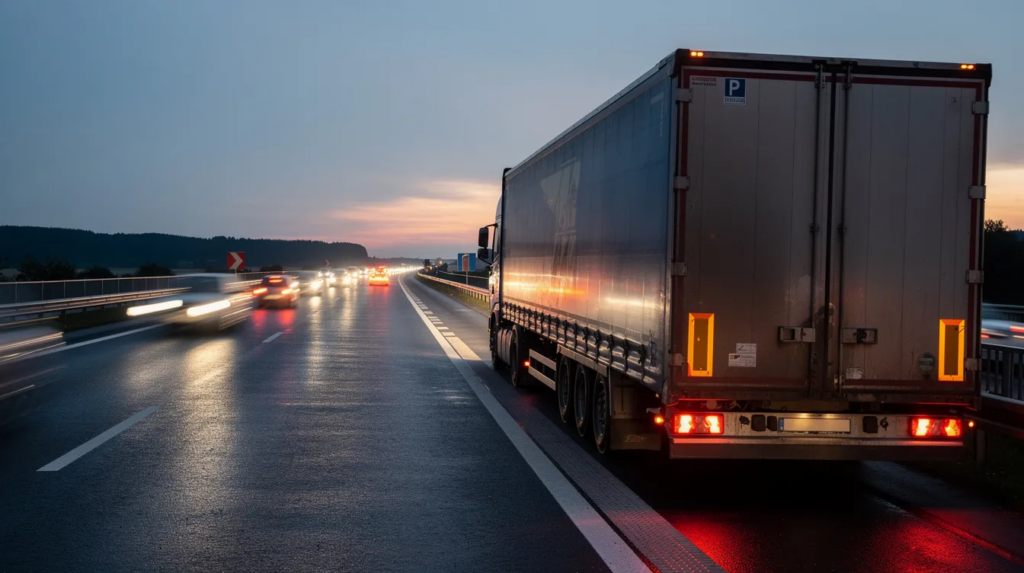
When orange lights suddenly flash on the motorway, every second counts. For drivers of heavy commercial vehicles from 7.5 t, the right reaction to hazard warning lights can mean the difference between a safe stop and a serious accident. This article explains what hazard warning lights can indicate, what the German StVO (road traffic regulations) requires, and how truck drivers should react correctly.
Key Takeaways (Summary)
- German driving test question 1.1.07-010 asks specifically: what can hazard warning lights indicate? The correct answer is: a traffic jam, broken-down vehicles, and school buses where children are boarding or getting off.
- Hazard warning lights warn of broken-down vehicles, signal a traffic jam, and are used to indicate school buses.
- For trucks from 7.5 t, reacting correctly is especially important. The braking distance of a 40-tonne truck at 80 km/h can exceed 70 metres. Every second of attention counts.
- Ignoring hazard warning lights can cause rear-end collisions and leads to fines and points under German traffic law.
- Lkwhelp24 organises breakdown assistance, mobile tyre service and towing exclusively for commercial vehicles from 7.5 t throughout Germany.
Introduction: What Can Hazard Warning Lights Indicate?
Hazard warning lights are a signal in which all direction indicators of a vehicle flash at the same time. It looks as if all indicators are active at once – left and right, front and back.
The question “What can hazard warning lights indicate?” comes directly from the German driving school question catalogue (question 1.1.07-010, category hazard awareness). The correct answer in the theory test is:
- School buses where children are boarding or getting off
- A traffic jam
- Broken-down vehicles
This answer is not only relevant for exam questions. For truck drivers on the motorway and federal highways, this knowledge is vital for survival. A 40-tonne truck needs considerably more space to brake than a car. Anyone who spots hazard warning lights too late risks a serious accident.
This article is written specifically from the perspective of truck and bus drivers from 7.5 t. It explains theory and practice, shows typical hazardous situations and gives clear recommendations for action in road traffic.
Legal Basis: The Meaning of Hazard Warning Lights Under the StVO
The legal rules on hazard warning lights are set out in the German road traffic regulations, above all in §§ 15, 15a and 16 StVO. Among other things, these sections govern behaviour during breakdowns, towing, and hazards in traffic.
What does switched-on hazard warning lights fundamentally mean?
- It always indicates a particular danger or an obstacle in road traffic.
- It is a signal that demands caution – not normal communication like a simple indicator.
- On trucks and buses, at least four indicator lamps work at the same time, often even more lamps on trailer and cab.
- Anyone who sees a vehicle with hazard warning lights on must significantly reduce speed and be ready to brake.
Ignoring this duty violates the StVO and can lead to a fine and a point on the German driving licence register (Flensburg). In serious cases, higher penalties are possible, especially if someone is endangered.
Typical Situations: When May and Must Hazard Warning Lights Be Switched On?
Hazard warning lights may only be used in genuinely dangerous situations. The most important cases at a glance:
- End of a traffic jam: Traffic suddenly comes to a stop. Switch on hazard warning lights to warn following road users.
- Accident scene: Damaged vehicles block the carriageway. The hazard lights signal the danger.
- Breakdown: Engine damage, tyre blowout, faulty air suspension. The vehicle cannot continue. Activate hazard warning lights immediately.
- Sudden obstacle: Lost cargo, wildlife crossing, debris on the lane.
- Towing: Both vehicles must use hazard warning lights.
An important point: on modern vehicles, hazard warning lights are activated automatically after heavy braking. Many current trucks have emergency brake assist systems that switch on the hazard warning lights automatically during full braking.
Despite this automation, the driver always bears responsibility. They must switch the system on manually when needed and switch it off again once the danger has passed. Unnecessary flashing confuses other drivers and other road users and is prohibited.
What Can Hazard Warning Lights on Other Vehicles Specifically Indicate?
The signal can have different meanings depending on the situation. Here are the most important traffic situations in which you, as a truck driver, will encounter flashing vehicles:
Traffic jam: Hazard warning lights indicate the end of a traffic jam or heavily slowed traffic. This is a common sight, especially on motorways. Easing off the accelerator and increasing distance is the correct reaction.
Broken-down vehicles: A stationary truck, bus or car on the traffic lane or hard shoulder shows through hazard warning lights that it can no longer move. This vehicle is an obstacle that must be driven around.
Accident scenes: Damaged vehicles, fluids on the carriageway or blocked lanes are often additionally marked with hazard warning lights.
School buses and public buses: When a bus is stopped at a stop with its hazard warning lights on, passengers are boarding or getting off. For school buses, this means children are in the area of the road. Maximum attention is required.
School Buses and Public Buses: Children Boarding or Getting Off
Particularly strict rules apply in Germany for buses carrying children. On school buses, hazard warning lights may be switched on while children are boarding or getting off. The road traffic authority orders this for certain stops – for example near schools.

What must truck drivers do?
- Pass a bus with flashing hazard warning lights only at walking pace. That means roughly 4 to 7 km/h.
- Keep as much side clearance as possible.
- Overtaking a stopped school bus with hazard warning lights on is generally prohibited or very strictly limited.
- Oncoming traffic must also drive at walking pace if there is no physical median separation.
Violations are especially expensive. High fines and a point in Flensburg are the consequence. Children react unpredictably – they can suddenly run across the road without watching the traffic. A truck driver must expect this behaviour at all times.
Broken-Down Vehicles: A Danger Signal on Motorways and Country Roads
Broken-down vehicles are especially dangerous for trucks. The high weight and long braking distance make quick evasive manoeuvres almost impossible.
Hazard warning lights are activated when a vehicle stops in a poorly visible location. A stationary truck with hazard warning lights on the carriageway or hard shoulder must always be regarded as an acute danger.
Here is how to react correctly:
- Brake in good time as soon as you see the flashing lights.
- Increase your distance to the obstacle.
- Only change lanes with a clear overview and your indicator set.
- Never stop in the lane behind the stationary vehicle.
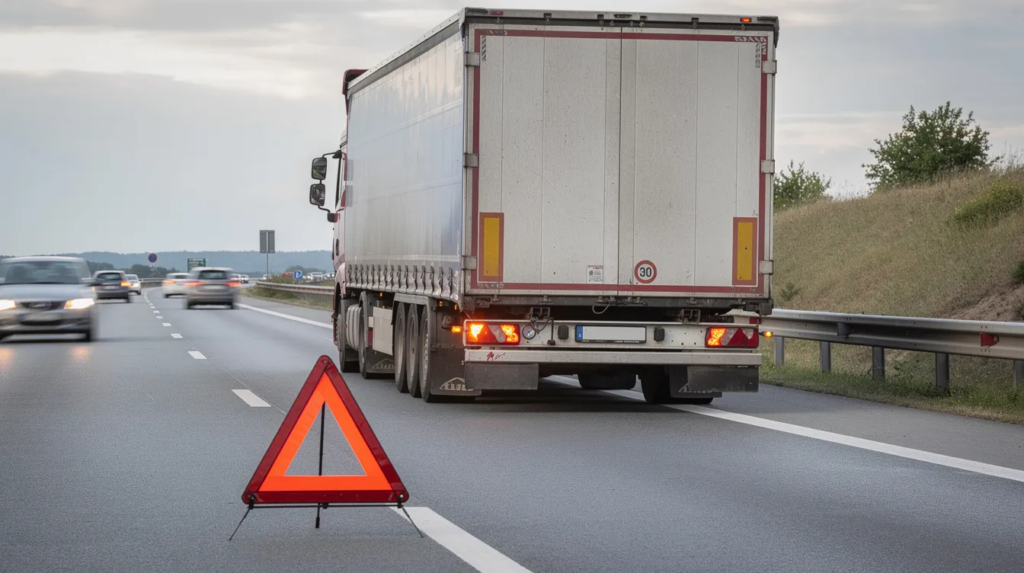
If you break down yourself with your truck, secure the vehicle immediately: switch on hazard warning lights, put on a high-visibility vest, and place a warning triangle at a sufficient distance. On the motorway, that is at least 100 metres behind the vehicle.
In such breakdown situations, Lkwhelp24 breakdown assistance is available around the clock in Germany for commercial vehicles from 7.5 t.
Hazard Warning Lights at the End of a Traffic Jam and in Heavily Slowed Traffic
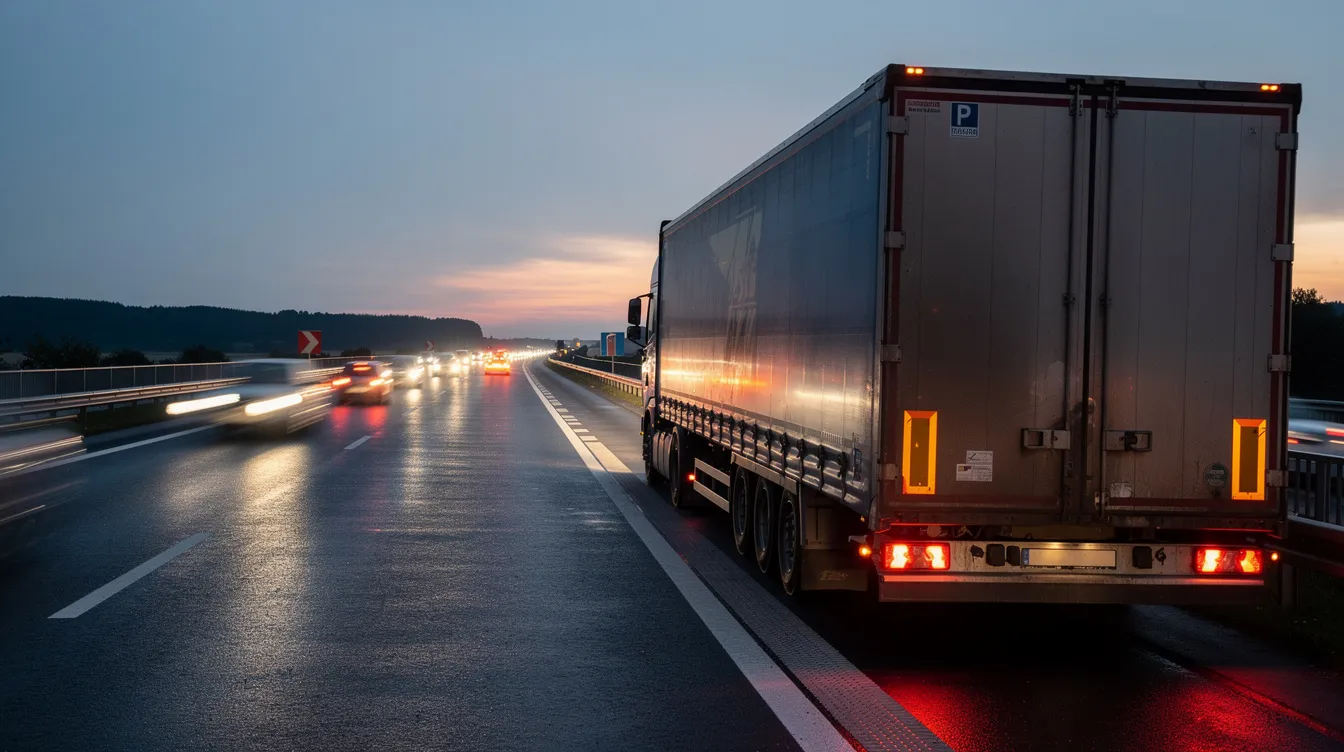
The end of a traffic jam is one of the most dangerous spots on the motorway. Rear-end collisions involving trucks regularly cause severe damage and injuries. Hazard warning lights signal a traffic jam and warn following road users.
Under § 16 StVO, hazard warning lights may be switched on at the end of a traffic jam to warn following traffic. This is not a legal obligation, but it is strongly recommended.
Practical tips for truck drivers:
- Switch on your hazard warning lights early as soon as traffic is visibly braking sharply.
- Reduce speed promptly and evenly.
- Significantly increase your distance to the vehicle ahead.
- Form an emergency corridor immediately – as a truck, keep as far right as possible.
- Check your mirrors to see whether following vehicles are also reacting.
Other drivers must react to flashing vehicles and brake as well. In this context, hazard warning lights are a warning that can save lives.
Hazard Warning Lights During Breakdowns and Towing of Trucks
A truck breakdown on the motorway is a typical exceptional situation. Hazard warning lights must be switched on immediately if the vehicle can no longer be moved safely.
When is switching them on mandatory?
- In the event of a tyre blowout, engine damage, or fuel problems
- In the event of brake system or air suspension failure
- With any defect that turns the truck into an obstacle
During towing, both vehicles must switch on hazard warning lights – both the towed and the towing vehicle. This is clearly regulated in § 15a (3) StVO. For more information on the rules for towing, see the article What to Watch Out for When Towing a Vehicle?
An important technical point: when hazard warning lights are running, they override the normal indicators. This means the direction indicator for turning does not work. When turning, drivers must then signal using hand signals or an agreed-upon manoeuvre.
Practical tip: in the event of a breakdown, contact a reputable breakdown service for commercial vehicles from 7.5 t. Lkwhelp24 arranges vetted service partners across Germany and can be reached via WhatsApp at +49 160 575 3826.
Misuse of Hazard Warning Lights: What Is Prohibited?
Unnecessary flashing is itself a danger. Other road users can misread the wrong signal and brake or swerve unnecessarily.
Typical prohibited uses:
- Double-parking with hazard warning lights on – this is not legal parking.
- Loading or unloading in a no-stopping zone with hazard warning lights on.
- Using them as a “parking permit” in front of shops or on squares.
Switching on hazard warning lights does not legalise unlawful stopping. This rule is often misunderstood. Anyone who misuses hazard warning lights must expect fines and, in some cases, points.
Hazard warning lights are intended exclusively as a warning of real dangers – not for convenience.
For professional drivers in particular: incorrect use can also cause problems with an employer and insurer. If it is established after an accident that the hazard warning lights were misused, this can affect the question of fault.
Special Traffic Situations: How to React Correctly to Hazard Warning Lights
The question “What can hazard warning lights indicate?” is always linked to “How do I react correctly?”
The general procedure when you spot hazard warning lights:
- Perceive: Recognise flashing lights and immediately increase your attention.
- Reduce speed: Ease off the accelerator, brake in a controlled way.
- Increase distance: Create more space to the vehicle ahead.
- Readiness to brake: Keep your foot over the brake pedal.
Extra caution is needed in:
- Darkness, rain, snow or fog
- Roadworks and tight bends
- Motorway exits, where flashing vehicles become visible late
This is especially true for truck drivers: anticipatory driving and regular mirror checks prevent secondary accidents. The reaction must come earlier than in a car, because the braking distance is significantly longer.

Hazard Warning Lights on Buses and School Buses in Detail
Buses may or must use hazard warning lights when approaching a stop and while stationary at it. This is separately regulated in § 20 StVO.
School buses with hazard warning lights on are a clear sign: children are in the area of the carriageway. School buses where children are boarding or getting off require maximum care from all road users.
Rules of conduct summarised once more:
Situation | Correct behaviour |
|---|---|
Bus approaching a stop with hazard warning lights on | Do not overtake |
Bus stationary with hazard warning lights on | Walking pace only (4–7 km/h) |
Oncoming traffic, no median separation | Walking pace as well |
Children visible on the carriageway | Stop immediately |
Violations lead to high fines and points. Anyone who drives past a school bus too fast risks not only penalties but the lives of children.
For international drivers, it is important to know: this rule is stricter in Germany than in some other European countries. This traffic situation appears regularly among the exam topics for the German driving licence.
Retrofit Requirements and Technical Details of Hazard Warning Lights
In Germany, every vehicle in road traffic must have a working hazard warning light system. This also applies to older commercial vehicles and even to a classic car taking part in regular traffic.
Older trucks and buses often had hazard warning lights retrofitted. Today, hazard warning lights count as mandatory lighting under the German vehicle registration regulations (StVZO).
The technical principle is simple: a single shared switch activates all indicators at the same time. The warning lamp on the dashboard shows a red or orange triangle symbol. On trucks, the switch is usually easily reachable in the centre of the dashboard.
The function of the hazard warning lights should be checked before setting off – especially before long tours. A faulty hazard warning light can become a serious problem at the next inspection or in the event of a breakdown.
Defects in the system should be fixed promptly. If you notice a defect while on the road, you can get help via a mobile workshop service for trucks, without having to drive to a stationary workshop.
What Truck Drivers Should Do During a Breakdown with Hazard Warning Lights On
This step-by-step guide is deliberately kept simple:
Step 1: Steer the vehicle onto the hard shoulder or another safe spot if possible.
Step 2: Switch on hazard warning lights immediately.
Step 3: Put on a high-visibility vest before leaving the cab.
Step 4: Leave the vehicle on the side away from traffic. Get out towards the crash barrier side.
Step 5: Set up the warning triangle. Distances:
- Motorway: at least 100 metres behind the vehicle
- Country road: about 50 to 100 metres
- Built-up areas: about 15 to 50 metres
Step 6: Determine your location. Use your phone for GPS coordinates. Look for the kilometre marker or the next exit.
Step 7: Call breakdown assistance. Send your location via WhatsApp.
Important: People must always wait behind the crash barrier. Never stand in front of or behind the truck on the carriageway. Following vehicles may not see your truck in time.
What Breakdown Services Exist for Trucks
There are four main groups of breakdown services for commercial vehicles:
Type | Characteristics |
|---|---|
Automobile clubs | Membership required, contractual commitment, sometimes also for company fleets |
Manufacturer service | Tied to new vehicles or maintenance contracts, brand-specific, limited coverage areas |
Independent mobile services | Local companies with their own tow trucks or workshop vehicles |
Brokers | Organise breakdown assistance via vetted partners, nationwide coverage |
Lkwhelp24 belongs to the broker category. We organise breakdown assistance and towing around the clock via vetted partners throughout Germany – specifically for trucks and buses from 7.5 t. Lkwhelp24 has no workshops or tow trucks of its own, but coordinates the response through a network of experienced service partners.
What the Driver Should Provide When Calling a Truck Breakdown Service
Clear information on the phone secures the right help and shortens response time. The driver should have this information ready:
Location:
- Motorway number and direction of travel
- Kilometre marker or next exit
- Rest area name (if applicable)
- GPS coordinates or location sent via WhatsApp
Vehicle:
- Number plate
- Vehicle type (articulated truck, solo truck, bus)
- Total weight
- Body type (curtain-sider, refrigerated trailer, tanker)
Additionally for a tyre blowout:
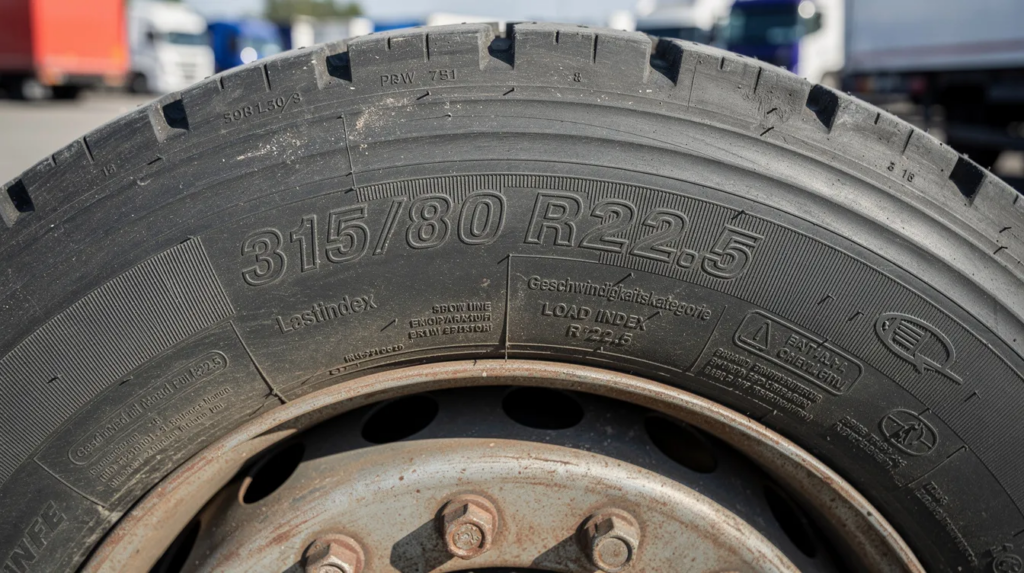
- Tyre size (e.g. 315/80 R22.5)
- Affected axle (steering axle, drive axle, trailer axle)
- Single or twin tyre setup
- Photo of the damage via WhatsApp
Description of the damage: In simple terms: engine defect, air suspension, electrical fault, accident, tyre blowout.
What Cost Factors Are Involved in Truck Breakdown Assistance
The cost of truck breakdown assistance depends on several factors. The price should always be confirmed by phone or WhatsApp before the callout.
Main factors:
- Time of day: Callouts during the day cost less than at night or on weekends.
- Distance: The distance to the location affects the price.
- Type of breakdown: Tyre replacement, jump-starting or towing have different costs. See our separate article on towing costs.
- Duration: Waiting times, traffic jams or difficult recovery situations affect the total price.
With mobile tyre service, the tyre price and mounting materials come on top. In an emergency, the tyre available immediately in the right size is fitted – preferred brands cannot be taken into account in an emergency.
Example prices from Lkwhelp24:
- Mobile tyre service during the day: from €290 net
- Nights and weekends: from €429 net
- Tyres from R17.5: from about €315 net
The fixed price is confirmed by phone before the vehicle sets off. No hidden costs.
How Lkwhelp24 Helps With Breakdowns and Hazard Warning Light Situations
Lkwhelp24 arranges breakdown assistance, mobile truck service and towing for commercial vehicles from 7.5 t throughout Germany. We work with vetted service partners and coordinate the entire response.
Important: We do not serve cars, vans or motorhomes.
Here’s how it works:
- The driver sends their location and photos via WhatsApp to +49 160 575 3826.
- We organise the nearest vetted partner.
- Response time is usually 30 to 60 minutes, depending on the location.
- Communication in German, English, Polish and Russian.
In the event of a tyre blowout, breakdown, or a truck stuck with hazard warning lights on the motorway or at a rest area: get in touch immediately. WhatsApp is the fastest route. Phone as a fallback option. If a sudden tyre blowout on the motorway forces an emergency wheel change, the same rule applies: secure the vehicle first, then call.
Lkwhelp24 – your breakdown assistance for trucks from 7.5 t. 24 hours, 7 days a week, throughout Germany.

Conclusion
What can hazard warning lights indicate? A traffic jam, broken-down vehicles, and school buses where children are boarding or getting off. For truck drivers from 7.5 t, every flashing signal on the road means: increase attention immediately, reduce speed and be ready to brake.
The meaning of hazard warning lights in road traffic goes far beyond an exam question. They protect lives – those of children at bus stops, of stranded drivers at the roadside, and your own.
If you break down with hazard warning lights on the motorway: secure your vehicle, put on your high-visibility vest and contact Lkwhelp24 via WhatsApp. We organise the rest.
FAQ on Hazard Warning Lights and Truck Breakdowns
What Can Hazard Warning Lights in Road Traffic Indicate?
Hazard warning lights can indicate a traffic jam, broken-down vehicles, and school buses where children are boarding or getting off. In general, they signal any particular hazardous situation or a sudden obstacle on the carriageway. This answer corresponds to the official exam question 1.1.07-010 from the question catalogue.
Am I Allowed to Pass a School Bus With Hazard Warning Lights On in Germany?
A stationary school bus with hazard warning lights on may be passed at walking pace at most – roughly 4 to 7 km/h. Overtaking is generally not permitted. Violations are punished with high fines and points. This rule applies to both directions of travel if there is no physical median separation.
Do I Always Have to Switch On My Hazard Warning Lights During a Truck Breakdown?
Yes, hazard warning lights must be switched on immediately for any breakdown where the vehicle poses a danger or an unexpected obstacle. This applies especially on motorways and country roads, when the truck stops or can only drive very slowly. A warning triangle and high-visibility vest must also be used.
Does Lkwhelp24 Also Help if I Break Down in a Car?
No. Lkwhelp24 supports exclusively commercial vehicles and buses from 7.5 t.
How Quickly Can Lkwhelp24 Be On-Site for a Breakdown With Hazard Warning Lights On?
Response time is usually 30 to 60 minutes, depending on location and current traffic conditions. The exact price and expected arrival time are confirmed by phone or WhatsApp before the callout. Contact: +49 160 575 3826 (WhatsApp preferred).