Skip to content
 A broken-down truck on the motorway is no small matter. Unlike a car, we’re talking about several tonnes of weight, often valuable cargo, and specific legal requirements that apply when towing a heavy goods vehicle. Drivers, dispatchers and fleet managers who know what matters can save valuable time in an emergency – and avoid unnecessary risks to themselves and others. This article summarises what really counts when towing a truck in Germany.

When is a truck actually allowed to be towed?
As a rule: towing is only permitted when a technical fault means the vehicle can no longer drive under its own power. This is set out clearly in Section 15 of the German Road Traffic Regulations (StVO). A vehicle that is still roadworthy but needs to be moved for other reasons doesn’t fall under this rule – in that case, regular transport on a low-loader or car transporter is the correct solution.
In practice, this means: before towing begins, it’s always worth briefly checking whether a genuine fault is actually preventing the vehicle from continuing. If in doubt, a call to a professional breakdown service helps – an on-site assessment always beats any remote diagnosis.
The key legal requirements at a glance
Clear rules apply when towing a truck in Germany, and they are notably stricter than for cars. Knowing them helps you avoid fines and, more importantly, dangerous situations in moving traffic.
- Maximum speed: As a general rule, 50 km/h must not be exceeded while towing, regardless of whether you’re on a country road or a motorway.
- Hazard lights: Both the towing vehicle and the towed vehicle must have their hazard lights switched on for the entire process.
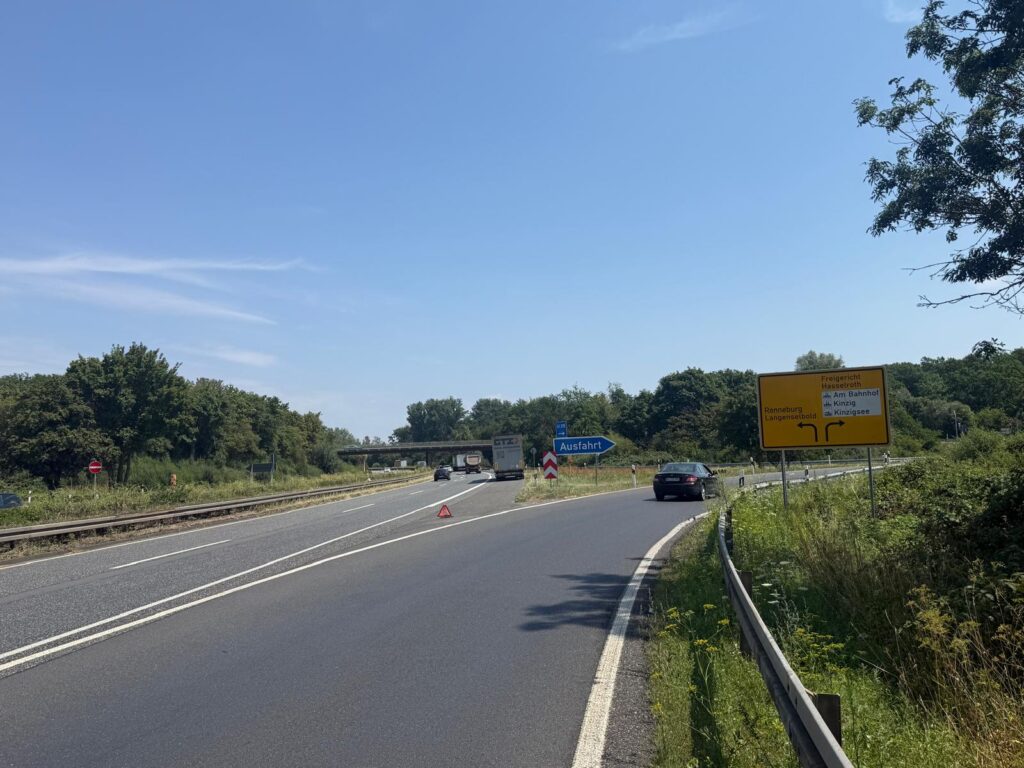
- Motorways: On the motorway, towing is generally only permitted as far as the next exit or the next rest area. Stopping in the middle of the carriageway creates a serious hazard.
- Connecting equipment: Tow ropes, tow bars or rigid connections must be rated for the total weight of the truck and attached only at the reinforced towing points provided for this purpose – never to bumpers or other unsuitable components.
- Securing the breakdown or accident scene: A warning triangle, high-visibility vest, and, if necessary, additional safety cones are mandatory, especially in poor visibility or on heavily trafficked routes.
Important to know: if a truck is towed on the motorway, this is only permitted as far as the next exit. For longer distances, transport on a low-loader is required instead. If you’re unsure whether towing or loading is the correct approach in a specific case, it’s best to contact a specialised breakdown service, which makes that call based on the situation on site.
Why towing a truck is different from towing a car
A loaded semi-truck can weigh up to 40 tonnes. A standard car towing service is built to handle a maximum of 3 to 5 tonnes – so that kind of equipment is never enough for a truck. Heavy commercial vehicles require specialised heavy-duty tow trucks, equipped with:
- winches with a pulling force of at least 20 tonnes,
- reinforced tow bars and attachment points rated for the truck’s total weight,
- and a trained team that knows the construction of trucks, semi-trucks and articulated combinations inside out.
With semi-trucks, there’s an added complication: the connection between the tractor unit and the trailer. Depending on the situation, it may be necessary to uncouple the trailer first before moving the tractor unit. An experienced recovery driver always makes this decision only after a careful on-site assessment – there’s no one-size-fits-all solution here.
Cargo also plays a role. Hazardous goods, refrigerated cargo or bulky freight place additional demands on the recovery process. A professional provider takes this into account from the start and plans the operation accordingly.
Safety comes first
Towing a truck on the motorway or a busy road carries a real risk of rear-end collisions. That’s why safety always takes priority over speed. The following points are essential:
- Keep hazard lights switched on continuously on both vehicles.
- Wear a high-visibility vest as soon as you leave the cab – even for quick tasks.
- Maintain a sufficient safety distance from moving traffic while the connection is being made.
- Use additional warning lights or flashers in darkness or poor visibility.
- Agree on communication between driver and recovery team before starting – who gives which signals, who’s responsible for which task.
The ADAC regularly points out that a large share of accidents connected to breakdowns and recoveries stem from inadequate securing of the incident site. For heavy commercial vehicles, this warning applies with particular force, since the reaction times and braking distances of following traffic on motorways are considerably longer than in urban traffic.
Choosing the right truck breakdown provider
Not every towing service specialises in heavy commercial vehicles. When choosing a truck breakdown provider, it’s worth looking at the following criteria:
- Equipment: Does the provider have heavy-duty tow trucks and winches suited to your vehicle’s weight?
- Availability: Is the service genuinely reachable around the clock, including nights, weekends and public holidays? Truck drivers are on the road at all hours – a breakdown doesn’t respect office hours.
- Response time: How quickly can a recovery vehicle be on site? On the motorway especially, every minute counts.
- Experience with semi-trucks and articulated combinations: Not every operator has the necessary routine handling trailers, refrigerated vehicles or hazardous goods carriers.
- Language support: For international drivers and haulage companies, it helps enormously if communication is possible in several languages – this significantly reduces misunderstandings in an already stressful situation.
- Coordination of next steps: A good provider doesn’t just organise the tow itself, but also transport to a suitable workshop actually capable of repairing vehicles of this size.
A proper on-site assessment – for instance by specialist inspection bodies such as TÜV afterwards, in the case of safety-relevant damage – can also help clarify whether a vehicle is actually roadworthy again after recovery.
What towing a truck costs
There’s no flat rate for truck recovery costs, since they depend on several factors:
- the distance between the breakdown location and the workshop or destination,
- the time of day – night, weekend and holiday callouts are usually more expensive,
- the weight and type of vehicle, for instance a solo truck versus a semi-truck,
- the complexity of the operation, for example recovering a vehicle from a ditch compared to a straightforward tow on a paved road,
- any additional need for a crane, cargo securing or a replacement vehicle.
It’s worth asking for a transparent cost estimate before commissioning a job, and clarifying whether some of the cost can be covered by assistance insurance, a fleet policy or a manufacturer warranty. Reputable providers are upfront about the expected price range before the job begins.
Checklist: your truck has broken down – what now?
First: secure the vehicle. Switch on the hazard lights, set up a warning triangle, and put on a high-visibility vest before leaving the cab.
Second: assess the situation. Is the vehicle on the hard shoulder, in the middle of the carriageway, or in an especially dangerous position? This information is crucial for the response team.
Third: call breakdown assistance. Provide your location, vehicle type, total weight and a brief description of the problem. The more precise the details, the more targeted the help can be.
Fourth: keep cargo documents and paperwork ready. Freight papers, vehicle registration and proof of insurance are often needed, especially if the police are on scene or a workshop change is coming up.
Fifth: don’t attempt improvised solutions. Trying to move a multi-tonne vehicle with unsuitable equipment usually only causes further damage – to the vehicle and, in the worst case, to people.
LKW Help 24 – your partner for truck breakdowns in Germany
We specialise in breakdown assistance and recovery for heavy commercial vehicles – semi-trucks, solo trucks, buses and construction machinery. Our team is available 24 hours a day, 7 days a week, with support in several languages. We know the legal requirements, have the right equipment, and coordinate every operation from the first call to the vehicle’s safe arrival at the workshop.
If your truck has broken down in Germany – give us a call. We take care of the coordination, so you don’t have to worry about your cargo or your schedule on top of everything else.
Search terms: truck towing, towing regulations Germany, truck breakdown assistance, semi-truck recovery, towing service for commercial vehicles, 24-hour truck help, truck towing cost, motorway towing rules for trucks.