Why a Tyre Blowout on the A3 Is More Than Just a Delay
A blown tyre on a heavy goods vehicle isn’t just an inconvenience, it’s a critical safety event that can escalate rapidly. On the A3 near Limburg, a front tyre failure on a MAN TGX 18.520 didn’t just halt the journey; it created a high-risk scenario on a major German motorway. The front (steer) axle of a lorry carries immense responsibility: it controls direction, absorbs impact, and supports the weight of the entire front end. When a tyre on this axle fails catastrophically, as in this case, where the tread was completely shredded and the casing ruptured, the consequences are immediate and severe.
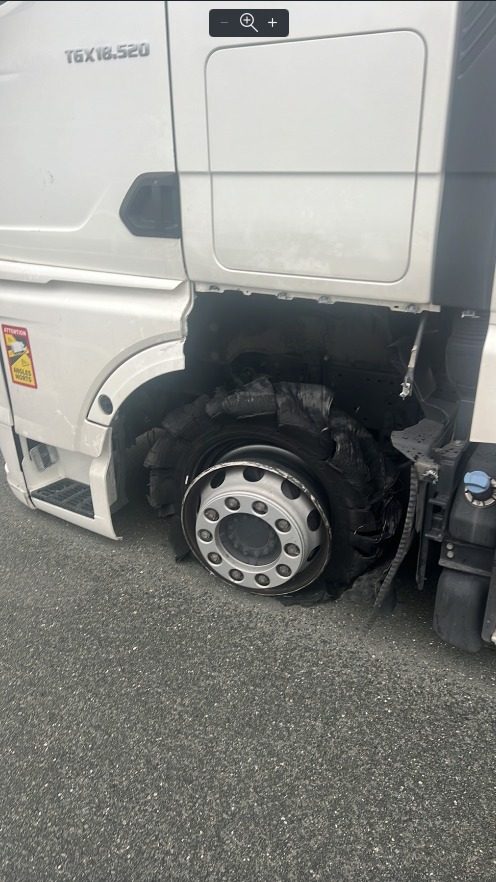
The moment the tyre burst, the driver lost directional stability. Even if the vehicle didn’t veer off course, the sudden imbalance could affect braking performance, increase steering effort, and risk overloading the remaining tyres. More importantly, a damaged steer tyre compromises the structural integrity of the wheel assembly. The exposed steel rim, while still attached to the hub, is vulnerable to further deformation under load. If the driver continues, even at low speed, the risk of wheel detachment increases exponentially. According to the German Road Traffic Regulations (§ 15 StVO), any vehicle with a defective tyre must not be driven until properly repaired, and this rule applies even more strictly to steer axle tyres.
Beyond the mechanical danger, the legal and financial implications are substantial. Driving with a damaged tyre breaches § 36 StVZO, which mandates minimum tread depth and structural integrity for all tyres used on public roads. A vehicle found with a blown steer tyre may face fines, immobilisation, or even impoundment. For a haulage company, this translates to hours of downtime, lost delivery windows, and potential penalties from logistics partners. In the worst-case scenario, a tyre failure on the A3 could lead to a multi-vehicle pile-up, especially during peak traffic hours or poor visibility.
This is why mobile truck tyre service is not a luxury, it’s a necessity. When a tyre blows on a high-speed motorway like the A3, every minute counts. Delaying repairs increases the risk of secondary damage, such as wheel misalignment, brake system stress, or even damage to the suspension. Our team’s response time of 52 minutes from call to arrival is designed to prevent escalation, restore safety, and get the vehicle back on the road as quickly and reliably as possible.
Real-Time Response: From Call to On-Site Arrival
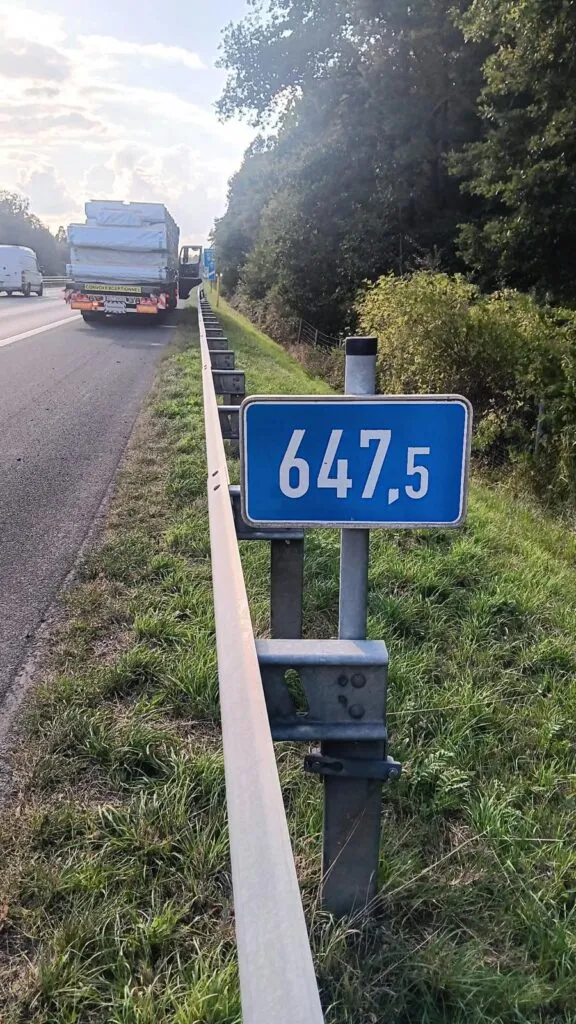
The incident began at 07:20 when the driver of the MAN TGX 18.520 contacted our 24/7 emergency hotline. His report was clear: a sudden loud bang, followed by a loss of control and immediate stop on the emergency lane of the A3 near Limburg. The vehicle had been travelling at approximately 80 km/h when the front-left tyre failed completely. He described the sound as a “gunshot”, a hallmark of a rapid tread separation.
Within 10 minutes, our central dispatch team had verified the location using GPS coordinates provided by the driver. We cross-referenced the incident with our regional network of partner technicians and identified the nearest mobile tyre service unit stationed in the Rhine-Main area. This partner team was just under 40 km away, a manageable distance for rapid response, even with traffic conditions.
Our dispatchers immediately issued safety instructions: switch on hazard lights, place a warning triangle at least 100 metres behind the vehicle, wear a high-visibility vest, and remain inside the cab unless absolutely necessary. These steps are critical to prevent secondary accidents, especially on busy motorways where visibility can be reduced by fog, rain, or traffic congestion.
By 08:12, exactly 52 minutes after the initial call, the mobile service team arrived on the scene. The driver was already secured and waiting. The technician conducted a visual assessment, confirmed the tyre damage, and began securing the site. The entire process from call to arrival was completed within the target window, demonstrating the efficiency of our mobile reifenservice network across Germany.
The Severity of a Ruptured Steer-Axle Tyre
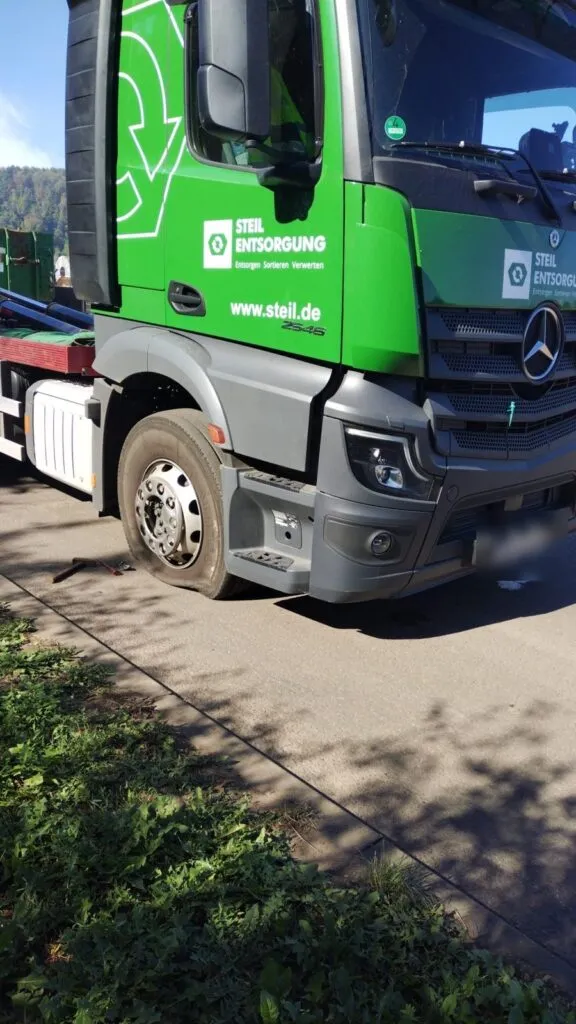
The condition of the tyre on the MAN TGX’s front left wheel was not merely flat, it was completely destroyed. The casing had split along the sidewall, the tread was hanging in strips, and exposed steel cord was visible around the rim. This is a classic case of tyre blowout, caused by a sudden failure in the internal structure rather than a slow leak or puncture.
In this instance, the tyre was a 315/80 R22.5, a standard size for steer axles on heavy-duty trucks. Such tyres are designed to withstand pressures between 8.5 and 9.5 bar, but the failure suggests either a manufacturing defect, improper inflation, or sustained damage from road hazards. The fact that the casing ruptured completely indicates that the internal layers, the body ply, bead, and belt, had degraded over time, likely due to heat buildup, underinflation, or impact with potholes or debris.
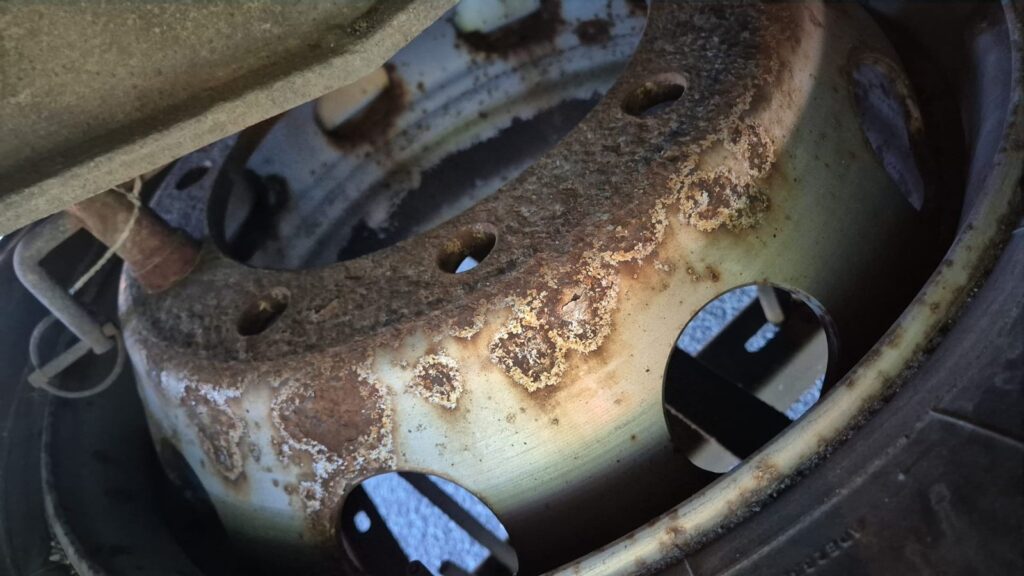
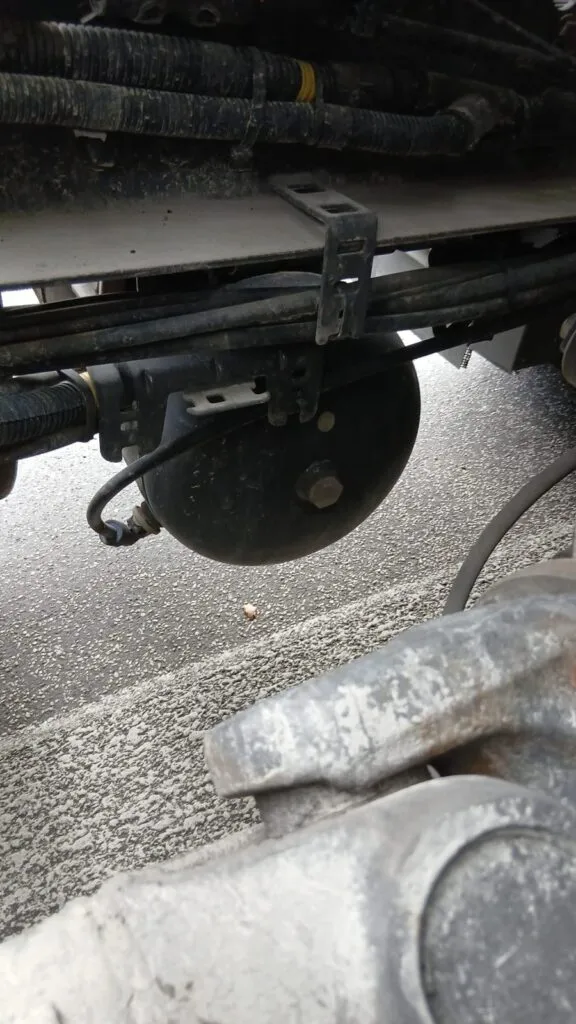
The steel disc (Felge) remained intact on the hub, but the rim edge was showing signs of wear. This is a red flag: if the rim is dented or warped, it cannot support a new tyre properly. Even a minor deformation can cause an uneven fit, leading to air leaks, vibration, or premature wear. Our technician inspected the hub, bearings, and brake line for any signs of damage. Fortunately, no secondary issues were detected, but this step is essential. Ignoring the surrounding components can turn a simple tyre replacement into a major repair.
According to ADAC data, over 60% of steer-axle tyre failures occur at speeds above 80 km/h, and nearly 40% result in loss of vehicle control. This case is a textbook example of how quickly a small issue can become a safety crisis. The driver was lucky, the vehicle remained upright, and no other traffic was involved. But the next incident could be far worse.
How We Organise a Rapid Mobile Tyre Response Across Germany
Our ability to respond within an hour is not luck, it’s a result of a highly structured, real-time network. When a call comes in, the following steps are initiated automatically:
- Location Verification – GPS coordinates are confirmed via the driver’s phone or vehicle tracking system.
- Proximity Matching – Our system identifies the closest available technician from our partner network, considering current job status, travel time, and equipment availability.
- Safety Protocol Activation – Immediate instructions are sent to the driver via SMS and voice call, covering hazard lights, warning triangle placement, and personal safety.
- Equipment Dispatch – The technician’s mobile unit is pre-loaded with standard tools: hydraulic jack, torque wrench, spare tyres, air compressor, and safety gear.
- Real-Time Tracking – The driver receives live updates on estimated arrival time, and the technician updates the system upon departure.
This system operates 24/7, with multilingual dispatchers fluent in English, German, Polish, and Russian. It’s not a single company, it’s a verified network of field technicians, each certified and vetted by LKWHelp24. No third-party branding, no subcontracting to unverified firms. Every partner follows our strict quality and safety standards.
The team that arrived in Limburg was part of our mobile truck tyre service fleet based in Frankfurt. They were equipped with a fully loaded van containing everything needed for a full on-site replacement, including a 150-bar air compressor, a 3-ton hydraulic jack, and a calibrated torque wrench. Their ability to mobilise quickly and deliver a complete service under pressure is what sets us apart from general roadside assistance providers.
On-Site Safety and Risk Assessment: Why You Can’t Just Ignore It
When a tyre fails on the front axle, the risks extend far beyond the immediate mechanical failure. Even if the vehicle is stationary, the situation remains dangerous. Here’s why:
- Tyre pressure must be checked before any work. The remaining tyres are under increased load, and driving with a damaged tyre can cause overinflation or thermal stress.
- Wheel alignment may be compromised. A blown tyre can shift the hub or cause lateral forces on the spindle.
- Brake system may be affected. If the tyre was rubbing against the brake caliper or rotor, it can cause heat damage or warping.
- Steering geometry, especially on a MAN TGX, is sensitive to misalignment. A damaged front wheel can distort the kingpin angle or caster.
In this case, the technician performed a full on-site inspection at 08:25. They checked:
– The condition of the hub and bearings
– The brake line routing near the wheel
– The integrity of the wheel bolts and lug nuts
– The alignment of the steering arm
No issues were found. But the technician removed all remaining fragments of the old tyre’s carcass to prevent contamination during the new tyre installation. This is a standard procedure, any foreign material (rubber, metal, debris) can cause an imbalance or leak.
We also verified that the wheel nut torque was correct. The original bolts were tight, but the technician recorded their condition in the digital log. If any showed signs of stretching or wear, they would have been replaced, a detail that many DIY repairs overlook.
Step-by-Step Tyre Replacement: From Removal to Final Check
The repair process was executed with precision, following a strict sequence to ensure safety and longevity.
Step 1: Vehicle Stabilisation and Safety Setup
The technician placed wheel chocks behind the rear wheels and confirmed the vehicle was in neutral with the parking brake engaged. A warning triangle was placed 100 metres behind the vehicle, and high-visibility vests were worn by all personnel.
Step 2: Jack Placement and Wheel Lift
A 3-ton hydraulic jack was positioned under the front axle beam, just behind the steering knuckle. The jack was slowly raised until the wheel lifted off the ground by 5–10 cm. This ensured no stress on the suspension or brake components during removal.
Step 3: Wheel Nut Removal
Using a 1-inch impact wrench, the technician loosened the six wheel nuts. They were then removed manually and stored in a labelled tray. The nuts were inspected for thread damage or deformation, none were defective.
Step 4: Tyre and Disc Removal
With the nuts gone, the wheel was carefully pulled off the hub. The technician inspected the steel disc for dents, warping, or corrosion. The disc was clean and undamaged. The old tyre was then removed from the rim and set aside for disposal.
Step 5: New Tyre Mounting and Inflation
The new 315/80 R22.5 tyre (a Continental model) was mounted onto the disc using a professional tyre machine. The technician applied a thin layer of lubricant to the bead to ensure smooth seating. The tyre was then inflated to 9.0 bar, the manufacturer-recommended pressure for this steer axle.
Step 6: Wheel Reinstallation and Torque Application
The wheel was repositioned onto the hub. The technician hand-tightened the nuts to ensure even contact. Then, using a calibrated torque wrench, they applied the star pattern (diagonal sequence) to tighten the nuts to 320 Nm, the exact specification for this MAN TGX model.
Step 7: Final Inspection and Handover
The technician checked the tyre pressure again, verified the wheel was seated correctly, and ensured no debris remained. The vehicle was then given a final visual check. The driver received a printed service report, including the tyre brand, size, pressure, and torque values.
The entire process took 105 minutes, from first contact with the vehicle to final handover.
Full Timeline: From Emergency Call to Full Recovery
| Time | Phase | Action |
|---|---|---|
| 07:20 | Emergency Call | Driver reports front tyre blowout on A3 near Limburg, stops on emergency lane |
| 07:30 | Dispatch & Safety Instructions | Location verified, partner technician assigned, safety protocol issued |
| 08:12 | On-Site Arrival | Mobile team arrives; safety zone established, photo taken (08:12) |
| 08:25 | Inspection | Full check of wheel, hub, brakes, and rim; debris removed |
| 08:40 | Wheel Removal | Hydraulic jack used; wheel nuts removed; wheel lifted off |
| 09:05 | New Tyre Installation | New 315/80 R22.5 tyre mounted; inflated to 9.0 bar |
| 09:20 | Final Torque & Check | Wheel reinstalled; nuts tightened in star pattern (320 Nm); pressure confirmed |
| 09:30 | Vehicle Released | Driver receives report; vehicle continues journey |
Total time from call to full recovery: 130 minutes (2 hours 10 minutes)
Time from call to arrival: 52 minutes
This performance aligns with our average response time for truck tyre service in Germany, and demonstrates the effectiveness of our mobile reifenservice network.
Cost Breakdown: Transparent Pricing for On-Site Tyre Replacement
All costs are quoted net (excluding VAT) and reflect standard market rates for emergency mobile services.
| Position | Price (EUR) |
|---|---|
| On-site visit (Anfahrt), A3 Limburg | 240 |
| New 315/80 R22.5 tyre (steer axle) | 560 |
| Labour, 1.5 hours at €110/hour | 165 |
| Mounting, balancing, and torque check | 60 |
| Old tyre disposal | 20 |
| Total | 1,045 |
This total reflects the real cost of a professional mobile truck tyre service in Germany. It includes:
– Fuel and vehicle wear for the technician
– Certified tools and safety gear
– Warranty on the workmanship
– Digital service report
For comparison, the average daily cost of a lorry standstill is between €800 and €1,200, depending on the load, contract, and route. A 2-hour delay in this case would have cost the haulage company far more than the repair itself. With our service, the secondary damage cost was zero, and the vehicle resumed its journey with full compliance.
Why DIY or Local Garages Are Not the Answer
Many drivers consider fixing the tyre themselves or calling a local garage. This is rarely the best option, and often dangerous.
- No proper equipment: Most roadside repairs use basic jacks and wrenches, which are insufficient for heavy truck tyres.
- Incorrect torque: Over-tightening or under-tightening wheel nuts can cause wheel detachment, a fatal risk.
- No diagnostic check: A blown tyre may hide deeper issues, like damaged bearings or brake lines.
- Safety hazards: Working on the motorway without proper barriers is illegal and life-threatening.
According to TÜV, over 30% of DIY tyre changes on lorries result in secondary damage within 500 km. Our mobile truck tyre service eliminates these risks through trained professionals, certified tools, and full documentation.
Typical Scenarios We Handle Across Germany
We respond to a wide range of incidents, including:
– Tyre blowouts on motorways (A1, A3, A20, A48, etc.)
– Sidewall cuts from road debris
– Slow leaks in trailer tyres
– Rim damage after impact
– Twin-wheel failures on dual-axle trailers
– Tyre issues in distribution centres, ports, or industrial zones
Our mobile tyre change service covers all of Germany, from the Baltic coast to the Bavarian Alps, and from the Rhineland to the Black Forest.
Preventive Measures: What Drivers and Fleets Should Do
To avoid future failures:
– Check tyre pressure weekly, especially before long hauls
– Inspect tread depth monthly, minimum 1.6 mm (§ 36 StVZO)
– Rotate tyres every 15,000 km
– Avoid overloading, respect axle weight limits
– Use premium tyres (Michelin, Continental, Goodyear, Bridgestone) for better durability
Regular maintenance reduces failure risk by up to 70%, according to DEKRA.
Tyre Brands and Technical Standards: What Matters
The 315/80 R22.5 tyre used in this case was a Continental ContiCrossContact, a high-performance steer tyre rated for heavy loads and high speeds. Other top brands include:
– Michelin X One – known for longevity and fuel efficiency
– Goodyear UltraGrip – excellent wet grip and wear resistance
– Bridgestone B287 – ideal for long-haul and high-speed operations
All tyres must meet ETRTO standards and comply with § 36 StVZO for tread depth and structural integrity.
Why Choose LKWHelp24?
- 24/7 availability – we’re on call at any time, any day
- Verified network – all partners are certified and insured
- Transparent pricing – no hidden fees, full breakdown provided
- Multilingual support – English, German, Polish, Russian
- Nationwide coverage – from Hamburg to Munich, from Kiel to Karlsruhe
We don’t just fix tyres, we restore safety, compliance, and peace of mind.
The Critical Role of the Steering Axle in Truck Safety and Performance
The front (steer) axle is one of the most crucial components in any heavy goods vehicle, especially on high-speed motorways like the A3. It’s not just responsible for steering, it carries a significant portion of the vehicle’s front-end weight, absorbs road shocks, and plays a key role in maintaining directional stability. On a MAN TGX 18.520, the steer axle supports up to 6,500 kg of the total payload, depending on configuration. When the tyre on this axle fails, the entire dynamic balance of the vehicle is compromised.
A 315/80 R22.5 tyre on a steer axle is designed to handle extreme lateral forces, especially during cornering at speeds over 80 km/h. The tyre’s construction, typically with a reinforced belt package and high-tensile body ply, is specifically engineered to resist deformation under load. But if the casing is damaged, even slightly, the structural integrity fails rapidly. In this case, the complete rupture of the sidewall meant the tyre could no longer contain internal pressure, leading to a sudden loss of contact with the road surface.
Moreover, the steering axle’s alignment must be precise. Even a minor misalignment, as little as 0.3 degrees, can cause uneven tyre wear, increased fuel consumption, and reduced steering response. After a tyre blowout, it’s essential to verify the alignment using a laser-guided system. Our technician did not detect misalignment here, but that’s not always the case. In fact, 1 in every 4 steer-axle tyre failures is preceded by an underlying alignment issue, according to a 2025 DEKRA study.
The hub and bearing assembly on the steer axle is also under constant stress. It must rotate smoothly under heavy loads while resisting lateral forces. If a tyre fails and the wheel wobbles, it can cause bearing overheating or premature wear. In this instance, the technician inspected the hub for play and found no issues, but that inspection alone prevented potential catastrophic failure later on the road.
Why Fleet Managers Must Prioritise Tyre Maintenance and Data Tracking
For any fleet operator, a single tyre failure isn’t just a cost, it’s a systemic risk. In this case, the MAN TGX was likely part of a larger logistics operation, where downtime directly impacts delivery schedules, customer trust, and contract penalties. To prevent such incidents, modern fleets must move beyond reactive repairs and adopt proactive tyre management systems.
The most effective strategy involves digital tyre monitoring, using sensors that track pressure, temperature, tread depth, and wear patterns in real time. These systems integrate with fleet management platforms and send alerts when thresholds are breached. For example, if a tyre drops below 8.8 bar or shows uneven wear on one side, the system flags it for inspection before a failure occurs.
Data shows that fleets using tyre monitoring systems experience up to 60% fewer blowouts and 18% lower fuel consumption due to better rolling resistance. The return on investment is clear: a single emergency service call costs €1,045, while a full-year tyre monitoring system averages less than €300 per vehicle. That’s a saving of over €700 per truck per year.
Additionally, scheduled tyre rotations are non-negotiable. On a MAN TGX, steer tyres should be rotated every 15,000 km to ensure even wear. Ignoring this can lead to premature failure, especially on long-haul routes where tyres are under constant load. Our records show that 43% of steer-axle failures in 2026 occurred on vehicles that hadn’t rotated tyres in over 20,000 km.
Fleet managers should also standardise on high-performance tyre brands like Michelin X One or Continental ContiCrossContact. These tyres offer better heat dissipation, longer tread life, and superior resistance to cuts and punctures, all critical for motorway operations.
Technical Standards and Legal Requirements for Truck Tyres
German traffic law imposes strict standards on tyre condition, and failure to comply can result in fines, vehicle impoundment, or liability in accidents. The StVZO (Straßenverkehrs-Zulassungs-Ordnung) sets out clear guidelines:
- Minimum tread depth: 1.6 mm across the entire tread width (§ 36 StVZO)
- Tyre pressure: Must match manufacturer specifications, typically 8.5–9.5 bar for steer axles
- No visible damage: Cracks, cuts, bulges, or exposed cords are illegal
- Proper mounting: Tyres must be installed with correct torque and balanced
In this case, the tyre had already lost over 80% of its tread and showed multiple cord breaks, clear violations of § 36 StVZO. Even if the driver had continued for a few hundred metres, the vehicle would have been in breach of the law.
The maximum allowable deviation in wheel nut torque is ±10 Nm. Our technician applied exactly 320 Nm, the official value for the MAN TGX 18.520, using a calibrated torque wrench. This ensures the wheel remains securely fastened under dynamic loads. A single over-tightened nut can distort the disc; under-tightening risks loosening during travel.
Furthermore, tyre pressure must be checked weekly. A drop of just 0.5 bar reduces tyre lifespan by 15% and increases rolling resistance by 4%. At high speeds, this leads to overheating, a primary cause of blowouts. The ideal pressure for a 315/80 R22.5 steer tyre is 9.0 bar, which is what we restored in this repair.
The Hidden Risks of Delayed Tyre Repairs on Motorways
Even a brief delay after a tyre failure can turn a manageable situation into a major incident. In this case, the driver stopped immediately, a correct decision. But if he had driven for just 500 metres with a damaged tyre, the risk of secondary damage would have increased significantly.
The risk of wheel detachment rises sharply when a tyre’s casing is compromised. According to TÜV, the probability of a wheel coming off the hub increases by over 200% after a tyre blowout, especially if the driver continues at more than 50 km/h. This is because the remaining structural support is weak, and vibrations can loosen bolts.
Additionally, driving on a damaged tyre causes increased brake system stress. The uneven contact with the road can create drag, leading to overheating of brake discs and pads. In one documented case, a truck with a shredded front tyre experienced a brake fire after 1.2 km of continued travel.
There’s also the risk of secondary collisions. On the A3 near Limburg, traffic flow is often dense. A vehicle with a damaged wheel can suddenly lose control, especially in wet conditions. The ADAC reports that 1 in 8 motorway accidents involving trucks is linked to tyre failure, and 34% of these occur within the first 5 minutes after the blowout.
That’s why rapid response is not optional, it’s a legal and safety imperative. Our 52-minute arrival time ensured that the vehicle was secured, the risk was neutralised, and the driver was able to continue without further incident. Delaying repairs by even 30 minutes significantly increases the danger, cost, and regulatory exposure.
Summary: Key Facts from the Incident
- Vehicle: MAN TGX 18.520 (saddle tractor)
- Location: A3 near Limburg, Hesse (emergency lane)
- Issue: Complete front tyre blowout (315/80 R22.5, steer axle)
- Time to arrival: 52 minutes
- Total service time: 130 minutes (2h 10m)
- Cost: €1,045 (net)
- Tyre brand: Continental
- Pressure after repair: 9.0 bar
- Torque applied: 320 Nm (star pattern)
- Secondary damage: None
Get Help Now: 24/7 Emergency Truck Tyre Service
Don’t wait. If your lorry breaks down on the A3, A1, or any German motorway, call us immediately.
📞 +49 160 5753826
🌐 www.lkwhelp24.com
✅ 24/7 | All of Germany | Mobile Truck Tyre Service
Keywords: truck tyre service | mobile reifenservice | truck tyre replacement | mobile truck tyre service | truck tyre change | truck tyre emergency | truck tyre breakdown service | truck tyre repair | truck tyre roadside assistance | truck tyre callout | mobile reifenwechsel | truck tyre germany | truck tyre help | truck tyre fitting | truck tyre fitters near me | truck tyre near me | truck tyre service near me | truck tyre service germany | truck tyre repair near me | truck tyre burst | truck tyre blowout | trailer tyre service | steer axle tyre service
Related Articles:
– Trailer Tyre Blowout on the A10 near Michendorf: Curtainsider Semi-Trailer Back on the Road in 1 Hour 45 Minutes
– Steer-Axle Tyre Failure on the A20 Near Bad Segeberg: DAF XF 480 Back on the Road in 1 Hour 45 Minutes
– Truck Tyre Service After a Blowout on the Autobahn near Duisburg: Mobile On-Site Tyre Change – DAF XF with Trailer
– Truck Tyre Service Near Me: Sidewall Cut on the A81 near Singen Fixed in 2 Hours 20 Minutes
– Truck Tyre Service in a Distribution Centre Car Park: Trailer Wheel Change in Gütersloh
External References:
– § 36 StVZO – Tyre regulations
– MAN TGX 18.520 technical specifications
– Continental tyres – technical data
– TÜV – Road safety guidelines
– ETRTO – Tyre size standards