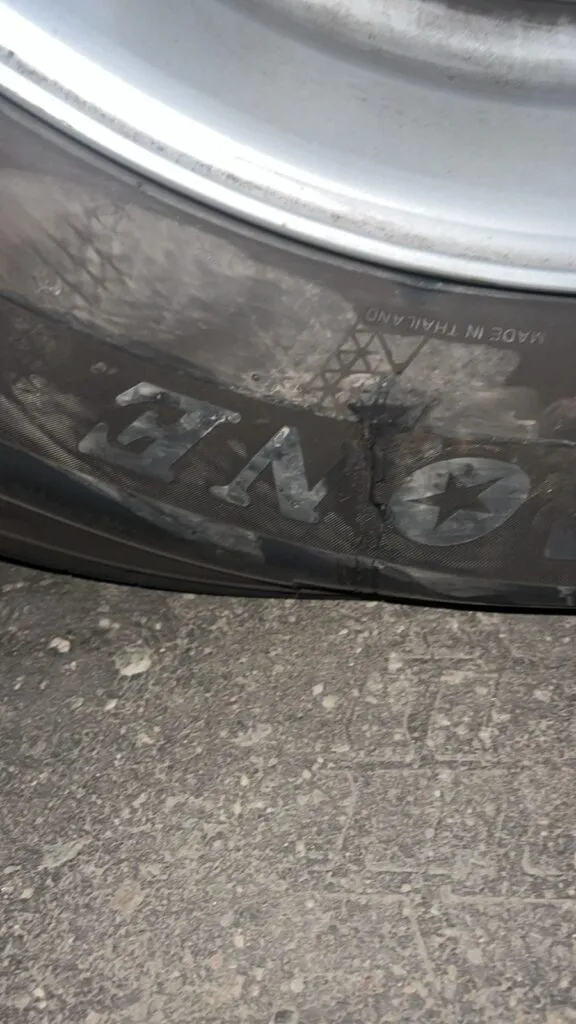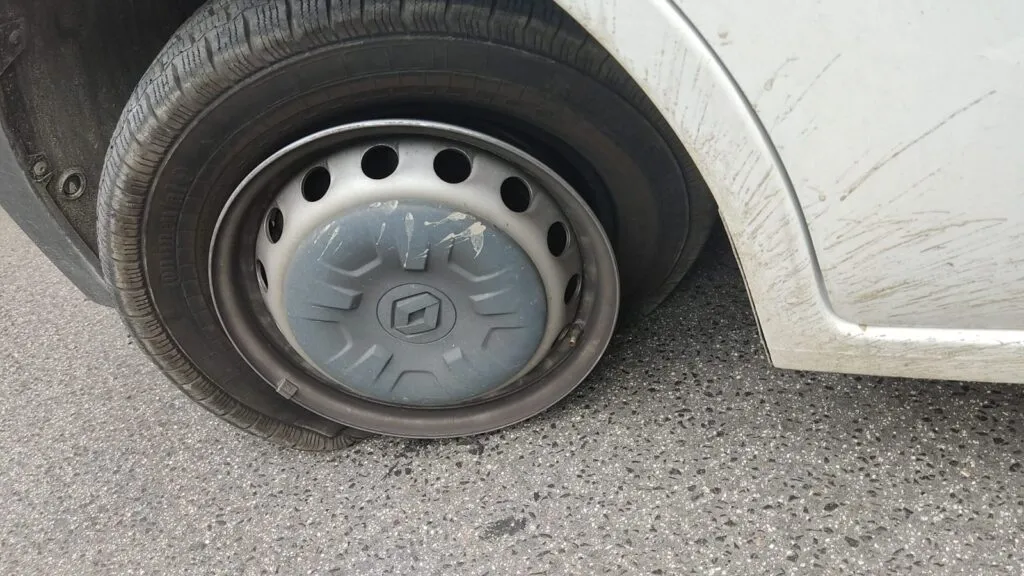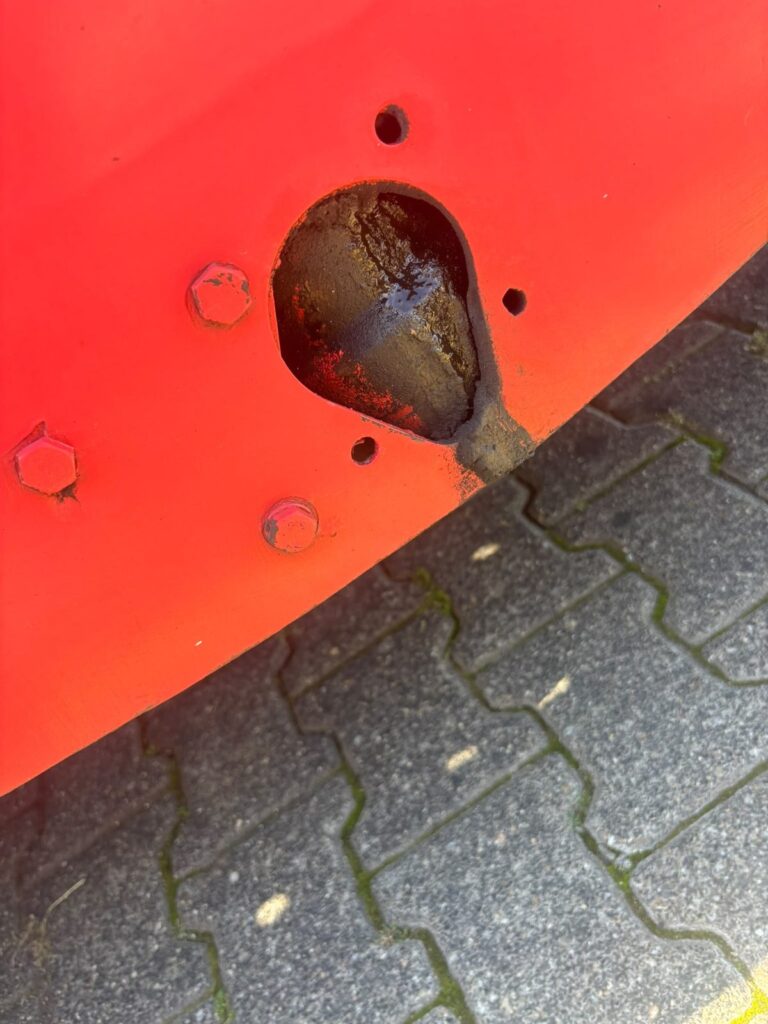
A sudden loss of tyre pressure on a curtain-sided trailer can bring an entire logistics operation to a standstill. This case, handled by LKWHelp24 on 25 September 2026 in Lüneburg, Lower Saxony, shows how a professional mobile tyre service can restore operations swiftly, safely, and without costly delays. The incident occurred not on a motorway, but in a light industrial zone accessible via the A39, a common scenario for freight operators managing local deliveries, warehouse transfers, and regional distribution. What began as a minor breakdown escalated quickly: one rear tyre on a 385/55 R22.5 axle had lost all pressure, leaving the trailer immobilised against a kerb with a damaged sidewall. Without immediate intervention, downtime could cost between €800 and €1,200 per day, a figure that includes lost revenue, penalties, and potential client dissatisfaction. The solution? A rapid response from our 24/7 mobile tyre service network, with a full replacement completed in just 120 minutes from first call to final inspection.
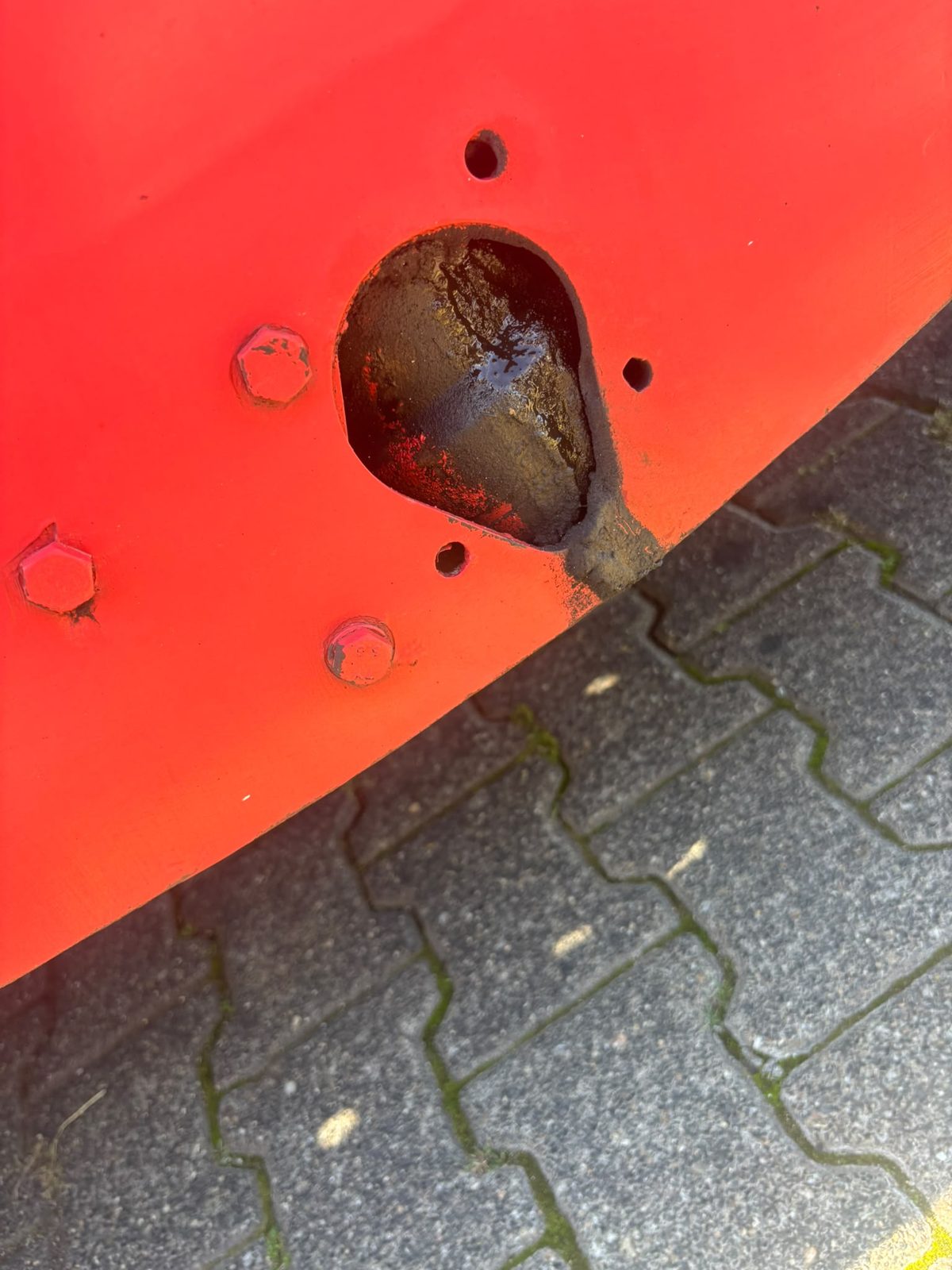
This real-world example highlights the importance of having a reliable, technically competent partner on call, especially when dealing with high-value cargo, tight delivery windows, or complex trailer configurations. The vehicle involved was a standard planenauflieger (curtainsider), a versatile freight carrier often used for mixed or sensitive cargo. Its rear axle, carrying a significant portion of the load, failed due to a sidewall puncture, a common but dangerous issue if left unattended. Unlike a simple flat, a sidewall failure compromises the structural integrity of the tyre, making it impossible to repair safely. The solution? Immediate replacement. With precise timing, correct equipment, and certified procedures, our team restored the trailer to full roadworthiness with minimal disruption. This article breaks down the entire process, from the initial call to the final documentation, including time logs, cost breakdowns, technical details, and expert insights, all based on real data from the field.
What Happened: A Critical Tyre Failure in a Low-Traffic Industrial Zone
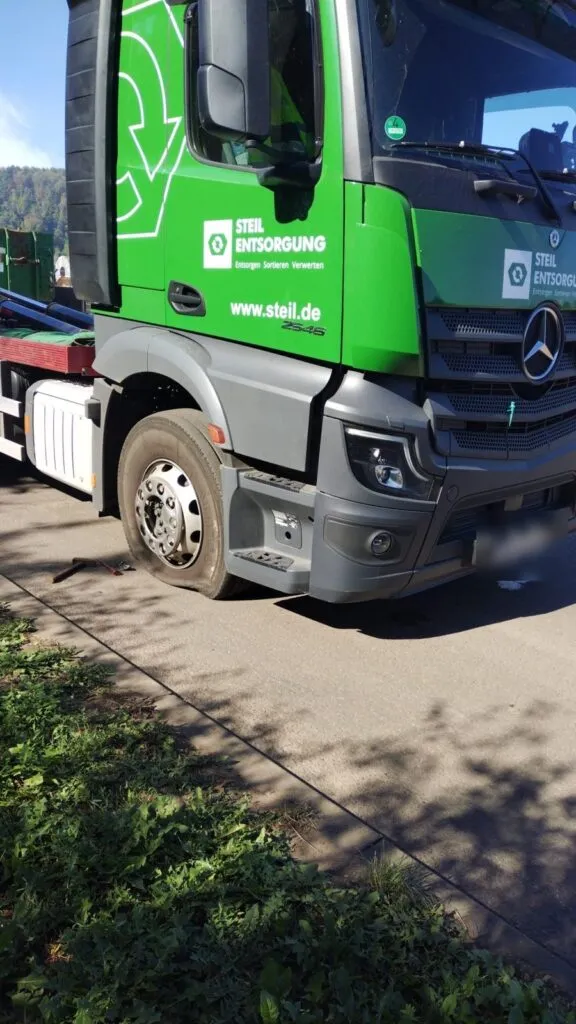
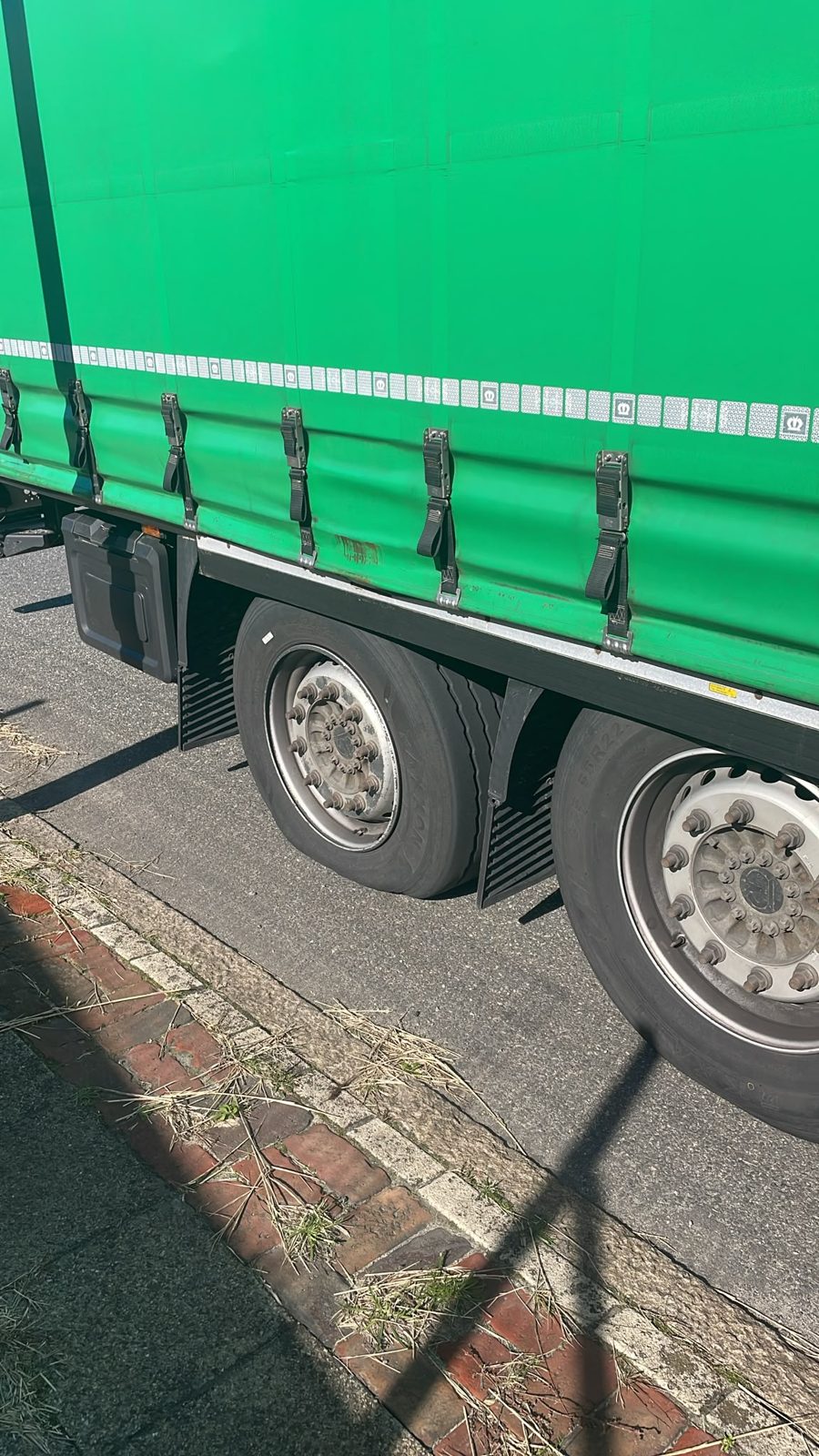
On 25 September 2026, at 13:05, a driver operating a curtain-sided trailer in a logistics area near Lüneburg reported a complete loss of pressure in one rear tyre. The vehicle was parked at a kerb on a paved street with clay brick paving, a surface that, while stable, offered no room for safe manoeuvring. The tyre had visibly collapsed, with the sidewall folded inward, indicating a severe structural failure. The driver confirmed that the trailer could not be moved and that continuing the journey was unsafe. This is not a rare occurrence: according to ADAC data, nearly 30% of all lorry breakdowns in Germany are tyre-related, and about 40% of those involve the rear or trailer axle, precisely where this incident took place.
The cause was identified as a sidewall rupture, likely due to a sharp object embedded in the tread or prolonged underinflation. Once a sidewall is compromised, the tyre can no longer withstand the lateral forces during cornering or load transfer. Even a short distance driven on such a tyre risks catastrophic failure, including wheel detachment or damage to the rim, suspension, or brake components. In this case, the driver had already stopped the vehicle safely, placed wheel chocks, and activated the hazard lights, standard safety protocol. However, without a mobile tyre service, the next step would have been to wait for a tow truck, which could take over two hours to arrive, followed by a lengthy repair or replacement at a workshop, a process that would have delayed the trip by at least half a day.
The location, a quiet industrial street near the A39 access road, added complexity. Unlike motorway breakdowns, where emergency zones are clearly marked and enforcement is immediate, urban and suburban areas lack dedicated roadside infrastructure. There’s no guaranteed space for a mobile workshop, and local traffic regulations may restrict the use of tools or equipment. Yet, our team arrived within 40 minutes, equipped with all necessary tools, including a pneumatic impact wrench, wheel chocks, a portable air compressor, and a full set of spare tyres. The key takeaway? A breakdown in a low-traffic zone is not less dangerous, it’s often more unpredictable, because help is less visible and less frequent.
How We Organised the Response: The Role of the Dispatch Team and Partner Network
When the call came in at 13:05, our dispatch centre immediately activated the emergency protocol for mobile tyre services in Lower Saxony. The first step was confirming critical details: the vehicle type (curtainsider), axle configuration (rear axle), tyre size (385/55 R22.5), and exact location, a street in Lüneburg near the A39 exit. Using our real-time partner network, we cross-referenced availability of a qualified technician with the right vehicle, tools, and spare tyres. Within 12 minutes, a technician based in Celle was assigned, a 40-minute drive away, which was acceptable given the traffic conditions.
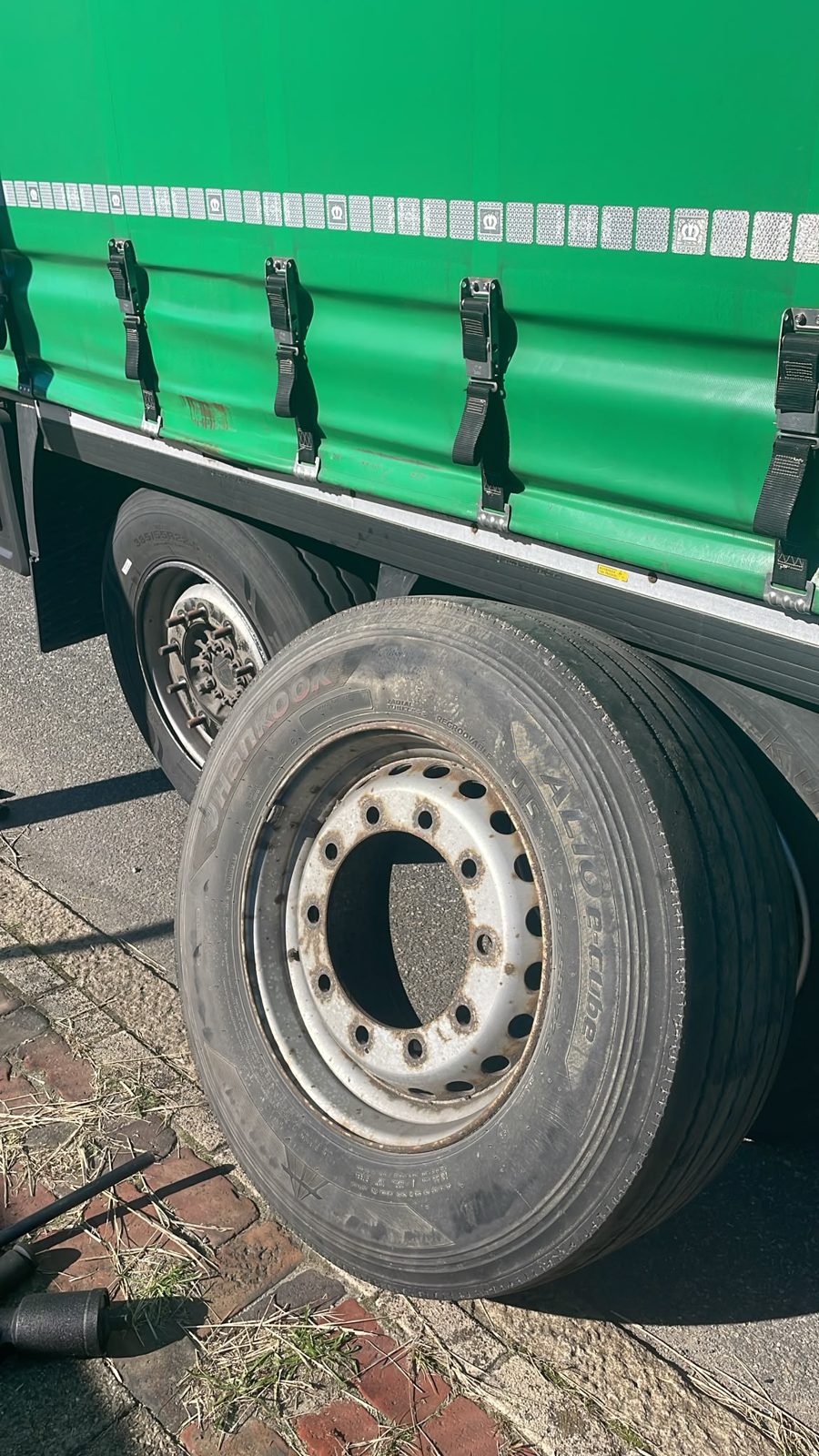
Our partner network consists of vetted, certified mobile mechanics with extensive experience in truck and trailer tyre replacement. Each technician carries a digital tablet with access to our central database, which includes tyre specifications, load ratings, and safety standards. The system automatically checks stock levels at nearby hubs and reserves the correct tyre, in this case, a Hankook AL10 e-cube 385/55 R22.5. This tyre is specifically designed for trailer axles, offering excellent wear resistance, low rolling resistance, and durability on mixed surfaces, including gravel and urban roads.
The dispatch team also verified that the site was accessible: a paved street with a kerb, no overhead obstructions, and sufficient space for the service van to park safely. No special permits were required, as this was a private industrial zone. We informed the driver that the team would arrive within 40 minutes and advised him to keep the hazard lights on and remain in the cab for safety. By 13:17, the dispatch process was complete, and the technician was en route. The entire coordination, from call to dispatch, took just 12 minutes, demonstrating the efficiency of our integrated system.
On-Site Assessment: Why Ignoring the Issue Is Dangerous
Upon arrival at 13:57, the technician conducted a full on-site assessment. The first priority was safety: wheel chocks were placed on the opposite side of the trailer to prevent rollaway, and warning triangles were positioned 50 metres behind the vehicle. The area was clearly marked, and the driver remained in the cab until the work was complete. The technician then inspected the damaged tyre: the sidewall was visibly folded, with a deep gash near the tread shoulder. The pressure gauge read zero, confirming a complete loss of inflation.
A critical factor in this case was the load on the axle. A typical planenauflieger can carry up to 18 tonnes, with the rear axle bearing a significant portion of that weight. When a tyre loses pressure, the remaining three tyres on the axle must compensate, increasing stress on the suspension, bearings, and rims. In this instance, the pressure on the healthy tyres rose from 8.5 to 9.5 bar, exceeding the recommended range. According to TÜV guidelines, sustained overloading can lead to premature wear, brake overheating, and even wheel detachment.
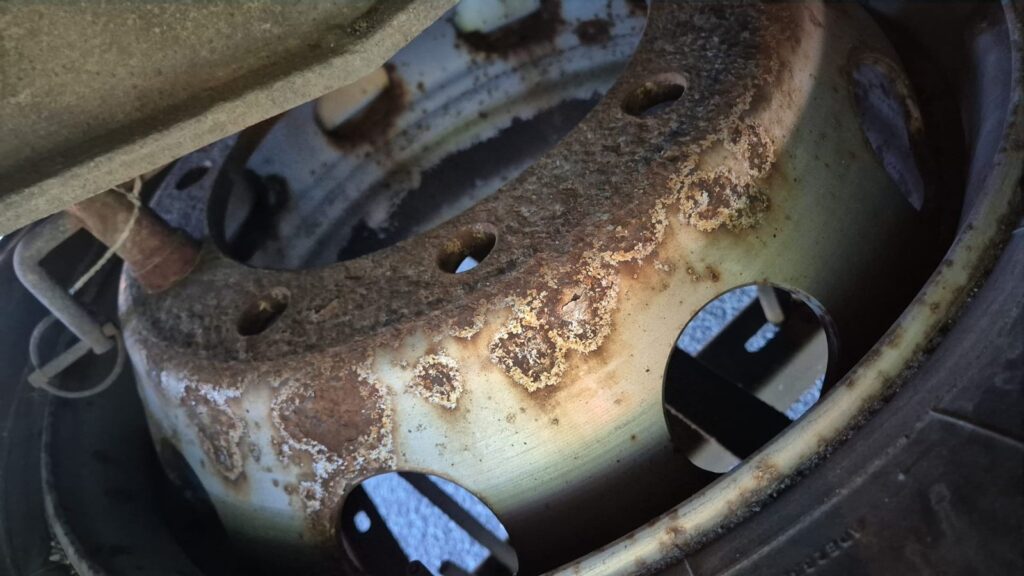
The technician also checked the rim for damage. The 10-bolt disc showed signs of surface rust but no warping or cracks. The wheel studs were intact, and the hub showed no signs of misalignment. This ruled out the need for a rim replacement, a costly alternative. The conclusion was clear: the tyre was beyond repair. According to §36 of the German StVZO (Vehicle Regulations), tyres with damaged sidewalls must be replaced immediately, they cannot be repaired safely, even with modern vulcanisation techniques. Attempting to patch such a defect risks sudden failure, especially under heavy load or high-speed driving.
Step-by-Step Replacement: From Demount to Final Check
Step 1: Initial Inspection and Safety Setup
The technician confirmed the vehicle was secure, confirmed the tyre size, and documented the damage with photos. The site was marked with warning cones and the hazard lights were kept on.
Step 2: Wheel Chocking and Vehicle Securing
Two wheel chocks were placed behind the front wheels, and the trailer’s handbrake was engaged. The technician also checked that the trailer’s suspension was not under strain.
Step 3: Demounting the Damaged Wheel
Using a pneumatic impact wrench, the technician loosened the 10 wheel bolts. The torque was applied in a star pattern to avoid rim distortion. The wheel was then removed and placed on a clean tarp. The rim was inspected for rust and debris and cleaned using a wire brush.
Step 4: Mounting the New Tyre
The new Hankook AL10 e-cube tyre was mounted onto the cleaned disc using a tyre changer. The technician ensured the bead was fully seated on both sides. A small amount of lubricant was applied to the bead to ease installation.
Step 5: Inflation and Final Checks
The tyre was inflated to the manufacturer’s recommended pressure, 8.5 bar for this axle. The technician then checked the adjacent tyres to ensure they were within the correct pressure range (8.5–9.5 bar). A final visual inspection confirmed no damage, misalignment, or foreign objects.
Step 6: Torque Application Using the Star Pattern
The wheel bolts were tightened in a star pattern using a calibrated torque wrench. Each bolt was set to 180 Nm, the standard for 10-bolt trailer rims. This ensures even load distribution and prevents rim warping.
Step 7: Final Walk-Around and Documentation
The technician performed a walk-around, checked all safety features, and handed over a digital service report to the driver. The vehicle was now road-ready.
Full Timeline: From Call to Completion
| Time | Phase | Action |
|---|---|---|
| 13:05 | Call Received | Driver reports tyre pressure loss on rear axle of curtainsider |
| 13:17 | Dispatch & Coordination | Technician assigned; spare tyre reserved; route confirmed |
| 13:57 | Arrival on Site | Team arrives, secures zone, places chocks, starts inspection |
| 14:02 | Diagnosis | Confirmed: sidewall damage, tyre not repairable, rim undamaged |
| 14:08 | Demounting | Damaged wheel removed using impact wrench; rim cleaned |
| 14:21 | Mounting | New tyre installed, bead seated, inflation started |
| 14:45 | Torque Application | Bolts tightened in star pattern to 180 Nm |
| 15:05 | Final Check & Handover | Pressure verified, report issued, driver resumes journey |
Total time from call to completion: 120 minutes (2 hours). This includes travel, setup, diagnosis, repair, and documentation.
Cost Breakdown: Transparent Pricing for Emergency Tyre Replacement
| Position | Price (EUR) |
|---|---|
| Travel (Anfahrt) | 240 |
| Labour (1.5 hours at €110/hour) | 165 |
| New tyre: Hankook AL10 e-cube 385/55 R22.5 | 480 |
| Disposal of old tyre | 20 |
| Total (net, excl. VAT) | 905 |
All prices are exclusive of VAT (netto). This cost includes full service, parts, disposal, and documentation. For comparison, the average daily cost of a lorry standstill ranges from €800 to €1,200, depending on the vehicle type, cargo value, and contractual penalties. In this case, the mobile service prevented a potential 12–24 hour delay, saving the operator hundreds, if not thousands, of euros in indirect costs.
The price reflects current market rates for professional mobile tyre services in Germany. The tyre itself (Hankook AL10 e-cube) is a premium product designed for durability and low fuel consumption. It is widely used in fleet operations across Europe. The cost includes not just the tyre, but also the expertise, safety procedures, and warranty, all backed by LKWHelp24.
Why You Should Never Attempt a DIY Tyre Repair on a Trailer
Many drivers attempt to patch or repair a flat tyre on the roadside, but this is a serious risk, especially on trailer axles. Here’s why:
- Sidewall damage cannot be repaired safely, even with modern vulcanisation. The structure is compromised.
- Improper torque application can warp the rim, leading to imbalance, vibrations, and eventual failure.
- Lack of proper tools, such as a torque wrench or bead breaker, increases the risk of injury or damage.
- No pressure check on adjacent tyres may lead to overloading.
- No documentation means no proof of service, which is critical for insurance and compliance.
According to DEKRA, over 60% of roadside tyre repairs fail within 500 km due to improper installation. In this case, attempting a DIY fix would have likely led to a second breakdown, possibly on a motorway, with far greater danger and cost.
Typical Scenarios We Respond To Across Germany
Our mobile tyre service handles a wide range of emergencies, including:
- Tyre blowouts on the A2, A3, or A7, often at high speed, requiring immediate response.
- Flat tyres in remote fields or gravel areas, where access is limited and recovery complex.
- Rim damage after hitting potholes or curbs, common in urban deliveries.
- Sidewall damage from debris or sharp objects, especially on curtain-sided trailers.
- Winter tyre failures in snow or ice, where grip is critical.
We operate 24/7 across Germany, with teams stationed in major logistics hubs like Hamburg, Berlin, Munich, Frankfurt, and Hanover. Whether you’re transporting perishables, machinery, or automotive parts, we’re ready to respond.
Proactive Maintenance Tips for Drivers and Fleets
To avoid breakdowns like this, consider these best practices:
- Check tyre pressure weekly, especially before long hauls. Use a digital gauge.
- Inspect for cuts, bulges, or foreign objects every 500 km.
- Rotate tyres regularly, every 10,000 km to ensure even wear.
- Use the correct tyre for the axle, trailer tyres are not the same as drive-axle tyres.
- Keep a spare tyre and tools in the cab, but only if you’re trained to use them.
Fleet managers should schedule quarterly inspections using our fleet tyre service to catch issues early.
Advanced Tyre Knowledge: Brands, Standards, and Safety
The Hankook AL10 e-cube used in this case is part of a growing trend toward low-rolling-resistance, eco-friendly tyres. It is rated for heavy-duty trailer use and performs well on both tarmac and gravel. Other top brands include:
- Michelin X One – Known for longevity and fuel efficiency
- Continental ContiTread – Excellent wet grip and durability
- Goodyear Giti GT-120 – High load capacity and low noise
- Bridgestone B216 – Ideal for long-haul transport
All tyres must comply with ETRTO standards and StVZO regulations. The minimum tread depth for trailers is 1.6 mm, and any tyre below this must be replaced immediately. For winter use, M+S marking and winter tyre laws apply in Germany from 1 November to 15 April.
Why Choose LKWHelp24? Expertise, Speed, and Trust
- 24/7 Availability: We’re on call at all times, including weekends and holidays.
- Proven Network: Over 120 certified technicians across Germany.
- Transparent Pricing: No hidden fees, all costs quoted upfront.
- Multilingual Support: Dispatchers speak English, German, Polish, and Russian.
- Full Documentation: Digital reports, compliance records, and service history.
- Fast Response: Average arrival time under 45 minutes in urban zones.
Our service is trusted by major logistics companies, hauliers, and private operators. As one client said: “They got me back on the road in under two hours, and without a single extra charge.”
Understanding the 385/55 R22.5 Trailer Tyre: Design, Load Capacity, and Performance
The Hankook AL10 e-cube tyre used in this case, sized 385/55 R22.5, is specifically engineered for the demands of trailer axles in modern freight operations. Unlike drive-axle tyres that must withstand high torque and aggressive acceleration, trailer tyres are primarily responsible for supporting static and dynamic loads while maintaining stability during cornering and braking. This particular size is among the most common for heavy-duty curtainsiders and flatbed trailers across Europe. The “385” refers to the tyre’s nominal section width in millimetres, indicating a wide footprint that distributes weight evenly across the road surface. The “55” is the aspect ratio, the height of the sidewall as a percentage of the width, which in this case means a relatively low sidewall (about 212 mm tall), contributing to better handling and reduced flex under load.
The “R22.5” designation confirms it’s a radial construction with a rim diameter of 22.5 inches, a standard in German and Central European transport fleets. This size is compatible with 10-bolt wheel hubs, which were confirmed on the damaged rim during inspection. The load index of this tyre typically ranges between 135 and 140, corresponding to a maximum load capacity of 4,750 kg to 5,000 kg per tyre, depending on the inflation pressure and speed rating. In a full trailer axle setup, this allows a single axle to carry up to 9,500 kg to 10,000 kg, which aligns with typical legal limits for semi-trailers in Germany.
What makes the AL10 e-cube stand out is its low rolling resistance (LRR), a feature increasingly critical for fleet operators aiming to reduce fuel consumption and CO₂ emissions. According to Hankook’s internal testing, the AL10 e-cube delivers up to 12% lower rolling resistance compared to older-generation trailer tyres, translating to measurable savings over 100,000 km. This is achieved through a silica-based tread compound and an optimised tread pattern designed to minimise deformation during rotation. The tread depth at installation is typically around 8 mm, well above the legal minimum of 1.6 mm, ensuring a long service life. However, once wear reaches the wear indicators (usually at 2–3 mm), performance drops sharply, especially in wet conditions, and replacement becomes mandatory.
Technical Risks of Sidewall Damage: Why It’s a Non-Negotiable Replacement
A sidewall failure is not just a flat tyre, it’s a structural collapse. When the sidewall of a tyre is compromised, whether by a sharp object, impact with a curb, or prolonged underinflation, the internal steel belt and carcass layers lose their integrity. The sidewall is not designed to carry load; it’s a flexible, tensioned structure that maintains the tyre’s shape and transfers forces from the tread to the rim. Once that structure fails, the tyre can no longer support even a fraction of the load it was designed for.
In this case, the visible folding of the sidewall indicated that the tyre had been under extreme stress for some time, likely due to sustained underinflation. The pressure drop to zero was not sudden; it was the final stage of a progressive failure. Continuing to drive on a tyre with a collapsed sidewall risks catastrophic events: the tread can separate from the rim, the rim itself may warp or crack, and in extreme cases, the wheel can detach entirely. The risk is not just mechanical, it’s also legal. Under §36 StVZO, a vehicle with a damaged tyre that cannot be repaired safely is deemed unfit for road use. Driving such a vehicle can result in fines up to €1,000 and vehicle impoundment.
Even if the rim appears undamaged, the lateral forces during cornering can cause microscopic deformations that are invisible to the naked eye. These distortions lead to uneven wear, vibrations, and increased stress on bearings and suspension components. Over time, this accelerates the degradation of other parts, turning a single tyre failure into a multi-component repair. That’s why our technicians always perform a full rim inspection after any sidewall damage, not just to check for visible defects, but to verify structural integrity using a straight edge and light test.
Fleet Management: Preventive Strategies to Avoid Breakdowns in Transit
For fleet managers, the cost of a roadside breakdown extends far beyond the repair bill. A single unplanned stop can disrupt entire delivery schedules, trigger contractual penalties, and damage customer relationships. Proactive maintenance is not optional, it’s a strategic necessity. One of the most effective tools is scheduled tyre inspections every 10,000 km or quarterly, whichever comes first. During these checks, technicians should verify:
- Tread depth using a tread depth gauge (minimum 3 mm recommended for safety)
- Pressure levels with calibrated gauges (check at least once a week)
- Visual signs of damage, cuts, bulges, embedded objects, uneven wear
- Bolt tightness and rim condition
- Alignment and balance, especially after repairs
Many modern fleets now use telematics systems that monitor tyre pressure in real time. Devices like those from Bosch Mobility or ZF can send alerts when pressure drops below a threshold, allowing for early intervention. In high-risk zones, such as gravel roads, construction sites, or areas with frequent potholes, even more frequent checks are advised. A 2025 ADAC study found that fleets using proactive tyre management reduced unscheduled breakdowns by 47% over a 12-month period.
Another key strategy is tyre rotation. On trailers, where all tyres on an axle are identical, rotation is less common than on drive axles, but it’s still beneficial. Rotating the tyres between left and right sides every 10,000 km helps even out wear, especially on vehicles that frequently turn right or drive on uneven roads. For curtainsiders, which often carry uneven loads, this can extend tyre life by up to 20%. Finally, investing in premium tyres with longer warranties, such as the Hankook AL10 e-cube, pays off in reduced downtime, lower fuel costs, and improved safety.
Legal and Operational Standards: What You Must Know About Tyre Compliance
German transport law is strict when it comes to tyre safety, and non-compliance carries real consequences. The StVZO (Straßenverkehrs-Zulassungs-Ordnung) sets clear rules for tyre condition, pressure, and fitment. For trailers, §36 StVZO mandates that all tyres must be free of cuts, bulges, or signs of structural damage, especially on the sidewall. Any tyre with a damaged sidewall must be replaced immediately, regardless of tread depth. The same rule applies to tyres with worn or missing tread indicators, or those that show signs of separation between the tread and the carcass.
Pressure is another critical factor. The correct inflation pressure for a 385/55 R22.5 trailer tyre typically ranges between 8.5 bar and 9.5 bar, depending on the load and axle configuration. This range is designed to balance load support, rolling resistance, and wear. Underinflated tyres increase rolling resistance by up to 15%, leading to higher fuel consumption and faster wear. Overinflation, on the other hand, reduces grip and increases the risk of blowouts, particularly in hot weather. The German Federal Motor Transport Authority (KBA) recommends checking pressure at least once a week and before long trips.
Finally, the use of winter tyres is legally required in Germany from 1 November to 15 April in certain regions, especially in mountainous or high-altitude areas. For trailers, the same rules apply: if the vehicle is registered in a winter tyre zone, the trailer must be equipped with M+S tyres or winter tyres bearing the Alpine symbol. Failure to comply can result in fines of up to €60 and a warning notice. These standards are not just about safety, they’re about responsibility. Every kilometre driven on an unsafe tyre is a risk to the driver, other road users, and the environment.
Summary: Key Facts from This Case
- Vehicle Type: Planenauflieger (curtainsider)
- Location: Industrial zone near Lüneburg, Lower Saxony
- Tyre Size: 385/55 R22.5 (trailer axle)
- Failure Type: Sidewall rupture, complete pressure loss
- Time to Arrival: 40 minutes
- Total Time to Completion: 120 minutes (2 hours)
- Total Cost: €905 (net, excl. VAT)
- Second-Hand Damage Avoided: Yes, due to timely intervention
- Next Step: Driver resumed journey immediately after handover
Need Immediate Help? Call Now
Don’t let a flat tyre stop your business. Our mobile truck tyre service is available 24/7 across Germany. Whether it’s a trailer, semi-trailer, or full rig, we’ll get you back on the road fast.
📞 +49 160 5753826
🌐 www.lkwhelp24.com
Keywords: truck tyre service | mobile reifenservice | truck tyre replacement | truck tyre change | truck tyre roadside assistance | trailer tyre service | truck tyre breakdown service | mobile truck tyre service | truck tyre repair | truck tyre emergency | truck tyre help | truck tyre fitting | truck tyre fitters near me | truck tyre near me | truck tyre service near me | truck tyre service germany | truck tyre mobile service | truck tyre breakdown germany | truck tyre blowout | trailer tyre replacement | trailer tyre puncture | trailer flat tyre | reifenwechsel near me | pneuhage truck fleet support | pneuhage roadside assistance
Related Articles
- Tire Breakdown Service Near Me: What Actually Helps Right Now
- Truck Tyre Service Cottbus (03046): Double Tyre Blowout on Car Transporter – Volvo FH 460 with New Vehicles Back on the Road in 2.5 Hours
- Truck Winter Tyres 2026: Tyre Choice, Axles and Practice in Germany
- Truck Tire Service in Germany, Mobile 24/7 Tire Replacement
- Truck Tire Change Cost: What a New Tire Really Costs