Skip to content
Introduction: Why winter tyres matter so much for trucks
Choosing the right winter tyres can decide, in a German winter, whether a truck gets through safely or ends up stranded at the roadside. Snow, slush and temperatures below 0 °C put heavy vehicles from 3.5 t upwards under real strain: braking distances grow, traction on gradients drops, and a tyre that’s the wrong choice, badly stored or worn out quickly makes the difference between carrying on and standing still.
Our 2025 yearly overview covers the legal duties, fines and checks around the winter tyre requirement in detail. This article focuses, for the 2026/27 season, on the practical side: which tyre suits which axle and usage profile, how a depot plans the seasonal changeover, what drivers and workshops should check when tyres are delivered, how to store tyres properly between seasons, and which mistakes fleets keep making when sourcing tyres. As a mobile truck breakdown and tyre service operating throughout Germany, LKWHelp24 sees every day which tyre decisions turn out to be costly later – from the wrong size to spares ordered too late.

Legal winter tyre requirement for trucks in Germany (Winterreifenpflicht)
The legal basis is unchanged for the 2026/27 season: § 2 Abs. 3a StVO requires suitable tyres whenever wintry road conditions occur (black ice, snow-covered roads, slush, ice or frost) – there is no fixed calendar date, what counts is the actual weather on the road. 3PMSF tyres are mandatory at least on the drive axles, and since 1 July 2020 also on the front steering axles; plain M+S marking has no longer been sufficient since the transition period ended on 30.09.2024.
The legal basis in detail, the affected axles, current fine amounts and the split of responsibility between driver and operator are covered in full in our yearly overview Winter Tyres for HGVs 2025: Legal Duties, Fines and Checks in Germany. For tyre choice in 2026/27, what matters most is this: basing procurement on this requirement keeps you legally covered – how that plays out by axle and usage profile is covered in the sections below.

Minimum tread depth for truck winter tyres (Mindestprofiltiefe)
The minimum legal tread depth is also covered in our 2025 yearly overview – 1.6 mm under § 36 StVZO, with experts and many internal fleet standards setting the bar considerably higher in practice. For tyre choice in 2026/27, one point matters most: a newly procured tyre that is already close to the legal minimum at purchase is the wrong choice for the coming season – winter performance drops off noticeably well before 1.6 mm is reached.
When sourcing and accepting new tyres, it therefore pays to look at remaining service life: a tyre should stay comfortably above the levels trade associations recommend for the whole planned period of use, not just scrape past them near the end. How to monitor this during operation, and when wear means it’s time to change, is covered in the tyre-acceptance and wear-check section below.
Tips for choosing the right winter tyres for trucks
Tyre choice for 2026/27 starts with axle and usage profile – see the table with full detail in the “Choosing tyres by axle and usage profile” section below. Beyond that, brand, quality, sourcing route, storage and a solid acceptance check all decide whether a fleet gets through winter reliably or keeps running into avoidable problems.
Brands, the EU label and retreaded tyres
From the 2024/2025 season, only winter or all-season tyres with 3PMSF marking are permitted – the same applies to any replacement tyres bought for 2026/27. For the safety-critical drive axles, premium tyres from established manufacturers are worth the extra cost: Michelin (X Multi Way), Continental (H-Space), Goodyear (KMAX), Bridgestone (M759) or Hankook (Winter I*Zen); tests show 20-30% better mileage than budget tyres.
The EU tyre label gives extra points of comparison: wet grip (ideally class A-C), rolling resistance (5-10% fuel savings at class A) and noise (below 73 dB). For winter use, though, manufacturer-specific winter testing and your own fleet’s real-world experience count for at least as much as the label itself.
Retreaded winter tyres can cut procurement cost by up to 50%, but should only come from certified manufacturers (ETRTO-tested) with valid 3PMSF approval. For steering and drive axles, stick to tyres retreaded at most once – mileage there runs around 10-20% below new tyres, which is worth factoring into the changeover plan.

Planning the seasonal changeover at the depot
Structured planning of the tyre changeover saves time and money and avoids unpleasant surprises in the middle of winter. A fixed framework that any depot can scale to its own fleet size has proven itself in practice:
- Fix a changeover date: plan the switch to winter tyres by mid-October at the latest, switch back no earlier than after Easter – and move it flexibly depending on the weather in the areas you actually operate in
- Order tyres early: supply bottlenecks are common with suppliers in October and November – ordering late risks vehicles going into winter without proper tyres
- Plan depot capacity: changing several vehicles at once needs time slots, staff, and sometimes an external tyre service alongside your own workshop
- Equip Alpine and low-mountain routes separately: for international traffic to Austria, Switzerland or Italy, fit 3PMSF tyres on all axles where possible, and have snow chains matching the tyre size ready at the depot before the season, test-fitted once
Tyre acceptance: what drivers and workshops should check
A new or previously stored tyre shouldn’t be fitted without checking it first. A short but consistent routine at the depot pays off when tyres are delivered:
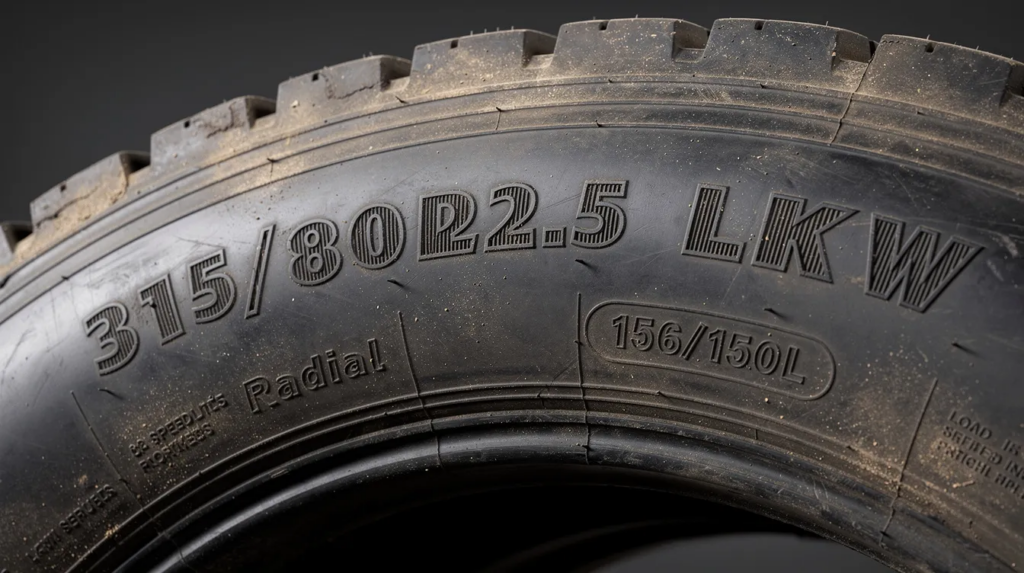
- Match delivery against order: size, load index and speed rating must match the axle they were ordered for
- Check the DOT number: a maximum age of 6 years from the production date is the usual benchmark for winter tyres, including unused stock straight from storage
- Do a visual check: inspect sidewall and tread for transport damage, cracks or deformation before the tyre goes on the truck
- Verify the 3PMSF symbol: spot-check it on the sidewall itself, not just on the delivery note – especially with bulk orders or a new supplier
- Valves and accessories: order spare valves and a pressure gauge along with the tyres, so operations don’t lose time re-ordering them later
Storage between seasons
How a tyre spends the summer months affects how many winters it can reliably serve. Key points for storage at the depot:
- Label tyres clearly at changeover time (axle position, rotation direction, vehicle) so they can be correctly matched again next season
- Store dry, cool and out of direct UV exposure – standing on the rim or stacked flat without the rim, depending on space at the depot
- Check for damage before putting tyres into storage, rather than discovering it at the next changeover
- Name a single point of contact for tyre logistics at the depot, especially when several vehicles need changing at once
When is a tyre worn enough to need changing?
Besides the legal minimum of 1.6 mm, many fleets work to higher internal replacement limits, because snow traction declines well before that point. These methods have proven themselves for ongoing checks:
- Tread depth gauge: a low-cost tool for a quick, precise reading directly on the vehicle
- TWI markings: the built-in wear indicators show the limit without any tool
- App-based scanners: a faster alternative to manual measurement for fleets with many vehicles
- A fixed check rhythm: log tread depth at least every 10,000 km or 3 months, plus a visual check before every longer trip
Logging these figures alongside purchase and storage dates lets you see early which tyre is due next – instead of being caught out at a roadside check or, worse, at the moment of a breakdown.
Common mistakes fleets make when sourcing winter tyres
- Ordering too late: order in November and the size or brand you actually want is often gone
- Mixed sizes across the fleet: makes replacement sourcing and stock-keeping harder, especially at short notice
- Neglecting the trailer axle: usually not a legal requirement, but tracking suffers across the whole combination without 3PMSF tyres there too
- No documentation: without a record of DOT number, tread depth and change dates, the right changeover moment is often noticed too late
- Fitting without checking axle assignment: a tyre built for the drive axle fitted to the steering axle (or the reverse) hurts safety and mileage alike
Keep central documentation:
Documentation field | Content |
|---|---|
Tyre type | Brand, model, axle assignment |
DOT number | Production date (max. 6 years recommended for winter tyres) |
Tread depth | Current status, measure at least every 10,000 km or 3 months |
Change dates | Date of fitting/removal, storage location |
LKWHelp24 also supports fleets with advice as part of the mobile tyre service – for example, with recommendations based on common breakdown causes. Around 40% of winter breakdowns, in our experience, are caused by incorrect or inadequate tyres; a solid sourcing and changeover routine noticeably cuts that risk. For acute problems such as frozen valves, pressure loss or a damaged tyre, LKWHelp24’s mobile tyre service helps on site around the clock.
Special notes for foreign drivers in Germany
Important for international truck drivers (plain language): An English-language 24/7 truck roadside assistance service in Germany is also available for foreign drivers, helping with breakdowns, towing and tyre service. The exact rules, fine amounts and checkpoints at German border crossings are set out in our 2025 yearly overview.
Before entering Germany, a quick check is worth it: 3PMSF symbol present on the required axles, tread depth comfortably above the legal minimum, no visible damage. Checking these three points before setting off saves unnecessary trouble at the border or during a check on German motorways.
LKWHelp24 supports multiple languages: Our team can help in English and, in some cases, Polish and Romanian. Via our dedicated 24/7 truck tyre service in Berlin, Polish-speaking drivers also receive fast help with tyre breakdowns – anywhere in Germany, at any time of year.

Choosing tyres by axle and usage profile for the 2026/27 season
Which winter tyre is right depends less on the calendar year and more on how the truck is actually used. Steering axle, drive axle and trailer axle carry different loads, and a long-haul truck needs different properties than one working a building site. The overview below helps with practical tyre choice for the 2026/27 season.
Steering axle, drive axle, trailer: different requirements
- Steering axle: needs tyres with strong lateral grip and precise steering response on snow and ice
- Drive axle: needs maximum traction and power transfer so the truck does not spin its wheels on gradients
- Trailer axle: not legally required to carry winter tyres in Germany, but recommended for tracking and braking stability
Long-haul, regional, building site: what matters
| Usage profile | What to look for |
|---|---|
| Long-haul (motorway, long distances) | Balanced tread pattern for even wear over high mileage and quiet running |
| Regional (mixed routes, town/country) | Versatile tread for changing conditions between motorway, rural road and urban driving |
| Building site / off-road use | Robust casing and coarse tread for unpaved ground, snow and slush off the road |
| Alpine / low mountain routes | Aggressive snow tread on all axles, combined with snow chains for gradients |
Tread depth in practice: when to change
The legal minimum is 1.6 mm of remaining tread. In practice that is too little for winter use: once tread depth drops below the levels trade associations recommend, snow traction noticeably declines. Many haulage firms therefore set internal replacement limits well above the legal minimum and change tyres on the steering and drive axles early rather than running them down to the limit.
Snow chains and storage at the depot
- Have snow chains matching the tyre size ready at the depot before the season and test-fit them once
- Label summer tyres clearly when swapping (axle position, rotation direction) and store them dry, cool and out of UV light
- Check winter tyres for damage before storing them after the season – it avoids unpleasant surprises at the next changeover
- A single point of contact for tyre logistics at the depot makes planning easier, especially when several vehicles need changing at once
Winter Tyres for Trucks – All Yearly Overviews
This article is part of our yearly series on winter tyres for trucks in Germany:
- Winter Tyres for HGVs 2025: Legal Duties, Fines and Checks in Germany
- Truck Winter Tyres 2026: Tyre Choice, Axles and Practice in Germany (this article)
- Winter Tyres for Trucks 2027: Rules, Safety and Breakdown Help
LKWHelp24 – your mobile winter tyre and breakdown service for trucks throughout Germany
LKWHelp24 is your specialised mobile breakdown and tyre service exclusively for trucks, tractor-trailers, buses and commercial vehicles throughout Germany. Our team understands the special requirements of commercial road transport and the urgency with which problems need to be solved, and works closely with our 24/7 truck tyre service in Berlin to provide especially fast regional help as well.
Our service at a glance:
- Availability: 24 hours a day, 7 days a week, 365 days a year
- Also on weekends, public holidays, at night and during heavy snowfall
- Network: Partners and service vehicles across Germany for fast help, supplemented by a news section with current information in our LKW Help 24 news portal
- Locations covered: Motorways, federal roads, service stations and rest areas, freight yards, customer terminals
LKWHelp24 doesn’t just fix tyre breakdowns – we also advise on choosing and switching to suitable truck winter tyres. We can source matching tyres from various brands and fit them directly on-site – so you’re mobile again as quickly as possible.
Contact us:
- 24/7 hotline: [phone number on our website]
- Online: Contact form on the LKWHelp24 website for breakdowns and winter advice
With the right winter tyres and a strong partner like LKWHelp24 behind you, truck drivers and fleets stay safe and mobile through the German winter. Don’t wait for the first breakdown to happen – contact us for advice, or in an emergency. We’re here for you, whenever and wherever you need us.