Skip to content
TL;DR: On 11 August 2026, our service team checked the twin tyres of five trailers at a haulier’s yard near Krefeld — 20 dual-wheel pairs, 40 tyres in size 385/65 R22.5. Six pairs (30%) showed a pressure gap above 0.5 bar, eight valve extenders were leaking and got replaced, and three pairs had stones wedged between the tyres. Total time on site: six hours, cost net €1,021 for the whole yard.
Twin tyres look simple: two tyres, one axle, double the load capacity. In practice it’s a delicate system that only works when both tyres roll exactly alike. A pressure gap of just 0.5 bar is enough to shift the workload from one tyre onto its partner, leaving one nearly idle and the other overloaded. Skip the regular checks, and a fleet pays for it twice — in fuel and in tread.
This is not a breakdown story. Nothing burst at the yard near Krefeld, no lorry was stranded. It was a scheduled inspection — exactly the kind of work that stops a breakdown from happening later.
Why twin tyres deserve their own chapter
Most heavy goods vehicles run twin tyres on the drive and trailer axles: two tyres per wheel position. That spreads the load and reduces ground pressure. The catch is that the two tyres in a pair have to be mechanically near-identical, or one starts working against the other. On a single tyre, pressure loss shows up immediately in handling. On a twin set, the neighbouring tyre silently absorbs the fault — until it too is overloaded.
That was the whole point of the visit near Krefeld: no alarm call, just a preventive check of the kind any well-run fleet should schedule every few weeks.
The job: a scheduled check, not an emergency
A haulage firm near Krefeld had five trailers parked at its yard, all fitted with 385/65 R22.5 twin tyres on the trailer axle. The vehicles were sitting between runs, a good window for a full pressure check. Our dispatch coordinated the appointment with the fleet manager and booked a service team with a calibrated gauge, spare valves and a compressor.
- Booking made by the fleet manager the day before
- Time slot (08:00–14:00) confirmed by our dispatch
- Kit prepared: gauge, valve extenders, compressor, stone pick
- Team on site at the yard on the morning of 11 August
What the yard looked like
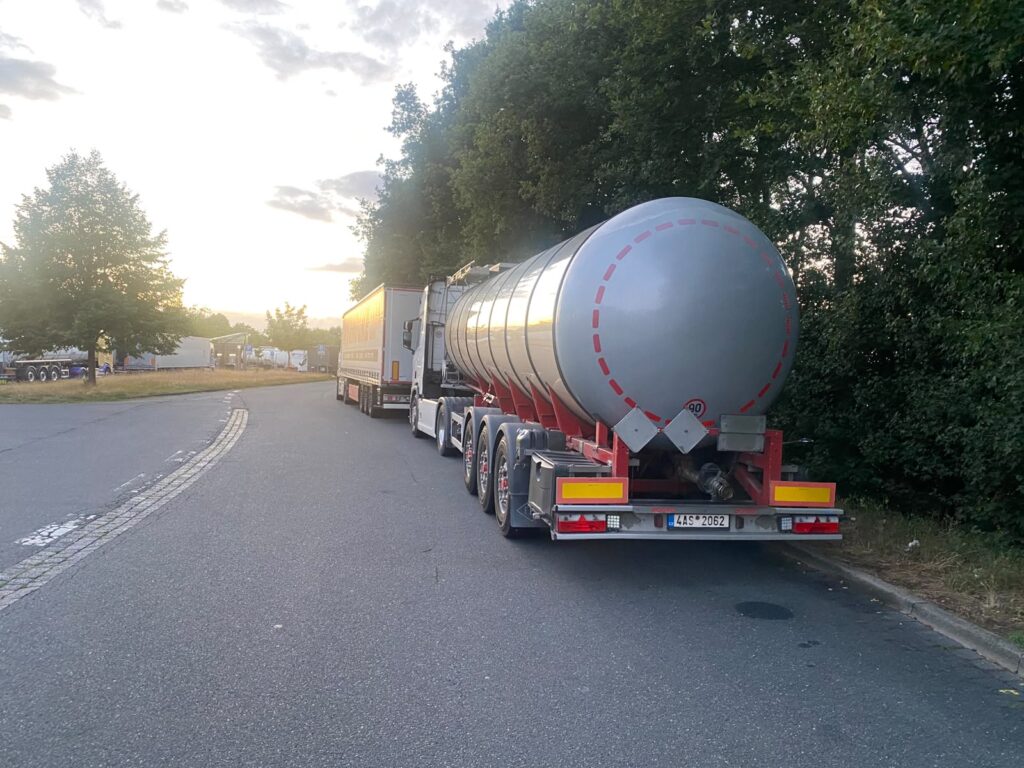
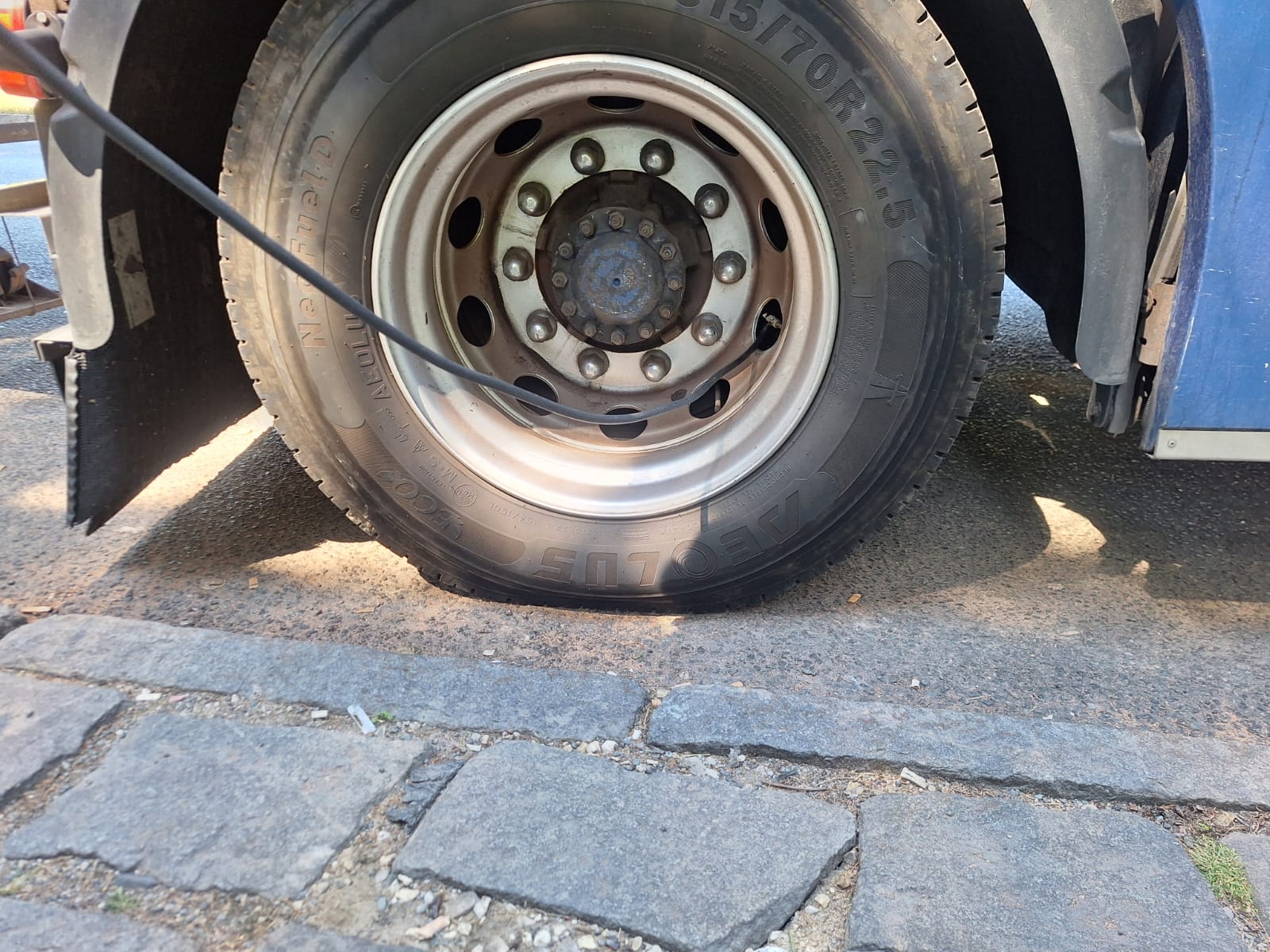
Cobblestone paving, five semi-trailers parked side by side, no visible damage. Unremarkable at first glance — which is exactly why this work gets skipped so often. A tyre that hasn’t blown out looks fine. Whether it’s holding 7.5 bar or 9.0 bar is invisible from the outside.
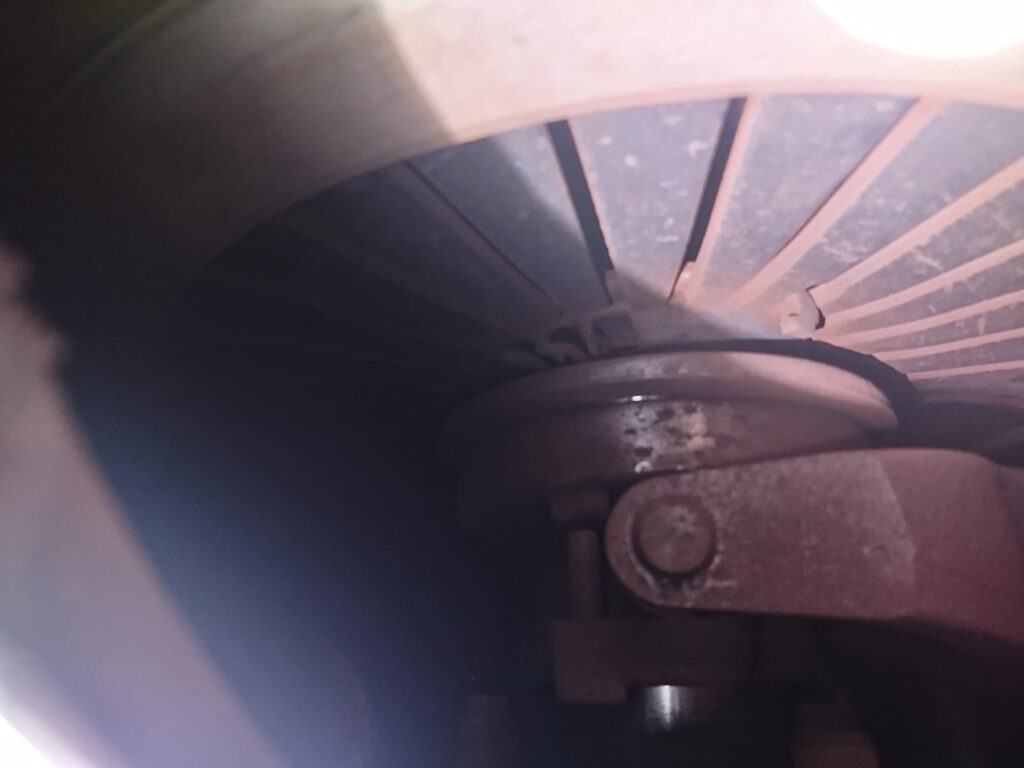
During the visual check, one wheel showed a cable and sensor area near the ABS ring — unremarkable in itself, but exactly the spot where foreign objects and damaged valves on twin tyres tend to hide. That’s where the real work starts.
Why a pressure gap is the biggest enemy of twin tyres
A pressure difference between the two tyres of a twin pair is the single most common and most expensive fault in this type of fitment. When one tyre loses pressure, its rolling radius shrinks slightly, so it carries less load — and the neighbouring tyre automatically picks up more. According to tyre manufacturers, a 1-bar gap can shift over 30% of extra load onto the partner tyre.
The result: the overloaded tyre runs hotter and wears faster, and in the worst case its carcass overheats. The under-inflated tyre suffers too — it flexes more, generating extra heat of its own. Together, these two effects explain why one unnoticed pressure loss ends up costing a fleet two tyres, not one.
In our check, six of the 20 pairs (30 percent) showed a gap above 0.5 bar — none of them critical yet, but every one a candidate for accelerated wear if left unnoticed.
Mismatched rolling circumference: the invisible tug-of-war
Two tyres with different rolling circumference in the same twin pair are permanently working against each other. The tyre with the larger diameter turns more slowly than the smaller one at the same road speed — yet both sit on the same axle and must cover the same distance per revolution. That forces slip between the two tread surfaces.
This constant slip generates friction, heat and extra fuel burn. Over weeks it produces an uneven, saw-tooth wear pattern that pulls the tyre out of service early. The cause is almost always a mismatch in tread depth, or pairing different tyre brands or patterns on the same axle.
On one pair at the yard near Krefeld, the difference in rolling circumference from uneven tread depth was clear enough that we repositioned the wheels on the axle to improve the pairing.
The rule for matching a twin pair correctly
A twin pair should match in size, tread pattern, and remaining tread depth, ideally from the same manufacturer. These four criteria aren’t a nicety — they’re the technical baseline for both tyres actually rolling at the same rate.
- Same tyre size (385/65 R22.5 throughout on this job)
- Same or at least compatible tread pattern
- Remaining tread depth within a few millimetres of each other
- One manufacturer where possible, comparable construction as the minimum
A fleet manager who mixes a new tyre with a heavily worn one in the same pair saves money at the point of purchase — and pays it back over months through extra wear, extra fuel and a higher risk of damage to the second tyre.
Why a new tyre and a worn tyre never belong in the same pair
Pairing a new tyre with a heavily worn one in a twin set automatically creates a rolling circumference mismatch. A new 385/65 R22.5 has full tread depth; a worn tyre has several millimetres less — enough to cause noticeable slip. That’s exactly the problem from the previous section, only self-inflicted: fit that combination anyway, and premature wear follows almost by design.
The practical consequence: whenever one tyre in a pair is replaced, its partner needs assessing too. If the gap is too large, the second tyre goes on the replacement list as well — or the pair is reshuffled so each tyre runs with a better-matched partner.
How you actually measure pressure in the inner twin tyre
Pressure in the inner tyre of a twin pair is measured through a valve extender that brings the inner valve out to the wheel’s edge, or via an electronic pressure sensor. Without one of these, the inner tyre is effectively inaccessible — it sits behind the outer tyre and the rim.
Valve extenders are the cheaper mechanical option, but they’re a wear part: a thin hose or tube with a fitting, vulnerable to vibration, stone chips and corrosion. A leaking extender bleeds air without the driver noticing — the tyre deflates slowly over days. That’s exactly why checking the extenders visually belongs in every pressure inspection, not just the measurement itself.
In our check, eight of the 40 valve extenders were damaged or leaking enough that we replaced them on the spot. The alternative to an extender is a fixed pressure sensor (a TPMS system built for twin axles) that transmits inner pressure by radio — more expensive to fit, but it removes the manual check entirely.
Why tapping the tyre tells you nothing about twin-tyre inner pressure
Tapping a tyre with a hammer only tests the outer tyre — the sound tells you nothing about the condition of the inner one. On a single-fitment wheel, tapping is a crude but usable emergency check. On a twin set, the inner tyre sits hidden behind the outer one; the sound of the hammer barely reaches it, and even where it does, a 0.5-bar difference is not something you can reliably tell by ear.
Anyone relying on tapping for twin tyres is effectively checking only half the fitment. A gauge on the valve extender is the only reliable way to determine inner pressure — which is why it was the core tool for all 20 pairs at the yard near Krefeld.
The gap between the tyres: a design feature, not an accident
The clearance between the two tyres of a twin pair is deliberately engineered, and it exists for cooling and mechanical separation. If the tyres sit too close together, the sidewalls rub during cornering and load transfer — generating heat exactly where the tyre is most vulnerable, at the sidewall.
An undersized gap is usually caused by the wrong spacer rings, a worn hub, or dual rims mounted incorrectly. The result is chronic sidewall overheating that often only becomes visible from the outside once cracks or bulges have already formed. Checking the gap is a standard step whenever new tyres are fitted or a wheel is changed.
Stones between the tyres: the underrated everyday risk
A stone wedged between the two tyres of a twin pair will gradually damage both sidewalls at once. On construction sites, cobblestone yards, and unpaved lots — exactly like the haulier’s yard near Krefeld — stones, gravel and metal debris easily get caught in the gap between tyres during manoeuvring. Centrifugal force and the narrow clearance keep them lodged there, scraping both sidewalls with every rotation.
Three of the 20 pairs we checked had stones wedged inside, which we removed before they could cause bigger damage. This check takes only minutes per axle, yet it’s frequently skipped during a pure pressure check — wrongly, because a trapped stone is one of the most common causes of sudden sidewall failure on twin tyres.
How often should twin tyres be checked?
A weekly check on cold tyres is the baseline for twin fitments, on top of a mandatory check before any long haul and immediately after replacing a single tyre in a pair. “Cold” means measured before the vehicle has driven for at least an hour, since air expands inside a warm tyre and skews the reading.
- Weekly: full pressure check of every twin pair
- Before every long-distance run: an extra check regardless of the weekly schedule
- After any single-tyre replacement: immediate check of the partner tyre’s pressure and tread depth
- On any visible anomaly (uneven wear, vibration): an immediate off-schedule check
A fleet that keeps to this rhythm catches a developing pressure gap before it turns into an economic problem.
The full timeline at the yard near Krefeld
| Time | Phase | Action |
|---|---|---|
| 08:00 | Arrival | Briefing from the fleet manager, overview of the five trailers |
| 08:15 | Visual check | Inspection of every twin tyre for tread, debris, valve condition |
| 08:45 | Pressure check | Measuring and equalising pressure on 20 twin pairs (385/65 R22.5) |
| 12:30 | Valve replacement | Replacing 8 damaged valve extenders |
| 13:00 | Debris removal | Removing wedged stones from 3 tyre pairs |
| 13:20 | Repositioning | Repositioning one pair with mismatched rolling circumference |
| 13:40 | Final check | Final pressure check, documentation, handover to the fleet manager |
| 14:00 | Done | Total time on site: 6 hours |
What the inspection cost
| Item | Price (EUR, net) |
|---|---|
| Callout to the yard | 220 |
| Labour (6 hrs × €110/hr) | 660 |
| Valve extenders (8 units) | 96 |
| Repositioning one tyre pair | 45 |
| Total | €1,021 |
All figures net, plus VAT. The price of a scheduled fleet check depends mainly on the number of axles and the condition of the valves — the more extenders need replacing, the higher the material cost. For comparison: a single unplanned tyre change on the motorway after a blowout typically costs €750–1,400, plus €800–1,200 a day in downtime for the vehicle. A scheduled check of 20 pairs for just over €1,000 is one of the cheapest insurance policies a fleet can buy.
Why this job belongs to a professional
Checking twin tyres yourself sounds simple: attach the gauge, read the number, done. In practice, a DIY check falls short on several points:
- Without a valve extender or a sensor, the inner tyre isn’t accessible at all.
- A damaged gauge gives false readings without the driver noticing.
- Without knowledge of acceptable tolerances, real problems get missed.
- A pure pressure reading rarely covers the gap check or a debris check.
- A mismatched pairing after a single-tyre replacement is easy to miss without experience.
A trained service team brings calibrated tools, knows the manufacturer specs for common sizes like 385/65 R22.5, and logs the readings so the fleet has a traceable history.
Typical call-outs we handle for twin tyres
Beyond scheduled checks like the one near Krefeld, we cover nationwide:
- Pressure checks and equalisation before the season starts or after a vehicle has stood idle
- Replacing damaged or worn valve extenders across whole fleets
- Re-pairing tyres after single replacements to keep matched partners
- Checks following reported vibration or uneven wear patterns
- Emergency call-outs for an acute blowout in a twin pair on the motorway or on-site
Prevention for drivers and fleet managers
Keeping twin tyres in view saves more in the long run than the check itself costs:
- Check cold pressure weekly, not only at the annual inspection
- Treat valve extenders as a wear part, not a one-time fit
- Insist on matching brand and tread pattern per pair when buying tyres
- After any manoeuvring on unpaved ground, check visually for trapped debris
- Log tread depth on both tyres of a pair, not just the legal minimum of 1.6 mm
Twin tyres and fleet economics, in numbers
A fleet running twin axles with chronically uneven pressure pays twice. Tyre makers such as Continental and Michelin note that a persistent pressure imbalance on twin tyres can noticeably raise fuel consumption and cut tyre service life short — the overloaded tyre reaches its wear limit early, while the under-inflated partner suffers structurally. Across a fleet of several dozen vehicles with four twin axles each, that adds up over a year to a sum that dwarfs the cost of regular checks.
Goodyear and Bridgestone both recommend fixed inspection intervals for twin tyres in their fleet handbooks — not as an extra, but as a standard part of fleet upkeep, on par with an engine oil change.
Why hauliers call LKWHelp24
Our dispatch is available around the clock, staffed in multiple languages, and works with a nationwide network of trained service teams. Whether it’s a scheduled fleet check like the one near Krefeld or an acute tyre blowout on the motorway, we send a technician with the right kit and a transparent price before the work starts, not after.
- Available 24/7, including weekends and public holidays
- A vetted partner network, not improvised subcontractors
- Fixed net prices, no hidden surcharges once the job begins
- Experience across common sizes, from 235/65 R16C to 385/65 R22.5
Frequently asked questions about twin tyres
How often should twin tyre pressure be checked?
At least once a week when cold, plus an extra check before any long haul and immediately after replacing a single tyre in the pair.
How do you measure pressure inside the inner twin tyre?
Through a valve extender that brings the inner tyre’s valve out to the wheel’s edge, or via an electronic tyre pressure sensor. Without either, the inner tyre can’t be measured.
What happens with a 1-bar pressure gap in a twin pair?
The lower-pressure tyre’s rolling radius drops, so its partner picks up significantly more load — tyre manufacturers put the extra load at over 30 percent.
Why isn’t tapping enough for twin tyres?
The hammer only tests the outer tyre. The inner tyre sits hidden behind it, and its condition can’t be judged reliably by sound — only a gauge gives a trustworthy reading.
What does a scheduled pressure check on a twin axle cost?
On our job for 20 pairs (40 tyres, 385/65 R22.5), the total net price was €1,021, including callout, labour, valve replacement and repositioning one pair.
Why shouldn’t a new tyre and a worn tyre run in the same pair?
The difference in rolling circumference forces slip between the two tyres, generating friction, heat and accelerated wear on both partners.
Summary
- Location: haulier’s yard near Krefeld, North Rhine-Westphalia, cobblestone paving
- Date: 11 August 2026
- Scope: 5 trailers, 20 twin pairs, 40 tyres, size 385/65 R22.5
- Findings: 6 pairs with a pressure gap above 0.5 bar, 8 faulty valve extenders, 3 pairs with wedged stones, 1 pair with mismatched rolling circumference
- Time on site: 6 hours (08:00–14:00)
- Cost: €1,021 net for the whole yard
- Follow-on damage: none — the check was preventive, no downtime resulted
Book a check for your fleet now
Twin tyres forgive neglect late, and expensively. Schedule a planned pressure check for your fleet before an unnoticed gap turns into a tyre failure on the motorway. Call us on +49 160 5753826 or visit www.lkwhelp24.com — 24/7, anywhere in Germany.
Keywords: twin tyre pressure check | dual wheel tyre service | mobile truck tyre service | 385/65 R22.5 | valve extender truck | fleet tyre service Germany | LKWHelp24
Related articles
- Truck Tire Service Near Me – 24/7 Mobile Truck Tire Service in Germany
- Truck Tire Service Near Me: How We Got a DAF Artic Back on the Road in 2 Hours After a Tyre Blowout on the Autobahn Near Hof
- Truck Tire Service Near Me: HGV Tyre Blowout on the Motorway near Duisburg – DAF XF Artic On-Site Replacement
- Truck Tire Service Near Me
- Mobile Truck Service