Skip to content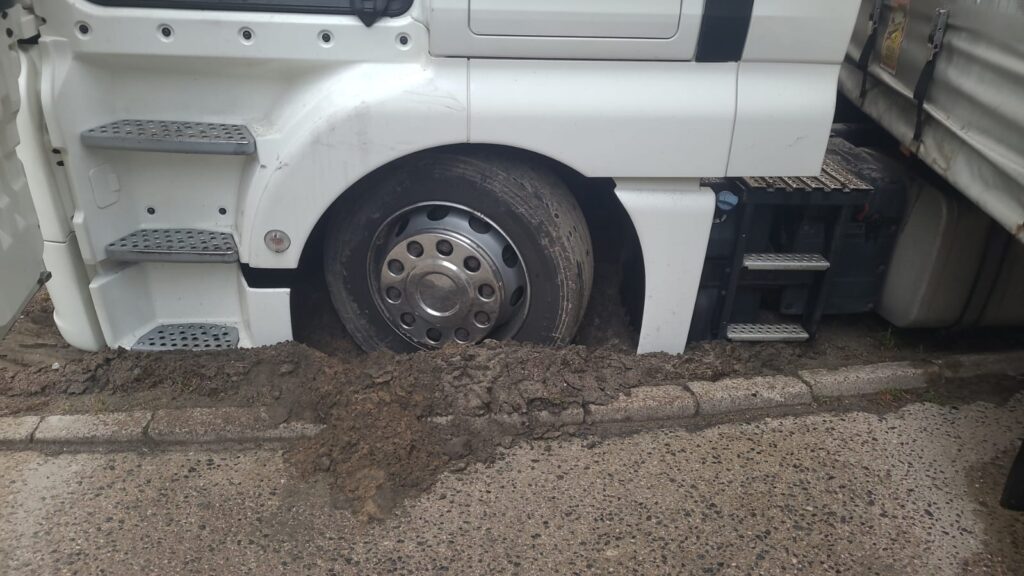
A semi-trailer truck buried up to its rims in the paving of a private yard looks, at first glance, like a write-off. In reality it is a problem that plays out somewhere in Germany almost every week: old cobble paving that was never built for a 40-tonne axle load, and a driver caught out on exactly the surface he trusted most.
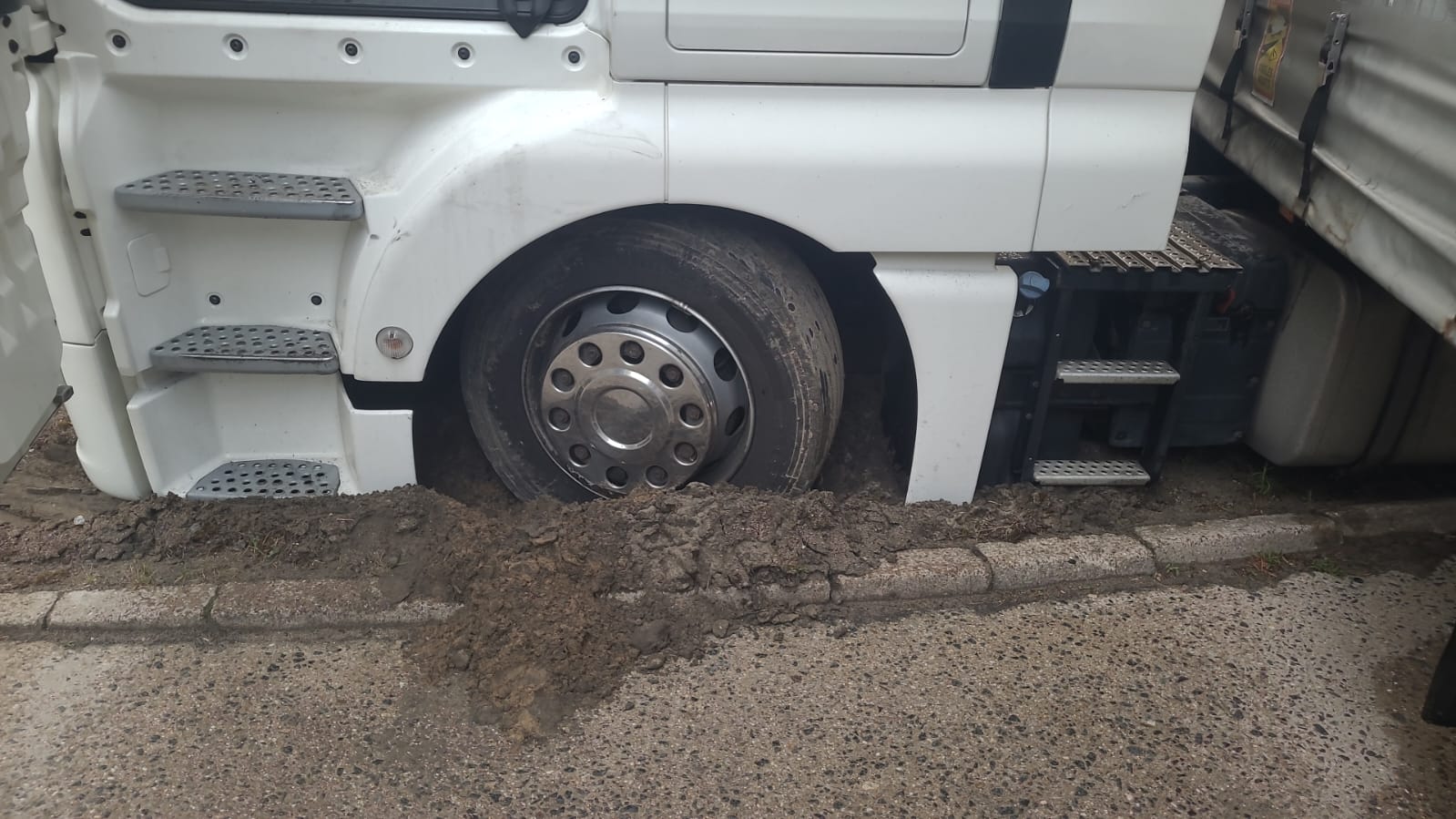
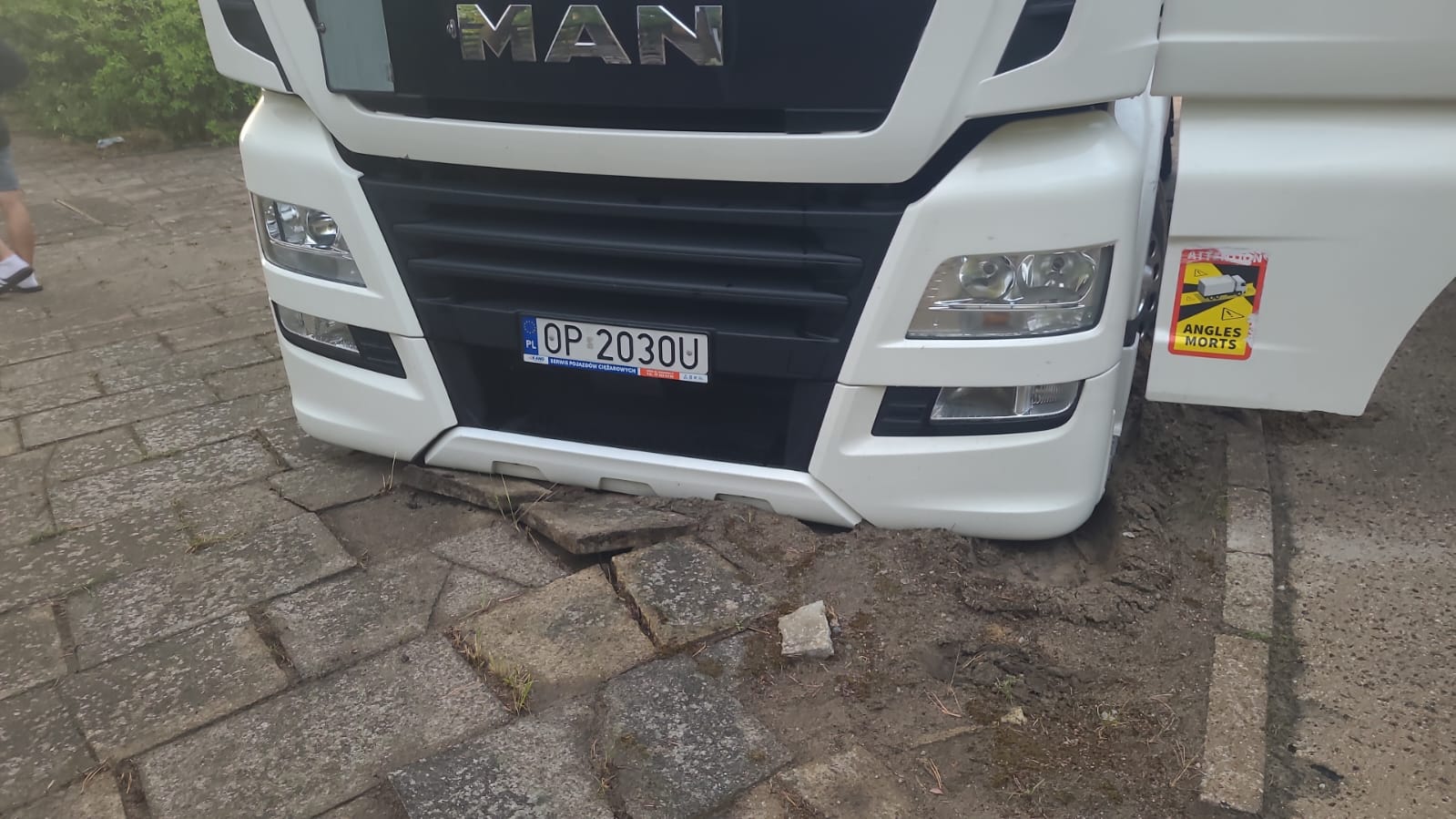
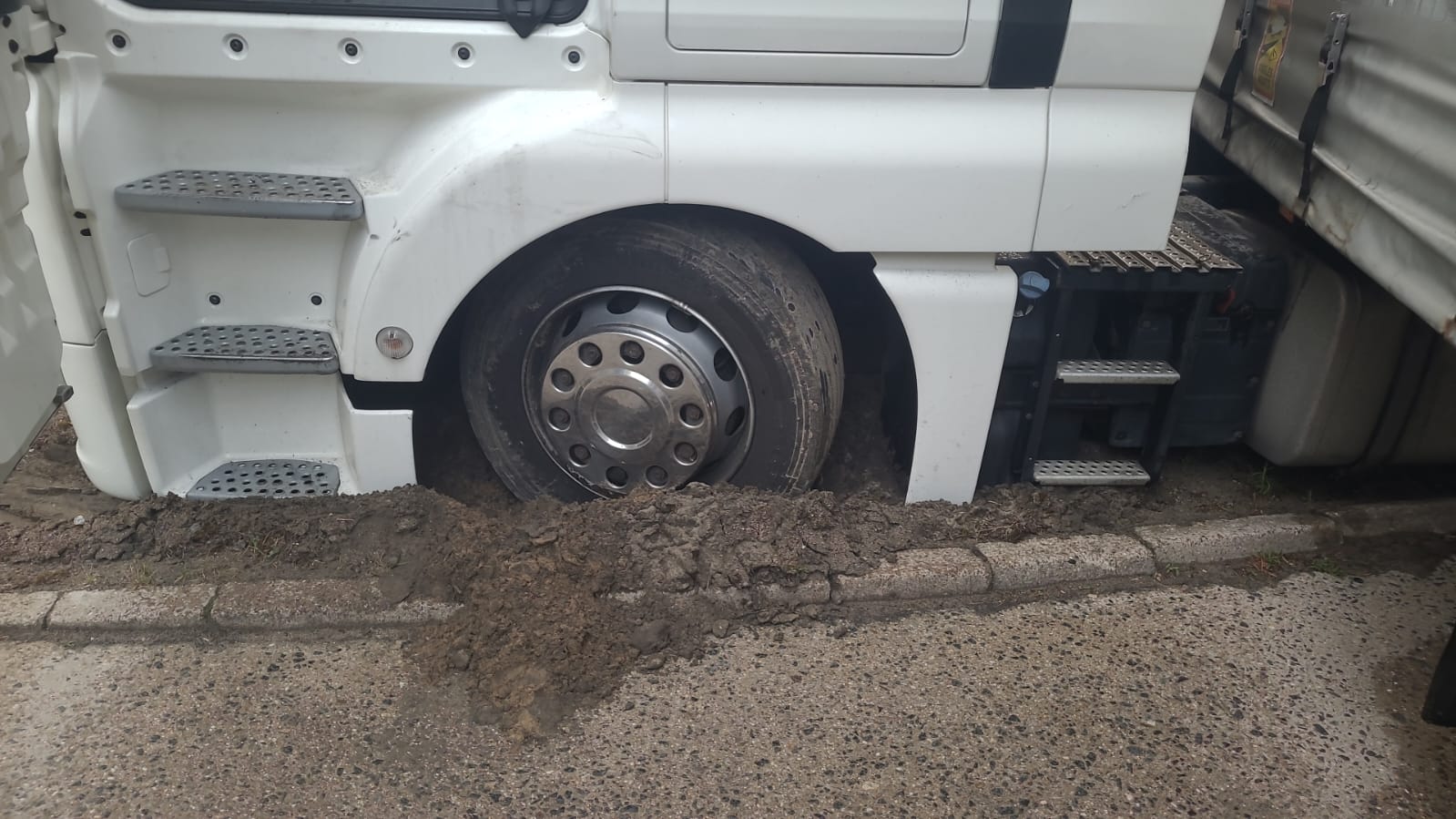
On 23 July, a MAN articulated lorry with Polish plates sank both drive axles through the block paving of an industrial yard in Duisburg. No motorway, no collision, just a surface that gave way under load. From the first call to handover, the recovery took 3 hours and 15 minutes, cost €1,680 net, and returned the artic to solid ground without further damage.
This report explains why yards and private sites are often more dangerous for HGVs than the autobahn, why you must never try to tow or drive out of a sunken vehicle under your own power, and how a professional recovery actually unfolds step by step.
The incident: sunk on private ground, not the road
A MAN artic with a curtain-sided trailer was due to load at a consignee’s yard in Duisburg. The access area was old block paving, apparently sound, driven over by delivery vehicles for years. While manoeuvring, the surface beneath the right-hand drive axle suddenly gave way. The paving blocks cracked open, loose, damp ground appeared underneath, and the truck settled several centimetres within seconds.
The driver stopped immediately, which was the right call. Any attempt to power out would only have worsened matters. Staff and bystanders gathered, some taking photos of an unusual sight: an 18-metre artic slowly sinking into the yard.
This is important context: this was not a road traffic accident and not a motorway situation. It was a private commercial site where the access route simply was not engineered for the weight of a loaded semi-trailer. Cases like this sit in their own category within HGV breakdown assistance, sometimes called recovery on private ground, with different equipment and procedure requirements than a standard motorway tow.
Why articulated lorries sink into yards and industrial sites
The public tends to picture HGV breakdowns happening on the motorway. In practice, a large share of recoveries happen away from it, on factory yards, storage sites, construction ground, and unpaved farm tracks. The causes repeat themselves:
- Old paving with no proper sub-base. Many yards were laid decades ago for lighter traffic. A compacted gravel base carries a van without complaint but collapses under a 40-tonner’s axle load once the compaction has degraded.
- Backfilled utility trenches. Where power, water or data cables were buried, the ground is often loosely reinstated. Invisible from above, but a hollow pocket waits underneath.
- Soft ground after rain. Moisture works into the joints between paving blocks, undermines the sub-base, and what held firm yesterday gives way under load today.
- Surfaces never rated for 40 tonnes. Manoeuvring areas near loading ramps are frequently sized for forklifts and cars, not the concentrated axle load of an artic turning.
- Hidden voids. Old drain shafts, settled foundation remnants, or leaking pipework washing out ground from below, none of it visible from the surface.
For a driver, this is nearly impossible to predict in advance. The paving looks intact right up to the point the vehicle’s weight delivers the decisive blow.
Why pulling with a rope or gunning the throttle makes it worse
The first instinct for many drivers is understandable: reverse or drive forward hard, maybe with a run-up. That instinct is precisely the biggest mistake here, for several reasons at once.
Spinning drive wheels dig deeper into soft or loose ground rather than finding traction. Every rotation worsens the starting point for the eventual recovery. What begins as a 15-centimetre sink can become 40 centimetres within minutes.
Even more dangerous is trying to pull the truck free with a second vehicle and a rope. An artic stuck in the ground creates enormous breakaway resistance. A sudden, jerking pull puts loads on half-shafts, the propshaft and universal joints that these components were never designed to absorb, and driveshaft failures are a common outcome of improvised pulling attempts. If an unsuitable tow rope or improvised strap snaps under that tension, the stored energy releases instantly. A rope failing under load can cause fatal injuries, and that is not an exaggeration, it is documented accident history. The fifth wheel coupling and chassis can also be damaged by a badly angled pull, with repair costs that dwarf the cost of the recovery itself.
The correct response is always the same: engine off, no more throttle, call a specialist.
The ADAC regularly points out that improper towing and recovery attempts remain among the most frequent causes of secondary damage to commercial vehicles, which matches what we see on site again and again.
How a professional yard recovery actually works
Recovering a truck from compacted but broken ground looks quite different from a standard motorway tow. Our partner network’s recovery crew works through defined steps:
- Ground and stability assessment. Before anything is touched, the crew establishes how deep the vehicle has settled, where solid ground begins, and where the recovery vehicle itself can stand safely.
- Uncoupling the trailer where possible. A detached trailer significantly reduces the weight being moved and allows the tractor unit to be recovered more precisely, without dragging the full combination.
- Packing with recovery mats and plates. Load-bearing plates or recovery mats are pushed under the drive wheels, spreading the load and restoring grip on a stable surface.
- Winching at the correct pulling angle. Unlike an improvised pull, the tension is applied in a controlled, shallow angle, increased in stages, with the vehicle’s behaviour monitored throughout.
- Jacking with hydraulic rams where needed. If a wheel sits deep in a void, the axle is lifted, the void is packed with fill material, and only then is the actual pull carried out.
- Re-coupling and function check. Once free, the trailer is reattached, brakes, air supply and lighting are all checked before the combination leaves the site.
This sequence is not arbitrary. Every step reduces the forces acting on the vehicle and minimises the risk of further damage to axles, chassis, or fifth wheel.
Who pays for the damaged paving?
A question that almost always comes up in cases like this is liability for the broken paving itself. As a general rule, if the surface was objectively not built to carry the vehicle’s axle load and the driver was proceeding with reasonable care, responsibility often falls on the site owner or operator who provided an unsuitable access route. That is not a blanket rule, though, it depends on the specific circumstances and is often settled between insurers.
A practical tip from experience: before anything is moved, the condition of the surface should be photographed – the crack in the paving, the position of the vehicle, any pre-existing damage to the surface. Those photos are frequently decisive later, when costs are being sorted out between the haulier, the site owner, and insurance. Forget this step in the panic of the moment, and you end up with a much weaker position afterwards.
Coordination with the site owner and limited manoeuvring space
Another difference from motorway recovery: on private ground, the site owner’s agreement is needed before heavy recovery equipment arrives. Usually that is straightforward, the owner wants the vehicle gone as much as the haulier does. It gets more complicated when the yard itself offers little room for a second recovery truck or winch vehicle, with loading ramps, parked trailers and building edges all narrowing the available space. Experienced dispatchers ask about access conditions on the phone before sending equipment, precisely so they don’t send a unit too large to turn around once it’s there.
Prevention: what drivers should check before entering unfamiliar yards
Most of these callouts are avoidable with a bit of caution:
- Give the surface a quick visual check before entering an unfamiliar yard: cracks, sunken patches or freshly patched areas are warning signs.
- Where possible, keep to continuous concrete lanes rather than manoeuvring across open block paving, particularly with a loaded trailer.
- If unsure, approach slowly in short stages rather than driving through in one continuous run.
- Turn a loaded semi-trailer on wide, properly surfaced areas rather than narrow paved strips between buildings.
- Take extra care on older paved or gravel surfaces after heavy rain, since softened ground beneath is not visible from outside.
Haulage dispatchers can also ask the consignee in advance whether the access route is rated for 40-tonne vehicles. That single question can save a costly recovery.
The full timeline
| Time | Phase | Action |
|---|---|---|
| 14:10 | Report | Call to emergency dispatch |
| 14:10–14:25 (15 min) | Dispatch | Partner crew in Duisburg alerted |
| 14:25–15:15 (50 min) | Travel | Drive to the yard |
| 15:15–15:45 (30 min) | Assessment | Ground checked, area secured |
| 15:45–16:15 (30 min) | Preparation | Trailer uncoupled |
| 16:15–17:10 (55 min) | Recovery | Recovery plates, winching, lifting |
| 17:10–17:25 (15 min) | Completion | Re-coupling, system check, handover |
Total time from call to handover: 195 minutes, or 3 hours 15 minutes.
That is considerably longer than a typical motorway tyre change (usually 90–120 minutes), but realistic for a recovery involving uncoupling, winching, and sub-base work. In heavier rain or with deeper sinking, this sequence can extend to as much as 4 hours.
Cost breakdown
| Item | Price (EUR, net) |
|---|---|
| Call-out fee | 280 |
| Assessment and site securing | 150 |
| Uncoupling and re-coupling trailer | 220 |
| Recovery operation (winch, plates, lifting) | 780 |
| Second recovery unit with vehicle | 250 |
| Total | 1,680 |
All figures are net, plus VAT. The price sits above a straightforward motorway tow (typically €850–1,600) because a second recovery unit was required and uncoupling the trailer added extra working time. For comparison, a stranded artic costs a haulier roughly €800–1,200 a day in lost running time, which is exactly why a fast, clean recovery beats days of waiting for an improvised fix.
Why this job needs professionals
- A wrong pulling angle can twist the axle. A winch pulling off-line rather than flat and straight overloads the steering knuckle and suspension at a single point.
- Improvised tow ropes snap under load and become a hazard to everyone nearby the instant that tension releases.
- Without knowing the ground’s bearing capacity, the recovery vehicle itself becomes a second casualty, an overweight winch truck on the same broken surface only compounds the problem.
- Improper jacking can cause chassis distortion that only surfaces weeks later as a suspension fault.
- Skipping coordination with the site owner can lead to disputes over access rights and liability before the actual work even starts.
Typical situations where we get called out
Beyond artics sunk in yard paving, common recoveries include:
- Tractor units stuck in mud on farm tracks and unpaved storage yards after rain.
- Articulated lorries losing traction on icy access roads in winter and ending up in the verge.
- Trucks that drift off a firm surface with one axle while manoeuvring near loading ramps.
- Vehicles sinking into freshly backfilled or poorly compacted ground on construction sites.
- Breakdowns on car parks with cracked, ageing surfacing similar to the case described here.
Extended context: tyres, axle load, and fleet care
Even though this callout was not a tyre failure, a truck’s ability to cope with difficult ground is closely tied to its technical condition. Tyres at the correct pressure, typically between 8.5 and 9.5 bar, distribute axle load more evenly and reduce concentrated stress points on soft surfaces. Manufacturers such as Michelin, Continental, Goodyear and Bridgestone offer specific tractor unit tread patterns with better grip on loose ground, which in a real situation can be the difference between staying upright and spinning uselessly. Regular checks of tread depth, tyre pressure and rim condition belong in every fleet’s basic prevention routine, alongside training drivers to assess unfamiliar access routes before committing to them. Manufacturers including MAN publish axle load guidance that can help fleets judge risky surfaces in advance.
Why hauliers and drivers choose us
Our dispatch desk is reachable 24 hours a day, 7 days a week, staffed in multiple languages, and works with a network of vetted recovery partners across Germany. We quote prices before work begins, no hidden line items, no surprises on the invoice. For drivers stuck on an unfamiliar yard, often far from home, what matters most is fast contact in their own language and a crew that has stood on broken paving before. Where follow-up repairs are needed, we can also route the job to our mobile truck service network.
Frequently asked questions
What does recovering a sunken articulated lorry cost?
In the case described here, the total came to €1,680 net, including call-out, assessment, uncoupling, winch recovery, and a second recovery unit. The exact price depends on how deep the vehicle sank, site access, and equipment required.
How long does a recovery like this take?
From the call to handover, this job took 3 hours 15 minutes. Deeper sinking or a tight site can extend the job to around 4 hours.
Who pays for the damaged paving?
It depends on the specifics of the case. Responsibility often sits with the site operator if the surface was not rated for the vehicle’s axle load. Photos taken before recovery work begins matter a great deal in settling this afterwards.
Can you try to drive out yourself?
No. Spinning wheels dig the vehicle in deeper, and pulling with a second vehicle can damage the driveshaft, universal joints, or fifth wheel coupling. In the worst case, an improvised tow rope snaps under tension.
Does every recovery need a second unit?
Not always, but for larger vehicles requiring trailer uncoupling on a tight site, a second unit is usually necessary to secure the tractor and trailer at the same time.
Is recovery on private ground covered the same way as on the motorway?
Broadly, yes, the same vehicle liability and insurance logic applies, though surface damage on private land raises separate questions about site liability that are settled independently.
Summary
- Vehicle: MAN articulated tractor with curtain-sided trailer, Polish plates
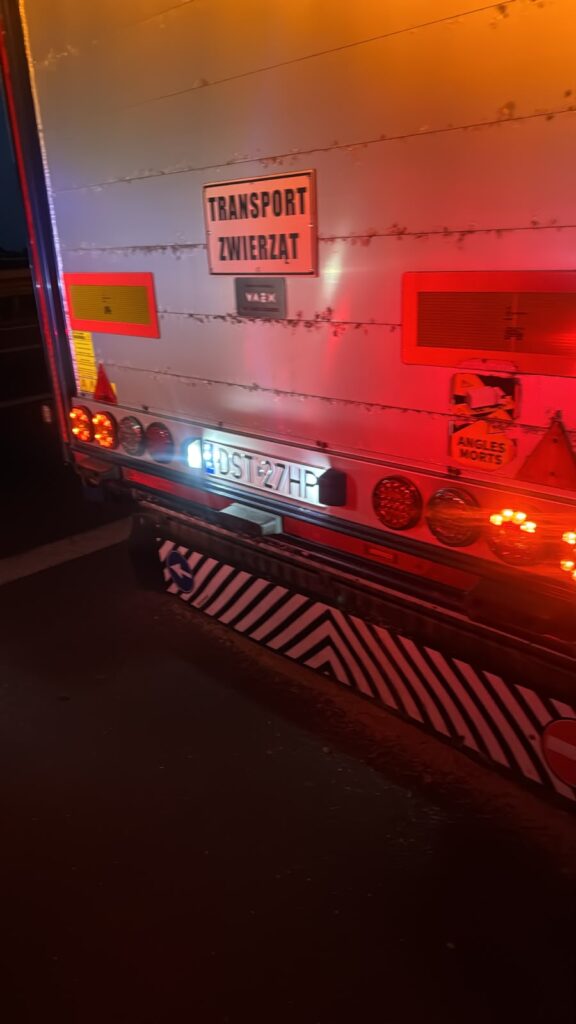
- Location: Industrial yard in Duisburg, private ground, not motorway
- Cause: Block paving collapse, both drive axles sunk
- Response time to arrival: 65 minutes (dispatch plus travel)
- Total time: 195 minutes (3h 15min)
- Cost: €1,680 net
- Secondary damage: None, vehicle fully roadworthy after recovery
Get help now
Is an artic stuck in a yard, on a construction site, or on unpaved ground? Call us on +49 160 5753826, we are available around the clock, every day of the week, across Germany. More information at www.lkwhelp24.com.
Keywords: truck recovery | articulated lorry sunk | recovery Duisburg | HGV stuck in paving | truck towing service | yard recovery | private ground recovery | 24/7 truck breakdown assistance
Related articles
- Towing Services: Truck Recovery in Winter
- Trucks Towing Service: How We Rescued a 25t Scania from the Mud in 85 Minutes in Regensburg (93055)
- How Much Does Trucks Towing Service Cost in Germany in 2026?
- Trucks Towing Service: Solutions Without a Local Card or Cash in Europe
- Truck Towing Service in Germany – 24/7 Heavy-Duty Assistance