Skip to content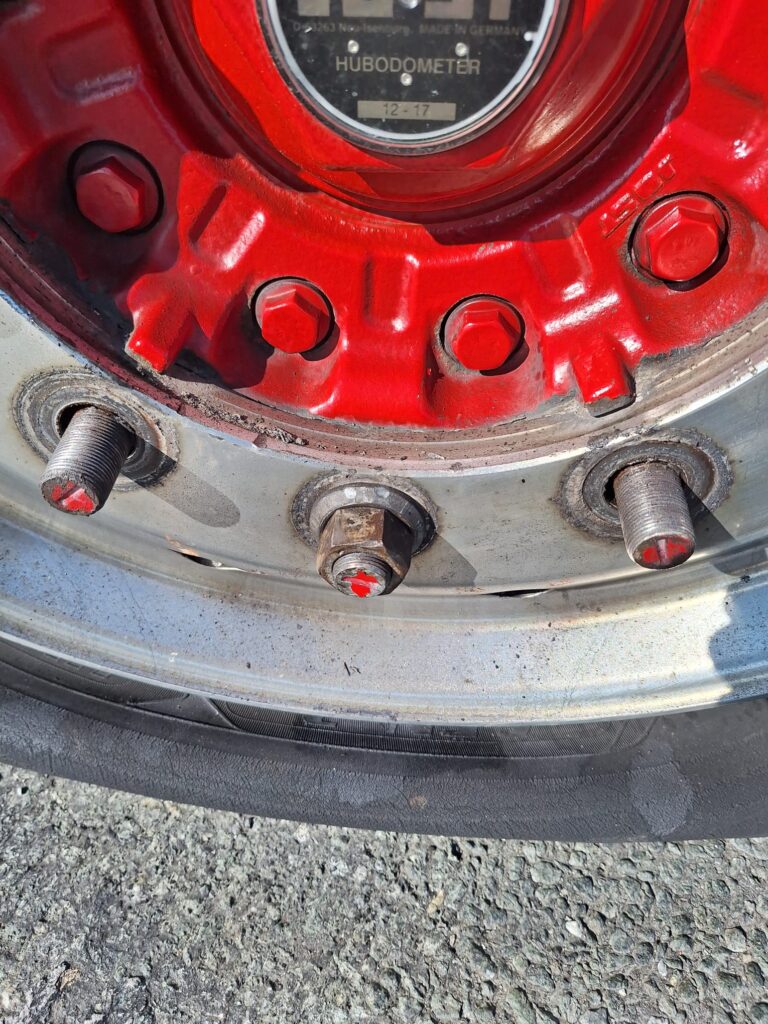
When a truck clips a kerb, the damage is not always visible from the cab. The wheel might still roll straight, the steering might feel normal, and a driver under time pressure is tempted to carry on. That is exactly the wrong instinct. A proper truck tyre service call after any kerb contact means pulling the wheel, checking the hub and mounting face, and refitting with a torque wrench rather than guessing.
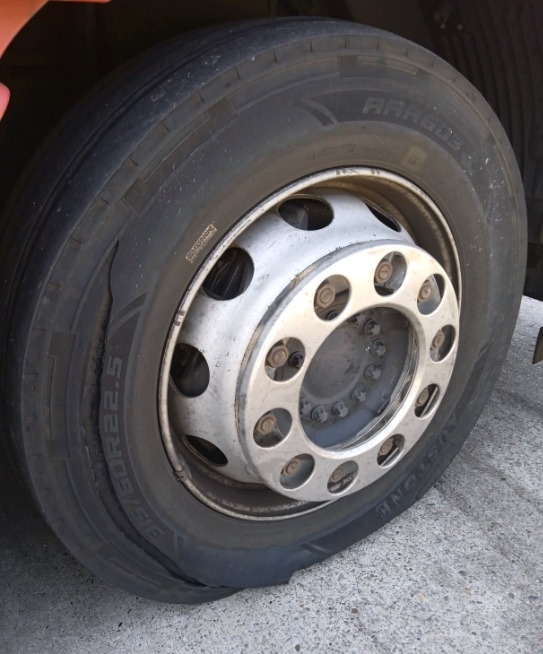
This case study covers a mobile wheel change carried out on 3 August in Mannheim, on a city street on the edge of an industrial estate. A delivery truck struck a kerb during a tight manoeuvre, and rather than send the driver back onto the road on a wheel of unknown condition, our dispatcher sent a technician to inspect, remove, and refit the wheel correctly. The whole job, from the first phone call to the truck rolling again, took one hour and fifty minutes.
The benefit of doing this properly is not abstract. A wheel nut that is under-torqued or fitted onto a dirty mounting face will loosen within a few kilometres, and a loose wheel on a truck axle is one of the more dangerous failures on the road — for the driver, for other traffic, and for the haulier’s liability if something goes wrong further down the line.
The emergency situation
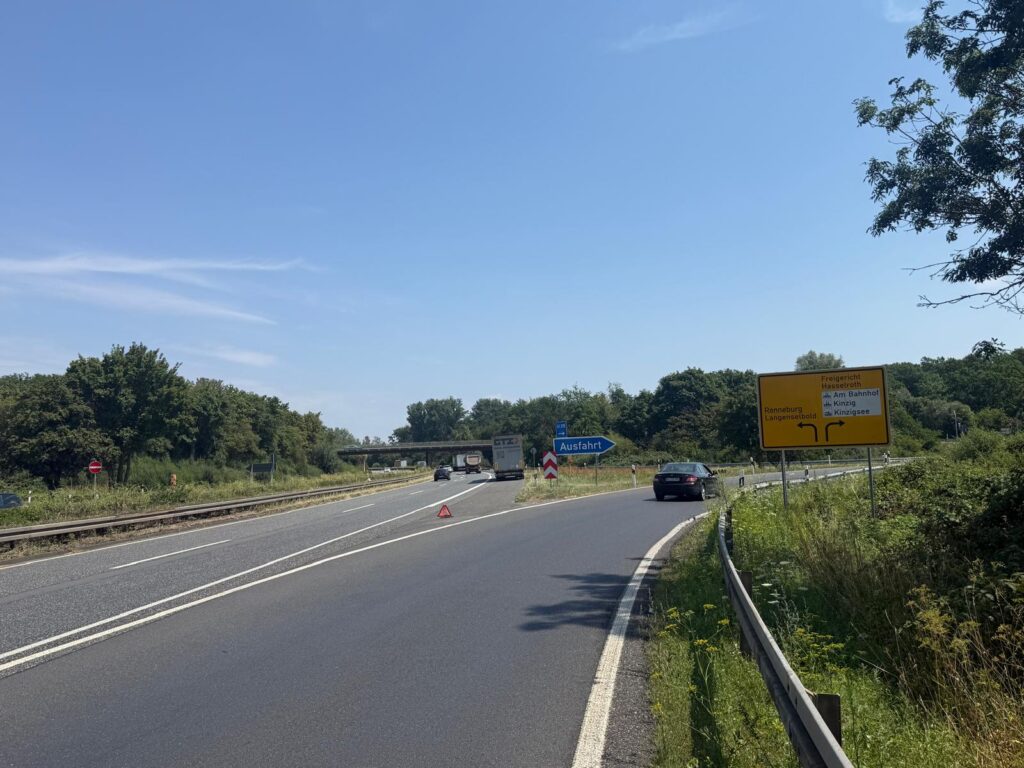
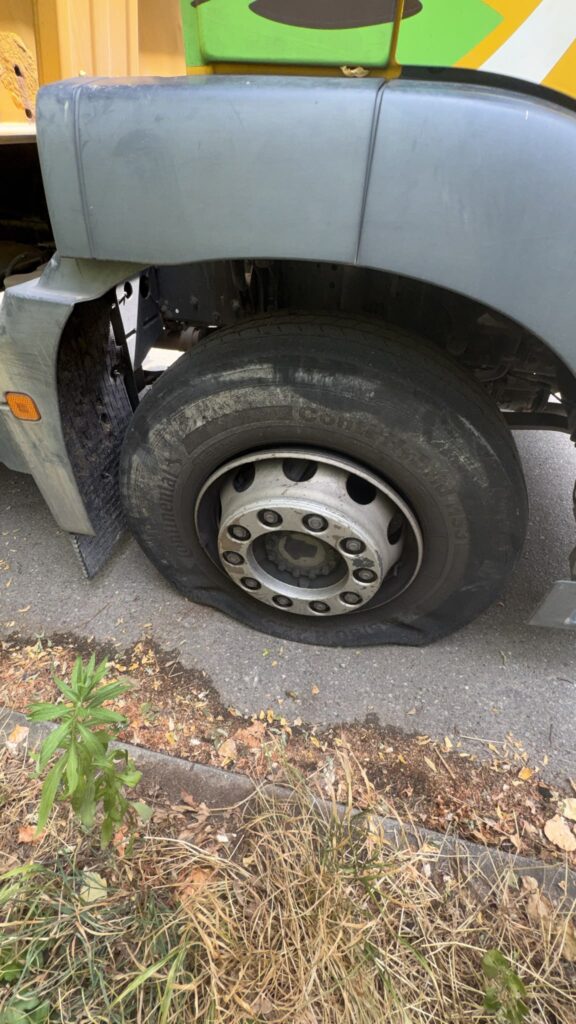
The call came in at 09:10 on a Monday morning. The driver had clipped a kerb while manoeuvring a delivery truck out of a loading yard near an industrial estate on the edge of Mannheim. Nothing dramatic — no bang, no obvious flat — but the driver heard a scrape and felt a slight vibration through the steering afterwards. He did the sensible thing and stopped rather than push on.
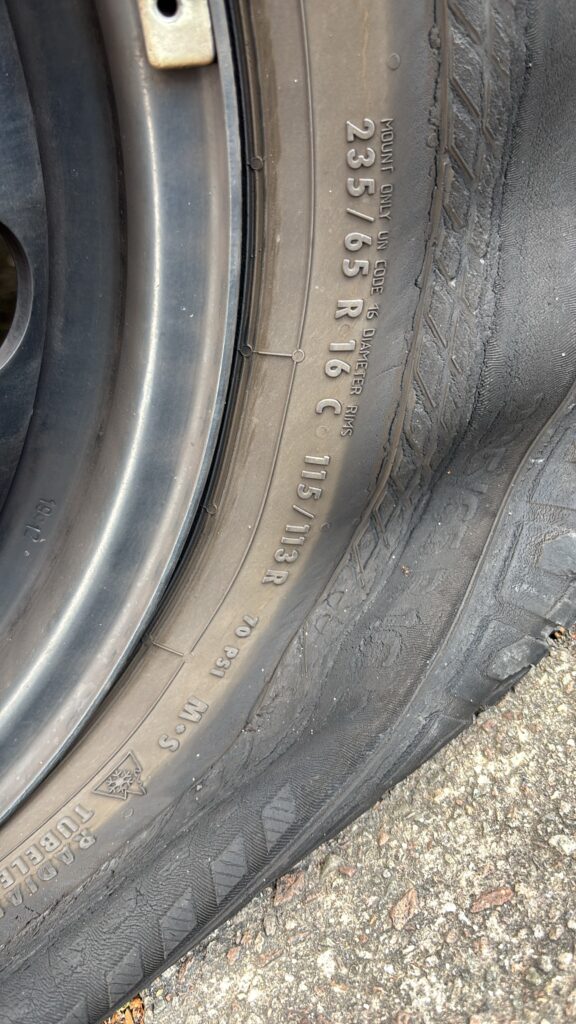
The wheel in question was fitted with a 245/70 R19.5 tyre, a common size on distribution trucks and light-to-medium rigids used for urban delivery work. This is not a motorway tyre size in the sense of a long-haul tractor unit on 315/80 R22.5 or 385/65 R22.5 rubber, but the fitting and torque requirements are governed by the same principles. A dented rim, a cracked mounting face, or a hub that has been knocked slightly out of true can all follow from what looks like a minor kerb strike.
How the help was organised
Our dispatch network covers Germany 24 hours a day, and for a job like this the priority is getting a technician who knows truck wheels — not car tyres — on site quickly.
- 09:10 — Call received, location and tyre size confirmed
- 09:25 — Job dispatched to our regional service partner, technician assigned
- 09:55 — Technician on site after a 30-minute drive through urban traffic
- 09:55 onward — Site secured and initial visual inspection begins
Dispatch time was 15 minutes, which is typical for an urban callout where we already have a vetted partner nearby. In our experience, a rural or motorway job with limited access points usually takes longer to reach, and in wet weather the drive itself takes longer regardless of distance.
Why this can’t be ignored
Truck tyres run at 8.5–9.5 bar depending on axle position and load, considerably higher than a car tyre. At that pressure, and with axle loads that can run into several tonnes per wheel position, a compromised rim or a loosely fitted wheel is not something to drive on and hope for the best.
A few points worth understanding here:
- The wheel hub and rim mating surfaces carry the entire clamping load. A film of rust or dirt as thin as 0.1 mm will compress under load within a few kilometres, and once it compresses the nuts lose tension — the wheel develops play even though it was torqued correctly at fitting.
- Truck wheels use hub-centric or stud-centric centring depending on the axle and rim design. On a hub-centric wheel the hub itself takes the radial load and the nuts only clamp; on a stud-centric wheel the studs and nuts do both jobs. Steel rims are usually stud-centric, many alloy rims are hub-centric — mixing up the approach at fitting is a common source of later looseness.
- A kerb strike can crack a rim near the stud holes or throw it slightly out of round (rim run-out), and a bent truck rim must never be straightened on-site. It gets replaced.
The BPW axle and hub systems commonly fitted to European trailers and rigids are engineered to tight tolerances, and a hub that has taken an impact needs a proper visual and, where possible, dial-gauge check before the wheel goes back on.
Step-by-step repair
Step 1 — Inspection. The technician checked the tyre for obvious damage, then looked at the rim edge and the area around the kerb contact point for scuffing, cracking or deformation.
Step 2 — Securing the scene. Warning triangle out, hi-vis vest on, wheel chocked. Standard practice even on a quiet estate road, because a truck up on a jack with one wheel off is a hazard to anyone walking or driving past.
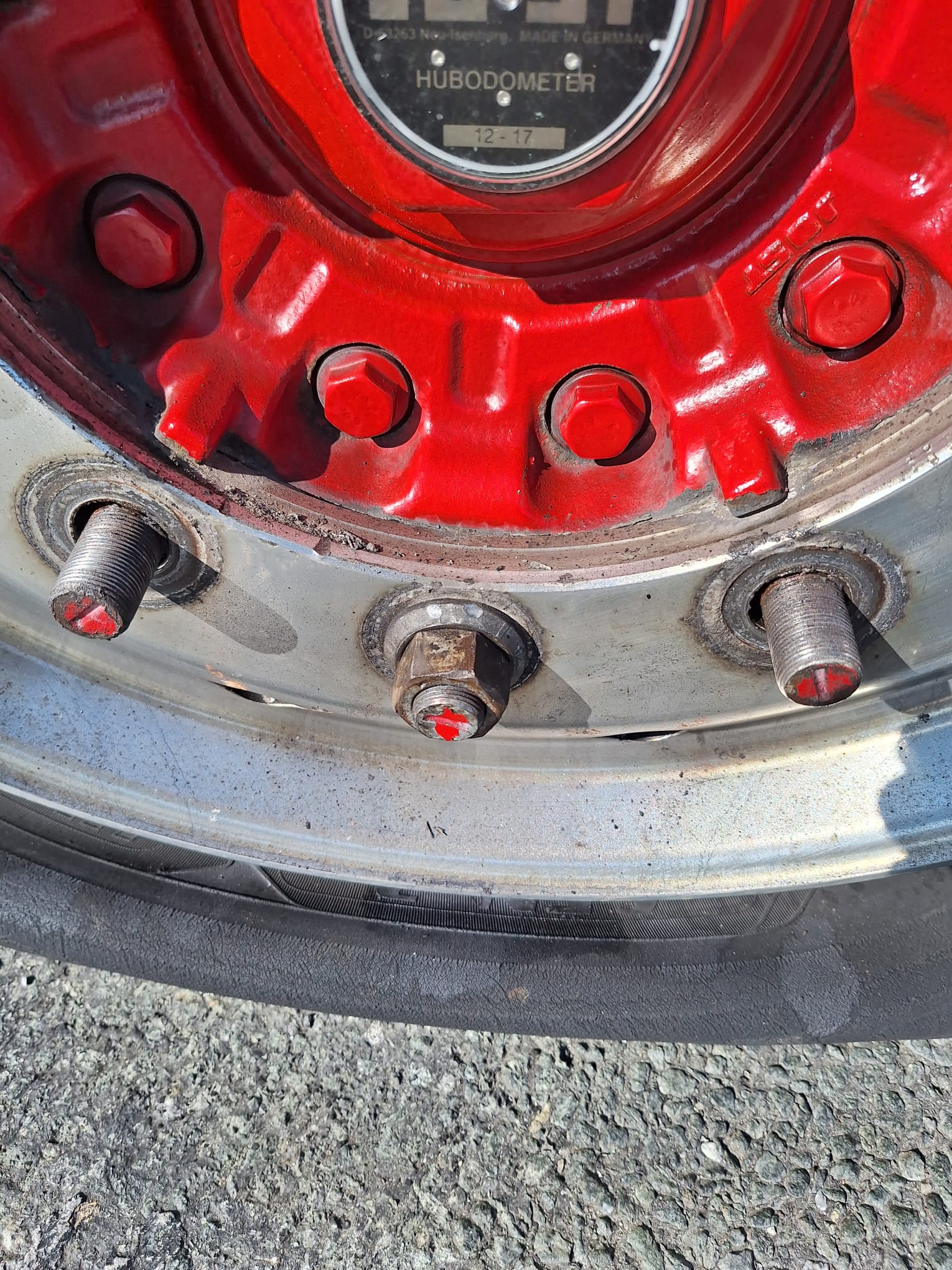
Step 3 — Removal. Before taking the nuts off, the technician marked the position of each nut and its relation to the stud with a chalk marker. This is a simple but effective control: on the next walkaround, a driver can glance at the marks and instantly see if a nut has rotated, which means it has loosened.
Step 4 — Hub, mounting face and rim check. With the wheel off, the hub face, wheel studs and rim mounting face were cleaned and inspected for rust, pitting, cracks near the stud holes and any sign of run-out. This is the part of the job that a driver simply cannot do at the roadside without a lift and the right light.
Step 5 — Refitting and final check. A new 245/70 R19.5 tyre was fitted, the wheel was mounted on the cleaned faces, and the nuts were tightened in a star pattern — that is, working across the hub diagonally rather than around it in a circle. Tightening in a circle pulls the rim slightly off-centre and produces uneven clamping load, which is exactly what causes a wheel to run untrue afterwards. The nuts were then torqued with a calibrated torque wrench, not an impact gun by feel, to the manufacturer’s typical figure for M22 truck wheel nuts of 600–650 Nm. Positions were marked again for the driver’s future reference, and the job was documented.
Full timeline
| Time | Phase | Action |
|---|---|---|
| 09:10 | Call received | Location and tyre size confirmed |
| 09:25 | Job dispatched | Local partner assigned (15 min dispatch) |
| 09:55 | Technician on site | 30 min drive, urban |
| 09:55–10:05 | Site secured | Visual inspection |
| 10:05–10:20 | Hub check | Hub, mounting face and rim checked for damage |
| 10:20–10:45 | Wheel work | Wheel removed and refitted (new tyre 245/70 R19.5) |
| 10:45–11:00 | Torque & sign-off | Star-pattern torque with torque wrench, documentation, nuts marked |
| 11:00 | Back in service | Vehicle back in service |
Total time from call to vehicle ready: 1 hour 50 minutes.
Cost
| Item | Price (EUR, net excl. VAT) |
|---|---|
| Call-out (urban) | 190 |
| Labour (approx. 70 min at €120/h) | 140 |
| Tyre 245/70 R19.5 | 380 |
| Old tyre disposal | 20 |
| TOTAL | €730 net (excl. VAT) |
Price drivers here are straightforward: urban call-out fees are lower than motorway or rural ones because access and safety setup take less time, tyre price depends on size and brand, and labour reflects the extra 15–20 minutes spent on the hub inspection rather than a straight swap. For comparison, downtime for a delivery truck typically costs the operator around €800–1,200 per day in lost delivery capacity and driver hours. At €730 total, the call-out effectively paid for itself against a single lost day.
Why you need a professional
Fitting a truck wheel looks simple from the outside — jack it up, swap the wheel, tighten the nuts. In practice there are several ways to get it wrong that are not obvious until the wheel comes loose weeks later.
- No torque wrench, or an impact gun used “by feel” — over-tightening stretches the studs permanently, weakening them, while under-tightening leaves the wheel prone to loosening under vibration
- Tightening nuts in a circular sequence instead of star-pattern, which distorts the rim seating and leads to uneven clamping
- Skipping the mounting-face cleaning step, leaving a thin layer of rust or grime that compresses after a few kilometres and drops clamping tension
- No re-torque check at 50 km — the single most commonly ignored rule in wheel fitting, despite bedding-in of new fittings being a well-documented and predictable process
- Missing rim damage from a kerb strike because the wheel was refitted without checking the hub or the mounting face at all
Wheel loss on trucks is not a rare event. It happens often enough that hauliers and carriers face direct liability questions when it does — for the vehicle, for anyone hit by a detached wheel, and for the load itself if the truck comes to a stop unexpectedly. We covered a case of exactly this outcome in Truck Loses 2 Wheels Near Hannover – Sheared Bolts, where inadequate fitting was the root cause.
Typical call-outs we handle
Wheel and tyre problems on trucks come in various forms across Germany, not just kerb strikes:
- Tyre blowouts on the autobahn, including on articulated lorries and tractor units — see our write-up of a DAF XF blowout near Duisburg
- Slow punctures discovered during a pre-trip walkaround, on trailer axles as well as drive and steer axles
- Wheel nuts found loose or missing during routine checks
- Sidewall damage from kerbs, potholes or debris on both trucks and vans
- Full wheel changes where a spare is not carried, common on rigid distribution trucks and box vans
We handle these across trailer, tractor unit, rigid and van fleets, on motorway hard shoulders as much as on city streets and industrial estates.
Prevention: tips for drivers and fleets
A handful of habits reduce the risk of hub and wheel problems considerably:
- Walk around the vehicle after any kerb, pothole or low-speed impact and look at each wheel for scuffing or an odd angle.
- Check that chalk or paint marks on wheel nuts (if your fleet uses them) line up correctly — any rotation means a nut has moved.
- Respect the 50 km re-torque rule after any wheel has been removed and refitted, whether by your own workshop or a roadside service.
- Keep an eye on tread depth and tyre pressure as part of routine checks, not just before long trips — German law under §36 StVZO sets minimum tread depth requirements, and running under-inflated increases both fuel use and blowout risk.
- Log driving hours realistically so pre-trip checks are not the first thing skipped when a schedule gets tight.
Tyres and fleet maintenance: what actually matters
Tyre brand matters less than people assume once you are talking about correct fitting, but it is not irrelevant. Michelin, Continental, Goodyear and Bridgestone all produce truck-specific ranges engineered around carcass strength, load index and wear patterns suited to steer, drive or trailer axle duty, and fleets that standardise on one or two brands tend to have an easier time with wheel balancing and matching tread patterns across an axle. What none of them can compensate for is poor fitting practice — a premium tyre on a badly torqued wheel fails just as readily as a budget one.
Fleet maintenance programmes that build in regular tyre pressure checks, tread depth monitoring and hub inspections after any impact catch problems before they become breakdowns. Organisations such as ADAC and DEKRA publish guidance on commercial vehicle tyre and wheel maintenance that is worth building into a fleet’s standard operating procedure, particularly around inspection intervals after kerb or pothole contact.
Why choose us
We run a 24/7 dispatch operation across Germany with a vetted partner network of technicians who work on trucks, not just cars — the distinction matters when the job involves M22 wheel nuts and torque values several times higher than a passenger vehicle. Pricing is agreed and confirmed before work starts, with no surprises on the invoice, and our dispatch team handles calls in German, English and other languages, which matters when a driver on an international route needs help fast and isn’t fluent in German.
FAQ
What does a truck wheel change cost in Germany?
For an urban call-out with a standard tyre size such as 245/70 R19.5, expect a total in the region of €700–800 net, covering call-out, labour and the tyre itself. Motorway or rural jobs, larger tyre sizes like 315/80 R22.5, or overnight callouts typically cost more due to access, safety setup and time.
How long does a mobile truck wheel change take?
In this case, from call to vehicle back in service was 1 hour 50 minutes, including a full hub and mounting-face inspection after a kerb strike. A straightforward tyre swap without an inspection step can be quicker, often under an hour once the technician is on site.
Who pays for the callout — driver, haulier or insurance?
This depends on the contract in place. Many hauliers have a standing agreement with a roadside assistance provider that bills the fleet directly; others require the driver to pay on-site and claim it back. We confirm the arrangement with dispatch before work begins.
How often should wheel nuts be re-torqued after fitting?
The standard rule is a re-torque check after approximately 50 km, because new or refitted fastenings settle and lose a small amount of tension as surfaces bed in. This is the step most often skipped, and it is a leading contributory factor in wheel-loss incidents.
Can a bent rim be straightened at the roadside?
No. A truck rim that has been bent or cracked by a kerb or pothole impact should be replaced, not straightened on-site. Continuing to run a distorted rim risks uneven tyre wear, air loss and further cracking under load.
What tyre pressure should a truck run?
Typical truck tyre pressures run 8.5–9.5 bar depending on axle position, load and manufacturer specification. Always check the plate or manual for the specific axle and vehicle, since steer and drive axle pressures often differ from trailer axle pressures.
Summary
- Tyre size: 245/70 R19.5
- Location: Mannheim, city street on the edge of an industrial estate
- Response time: 30 minutes drive after 15-minute dispatch
- Total time: 1 hour 50 minutes, call to vehicle back in service
- Total cost: €730 net (excl. VAT)
- Secondary damage: none found after hub and mounting-face inspection; wheel refitted with star-pattern torque at 600–650 Nm and positions marked for future checks
Need a truck tyre service, anywhere in Germany, right now?
Call +49 160 5753826 — we dispatch 24/7, across Germany, with technicians who understand truck wheels and torque specifications, not just tyre swaps. More at www.lkwhelp24.com.
Related services: Tyre Service | Truck Service | Mobile Truck Service | Towing Service | Contact Us
Keywords: truck tyre service | truck wheel change | mobile truck tyre service Germany | wheel torque truck | hub inspection kerb damage | 245/70 R19.5 | truck breakdown assistance | 24/7 truck roadside assistance | wheel nut torque M22 | star pattern tightening