Skip to content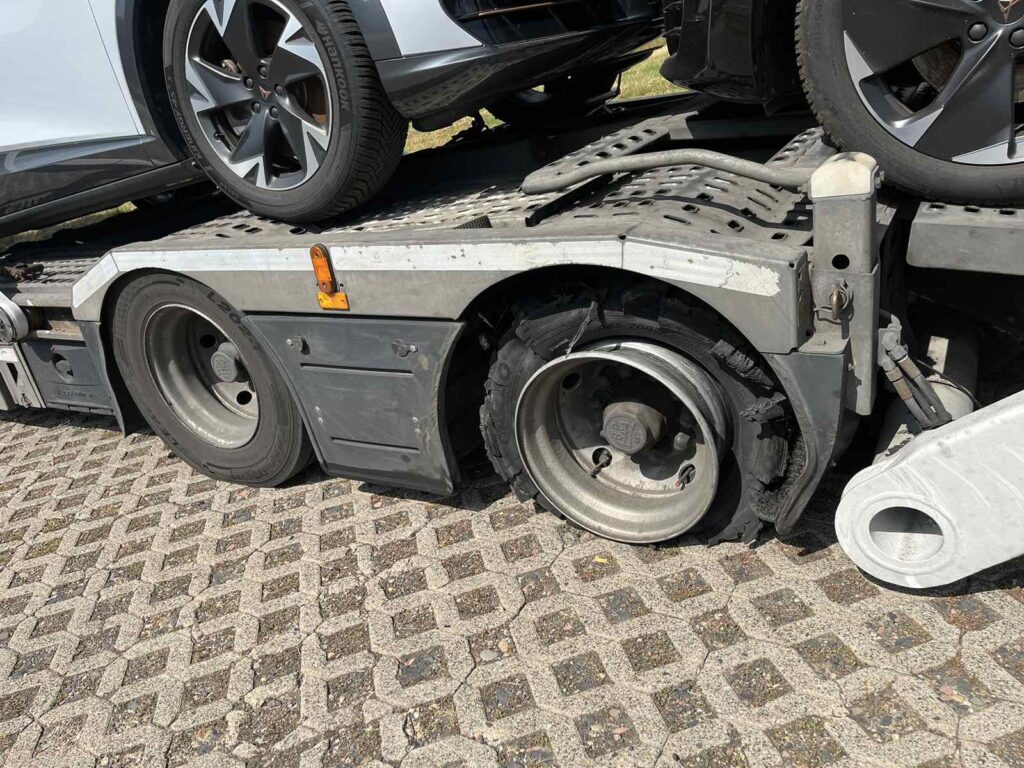
A car transporter loaded with new vehicles on its upper deck rarely gets a quiet manoeuvre. Narrow lanes, tight full-lock turns, and a trailer that has to be threaded between rows of parked stock all put strain on the tyres long before the vehicle ever reaches a motorway. On 5 August, that strain caught up with one driver at the car terminal in Bremerhaven, where a rear trailer tyre let go while the rig was still being positioned inside the yard.
This is not the usual roadside blowout story. There was no hard shoulder, no passing traffic, no autobahn recovery lane. The truck tyre service call in this case played out entirely inside a working seaport logistics yard, with a loaded deck of cars sitting a few metres above the technician’s head and a terminal schedule ticking in the background. That combination changes almost everything about how the job has to be done.
Our dispatch centre logged the call at 09:15. By 11:35 the transporter had cleared the yard under its own power, cargo untouched, paperwork in hand. What happened in between says a lot about why fixing a tyre on a car-carrier trailer is a different trade from fixing one on a curtainsider.
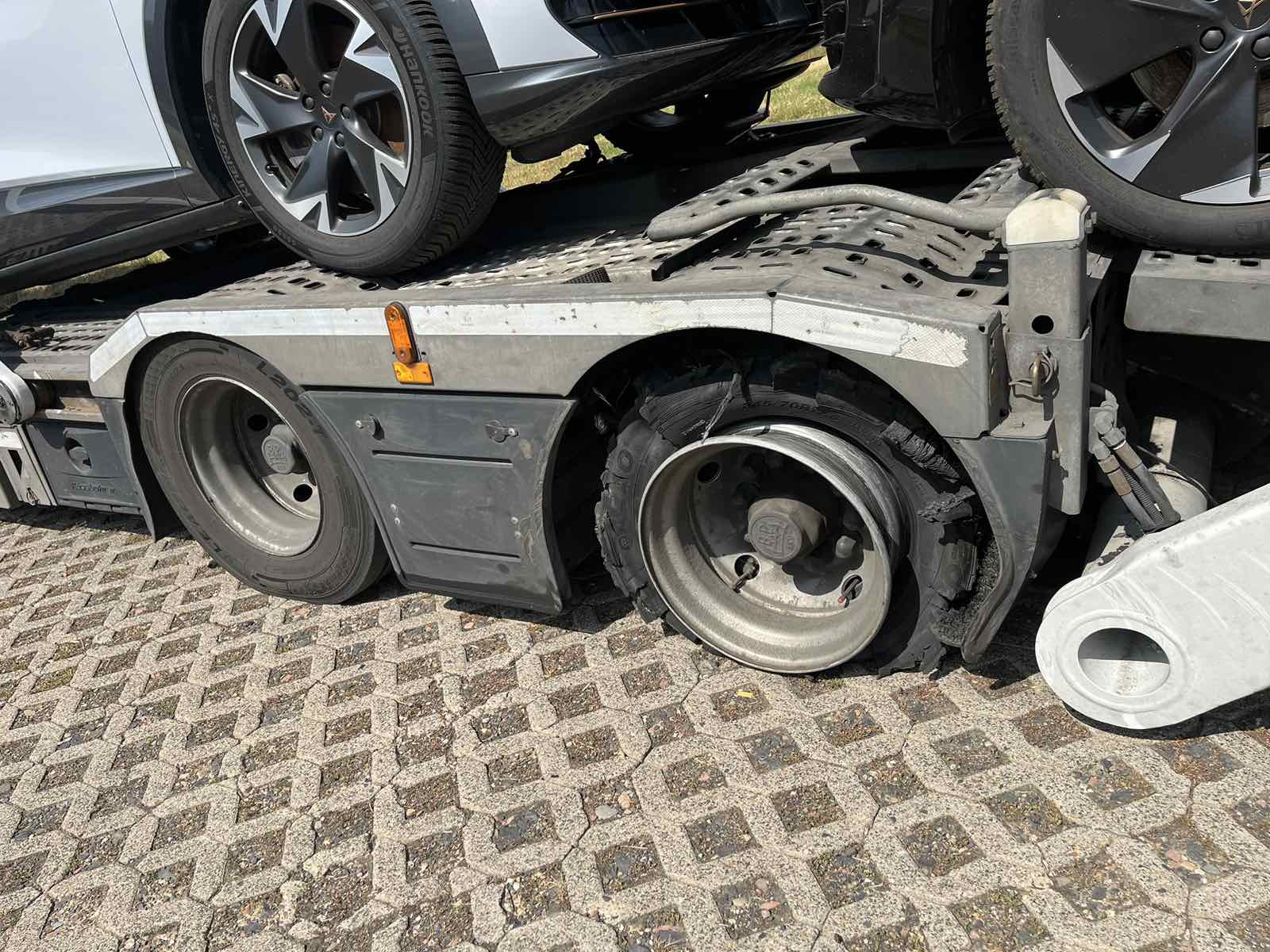
The emergency: a blowout inside the terminal, not on the road
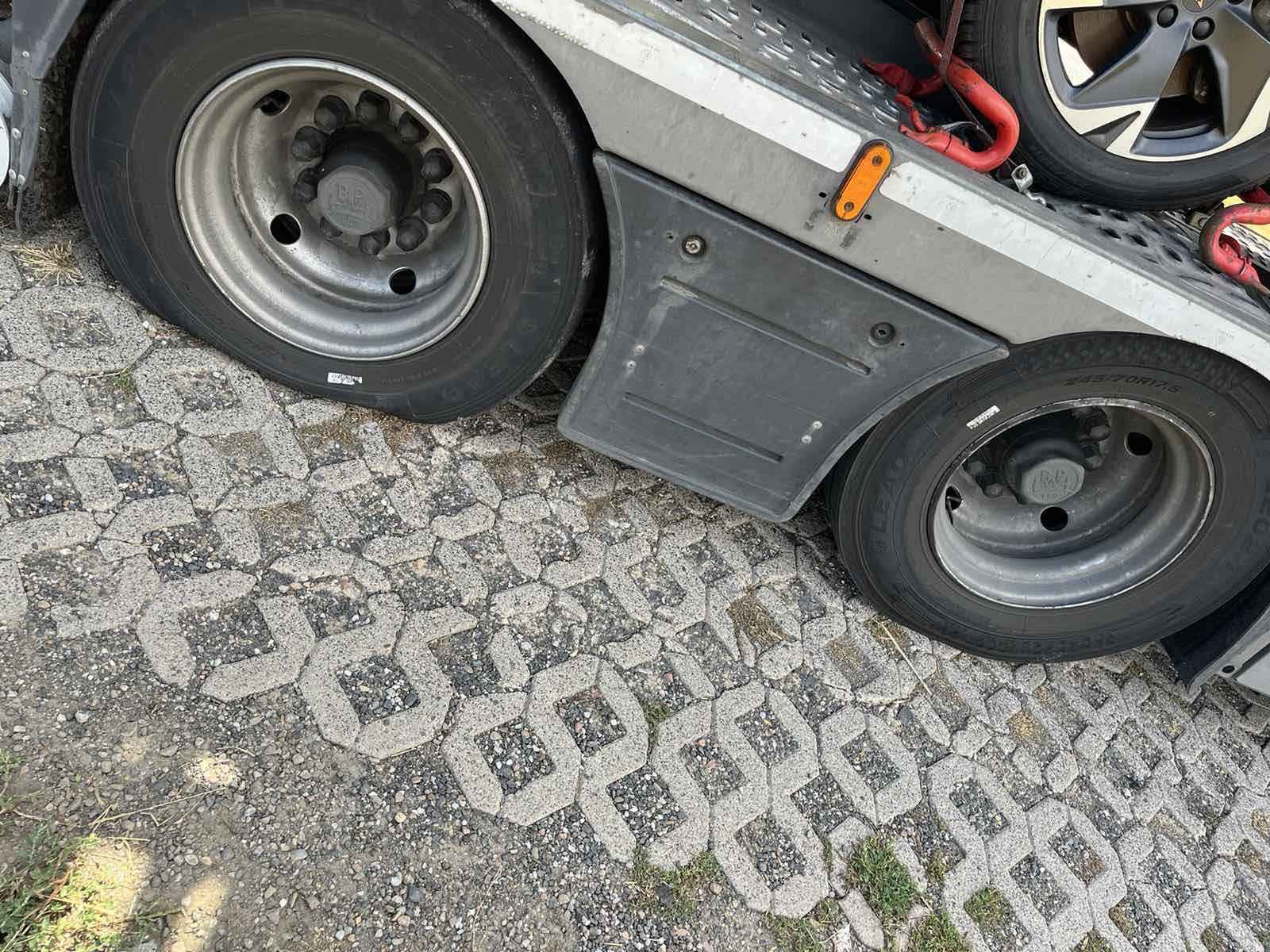
The location matters here. This was not a breakdown on the A27 or any other stretch of autobahn — it happened directly at the car terminal of the seaport in Bremerhaven, on a paved logistics yard used for loading and staging vehicles onto and off transporters. The car transporter, carrying a full load of new cars on its hydraulically raised upper deck, suffered a sudden tyre blowout on one of the trailer axles while manoeuvring between rows of parked stock.
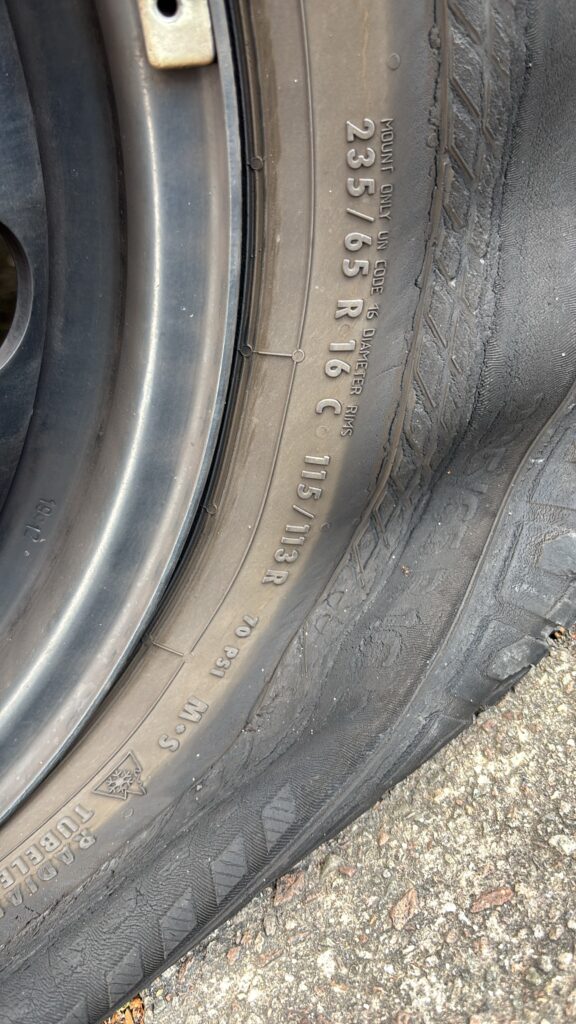
The tyre in question was a 215/75 R17.5, the standard low-profile size fitted to most car-carrier trailers and rigid car transporters operating in Germany. Photographs taken at the scene showed the casing torn open, the steel belt exposed, and the rim visible through what remained of the tread — a textbook sidewall failure rather than a slow puncture. The neighbouring wheels on the same axle group were undamaged, which the technician confirmed and photographed before touching anything.
A tyre failure like this at a terminal is a hazard on two fronts. First, the trailer itself becomes unstable on one corner, which matters more on a car transporter than on almost any other type of trailer because of the raised deck. Second, the yard keeps moving around the stricken vehicle — other transporters, forklifts, and terminal staff still need access to adjacent lanes, so the truck cannot simply be left where it stopped.
How help was arranged
The driver’s dispatcher rang our 24/7 line just after 09:15 with the basics: location, vehicle type, and a description of the damage. Because the job specifically mentioned a car transporter, our controller immediately flagged it as a load-securing case rather than a routine tyre change, which changes which technician and which equipment get sent.
The steps that followed:
- Location and tyre size confirmed with the driver (215/75 R17.5, trailer axle)
- Our local service partner in Bremerhaven briefed on the cargo type and the need for load-securing precautions
- A technician experienced with car-carrier trailers dispatched from the nearest depot, with a spare tyre of the correct size and load rating already on the van
- Terminal access details relayed so the crew could reach the yard without delay at the gate
- Estimated arrival communicated back to the driver and the terminal coordinator so the loading slot could be adjusted if needed
This last point is not a courtesy detail. A car transporter sitting immobile inside a terminal blocks a lane other trucks need, so the terminal’s own staff wanted an arrival estimate as much as the driver did.
On-site situation: why a car transporter is not a normal tyre job
By the time the technician arrived at 10:05, the yard was still busy — other transporters queuing for loading slots, terminal forklifts crossing between rows. The truck had been left where it stopped, hazard lights on, with warning triangles set out in line with standard breakdown practice even though this was a yard rather than a public road.
A loaded car transporter is a genuinely different animal from a standard articulated lorry. The upper deck, once hydraulically raised to load or unload vehicles, sits high and carries a shifting centre of gravity — new cars are strapped down at the wheels, not bolted to a fixed chassis, so the whole assembly behaves less predictably than a solid load of pallets. On this rig the deck was lowered and the load already fully strapped for transit, but the axle carrying the burst tyre was still bearing a share of several tonnes of vehicle weight unevenly distributed across the trailer.
You cannot simply jack a rig like this the way you would a curtainsider. The weight distribution of the loaded upper deck has to be accounted for before any lift begins, because raising one corner of a car transporter can shift load pressure onto straps and axles that were never meant to carry it that way. In some cases the deck has to be partially lowered, or a section of the load repositioned, before a jack can even be placed safely. On this job the crew opted to use a low-profile hydraulic jack rated for the full corner weight, supported by axle stands positioned only after confirming the trailer’s parking brake and wheel chocks were holding on the paved yard surface — no partial unloading was required, but the option was assessed and ruled out only after checking strap tension and deck angle.
For comparison, a standard truck tyre runs at 8.5–9.5 bar depending on axle load and manufacturer specification — considerably higher than a car or van tyre, which is one reason a sudden failure is so violent. Axle load on a car transporter trailer varies by position but commonly reaches several tonnes per axle when fully laden, meaning the remaining tyres on that axle group were carrying extra load the moment their neighbour failed. The rim itself was inspected closely for damage, since running even briefly on a collapsed tyre can deform or crack a steel rim, and a car transporter’s high per-tyre load makes rim damage a real risk rather than a formality.
The cargo made the whole job higher stakes. New cars worth hundreds of thousands of euros between them sat a few centimetres from where the jack and tools were being positioned. A single scratch or paint chip on any one of those vehicles turns into a dealer claim, and dealer claims are far more expensive and far slower to resolve than a tyre change. That is why the crew worked with protective covers laid across the lower edges of the deck and the nearest vehicle wheels, and why photographs were taken of the whole scene before any tool touched the trailer.
Step-by-step repair
Step 1 — Inspection. The technician walked the full axle group, checked the burst tyre’s failure point, inspected the rim for cracking or deformation, and checked tyre pressure and tread on the remaining wheels of the same trailer.
Step 2 — Securing the load and the site. Wheel chocks confirmed, parking brake checked, warning triangles placed, protective covers laid over the deck edge and neighbouring vehicle tyres. Before photographs taken of the damaged tyre, the rim, and the surrounding cargo — a step that is not optional on a job like this, for reasons covered below.
Step 3 — Removal. Wheel nuts loosened before the partial lift, trailer raised just enough to clear the damaged tyre using a jack rated for the corner weight, wheel removed and set aside for disposal.
Step 4 — Fitting. New 215/75 R17.5 tyre fitted to the rim, mounted onto the hub, and wheel nuts tightened in a cross pattern to the manufacturer’s specified torque — critical on a car transporter, where an unevenly torqued wheel can work loose faster given the constant full-lock manoeuvring these trailers do inside terminals.
Step 5 — Final check. Tyre pressure set and verified, a visual check made of the neighbouring wheels on the same axle for any secondary stress damage, and after photographs taken to close out the load-securing record before the trailer was cleared to move.
Full timeline
| Time | Phase | Action |
|---|---|---|
| 09:15 | Emergency call | Report of a tyre blowout on a car transporter reaches the dispatch centre |
| 09:15–09:25 (10 min) | Dispatch | Local partner in Bremerhaven briefed, tyre size 215/75 R17.5 confirmed |
| 09:25–10:05 (40 min) | Response drive | Technician reaches the logistics yard at the car terminal |
| 10:05–10:15 (10 min) | Assessment | Load-securing check, photos taken before work begins |
| 10:15–11:20 (65 min) | Tyre change | Securing the vehicle, partial lift/lowering, removal, fitting, cross-pattern torque |
| 11:20–11:35 (15 min) | Final check | Tyre pressure, visual check of neighbouring wheels, after photos |
Total elapsed time from the emergency call to the transporter clearing the yard: 2 hours 20 minutes.
Costs
| Item | Price (EUR) |
|---|---|
| Call-out | €190 |
| Labour (1.5 hrs at €110/hr, higher due to load-securing precautions) | €165 |
| Tyre 215/75 R17.5 | €295 |
| Old tyre disposal | €20 |
| Total | €670 net, plus VAT |
The labour rate on this job ran above a standard tyre change because of the extra time spent on load-securing checks, protective covers, and before/after documentation — none of which is optional when new vehicles are within touching distance of the jack. Tyre price varies by brand and load rating; 215/75 R17.5 is a widely stocked size, which kept sourcing straightforward.
Set against that €670 net figure, standing time for a car transporter at a terminal typically costs the haulier something in the region of €800–1,200 per day in missed loading slots, once knock-on delivery penalties and rescheduled loading windows are factored in. A same-morning fix that gets the rig out of the yard within a couple of hours is, in practical terms, considerably cheaper than losing even half a day’s slot.
Why you need a professional for this kind of job
Car transporters are not a job for a roadside amateur or a driver working alone with a bottle jack, and the risks go well beyond the usual truck tyre service concerns:
- Misjudging the weight distribution of a loaded upper deck can cause the trailer to tip or shift on the jack, endangering both the technician and the cargo
- A scratch, dent, or paint chip on a nearby vehicle during a rushed wheel change can trigger a dealer claim worth far more than the tyre itself
- Wheel bolts torqued unevenly or to the wrong spec can work loose on the tight, repeated full-lock turns typical of terminal manoeuvring, risking a second failure days later
- Skipping before/after photo documentation leaves the haulier with no evidence if a damage dispute arises over the cargo later
- Working without protective covers or without checking the parking brake and yard surface first invites a rolling trailer on a site full of pedestrians and other traffic
Typical callouts for car transporters across Germany
Bremerhaven’s seaport terminal is one of several recurring hotspots for this kind of job simply because so many car transporters pass through it daily, loading and unloading in tight formation. Similar patterns show up wherever transporters cluster: dealership forecourts during large deliveries, rail-ramp transfer yards, and motorway service areas where drivers stop to check straps after a long haul. Our archive of related jobs includes a car transporter breakdown on the A5 near Freiburg and a tyre service call for a car transporter in Cottbus — two very different settings with the same underlying cause: a low-profile trailer tyre under high, uneven load.
Prevention tips for drivers and fleets
Car-carrier trailers run on 215/75 R17.5 tyres or similarly sized low-profile fitments, and these have a smaller diameter and a higher load rating per tyre than the tyres on many other trailer types. That combination means they run hotter under sustained load and tend to wear faster than a standard trailer tyre, particularly when a route involves repeated tight manoeuvring rather than steady motorway miles.
Narrow lanes between rows at logistics yards and terminals, together with the frequent full-lock turns needed to position a long transporter into a tight bay, are the leading cause of sidewall cuts and eventual blowouts on this vehicle type. A tyre that picks up a small cut against a kerb or a stray piece of terminal debris may run fine for days before it fails suddenly under load, which is exactly what appears to have happened here.
A few habits reduce the risk meaningfully:
- Check tyre pressure at every loading, not just at the start of a shift, since a heavier deck changes the load per tyre
- Inspect all wheels after every terminal visit, looking specifically for sidewall cuts picked up during tight manoeuvring
- Rotate tyres according to the manufacturer’s schedule rather than running them to failure, given how much faster low-profile trailer tyres wear under uneven cornering stress
- Keep a record of tread depth across the fleet so a marginal tyre gets replaced before a job, not during one
Extended notes on tyres and fleet maintenance
German road traffic licensing regulations set out the baseline technical requirements for tyres on commercial vehicles, including minimum tread depth, under §36 StVZO. Periodic technical inspections check tyre condition alongside braking and lighting systems, and a marginal tyre that would pass a casual glance often fails that closer inspection.
The 215/75 R17.5 size is produced by all the major truck tyre manufacturers, including Michelin and Continental, each offering slightly different casing constructions aimed at either long-haul stability or the tighter, stop-start use typical of terminal and yard work.
Goodyear and Bridgestone round out the main options fleets tend to specify for car-carrier trailers. For a car transporter that spends most of its working life manoeuvring rather than cruising, a casing built for load resilience under cornering stress tends to outlast a pure long-haul design, even if the headline mileage figures look similar on paper.
None of that changes the core fact from this job: a low-profile trailer tyre under uneven cornering load, in a tight terminal environment, is a wear item that needs checking more often than most fleet schedules allow for.
Why choose us
Our dispatch centre runs 24/7 across Germany, with a vetted network of local service partners who understand the difference between a standard trailer tyre change and a load-securing job on a car transporter. Multilingual dispatch means the driver, the haulier’s office, and the terminal coordinator can all get updates in a language they are comfortable with, without delays caused by translation back and forth. Every callout involving cargo — car transporters especially — comes with transparent before/after photo documentation as standard, not as an optional extra billed later.
FAQ
How much does a tyre change on a car transporter cost?
In this case the total came to €670 net plus VAT, covering the call-out, 1.5 hours of labour at the higher rate for load-securing precautions, the replacement 215/75 R17.5 tyre, and disposal of the damaged one. Costs vary with tyre brand, size, and how much load-securing work is needed on the specific rig.
How long does a callout to a logistics yard or terminal take?
This job ran 2 hours 20 minutes from the initial call at 09:15 to the transporter clearing the yard at 11:35, including a 40-minute response drive and roughly an hour of hands-on work once load-securing checks were complete.
Who is liable if a new car is damaged during a tyre change?
Liability depends on the circumstances, but photo documentation taken before and after the job is standard practice specifically to establish the condition of the cargo at each stage, protecting both the haulier and the service provider if a dispute arises later.
Why can’t the crew just jack up a loaded car transporter like any other lorry?
The weight distribution of a loaded upper deck is uneven and can shift under a straightforward lift, so the crew has to assess strap tension, deck position, and axle load before deciding whether a straightforward jack lift is safe or whether the deck needs partial lowering first.
Why do car transporter tyres fail more often than standard trailer tyres?
The 215/75 R17.5 low-profile size carries a high load per tyre in a smaller diameter than many other trailer tyres, and the tight, repeated full-lock manoeuvring typical of terminal work generates more heat and sidewall stress than steady motorway running.
Is a breakdown inside a terminal treated differently from one on the motorway?
Yes. There is no hard shoulder or passing traffic to manage, but there are other vehicles, forklifts, and terminal staff moving through the same space, plus a loading schedule that gets disrupted for every hour the trailer blocks a lane.
Summary
A 215/75 R17.5 trailer tyre blew out on a loaded car transporter manoeuvring inside the car terminal at the seaport in Bremerhaven on 5 August. Our on-call crew reached the yard within 40 minutes of the call, completed the load-securing checks, wheel change, and final inspection within 2 hours 20 minutes total, and the transporter departed with its cargo untouched and no secondary damage recorded. Total cost came to €670 net plus VAT, a fraction of the €800–1,200 a day the haulier would otherwise have lost to a missed loading slot.
Get help now
Call +49 160 5753826 or visit www.lkwhelp24.com for mobile truck tyre service, breakdown recovery, and load-securing support — 24/7 across Germany, wherever your fleet is working.
For more on our core services, see truck tyre service and towing and recovery.
Or browse our mobile truck service and general truck service page.
You can also get in touch with our dispatch team directly.
Keywords: truck tyre service | car transporter tyre change | mobile lorry tyre service Bremerhaven | 215/75 R17.5 tyre replacement | breakdown service car carrier trailer | 24/7 truck tyre service Germany