Skip to content
Truck breakdown in Germany: the first minutes matter most
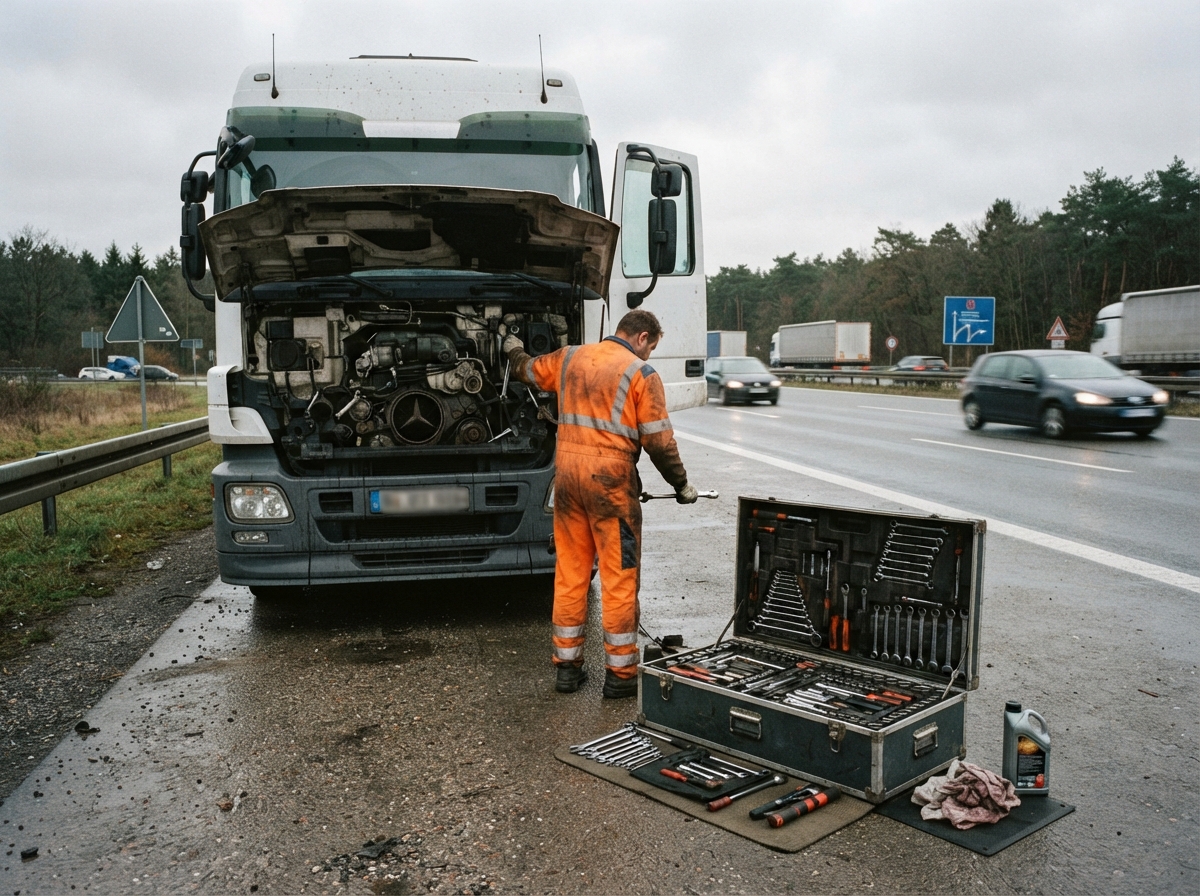
A driver on the A5 near Frankfurt hears a metallic knock under the hood, and moments later the engine warning light comes on. He pulls onto the hard shoulder, switches on the hazard lights, and sets out the warning triangle. It’s dark, it’s raining, and the nearest exit is ten kilometers away. This scene repeats itself several times a day on German highways, only with different drivers and different faults each time. The question that comes to mind at that moment is always the same: who do you call, and what will it cost.
The answer isn’t always obvious. Back home, a truck breakdown usually means calling a trusted workshop or a company mechanic who comes after hours. Far from base, without a familiar workshop nearby, the only realistic option in Germany is a mobile service, a mechanic who drives to the breakdown site with tools and parts in a service van. This article walks through exactly how such a call-out works, how it differs from towing, what can be fixed roadside versus what needs a workshop, and what help for vehicles from 7.5 tonnes actually costs.
Mobile mechanic versus towing: two very different services
Many drivers mix these two services up, but the difference is fundamental. A mobile mechanic comes to the vehicle and repairs the fault right where the truck is standing, whether that’s the hard shoulder, a car park, a construction site, or a loading dock. He diagnoses the problem, replaces a part, or repairs a component without pulling the vehicle into a workshop. The goal is simple: get the driver back on the road under his own power as fast as possible.
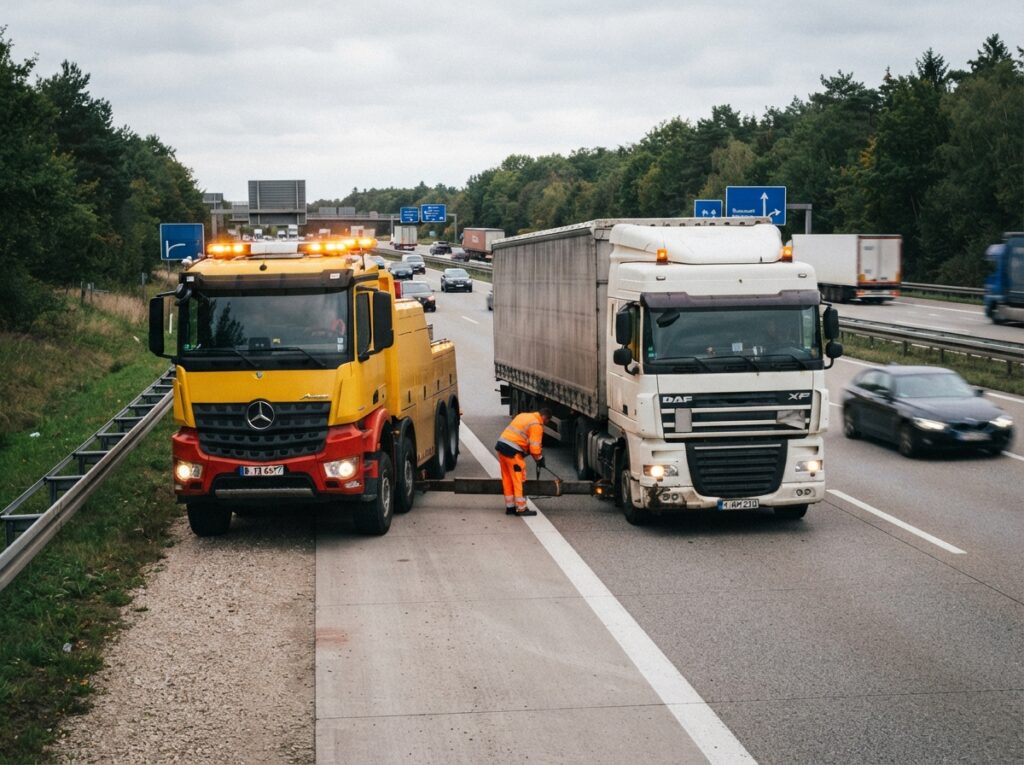
Towing, the classic breakdown recovery service, comes into play when an on-site repair is impossible or not worth attempting. A broken gearbox, a serious engine failure requiring cylinder head removal, or frame damage after a collision are typical examples. In those cases the truck has to be transported to a workshop, which means a specialized heavy-vehicle tow truck, a longer wait, and a higher cost. For more detail on how that kind of operation works and what drives the price, see the article on truck towing costs.
A good dispatcher should be able to form an initial picture right after hearing the symptoms described. If the engine won’t start, the battery is dead, or an electronic fault code has appeared, a mobile mechanic call-out is enough in the vast majority of cases. If, on the other hand, oil is leaking with a visible puddle under the gearbox, or a wheel has come off, the situation usually ends with a tow truck.
What a mobile mechanic can fix on the spot
A mobile service is equipped with diagnostic tools, a compressor, a welder, a stock of parts for common truck brands, and electrical equipment. That means a lot can genuinely be sorted out roadside without towing at all.
Starter motors and batteries are the classic case. A truck that’s been sitting for hours in the cold, or one with a worn-out battery, simply won’t start. The mechanic in the service van carries testers, jump-start units, and spare batteries that fit most European tractor units. Swapping a battery or starter motor at a rest stop typically takes between thirty minutes and an hour.
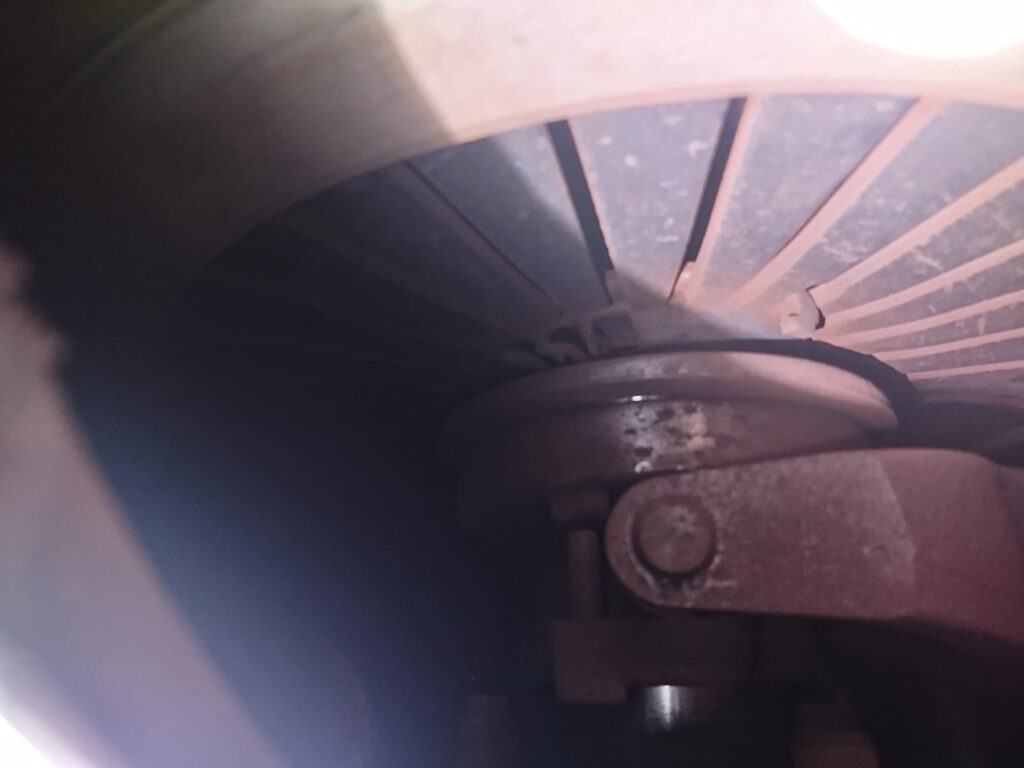
The brake system can often be repaired on site as well, especially pneumatic faults, a burst air line, or a leak in the brake circuit. This is one of the most sensitive systems on a truck, and also one where a fast response matters most for safety, since a vehicle without working brakes should not move at all.
The electrical system is another area where a mobile mechanic does very well. Short circuits, blown fuses, damaged wiring harnesses, lighting problems, or tachograph issues can all be diagnosed and repaired with a diagnostic computer and basic electrical tools right there in the car park.
The fuel system also frequently gets fixed in the field. Air in the system, a failed low-pressure fuel pump, a leaking line, or a filter clogged with contaminated fuel are typical faults that can be resolved without pulling the vehicle into a workshop, as long as the injectors or the high-pressure pump haven’t suffered serious damage.
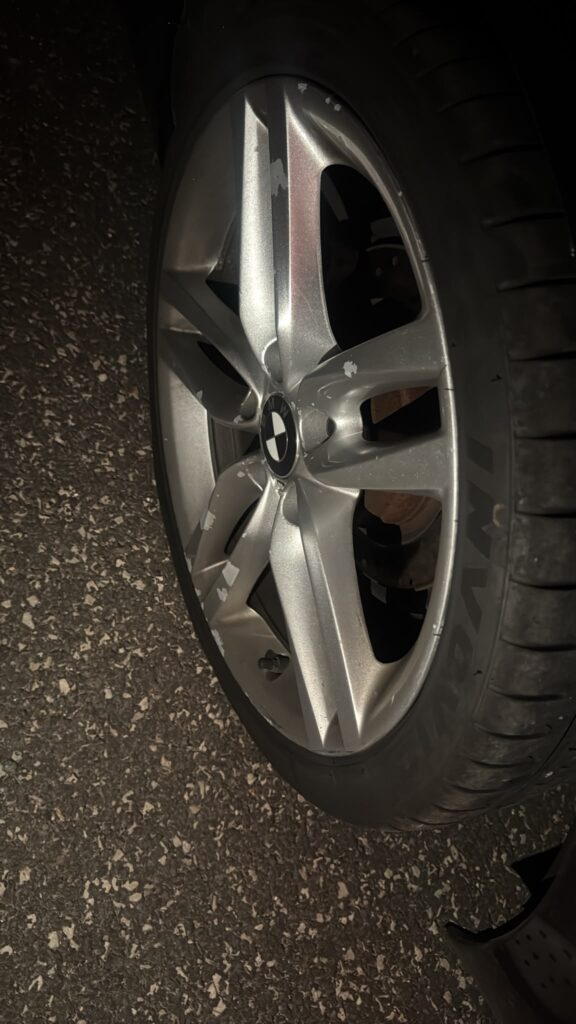
Then there’s the road classic, tires. A punctured tire, a torn tread, a rim damaged while hitting a curb during unloading, all of this is handled by mobile tire service, often the very same team that responds to general breakdowns. More on the tire side of things can be found in the article on emergency tire service nearby.
What actually needs a workshop, not a parking lot
There are faults no mobile mechanic will attempt to fix on the spot, and for good reason. A serious engine failure, such as a blown head gasket, a cracked engine block, or damaged connecting rod bearings, requires disassembly under proper workshop conditions, with a lift, a hoist, and full equipment.
The gearbox is another case entirely. Clutch replacement, automatic gearbox repair, or swapping the whole drivetrain unit require a lift and specialized tools that simply cannot be carried in a service van.
Frame damage, suspension damage after a serious collision, or a deformed cab belong at a bodywork shop, not with mobile service. The same goes for turbocharger repairs that need specialized calibration equipment, or deeper work on a common-rail injection system, which needs a clean workspace and dedicated test benches.
In those cases, the mobile mechanic’s job is usually to stabilize the situation, that is, to check whether the vehicle can safely reach the nearest workshop under its own power, or to make the call for a tow. A good dispatcher tells the driver upfront what to expect, so no time is wasted on repairs that were never going to work. More on the workshop network for heavy vehicles in Germany can be found in the article on the truck workshop, and if the situation does end in transport, there’s more information on the towing service itself in the article on towing.
How to call for help: phone or WhatsApp
In an emergency, speed and accuracy of the information passed on matter enormously. The driver can call or message on WhatsApp at +49 160 5753826, available around the clock, seven days a week. WhatsApp has a real advantage that’s easy to overlook under stress: it lets you send a photo or a short video of the fault, an exact GPS location with one tap, and the vehicle’s registration number, without having to dictate everything by voice over a phone line, which is often difficult with poor signal or highway noise.
Information worth having ready includes the exact location, ideally GPS coordinates or a highway kilometer marker plus direction of travel, the make and model of the vehicle, a description of the symptoms, whether the vehicle is parked somewhere safe or blocking traffic, and whether there’s cargo on the trailer and what kind. This lets the dispatcher immediately send the right mechanic with the right equipment, instead of sending a team based on a guess and only discovering on site that a different specialization was needed.
It’s also important not to delay calling for help if the vehicle is stopped somewhere dangerous, such as on a bend, just past a hill crest, or without visible hazard lights. The driver’s safety always takes priority over any potential time savings.
The language barrier: why a Polish-speaking dispatcher isn’t a luxury
Many Polish drivers working for German haulage companies, or driving on contract, speak German well enough for everyday use but not always well enough to precisely describe a technical fault under time pressure and stress. In an emergency, when you need to quickly explain that the problem is with the pressure regulator valve in the pneumatic brake system and not a simple flat tire, the language barrier can cost precious minutes, and sometimes results in the wrong team being sent out.
That’s why a dispatcher who speaks the driver’s own language has real practical value, not just convenience. The driver describes the breakdown in his own language, without having to mentally translate technical terms, and the information reaches the mechanic already processed and precise. LKWHelp24 handles requests in four languages, German, English, Polish, and Russian, which covers most drivers working German routes regardless of which country the haulage company or the driver comes from.
It’s also worth knowing that some German breakdown service providers only handle requests in German, or offer very limited support in other languages, which in practice means the driver is left relying on a phone translator app or broken English, in a situation where every minute counts.
Typical breakdowns on German routes
Looking at the pattern of call-outs, a few scenarios repeat constantly. The most common is a tire failure, usually a puncture or torn tread after running over a sharp object on the highway, especially near roadworks, where debris and metal fragments often end up on the road surface. The second large group involves starting problems, a weak battery or a failed starter motor, which spike in winter when low temperatures place extra strain on the electrical system.
The third group covers pneumatic and brake system faults, often signaled by a sudden drop in air pressure and a warning light on the dashboard. The fourth group is electrical faults, from blown fuses to failed ABS sensors or lighting problems, which German roadside inspections take very seriously.
A fifth, less frequent but more serious category is fluid loss, engine oil, coolant, or brake fluid, which demands an immediate response, since continuing to drive risks more severe engine damage or brake failure. In these cases the mechanic on site assesses whether topping up the fluid allows the vehicle to continue safely to the nearest workshop, or whether towing is unavoidable.
Seasonality matters too. Winter brings more battery and cooling system problems, along with a frozen pneumatic system if the air dryer isn’t working properly. Summer, on the other hand, increases the risk of engine overheating and air conditioning failure, which after long hours in the cab isn’t just a comfort issue but a safety one, since driver fatigue rises much faster in the heat.
What it costs: the pricing structure
Prices for a mobile mechanic call-out in Germany depend on several factors, the time of day, the day of the week, the distance from the service base, and the scope of the repair needed. A call-out on a weekday during standard hours starts from 290 euros. That’s the base rate covering travel and a basic diagnosis plus a minor repair.
A call-out in the evening, at night, or on weekends costs more and starts from 429 euros, reflecting the higher cost of maintaining service readiness outside standard working hours. That’s a difference worth knowing in advance, so there’s no surprise on the invoice, especially if the haulage company is covering costs and requires a quote beforehand.
On top of the base rate come the costs of any replacement parts, if the repair requires them, and potentially additional labor time for more complex faults. A reputable service gives an approximate cost estimate before dispatching a mechanic, based on the description of the fault, so the driver or the fleet dispatcher can make an informed decision. It’s also worth asking directly about a flat rate for a specific type of repair, since some services, like a simple wheel change, are often billed as a package rather than hourly plus travel.
How this compares to motoring clubs
The structure of roadside assistance in Germany, including services offered by large motoring clubs such as ADAC, is built mainly around membership and an annual fee. The driver or the company pays a yearly subscription and in exchange gains the right to call for help in the event of a breakdown, often with limits on the number of call-outs, the geographic coverage, or the type of vehicle included.
An independent mobile service works differently: no membership, no prior registration required, you pay only for the service actually performed, at the moment it’s needed. For a driver who only crosses into Germany occasionally, or works for a company without a German breakdown membership, this is a much simpler logistical solution: no need to remember a policy number, no need to worry whether a given vehicle type is covered, a call or a message is enough.
There’s also a difference in specialization. Large motoring clubs cover a wide range of vehicles, from cars to trucks, while a mobile service that specializes exclusively in vehicles from 7.5 tonnes has a team and equipment tailored specifically to trucks, trailers, and commercial vehicles, which in practice means more experience with systems like pneumatic brakes or gearbox electronics in tractor units.
Regulations worth knowing
Stopping on the hard shoulder of a German highway after a breakdown is only permitted when genuinely necessary, and the driver is required to immediately mark the vehicle with a warning triangle and switch on the hazard lights, under the German road traffic regulations, the Straßenverkehrsordnung. The driver and any passengers should leave the vehicle as quickly as possible and move behind the crash barrier, away from the carriageway, since accident statistics show the hard shoulder is one of the most dangerous places on a highway.
Oversight of road freight transport and haulage companies in Germany falls under the Bundesamt für Güterverkehr, the federal agency responsible among other things for monitoring driving hours, vehicle weight, and compliance with transport regulations. This matters because a long roadside stop due to a breakdown also affects the driver’s working hours as logged by the tachograph, which is worth keeping in mind when planning the rest of the route after the repair.
What to keep in the cab in case of a breakdown
Experienced drivers carry a few things that make dealing with a mobile service much easier in a breakdown. A charged power bank is essential, since a phone drained after hours of navigation running can fail at exactly the moment it’s needed most. It’s also worth saving the service’s WhatsApp number in contacts before setting off, rather than searching for it on the roadside with a weak signal.
Vehicle documents, including the registration certificate, haulier details, and the VIN, are worth having as a photo on the phone, since the dispatcher sometimes asks for these to prepare the right replacement part before the mechanic even sets off. Knowing the exact type and year of the vehicle also helps, since different generations of the same tractor unit model can have completely different brake or electronic systems.
A high-visibility vest and warning triangle are mandatory equipment, but it’s worth checking before every trip that they’re actually in the cab and not buried somewhere under the cargo. German roadside checks pay close attention to this, and in a breakdown on the highway this equipment can genuinely be life-saving, since visibility of a driver standing next to the vehicle at night in bad weather is a critical safety factor.
It also helps to know the route in advance and keep a rough list of highway numbers and directions handy, since under stress it’s easy to mix up a direction or road number, which delays the mechanic’s arrival. Navigation apps that let you copy GPS coordinates with one tap and send them via WhatsApp speed up the whole reporting process considerably.
The role of the haulage company and fleet dispatcher
It’s worth remembering that in many cases the driver doesn’t decide alone whether to call for help, but coordinates with the haulage company’s dispatcher. That’s good practice, since a fleet dispatcher often already has established billing arrangements with breakdown services and can approve repair costs faster, especially if they exceed the usual budget for minor faults.
At the same time, in an emergency, when the vehicle is stopped somewhere dangerous, the driver shouldn’t wait too long for a reply from the dispatcher if safety is at risk. The best approach is to act in parallel: report the situation to the mobile service with a description of what’s happening, and inform the company at the same time, so everyone has current information and can quickly decide on cost approval.
Some haulage companies have already established contacts with specific mobile services operating in Germany, which speeds up the whole process, since the dispatcher immediately knows who to call instead of scrambling for help in a panic after the fact. It’s worth making sure such a number is saved permanently in the company’s contact database, not just in one driver’s phone.
A real case: starter motor failure near Erfurt
A tractor unit driver was heading toward Leipzig when, after a short stop at a fuel station, the vehicle wouldn’t start. The starter was turning over, but the engine wouldn’t catch, and a fault code related to the low-pressure fuel system appeared on the dashboard. Worried about a serious fuel pump failure, the driver messaged on WhatsApp with a description of the situation, a photo of the dashboard showing the fault code, and the GPS location.
Based on the description and the photo, the dispatcher sent a mechanic equipped with diagnostic tools and a replacement low-pressure pump matching that model. On site, it turned out the problem was simpler than feared: air in the fuel system combined with a small leak in one of the lines. The mechanic fixed the leak, bled the system, and after checking the fuel pressure the vehicle started without any issue. The whole repair, from the mechanic’s arrival to the driver setting off again, took just under two hours, instead of a multi-hour tow to a workshop and waiting for parts at a fixed-location shop.
This case shows well why an initial diagnosis over WhatsApp, with a photo and a description, matters so much: it allows the right equipment to be sent immediately, instead of wasting time on a second trip if the part brought turns out not to fit, or the problem turns out to be different from what it first looked like.
More information on vehicles and service
Anyone wanting to better understand the specifics of trucks operated on German roads, the differences between models and drivetrains, and the rules of roadside assistance for vehicles from 7.5 tonnes will find more background in the article Lkw in Deutschland: Modelle, Antriebe und Pannenhilfe ab 7,5 Tonnen. Drivers whose problem specifically involves a tire should also check the information on mobile tire service in the article on mobile service.
Frequently asked questions
Does the mobile mechanic only handle trucks, or also vans and trailers? LKWHelp24’s service covers vehicles from 7.5 tonnes, meaning tractor units, solo trucks, trailers, and semi-trailers. Lighter delivery vans below that threshold are outside the scope of the service.
What if I don’t speak good German or English? You can report the issue in Polish, the dispatcher handles requests in Polish, German, English, and Russian, so the language barrier shouldn’t be an obstacle.
Do I need to pay upfront before the mechanic arrives? Billing terms and an approximate cost estimate are provided before dispatch, based on the description of the fault, so the driver or the haulage company knows what to expect financially.
How fast will the mechanic reach the location? Arrival time depends on the location and the service’s current workload, but the service operates around the clock, seven days a week, including nights and weekends.
What should I do if the fault looks serious and I don’t know whether it can be fixed on the spot? Just describe the symptoms and ideally send a photo over WhatsApp. The dispatcher or the mechanic on site will assess whether an immediate repair is possible or whether towing is needed.
Does the service cover all of Germany, or only certain regions? The service includes a network of mechanics located across different parts of Germany, allowing a response to call-outs from highways and national routes throughout the country, not just in individual cities.
A truck breakdown far from home is always stressful, but it doesn’t have to mean hours of downtime and a lost job. The key is a fast, precise report, ideally with location and a photo of the fault, sent via WhatsApp to +49 160 5753826, available around the clock for drivers crossing Germany.