Skip to content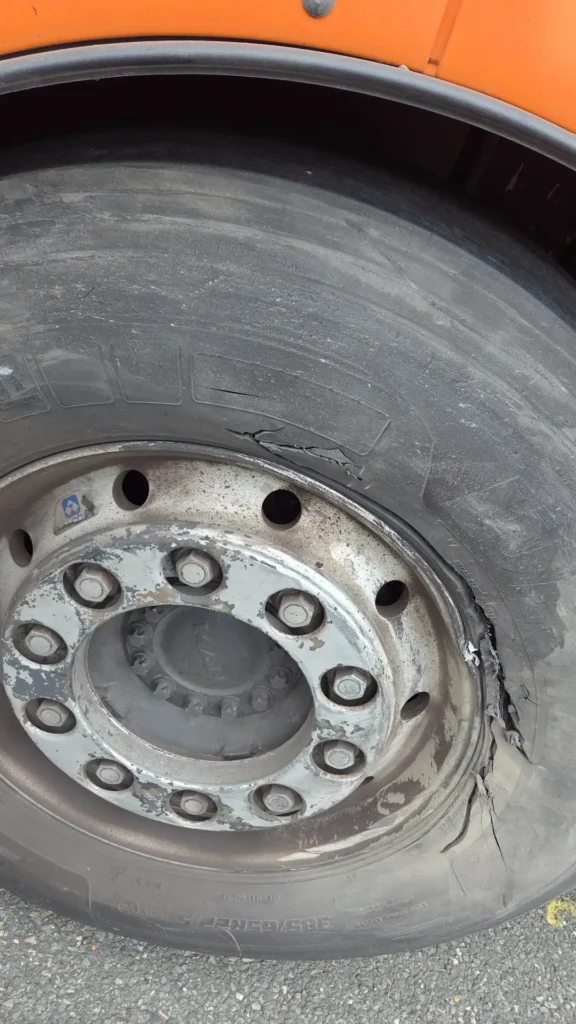
A tyre failure on a steer axle is one of the few roadside emergencies that genuinely deserves the word \”dangerous.\” Lose grip on the wheel that actually steers a forty-tonne artic and you are no longer driving the truck — you are hoping the truck goes where you point it. That is exactly what happened to a Scania tractor unit on the A6, on the hard shoulder near Mannheim, heading towards Heilbronn, on a weekday morning that started like any other and very quickly did not.
n\\n
The driver did everything right. He felt the pull, heard the change in road noise, and got the rig safely onto the hard shoulder before the tyre gave up completely. From there, it was a phone call to LKWHelp24 that turned a stranded lorry and a blown deadline into a fifty-minute repair and a truck back on the autobahn inside two hours of the first ring. No towing, no wrecker, no overnight in a lay-by. Just a properly equipped mobile tyre technician, a new Continental cover, and a driver who was back on schedule before lunch.
n\\n
This is the story of that callout: what actually went wrong, how LKWHelp24\’s partner network responded, what the repair involved on a technical level, and — because hauliers and fleet managers care about numbers, not adjectives — the exact timeline and the exact invoice. If you run trucks in Germany, or you are simply searching for \”truck tyre service near me\” at two in the morning with a driver stuck on the hard shoulder, this case study should tell you precisely what to expect.
n\\n
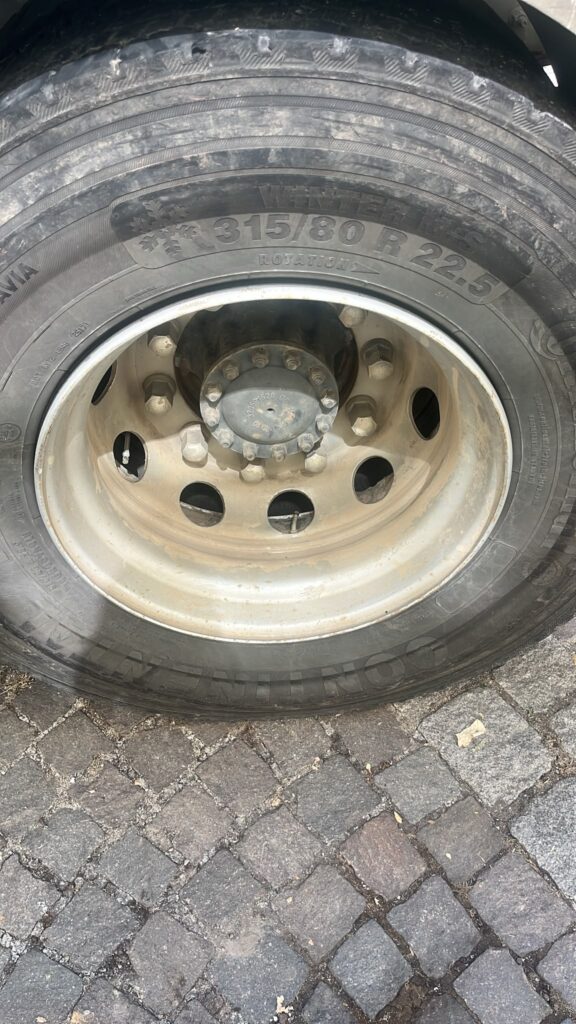
Tyre damage 385/55 R22.5 on a Scania on the A6 near Mannheim – mobile truck tyre service by LKWHelp24.
n\\n
The Emergency: A Scania Steer Axle Tyre Fails on the A6
n\\n
The vehicle was a Scania tractor unit — the familiar orange cab of a long-haul workhorse, running a scheduled international trip when the fault developed. The problem sat on the front axle: a 385/55 R22.5 steer tyre, the wide, load-bearing rubber that carries the whole weight of the cab and, more importantly, does all the steering. The tyre had degraded to the point of air loss and was no longer safe to drive on. This was not a slow puncture the driver could nurse to the next services. It was a steer-axle failure on one of Germany\’s busiest north-south corridors, in live traffic, with articulated lorries and cars streaming past at autobahn speed.
n\\n
The location itself made this a textbook high-risk breakdown: the A6 hard shoulder near Mannheim in the Heilbronn direction, a stretch with limited refuge space and a steady flow of heavy traffic. Every minute a stranded lorry sits half-exposed on that shoulder is a minute of real risk — to the driver stepping out to inspect the wheel, and to every vehicle passing at 130 km/h a few metres away. This is precisely the scenario 24/7 breakdown cover exists for, and it is why LKWHelp24 treats steer-axle tyre failures as a top-priority dispatch, not a routine job in the queue.
n\\n
How Help Was Organised
n\\n
LKWHelp24 does not run one lone van covering the whole of Germany — it works because of a nationwide network of vetted, fully equipped tyre and breakdown partners, positioned so that a call from almost anywhere in the country reaches someone genuinely close by, not someone three hours away. For this callout near Mannheim, that meant:
n\\n
- n\\n
- The driver rang the LKWHelp24 emergency line and gave the essentials: location (A6 hard shoulder, direction Heilbronn), vehicle type (Scania tractor unit), and the problem (steer-axle tyre losing air, vehicle no longer safe to drive).
- Dispatch immediately identified the nearest certified tyre partner in the Mannheim area and confirmed the tyre size and stock availability before mobilising, so the technician wasn\’t driving out blind.
- The partner was given an estimated time of arrival and briefed on the hazard — steer axle, hard shoulder, live traffic — so the crew arrived with the right safety equipment from the outset.
- LKWHelp24 stayed in contact with the driver throughout, confirming ETA and giving him clear guidance on warning triangles, hazard lights, and staying behind the barrier until the technician arrived.
- The whole process, from first ring to a technician mobilised and en route, took just twelve minutes — the kind of turnaround that matters enormously when someone is standing next to a live carriageway.
n\\n
n\\n
n\\n
n\\n
n\\n
n\\n

n\\n
The Situation On-Site: Why This Couldn\’t Wait
n\\n
Once the technician arrived, the inspection confirmed what the driver already suspected: the 385/55 R22.5 was beyond saving, with air loss severe enough that continuing to drive on it — even at low speed to the next exit — would have risked further damage to the tyre carcass, the rim, or worse, loss of steering control. Steer tyres on a truck this size typically run at pressures of around 8.5 to 9.5 bar; even a modest drop below that range changes handling characteristics noticeably, and a tyre that has already lost structural integrity offers no margin for error on an axle responsible for directional control.
n\\n
There was a second reason this couldn\’t be a \”get to the next services and sort it there\” situation: the hard shoulder position itself. Every additional minute spent driving on a failing steer tyre, however slowly, extended the exposure of both the vehicle and anyone near it to fast-moving traffic. The safest, and ultimately quickest, course of action was exactly what happened — stabilise the vehicle where it stood and carry out the wheel change on-site.
n\\n
Step-by-Step: What the Repair Team Did
n\\n
Step 1 — Safety and stabilisation. The technician first secured the scene: warning triangles placed at the correct distance, hazard lights confirmed, and the truck positioned as far onto the shoulder as the geometry allowed. Only once the area was properly marked did work on the vehicle begin.
n\\n
Step 2 — Jacking and axle support. The Scania was jacked and supported correctly for a steer-axle job, which demands more care than a trailer or drive-axle wheel change, given the load distribution and steering geometry involved.
n\\n
Step 3 — Wheel removal and inspection. The damaged 385/55 R22.5 was demounted. Crucially, the rim itself was inspected before anything else went back on — a bent or cracked rim on a steer axle is a separate and more serious problem, and fitting a new tyre to a compromised rim would simply set up the next failure. In this case, the rim was found intact, with no secondary damage to report.
n\\n
Step 4 — Fitting the replacement tyre. A new Continental Conti Hybrid HS3 in the correct 385/55 R22.5 specification was mounted, balanced, and inflated to 8.5 bar — the manufacturer-correct pressure for this steer-axle application.
n\\n
Step 5 — Torque and final checks. Wheel nuts were tightened in the correct cross (\”star\”) pattern to the specified torque, which is essential on a steer axle to avoid uneven seating and vibration at speed. A final visual and pressure check confirmed the wheel was roadworthy before the truck was released back onto the carriageway.
n\\n
Full Timeline: Call to Roadworthy
n\\n
| Time | Phase | Action |
|---|---|---|
| 09:10 | Call received | Driver reports steer-axle tyre failure, A6 hard shoulder near Mannheim |
| 09:22 | Partner dispatched | Nearest certified tyre partner confirmed, tyre size verified, ETA given |
| 10:00 | On-site arrival | Technician reaches the vehicle |
| 10:08 | Scene secured | Warning triangles placed, vehicle jacked and supported |
| 10:30 | Wheel removed | Damaged tyre demounted, rim inspected — no secondary damage found |
| 10:48 | New tyre fitted | Continental Conti Hybrid HS3 385/55 R22.5 mounted and inflated to 8.5 bar |
| 10:58 | Torque and final check | Wheel nuts tightened in cross pattern, roadworthiness confirmed |
| 11:00 | Truck roadworthy | Vehicle cleared to rejoin the A6 |
n\\n
Total elapsed time: approximately 1 hour 50 minutes from call to roadworthy — with the on-site repair itself taking roughly one hour once the technician arrived.
n\\n

n\\n
Cost Breakdown
n\\n
Transparency on price is something we insist on, because a driver stuck on a hard shoulder should never have to negotiate blind. Here is exactly what this callout cost, with no rounding and no hidden extras:
n\\n
| Item | Price (EUR) |
|---|---|
| Callout / 24/7 emergency autobahn service | 190 |
| Tyre — 385/55 R22.5 Continental Conti Hybrid HS3 | 360 |
| On-site fitting and balancing | 90 |
| Old tyre disposal | 20 |
| TOTAL | 660 EUR |
n\\n
A few points on what drives this figure. The callout fee reflects genuine 24/7 autobahn emergency response — a technician mobilised within minutes, with the right stock already confirmed before setting off, not a standard workshop visit booked days in advance. The tyre itself is a premium steer-axle cover; Continental\’s Conti Hybrid HS3 is built specifically for the mixed long-haul and regional use this Scania sees, and equivalents from Michelin (X Line Energy Z) or Goodyear (KMAX S) sit in a similar bracket. Fitting and balancing on a live hard shoulder, with correct steer-axle procedure and torque-to-spec, is not the same job as a tyre change in a workshop bay, and the price reflects the equipment and expertise that has to travel to the truck rather than the other way round.
n\\n
Compare that 660 EUR and roughly two hours against the alternative: a recovery truck, a tow to the nearest workshop, a driver\’s hours eaten up waiting, and — depending on how far the nearest suitable garage is — a very real chance of losing the rest of the working day, plus recovery charges that routinely run into four figures before a single new tyre is even fitted. A mobile steer-axle repair, done properly on-site, is very often the cheaper option as well as the faster one.
n\\n
Why a Professional Service Is Essential for Steer-Axle Tyre Failures
n\\n
It is tempting, especially for an experienced driver, to think a wheel change is a wheel change. On a steer axle, that assumption is genuinely risky, and here is why:
n\\n
- n\\n
- Steering geometry is unforgiving. An incorrectly seated tyre, a rim that wasn\’t checked properly, or a pressure even slightly off spec changes how the vehicle steers at speed — not a fault you want to discover on the autobahn.
- Torque matters more than people think. Wheel nuts tightened out of sequence or under-torqued on a steer axle can work loose at motorway speed, with consequences far more serious than on a trailer axle.
- Rim damage is easy to miss without training. A hairline crack or deformation on a steer-axle rim, left unchecked, will cause the next tyre to fail too — often faster and more dangerously than the first.
- Roadside safety is a discipline in itself. Working a wheel change on a live hard shoulder, with triangles, positioning, and traffic awareness, is a different skill set from a workshop repair, and it is not something to improvise.
- DIY attempts on the hard shoulder create a second hazard. A driver without the right jack, torque wrench, or spare risks turning a tyre problem into a personal injury incident, metres from live traffic.
n\\n
n\\n
n\\n
n\\n
n\\n
n\\n
This is the case for calling a specialist mobile truck service rather than attempting a makeshift fix, and it is the entire reason LKWHelp24\’s partner network exists.
n\\n

n\\n
Typical Breakdown Situations We Handle Across Germany
n\\n
The A6 Scania case is one example of a much broader picture. LKWHelp24\’s network responds to breakdowns of every kind, across the whole of Germany, 24 hours a day:
n\\n
- n\\n
- Steer, drive, and trailer axle tyre blowouts and slow punctures on motorways and rural roads
- Trailer tyre failures on semi-trailers and full trailers mid-journey
- Battery replacement and jump-starts for tractor units, vans, and buses
- General roadside assistance for mechanical faults that leave a vehicle immobile
- Towing service and recovery when a repair cannot be carried out on-site
- Mobile tyre service and tyre fitting cost transparency for fleets on tight schedules
- Coach and bus breakdowns requiring passenger-safety-aware response
- Emergency support related to lenk und ruhezeiten (driving and rest time) disruptions caused by unplanned downtime
n\\n
n\\n
n\\n
n\\n
n\\n
n\\n
n\\n
n\\n
n\\n
Whether the vehicle is a solo Scania, a full articulated combination, or a fleet van, the same principle applies: fast, certified, transparent help, wherever the breakdown happens.
n\\n
Prevention Tips for Drivers and Fleet Managers
n\\n
A blown steer tyre is rarely a complete surprise if you know what to watch for. A few habits go a long way:
n\\n
- n\\n
- Check steer-axle tyre pressure at every stop where practical — a slow leak on a steer tyre is far more dangerous than on a trailer axle, and far easier to catch early.
- Inspect tread depth and sidewalls visually before long trips, particularly on vehicles doing heavy motorway mileage.
- Keep a record of tyre age and mileage per axle position; steer tyres wear differently from drive and trailer tyres and should be rotated or replaced on their own schedule.
- Brief drivers on what to do the moment they feel a pull or vibration — get to the hard shoulder safely rather than pushing on to the next exit.
- Save LKWHelp24\’s number in the cab before it\’s needed, not after. A driver who can call immediately, with location and vehicle details ready, cuts response time significantly.
n\\n
n\\n
n\\n
n\\n
n\\n
n\\n

n\\n
Fleet Maintenance and Tyre Brand Options
n\\n
For fleet operators managing multiple Scania, Volvo, or Mercedes-Benz tractor units, steer-axle tyre choice deserves particular attention, because it directly affects fuel consumption, handling, and — as this case shows — breakdown frequency. Continental\’s Conti Hybrid HS3, the tyre fitted in this repair, is designed for mixed long-haul and regional operation and offers a strong balance of mileage and grip on steer positions. Michelin\’s X Line Energy Z is a common alternative for fleets prioritising fuel economy over very long distances, while Goodyear\’s KMAX S is frequently specified where wet-grip performance is the priority, particularly for routes through central and southern Germany with variable weather.
n\\n
A structured fleet maintenance approach — scheduled pressure checks, tread monitoring, and axle-specific tyre rotation — reduces the odds of an unplanned steer-axle failure considerably. It will not eliminate the risk entirely; tyres fail from road debris, manufacturing faults, and simple wear regardless of how well a fleet is managed. But it does mean that when a failure does happen, as it did on the A6 near Mannheim, it happens to a driver who knows exactly who to call and how quickly help will arrive.
n\\n
LKWHelp24: Your Truck Emergency Partner
n\\n
LKWHelp24 exists for exactly this kind of moment — the one where a driver is standing on a hard shoulder with a failed steer tyre and traffic streaming past. What sets the service apart:
n\\n
- n\\n
- True 24/7 coverage across all of Germany, not just business hours or major cities.
- A certified partner network, meaning the technician who turns up is properly trained and equipped for steer-axle and heavy commercial vehicle work, not a general-purpose breakdown van.
- Transparent, upfront pricing — the driver and fleet manager know the cost before work begins, as shown in the breakdown above.
- Multilingual dispatch, essential for international hauliers whose drivers may not speak German fluently.
- Fast, location-aware dispatch, matching the call to the nearest genuinely available partner rather than the nearest name on a list.
- A single number to remember: +49 160 5753826, answered around the clock.
n\\n
n\\n
n\\n
n\\n
n\\n
n\\n
n\\n
Summary
n\\n
- n\\n
- Tyre size: 385/55 R22.5 steer-axle tyre
- Vehicle: Scania tractor unit
- Location: A6 hard shoulder near Mannheim, direction Heilbronn
- Response time: 12 minutes from call to partner dispatched; 50 minutes from call to technician on-site
- Total time, call to roadworthy: approximately 1 hour 50 minutes
- Total cost: 660 EUR (callout, tyre, fitting, disposal)
- Secondary damage: none — rim confirmed intact
n\\n
n\\n
n\\n
n\\n
n\\n
n\\n
n\\n
n\\n

n\\n
Request Emergency Assistance Now
n\\n
If your Scania, Volvo, Mercedes-Benz, or any heavy commercial vehicle has a tyre problem anywhere in Germany, don\’t wait it out on the hard shoulder.
n\\n
Call +49 160 5753826 or visit lkwhelp24.comn\\nAvailable 24/7 across all of Germany.
n\\n
External references: Scania Deutschland · Continental Truck Tyres
n\\nn\\n
You Might Also Be Interested In
n\\n
- n\\n
- Truck Tyre Service A9 Nuremberg: Volvo FH 460 Steer Axle Blowout, 2026
- Mobile Truck Tyre Service: Trailer Blowout and Wheel Change Across Germany
- Mobile Truck Tyre Service on the Autobahn: Mercedes Actros 2543 Wheel Change
- Truck Tyre Service Near Me: How LKWHelp24 Fixed a Semi-Truck Blowout on the A2 Near Hannover in 1 Hour 42 Minutes
n\\n
n\\n
n\\n
n\\n