Skip to content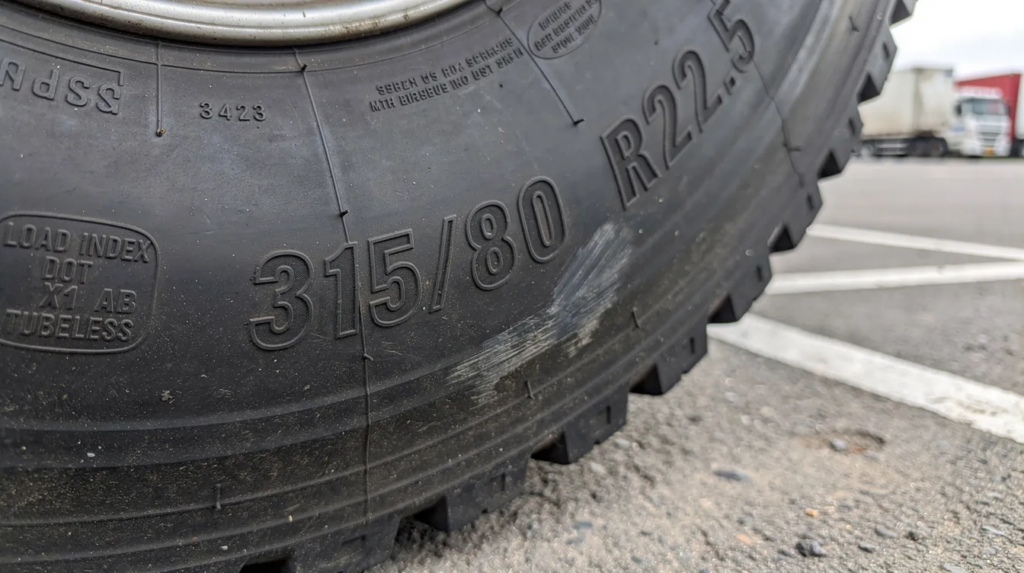
The marking “91H” on a tyre tells you two things: how much weight the tyre may carry and up to what speed it is approved. For drivers and dispatchers in commercial transport it is important to know the difference, because trucks over 7.5 tonnes work with completely different values than cars.
Key takeaways
- The marking 91H consists of the load index 91 and the speed rating letter H. The two values are independent of each other.
- The load index 91 gives the maximum load capacity per tyre. The speed rating H stands for a permitted top speed of 210 km/h.
- Tyres with a load index or speed rating that is too low must not be used. Load and speed indices must match the entries in the registration certificate or exceed them.
- The marking 91H has no influence on general tyre quality or grip. It describes only load-bearing capacity and speed approval.
- 91H is typical for car sizes such as 205 55 R16 91H. Trucks and commercial vehicles over 7.5 t need much higher load indices and tyre sizes from R17.5.
What does 91H on a tyre mean in concrete terms?
The marking “91H” on the tyre sidewall is made up of two standardised values. “91” is the load index, “H” is the speed rating. Both values come directly after the rim diameter and describe the performance limits of the tyre under standard conditions.
- Load index 91: Defines the maximum load capacity per tyre according to a standardised table. The maximum load capacity of a vehicle is obtained by multiplying the single value by the number of tyres.
- Speed rating H: Tyres with speed rating H are designed for continuous operation up to 210 km/h.
- The combination 91H is typical for car sizes such as 205 55 R16 91H, for example on the Golf IV, Touran or Zafira.
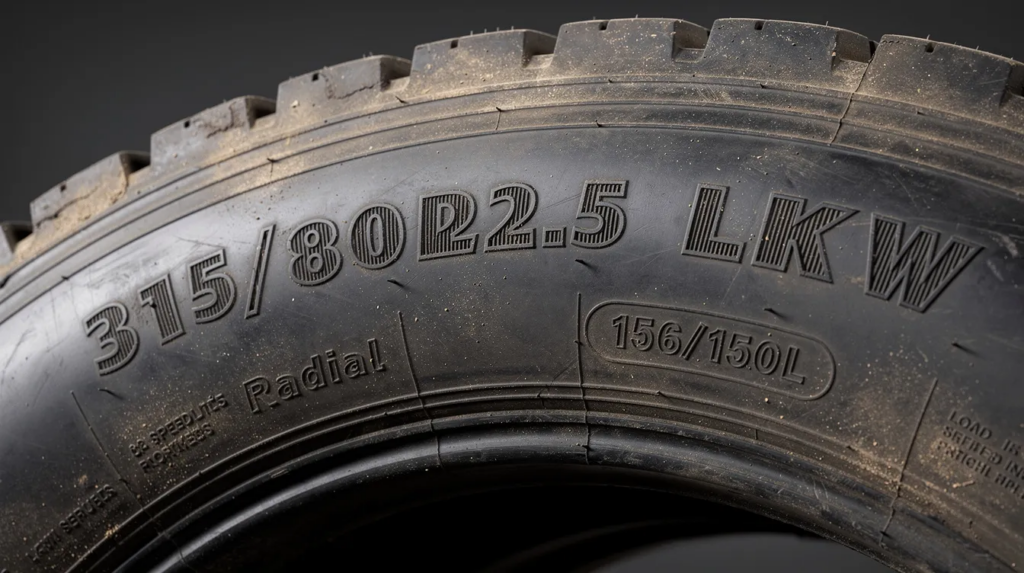
- Heavy trucks use other sizes and much higher load indices. Tyres for commercial vehicles generally start at size R17.5.
- The index is printed on the tyre sidewall next to details such as tyre width, aspect ratio and rim diameter. Always follow the values in the registration certificate Part I (Zulassungsbescheinigung Teil I, the Fahrzeugschein).
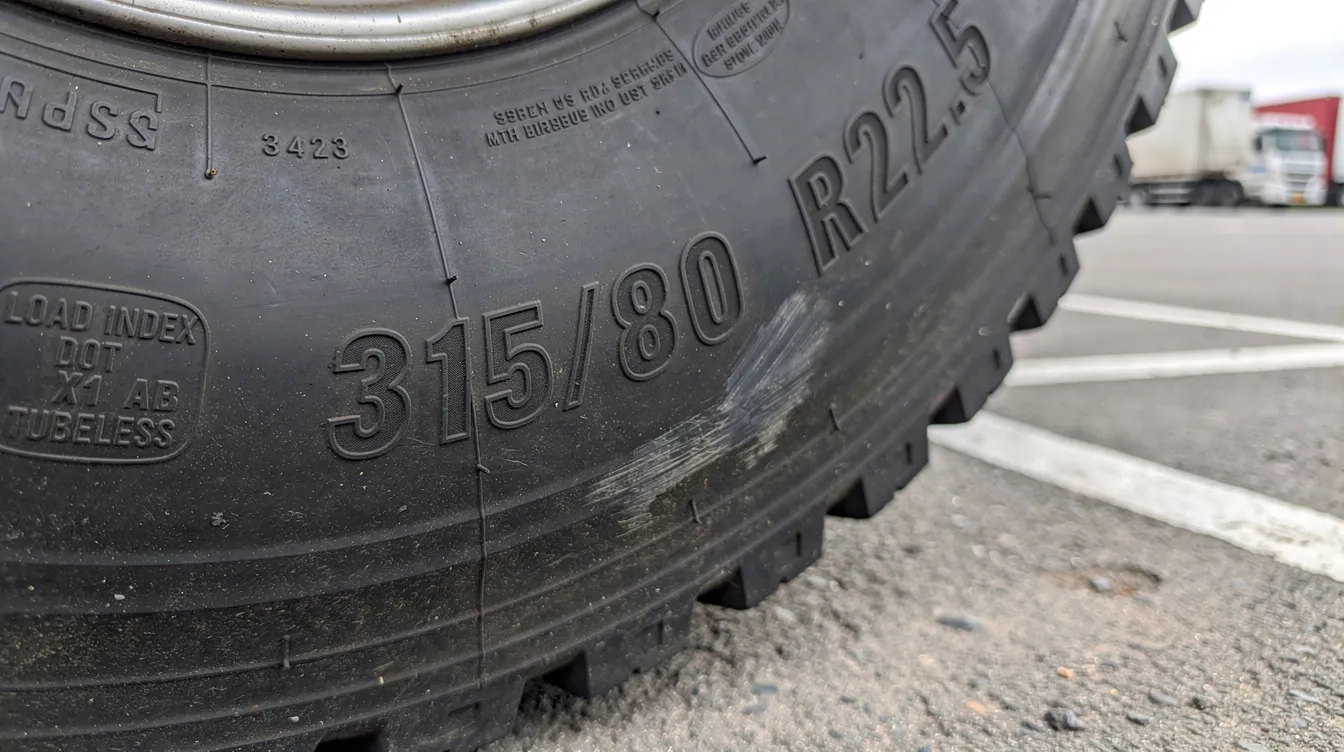
Structure of the tyre size using 205 55 R16 91H as an example
The full description “205 55 R16 91H” contains all relevant data of a tyre size. Each part has its own meaning. Tyre markings have been regulated by law since 1 November 2012.
Section | Meaning | Example value |
|---|---|---|
205 | Tyre width in mm | 205 mm |
55 | Aspect ratio (height to width) in % | 55 % |
R | Construction type (radial tyre) | Radial |
16 | Rim diameter in inches | 16 inches |
91 | Load index (load-carrying capacity index) | Load capacity according to table |
H | Speed rating | 210 km/h |
- The tyre width (205 mm) determines the contact patch on the road.
- The ratio 55 describes the height of the sidewall as a percentage of the width.
- “R” stands for radial construction, which is today standard for almost all car and vehicle tyres.
- The last two values, load index 91 and speed rating H, are safety-relevant and must match the vehicle type.
Other sizes apply to truck tyres. The rims start from 17.5 inches, and the load indices are far above 91.
Load index 91: what does the load capacity tell you?
The load index defines the maximum load that a single tyre may carry at the correct tyre pressure. The value is converted into kilograms using a standardised table.
- Load index 91 corresponds to a load capacity designed for typical mid-size cars. With four tyres, the total load capacity is obtained by multiplying the single value by four.
- Tyres for heavy vehicles have a load index of 93 to 94. Load index 94 means 670 kg per tyre, which is relevant, for example, for compact SUVs or more heavily loaded estate cars.
- Commercial vehicles and trucks over 7.5 t need load indices well above 130. Axle loads, twin tyres and the type of operation play a central role here.
- A load index that is too low leads to overheating, accelerated wear and, in the worst case, a tyre blowout when the vehicle is fully loaded.
- Higher load and speed indices are permitted, while lower ones generally must not be used. This applies to cars as well as trucks.
Speed rating H: what speed is permitted?
The speed rating gives the maximum permitted continuous speed of a tyre. Speed category H means a permitted top speed of 210 km/h.
The scale runs from low letters to high values:
Index | Maximum speed |
|---|---|
Q | 160 km/h |
S | 180 km/h |
H | 210 km/h |
V | 240 km/h |
W | 270 km/h |
Y | 300 km/h |
- H sits in the middle of the scale. For vehicles with a higher design top speed, a correspondingly higher index is required.
- The actual speed must stay below the index value. Anyone who drives faster for a long time overloads the tyre.
- On motorways, the speed rating and load index of commercial vehicles are considered together. Trucks usually only drive 80–90 km/h, but the constantly high load combined with speed demands perfectly matched tyres.
- For winter tyres, the speed rating may be lower than the value stated in the registration certificate if a notice is placed in the driver’s field of view. This is one of the few exceptions to the basic rule.
Difference between 91H, 91V, 94V & Co.: which combination is right?
Different combinations differ in the load index, the speed rating or both values. The right category depends on the vehicle.
Marking | Load index | Speed rating | Special feature |
|---|---|---|---|
91H | 91 | H (210 km/h) | Standard mid-size car |
91V | 91 | V (240 km/h) | Same load, higher speed |
94V | 94 | V (240 km/h) | More load capacity + higher speed |
- With 91H and 91V the load index stays the same, but the speed rating changes.
- A 94V tyre can carry up to 670 kg and is approved up to 240 km/h, suitable for heavier or faster cars.
- Mixed tyres with different indices on one axle are problematic and only permitted with manufacturer approval.
- Comparable rules apply to truck tyres, but the values are much higher. There, specialist workshops check the correct combination of load index, speed rating and tyre size for each axle.
Winter tyre markings: 3 Peak Mountain Snow Flake & M+S
Besides details such as 91H, many tyres carry additional symbols for snow grip. The two most important are “M+S” and the 3 Peak Mountain Snow Flake (3PMSF), the alpine symbol with a mountain and a snowflake.
- The 3PMSF mark identifies winter or all-season tyres that have tested minimum snow grip properties under UNECE R-117.
- In the EU the alpine symbol is mandatory if a tyre is to be considered suitable for winter. All-season tyres without 3PMSF are no longer recognised everywhere.
- “M+S” (Mud and Snow) on its own, without the 3PMSF symbol, no longer counts as a full winter marking in all conditions.
- Truck and commercial vehicle tyres are also available with the 3 Peak Mountain Snow Flake. For winter operations, snowy roads or mountain regions this type of tyre is sensible.
- EU Regulation 2020/740 applies from 1 May 2021 and regulates, among other things, the tyre label with information on rolling resistance, wet grip and noise emissions. The fuel efficiency of tyres is divided into classes A to E. Tyres in class A offer the highest wet grip. The noise emissions of tyres are measured in classes A to C. These data are shown on the tyre label, which must be visible when a product is bought.
Safety risks with a wrong load or speed index
A tyre with the wrong index endangers lives. This applies to every vehicle, but on a 40-tonner the consequences are especially severe.
Typical risks:
- Overheating of the tyre under permanent overload
- Accelerated wear of the tread and carcass
- Instability in corners and in the wet
- Tyre blowout, especially dangerous at high weight and high speed
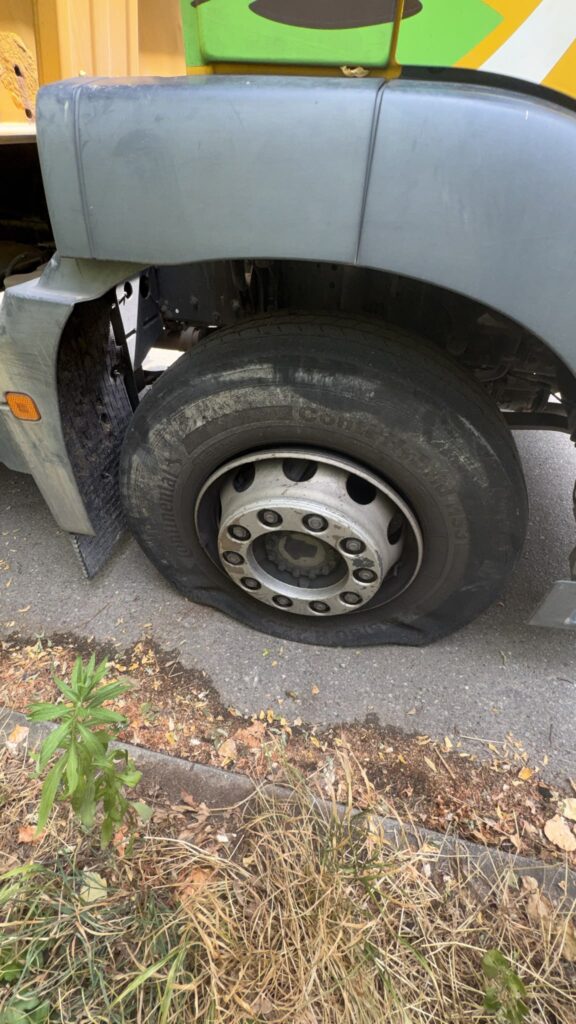
With overloading or permanent driving at the performance limit, the reserves of an under-dimensioned tyre are used up quickly. A tyre blowout on a truck on the motorway can lead to long closures, follow-on accidents and considerable costs.
According to StVZO § 36 (German road vehicle licensing regulations), tyres must suit the operating conditions of the vehicle, in particular with regard to load and top speed. Responsibility for safety lies equally with the keeper and with the seller of the tyre.
If you are unsure, contact a specialist workshop or a mobile tyre service. Lkwhelp24 advises you by phone or WhatsApp on the right properties and the suitable quantity for your commercial vehicle.
Special features of truck and commercial vehicle tyres (from 7.5 t)
Trucks and commercial vehicles from 7.5 t use different tyre sizes than cars. A load index of 91 is nowhere near enough here.
- Tyres for commercial vehicles generally start at size R17.5. Rims and tyres are designed for different axle loads and types of operation.
- Multiple axles and twin tyres are standard. This requires exact matching of load index and speed rating for each axle.
- The correct combination of load index, speed rating and type of operation (long-distance, construction site, winter) is decisive for safety and performance.
- In fleet operation, a uniform tyre specification for all vehicles helps keep breakdowns and product safety problems to a minimum.
- Lkwhelp24 serves only trucks from 7.5 tonnes. Car tyres such as 205 55 R16 91H are not part of our offer. Our mobile truck tyre service covers all of Germany.
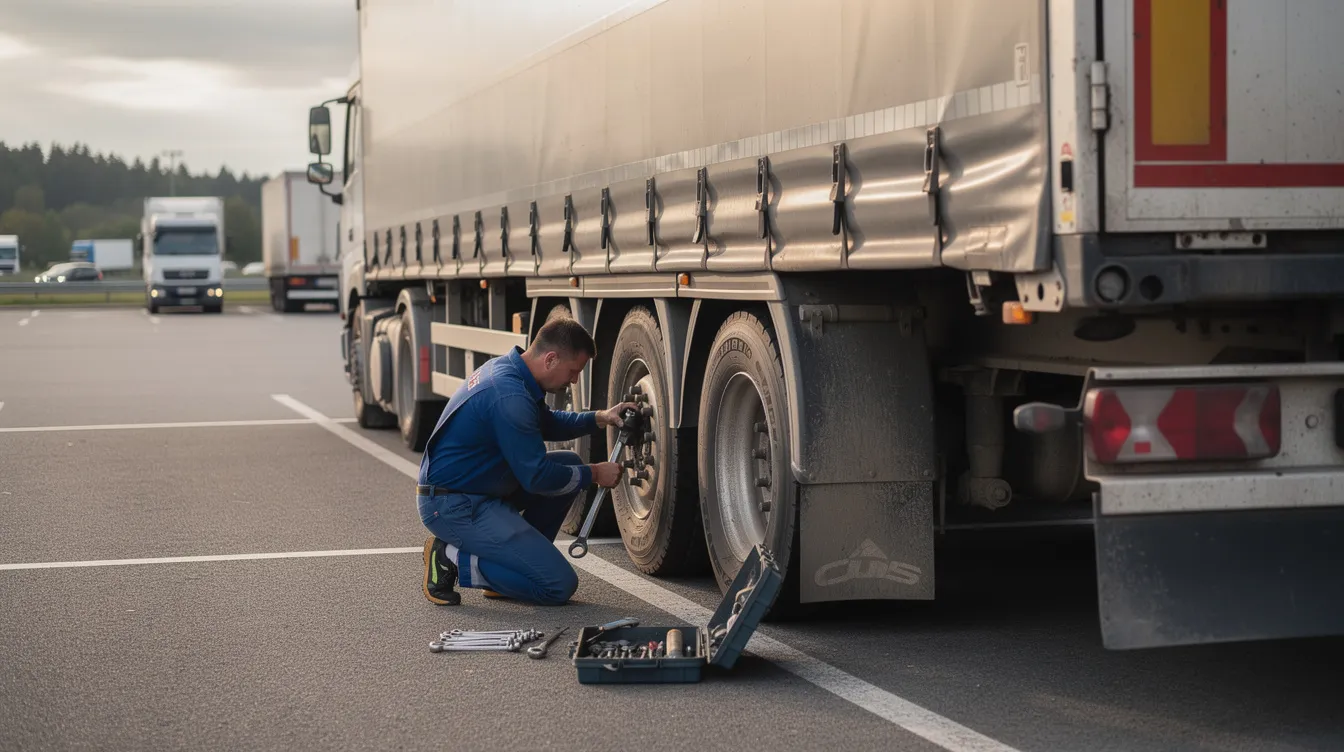
Truck tyre breakdown: immediate actions on the motorway and country roads
With a tyre blowout or a tyre breakdown on a truck, staying calm counts. The following steps help you handle the situation safely:
- Switch on the hazard warning lights immediately.
- Steer the vehicle in a controlled way onto the hard shoulder or a safe parking area. No abrupt steering movements.
- Put on your high-visibility vest before you leave the cab.
- Move behind the crash barrier or to a safe distance from the traffic lane.
- Set up the warning triangle at a sufficient distance on the motorway (depending on visibility).
- Call roadside assistance. Attempting repairs yourself at the roadside is dangerous on a truck and in many situations not possible.
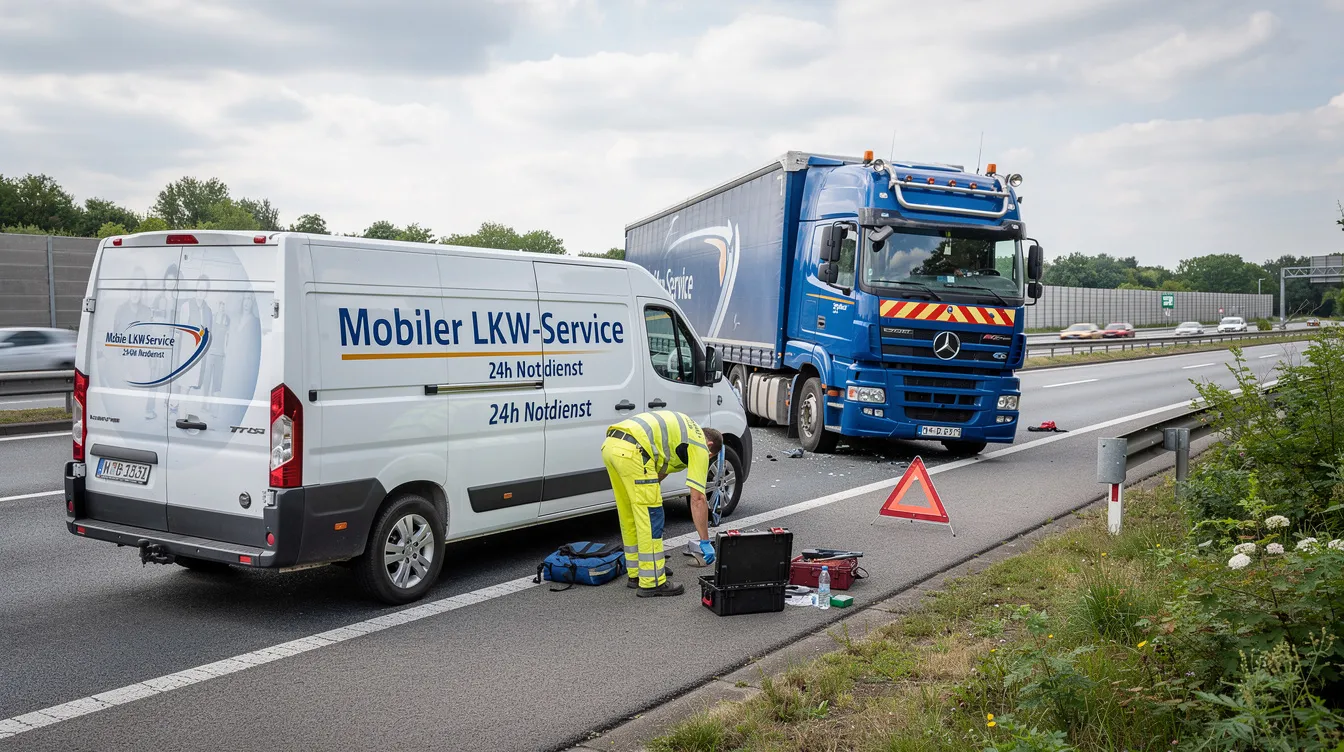
Lkwhelp24 offers roadside assistance 24/7 across Germany. The tyre change takes place on site, even on the motorway. Send us your location via WhatsApp and we will organise professional help.
What information does the breakdown service need for a tyre breakdown?
Complete information speeds up help and avoids wasted trips. Have the following data ready:
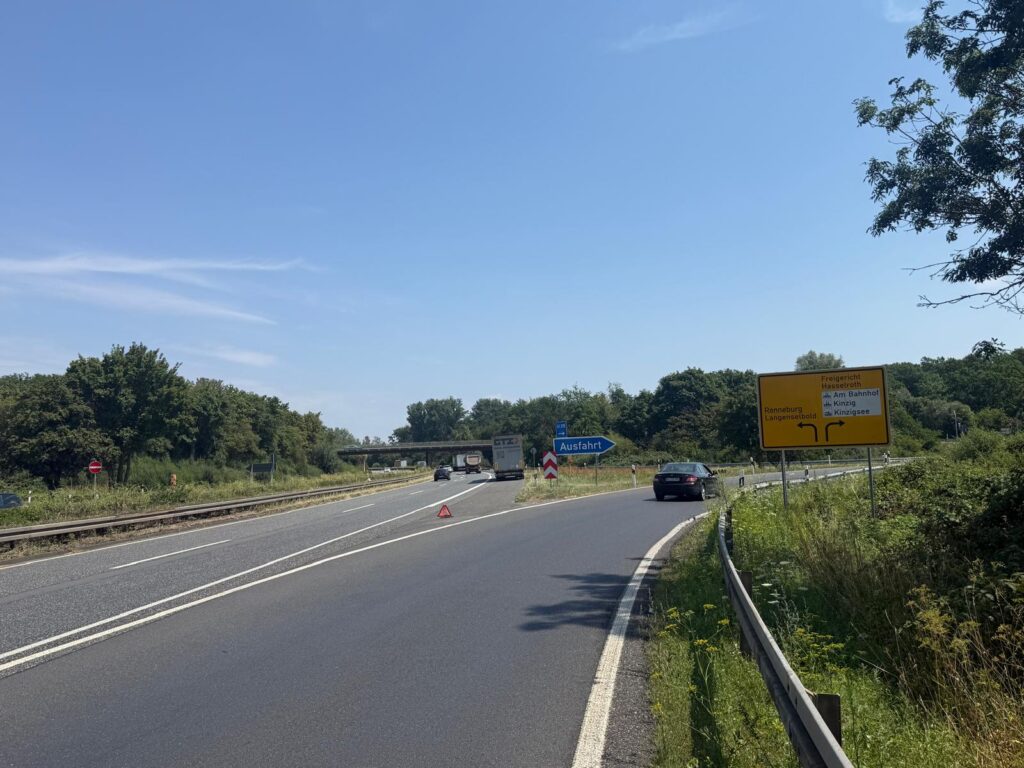
- Exact position: motorway number, direction of travel, kilometre marker or exit, name of the rest area
- Vehicle type and total weight: tractor unit, semi-trailer, rigid truck, trailer
- Tyre size: read the dimension off the sidewall (for trucks e.g. from R17.5; for cars e.g. 205 55 R16 91H, but that is not our field of operation)
- Faulty position: front axle / rear axle, left or right, steering axle, drive axle, trailer or tractor unit
- Special circumstances: dangerous goods transport, difficult standing position (tunnel, bridge, narrow roadworks), shipment under time pressure
The more precise the information, the faster the answers and actions of our dispatch team. You will also find current tips and practical examples in our news about truck breakdown assistance. Contact us by email (info@lkwhelp24.com) or directly via WhatsApp.
Mobile truck tyre service from Lkwhelp24: how a call-out works
Lkwhelp24 offers mobile truck tyre service for commercial vehicles from 7.5 t directly at the breakdown location across Germany.
- Contact: by phone or WhatsApp, 24/7. The response time is normally 30–60 minutes.
- Dispatch: Lkwhelp24 works as a dispatch service and arranges the nearest suitable workshop from around 2,500 partner workshops. We do not own any workshops of our own; we coordinate.
- On-site solution: In about 90 % of cases the fitting or tyre change is done directly at the breakdown location. No trip to a workshop needed.
- Transparent prices: Prices start at €290 for daytime breakdown assistance. In the evening, at night and at weekends from €429 (net, tyres extra). The price is communicated before the order is placed, with no hidden costs.
- Payment: Cash or card. Invoice for haulage companies and fleets on request. Payment details are communicated transparently.
- Languages: German, English, Polish, Russian.
Whether you are stuck in Berlin, Osnabrück or on any motorway in Germany, our truck tyre service in Berlin and nationwide organises help.
Which tyres do you get in an emergency? Choice of brands & 3PMSF
In an acute emergency, quickly restoring the ability to drive is more important than choosing a particular tyre brand.
- In breakdown call-outs Lkwhelp24 works according to availability, as part of a 24/7 truck tyre service in Germany. A specific manufacturer number or a specific tyre manufacturer cannot be guaranteed. The offer depends on what the nearest partner has in stock.
- A targeted choice of brand is only possible on request, with a possible surcharge without discount and a longer waiting time for delivery.
- Dimension, load index and speed rating are always chosen to match the truck’s approval. This is the basic condition.
- Depending on the region of operation and the season, winter-suitable tyres with the 3 Peak Mountain Snow Flake are also available if operationally necessary.
- In an emergency the article number counts for less than the correct size and the matching load index. Customers can check reviews and the description of the tyre product afterwards with their regular tyre dealer if a permanent replacement is planned.
Maintenance and checks: how to prevent breakdowns caused by wrong loading
Regular checks prevent expensive breakdowns and dangerous situations. This applies especially to international commercial vehicles that move heavy loads over long distances every day and, in an emergency, depend on truck roadside assistance in Germany 24/7.
- Visual inspection: Check tyres regularly for cracks, bulges, foreign objects and uneven wear. Pay attention to tread condition and tyre age.
- Observe the load index: For trucks the indices must be far above 91. Compliance with the permitted axle loads is essential for product safety.
- Load distribution: Permanently overloaded axles or wrong load distribution lead to overheating and damage to other tyre parts (carcass, bead).
- Involve a specialist workshop: Plan inspections regularly as part of fleet maintenance. For questions about terms, right of withdrawal or warranty when buying new tyres, contact the manufacturer.
- Keep a record of tyre condition: Document mileage and condition per axle. This makes it easier to plan replacements and the transaction for the next tyre purchase.
FAQ on 91H and truck tyres
Does 91H also apply to trucks and commercial vehicles over 7.5 t?
No. 91H is a typical car index and is not enough for trucks over 7.5 t. Heavy commercial vehicles need much higher load indices and special sizes from R17.5. Drivers and dispatchers should always check the manufacturer approvals and the registration certificate. In a tyre dealer’s shopping basket the item must fit the vehicle type, not the other way round.
May I fit a tyre with a higher load index than prescribed?
Yes, a higher load index is permitted in many cases and can even make sense. What matters is that the dimension, speed rating and manufacturer approvals are observed. Before a conversion you should consult a specialist workshop or your own fleet workshop. The EAN and manufacturer number of the new tyre should also be documented.
Can I freely choose the brand and tread of the replacement tyre in a breakdown?
In an emergency, availability at the nearest location is decisive, not the brand. Lkwhelp24 arranges the suitable tyre by size, load index and purpose. Preferred brands are only possible by arrangement and possibly with a surcharge and a longer waiting time. The keyboard of your smartphone is enough: write to us on WhatsApp which product you prefer.
How quickly is Lkwhelp24 on site on average?
The typical arrival time is 30–60 minutes, depending on location and traffic. Lkwhelp24 works nationwide around the clock with a mobile truck service in Germany and always looks for the nearest available partner. The fastest way to reach us is WhatsApp with location sharing: +49 160 5753826. All replies come in German, English, Polish or Russian.
What does a mobile truck tyre service cost in a breakdown?
The price starts from €290 during the day and from €429 in the evening, at night and at weekends (each net, excluding VAT, tyres extra). The exact price depends on location, time and the material needed. The driver or dispatcher receives the specific price by phone or WhatsApp before the order is placed, with transparent payment and no hidden costs.
Tyre breakdown with your truck? Call or write on WhatsApp, we are available around the clock.
📞 +49 160 5753826 💬 WhatsApp: send your location and get help
Lkwhelp24: fast, professional help for trucks from 7.5 t across Germany.