Skip to content
This article explains what the all-weather tyre symbol actually means for truck drivers and dispatchers, what changed in Germany from October 2024, and what to do after a tyre blowout on the motorway. All information in this article applies exclusively to commercial vehicles from 7.5 t – not cars, not vans under 7.5 t.
Key Takeaways
- The all-weather tyre symbol is not a separate legal marking – it is the combination of M+S and the Alpine symbol (snowflake symbol / 3PMSF) on the tyre sidewall. Since 2018, this marking has been the standard for new winter and all-season tyres.
- From October 2024, only tyres with the Alpine symbol meet the winter tyre requirement in Germany in winter road conditions. Tyres carrying only the M+S marking without the snowflake no longer count as winter-capable.
- For truck fleets, correct marking has direct consequences: fines, liability risks and restrictions on winter route planning – both in Germany and abroad.
- Lkwhelp24 is your 24/7 contact for mobile truck tyre service and breakdown assistance across Germany. We serve exclusively commercial vehicles from 7.5 t. Cars and vehicles under 7.5 t are outside our scope.
What does the all-weather tyre symbol on a truck actually mean?
In practice, “all-weather tyre symbol” refers to the visible markings M+S and, above all, the Alpine symbol (mountain with snowflake) on the tyre sidewall.
There is no separate, legally defined symbol just for all-weather tyres. All-season tyres are identified through the combination of their winter markings. A tyre counts as winter-capable if it carries the Alpine symbol – regardless of whether it is marketed as a winter tyre or an all-weather tyre. The Alpine symbol indicates a tyre’s winter capability by confirming that it has passed standardised snow tests.
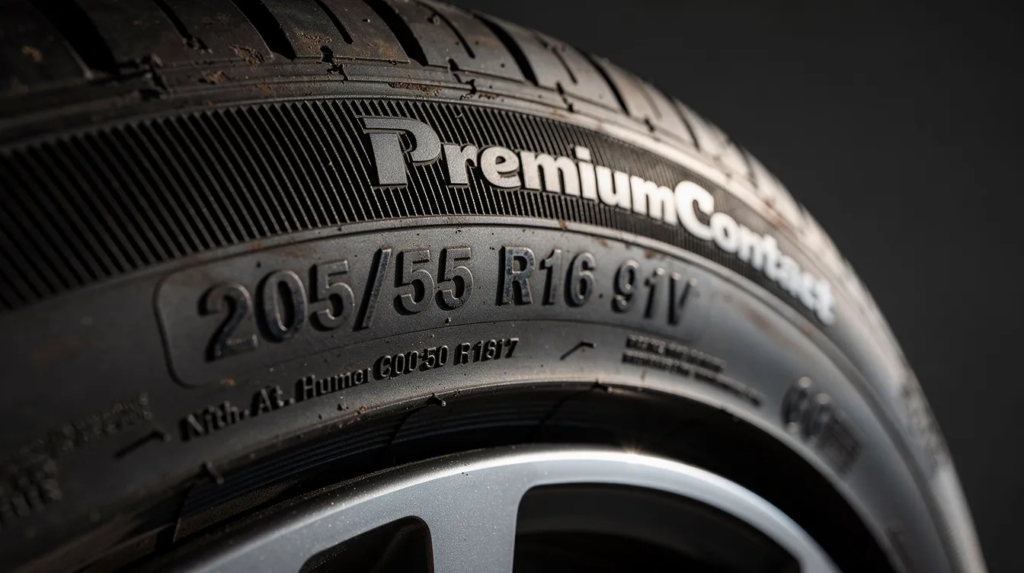
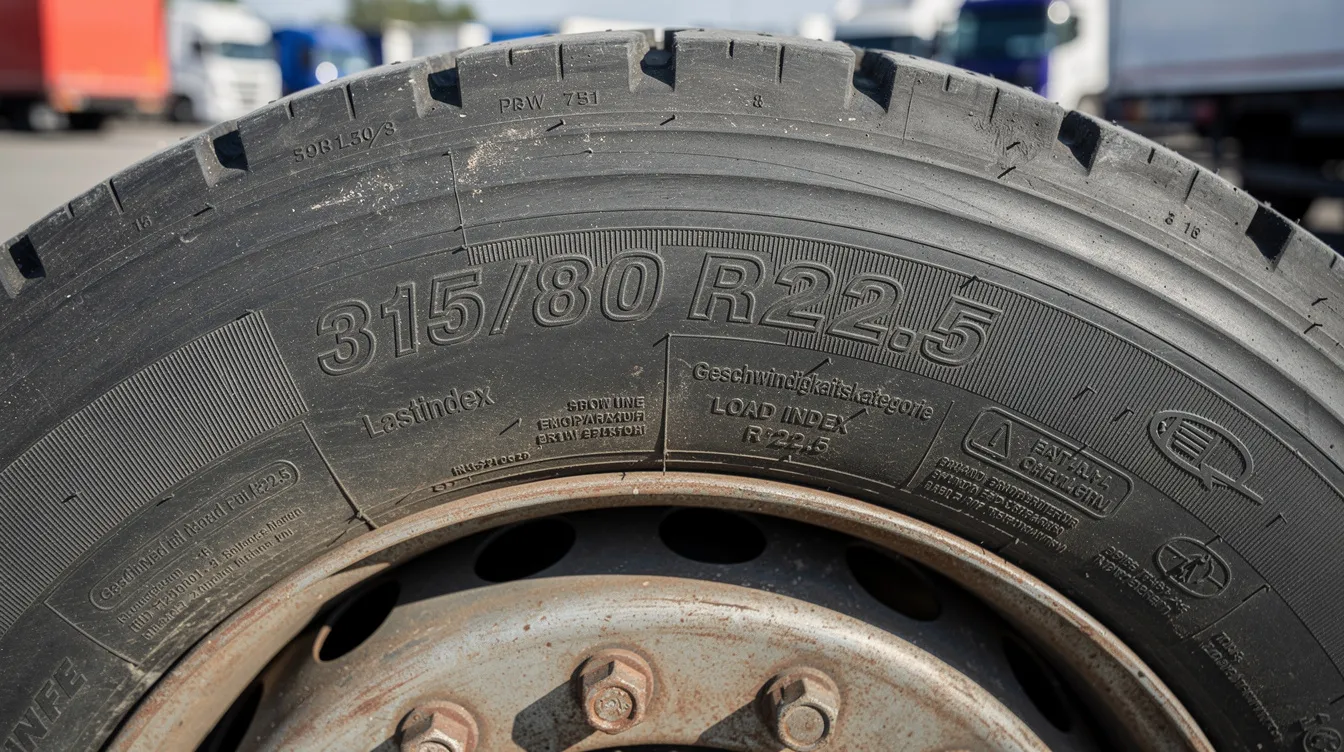
On a typical truck tyre (e.g. 315/70 R22.5), you’ll find the symbols on the sidewall, usually near the tyre size, the load index and the DOT number.
- All-weather tyres usually carry both M+S and the Alpine symbol
- Additional labels such as “All Season” or “4-Season” are often printed on the sidewall
- Without the Alpine symbol, a tyre no longer meets the legal requirements in winter conditions since October 2024
- The DOT number shows the week and year of production (e.g. “0518” = week 5, year 2018) – relevant for transition deadlines
How do I recognise all-weather tyres on a truck – step by step?
You recognise all-weather tyres by the Alpine symbol, often combined with M+S, plus labels such as “All Season” or “4-Season” on the sidewall. The tread of all-weather tyres combines elements of summer and winter tyres – wide longitudinal grooves for water drainage and fine sipes for snow grip.
Check your tyres in 5 steps:
- Secure the vehicle – engine off, parking brake applied, hazard lights on.
- Move to the outer side of the tyre – always work from the side facing away from traffic.
- Find the tyre size – printed on the sidewall, e.g. 385/65 R22.5 or 315/80 R22.5.
- Check the symbols – look right next to the size marking for the M+S sign and the Alpine symbol (mountain with snowflake). If “All Season” is also printed, it’s an all-season tyre.
- Check the DOT date – the last four digits of the DOT number reveal the production date. Tyres made before 2018 without the Alpine symbol are no longer permitted in winter road conditions since October 2024.
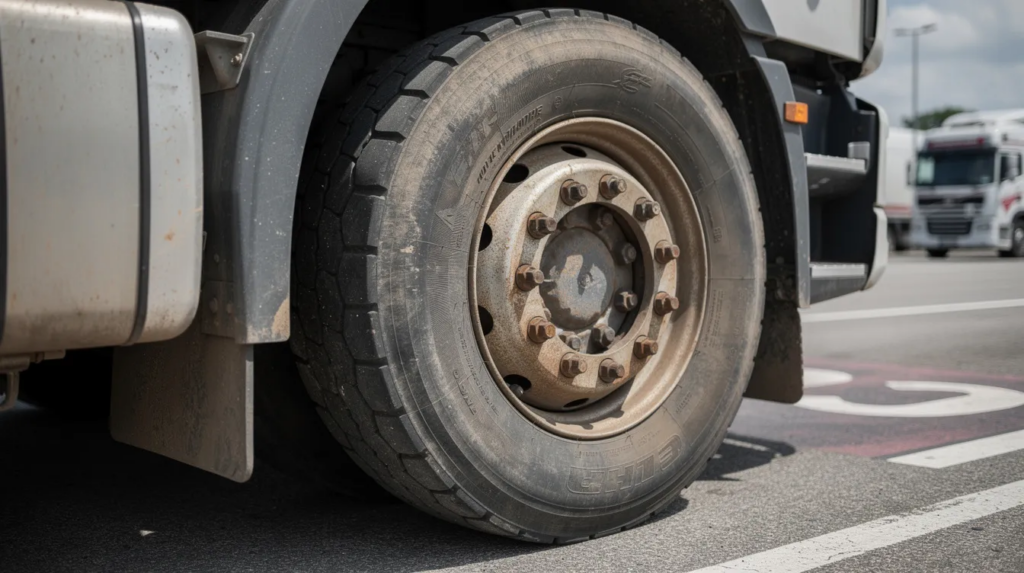
On twin-mounted wheels or trailer axles, sometimes only the markings on the outer side are easy to read. Check the inner wheels too when it’s safe to do so. Legally, what counts is always the marking on the tyre sidewall, not the tread pattern.
What’s the difference between M+S tyres and the Alpine symbol?
M+S is an unprotected manufacturer designation without a binding test standard. The Alpine symbol (3PMSF) is a tested winter-capability mark based on uniform tests.
M+S (Mud and Snow): The M+S marking was originally developed to mark tyres suitable for muddy and snowy roads. However, there is no standardised test behind it. Any tyre manufacturer could apply this marking themselves – without proof of actual snow performance.
Alpine symbol (3PMSF): The Alpine symbol shows a mountain with three peaks and a snowflake. Tyres bearing this pictogram must have passed standardised snow tests. Specifically, the Alpine symbol guarantees at least 7 percent better braking or traction performance on snow than a reference tyre. These tests are defined in UNECE Regulation R117.
- Since 2018, new winter tyres must carry the Alpine symbol if they are to be offered as winter-capable
- The Alpine symbol has been mandatory for new tyres since 2018 – this applies to all tyre types including winter and all-season tyres
- In roadside checks from 2024, practically only the Alpine symbol counts; M+S alone is no longer enough for the winter tyre requirement
What changes from October 2024 for all-weather tyres with M+S and the snowflake symbol?
From October 2024, German law only accepts tyres with the Alpine symbol as winter-capable in winter conditions. Old M+S tyres, previously tolerated under a transition rule, lose that status.
The new rules at a glance:
- The transition period for old M+S tyres ended on 30 September 2024. Tyres with M+S marking produced up to the end of 2017 were allowed to be driven on snow and ice until then.
- From 1 October 2024, all-weather tyres used in winter must carry the snowflake symbol (3PMSF) to meet the situational winter tyre requirement. Tyres with only the M+S marking are no longer permitted from October 2024.
- From 1 October 2024, only tyres with the Alpine symbol are allowed when winter road conditions apply – i.e. black ice, snow-covered roads, slush, ice or frost.
- Tyres with M+S marking are no longer valid from 2024 as the sole proof of winter capability.
Fleets should have checked their stocks of older M+S tyres in good time and replaced them by autumn 2024. This also applies to trailers, semi-trailers and drawbar trailers from 7.5 t upwards.
Does this all apply to trucks and commercial vehicles from 7.5 t too?
Yes, the distinction between summer tyres and winter-capable tyres (Alpine symbol) also applies to heavy trucks, articulated units and buses. German traffic law has no separate symbols just for cars – it distinguishes tyres solely by winter capability.
The situational winter tyre requirement has applied in Germany since 2010 (§ 2 (3a) StVO). This means: as soon as winter weather conditions occur, all motor vehicles – including heavy commercial vehicles – must be fitted with suitable tyres.
- Because of the high axle loads of trucks, requirements for winter grip, braking performance and safety are especially relevant
- Trucks running year-round long-haul routes often rely on all-weather tyres, but must observe the Alpine requirement from October 2024
- Under German StVZO § 36 (4), winter-capable tyres must be fitted at least on the permanently driven axle and the steering axle
This article is aimed exclusively at drivers and dispatchers of vehicles from 7.5 t.
What does the Alpine symbol (snowflake symbol) actually look like?
The Alpine symbol shows three mountain peaks with a snowflake in the middle. Officially it is called 3PMSF – short for “Three Peak Mountain Snowflake”. The 3PMSF symbol is uniform internationally and moulded into the tyre sidewall, as explained in Michelin’s guide to winter tyre markings.
On a typical 22.5″ truck tyre, you’ll usually find the symbol near the load index and speed rating, often right next to the M+S marking. The embossing is at least 10 mm wide and clearly visible – provided the sidewall is clean.
- The 3PMSF symbol indicates a passed snow traction test and is recognised in the EU as proof of winter capability
- The Alpine symbol is also known as 3PMSF and may only be granted if the tyre has passed tests under UNECE R117
- Don’t confuse the symbol with decorative logos or brand marks of individual tyre manufacturers – look specifically for the clearly recognisable mountain-with-snowflake pictogram
- An illustration can be added later to show the symbol visually
What role does the M+S symbol still play on truck tyres today?
Today, M+S is more of an additional piece of information. Legally, from October 2024 only the Alpine symbol is decisive for winter capability. The M+S symbol alone is no longer enough for the winter tyre requirement.
What does M+S mean? The letters stand for “Mud and Snow” (also written as “M.S.”, “M&S” or “M S”). This marking is even found on some summer tyres intended for light off-road use. It was never a guarantee of genuine winter properties.
Why the change? Lawmakers recognised that the plain M+S marking, without a test standard, is not a reliable sign of safety on snow, ice and black ice. That’s why the system was gradually shifted to the stricter 3PMSF standard, based on measurable performance.
For fleet managers, M+S still remains useful:
- It helps classify the tyre type (e.g. for use on unpaved roads or in mud)
- But M+S alone is no longer enough to meet the winter tyre requirement
- Check your stock specifically for the combination of M+S plus Alpine symbol
Do all-weather tyres with the Alpine symbol meet the winter tyre requirement for trucks?
Yes, all-weather tyres with the Alpine symbol are legally recognised as winter-capable and meet Germany’s situational winter tyre requirement. Tyres with the Alpine symbol are suitable for winter conditions – confirmed by the passed test.
Still, all-weather tyres are a compromise between summer and winter tyres. The rubber compound of all-weather tyres stays flexible in the cold and doesn’t harden like pure summer tyres. In mild temperatures, all-weather tyres offer good traction and reduce the need for tyre changes. But in extreme winter conditions – deep snow, heavy ice, steep alpine passes – specialised winter tyres with a more aggressive tread are often superior.
Advantages for hauliers:
- One tyre set for the whole year, no seasonal tyre change needed
- Less downtime, no separate storage costs for summer and winter tyres
- Year-round operational readiness even in changeable climates
Disadvantages:
- In extreme winters (alpine passes, mountain regions, Scandinavia), often less grip than pure winter tyres
- Higher wear in summer compared with pure summer tyres
Dispatchers should carefully review the route profile: flatland logistics allow all-weather tyres without issue. For regular winter mountain routes, dedicated winter tyres are the safer choice.
What happens at truck checks without the snowflake symbol in winter?
Without the Alpine symbol in winter weather conditions, drivers and vehicle keepers risk fines, penalty points and serious problems in the event of an accident.
A fine of 60 euros applies for incorrect tyres – that’s the base amount. If other road users are obstructed or endangered, the amount rises significantly. Tyres without the Alpine symbol can result in fines and penalty points on the German driving licence register (Flensburg) from 2024. In addition, insurance cover can be at risk: after an accident in winter conditions without correct tyres, insurers may seek recourse or reduce the payout.
- Police carry out targeted checks on gradients, border crossings and busy motorways – checking symbols, tread pattern and tread depth
- Unsuitable tyres can lead to the vehicle being immediately taken out of service, which disrupts supply chains massively and costs money
- A ban on continuing the journey can apply to the keeper even in a mild winter, if black ice or frost is reported
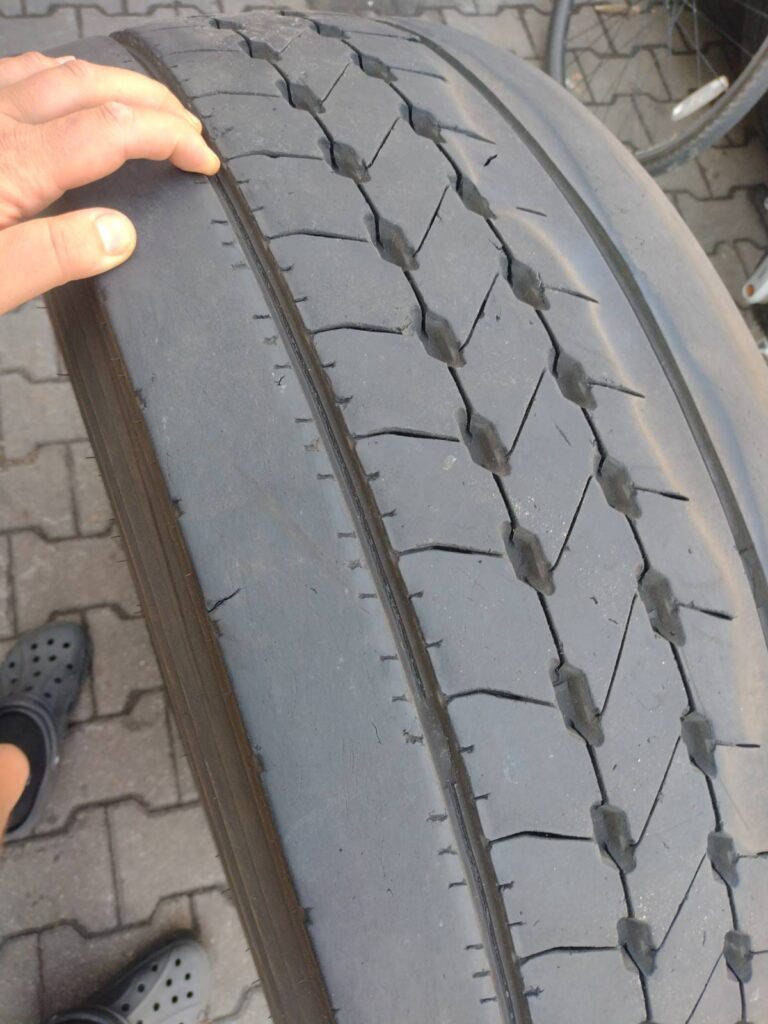
Recommendation: Before every winter season, visually check all truck tyres for the Alpine symbol and sufficient tread depth. The legal minimum depth is 1.6 mm; at least 4 mm is recommended for winter use.
The all-weather tyre symbol and trips abroad (e.g. Austria, Switzerland, Italy)
Rules abroad are sometimes stricter or different. However, the Alpine symbol is accepted almost everywhere as proof of winter capability.
Austria: A date-based winter tyre requirement applies (1 November to 15 April) in winter conditions. Tyres with the Alpine symbol are recognised. For trucks, detailed tread-depth rules can go beyond the German minimum requirement.
Switzerland: There is no rigid winter tyre obligation. However, drivers with unsuitable tyres risk increased liability and fines in the event of an accident. Alpine-symbol tyres are the safest choice.
Italy: Regional and seasonal rules vary widely. In alpine and northern Italian regions, winter marking is checked particularly closely. The Alpine symbol helps at every check.
Recommendation for fleets:
- Check the current rules of the destination country before international trips
- Only schedule trucks with correctly marked tyres (Alpine symbol) for international routes
- Carry tyre documentation (tyre type, symbol, DOT) in the vehicle
How does choosing all-weather tyres affect truck operating costs?
All-weather tyres with the Alpine symbol can save on change and storage costs. But they must fit the fleet’s mileage and route profile.
- Less downtime for seasonal tyre changes means more operating hours per vehicle – especially relevant for just-in-time logistics and international routes
- All-weather tyres now account for over 15 percent of tyres sold – a clear sign that many fleets are opting for this compromise
- Differences between brands and models can be significant in wet summer or dry winter conditions – not every all-weather tyre is equally good
- The EU tyre label provides information on wet grip, fuel efficiency and noise level, and can help with purchasing decisions
Dispatchers should analyse driving profiles before switching entirely to all-weather tyres:
Route profile | Recommendation |
|---|---|
Long-haul motorway, flat terrain | All-weather tyres with Alpine symbol suitable |
Urban distribution / local transport | All-weather tyres often economically sensible |
Regular alpine passes / mountains | Specialised winter tyres recommended |
Construction site traffic | Check route profile and rims individually |
In a breakdown, the exact tyre you’d prefer often isn’t available. In an emergency callout, getting back on the road quickly comes first.
What to do right after a tyre blowout with all-weather tyres on the motorway?
After a tyre blowout, safety comes first, then securing the breakdown site, and only after that checking symbols and tyre data.
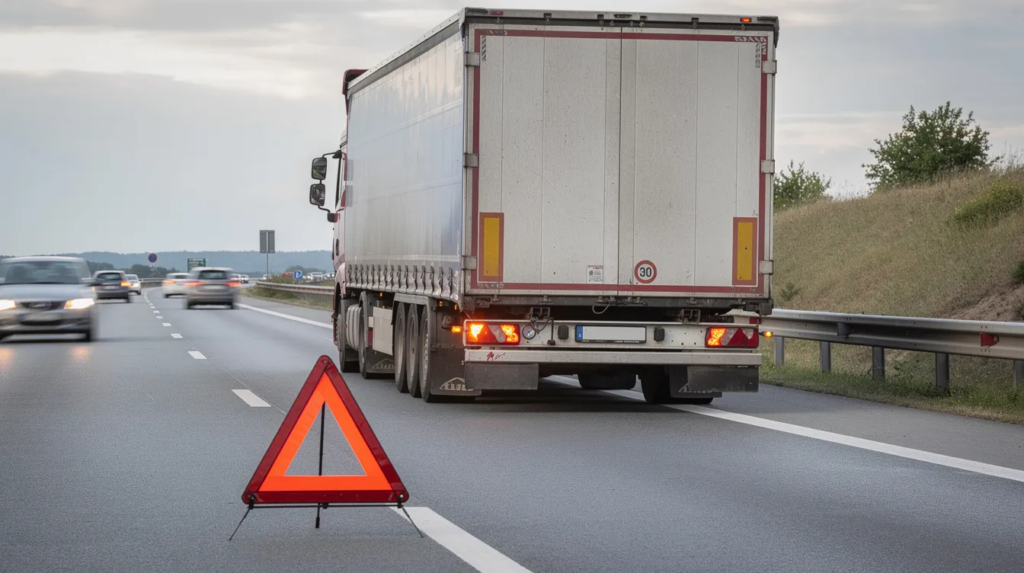
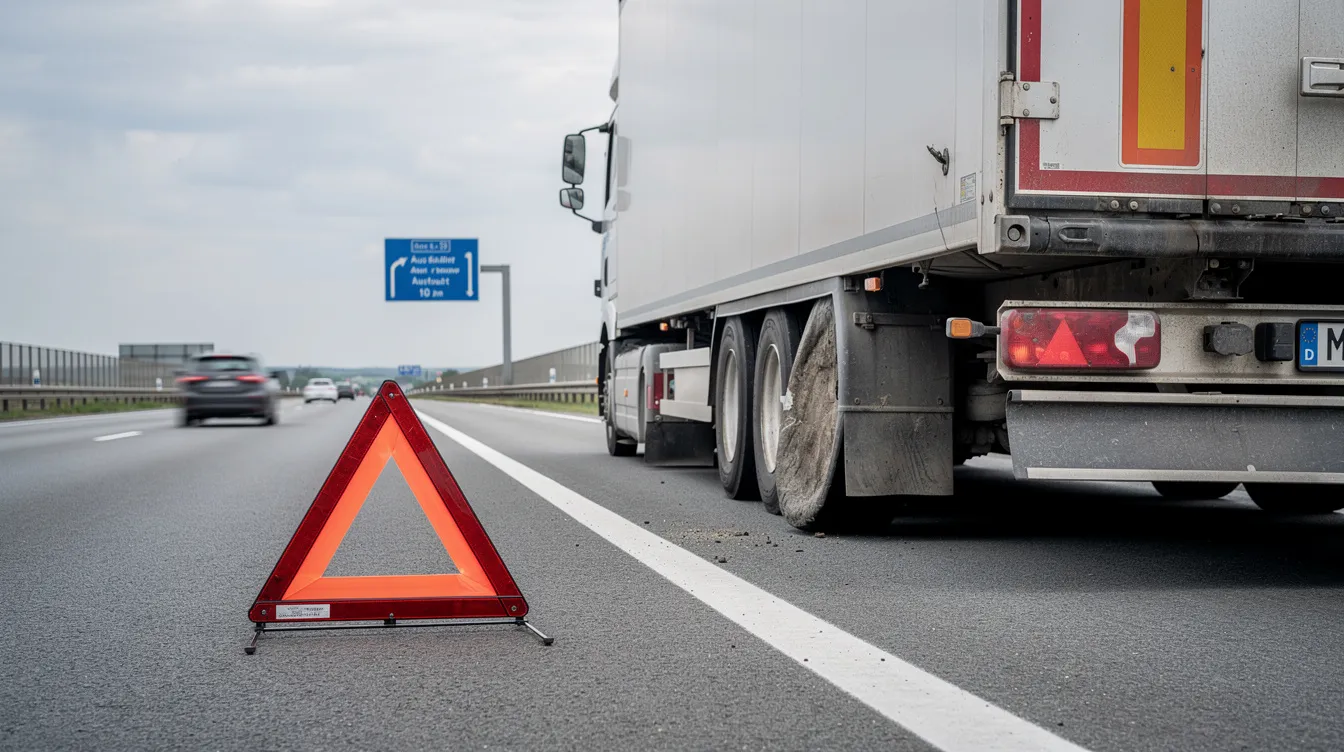
Step 1 – Stop the vehicle in a controlled way: Let the vehicle roll to a stop in a controlled manner. Move to the hard shoulder or a parking area. Switch on hazard lights immediately. Do not stop in the traffic lane.
Step 2 – Secure everyone: Put on a hi-vis vest. Leave the cab carefully from the side facing away from traffic. Move behind the crash barrier to safety. Passengers too.
Step 3 – Secure the breakdown site: Place the warning triangle at a sufficient distance. No risky repair attempts in the traffic lane. Your own safety comes first.
Step 4 – Check tyre data (only if safe to do so): Check the tyre and symbols (M+S, Alpine, DOT, size) only if this can be done safely from the protected side. Note the size and axle position.
Step 5 – Contact Lkwhelp24: Call us or send a WhatsApp message with your location and tyre data. We’ll arrange mobile truck tyre service to come to you.
What information does Lkwhelp24 need when you call about a tyre emergency?
We need exact location, vehicle and tyre data to send the right mobile truck tyre service to you within 30–60 minutes.
Location:
- Motorway number and direction of travel
- Kilometre marker or name of the rest stop / car park
- Ideally: send your location pin via WhatsApp
Vehicle:
- Type of vehicle (e.g. 4×2 tractor unit, trailer, semi-trailer)
- Total weight (at least 7.5 t) – no cars or vans under 7.5 t
- Number plate
Tyres:
- Tyre size (e.g. 385/65 R22.5 or 315/70 R22.5)
- Axle position (e.g. steering axle, drive axle, outer left trailer)
- Whether it’s an all-weather / M+S / Alpine-symbol tyre
Other details:
- Number of damaged tyres
- Whether the vehicle is still able to roll
- Preferred payment method (cash, card, or invoice for fleet customers)
WhatsApp is the fastest channel. Send your location, a photo of the tyre and the size directly to +49 160 5753826. We speak German, English, Polish and Russian.
How exactly does Lkwhelp24 help with tyre breakdowns involving all-weather tyres?
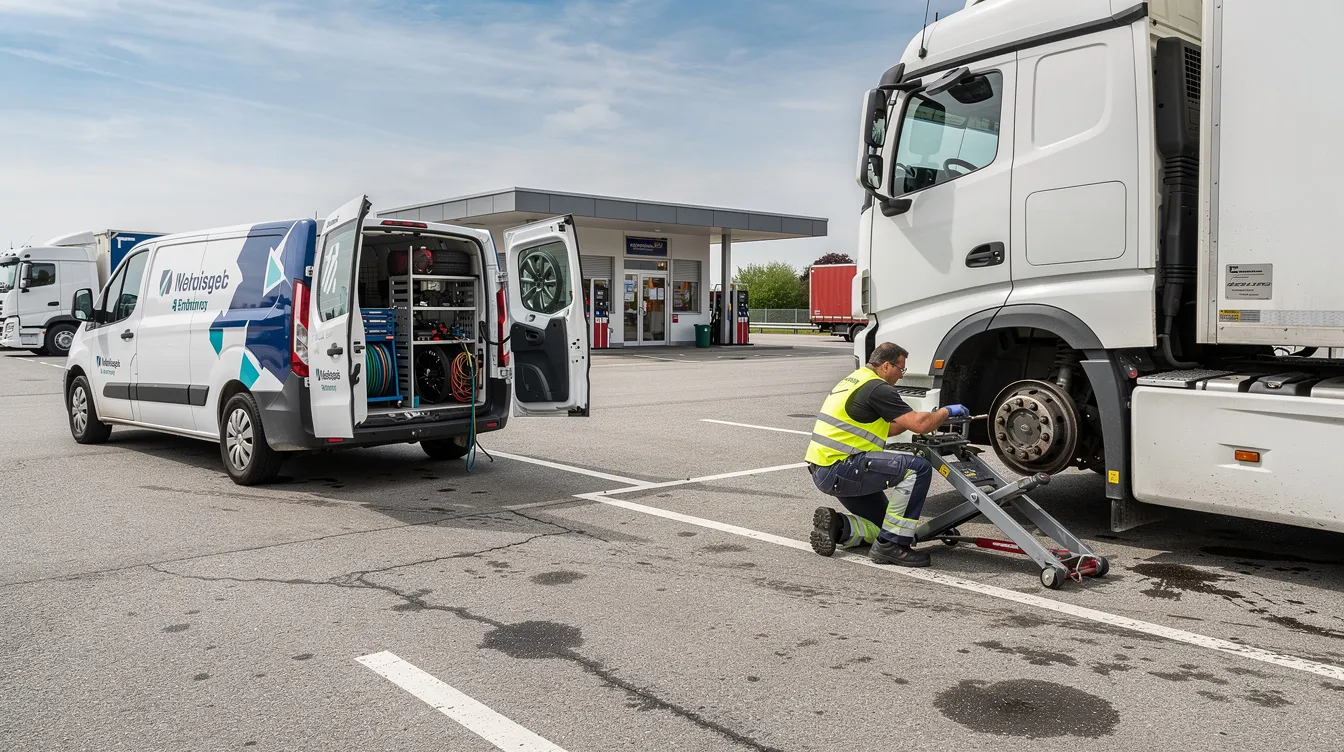
Lkwhelp24 organises 24/7 mobile truck tyre service from a network of around 2,500 partner workshops across Germany – exclusively for vehicles from 7.5 t.
- Response time: Typically 30–60 minutes, depending on location and traffic, directly to the hard shoulder or car park
- On-site fix: Around 90% of tyre problems are solved on site, so towing is not needed. Only in cases of severe damage do we arrange towing or recovery.
- Prices: Call-outs from €290 during the day or from €429 in the evening, at night and on weekends (net, plus tyre). No hidden costs.
- Tyres: The specific tyre comes from the partner’s available stock. A particular brand cannot be guaranteed in an emergency. A preferred brand may be possible for a surcharge and subject to availability.
- Payment: Cash or card. Invoicing available for hauliers and fleet customers.
What kind of vehicles does Lkwhelp24 serve – and which not?
Lkwhelp24 helps exclusively with heavy commercial vehicles from 7.5 t.
We serve:
- Tractor units and semi-trailers
- Rigid trucks with trailers
- Heavy municipal vehicles
- Buses and other commercial vehicles over 7.5 t
- Tyre sizes from R17.5 (17.5″, 19.5″, 22.5″)
We do not serve:
- Cars, SUVs, motorhomes, caravans
- Vans such as Sprinter, Boxer, Ducato, Ford Transit, Iveco Daily
- All vehicles under 7.5 t
All information on the all-weather tyre symbol in this article applies to truck and commercial vehicle tyres.
How should fleet managers plan their truck all-weather tyres by October 2024?
Fleet managers should specifically check which tyres still carry only M+S and replace these step by step with Alpine-marked all-weather or winter tyres. The change has been in force since October 2024.
- Take stock: Build an internal list of all tyres – axle, size, symbol, DOT date. Vehicles with old stock (M+S only, no Alpine) take priority.
- Long-haul first: Convert long-haul vehicles first, as they’re more likely to be in severe winter regions and abroad.
- Timing: Best to plan changeovers outside peak season to avoid workshop bottlenecks. Don’t wait until Easter or the first snow.
- Realistic expectations: Lkwhelp24 supports acute tyre breakdowns around the clock, but doesn’t replace permanent tyre storage or fleet planning software.
Forward planning saves money, avoids fines and keeps the fleet operational – even in unexpected weather.
How do you maintain all-weather tyres with the Alpine symbol on a truck correctly?
Regular checks of tyre pressure, tread depth and damage are even more important with all-weather tyres, because they are used year-round without a seasonal break.
- Tyre pressure: Keep tyre pressure within the manufacturer’s specified range. Too low increases wear and fuel consumption; too high reduces the contact area.
- Visual inspection: Check regularly for cracks, bulges, foreign objects and damage on the sidewall and in the tread.
- Uneven wear: If tyres wear unevenly, this can indicate axle or suspension issues. Have this checked promptly.
- Use rest stops: At every break, do a quick walkaround and check the tread and sidewalls.
- The symbol alone isn’t enough: Even a tyre with the correct Alpine symbol loses its winter capability once the tread and rubber are worn or damaged. Replace tyres in good time – regardless of marking.
FAQ on the all-weather tyre symbol for trucks
Is there a separate legal symbol just for all-weather tyres?
No, there is no specific “all-weather tyre symbol” in German traffic law. What matters legally is the Alpine symbol (mountain with snowflake), which can appear on both winter tyres and all-season tyres. It confirms winter capability based on standardised tests. The rule only distinguishes between tyres with and without the Alpine symbol – not between tyre types such as “all-weather” or “winter”.
Can I still drive on plain M+S tyres without the snowflake symbol in winter after October 2024?
In winter road conditions, plain M+S tyres without the Alpine symbol no longer meet the winter tyre requirement. Since 1 October 2024, all truck tyres used for winter capability must carry the snowflake symbol. Anyone still driving on plain M+S tyres in snow, ice or frost risks a fine from 60 euros, penalty points on the German licence register, and significant liability risks in the event of damage. The ban applies to all motor vehicles in Germany.
Are all-weather tyres with the Alpine symbol sufficient for demanding winter tours in the Alps?
Legally, they count as winter-capable. Technically, however, all-weather tyres are a compromise. For frequent trips to high altitudes with heavy snowfall and steep gradients, specialised winter tyres with a more aggressive tread are often the safer choice. Performance in deep cold and heavy snow is usually better with pure winter tyres than with all-season tyres – even if both carry the same Alpine symbol.
How old can truck all-weather tyres with the Alpine symbol be at most?
There is no rigid legal age limit for tyres. But as tyres age, rubber elasticity deteriorates, which worsens performance in cold and on wet roads. Alongside the symbol, fleets should always also check the DOT date, tread depth and visible damage. Tyres older than 5–6 years should be assessed particularly critically and replaced early.
How can I reach Lkwhelp24 fastest in an emergency?
The fastest way is via WhatsApp. Send your location pin and tyre data to +49 160 5753826. Alternatively, call us on the same number. Lkwhelp24 organises the right mobile truck tyre service 24/7 from a network of around 2,500 partner workshops across Germany. Typical response time: 30–60 minutes. We serve exclusively commercial vehicles from 7.5 t.
Stranded on the motorway and need help now?
Contact Lkwhelp24 – 24/7, 365 days a year.
📱 WhatsApp (fastest way): +49 160 5753826 📞 Phone: +49 160 5753826 📧 Email: info@lkwhelp24.com
Send us your location, tyre size and axle position. We’ll take care of the rest.