Skip to content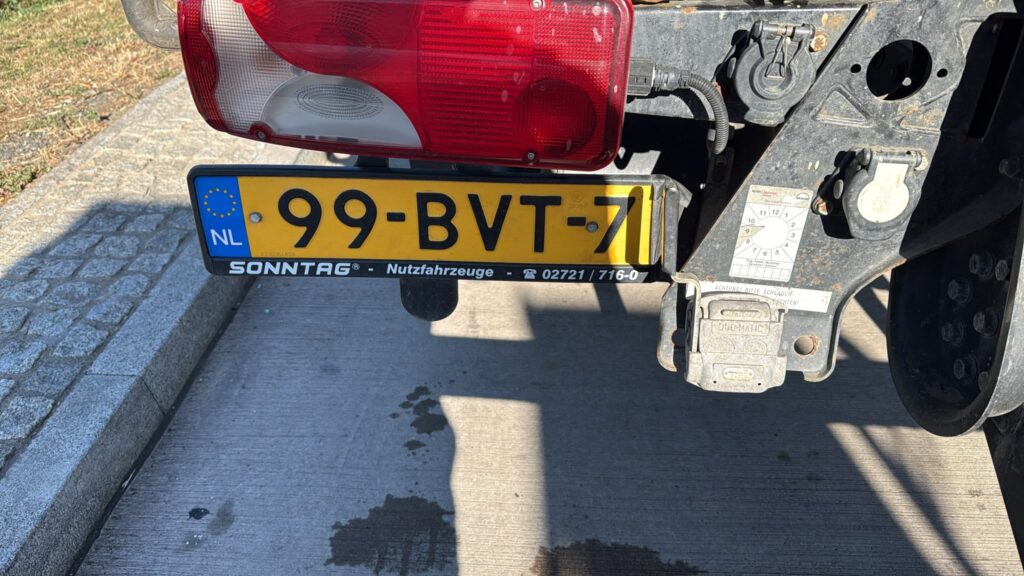
TL;DR: A routine HGV roadside inspection Germany on the hard shoulder of the A3 near Emmerich found a defective 385/65 R22.5 tyre and a lighting fault on a Dutch haulier’s trailer. Both were repaired on site, no prohibition of further travel was issued, and the vehicle was cleared in 2 hours 25 minutes from the driver’s call to LKWHelp24.
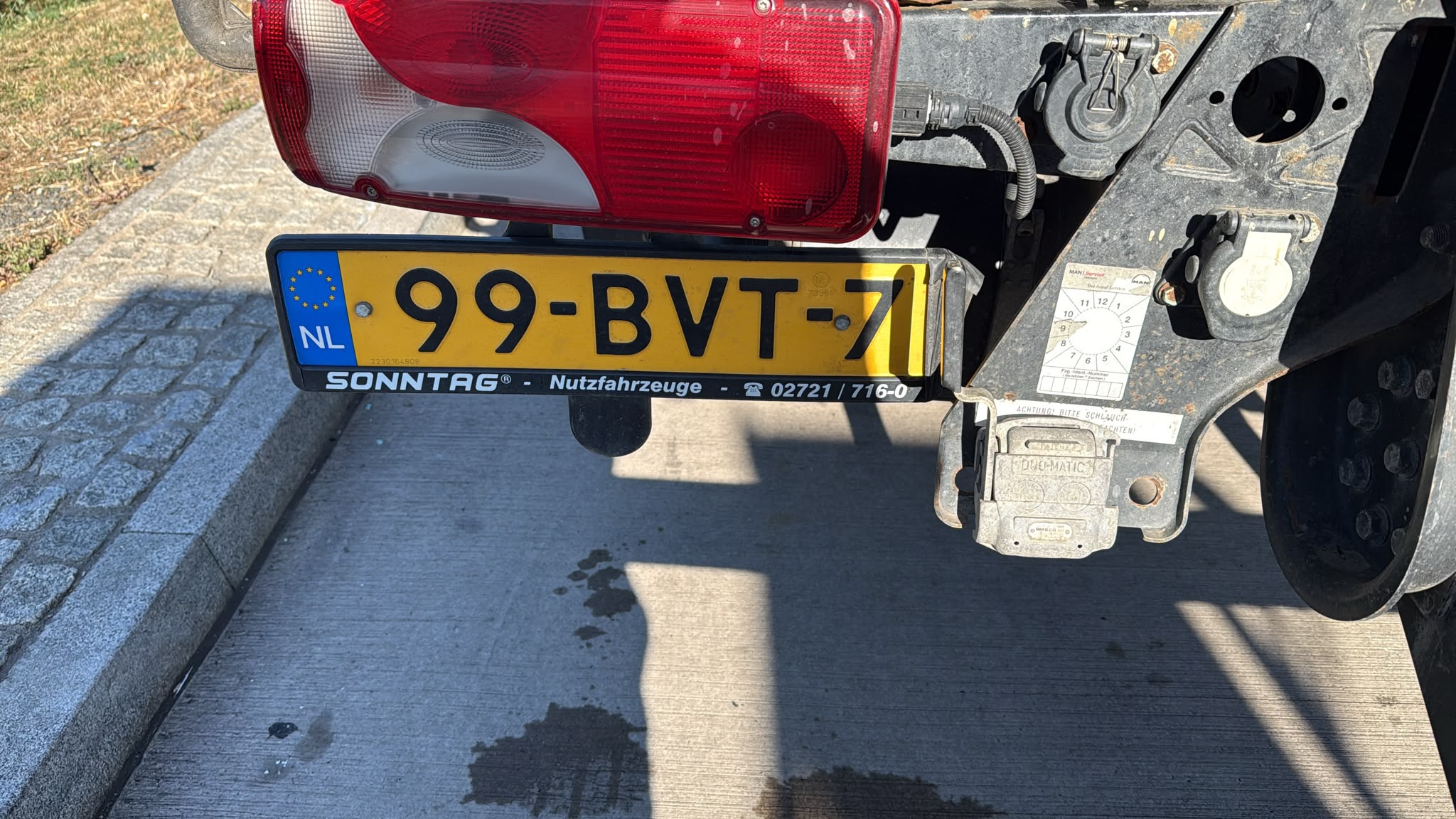
Roadside checks on the A3 near the Dutch border happen daily, and on 14 August one of them turned into exactly the kind of call LKWHelp24 exists for. BAG (Bundesamt für Logistik und Mobilität) officers and police carried out a standard technical inspection of a trailer belonging to a Dutch haulier, found a worn tyre and a lighting defect, and the driver needed a fast, compliant fix before the check escalated into something worse.
This case report walks through what happens during a truck roadside inspection Germany near a border crossing, why tyres and lighting are the two most common failure points on trailers, and how a coordinated dispatch turned a potential driving ban into an 80-minute repair job. It also sets out what BAG and police actually check, where the line sits between a fine and a full prohibition of further travel, and what drivers and fleets can do to avoid ending up in this position at all.
What happened on the hard shoulder near Emmerich
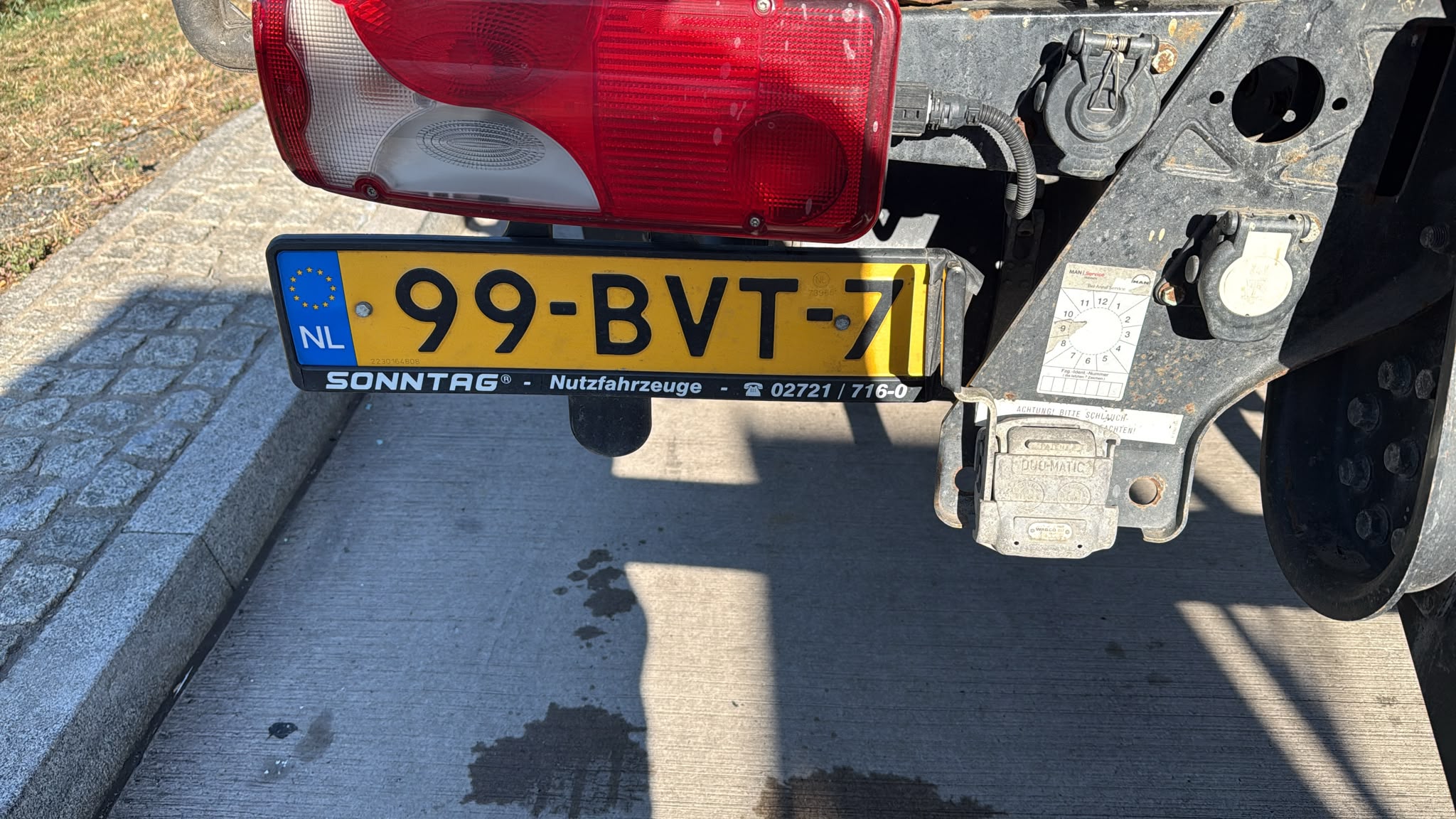
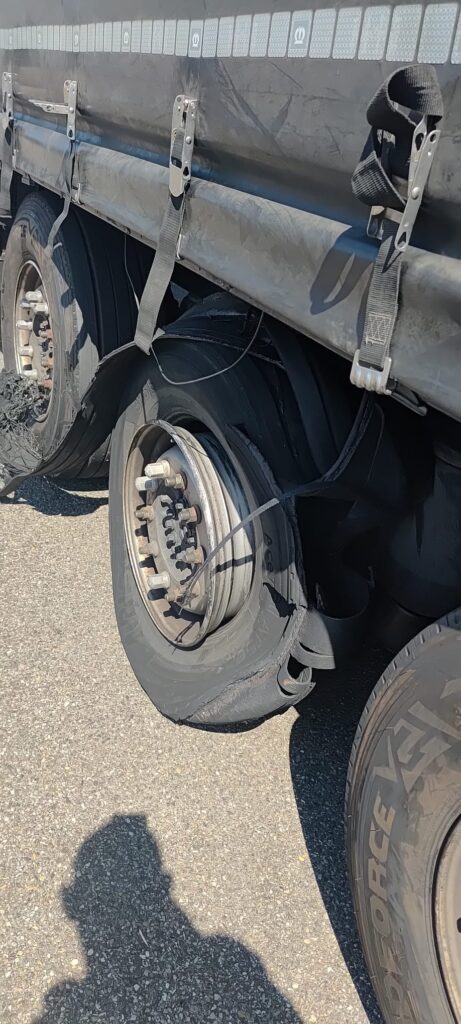
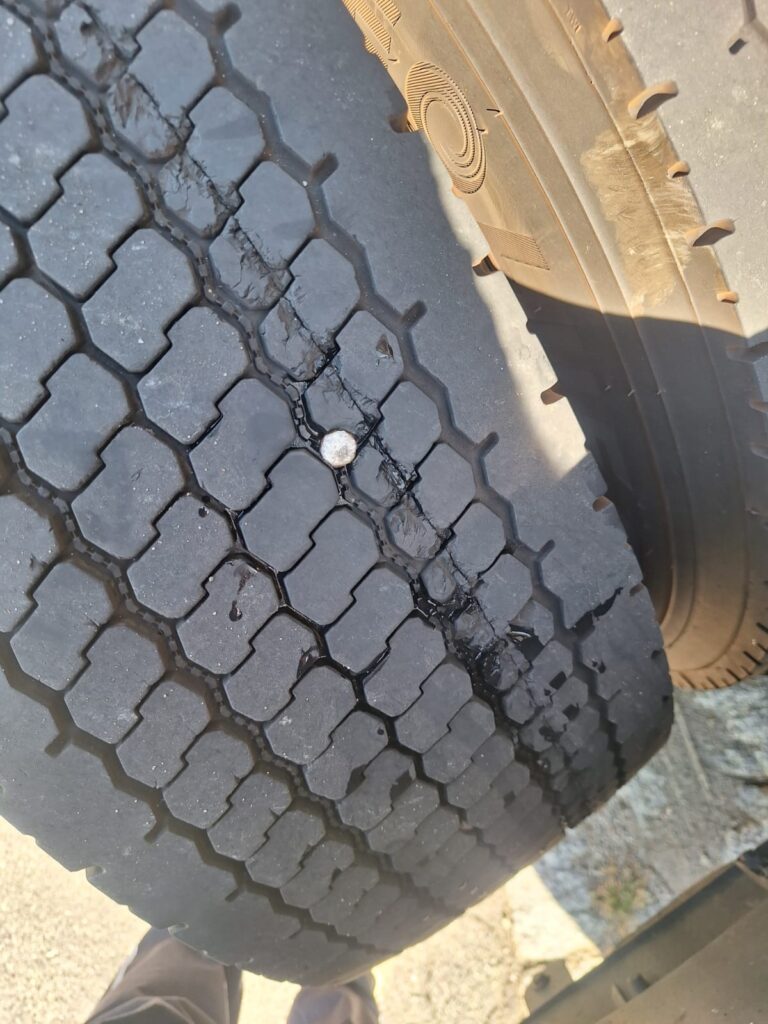
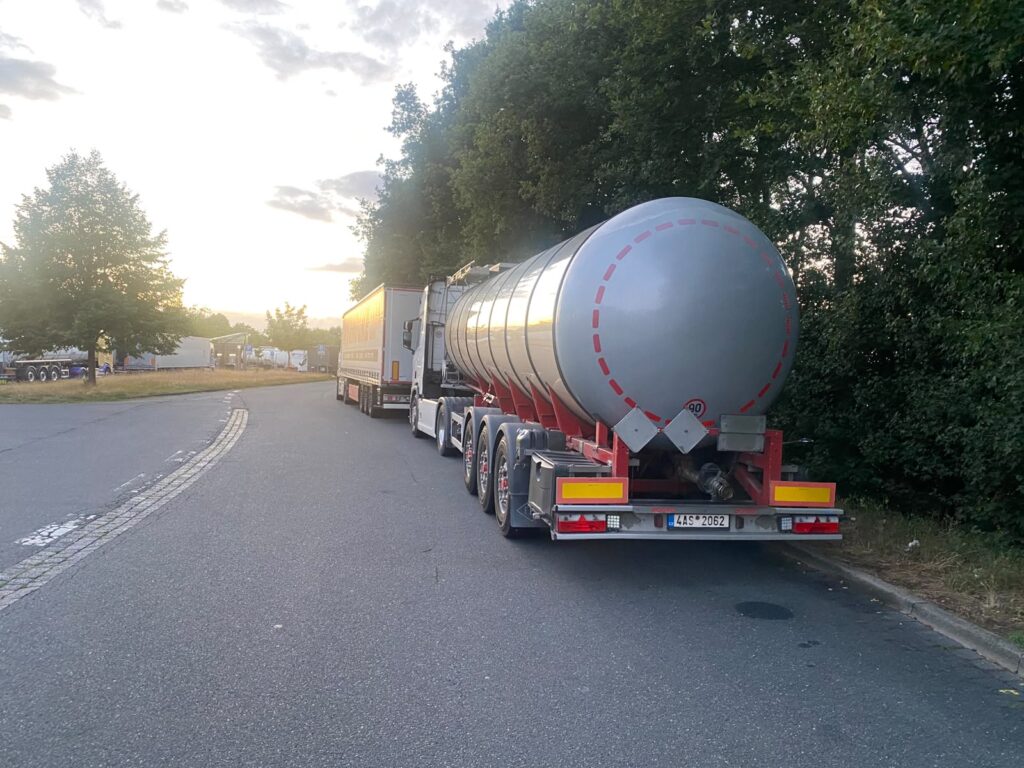
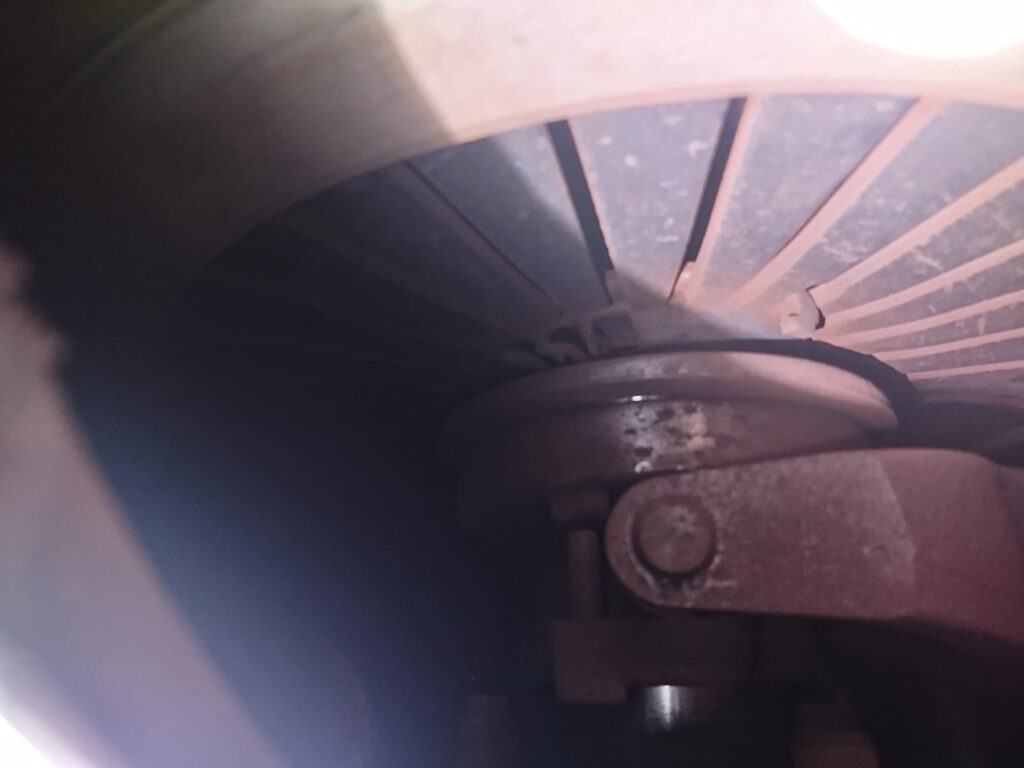
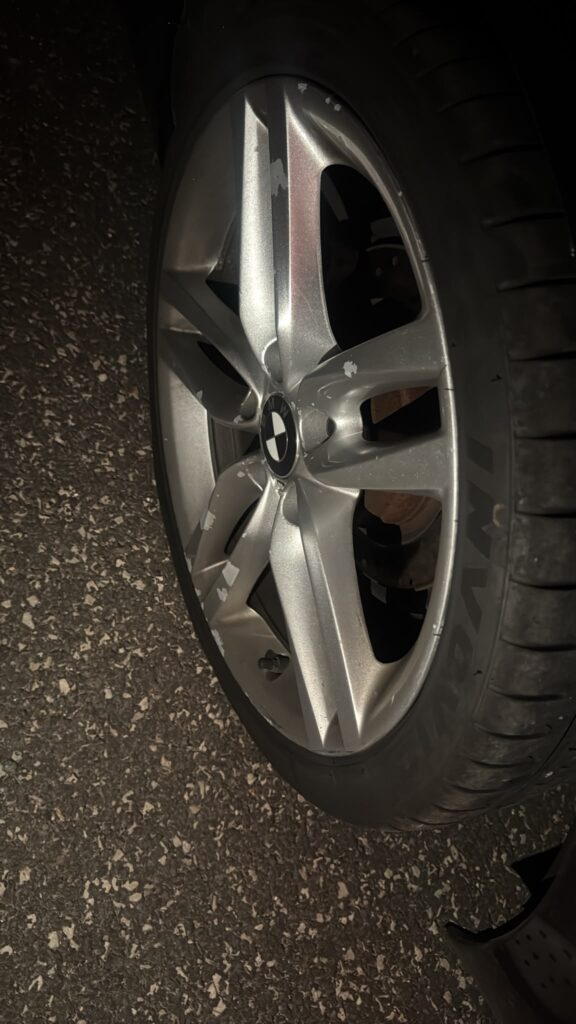
At 13:50 on 14 August, BAG officers working alongside the police stopped a trailer on the hard shoulder at the A3 motorway exit near Emmerich, close to the Dutch border, for a routine roadside check. A visual inspection of the tyres and lighting turned up two defects: one tyre, a 385/65 R22.5, showed tread and sidewall wear beyond the acceptable limit, and the trailer’s rear lighting had a fault traced to a corroded connector.
The driver reported the findings and called LKWHelp24 at 14:05. Because the location sits on one of the busiest transit corridors between the Netherlands and the Ruhr region, our regional service partner was already positioned nearby and confirmed the job within minutes. Both defects were fixed on site, the officers signed off the completion report, and the trailer was cleared to continue at 16:30. No prohibition of further travel was needed at any point.
Who checks what on German roads
BAG and police roadside checks cover far more than a quick look at the tyres. Officers work through driving and rest times via the tachograph, axle loads, the general technical condition of the vehicle, load securing, and a set of mandatory documents, and any one of these can trigger a deeper inspection.
- Driving and rest times — pulled directly from the digital tachograph, checked against EU Regulation 561/2006 limits for daily and weekly driving hours.
- Axle loads — weighed at the roadside unit or estimated visually, with overloading treated as a serious offence.
- Technical condition — tyres, brakes, steering, lighting, and general roadworthiness, often assessed to the same standard applied at a DEKRA periodic inspection.
- Load securing — straps, chains, and blocking checked against VDI 2700 guidance, particularly on trailers carrying palletised or loose freight.
- Documents — driving licence, vehicle registration, ADR papers where relevant, and proof of the haulier’s operating licence.
According to BAG, which runs a substantial share of Germany’s commercial vehicle enforcement together with the Autobahnpolizei, checks are concentrated on major freight corridors and border crossings precisely because that is where non-compliant vehicles are most likely to pass through.
What gets checked first on a trailer
Tyres and lighting are the two areas officers inspect first on any trailer, simply because both are visible from outside the cab without tools. Tread depth, sidewall damage, and DOT or ECE markings are checked in seconds; a bald patch, a cut in the carcass, or a mismatched tyre size stands out immediately. Brakes come next, often via a quick visual check of pad wear and disc condition through the wheel, followed by lighting and reflectors, load securing, and the vehicle’s identification plates against the registration documents.
A single worn tyre on a twin-wheel axle is a common finding. It rarely stops there, though — officers frequently check the matching wheel on the same axle for mismatched wear, since uneven tyre pressure across a pair accelerates damage on both.
The escalation ladder: rectification, fine, or driving ban
Most minor defects found at a roadside check are resolved through on-the-spot rectification, but the response scales quickly with severity. A single worn tyre with adequate legal tread depth remaining might draw a warning; a tyre below the § 36 StVZO minimum, or a lighting fault that reduces visibility, typically brings a fine collected on the spot. A genuinely dangerous defect — a tyre with cord showing, defective brakes, or no functioning rear lights at night — results in a prohibition of further travel (Weiterfahrtuntersagung), and the vehicle stays parked until it is fixed or recovered.
The line between these outcomes is not always obvious to a driver under pressure. Officers weigh whether the defect creates an immediate safety risk versus one that can safely wait for repair; a lighting fault discovered in daylight, for instance, carries less urgency than the same fault found after dusk. In this case, both defects sat in the fine-plus-rectification band rather than the driving-ban band, which is why repairs could go ahead on the hard shoulder rather than at a workshop.
Foreign hauliers and roadside fines
Foreign hauliers stopped in Germany are frequently asked to pay fines as a security deposit on the spot, since German authorities have limited means of collecting from a company registered abroad after the fact. This catches many Dutch, Polish, and Belgian drivers off guard, particularly when the amount runs into several hundred euros and the vehicle carries no company card or sufficient cash. Officers generally accept card payment at the roadside unit, though a driver should always confirm this before assuming otherwise.
Practical questions worth asking before setting off matter more here than almost anywhere else in Europe. Does the company issue drivers with a card that covers on-the-spot fines? Is there a clear internal process for who authorises payment when a driver calls in from the hard shoulder? A five-minute conversation before departure avoids an hour of confusion during a stop.
Why fixing it on site beats a workshop trip
Sending a mobile team to the hard shoulder is almost always cheaper than the alternative of a driving ban followed by a workshop visit. A prohibition of further travel stops the clock on the whole journey, not just the repair — recovery to a garage, waiting for parts, and rebooking the delivery slot can turn an 80-minute tyre change into a two-day delay.
Downtime for an idle lorry runs roughly €800 to €1,200 a day once missed delivery windows, driver wages, and knock-on scheduling costs are factored in. Against that backdrop, a same-day mobile call-out that keeps the vehicle moving is rarely the expensive option, even before counting the reputational cost of a late delivery to the customer at the other end.
Tread depth: the most common issue on the road
Tread depth is the single most frequent defect found during roadside tyre checks, and the legal threshold in Germany is set out in § 36 StVZO, which requires a minimum of 1.6 millimetres across the tyre. Most fleets set their own replacement point well above that legal floor, typically around 3 to 4 millimetres, because grip and braking distance degrade measurably before a tyre reaches the statutory minimum, especially in wet conditions on the autobahn.
Replacing a tyre early costs less than the alternative of a roadside failure. A tyre that fails in transit, rather than at a scheduled service interval, forces an unplanned call-out at whatever rate is available at that hour, on top of the delay itself. Fleets running Michelin, Continental, Goodyear, or Bridgestone tyres on their trailers generally see the most consistent wear patterns when tyre pressure is checked weekly rather than left to visual inspection alone, since a slow puncture is invisible until the carcass has already been damaged.
Trailer lighting: the second most common defect
Lighting faults are the second most frequent finding on trailers, and the cause is almost always mechanical rather than electrical in the strict sense. Corroded contacts at the coupling connector, damaged wiring where the cable runs along the chassis, and simply dirty or mud-caked lamps account for the majority of failures officers log. A rear lamp that worked perfectly at the depot can fail thirty minutes later once vibration on the autobahn works a loose pin free.
A daily walk-round check before departure catches most of this. It takes under two minutes to walk the length of a trailer, check every lamp lights, and glance at the coupling connector for visible corrosion, yet this single habit prevents a large share of the lighting-related stops that BAG and police log every week.
Which documents get requested
Officers at a roadside check will typically ask for the driver’s licence, the vehicle registration document, the driver card for the tachograph, proof of the haulier’s operating licence (Gemeinschaftslizenz for EU operators), and, where the load requires it, ADR documentation or a CMR consignment note. Missing paperwork rarely triggers a prohibition of further travel on its own, but it does extend the length of the stop considerably while officers verify details by phone or radio.
Checklist: preparing for an inspection
- Walk the vehicle before departure, checking tyre condition, tread depth, and all lighting.
- Keep the driver’s licence, vehicle documents, and operating licence together and easily accessible.
- Confirm the tachograph card is inserted correctly and driving times are within limits before setting off.
- Carry a warning triangle and hi-vis vest, and know exactly where they are stowed.
- Save LKWHelp24’s number in the cab so a call-out can be arranged the moment a defect is found.
Transit near the Dutch border: why checks are so frequent here
The A3 corridor near Emmerich carries an exceptionally high volume of cross-border freight moving between Rotterdam, the Ruhr, and destinations further into Germany, which is exactly why BAG and police concentrate resources on this stretch. Foreign-registered vehicles pass through in large numbers, and enforcement data consistently shows a higher rate of defects among vehicles that have not been serviced under German inspection standards recently. A trailer that last saw a full technical check in the Netherlands months earlier is statistically more likely to be pulled over here than one running a domestic route entirely within Germany.
How the job was organised
Coordinating a roadside repair against the clock depends on dispatch discipline as much as technical skill. On this call, the sequence looked like this:
- The driver’s call at 14:05 was logged and matched to the nearest available regional service partner.
- Dispatch confirmed vehicle details, tyre size, and the nature of the lighting fault before the team left base, so the correct 385/65 R22.5 tyre was loaded rather than sourced after arrival.
- The partner team departed within fifteen minutes of confirmation, reflecting the response time our network aims for on this corridor.
- Arrival was communicated to the driver in advance so the trailer stayed accessible and safely positioned on the hard shoulder.
- After the repair, the completion report was prepared on site for immediate handover to the inspecting officers, closing out the stop without further delay.
Full timeline
| Time | Phase | Action |
|---|---|---|
| 13:50 | Inspection | BAG/police stop the trailer for a routine check, visual inspection of tyres and lighting |
| 14:05 | Call | Driver reports the defects and calls LKWHelp24 |
| 14:20 | Dispatch | Regional partner team confirms the job, departs (15-minute response time) |
| 15:10 | Arrival | Service team arrives after a 50-minute drive |
| 15:10–15:50 | Tyre change | Fitting the new 385/65 R22.5 tyre |
| 15:50–16:25 | Lighting | Repair of connector/bulb on the trailer |
| 16:25–16:30 | Report | Sign-off and handover of the completion report for the inspection |
| 16:30 | Clearance | Vehicle cleared to continue |
Total time from call to clearance: 2 hours 25 minutes.
Cost breakdown
| Item | Price (EUR) |
|---|---|
| Call-out/mobilisation | 260 |
| Labour (approx. 80 min) | 160 |
| Tyre 385/65 R22.5 incl. fitting | 480 |
| Old tyre disposal | 20 |
| Lighting repair (wiring, bulb) | 140 |
| TOTAL (net, plus VAT) | 1060 |
Pricing on a call-out like this reflects distance from the nearest partner base, the size and specification of the tyre required, time of day, and whether a second technician is needed to handle both a tyre change and an electrical repair simultaneously. Set against downtime of €800 to €1,200 per idle day, a total of €1,060 that keeps the vehicle moving within two and a half hours is, in almost every case, the cheaper outcome.
Why you need a professional, not a DIY fix
Attempting a roadside tyre or lighting repair without proper equipment carries risks that go well beyond the immediate job.
- Fitting a trailer tyre without a torque wrench risks incorrect wheel nut tension, which can work loose within a few hundred kilometres and cause a wheel separation at speed.
- Working on the hard shoulder without a warning triangle, hi-vis vest, and correct positioning of the breakdown vehicle exposes the driver and technician to passing traffic.
- A lighting repair that bypasses the correct connector pinout can cross-wire brake lights and indicators, creating a defect that is worse than the original fault.
- An improvised fix that satisfies the inspecting officer today may not hold for the rest of the journey, risking a second stop, a second fine, or a breakdown further down the autobahn.
- Disposal of a damaged tyre is regulated; leaving it at the roadside or in a random skip can expose the haulier to environmental fines.
Situations LKWHelp24 responds to across Germany
Roadside inspections are one recurring trigger for a call-out, but they sit alongside a broader range of jobs our dispatch handles nationwide: tyre blowouts on the autobahn, brake and lighting faults found during a driver’s own walk-round check, recovery after a breakdown on a hard shoulder, and coordination for hauliers who need a compliant repair documented for their own fleet records. Coverage runs 24/7 across Germany, with particular density along the western border corridors where cross-border freight volume is highest.
Prevention tips for drivers and fleets
A short pre-trip check catches most of what a roadside inspection would otherwise flag. Drivers should look at tread depth and tyre pressure, confirm every light functions including indicators and the number plate lamp, and check the coupling connector for corrosion before hitching a trailer. Fleets, for their part, benefit from tracking tyre age and mileage centrally rather than leaving replacement decisions to individual depots, since a tyre nearing its service limit on paper is far easier to schedule for replacement than one discovered worn at a roadside stop three countries from home.
Tyres and fleet maintenance: what matters beyond the legal minimum
Tread depth is only one factor in tyre condition. Sidewall cracking from UV and ozone exposure, irregular wear from misaligned axles, and carcass damage from kerb strikes all shorten a tyre’s working life well before the legal tread limit is reached. Fleets running mixed brands across their trailers — Michelin, Continental, Goodyear, and Bridgestone are the most common on German roads — generally find that consistent wheel balancing and correct torque at fitting reduce irregular wear more than brand choice alone. Steering axle tyres wear differently from drive axle and trailer tyres, and a maintenance schedule that treats all three the same tends to miss problems until a roadside check finds them first.
Regular pressure checks matter as much as tread depth. A tyre running underinflated by even 15 per cent heats up faster on long autobahn stretches, accelerating carcass fatigue in a way that is invisible until a blowout or, as in this case, a defect flagged during a routine inspection.
Why choose LKWHelp24
LKWHelp24 runs a vetted partner network across Germany with dispatch available 24/7, coordinated in multiple languages so drivers from any EU country can explain a fault clearly on first contact. Pricing is agreed and confirmed before a team departs, with no surprise charges added once the job is under way, and every call-out that involves a compliance stop is documented in a completion report the driver can hand directly to the inspecting officer. That combination of speed, transparency, and clear documentation is what turns a roadside inspection from a lost day into a two-hour delay.
FAQ
What happens if a tyre fails a roadside check in Germany?
Officers assess severity on the spot. A tyre below the § 36 StVZO tread limit or with visible carcass damage usually means a fine plus immediate repair; a genuinely dangerous defect can trigger a prohibition of further travel until it is fixed.
Can a foreign haulier pay a German roadside fine on the spot?
Yes, in most cases. Officers commonly collect fines from foreign-registered vehicles as a security deposit by card at the roadside, since recovering payment later from a company abroad is far harder.
How long does a roadside tyre and lighting repair usually take?
On this 14 August call-out, both repairs took roughly 80 minutes once the technician arrived, with total elapsed time from the driver’s call to clearance at 2 hours 25 minutes.
What is the minimum legal tread depth for a lorry tyre in Germany?
1.6 millimetres under § 36 StVZO, though most fleets replace well before that point, typically around 3 to 4 millimetres, since braking performance drops noticeably as tread wears down.
What documents does BAG usually ask for at a stop?
Driving licence, vehicle registration, tachograph driver card, the haulier’s operating licence, and, where relevant, ADR papers or a CMR consignment note.
Is a lighting fault enough to stop a lorry travelling?
It depends on severity and time of day. A single faulty bulb found in daylight is usually a fine-and-fix situation; a widespread lighting failure discovered after dark is far more likely to bring a prohibition of further travel.
Summary
A routine BAG and police inspection on the A3 hard shoulder near Emmerich on 14 August found a defective 385/65 R22.5 tyre and a trailer lighting fault on a Dutch haulier’s vehicle. Both were repaired on site by our regional service partner within 80 minutes of arrival, for a total net cost of €1,060, and the vehicle was cleared to continue 2 hours 25 minutes after the driver’s first call. No prohibition of further travel was required.
Need a roadside call-out anywhere in Germany?
Call +49 160 5753826 or visit www.lkwhelp24.com — LKWHelp24 dispatch runs 24/7 across Germany.
Keywords: truck roadside inspection Germany | HGV roadside check | BAG inspection trailer | tyre defect autobahn | trailer lighting repair Germany | prohibition of further travel | 385/65 R22.5 tyre | roadside assistance A3 Emmerich | mobile truck tyre service | tread depth § 36 StVZO | HGV breakdown assistance Germany | tachograph roadside check