Skip to content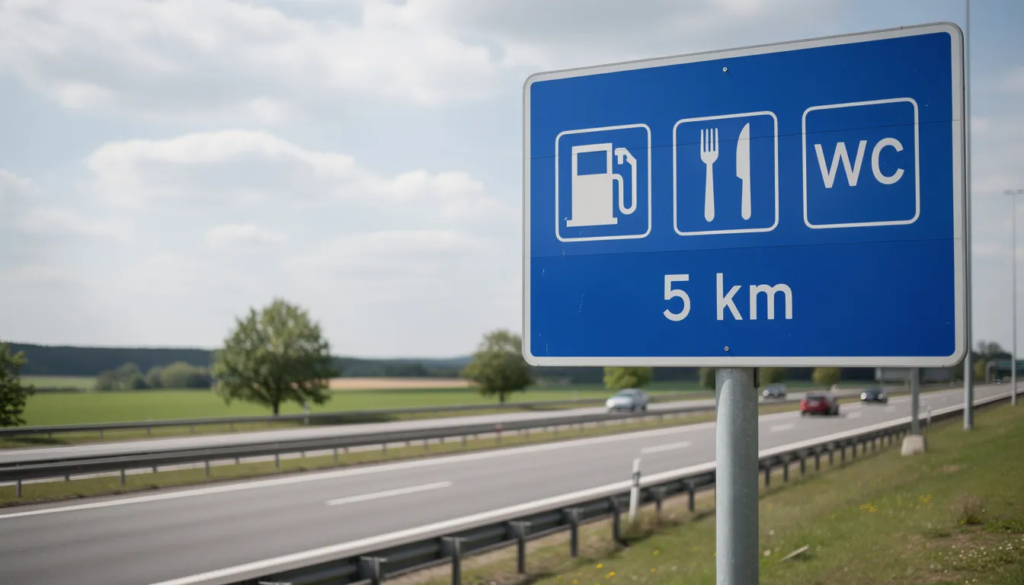
Driving on the German motorway and need a break? This article is for you. Find out how to quickly locate the nearest Raststätte (service area) or Rastplatz (rest stop) — using a map, an app, or simply the signs along the road. And if you ever get a flat tyre or breakdown at a rest area, AutoHelp UG’s 24/7 mobile truck tyre service is just one call away.
Introduction: Rest Areas on German Motorways
Rest areas on German motorways are essential for every traveller. They provide a safe place to take a break. Truck drivers are legally required to observe mandatory rest periods. All visitors can refuel, eat, and use the toilet here.
Every year, approximately 500 million people use rest facilities in Germany. On average, you will find a facility every 60 kilometres. The German motorway network stretches over 13,000 kilometres — so there are many locations to stop.
This article explains:
- How to quickly find the nearest service area
- The difference between Raststätte, Rasthof and Rastplatz
- Which apps and route planners can help
- What to expect at a German motorway service area
The situation is currently strained: traffic is increasing, there are more trucks on the road, and by the evening from around 17:00 parking spaces are often full. Fuel prices at service areas are also frequently higher than at roadside stations.
Terms Explained: Raststätte, Rasthof and Rastplatz
In Germany there are three types of rest facilities. The terms appear on signs and in every map. Here is the difference in plain language:
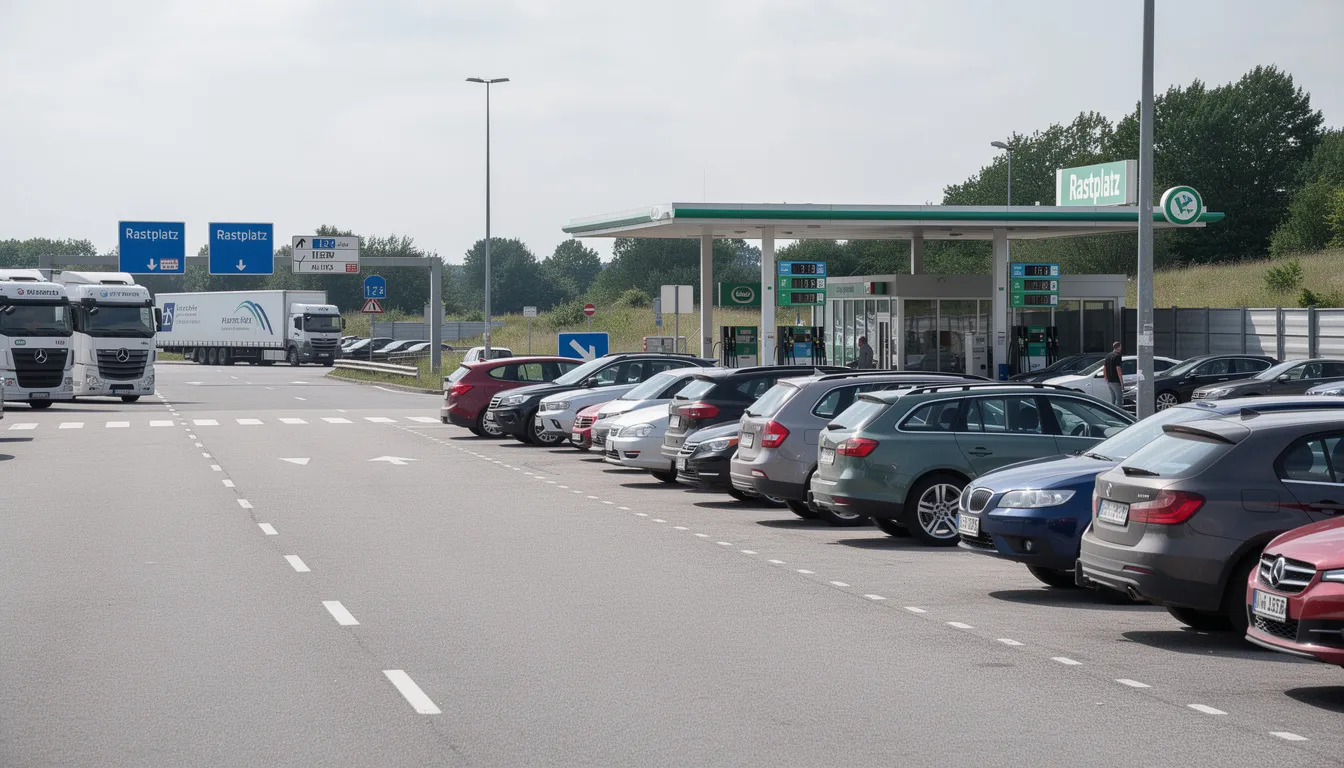
Raststätte (Motorway Service Area)
A Raststätte is located directly on the motorway. No exit is required. You will find:
- Petrol station (diesel, petrol, AdBlue)
- Food and drink (e.g. McDonald’s, Burger King, Marché, Nordsee)
- Toilets and showers
- Often a hotel or motel
Example: Raststätte Spessart Nord on the A3 with Aral petrol station and McDonald’s.
Rasthof (Truck Stop off the Motorway)
A Rasthof is located slightly off the motorway. You need to take an exit. These are often privately operated. Advantages:
- Lower prices (up to 20% cheaper than at a Raststätte)
- Greater variety of food
- Regional specialities
Example: Rasthof Münsterland on the A1.
Rastplatz (Basic Rest Stop)
A Rastplatz is a basic facility. Here you will find:
- Parking for trucks and cars
- Toilets (sometimes coin-operated only)
- Picnic tables
- No petrol station, no restaurant
Example: Rastplatz Ohligser Heide on the A3.
How to Recognise the Facilities on Signs
Symbol | Meaning |
|---|---|
Fuel pump (green) | Petrol station |
Fork and knife | Restaurant |
WC | Toilet |
Bed | Hotel |
Truck silhouette | Truck parking |
Plug (since 2021) | EV charging point |
How to Find the Nearest Service Area or Rest Stop
Signage on German motorways is consistent. Even without German language skills, you can understand everything. Here are the most important tips:
Reading the Signs
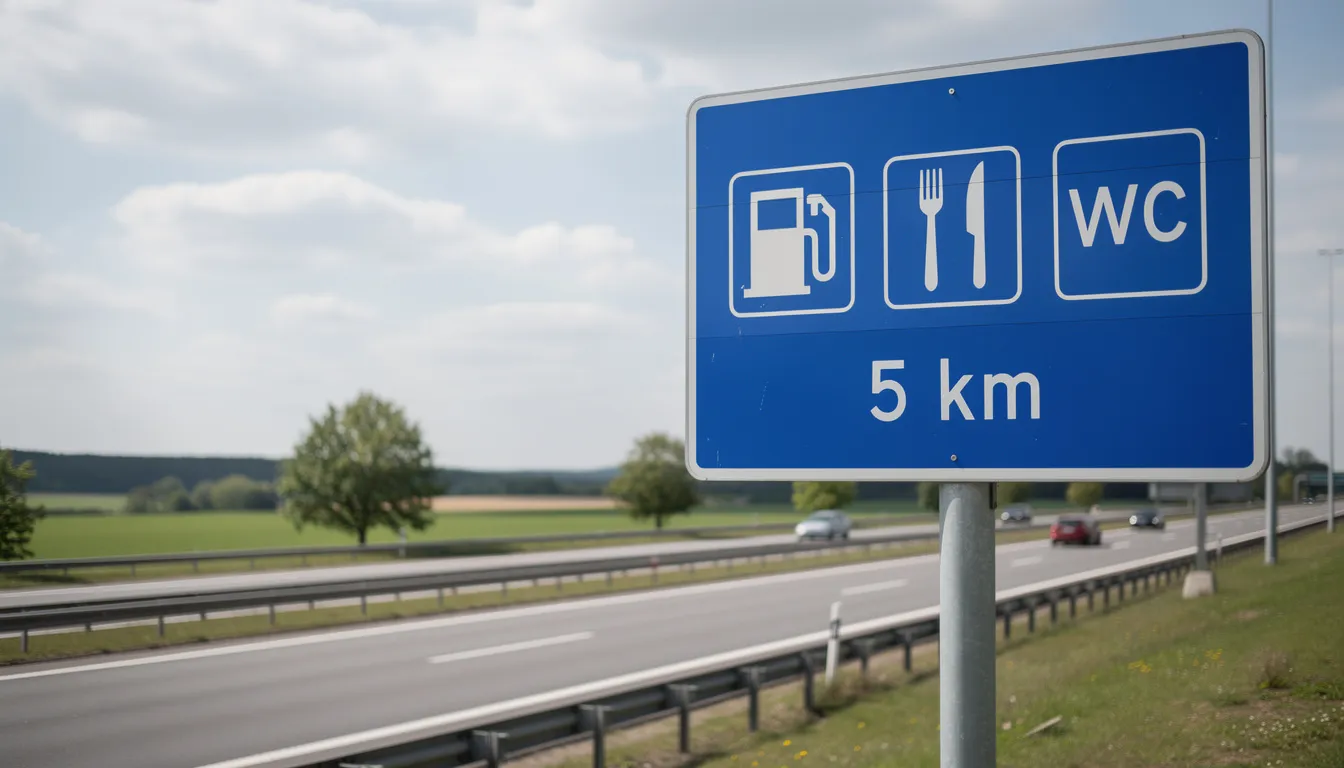
Blue advance warning signs appear:
- 2 kilometres before the entrance
- 500 metres before the entrance
The signs show symbols for all services: fuelling, food, toilets, hotel, EV charging, truck parking. Distance is shown in kilometres.
Using Kilometre Markers
Kilometre markers are positioned every 1 km along the motorway. Example: A3 km 450. Service areas are typically planned every 50–60 km. This lets you estimate when the next facility is coming.
Tips Specifically for Truck Drivers
- Plan your break early enough
- Do not wait until the end of your 4.5-hour driving period
- Avoid the period between 17:00 and 22:00 — up to 80% of spaces are occupied
- On routes through Sauerland West or towards Lüdenscheid via the A45, plan extra time
- If a tyre fails before you reach the next service area, our tyre emergency guide explains what to do while you wait for help
For International Drivers
The symbols on the signs are the same throughout Germany. You do not need German language skills to understand the signs.
Digital Tools: Maps, Apps and Route Planners with Rest Areas
Digital tools make break planning easy. As of 2024, there are many ways to find the nearest rest facility.
Google Maps and Apple Maps
- Filter for “service area”, “truck stop” or “car park”
- Opening hours and reviews (e.g. 4.2 stars)
- Real-time data from other users
Specialist Apps for Trucks and Travellers
App | Focus | Special Feature |
|---|---|---|
Autohof-Guide | Trucks | Over 1,000 German locations, shower filter |
Truck Parking Europe | Truck parking | Real-time occupancy, 95% forecast accuracy |
Park4Night | Motorhomes/trucks | Community ratings |
Official Sources
The website of Autobahn GmbH des Bundes lists all 700+ rest facilities since 2021. You will also find over 3,000 EV charging locations there.
Route Planners for Rest Periods
Route planners such as ViaMichelin or PTV-Truck combine:
- Planned driving times (9-hour limit)
- Break stops at service areas
- Live data on available truck spaces
Some apps show: “20% of spaces free at 15:00”. This helps you plan your journey optimally.

Truck Parking: Availability and the Current Situation
The availability of truck parking is a major problem in Germany. Many facilities are full from early evening onwards. Drivers who cannot find a spot in time and end up stranded on the hard shoulder can call our 24/7 towing service to reach a safe location.
Statistics on the Situation
- Approximately 25,000 truck parking spaces nationwide (Autobahn GmbH estimate)
- 70% of truck drivers have difficulty finding a space in the evening
- Over 800,000 trucks on German motorways daily
- 20% more freight traffic since 2020
Why Are Parking Spaces Scarce?
- Sharply increased freight traffic
- More international trucks in transit
- Slow infrastructure expansion (only 500 new spaces per year)
Tips for Truck Drivers
- Plan to park before 19:00
- Use Autohöfe (off-motorway truck stops) as an alternative
- Check apps with live occupancy data
- Drive towards your break stop early
Secured Parking
For valuable, securely loaded cargo, there are secured facilities with:
- CCTV surveillance
- Barriers
- Security personnel (e.g. Tank und Rast Security Programme)
This protects you from theft.
Reservation Systems
Since 2023, around 50 locations have been testing digital reservations. Via an app you can book up to 24 hours in advance. This reduces occupancy to around 80%.
Facilities and Services: What Does a German Motorway Service Area Offer?
Facilities vary by location. But some standards apply almost everywhere.
Typical Facilities
Service | Details |
|---|---|
Petrol station | Diesel, petrol, AdBlue, truck pumps |
Toilets/Showers | Truck showers often with curtain (2–3 €) |
Food & drink | McDonald’s, Burger King, Nordsee, Marché, Starbucks, Lavazza, Segafredo |
Shop | Snacks, drinks, travel essentials |
Petrol Station Brands
At German service areas you will find operators such as Aral, Shell, Esso or TotalEnergies. Biodiesel is available at many pumps.
Additional Services
- Wi-Fi (often 30–60 minutes free)
- ATM
- Children’s play area
- Dog exercise area
- Baby changing rooms
Special Features for Truck Drivers
- Dedicated truck showers
- Rest rooms
- Meals for professional drivers
- Loyalty card discounts (e.g. 10% at Tank & Rast)
If your truck needs more than a break — a dead battery, a warning light or a minor repair — AutoHelp UG’s mobile truck service can come directly to the rest area, so you do not have to leave the motorway.
Rasthof vs. Raststätte: Price Comparison
Rasthöfe often offer:
- Lower prices (diesel approx. €0.15/l cheaper)
- Greater variety of food
- Require a 1–2 km detour off the motorway
For those who have the time, the short detour is worth it. And if you pick up a flat tyre while queueing at the pump, AutoHelp UG’s tyre service can reach you right at the Rasthof.
EV Charging Points and Modern Infrastructure
Since around 2018, the network of fast-charging stations at service areas has grown significantly. This is important for commuters and EV drivers.
Charging Speeds
Typical fast chargers offer:
- 50 kW
- 150 kW
- 300 kW
- 350 kW (DC fast charger)
Operators at German Service Areas
Operator | Number of Locations | Special Feature |
|---|---|---|
EnBW | approx. 1,200 points | Large network |
Ionity | 400+ stations | 300 kW standard |
Aral pulse | Growing | At Aral stations |
Fastned | Selected | Premium charging stations |
Signage
Since 2021, motorway signs display an E symbol for charging stations. Apps like PlugShare show real-time availability.
Electric Truck Charging
The first pilot projects for electric trucks launched in 2024 at major logistics hubs (e.g. A2). Mega-watt chargers with 350 kW are planned. Nationwide coverage is expected by 2030.
Practical Tip
Combine charging with your break. 30–40 minutes of charging fits perfectly with a visit to the restaurant or shop.

Facts and Figures: How Many Service Areas and Rest Stops Are There in Germany?
Here is an overview of the scale:
The German Motorway Network
- Over 13,192 km of motorway (as of 2024)
- One of the largest networks in Europe
- Connections to all neighbouring countries
Number of Rest Facilities
Type | Number |
|---|---|
Staffed service areas/truck stops | approx. 220 |
Basic rest stops | 500+ |
Total | over 700 facilities |
On average you will find a rest facility approximately every 60 km.
Who Operates the Facilities?
The Tank und Rast Group operates around 140 of the staffed service areas. Since privatisation in 1998 there are also many independent Rasthöfe.
Expansion Plans
The federal government plans around 1,000 new truck parking spaces by 2027. Autobahn GmbH is continuously building new facilities. The shortage is worst in winter, when drivers stuck on snow-covered stretches often need to reach the nearest rest area under difficult conditions — see how our team helped a truck stuck in snow near Münchberg on the A9.
Where to Find Current Information
For precise figures and current projects, visit:
- Website of Autobahn GmbH des Bundes
- BMVI (Federal Ministry for Digital and Transport Affairs)
Safety, Rules and Costs at the Service Area
Safety
Most facilities offer:
- Good lighting (80% with CCTV)
- Police presence at major service areas
- Motorway maintenance depot nearby
Rules for Truck Drivers
Under EU social regulations, enforced in Germany by the Bundesamt für Güterverkehr (BAG), the following apply:
Rule | Time |
|---|---|
Max. daily driving time | 9 hours |
Daily rest period | 11 hours |
Max. weekly driving time | 56 hours |
Break after 4.5 hours | 45 minutes |
Parking duration is unlimited, but there are sometimes fees for trucks (€5–15 per 24 hours).
Toilet System
The Sanifair system is standard at most service areas:
- Fee: approx. €1
- You receive a voucher (approx. €0.50)
- Redeemable in the shop
Personal Safety Tips
- Choose well-lit areas
- Do not leave valuables visible in the vehicle
- Always lock doors
- If theft is suspected: call the police
Environmental Rules
- Do not leave the engine running while stationary — a parking heater is the legal, fuel-saving alternative for keeping the cab warm
- Sort and dispose of rubbish correctly
- Do not dump cargo remnants in the car park
Tips for International Drivers and Travellers
Just passing through Germany? From Poland to France or from Denmark to Italy? Here are the most important tips:
German Terms on Signs
German | English |
|---|---|
Raststätte | Rest area / Service area |
Autohof | Truck stop |
Rastplatz | Parking area / Lay-by |
WC | Toilet |
Dusche | Shower |
Ausfahrt | Exit |
Umleitung | Diversion/Detour |
City | City centre |
Opening Hours
Most motorway service areas are open 24 hours, 7 days a week. Petrol stations and toilets are almost always available around the clock. No subscription or registration is required.
Payment Methods
- Debit card / credit card
- Contactless (NFC)
- Cash payment in euros
Planning Refuelling
Diesel prices vary (approx. €1.50–1.80/l). Service area prices are often higher than at roadside stations in Germany. Tip: refuel before expensive countries or after cheaper ones.
Travelling with Family or Pets
Plan your breaks early enough. Many service areas have:
- Playgrounds for children
- Dog exercise areas
- Baby changing rooms
When travelling with a dog, there are designated areas available.
What You Should Know
Everything at the service area is geared towards your visit. You do not need to make a purchase to use the toilet (except for the Sanifair fee). App filters help you find exactly the services you need.
In this article you have learned everything important about German motorway rest facilities — from searching with apps to a concrete break stop at one of the 700+ facilities. You are now well prepared.
If you experience a breakdown or tyre problem on the motorway, AutoHelp UG provides 24/7 truck towing and roadside assistance across Germany. One call to +49 160 5753826 — and our team is on its way to you.
Plan your next break in good time. Use the many digital tools and travel safely through Germany. For urgent roadside help around the clock, keep our contact details to hand. Have a safe journey on the German motorway!